Introduction
The reaction of free radicals with polyunsaturated fatty acids (PUFAs) initiates a chain-reaction process known as lipid peroxidation. When these biochemical events occur in living systems, lipid peroxidation changes the structure of amino acids and enzymatic activities and cause damage to DNA and the structures within cell membranes (Lima and Abdalla, Reference LIMA and ABDALLA2001). In foods, lipid peroxidation causes rancid flavours, changes in nutritional value and formation of toxic products, mainly aldehydes (Guedes, Reference GUEDES2006).
Whereas embryonic tissues are characterised by high concentration of PUFAs, it is necessary to add vitamins and minerals with antioxidant activities into broiler breeder diets to improve the oxidative protection of the newly hatched chick.
Although shelled eggs are more resistant to lipid oxidation, studies have shown that the yolk lipids oxidise during storage, especially if this is done at room temperature and for long periods. This susceptibility to oxidation may be greater in eggs enriched with ω-3 fatty. Spray-dried eggs can also loss nutritional value due lipid oxidation that occurs during the processing carried out under high temperatures and contact with oxygen. Therefore, experiments with addition of vitamin E to the laying hens diet have been done to verify the vitamin antioxidant action to preserve the egg's nutritional value.
The purpose of this review was to clarify the effects of vitamin supplementation in the diets of broiler breeders and laying hens on the oxidative stability of embryonic tissues and yolk lipids of the eggs.
Lipid oxidation
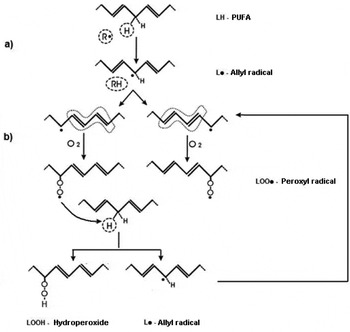
Lipids are susceptible to attack by free radicals and oxidation via a chain reaction. PUFAs are more susceptible to oxidation, resulting in formation of alkanes, aldehydes, alcohols and hydroperoxides, among other products (Hogg and Kalyanaraman, Reference HOGG and KALYANARAMAN1999). The higher susceptibility of PUFAs to oxidation is due to the presence of bis-allylic hydrogens of the methylene group which are more susceptible to abstraction by free radicals than the methylene hydrogens from saturated lipids (Figure 1). Bis-allylic hydrogen is attached to a carbon adjacent to two double bonds, which has lower dissociation energy, facilitating the process of abstraction. Lipid peroxidation is divided into three stages: initiation, propagation (Figure 1) and finishing. This third and final stage, two free radicals formed in the previous steps (L● and LOO●) - react originating non-radical end products.
According to Silva et al. (Reference SILVA, BORGES and FERREIRA1999), it is possible to distinguish these three stages as follows:
1) disappearance of oxidation substrate - unsaturated lipid, oxygen,
2) appearance of primary products - peroxides and hydroperoxides - whose structure depends on the nature of the fatty acids present,
3) appearance of secondary products, obtained by division and rearrangement of peroxides.
Lipid peroxidation - a chain reaction: a) initiation: free radical interaction with PUFA causes loss of a hydrogen atom and formation of allyl radical, b) propagation: This radical rapidly incorporates one or more molecules of oxygen and becomes peroxyl radical. The lipid peroxyl radical is the central species of the lipid peroxidation chain reaction. This radical can abstract a bis-allylic hydrogen from an adjacent fatty acid to form a lipid hydroperoxide and a second lipid radical, which subsequently reacts with oxygen to regenerate a peroxyl radical. Adapted from Vannucchi et al. (Reference VANNUCCHI, MOREIRA, CUNHA, JUNQUEIRA-FRANCO, BERNARDES and JORDÃO1998), Hogg and Kalyanamaran (1999) and Gurr et al. (Reference GURR, HARWOOD and FRAYN2002).

Peroxides are unstable intermediates, especially if exposed to high temperatures or in the presence of transition metals, so they are decomposed by the interaction with free radicals, forming the radical peroxyl (LOOH + R● → LOO● + RH), or the collapse of oxygen-oxygen linkage, which is relatively weak, forming the radical alkoxyl (LO ●) and hydroxyl (●OH). The secondary products are produced during the decomposition of the primary compounds, malondialdehyde (MDA) being one of them. This aldehyde (containing three carbon atoms (C3H4O2)) is widely used as a marker to evaluate the degree of lipid oxidation in foods and oxidative stress in biological samples through the testing of substances reactive to thiobarbituric acid (TBARS). The principle of TBARS is based on the reaction of one MDA molecule with two thiobarbituric acid molecules in acid environment and under high temperatures, forming a red complex, which can be determined by absorption in the visible (532 nm) or by fluorescence.
Enzymatic system of antioxidant defence
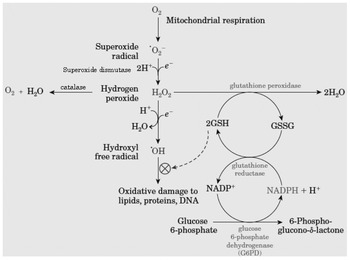
In aerobic systems, the balance between free radicals and antioxidant defence system is essential. Since free radicals are generated endogenously in the body as a result of the oxygen metabolism, most living species have efficient protection systems able to neutralise the negative effects of these reactive species. The enzymes involved in these processes include glutathione peroxidase (GSH-Px), superoxide dismutase (SOD) and catalase, whose mechanisms of action are shown in Figure 2.
Role of enzymes in protect cells against highly oxidative free radicals. The reactive oxidants are generated as metabolic products (Nelson and Cox, Reference NELSON and COX2002). During the normal processes of detoxification, the enzyme SOD converts the superoxide radical from the respiratory chain in hydrogen peroxide. Both catalase and GSH-Px act removing hydrogen peroxides from the cell. The hydrogen peroxide is converted into water by reduced glutathione (GSH) under action of GSH-Px. The oxidised glutathione (GSSG) is recycled in the reduced form by glutathione reductase and NADPH. The H2O2 can be further broken into H2O and O2 by catalase action. Adapted from Nelson and Cox (Reference NELSON and COX2002) and Champe et al. (Reference CHAMPE, HARVEY and FERRIER2006).

The high concentration of PUFAs in embryonic tissues (Surai et al., Reference SURAI, SPEAKE, NOBLE and SPARKS1997) is associated with increased oxygen consumption and respiration towards the end of the incubation period (Wilson et al., Reference WILSON, LUI and DEL MAESTRO1992), which are accompanied by changes in concentrations of antioxidant enzymes in embryonic tissues (Surai, Reference SURAI1999). According to Surai et al. (Reference SURAI, SPEAKE, NOBLE and SPARKS1999b), the antioxidant enzymes SOD, GSH-Px and catalase, protect embryonic tissues against lipid peroxidation during incubation and act as the principal antioxidant defence system in the hatch of the bird.
Role of nutrients in lipid peroxidation
The ingestion of nutrients with antioxidant properties, such as vitamin E, C and carotenoids, help the enzymatic defence system in controlling the damage caused by free radicals in cells. In membranes, the main free radical remover is alpha-tocopherol or vitamin E. The beta-, gamma- and sigma-tocopherol forms are less important because they are less well absorbed. Tocopherols remove the peroxyl radicals, donating its hydrogen atom to that, converting it to peroxide.
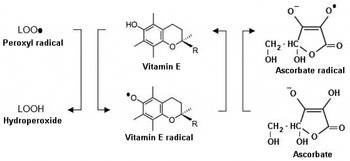
The most interesting property of vitamin C (ascorbic acid) is its ability to act as a reducing agent (electron donor). It reacts rapidly with free radicals and acts synergistically with vitamin E, facilitating its regeneration in biological systems (Figure 3). Studies on the supplementation of vitamin C for birds are scarce, because birds are able to synthesise this vitamin and it is not transferred to the egg, unlike the properties of vitamin E and carotenoids.
Regeneration of vitamin E by vitamin C. After donating the hydrogen, vitamin E is converted into vitamin E radical. This radical migrates to the surface of the membrane to be reduced by ascorbic acid or vitamin C, which is soluble in water. The result of this interaction is the formation of ascorbate radical. The vitamins E and C radicals are not reactive, because their non-paired electrons are energetically stable. Adapted from Araújo (Reference ARAÚJO2006).

The carotenoids are known to form precursors of vitamin A by cleavage and reduction of beta-carotene, hence they have important antioxidant role. The carotenoids act as free radical removal systems and physical attenuators, absorbing and dissipating the excess energy of highly reactive chemical species. Böhm et al. (Reference BÖHM, EDGE, LAND, MCGARVEY and TRUSCOTT1997) demonstrated the ability of carotenoids to recycle vitamin E, via donation of electrons to the alpha-tocopheroxyl radical (TO● + CAR + H+ → TOH + CAR●+).
Less than 10% of carotenoids can be converted into vitamin A, and, in birds, only alpha- and beta-carotene and cryptoxanthin found in natural feed materials are capable of contributing to the supply of this vitamin (Surai et al., Reference SURAI, SPEAKE and SPARKS2001). As poultry diets are supplemented with synthetic retinol, the contribution of carotenoids from feed in the formation of vitamin A is minimal (Surai et al., Reference SURAI, SURAI, STEINBERG, WAKEMAN, SPEAKE and SPARKS2003).
Vitamin E added to broiler breeder diets
To evaluate vitamin E concentrations in the egg yolk, embryo and newly hatched chicks tissues, and the susceptibility of these tissues to lipid peroxidation, Surai et al. (Reference SURAI, NOBLE and SPEAKE1999a) studied Ross broiler breeders fed diets supplemented with 30 and 250 mg vitamin E/kg diet. The authors observed that the higher amounts of vitamin E in the diet increased vitamin E levels in the egg yolk as well as in embryonic and hatched chick tissues. Egg yolk and chick tissues from broiler breeders fed with higher vitamin E levels showed reduced susceptibility to spontaneous peroxidation and damage stimulated by ferrous sulphate (P ≤ 0.05). The increased levels of vitamin E in broiler breeder diets significantly reduced the peroxidative susceptibility of chick tissues, specially the brain, which is the tissue most affected as it contains high quantities of PUFAs.
Surai (Reference SURAI2000) evaluated the effect of four vitamin E levels added to Cobb breeder diets (0, 40, 100, 200 mg vitamin E/kg diet) on their transfer to the egg yolk and tissues of the newly hatched chick and on the development of the antioxidant system in the chick liver in early postnatal life. The inclusion of vitamin E in broiler breeder diets significantly increased their concentration in the egg and liver of 1 day old chicks obtained from the eggs enriched with this vitamin. Further positive effects of this supplementation were seen at day five and ten of post-natal development. The author concluded that the nutritional status of the laying hen determined the efficiency of the antioxidant system throughout embryonic and early post-natal development of the progeny.
Interaction of Vitamin A in vitamin E concentration
The interference of vitamin A supplementation in broiler breeder diets on the reduction of enteric absorption of vitamin E was reported by Combs (1976). He noted that this interference affected the chicks, because hens fed high vitamin A levels had low plasma levels of vitamin E and therefore low concentrations of the latter in egg yolk.
Surai et al. (Reference SURAI, IONOV, KUKLENKO, KOSTJUK, ACPHERSON, SPEAKE, NOBLE and SPARKS1998) observed the effect of a range of supplementation with vitamin A to the laying hen on the concentration of vitamin E in the maternal liver, the egg yolk and the embryonic liver. The concentration of vitamin E in the maternal liver was markedly reduced by high dietary contents of vitamin A. In general, higher levels of vitamin A in the diet significantly reduced concentrations of vitamin E in the egg yolk and in the liver of chickens and the embryo. The susceptibility of the embryonic/neonatal liver to lipid peroxidation was significantly increased as a result of high provisions of maternal vitamin A. The authors concluded that excessive supplementation with vitamin A in laying hen diets results in an adverse effect on vitamin E in the embryonic/neonatal liver that can compromise the antioxidant status of the progeny.
Grobas et al. (Reference GROBAS, MÉNDEZ, BOTE, DE BLAS and MATEOS2002) also observed negative effect of vitamin A supplementation in the diet of hens on the concentration of alpha-tocopherol in egg yolk. This was attributed to competition between these vitamins for absorption.
Carotenoids in broiler breeder diets
Surai and Sparks (Reference SURAI and SPARKS2001) compared eggs, embryos and chicks produced by hens fed with two diets:
1) corn-based diet, rich in carotenoids, especially lutein and zeaxanthin (11.8 mg carotenoids/kg diet) and
2) wheat-based diet (5.6 mg carotenoids/kg diet).
Eggs from hens fed corn-based diets had higher (P ≤ 0.01) concentrations of beta + gamma-tocopherol, total carotenoids, lutein and zeaxanthin, which was reflected in the tissues of chicks hatched from these eggs. The authors concluded that the maternal diet has an important role in the formation of antioxidant systems during embryonic development and that a diet based on corn increased the antioxidant potential of the egg yolk and embryonic tissues as compared to a diet based on wheat.
To observe the effects of supplementation of canthaxanthin (Carophyll Red) in the diet of hens at 30 weeks of age on the antioxidant system of the embryo and hatch chick, Surai et al. (Reference SURAI, SURAI, STEINBERG, WAKEMAN, SPEAKE and SPARKS2003) studied five diets: a control with less than 2mg of total carotenoids/kg diet and no canthaxanthin added, and 3, 6, 12 and 24 mg canthaxanthin/kg diet. The levels of canthaxanthin in the egg yolk, liver and the yolk sac of embryos at 16 days, in hatched chicks and in the liver of 7-days-old chicks increased (P ≤ 0.001) in accordance with the level of canthaxanthin supplementation in the maternal diet. In the control group, canthaxanthin was not found in any of the samples above. Canthaxanthin supplementation showed a positive effect on vitamin E concentration in three ways:
1) Increased assimilation of gamma-tocopherol in the diet and its transfer to the egg yolk, increasing concentrations of this substance in the liver of the embryo and hatchling chick
2) Increased alpha-tocopherol concentrations in tissues and plasma of hatch chicks, because canthaxanthin acted as an antioxidant during the embryonic development leaving less free radicals available to react with vitamin E. Thus, vitamin E was conserved and its concentration was increased
3) Possibly contributed to the regeneration of vitamin E through electron transfer from the carotenoids to the alpha-tocopheroxyl radical.
The authors concluded that carotenoids can modulate antioxidant system of the embryo and hatch chick and help to maintain its efficiency.
Koutsos et al. (Reference KOUTSOS, CLIFFORD, CALVERT and KLASING2003) showed that a maternal diet rich in carotenoids influenced the concentration in chicken tissues until 28 days of age. Based on the important role of carotenoids as antioxidants and immune-stimulating agents immediately after hatching, the authors concluded that the consumption of carotenoids by broiler breeders, in addition to influencing the incorporation of these substances by progeny tissues, may be necessary to increase chicken viability. But according to Karadas et al. (Reference KARADAS, PAPPAS, SURAI and SPEAKE2005) broiler breeder diets enriched with carotenoids are the main factor that influences the carotenoid concentration in liver of chicks just in the first week of life.
Souza et al. (Reference SOUZA, SOUZA, SOUZA and NEVES2008) added 6 mg canthaxanthin/kg diet in the broiler breeder diet and observed a reduction in the number of infertile eggs and embryonic mortality and improvement in hatchability.
Vitamin E in laying hen diets
Eggs have been enriched with ω-3 fatty acids because of the beneficial effects of the consumption of these fatty acids to human health. Increased the degree of unsaturation in the total amounts of fatty acids present in yolk of enriched eggs can lead to increased susceptibility to oxidation (Galobart et al., Reference GALOBART, BARROETA, BAUCELLS, CORTINAS and GUARDIOLA2001b and 2002). Studies have showed that yolk lipids can oxidise during storage ranging from 4 to 25°C, and oxidation increases with increased period temperature (Franchini et al., Reference FRANCHINI, SIRRI, TALLARICO, MINELLI, IAFFALDANO and MELUZZI2002; Cherian et al., Reference CHERIAN, TRABER, GOEGER and LEONARD2007; Giampietro et al., Reference GIAMPIETRO, SCATOLINI, BOIAGO, SOUZA, PIZZOLANTE and LIMA2008). Antioxidants, especially vitamin E, have been evaluated experimentally to increase the shelf life of the egg and to prevent lipid oxidation during processing of the spray-dried eggs.
Despite Melluzi et al. (Reference MELLUZI, SIIRI, MANFREDA, TALLARICO and FRANCHINI2000) not observing any effect of vitamin E in preventing the oxidation of lipids in eggs stored for 28 days at room temperature, results presented by Galobart et al. (2001a, c) demonstrated the positive effect of 200 mg vitamin E/kg diet on the oxidative stability of ω-3 enriched eggs. Botsoglou et al. (Reference BOTSOGLOU, FLOROU-PANERI, NIKOLAKAKIS, GIANNENAS, DOTAS, BOTSOGLOU and AGGELOPOULOS2005) showed the in vivo antioxidant effect of vitamin E, reducing the chain reaction from the oxidation of fat consumed by laying hens, and therefore decreased the transfer of oxidation products, like MDA, to the egg yolk. In general, the levels of vitamin E required to achieve an antioxidant effect for maintaining the table egg quality during storage varies from 100 to 400 mg vitamin E/kg diet (Leeson, Reference LEESON2007).
Conclusions
Vitamins play an important role in providing antioxidant protection in poultry and their developing eggs. Vitamin E is a key antioxidant, protecting embryonic tissue and yolk lipids of table eggs efficiently. Based on these effects, its supplementation is recommended in broiler breeder and laying hen diets. However, the levels in experiments reviewed (usually 200 mg vitamin E/kg diet) are much higher than those used in practice - 40 mg vitamin E added/kg broiler breeder diet and 10 mg vitamin E added/kg laying hen diet. Therefore, economic factors are a limitation to its use as an antioxidant.
It is important to evaluate the effects of incubation yield and broiler chicken performance in studies with antioxidant vitamins for broiler breeders because, without these economic variables, the positive results observed in the oxidative status of the embryo and the chick in the first week have little application in the field.