


INTRODUCTION
The process through which early modern European states monopolized tax collection and achieved gains in centralized fiscal capacity has been at the center of the study of state formation. What were the drivers of, and mechanisms for the consolidation of the fiscal capacity of states? What roles did changes in domestic economic structure and the stimuli of interstate warfare play in state formation? Was it representative or authoritarian regimes that facilitated gains in fiscal and state capacity? These questions have been central not only to the study of politics,Footnote 1 but also to understanding the economic development process itself.Footnote 2
The theoretical answers for these questions originate mainly from the experiences of early modern European states, because these states were the first to permanently break cycles of gains and losses in centralized fiscal capacity and build toward the modern state system. There is, however, a void in the literature in terms of quantitative documentation of this process and empirical analysis of its determinants. To fill this void, this study compiles a new and comprehensive tax revenues dataset, reviews the patterns of fiscal capacity across the continent through the early modern era, examines and categorizes various threads in the literature, and empirically investigates alternative hypotheses. Our main finding is that warfare tended to have a greater impact on state-building under representative regimes in more urban economies, and under authoritarian regimes in more rural economies.
The first part of the article reviews the long-term trends in fiscal capacity for 12 major European states between 1500 and 1800. Specifically, we present long-term series for the central treasury revenues in silver, the common monetary unit of account for the period, and place them in the context of changes in population, prices, and per capita incomes. The evidence corroborates a continent-wide trend of increases in centralized fiscal capacity that was significantly higher than the gains in average incomes. However, the patterns also suggest that not all states achieved fiscal gains and, among those that did, there were significant differences in the timing and extent of the gains.
To identify the determinants of these revenue patterns, in the first stage of the empirical analysis we evaluate hypotheses that posit unconditional and independent impacts for war, urbanization, and political regime. Specifically, we examine hypotheses that argue that changes in economic structure (as proxied by urbanization) and interstate wars increased fiscal capacity, as well as the two hypotheses for political regime that alternatively posit that representative and authoritarian regimes were better at raising taxes. The empirical evidence supports positive fiscal impacts for urbanization and wars. The results, however, do not resolve the ambiguity regarding the fiscal impact of political regime, as the estimated difference between the fiscal performances of the regime types is insignificant.
We resolve this ambiguity in the second and third stages of the analysis by developing a hypothesis that combines three insights into early modern Europe. The first is that domestic elites had a higher organizational capacity under a representative regime and a lower organizational capacity under an authoritarian regime. The second is that political regime type, and thus elites’ organizational capacity, mattered for state-building primarily during wars. The third is that urban elites were more cooperative and rural elites more antagonistic towards centralized state-building. Taken together, these three insights suggest that, when war pressure hit, the fiscal impact tended to be greater if the cooperative urban elites were well organized under a representative regime and if the antagonistic rural elites were weak under an authoritarian regime. Conversely, authoritarian regimes in more urban and representative regimes in more rural economies tended to underperform in war. The empirical evidence provides strong support for this hypothesis.
The claim that early modern state-building followed more than one path is central to some of the seminal works in the literature. Most prominently, Tilly (Reference Tilly1992) argues that polities with different economic structures followed alternate paths, whereas Ertman (Reference Ertman1997) observes that, in some polities authoritarian, and in others representative regimes were successful in building centralized-bureaucratic states. Our findings suggest that both economic structure and political regime mattered for the variation in paths, because it was the matches and mismatches between the two that determined whether a state could successfully respond to war pressure. Our estimation results also allow for a rough classification of each polity's history into episodes where their regime type either improved or hurt their ability to raise taxes for war and to place the findings in historical context.
We have chosen to restrict the scope of this study to the early modern era and exclude the 19th century from our analysis. This choice reflects our concern that the determinants and dynamics of early modern state-building were significantly different in the later period. While politics in the early modern era was an intraelite affair, by the 19th century industrialization and the advent of mass armies increasingly brought states in contact with ordinary citizens and their principal political concern became dissent by the masses.Footnote 3 In a similar vein, while early modern states raised and spent taxes mainly for warfare, the frequency of wars dropped sharply in the 19th century and domestic concerns induced states to spend part of their revenues on public services.Footnote 4 We would also emphasize, however, the broader implications of the findings for state-building—that the demands of interstate system, domestic economic interests and design of the political system worked in conjunction with each other and not as stand-alone influences, generalizes to other periods.
REVENUE PATTERNS IN EARLY MODERN EUROPE
In this section we first describe the tax revenue dataset we have compiled for leading European states. We then provide an overview of patterns in total tax revenues and per capita tax revenues during the early modern period based on this data set. Lastly, we discuss the figures for per capita tax revenues divided by per capita incomes, widely employed in the empirical literature as a proxy for state capacity. We establish that the patterns for this last measure are consistent with continent-wide gains in centralized fiscal and state capacity during the early modern era.
For this study, we have compiled annual central treasury tax revenue figures for the leading states of Europe. Specifically, our data set covers Portugal, Spain, England, France, the Dutch Republic, Venice, Prussia, Austrian Habsburgs, Sweden, Polish-Lithuanian Commonwealth, Russia, and the Ottoman Empire, from the beginning of the sixteenth century until the end of the eighteenth century.Footnote 5 Each of these 12 states had more than 1% of the continent's population and together they added up to between three- to four-fifths of the total.Footnote 6 The sample is comprehensive in the sense that the variation in the characteristics of major European states, ranging from territorial empires such as the Ottomans and Austrian Habsburgs to maritime powers with sizable rural hinterlands such as the Dutch Republic, Venice, and Portugal, are well represented. Similarly, we are able to base our findings not only on the experiences of states in western Europe but also on those in central and eastern Europe, which have received less attention in the literature.
To make the revenue figures comparable across the polities in the sample, we have converted all monetary magnitudes into tons of silver by multiplying the annual revenues in the monetary units of account in each polity with the silver content of the unit of account for that year. We have taken great care to apply similar definitions of revenue to all the states. However, the limitations imposed by the variations in accounting procedures and fiscal structures should be kept in mind.
Figure 1 shows decade averages of annual total central treasury tax revenues of the leading European states during the early modern era. It makes clear that central treasury revenues of most European states increased sharply during the seventeenth and especially the eighteenth centuries, and these revenue patterns are consistent with the historical shifts in the interstate power balance. Most striking in this respect was England, where total central tax revenues, in tons of silver, increased more than 60-fold between the early sixteenth century and the late eighteenth century. In France, total revenues increased more than 15-fold during the same period. In the Dutch Republic, total revenues began at a much higher level and increased fourfold during the seventeenth and eighteenth centuries. Outside Western Europe, revenues of some but not all states also showed significant increases. In Austria, total revenues increased more than 20-fold from the middle of the sixteenth century until the end of the eighteenth century. In Russia further to the east, total central revenues rose more than 10-fold between late seventeenth and late eighteenth centuries. Interstate differences in total revenues reached their peak during the second half of the eighteenth century when the revenues of not only the more powerful states in western Europe, but also of those in central and eastern Europe, such as Austrian Habsburgs and Russia, showed rapid increases. By contrast, those of Venice, the Ottomans, and Poland lagged behind.
Total Tax Revenues (in tons of silver) and Per Capita Tax Revenues (in grams of silver)

Not all changes in total tax revenues were necessarily driven by gains in state capacity, however. As Identity 1 below suggests, if we breakdown total tax revenues into their components, it is then possible to distinguish between the changes in total revenues due to changes in socioeconomic variables (i.e., population, price level, and real income per capita) and changes in state capacity, as measured here by per capita tax revenues over per capita income ratio.
Identity 1: Total Tax Revenues in Current Prices or Tons of Silver = Population · Price Level · Real Income Per Capita · Real Tax Revenues Per Capita as a percent of Real Income Per Capita.
To separate out the impact of population changes, we calculate per capita tax revenues by dividing total revenues by population.Footnote 7 The resulting per capita tax revenue figures are in grams of silver and summarized in Figure 1 based on the scale on its right axis. Not surprisingly, adjusting for population alters the cross-polity rankings. Small, urbanized polities such as England, the Dutch Republic, and Venice fare better in per capita terms. In terms of trends, the pattern of gains in taxation over time is still robust for most polities, however. For England, per capita revenues, in grams of silver, increased by more than 20 times from the middle of the sixteenth century to the end of the eighteenth century. In France, per capita revenues increased by eight times during the same period. In the Dutch Republic, per capita revenues more than doubled during the seventeenth and eighteenth centuries. In Austria and Russia, per capita revenues increased by more than three and five times, respectively, during the eighteenth century.
Last, we divide the annual per capita central tax revenues in silver by the daily wages of unskilled workers in silver. This allows us to control for both the effects of changes in average real incomes and the price level in silver.Footnote 8 The wage series are available annually for most politiesFootnote 9 and due to their high quality are frequently used by economic historians as a proxy for per capita income during this period.Footnote 10
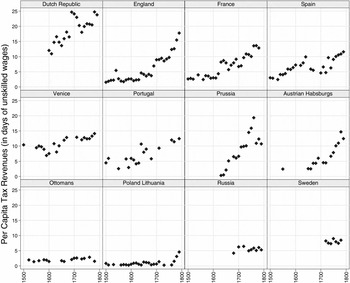
Figure 2 presents per capita tax revenues in days of unskilled workers’ wages, our proxy for state capacity. It makes clear that, except for Poland-Lithuania and the Ottomans, there was a strong pattern of gains in state capacity across Europe during the early modern centuries. Figure 2 also indicates that gains in centralized state capacity proceeded quite unevenly across the continent. During the first half of the sixteenth century, annual tax revenues per capita did not exceed five days of unskilled urban wages in most European countries. The only exceptions were small and highly urbanized entities such as Venice and the Dutch Republic. By the end of the eighteenth century, however, differences in fiscal centralization across Europe had increased substantially. While the annual per capita revenues of some central administrations such as Poland-Lithuania and the Ottoman Empire still remained below five days of urban wages, many others had reached the 10 to 20 daily wages range and annual per capita revenues of the central administration in the Dutch Republic exceeded 20 days of urban wages. It is worth noting that the middle group where annual per capita revenues reached 10 to 20 daily wages included not only the more urbanized western European countries such as England, France, Spain, and Venice but also the more rural and agricultural countries in central and eastern Europe such as Austria and Prussia.Footnote 11 These broad trends make clear that the increases in state capacity preceded the Industrial Revolution and the onset of modern economic growth during the nineteenth century.Footnote 12
Per Capita Tax Revenues (in days of unskilled wages)

These levels of per capita tax collection and per capita tax collection as a multiple of the daily urban wage place Europe in a unique position in the early modern world. We do not have detailed tax revenue and other data for many Asian states. However, such data as we have been able to gather show clearly that the tax collection capacities of central administrations in Asia, during both the early modern era and the nineteenth century, remained well below those of most European states during the eighteenth century. In both China and Iran, for example, per capita tax collections remained well below five days of wages during the eighteenth and nineteenth centuries.Footnote 13 The only exception was Japan after the Meiji Restoration, where per capita tax collections as a multiple of the daily unskilled wage started at very low levels but increased rapidly to exceed 10 days in the years before World War I equivalent to the levels of Spain at the end of the eighteenth century.Footnote 14 Even in the case of Japan, levels of per capita tax revenue as a multiple of the daily urban wage in the early part of the twentieth century remained well below that of Great Britain, France, and the Dutch Republic during the second half of the eighteenth century. Because of the rapid economic growth in Europe during the nineteenth century, the revenue differences, in total and per capita silver terms, became even larger. This disparity in fiscal resources made it very difficult for Asian states to resist European military power.
THEORIES OF STATE FORMATION IN EARLY MODERN EUROPE
The long-term trends reviewed in the previous section indicate significant gains in centralized fiscal capacities across Europe before the nineteenth century. To investigate the determinants of these gains, this section first offers a characterization of the historical environment in which early modern state-building took place. We then review impacts conjectured for three variables: interstate warfare, economic structure, and political regime in historical sociology and political science literatures. The arguments for the impacts of these variables in these literatures are often complex and multilayered, making it difficult to reduce them to testable hypotheses. Therefore, at the risk of oversimplifying these arguments, we focus, in the first round of empirical analysis, on the simplest and most unconditional interpretations and leave more complex interpretations to later sections.
A critical observation for politics before the nineteenth century is that it was primarily an intraelite game. In particular, a small segment of the population controlled a disproportionately large share of political and economic resources and the dissent of the masses remained a secondary concern until the French revolution, industrialization, and the advent of mass armies. In this environment, state-building mainly concerned the reorganization of intraelite relations from fragmented control over violence and taxation towards the buildup of a central apparatus that monopolized them both.Footnote 15
In explaining the buildup of the central apparatus, a major thread in the literature argues that it was primarily driven by the external stimuli of interstate warfare.Footnote 16 At the core of this argument is the claim that interstate warfare of the early modern era set in motion innovations in military technology, training, and tactics that favored centralized modes of coercive organization and demanded standing armies of ever greater size and cost. In turn, the pressure to provision and manage these armies induced experimentation and advances in fiscal and administrative methods paving the way for the modern state.Footnote 17 These advances were often ad hoc responses to exigencies of warfare, and thus were piecemeal and limited. In Europe, however, the existence of multiple core agricultural areas, large islands, and mountain ranges that divide up the continent facilitated a fragmented state system, more or less continuous warfare, and ensured that the gains accumulated over time.Footnote 18 Hence, in its simplest interpretation, this literature suggests the following hypothesis:
H1: Interstate warfare had a positive effect on centralized fiscal capacity.
A second set of arguments concerns the impact of changes in domestic economic structure from rural-agrarian to urban and commercial economies. In the Marxist tradition, where the state is essentially treated as the instrument of the elites, it is argued that these changes in economic structure realigned elite incentives towards a centralized state apparatus.Footnote 19 For example, in his discussion of Western Europe, Anderson argues that the rise of centralized monarchies in the early modern period was due to the reorganization of aristocratic power to retain its privileged position in a more centralized fashion.Footnote 20 According to this argument, the dissolution of feudalism and the rise of towns and markets undermined the aristocracy's coercion-based extractive capacity at the village level. Their role was taken on by the rising monarchies, which then served to mobilize resources at the scale of newly forming nations. For Wallerstein, the international division of labor between core and peripheral economies led to changes in domestic economic structure, which in turn drove state-building.Footnote 21 In the advanced and richer economies of the core, the elites favored a strong and effective state to govern economic activity and assert collective interests in the international arena.
Alternatively, the monetization of the economy might have facilitated centralized tax collection by making it possible to transfer the revenues to the political center, pay a standing central army or mercenaries in cash and, when necessary, redistribute the funds around the polity.Footnote 22 These arguments are all consistent with the following hypothesis:
H2: Urbanization, which was at the nexus of changes in economic structure, had a positive effect on centralized fiscal capacity.
A third set of arguments concerns the impact of political regime types on state-building. In these arguments, the central executive-military apparatus, often personified by the ruler, is modeled as autonomous and distinct from domestic elites. State capacity, it is argued, was determined as the outcome of the interaction between the ruler and the elites. Political regime types mattered for this interaction, because they corresponded to different levels of the organizational capacity and leverage for domestic elites. Specifically, the distinction between representative regimes, where the elites had access to a formal and inclusive assembly, and authoritarian regimes, where they did not, altered elite capacity. A representative assembly enhanced the organizational capacity of the elites by providing a venue for information sharing, coordination, and sanctioning of deviant members. This, in turn, allowed the elites to formulate policies separate from the ruler, solve collective action problems, and credibly act in unison.Footnote 23 This can be contrasted with authoritarian regimes, where ruler-elite interaction was for the most part bilateral, particularistic, and informal, and where the ruler retained the capacity to reward, punish, and play elites against each other.Footnote 24 Consequently, in authoritarian regimes, the elites lacked the capacity to formulate and coordinate their actions independently of the ruler.
Beyond the common premise that a representative assembly enhanced the organizational capacity of the elites, there are conflicting hypotheses concerning whether this capacity worked against or toward state-building.Footnote 25 The argument that it worked against state-building is based on an antagonistic characterization of elite-ruler relations. For early modern Europe, this line of argument portrays elites as driven by redistributive concerns, interested in retaining their prerogatives at the local level and opposed to the expansion of the central apparatus. Hence, representative assemblies, where they existed, acted as nodes of resistance against fiscal centralization. In contrast, under an authoritarian regime, rulers were better able to pass laws that broadened the tax net, compelled elites to behave in ways that countered their interests, and suppressed their activities to obtain exemptions and favors. The degree to which rulers encroached on elite prerogatives in turn determined the extent of the gains available to be made in terms of centralized fiscal capacity. This line of argument implies the following hypothesis:
H3: Authoritarian regimes had a positive effect on centralized fiscal capacity.
The alternative hypothesis, that representative regimes performed better in raising taxes, builds on a cooperative view of the elite-ruler relations. In this vein, the contract theory of the state argues that there were economies of scale in the provisioning of violence and hence returns to the buildup of a centralized state apparatus.Footnote 26 The ruler, or more broadly the specialist in violence, provided a group of services, mainly security and justice, and in exchange, wealth holders provided the tax revenues. Representation facilitated this exchange, because it solved collective action and free-rider problems among the taxpayers, permitted better information sharing, reduced costs of negotiation, measurement and monitoring, lent legitimacy to taxation, and allowed credible commitments over the terms of exchange. As cases in point, this line of argument invokes the representative regimes and fiscal successes of the Dutch Republic and England after the Glorious Revolution and compares them favorably with the authoritarian regimes and fiscal demise of Spain and France.Footnote 27 For empirical analysis, the unconditional reading of this argument is that representation increases revenues.Footnote 28 Formally:
H4: Representative regimes had a positive effect on centralized fiscal capacity.
TESTING THE THEORIES
While theories of state-building borrow heavily from the early modern European experience, they have not been thoroughly tested with actual data from the period. Most empirical studies use nineteenth and twentieth century data,Footnote 29 and the few that use early modern data focus on Western Europe.Footnote 30 Using our new revenue dataset, we try to fill the void for major states across Europe.
In the first stage of the empirical analysis, we test H1–H4 by introducing proxies for each of warfare, urbanization, and political regime, and by evaluating the significance and magnitude of their coefficients. We delay investigation of hypotheses that allow for interactions between these three determinants until later sections. In the rest of this section, we describe the variables and econometric models employed and present the first stage of our results.
Variables
Our dependent variable is per capita central tax revenues in days of unskilled urban workers’ wages (Taxrev). In its immediate interpretation, central tax revenues adjusted for population and incomes is a proxy for the fiscal capacity of the state. In this and in other empirical studies, it is also interpreted more broadly as a proxy for state capacity. The justification is, for one, that fiscal capacity captures the state's capacity to monitor economic activity and enforce laws to mobilize the polity's resources. Second, a state's fiscal capacity sets the limits of the policies that it can implement.Footnote 31 This close relationship between fiscal capacity and statehood is explicit in most definitions of the state.Footnote 32
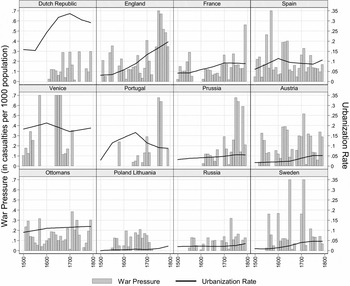
The proxy for the impact of war (H1) is the “apportioned” war casualties per thousand of population per year. This variable is calculated over a number of stages. The number of casualties for each war, which captures its size or severity, is apportioned equally between the two contending coalitions of belligerents.Footnote 33 We use apportioned rather than actual casualties of the two sides, because the latter is an ex-post measure and puts disproportionate weight on the losing side. The hypothesis we are testing, however, concerns ex ante demand for resources that war placed on the participants. The apportioned casualty is then divided by the duration of the war and the total population of the coalition to reach an estimate of the annual per capita burden of the war. If a polity engages in more than one war in a year, we add the per capita burdens up across the wars. The resulting proxy for war pressure (Warp) is summarized in Figure 3.Footnote 34
War Pressure and Urbanization

The economic structure argument (H2) posits that, with the shift in economic structure from rural-agricultural to urban-commercial economies, domestic elites became more favorable toward centralized state-building. The natural proxy for this argument is the urbanization rate (Urb). Our main data source for this variable is de Vries (Reference De Vries1984), who uses a threshold of 10,000 inhabitants to define urban centers and provides the most detailed series for the period with estimates for each half century. We interpolate for the decades in between. Figure 3 summarizes the urbanization series.
A caveat with using urbanization as a proxy is not only that it captures the changes in economic structure, but also, for the early modern period, it is related to changes in average per capita real incomes. In most studies, this distinction is not made, and urbanization is used as a catch-all proxy for economic development.Footnote 35 However, because H2 is concerned with the changes in economic structure rather than changes in average incomes, in some specifications, we include a separate proxy, per capita real wages (Rwage), to control for the latter.
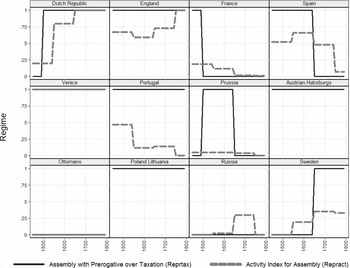
The hypotheses for the impact of political regime (H3 and H4) concern elites’ organizational capacity and influence on fiscal outcomes. Our main proxy is a dummy variable for the existence of a representative assembly with prerogative over taxation (Reprtax). For each decade, it takes the value 1 if such an assembly exists, and 0 otherwise.Footnote 36 The second proxy, (Repract) is an index of activity for the representative assembly covering the whole realm.Footnote 37 For each century, it counts the number of calendar years in which the assembly was convened. The variable is rescaled to vary between 0, when no assembly existed or the assembly did not convene, and 1, when a meeting took place in every year of the century.
These two proxies for regime have their advantages and disadvantages in measuring the organizational capacity of elites. Qualitatively Reprtax is the better proxy, in that it explicitly codes for the involvement of the representative assembly in fiscal decision-making. On the other hand, it is a dichotomous variable and does not provide a precise measure of changes in the assembly's influence over time. The activity index, Repract, is a finer measure of the actual influence of the assembly, but does not explicitly code for whether the assembly was involved in tax collection and is anyway not available for Poland-Lithuania and Austrian Habsburgs. Figure 4 shows that with the exception of Portugal these two proxies are closely related for the polities in the sample. Nevertheless, for robustness, in the econometric analysis we repeat each empirical specification for both regime proxies.
Political Regime

In some specifications, we also include the log of population (lnPop) to control for the possibility that a change in population may lead to a more or less than proportional change in total tax revenues.
All specifications include polity and decade fixed effects. As such, the regression results are driven by the variation the explanatory variables exhibit around their mean values for each polity and each decade. The polity fixed effects allow controlling for any omitted polity specific effects that do not vary over time, such as geographical attributes or any time persistent differences in the conventions used for recording tax revenues. The decade fixed effects allow controlling for omitted common shocks and trends such as gains in transportation, communication, and information technologies.
The fixed effects also help resolve potential collinearity issues. For example, in our sample, urbanized polities tend to have representative regimes. In the estimation, because fixed effects are included, this correlation is factored out, and it is the changes the two variables exhibit around their respective polity means that drive the results. As can be observed from Figures 3 and 4, the changes in urbanization rates did not necessarily move in step with regime changes, and collinearity is not a major issue.
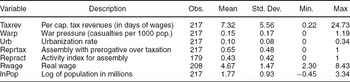
Table 1 presents the summary statistics for the variables employed in our econometric analysis. There are 12 polities in the sample, and 30 decades between 1500 and 1799, implying a maximum number of 360 observations. Prussia and the Dutch Republic can be considered autonomous political entities only by the seventeenth century, and Portugal drops out of the sample between 1580 and 1640 due to the unification with Spain, reducing the upper limit for observations to 334. We were able to collect revenue figures for 217 observations, which set the maximum number of observations in our regressions. Real wage data is not available for Russia, and activity index for the assembly is not available for Austria and Poland, reducing the number of observations for econometric specifications that include these variables as regressors. Other econometric requirements and subsample analyses further reduce the number of available observations. All in all, the number of observations in the regressions ranges between 108 and 217.
Summary Statistics for Variables

Baseline Empirical Analysis
Our base econometric specification is OLS with polity and decade fixed effects and panel corrected standard errors. We assume that the disturbances are heteroscedastic across panels, there is a common autocorrelation term for all panels, and no contemporaneous correlation across panels. The equation we estimate is
 \begin{eqnarray*}
{\rm Taxrev}_{it} &=& {\rm \alpha }_i + {\rm \beta }_t + X_{it}^{\prime} {\rm \gamma } + {\rm \theta }_1 {\rm Warp}_{it} + {\rm \theta }_2 {\rm Urb}_{it} \\
&&+\, {\rm \theta }_3 {\rm Repr}_{it} + {\rm \varepsilon }_{it} ,
\end{eqnarray*}
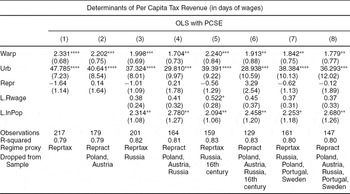
Table 2 reports the first set of regression results. Each regression is repeated twice for the two regime proxies, Reprtax in odd-numbered and Repract in even-numbered specifications.
Baseline Regressions

Notes: Standard errors in parentheses.
Levels of statistical significance: *0.1; **0.05; ***0.01; ****0.001.
Estimated using Stata xtpcse procedure, with two-way fixed effects and c(ar1) and hetonly options.
Specifications 1 and 2 include regime, urbanization, war pressure, specifications 3 and 4 also control for population and real wage. In specifications 5–8 we work with subsamples in order to address concerns about sample selection and data quality. The revenue series for the Dutch Republic, Prussia, and Russia are available starting in the seventeenth century and for Sweden in the eighteenth century. If the late availability of these revenue series was due to variables other than those included in our estimations, this would introduce a bias. In order to address this concern, in specifications 5 and 6, we drop observations for the sixteenth century and repeat the regressions with a more balanced sample. Finally, in specifications 7 and 8, we drop from the sample Sweden, Portugal, and Russia, which have data for less than 10 decades out of a maximum possible of 30, and Poland-Lithuania, for which the quality of revenue data is uneven.
Across the eight specifications, the empirical findings are consistent. We find strong support for a positive impact of wars on centralized fiscal capacity (H1), significant at 5% or lower levels.Footnote 38
We also find strong support for H2, in that urbanization is significant across the specifications at the 1 or 0.1% level.Footnote 39 This finding is robust when real wage is included as regressor, despite the fact that wage captures similar trends and is less prone to measurement errors than urbanization.
For representation, we do not find evidence of either a negative (H3) or a positive (H4) impact. For both of the regime proxies, the estimated coefficient is insignificant at 10% level in all specifications.
Of the control variables, the coefficient for lagged real wage carries a positive sign in all specifications but is significant at 10% level in only specification 5. The coefficient for lagged log population, on the other hand, is positive and significant at 10% in all specifications. Note that in this period the territorial changes for polities in the sample are minor (with the exception of Prussia, Austria, and England's union with Scotland). Consequently, the estimated positive impact could be interpreted as that of population density rather than population per se.
Endogeneity Concerns
In this section, we discuss potential sources of correlation between the explanatory variables and the error term and attempt to address endogeneity concerns.
For the war variable, a distinction can be made between two sources of variation. The first source is the set of factors that determined the propensity for the onset of war. There is an extensive literature on the subject, and a review of the main determinants identified in this literature suggests that they are either already controlled for in the regressions or are unlikely to be correlated with the error term.Footnote 40
The second source of variation is the immediate triggering factors that determined whether and when the underlying propensity broke into actual war. Figure 3, the plot of the war variable, suggests that the variation in our sample is mainly driven by these triggering factors, manifested in a high period-to-period volatility, rather than changes in underlying propensity, which would be consistent with slow trends. Unlike the determinants of propensity, however, these triggers are not methodologically classified and studied in the literature, for the simple reason that they tended to be diverse, context dependent, and unsystematic shocks, ranging from dynastic accidents to diplomatic blunders. For the same reason, it is difficult to argue that these triggering factors were systematically related to the error term in one way or the other. In other words, when war broke out in a particular year, the incident that triggered it had little to do with the changes in taxation in that year, introducing identifying variation to the war variable. Consequently, there are good reasons to assume that the estimated impact of war is causal, even if a bias cannot be completely ruled out.
For the estimated impact of political regime, on the other hand, there are good reasons to suspect endogeneity. Early modern parliaments mainly convened to discuss matters of taxation, and consequently, unlike war, the relationship between regime and taxation was immediate. If, as historical evidence suggests, rulers convened parliaments only when domestic elites were willing to consent to taxation, this would introduce a positive bias to the estimated fiscal impact of representation. Alternatively, if windfall revenues from external sources led the rulers to suppress the activities of the representative assemblies, this would introduce a negative bias.Footnote 41
There is also a clear case for endogeneity of the estimated impact of urbanization. If higher centralized fiscal capacity encouraged market activity and urbanization through gains in public security, contract enforcement, and other means, this would lead to a positive bias in the estimated impact of urbanization.
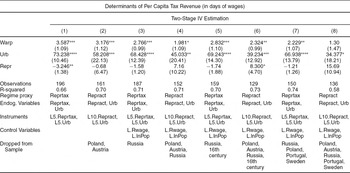
Based on the discussion above, we address the endogeneity concerns for representation and urbanization by instrumenting them with their values 50 years or 100 years lagged.Footnote 42 The results of 2-Stage Least Squares estimation, reported in Table 3, are consistent with the baseline findings in Table 2. The coefficient for urbanization is positive and significant at the 10% confidence level or lower. The impact for war is significant at the 10% level except for specification 8. Finally, the impact of regime is again indeterminate, with an estimated coefficient negative and significant at the 5% level in specification 1, positive and significant at the 10% level in specification 6, and insignificant in the other six specifications.Footnote 43
Controlling for Endogeneity

Notes: Standard errors in parentheses.
Levels of statistical significance: *0.1; **0.05; ***0.01; ****0.001.
Estimated using Stata xtivreg2 procedure with fe first robust bw(1) options.
For Repract in (2) and (8) AP F statistics reject weakly identified instruments at 0.05 level.
For all other variables in all specifications, AP F statistics reject weakly identified instruments at 0.01 level.
INTERACTION BETWEEN REPRESENTATION AND INTERSTATE WARFARE
In the previous section, we found strong evidence that wars and urbanization had on average positive impacts on fiscal capacity. With regard to the alternative hypotheses that authoritarian (H3) and representative regimes (H4) raised more taxes, however, we did not find conclusive evidence for one or the other. In these two hypotheses, the conjectured fiscal impact of the political regime was unconditional and direct. There are also arguments in the literature that suggests political regime might instead have had an indirect impact, by moderating the impact of war pressure on tax revenues. In this section, we review these hypotheses, arguing, respectively, that it was authoritarian (H5) and representative regimes (H6) that performed better in turning the stimuli of wars into tax revenues.
The two hypotheses discussed in this section regarding political regime are contingent versions of those discussed in the previous section. The essence of representative assemblies is again identified as their role in improving the organizational capacity of domestic elites. The additional insight is that the organizational capacity of elites mattered most during wars, because historically it was during the wars that bargaining over taxes and reorganization of the state apparatus took place.Footnote 44
This observation, when interpreted together with the two different characterizations of elite attitudes towards the buildup of the central apparatus, implies two conflicting hypotheses for the regime-warfare interaction. The view that domestic elites were essentially opposed to state-building implies that authoritarian regimes performed better in transforming war into taxes. This line of argument is most explicit in Hinze (Reference Hintze and Gilbert1975) and Downing's (Reference Downing1992) discussion of Europe. In parts of Europe where war pressure was heavy, wars were protracted and states needed to finance themselves through domestic taxation, representative regimes did not fare well and could not compete with authoritarian regimes, whereas in regions where the pressure was light, representative regimes survived. Formally,
H5: Interstate warfare induced greater gains in centralized fiscal capacity under authoritarian regimes.
The alternative hypothesis follows from the cooperative view of elite-ruler relation and the contract theory of state. Contract theory argues that elites paid taxes in exchange for services provided by the ruler, and that representation mattered by facilitating this exchange. Hence a finer reading of the contract theory suggests that a representative regime is not necessarily associated with higher taxes, but higher taxes relative to the service that the ruler provided.Footnote 45 Since, during the early modern era, the main prerogative and main expenditure item for the ruler and the central apparatus was interstate war-making, this would suggest that a representative regime better matched increases in war pressure with increases in tax revenues. In this vein, Hoffman and Rosenthal (Reference Hoffman, Rosenthal, Drobak and Nye1997) and Rosenthal (Reference Rosenthal, Bates, Greif, Levi, Rosenthal and Weingast1998) argue that in Western Europe representative regimes corresponded to a deal between ruler and domestic elites that entailed financing warfare in exchange for a greater say over its conduct. In formal terms,
H6: Interstate warfare induced greater gains in centralized fiscal capacity under representative regimes.
Empirical Analysis
To investigate H5 and H6, we add the interaction term between war pressure and representation as a regressor to different econometric specifications discussed in the preceding section and investigate its sign. We first do so for OLS with PCSE with two-way fixed effects specification. The regression equation is
 \begin{eqnarray*}
{\rm Taxrev}_{{\rm it}} &=& {\rm \alpha }_{\rm i} + {\rm \beta }_{\rm t} + {\rm X}_{{\rm it}}^{\prime} {\rm \gamma } + {\rm \theta }_1 {\rm Warp}_{{\rm it}} + {\rm \theta }_2 {\rm Urb}_{{\rm it}} \\
&& +\, {\rm \theta }_3 {\rm Repr}_{{\rm it}} + {\rm \theta }_4 ({\rm Warp}_{{\rm it}} \cdot {\rm Repr}_{{\rm it}} ) + \varepsilon _{{\rm it}} ,
\end{eqnarray*}
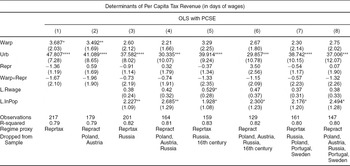
Table 4 reports the regression results. As in Table 2, we report the estimates without (1 and 2) and with (3 and 4) the controls for real wage and log population, dropping the sixteenth century (5 and 6) and polities with short series and uneven data quality (7 and 8). In none of the specifications is the interaction term significant at the 10% level.
Baseline Regressions with Representation-War Pressure Interaction

Notes: Standard errors in parentheses.
Levels of statistical significance: *0.1; **0.05; ***0.01; ****0.001.
Estimated using Stata xtpcse procedure, with two-way fixed effects and c(ar1) and hetonly options.
The specifications in Table 5 are estimated using 2-Stage Least Squares, where urbanization, representation, and representation-war pressure interactions are instrumented by their lagged values. The interaction terms are again insignificant at 10%. Hence the empirical evidence does not lend support to either H5 or H6.
Controlling for Endogeneity with War Pressure-Representation Interaction

Notes: Standard errors in parentheses.
Levels of statistical significance: *0.1; **0.05; ***0.01; ****0.001.
Estimated using Stata xtivreg2 procedure with fe first robust bw(1) options.
For Repract in (4) and (8) AP F statistics reject weakly identified instruments at 0.05 level.
For all other variables in all specifications, AP F statistics reject weakly identified instruments at 0.01 level.
INTERACTION BETWEEN URBANIZATION, REPRESENTATION, AND INTERSTATE WARFARE
The previous section reviewed alternative hypotheses, respectively, arguing that authoritarian (H5) and representative (H6) regimes performed better in transforming war stimuli into taxes and the empirical evidence did not support one or the other. This section investigates yet a finer hypothesis (H7) that posits that economic structure determined whether authoritarian or representative regimes performed better, because it determined elite incentives with respect to the buildup of the central apparatus.
The hypothesis we investigate in this section is consistent with the characterization of the impact of political regime in the previous section, in that the type of regime mattered as it determined the organizational capacity of domestic elites at times of war. The added insight we offer is that economic structure determined whether a particular regime type moderated war's impact against or toward gains in state capacity, because it determined whether the elites were opposed to or willing to cooperate for state-building. In particular, in rural-agrarian economies, elites tended to oppose state-building, and hence, as conjectured in H5, authoritarian regimes, where elites had low organizational capacity, tended to perform better in turning wars into taxes. In contrast, in urban-commercial economies, elites had more incentive to cooperate with the ruler over taxation, and as conjectured in H6, their greater organizational capacity under representative regimes improved fiscal performance.
As to why rural elites might be more antagonistic and urban elites more cooperative towards state-building, the literature suggests a number of reasons. For the landowning elites in rural-agrarian economies, retaining their coercive capabilities was critical for administering and taxing land and labor, the main economic resources.Footnote 46 Rural elites also depended on their coercive capacity to defend their interests against infringements by the central state.Footnote 47 These factors arguably made them wary of the implications of the monopolization of coercion by the central apparatus. With urbanization and the commercialization and commodification of land and labor, however, the effectiveness of coercion in appropriating economic resources declined. Urban elites were also less averse to the redistributive implications of a centralized coercive apparatus, because commercial wealth was more mobile, harder to monitor, and seize by coercion.Footnote 48 In fact, to the extent that it served their interests in interstate war-making over commerce and colonies, elites stood to benefit from a militarily capable central apparatus.Footnote 49 This set of arguments is consistent with the following hypothesis:
H7: Interstate warfare tended to induce greater gains in centralized fiscal capacity under authoritarian regimes at lower urbanization rates and under representative regimes at higher urbanization rates.
Empirical Analysis
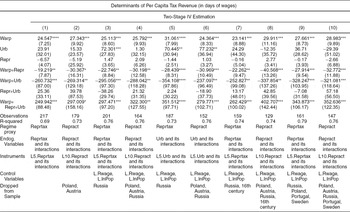
In this section we extend the empirical models to investigate H7. To do so, we include the three-way interaction term between the proxies for war pressure, urbanization, and representation as a regressor. For unbiased estimation, it is also necessary to include the three two-way interaction terms. Hence the baseline regression equation for OLS with PCSE estimation is
 \begin{eqnarray*}
{\rm Taxrev}_{it} &=& \alpha _i + \beta _t + X_{it}^{\prime} \gamma + \theta _1 {\rm Warp}_{it} + \theta _2 {\rm Urb}_{it}\\
&& +\, \theta _3 {\rm Repr}_{it} + \theta _4 ({\rm Warp}_{it} \cdot {\rm Repr}_{it} ) \\
&& +\, \theta _5 ({\rm Warp}_{it} \cdot {\rm Urb}_{it} ) + \theta _6 ({\rm Repr}_{it} \cdot {\rm Urb}_{it} )\\
&& +\, \theta _7 ({\rm Warp}_{it} \cdot {\rm Repr}_{it} \cdot {\rm Urb}_{it} ) + \varepsilon _{it} . \\
\end{eqnarray*}
H7 states that the estimated coefficient of the three-way interaction term, θ7, should be positive and significant.
Table 6 reports the OLS with PCSE estimation results. In all specifications, θ7 is positive and significant at the 5% level. Table 7 reports the results for instrumental variables regressions. In specifications 1 and 2, representation proxies Reprtax and Repract and their two- and three-way interactions are instrumented by their lagged values and their two- and three-way interactions. Specifications 3 and 4 also control for real wage and log population. Specifications 7 and 8 drop sixteenth century and specifications 9 and 10 drop polities with short series. In specifications 5 and 6 urbanization and its two- and three-way interactions are instrumented by its lagged value and its two- and three-way interactions. The evidence is again consistent with H7, with a positive coefficient significant at 10% or lower.Footnote 50
Baseline Regressions with 2 and 3-way Interactions

Notes: Standard errors in parentheses.
Levels of statistical significance: *0.1; **0.05; ***0.01; ****0.001.
Estimated using Stata xtpcse procedure, with two-way fixed effects and c(ar1) and hetonly options.
Controlling for Endogeneity with 2 and 3-way Interactions

Notes: Standard errors in parentheses.
Levels of statistical significance: *0.1; **0.05; ***0.01; ****0.001.
Estimated using Stata xtivreg2 procedure with fe first robust bw(1) options.
For Repract in (2), AP F statistics does not reject weakly identified instruments at 0.1 level.
For Reprtax in (1), Repract*Urb in (2), Urb in (6) AP F statistics reject weakly identified instruments at 0.05 level.
For all other variables in all specifications, AP F statistics reject weakly identified instruments at 0.01 level.
INTERPRETATION OF THE RESULTS
The empirical evidence we have analyzed strongly supports the hypothesis that the impact of warfare on revenues was conditional on economic structure-political regime combinations. In this section, we interpret this finding and discuss how it relates to the existing literature.
Table 8 puts the empirical results in historical context. The columns in the table correspond to different regime types and the rows correspond to urbanization rates below and above a threshold rate of 8.0%.Footnote 51 The estimation results suggest that during the historical episodes in the diagonal cells (i.e., rural-authoritarian and urban-representative combinations) states performed better in wars with their actual regime than they would have under the alternative regime type. These episodes generally overlap with episodes of military ascendancy and successful state-building, such as France and Sweden in the first half and Prussia and England in the second half of the early modern era. For the cases in the off-diagonal cells, it is estimated that, had the states switched their regime type, they would have raised more revenues per unit of war pressure. These are generally cases of states with fiscal troubles, such as the Ottomans, Poland-Lithuania as well as England in the first half and France in the second half of the early modern era.Footnote 52
Classification of Polities Based on Urbanization Rates and Actual Regime Type
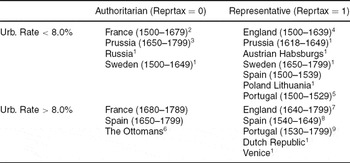
Notes: Decades at which the difference in war pressure's impact on per capita tax revenues for the two regime types is significant at the 10% level:
1All; 21500–1579; 31650–1729; 41500–1589; 51500–1519; 61590–1799; 71680–1799; 81590–1609; 91550–1719.
Figure 5 presents the same findings by taking individual countries and making a hypothetical comparison of per capita tax revenues under the two regime types. First, consider two polities that remained rural through the early modern era, Austrian Habsburgs and Prussia. The estimation results suggest that under war pressure both were in a better position to raise revenues with authoritarian regimes. In the figure, this is reflected in the pattern that whenever war pressure rises, the wedge between the estimated revenues for an authoritarian regime, the dashed line, and for a representative regime, the solid line, increases. In actuality, Austria had a representative regime which, our results suggest, induced it to underperform. Prussia also initially had a representative regime, but had switched to an authoritarian regime by 1650, and thereafter the revenue performance improved as estimated.Footnote 53
Per Capita Tax Revenues

At the other extreme, the Dutch Republic had urbanization rates of 15% or more. At these rates, the Republic is estimated to have performed better at wars with its actual representative regime than it would have under a hypothetical authoritarian regime. Finally, England offers an interesting case, in that it was rural in the sixteenth century and urban by the eighteenth century. Hence in the former era, an authoritarian regime, and in the latter, a representative regime is estimated to better respond to war. England had a representative regime throughout the period, and its actual tax revenues closely follow those estimated for a representative regime.Footnote 54
A pattern that emerges from Table 8 and Figure 5 is that polities moved from cell to cell, improving or worsening their fiscal performance at war. In some cases, this was due to a change in regime type for better (e.g., Prussia) or for worse (e.g., Sweden). In others, regime type stayed the same, but changes in economic structure changed the way regime moderated the impact of war. For example, as discussed above, rapid urbanization in England turned the representative regime from an obstacle into a catalyst of war financing, whereas in France, where the urbanization rate also increased, it undermined the early advantage of the authoritarian regime.
In terms of the theoretical literature, our findings closely relate to Tilly's (Reference Tilly1992) seminal work that traces the variations in state-building experiences across Europe back to differences in economic structure. Tilly distinguishes between “coercion-intensive regions (areas of few cities and agricultural predominance, where direct coercion played a major part in production)” such as Poland, Hungary, Russia, and Prussia; “capital-intensive regions (areas of many cities and commercial predominance, where markets, exchange, and market-oriented production prevailed)” such as Dutch Republic, Portugal, and Venice; and polities in between the two extremes such as France and England. In the rural coercive-intensive regions, resources remained embedded in agriculture, and the ruler and rival armed landlords jointly exploited the peasantry and bargained over the extracted resources. In the urban-capital intensive regions, rulers necessarily relied on contracts with capital owners over taxation and debt. In Tilly, these variations in economic structure, together with the intense warfare of the era determines the variation in state structure, with bulky and permanent states in rural regions, lean and small states in capital intensive regions.
Ertman's (Reference Ertman1997) work on state-building, on the other hand, identifies an independent impact for political regime that worked toward different outcomes in different polities. In his classification, representative regimes in England, Sweden, and Denmark, and absolutist regimes in Prussia helped build proto-bureaucratic and centralized states, whereas absolutist regimes in France, Spain, and representative regimes in Poland-Lithuania and Hungary (before its partition in 1641) worked against it. He argues that the differences in the impacts of regime types was driven by the sequencing of the establishment of the representative assembly, the onset of war pressure, and the proliferation of European universities as well as other idiosyncratic shocks such as capable rulers and foreign invasions.
The main difference between our findings and these two works is that we do not trace variations in state-building patterns back to economic structure or regime per se, but to the interaction of the two. Tilly does not specify an independent impact for political regime, and does not propose an explanation for the variation in state-building experience in regions with similar economic structure, i.e., why Prussia and Russia performed well and Poland-Lithuania and Hungary failed. Ertman, on the other hand, does not specify a role for economic structure but rather puts the emphasis on the path dependency of the state-building process.
It is also worth highlighting that while our results identify two different formulas for successful state-building under war pressure, they come at different political conditions. In particular, the underlying argument suggests, for the central military-executive apparatus, changes in economic structure resulted in different tradeoffs between fiscal capacity at war and autonomy from domestic elites. In the rural-agrarian setting, higher fiscal capacity was associated with higher autonomy through an authoritarian regime. In contrast, for urban-commercial economies, higher fiscal capacity occurred at the cost of autonomy, because it required cooperation and consent seeking through a representative regime. In fact, for the representative regimes in urban economies, such as England in the eighteenth century and the Dutch Republic, it becomes difficult to speak of a ruler and state apparatus as distinct and autonomous from domestic elites.
On the empirical front, our findings complement and qualify those of Dincecco (Reference Dincecco2009). Dincecco argues that fiscal gains in Europe were driven by two factors: establishment of parliamentary control over spending, and centralization of tax administration. He argues that, with the exception of England and the Dutch Republic, these changes occurred in the nineteenth century, as did the gains in fiscal capacity. Our revenue series suggest, in contrast, that the fiscal gains dated as far back as the sixteenth century and occurred at different periods for different states. Moreover, in terms of explaining the gains, we find that the argument for the positive effect of parliamentary control over spending is underspecified. The reason is that the parliamentary control over spending had a necessary precondition, i.e., elites should be willing to cooperate and engage in a tax-for-control over spending deal. In the urban Dutch Republic, Venice and post-1640 England they were willing to do this, so the deal was struck. In Poland, rural elites were opposed to state-building, and there was no deal. It is therefore not the institutional innovation of control over spending per se, but also the underlying elite incentives that drove the fiscal gains.
Finally, our findings also relate to the literature on the impact of political regime on public debt and its role in the rise of modern states.Footnote 55 Our results are most similar to Stasavage's finding that the impact of representative regimes on the capacity to borrow was greater for urban economies, where commercial wealth prevailed over landed interests and dominated the assembly.Footnote 56 This is the same set of polities for which we find evidence for the greater effectiveness of representative regimes in war financing. In other words, the two mechanisms worked towards the same effect. We also want to argue, however, that public debt was ultimately underpinned by expanding revenues. Hence the basis for the growth in state capacity in this period was taxation, above all.Footnote 57
CONCLUSION
This study re-examined early modern state-building in Europe, making use of a new and comprehensive dataset that included annual tax revenue series for 12 leading states across the continent. The first part discussed measures of centralized fiscal capacity for these states and the patterns they reveal. In broad terms, the series identify large increases in the resource mobilization capacity of states across the continent. They also indicate earlier revenue increases in the West than in the East and large variations within each region, helping to explain shifts in the continental balance of power. When compared with the fragmentary evidence available for other regions of the world, it is clear these large gains in fiscal capacity were peculiar to Europe, and arguably served as the basis for European hegemony around the world. Our findings also relate to the debate regarding the timing and determinants of the onset of modern economic growth. In particular, they strongly point to an early divergence for Europe in the form of a growing role for centralized states that predated the nineteenth century industrialization and increase in average incomes.
The second part of the study investigated the explanations proposed for the fiscal gains. The first stage of the empirical analysis, under the premise that their impacts worked independently and unconditionally, found that changes in economic structure and interstate warfare had on average positive fiscal effects, while there was no empirical support for a positive or negative effect of political regime types. The second and third stages made explicit the interaction of political regime with, first warfare, and then subsequently with economic structure. In this more flexible framework we find support for the argument that differences in economic structure induced differences in elite incentives and consequently these altered the relative fiscal performance of the regime types at war. Specifically, it was authoritarian regimes in more rural economies and representative regimes in more urban economies that tended to better translate war into state-building.
These findings offer a complex characterization of early modern state-building. They suggest that interstate wars could have a centrifugal or centripetal fiscal impact, conditional on domestic economic interests and their political leverages. Likewise, the same regime type, in different international security environments, could aggregate domestic interests toward or against state-building. These results corroborate insights in the earlier studies that there were multiple paths to build states, while also arguing for a more complex explanation for this variation based on the three-way interaction of warfare, economic structure, and political regime. Finally, our results suggest that despite the great deal of variation and complexity, early modern state-building in Europe can still be understood and explained in a unified framework for the entire continent.








Comments
No Comments have been published for this article.