1. Introduction
Shock waves are fundamental processes in plasmas which are usually studied within the context of magnetohydrodynamics (MHD). As an extension of fluid dynamics to plasmas, MHD entails the same assumption of small mean free path (see for example Gurnett & Bhattacharjee Reference Gurnett and Bhattacharjee2005, § 5.4.4, Goedbloed, Keppens & Poedts Reference Goedbloed, Keppens and Poedts2010, chaps. 2 and 3 or Thorne & Blandford Reference Thorne and Blandford2017, § 13.2). When fulfilled, collisions ensure that the pressure is isotropic both in the upstream and downstream, which simplifies the conservation equations.
In collisionless shock, where the mean free path is larger than the size of the system, the isotropy assumption may not be fulfilled, possibly resulting in a departure from the MHD predicted behaviour. Such is especially the case in the presence of an external magnetic field which can stabilize a temperature anisotropy, as has been observed in the solar wind (Bale et al. Reference Bale, Kasper, Howes, Quataert, Salem and Sundkvist2009; Maruca, Kasper & Bale Reference Maruca, Kasper and Bale2011; Schlickeiser et al. Reference Schlickeiser, Michno, Ibscher, Lazar and Skoda2011) and is projected to be studied in the laboratory (Carter et al. Reference Carter, Dorfman, Gekelman, Tripathi, van Compernolle, Vincena, Rossi and Jenko2015).
Some authors worked out the MHD conservation equations in the case of anisotropic pressure and studied the consequences on the shock properties (Erkaev, Vogl & Biernat Reference Erkaev, Vogl and Biernat2000; Double et al. Reference Double, Baring, Jones and Ellison2004; Gerbig & Schlickeiser Reference Gerbig and Schlickeiser2011). Yet, in these works, while the upstream is assumed isotropic, the downstream degree of anisotropy is left as a free parameter.
Recently, a self-contained theory of magnetized collisionless shocks has been developed. By making some assumptions on the kinetic history of the plasma as it crosses the front, we could compute the downstream degree of anisotropy, for the parallel and the perpendicular cases, in terms of the magnetic field strength (Bret & Narayan Reference Bret and Narayan2018, Reference Bret and Narayan2019, Reference Bret and Narayan2020).
Noteworthily, the theory for parallel shocks described in Bret & Narayan (Reference Bret and Narayan2018) has been successfully tested against the Particle-In-Cell (PIC) simulations of Haggerty, Bret & Caprioli (Reference Haggerty, Bret and Caprioli2022).
In MHD, several shock solutions exist when the upstream magnetic field is aligned with the flow. The most common solution is the one where the downstream field is also aligned with the flow. This is the fully parallel case, where the fluid and the field are decoupled (Lichnerowicz Reference Lichnerowicz1976; Majorana & Anile Reference Majorana and Anile1987). Yet, still for the case where the upstream field is parallel to the flow, MHD offers a second option: the switch-on shocks (Kulsrud Reference Kulsrud2005; Goedbloed et al. Reference Goedbloed, Keppens and Poedts2010; Fitzpatrick Reference Fitzpatrick2014). In such shocks, while the magnetic field does not have any components along the shock front in the upstream, it has one in the downstream. Indeed, the MHD conservation equations only enforce the continuity of the field component perpendicular to the front, not the continuity of the normal component. Therefore, they allow for solutions, the switch-on solutions, where the upstream field is normal to the front while the downstream field is not.
The theory developed in Bret & Narayan (Reference Bret and Narayan2018) was the collisionless version of the fully parallel MHD case. The present article deals with the collisionless version of the MHD switch-on shocks.
As in Bret & Narayan (Reference Bret and Narayan2018), we consider, for simplicity, pair plasmas for which both species have the same perpendicular and parallel temperatures to the field. In § 2, we remember the MHD results for switch-on shocks. In § 3, we explain the method used. It significantly differs from that in Bret & Narayan (Reference Bret and Narayan2018) since we need to account for an oblique downstream field. In addition, MHD results suggest the obliquity of the downstream field, labelled $\theta _2$ in the following, can be as high as $0.56 ({{\rm \pi} }/{2})$
 (see figure 2a). We cannot therefore work out a theory restricted to $\theta _2 = \varepsilon$
 , with $0 < \varepsilon \ll 1$
 . Then, in §§ 4 and 5, we explain the solutions found for switch-on shocks within our model.
2. MHD results
The system considered is sketched in figure 1. The upstream field $\boldsymbol {B}_1$ and velocity $\boldsymbol {v}_1$
 are normal to the front, but the downstream ones $\boldsymbol {B}_2$
 and $\boldsymbol {v}_2$
 are not. They make an angle $\theta _2$
 and $\xi _2$
 with the shock normal and by default, $\theta _2 \neq \xi _2$
 (even though they will be found equal in the following).
System considered. The upstream has density $n_1$ and isotropic temperature $T_1$
 . Both the upstream field $\boldsymbol {B}_1$
 and velocity $\boldsymbol {v}_1$
 are normal to the front. The downstream has density $n_2$
 and temperatures $T_{2\parallel }, T_{2\perp }$
 , parallel and perpendicular to the downstream field, respectively. The downstream field $\boldsymbol {B}_2$
 and velocity $\boldsymbol {v}_2$
 make an angle $\theta _2$
 and $\xi _2$
 , respectively, with the front normal. The parallel and perpendicular directions are therefore defined with respect to the local magnetic field.

We here briefly remember the MHD theory for switch-on shocks. Due to the complexity of the forthcoming calculations, we treat only the case of a sonic strong shock, namely upstream temperature $T_1=0$ , or equivalently, upstream sonic Mach number $\mathcal {M}_{s1}=\infty$
 .
For isotropic pressures in the upstream and the downstream, and $\theta _1=\xi _1=0$ , the MHD conservation equations for strong shock and an adiabatic index of $\gamma =5/3$
 read (see for example Kulsrud Reference Kulsrud2005, p. 141)


where $m$ is the mass of the particles and $k_B$
 the Boltzmann constant.
Equation (2.1) stands for the conservation of mass. Equation (2.2) for the conservation of the magnetic field normal component. Equation (2.3) for the vanishing of the $z$ component of the electric field. Equations (2.4) and (2.5) come from the conservation of the momentum flux (see Appendix A), and (2.6) from the conservation of energy.
By eliminating $v_2$ and $B_2$
 thanks to (2.1) and (2.2), and then eliminating $T_2$
 thanks to (2.4), the system is amenable to three equations,


in terms of the dimensionless density ratio $r$ and the Alfvén Mach number $\mathcal {M}_{A1}$
 ,

The first equation imposes $\theta _2=\xi _2$ . Replacing in the last two gives


Equation (2.11) clearly defines two kinds of shocks.
(i) The first kind comes from $\tan \theta _2=0$
 , that is, $\theta _2=0$. Inserting it into (2.12) gives $r=1$ or $r=4$. The first option, $r=1$, is the continuity solution, where nothing changes between the upstream and the downstream. The second option is the parallel shock solution, with $r=4$ for a sonic strong shock and an adiabatic index $\gamma =5/3$.
(ii) Yet, (2.11) also allows for
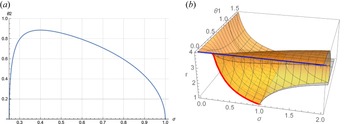
(2.13)\begin{equation} r = \mathcal{M}_{A1}^2, \end{equation}which is the MHD switch-on solution. Inserting it into (2.12) gives(2.14)\begin{equation} \cos^2\theta_2=\frac{3}{10 \mathcal{M}_{A1}^2-2 \mathcal{M}_{A1}^4-5}. \end{equation}The value of $\theta _2$ so defined is displayed in figure 2(a). Here, $\theta _2 \neq 0$ is only permitted within a finite range of Alfvén Mach numbers defined by $\cos ^2\theta _2<1$, that is, $1 < \mathcal {M}_{A1} < 2$. Note that instead of parametrizing $\theta _2$ by the Alfvén Mach number $\mathcal {M}_{A1}$, we choose the variable
(2.15)\begin{equation} \sigma = \frac{B_1^2/4{\rm \pi}}{m n_1 v_1^2} = \frac{1}{\mathcal{M}_{A1}^2}. \end{equation}This $\sigma$ parameter allows for a straightforward comparison with PIC simulations where $\sigma$ is usually used instead of $\mathcal {M}_{A1}$ (see for example Sironi & Spitkovsky Reference Sironi and Spitkovsky2011; Bret Reference Bret2020). As a function of $\sigma$, $\theta _2 \neq 0$ is allowed for $\sigma \in [1/4,1]$.


(a) Value of $\theta _2$ from (2.14) in terms of $\sigma =\mathcal {M}_{A1}^{-2}$
 . Its maximum value is $\arccos \sqrt {2/5} \sim 0.56 ({{\rm \pi} }/{2})$
 . (b) MHD density jump $r$
 in terms of $(\sigma,\theta _1)$
 for $\theta _1 \in [0,{\rm \pi} /2]$
 . Only the blue line, which has $\theta _1=\theta _2=0$
 , was considered in Bret & Narayan (Reference Bret and Narayan2018). The red line is the switch-on solution (2.13), with $\theta _1=0$
 but $\theta _2\neq 0$
 .

For a finite upstream temperature $T_1 > 0$ , MHD switch-on solutions are also restricted to a range of upstream temperatures via $\beta _1=n_1k_BT_1/B_1^2 < 2/\gamma$
 , where $\gamma$
 is the adiabatic index (Kennel, Blandford & Coppi Reference Kennel, Blandford and Coppi1989; de Sterck & Poedts Reference de Sterck and Poedts1999; Delmont & Keppens Reference Delmont and Keppens2011). (See in particular figure 3 in de Sterck & Poedts (Reference de Sterck and Poedts1999).) Since the present work is limited to $T_1=0$
 , it cannot explore this dimension of the switch-on solutions range.
While they have been produced in the laboratory (Craig & Paul Reference Craig and Paul1973), such shocks have been rarely detected in space due to the smallness of the parameter window that allows them. Feng et al. (Reference Feng, Lin, Chao, Wu, Lyu and Lee2009) reported the detection of a ‘possible’ interplanetary switch-on shock. Also, Farris et al. (Reference Farris, Russell, Fitzenreiter and Ogilvie1994); Russell & Farris (Reference Russell and Farris1995) reported the detection of one switch-on shock among the ISEE (International Sun-Earth Explorer; see Ogilvie, Rosenvinge & Durney (Reference Ogilvie, Rosenvinge and Durney1977)) data. The more recent review by Balogh & Treumann (Reference Balogh and Treumann2013) still refers to the results of Farris et al. (Reference Farris, Russell, Fitzenreiter and Ogilvie1994) as ‘the rare case of observation of a switch-on shock’ in its § 2.3.6.
Finally, it is interesting to compute the MHD density jump $r$ for any upstream angle $\theta _1$
 . This can be done solving the ‘shock adiabatic’ equation given in Fitzpatrick (Reference Fitzpatrick2014, § 7.21), and setting $T_1=0$
 . ($V_{S1}=0$
 in the notation of Fitzpatrick (Reference Fitzpatrick2014).) The result is pictured in figure 2(b), in terms of $\theta _1 \in [0,{\rm \pi} /2]$
 and $\sigma$
 . Only the blue line, which has $\theta _1=\theta _2=0$
 , was considered in Bret & Narayan (Reference Bret and Narayan2018). The red line is the switch-on solution (2.13), with $\theta _1=0$
 but $\theta _2\neq 0$
 .
3. Method
Our method to determine the downstream anisotropy in terms of the upstream field relies on a monitoring of the kinetic history of the plasma as it crosses the front. In this process, the parallel and perpendicular temperatures of the plasma are changed according to some prescriptions explained below. The resulting state of the plasma downstream is labelled ‘Stage 1.’ Stage 1 is generally not isotropic.
Depending on the strength of the downstream field $\boldsymbol {B}_2$ , Stage 1 can be stable or not. If it is stable, then Stage 1 is the end state of the downstream. If it is unstable, then the plasma migrates towards its instability threshold, namely mirror or firehose stability. This is ‘Stage 2.’ In such a case, Stage 2 is the end state of the downstream.
Stages 1 and 2 are therefore temporal evolving stages of the downstream plasma. This has been verified for the parallel case by the PIC simulations performed by Haggerty et al. (Reference Haggerty, Bret and Caprioli2022), where the two stages have been clearly identified.
Also, the stability alluded here is not the one of the whole shock structure, like for example the corrugation instability (Landau & Lifshitz Reference Landau and Lifshitz2013, § 90). It is rather the stability of the downstream plasma as an isolated and homogeneous entity.
This algorithm was applied to the parallel and perpendicular cases in Bret & Narayan (Reference Bret and Narayan2018) and Bret & Narayan (Reference Bret and Narayan2019), respectively. In both cases, the orientation of $\boldsymbol {B}_2$ makes it simple to set the temperatures of Stage 1. We will now see that the obliquity of $\boldsymbol {B}_2$
 demands further characterization of Stage 1.
3.1. Characterization of Stage 1
If the motion of the plasma through the front were adiabatic, the corresponding evolution of the parallel and perpendicular temperatures would be described by the double adiabatic equations of Chew, Goldberger & Low (Reference Chew, Goldberger and Low1956):

Here, like in the rest of the paper, the parallel and perpendicular are defined with respect to the local magnetic field.
Now, since we are dealing with shockwaves, the evolution of the plasma from the upstream to the downstream is not adiabatic. For parallel and perpendicular shocks, this results in different prescriptions.
(i) For the parallel shock case treated in Bret & Narayan (Reference Bret and Narayan2018), we took $\theta _{1,2}=\xi _{1,2}=0$
and considered the entropy excess goes into the parallel temperature. Intuitively, this stems from the fact that the transit of the plasma through the front can be viewed as a compression between two converging virtual walls, normal to the flow. These walls by no means exist. They are simply an analogy of how the entropy gain is realized.Regarding the perpendicular temperature, (3.1) simply gives $T_{\perp }=cst$
in the parallel case, since $B_2=B_1$ for such a shock. Such changes of the temperatures have been successfully checked through PIC simulations by Haggerty et al. (Reference Haggerty, Bret and Caprioli2022).(ii) For the perpendicular shock case treated in Bret & Narayan (Reference Bret and Narayan2019), we took $\theta _{1,2}={\rm \pi} /2$
and $\xi _{1,2}=0$. Here the plasma can still be viewed as compressed between two virtual walls normal to the flow. We therefore considered that the temperature normal to the flow, that is, parallel to the field, evolves adiabatically.


An additional constraint that must always be satisfied is the equality of the two temperatures perpendicular to the field, enforced by the Vlasov equation (Landau & Lifshitz Reference Landau and Lifshitz1981, § 53).
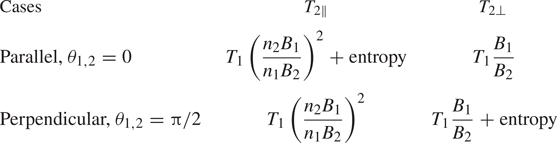
These considerations are summarized in table 1 which gives the values of $T_{2\parallel }$ and $T_{2\perp }$
 in the parallel and perpendicular cases.
Values of $T_{2\parallel }$ and $T_{2\perp }$
 in Stage 1 for the parallel and perpendicular cases.

As already stated in § 1, MHD suggests that in a switch-on shock, the obliquity $\theta _2$ of the downstream field can be as high as $0.56 \frac {{\rm \pi} }{2}$
 . Hence, we need to interpolate between the two extremes of table 1. We cannot just elaborate from Bret & Narayan (Reference Bret and Narayan2018) by exploring $\theta _2 = \varepsilon$
 , with $0 < \varepsilon \ll 1$
 .
For intermediate values of $\theta _2$ , we propose the following interpolation between the two extremes of table 1:

Our ansatz is therefore that the downstream temperatures are the sum of the adiabatic ones given by Chew et al. (Reference Chew, Goldberger and Low1956), plus an entropy excess. For the parallel temperature, the entropy excess is a fraction $\cos ^2\theta _2$ of a quantity we label $T_e$
 (subscript ‘$e$
 ’ for entropy). For the perpendicular temperature, the entropy excess is a fraction $\sin ^2\theta _2/2$
 of the same $T_e$
 . Here, the factor $1/2$
 accounts for the necessary identity of the two perpendicular temperatures. Finally, the three temperature excesses sum to $T_e$
 .
The $\cos ^2\theta _2$ and $\sin ^2\theta _2$
 functions are the simplest choice fulfilling these requirements. Further works, notably PIC simulations (see § 6), should allow to test their relevance.
Note that $T_e$ is not arbitrary but is solved for using the conservation equations (see (B6) in Appendix B). It represents the heat generated from the shock entropy.
We now compute the properties of Stage 1 accounting for these extended prescriptions for Stage 1.
4. Properties of Stage 1
Due to the complexity of the calculations, we treat only the case of a sonic strong shock, namely $T_1=0$ .
4.1. Conservation equations for anisotropic temperatures
The conservation equations for anisotropic temperatures in the downstream are established in Appendix A. Though with different notation, they can be found in Hudson (Reference Hudson1970); Erkaev et al. (Reference Erkaev, Vogl and Biernat2000). With $T_1=0$ , they read,


where

In (4.6), the notation $[Q]_1^2$ stands for the difference of any quantity $Q$
 between the upstream and the downstream.
With $T_1=0$ , prescriptions (3.2) for the downstream temperatures in Stage 1 simply read

4.2. Resolution of the system of equations
The resolution of the system (4.1)–(4.8) is lengthy and reported in Appendix B. It turns out that it is convenient to determine first the angle $\theta _2$ as a function of $\sigma$
 , and then to compute the density jump $r(\sigma )$
 .
The algebra unravels three $\theta _2$ -branches for $\theta _1=0$
 .
(i) One branch is simply $\theta _2=0$
, with $r=1$ and $r=2$. The first one, with $r=1$, is the continuity solution. The second one, with $r=2$, is the parallel strong sonic shock solution for Stage 1, already studied in Bret & Narayan (Reference Bret and Narayan2018).(ii) The other branch defines two values of $\theta _2(\sigma )$
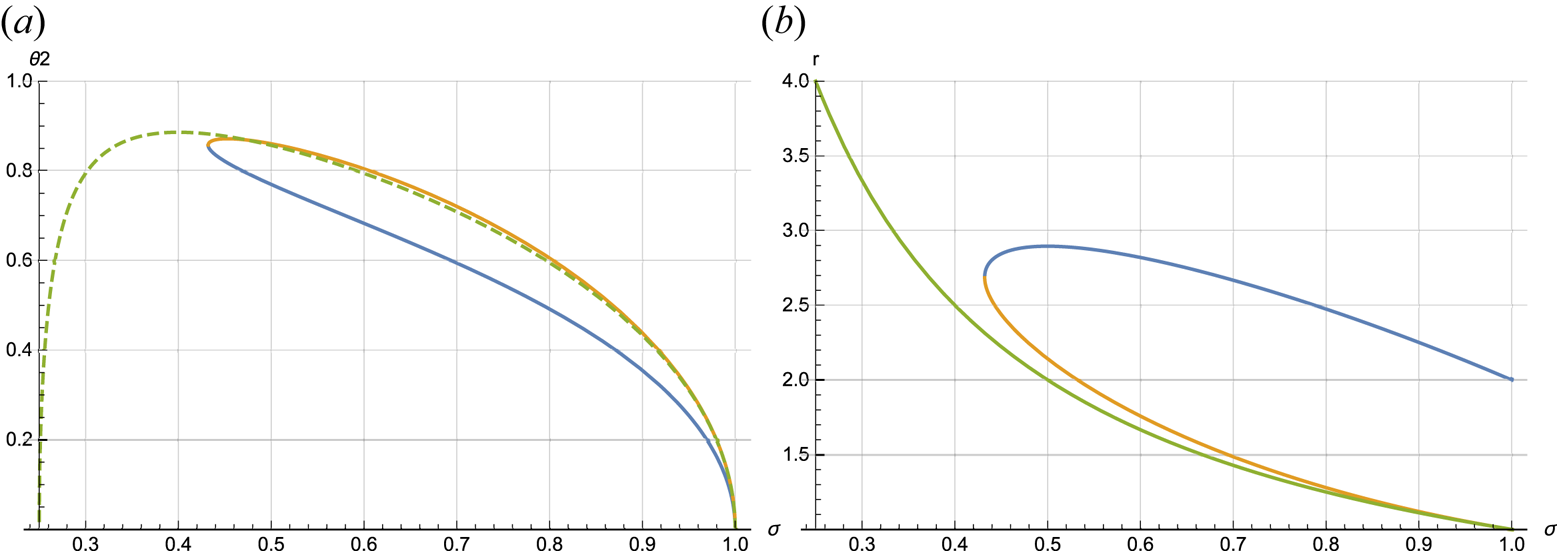
which correspond to our switch-on solutions. They are pictured in figure 3(a). Then the corresponding density jump $r(\sigma )$ is computed and plotted in figure 3(b). The green curve pictures the MHD switch-on solution (2.13), defined for $\sigma \in [1/4,1]$. In Stage 1, numerical exploration shows solutions exist only for $\sigma \in [0.432, 1]$.Therefore, while there is only one switch-on solution in MHD, our model offers two. Figure 3(a) shows that both of our branches merge with the MHD result for $\sigma =1$
as far as $\theta _2$ is concerned. Such is only the case for the lower of our $r$-branch, as can be seen from figure 3(b).


Figure 3(a) shows that the largest value of $\theta _2$ in Stage 1 is almost as high as its MHD counterpart.
In accordance with the method explained in § 3, we now study the stability of Stage 1.
4.3. Stability of Stage 1
If unstable, Stage 1 is mirror or firehose unstable. The thresholds for these instabilities are given by (Gary Reference Gary1993; Gary & Karimabadi Reference Gary and Karimabadi2009)

where

and the ‘+’ and ‘$-$ ’ signs stand for the thresholds of the mirror and firehose instabilities, respectively. From (4.8), we obtain the downstream anisotropy $A_2$
 ,

For $\beta _{\parallel 2}$ , we obtain, in Appendix C,

To assess the stability of Stage 1, we then proceed as follows.
(i) From (4.9), we plot the thresholds for the mirror and firehose instabilities in the $(\beta _{\parallel 2},A_2)$
plane.(ii) Then, on the same graph, we plot the curves $(\beta _{\parallel 2},A_2)$
for the two non-trivial $\theta _2$-branches found in § 4.2.


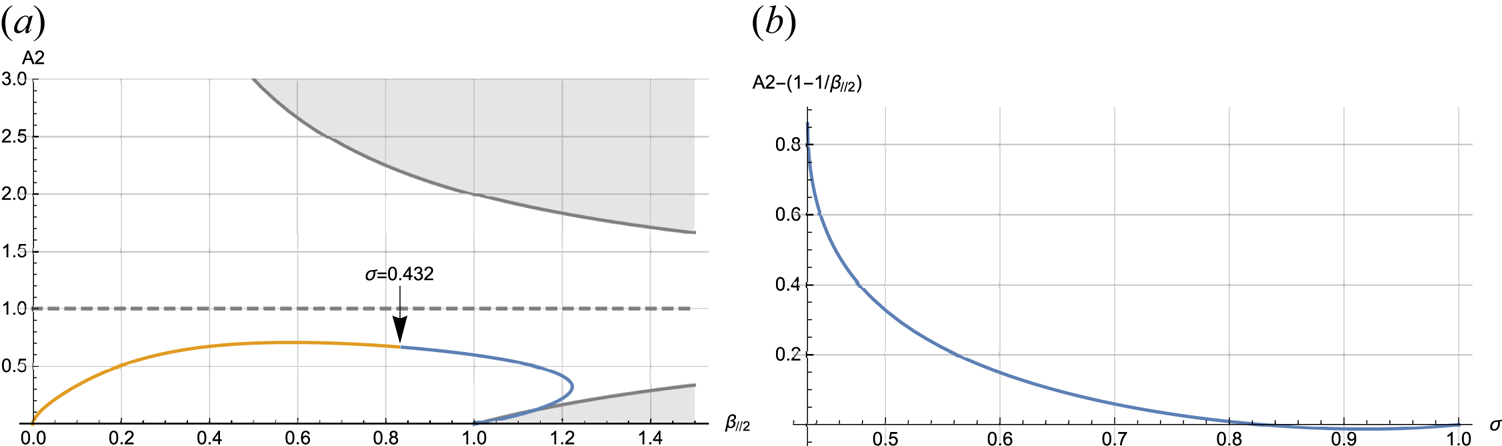
The result is pictured in figure 4(a). In Bret & Narayan (Reference Bret and Narayan2018), Stage 1 had $A_2=0$ for the sonic strong shock case. Here, $A_2$
 departs from 0 but remains small.
(a) Thresholds for the mirror (upper grey line) and firehose (lower grey line) instabilities. The plasma is unstable within the shaded areas. The loop shows the curves $(\beta _{\parallel 2}(\sigma ),A_2(\sigma ))$ for the two $\theta _2$
 -branches defined previously. The two branches start from the same point for $\sigma =0.432$
 , and both reach $A_2=0$
 for $\sigma =1$
 . (b) Stability analysis of the blue branch for $\sigma \in [0.432, 1]$
 . It is found firehose unstable for $\sigma \in [0.82, 1]$
 .

It turns out that the orange branch pictured in figure 3(a), namely the one closest to the MHD solution, is stable for any $\sigma$ . Yet, the blue one is slightly unstable in some $\sigma$
 range. For this branch, the quantity $A_2 - (1-\beta _{\parallel 2}^{-1})$
 is plotted in figure 4(b). It is negative for $\sigma \in [0.83, 1]$
 , indicating firehose instability. In this $\sigma$
 -range, the downstream will therefore migrate to Stage 2, on the firehose threshold.
As can be seen in figure 4(a), the blue branch Stage 1 is only slightly unstable. Consequently, the corresponding marginally stable Stage 2 is very close to the unstable states. This is confirmed below in § 5, where Stage 2 is analysed.
For now, to document the differences between our two branches, we further study Stage 1 by computing its entropy and its Alfvénic downstream velocity.
4.4. Entropy of Stage 1
The two branches for Stage 1 cannot be distinguished by their energy since they both fulfil the energy conservation equation (4.6), where the upstream energy is the same in both cases. Their energy densities are therefore identical. Yet, they can be distinguished on the basis of their entropy.
For a bi-Maxwellian of the form,

where $a=2k_BT_\parallel /m$ and $b=2k_BT_\perp /m$
 , the entropy reads

where $n=\int F d^3v$ . Using the subscript ‘b’ for the blue branch in figure 3, and subscript ‘$o$
 ’ for the orange one, we get for the entropy difference per particle between the two branches,

where we have used $A_2=T_{\perp 2}/T_{\parallel 2}$ and then $T_{\parallel 2} = T_e \cos ^2\theta _2$
 for both branches.
The numerical evaluation ($T_e$ is given by (B6)) of this quantity displayed in figure 5(a) shows that $\Delta s < 0$
 for any $\sigma \in [0.432, 1]$
 . Therefore, $S_o/n_o < S_b/n_b$
 for any $\sigma$
 . The orange branch in figure 3 has lower entropy than the blue one.


4.5. Downstream Alfvénic Mach number of Stage 1
Another difference between the two branches lies in their respective Alfvénic Mach number, namely,

From (4.2), we get $B_2=B_1/\cos \theta _2$ . Then (4.1) gives $v_2 = n_1v_1/n_2\cos \xi _2 = n_1v_1/n_2\cos \theta _2$
 , since $\xi _2=\theta _2$
 in our model as in MHD (see (2.7) for MHD and Appendix B for our model). We finally obtain, in terms of the dimensionless variables (2.10), with both our model and MHD,

(i) In MHD, (2.13) has $r=\mathcal {M}_{A1}^2$
, so that for the switch-on MHD shock, $\mathcal {M}_{A2} = 1$ (Goedbloed et al. Reference Goedbloed, Keppens and Poedts2010, p. 853).(ii) In our model, the value of $\mathcal {M}_{A2}$
is pictured in figure 5(b) for the two branches represented in figure 3. Our two branches are found slightly sub-Alfvénic.


5. Properties of Stage 2
The firehose instability of the blue branch for $\sigma \in [0.83,1]$ requires studying the properties of Stage 2 when marginally firehose stable. The conservation equations are the same. However, instead of imposing prescriptions (3.2) for the temperatures, we now impose firehose marginal stability for the downstream, namely,

The resolution of the system follows the same path as that described in Appendix B for Stage 1. It yields three equations for $\theta _2,\xi _2$ and $r$
 ,


Equation (5.2) imposes again $\theta _2 = \xi _2$ . Replacing in (5.3) gives

which leaves two options only.
(i) $\theta _2=0$
, which pertains to the parallel shock solution. Setting then $\theta _2=0$ in (5.4) then gives exactly the Stage 2 solution found in Bret & Narayan (Reference Bret and Narayan2018). (See (3.5) of Bret & Narayan (Reference Bret and Narayan2018) for $\chi _1=\infty$.)(ii) The other option is,
(5.6)\begin{equation} r=2\mathcal{M}_{A1}^2=2/\sigma. \end{equation}Inserting this result in (5.4) and solving for $\theta _2$ gives
(5.7)\begin{equation} \cos^2 \theta _2 = \frac{1}{10 \mathcal{M}_{A1}^2 - 4 \mathcal{M}_{A1}^4 - 5}, \end{equation}reminiscent of (2.14) for the MHD case. Solutions can here be found for(5.8)\begin{equation} \left. \begin{aligned} \mathcal{M}_{A1} & \in \left[ \frac{\sqrt{5-\sqrt{5}}}{2}, \frac{\sqrt{5+\sqrt{5}}}{2} \right] \sim [0.83, 1.34], \\ \Leftrightarrow \sigma = \frac{1}{\mathcal{M}_{A1}^2} & \in \left[ \frac{4}{5+\sqrt{5}}, \frac{4}{5-\sqrt{5}} \right] \sim [0.55, 1.44]. \end{aligned} \right\} \end{equation}


The counterpart to switch-on shock is therefore recovered in our model for Stage 2 as well, still in a limited range of Alfvén Mach numbers.
Figure 6 is eventually the end result of the present work. Like figure 3(b), it features the density jump of the MHD switch-on solution, together with the two branches of our model. However here, the way Stages 1 and 2 fit together in the $\sigma$ unstable range is elucidated. Since the blue branch has been found firehose unstable for $\sigma \in [0.83, 1]$
 , it is replaced by Stage 2, namely (5.6), in this range. As expected, the corresponding density jump is very close to that of Stage 1 since the system is almost marginally stable in this range, while Stage 2 sits exactly on marginal stability.
Same as figure 3(b) but showing how Stages 1 and 2 fit together when accounting for the firehose instability of the blue branch for $\sigma \in [0.83, 1]$ . Stage 2 density jump $r=2/\sigma$
 is discontinued from $\sigma = 1$
 since Stage 1 has no solution in this range.

In figure 6, the jump for Stage 2, namely $r=2/\sigma$ , is shown in black and plotted within the full range (5.8) where it is defined. For $\sigma < 0.83$
 , the line is dashed because Stage 1 is stable, and hence defines the density jump. Then for $\sigma \in [0.83, 1]$
 , the blue branch is dashed since it pertains to the unstable Stage 1. There, the jump is now given by Stage 2 through $r=2/\sigma$
 . Beyond $\sigma = 1$
 , Stage 1 offers no solutions. Since in our scenario Stage 1 is the first state of the downstream after crossing the front, the shock cannot accommodate such values of $\sigma$
 in the switch-on regime. For $\sigma > 1$
 , there is therefore no Stage 1 from where the system could jump to Stage 2, even though Stage 2 offers solutions. As a consequence, the black curve is dashed from $\sigma =1$
 to $1.44$
 .
6. Conclusion
In a collisionless non-magnetized plasma, the Weibel instability ensures isotropy, since it makes anisotropies unstable (Weibel Reference Weibel1959; Silva, Afeyan & Silva Reference Silva, Afeyan and Silva2021). Therefore, for collisionless shocks in such medium, the only source of departures from MHD should stem from accelerated particles (Bret Reference Bret2020; Haggerty & Caprioli Reference Haggerty and Caprioli2020).
In contrast, a temperature anisotropy can be stabilized in a collisionless plasma by an external magnetic field. Therefore, if the plasma turns anisotropic when crossing the front of a collisionless shock, its downstream anisotropy could be stable, resulting in a departure from MHD.
Several authors studied the conservation equations for a shock accounting for anisotropic pressures. Yet, the downstream degree of anisotropy is considered a free parameter in these works (Erkaev et al. Reference Erkaev, Vogl and Biernat2000; Double et al. Reference Double, Baring, Jones and Ellison2004; Gerbig & Schlickeiser Reference Gerbig and Schlickeiser2011). In the present article, we devised a model allowing to compute the degree of anisotropy of the downstream, in terms of the upstream parameters. We focused on the switch-on solutions where the field is aligned with the flow in the upstream, but not in the downstream.
For such a configuration, MHD allows for one shock solution, the switch-on solution, for which the density jump is given by (2.13). According to our model, which has been successfully tested against PIC simulations for the parallel case (Haggerty et al. Reference Haggerty, Bret and Caprioli2022), there are two collisionless switch-on solutions for which the angle $\theta _2$ and the density jump $r$
 are plotted in figures 3 and 6. One solution for what we named ‘Stage 1’ is stable for any $\sigma$
 where it is defined. The other is slightly firehose unstable within a limited $\sigma$
 -range. Exploring then Stage 2 in this range allows to correct the computed density jump. Since the Stage 1 that needed to be corrected was only slightly firehose unstable, the correction found with Stage 2 marginally firehose stable is small.
The existence of two switch-on solutions in our model instead of one in MHD could be explained. We plotted in figure 2(b) the MHD solutions for a cold upstream and any upstream field obliquity $\theta _1$ . One can see that the MHD switch-on solution for $\theta _1=0$
 splits into two different solutions for $\theta _1 > 0$
 . These two solutions are the intermediate and fast shocks. They merge for $\theta _1=0$
 , which is why MHD switch-on shocks can be termed intermediate or fast (Goedbloed et al. Reference Goedbloed, Keppens and Poedts2010, p. 853).
Possibly within our model, these two kinds of shocks do not merge for $\theta _1=0$ . Future works dealing with the fully oblique case $\theta _1 > 0$
 will explore how the MHD intermediate and fast shocks morph within our model.
Is one of our two branches physically favoured? Both pertain to a downstream plasma with the same energy density since both fulfil the energy conservation equation (4.6) where the upstream term is the same. We see from figures 3 and 5 that the orange one is the closest to the MHD solution, yet we found in § 4.4 that it has lower entropy than the blue branch. Further works, notably PIC simulations, would be needed to find out if these two branches are just our model's version of the oblique intermediate and fast shocks in the limit $\theta _1=0$ .
In the same way that the theory devised for the parallel case has been tested through PIC simulation (Bret & Narayan Reference Bret and Narayan2018; Haggerty et al. Reference Haggerty, Bret and Caprioli2022), it would be interesting to test the present conclusions through the same means. Yet, to our knowledge, no PIC simulations of switch-on shocks have been performed to date (Sironi & Lembège Reference Sironi and Lembège2022). An option in this respect would be to reproduce in PIC the bow shock MHD simulation performed by de Sterck & Poedts (Reference de Sterck and Poedts1999). There, it was found that a portion of the bow shock produced by the simulation was of the switch-on type. Possibly a PIC counterpart of this work would allow to produce a switch-on shock and study it at the kinetic scale.
Acknowledgements
Thanks are due to L. Sironi and B. Lembège for enriching discussions.
Editor Luís O. Silva thanks the referees for their advice in evaluating this article.
Funding
A.B. acknowledges support by grants PID2021-127322OB-I00 from the Spanish Ministerio de Economía y Competitividad. R.N. acknowledges support from the NSF Grant No. AST- 1816420. R.N. thanks the Black Hole Initiative (BHI) at Harvard University for support. The BHI is funded by grants from the John Templeton Foundation and the Gordon and Betty Moore Foundation.
Declaration of interests
The authors report no conflict of interest.
Appendix A. Derivation of the conservation equations for anisotropic temperatures
Equations (4.1)–(4.3) are identical to their MHD counterparts since they do not involve the pressure. The differences due to anisotropic pressure are rather to be found in (4.4)–(4.6). For (4.4) and (4.5), we start from the momentum flux density tensor equation (Landau & Lifshitz Reference Landau and Lifshitz2013, § 7),

In the shock frame, the left-hand side vanishes. Using the basis $x,y,z$ represented in figure 1, where the shock jump is in the $x$
 direction, we obtain the following jump conditions:

where the notation $[Q]_1^2$ stands for the difference of any quantity $Q$
 between the upstream and the downstream.
There are three contributions to the tensor $\varPi _{ik}$ : ram pressure, magnetic pressure and thermal pressure.
(i) The ram pressure part reads
(A3)\begin{equation} \varPi_{{\rm ram}} = \begin{pmatrix} nmv^2\cos^2\xi & nmv^2\cos\xi\sin\xi & 0 \\ nmv^2\cos\xi\sin\xi & nmv^2\sin^2\xi & 0 \\ 0 & 0 & 0 \end{pmatrix}, \end{equation}where all quantities are to be taken with subscript 1 for the upstream and 2 for the downstream.(ii) For the magnetic pressure, we start in a basis $(x',y',z')$
aligned with the field. In such a basis,
(A4)\begin{equation} \varPi_{{\rm mag}}' = \begin{pmatrix} -B^2/8{\rm \pi} & 0 & 0 \\ 0 & B^2/8{\rm \pi} & 0 \\ 0 & 0 & B^2/8{\rm \pi} \end{pmatrix}. \end{equation}We now express this tensor in our basis $(x,y,z)$, where $z=z'$ and $(x',y')$ are rotated by an angle $\theta$. Hence, we compute $R^{-1}\varPi _{\textrm {mag}}'R$, with
(A5)\begin{equation} R= \begin{pmatrix} \cos \theta & \sin \theta & 0 \\ -\sin \theta & \cos \theta & 0 \\ 0 & 0 & 1 \\ \end{pmatrix}. \end{equation}The result is(A6)\begin{equation} \varPi_{{\rm mag}} = \frac{B^2}{8{\rm \pi}}\begin{pmatrix} -\cos 2\theta & -\sin 2\theta & 0 \\ -\sin 2\theta & \cos 2\theta & 0 \\ 0 & 0 & 1 \end{pmatrix}. \end{equation}(iii) The calculation is similar for the thermal pressure. We start in a basis adapted to the field,
(A7)\begin{equation} \varPi_{{\rm th}}' = nk_B\begin{pmatrix} T_{{\parallel}} & 0 & 0 \\ 0 & T_{{\perp}} & 0 \\ 0 & 0 & T_{{\perp}} \\ \end{pmatrix}, \end{equation}where the directions $\parallel$ and $\perp$ are considered with respect to the field. Computing $R^{-1}\varPi _{\textrm {th}}'R$, where the tensor $R$ is still given by (A5), gives, in our basis $(x,y,z)$,
(A8)\begin{equation} \varPi_{{\rm th}} = nk_B\begin{pmatrix} T_{{\parallel}}\cos^2\theta + T_{{\perp}}\sin^2\theta & (T_{{\parallel}}-T_{{\perp}}) \cos\theta\sin\theta & 0 \\ (T_{{\parallel}}-T_{{\perp}}) \cos\theta\sin\theta & T_{{\parallel}}\sin^2\theta + T_{{\perp}}\cos^2\theta & 0 \\ 0 & 0 & T_{{\perp}} \end{pmatrix}. \end{equation}


When adding the contributions (A3), (A6) and (A8), the conservation (A2) yields (4.4) and (4.5).
For the last equation, namely (4.6), we start from the energy conservation equation (Landau & Lifshitz Reference Landau and Lifshitz2013, § 6),

where $\varepsilon$ is the internal energy density,


and $\varPi _{\textrm {mag}}, \varPi _{\textrm {th}}$ are given by (A6) and (A8), respectively. Setting the left-hand side of (A9) to 0, and equating the right-hand side between the upstream and the downstream, gives (4.6).
Appendix B. Resolution of the system (4.1)–(4.8)
The system (4.1)–(4.8) can be reduced to a system of three equations for $r\equiv n_2/n_1, \theta _2$ and $T_e$
 . The pathway to do so is as follows.
(i) We first notice that (4.3) imposes $\xi _2=\theta _2$
(as in MHD). We can therefore set $\xi _2=\theta _2$ everywhere.(ii) We then use (4.1) to eliminate $v_2$
everywhere.(iii) Next, we use (4.2) to eliminate $B_2$
everywhere.


At this junction, we are left with three equations which are the updated versions of (4.4)–(4.6). They read


in terms of the density ratio $r$ and the magnetic parameter $\sigma$
 defined in (2.15), plus

For further progress, it is convenient to define

This change of variables makes the forthcoming equations polynomial in $X_2$ easy to solve numerically. The value of $\overline {T_e}$
 can be extracted from (B1) and reads

Substituting it in (B2) and (B3) yields the two equations,


with

Equation (B7) clearly displays two branches.
(i) One branch is $X_2 = 0$
, that is, $\theta _2=0$. Inserting it into (B8) gives $a_0=0$, that is, $r=1$ or $r=2$. The first one, with $r=1$, is the continuity solution. The second one, with $r=2$, is the parallel strong sonic shock solution for Stage 1, already studied in Bret & Narayan (Reference Bret and Narayan2018).(ii) The second branch pertains to $\varLambda =0$
. We can extract the value of $r$ from $\varLambda =0$, namely,
(B10)\begin{equation} r=\frac{2 X_2^2}{\sigma [3 (X_2^2-2) X_2^2+4]-6 X_2^4+10 X_2^2-4}, \end{equation}and substitute in (B8). This eventually gives a polynomial equation for $X_2$ only, which reads
(B11)\begin{equation} Q(X_2) = \sum_{k=0}^4 b_k X_2^{2k}, \end{equation}with(B12)\begin{equation} \left. \begin{aligned} b_0 & = 32 \sigma^2-64 \sigma+32,\\ b_1 & ={-}80 \sigma^2+200 \sigma-120,\\ b_2 & = 76 \sigma^2-224 \sigma+160,\\ b_3 & ={-}30 \sigma^2+100 \sigma-84,\\ b_4 & = 3 \sigma^2-12 \sigma +12. \end{aligned} \right\} \end{equation}It can be solved numerically and gives the two values of $\theta _2(\sigma )=\arcsin X_2(\sigma )$ plotted in figure 3(a). Solutions exist only for $\sigma \in [0.432, 1]$. Then (B10) allows to compute the density jump $r$ for each $\theta _2$-branch and plot them in figure 3(b).


Appendix C. Calculation of $\beta _{\parallel 2}$

We need to evaluate

Equation (4.2) gives $B_2 =B_1/\cos \theta _2$ . Also, (4.8) gives $T_{2\parallel } = T_e \cos ^2\theta _2$
 . Finally, (B6) gives $T_e$
 . Expressing the result in terms of the dimensionless variables $r$
 and $\sigma$
 yields (4.12) for $\beta _{\parallel 2}$
 .