Introduction
… each of the mental disorders is conceptualized as a clinically significant behavioral or psychological syndrome … [that] must not be merely an expectable … response to a particular event (APA, 1994, p. xxi).
How can we distinguish between a psychiatric disorder and a syndrome that might be unpleasant or distressing but in fact reflects an expectable reaction to adversity? An individual experiencing a panic attack after just barely escaping a fatal climbing accident would not be considered psychiatrically disordered because the mechanism for panic attacks probably evolved to prepare us for such situations of real danger. This contextual approach is incorporated into the DSM-IV criteria for panic disorder, which requires a panic attack to be ‘unexpected’ (APA, 2000, p. 395).
By contrast, consider someone who develops bizarre delusions and hallucinations after being evicted from their apartment. Few psychiatrists would hesitate to give a diagnosis of psychotic illness because developing bizarre delusions is, they would feel, in and of itself disordered regardless of the psychosocial context. That is, there are no known environmental stressors to which the development of a bizarre delusion is a normative or expected response.
These cases highlight two fundamentally different approaches to the diagnosis of psychiatric disorders. Should they be conceptualized as context-independent syndromes defined solely by particular symptoms and signs, or as context-dependent syndromes that could either reflect a normal or expected reaction to the psychosocial context or represent a disorder?
DSM-IV sometimes uses a context-dependent approach to diagnosis. If an individual develops what looks like an episode of major depression (MD) in response to the death of a loved one, and the presentation is consistent with a normal grief reaction, bereavement would be the appropriate DSM-IV diagnosis, not MD. However, DSM-IV makes no provision for an ‘expectable’ depressive episode related to romantic rejection, job loss or public humiliation. One DSM-IV criterion for Adjustment Disorder requires ‘marked distress that is in excess of what would be expected from exposure to the stressor’. Post-traumatic stress disorder requires symptoms to emerge in a particular psychosocial context: exposure to serious trauma.
However, most DSM-IV disorders are conceptualized in a context-independent manner. No bereavement-like exclusion for mania exists in DSM-IV. No psychosocial context is allowed (such as falling in love or winning the lottery), in which a euphoric reaction meeting diagnostic criteria for mania would be considered normal.
In the current study, we addressed the question of whether MD should be diagnosed in a ‘context-dependent’ or a ‘context-independent’ manner. Should only depressive episodes that occur in the absence of high levels of psychosocial adversity be considered disorders? Or, like schizophrenia and mania, should MD be defined by duration, symptoms and signs independent of psychosocial context?
We identified, from the epidemiologically ascertained Virginia Adult Twin Study of Psychiatric and Substance Use Disorders (VATSPSUD; Kendler & Prescott, Reference Kendler and Prescott2006), subjects with depressive episodes in whom the MD arose, according to the subject themselves, in reaction to differing levels of psychosocial adversity. We also assessed in these subjects indices of liability to depression, including genetic risk, history of prior episodes, levels of depression-prone personality traits, risk for future episodes and severity of illness.
We then tested the context-dependent model in another complementary way. We selected subjects whose MD arose at the highest level of adversity and compared them with our epidemiological sample on these indices of liability to depression. If the context-dependent model is correct, then a preponderance of such individuals should not be disordered but rather have experienced an understandable ‘depressive reaction’ analogous to panic attacks at times of serious danger. We would not, we contended, expect such individuals to have a liability to MD that is much greater than that expected in the general population. By contrast, the context-independent approach to the diagnosis of MD would predict minimal differences between the low and high adversity groups in their liability to depression, and large differences on these risk indices between cases who develop MD in reaction to severe adversity and the general population.
Method
Sample and diagnostic assessments
Participants derived from two inter-related investigations in Caucasian twin pairs in VATSPSUD (Kendler & Prescott, Reference Kendler and Prescott2006), a sample ascertained from a population-based twin register in the Commonwealth of Virginia. Female–female (FF) twin pairs, born 1934–1974, became eligible if both members responded to a mailed questionnaire in 1987–1988, the response rate to which was approximately 64%. This sample was interviewed four times over 10 years, with cooperation rates ranging from 85% to 92%. Male–male and male–female (MMMF) pairs (born 1940–1974) were ascertained directly from registry records by a telephone interview with a response rate of 72%. The second interview wave, conducted up to 5 years later, had an 83% response rate. The mean (s.d.) age and years of education of the twins at the fourth FF and second MMMF interviews were 36.3 (8.2), 14.3 (2.2) and 37.0 (9.1), 13.6 (2.6) respectively.
At each interview, participants reported on the occurrence of 15 categories of stressful life events (SLEs) in the month of the interview and the 12 preceding months. Lifetime history of MD was assessed by structured psychiatric interview based on the Structured Clinical Interview for DSM-III-R (SCID; Spitzer & Williams, Reference Spitzer and Williams1985). Furthermore, at all interview waves, we assessed the occurrence over the past year of 14 individual symptoms, representing the disaggregated nine ‘A criteria’ for MD in DSM-III-R. For each symptom, we eliminated responses arising from physical illness or medication. The respondents aggregated their symptoms over the past year into co-occurring syndromes reporting months of onset and remission. The diagnosis of MD was made using DSM-IV criteria without the bereavement exclusion.
These analyses include the third and fourth waves of the FF sample and the second wave of the MMMF sample because these waves included interviewer-ratings of long-term contextual threat (LTCT) for each reported SLE. We instructed our interviewers to rate ‘what most people would be expected to feel about an event in a particular set of circumstances and biography, taking no account either what the respondent says about his or her reaction, or about any psychiatric or physical symptoms that followed it’ (Brown & Harris, Reference Brown and Harris1989, p. 24).
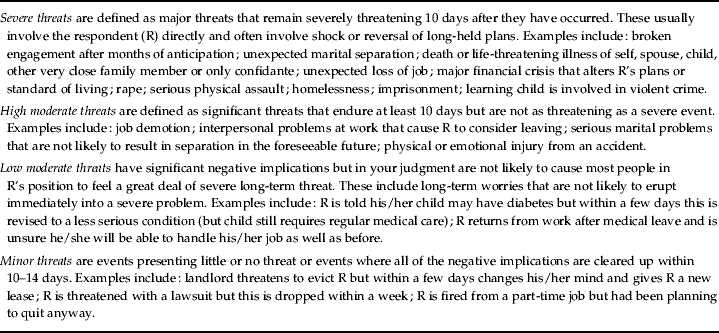
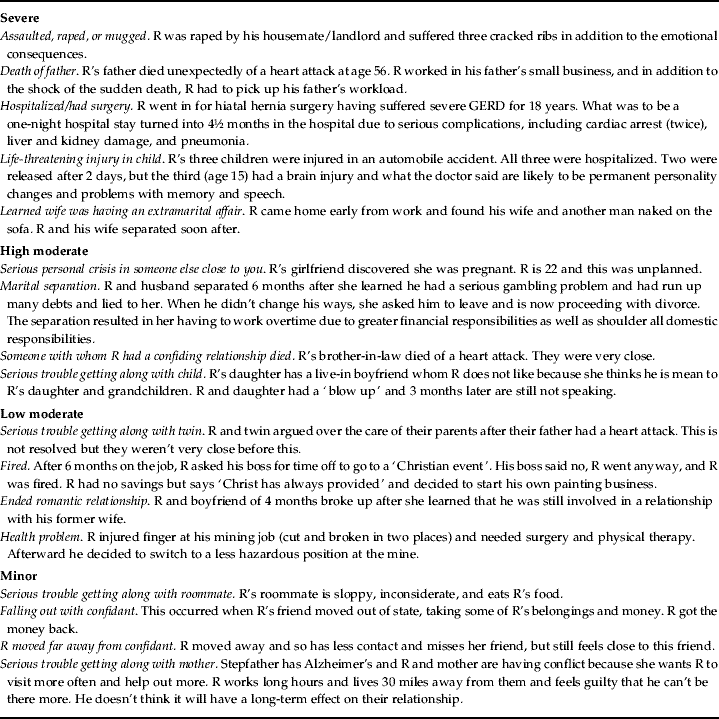
LTCT was rated on a four-point scale: minor, low moderate, high moderate, and severe. Inter-rater (rating tape recordings of 92 randomly selected SLEs) and test–retest reliability (173 life events obtained by repeating interviews with 191 respondents at a mean interval of 4 weeks) were calculated by Spearman correlation (r s) and weighted κ (Fleiss et al. Reference Fleiss, Cohen and Everett1969) and were r s=+0.60, κ=+0.41 and r s=+0.69, κ=+0.67 respectively. Definitions and examples of the four LTCT levels in our instructions to interviewers are illustrated in Table 1. Examples of events rated in subjects in this study are presented in Table 2.
Abbreviated definitions and examples of the four levels of long-term contextual threat (LTCT) in instructions to interviewers

Events reported with varying levels of long-term contextual threat (LTCT)Footnote a

a Life event category given in italics.
The increased risk for depression after SLEs in this sample was short lived, restricted largely to the month of occurrence and the subsequent month (Kendler et al. Reference Kendler, Karkowski and Prescott1998). LTCT was robustly related to risk for MD; the relative risk for MD in the month of event occurrence with minor, low moderate, high moderate and severe levels of LTCT was 1.22, 2.08, 6.10 and 14.85 respectively (Kendler et al. Reference Kendler, Karkowski and Prescott1998).
The analyzed sample contained 122 174 person-months of exposure from 7733 individuals, with 2090 depressive onsets occurring in 963 individuals and 24 307 SLEs, of which 8683 (35.7%), 9120 (37.5%), 5406 (22.2%) and 1098 (4.5%) were rated as having minor, low moderate, high moderate and severe levels of LTCT respectively.
For the worst depressive episode in each 1-year period, respondents were asked whether ‘something happened to make you feel that way’ or whether the episode occurred ‘out of the blue’. If they answered ‘something happened’, they were asked to describe the event, which was then coded. We considered episodes to be a confirmed SLE-associated MD only if we were able to determine that the SLE reported in the month of, or just prior to, the episode onset (the event for which we had scored the LTCT) was the same event as that reported by the respondent as ‘making you feel that way’.
Lifetime MD was assessed at personal interview by DSM-III-R criteria in co-twins and by family history using the Family History Research Diagnostic Criteria (FH-RDC) in parents (Endicott et al. Reference Endicott, Andreasen and Spitzer1975). Neuroticism, which was assessed by the short form of Eysenck's Personality Questionnaire (Eysenck et al. Reference Eysenck, Eysenck and Barrett1985), has been shown in this (Kendler et al. Reference Kendler, Neale, Kessler, Heath and Eaves1993) and other samples (Kendler et al. Reference Kendler, Gatz, Gardner and Pedersen2006) to index effectively the genetic risk for MD. We examined other internalizing disorders because of evidence that they share genetic risk factors with MD (Kendler et al. Reference Kendler, Prescott, Myers and Neale2003). Generalized anxiety disorder (GAD) was diagnosed using DSM-III-R (APA, 1987) criteria requiring a 1-month minimum duration. Phobia was diagnosed using an adaptation of DSM-III criteria (APA, 1980) requiring one or more unreasonable fears that interfere with the respondent's life. Panic disorder was defined using DSM-III-R criteria, except, because of the rarity of fully syndromal panic disorder (Kendler et al. Reference Kendler, Gardner and Prescott2001), we allowed up to 30 min for symptoms to maximize. Age at onset was studied because early onset reflects high genetic risk for MD (Sullivan et al. Reference Sullivan, Neale and Kendler2000; Kendler et al. Reference Kendler, Gatz, Gardner and Pedersen2005). We calculated the risk for new depressive onsets within the 1-year prevalence window assessed by our interview.
For early life risk factors, we examined parental warmth as measured by a shortened version of the Parental Bonding Instrument (Parker et al. Reference Parker, Tupling and Brown1979) and childhood sexual abuse (defined as genital contact and/or attempted/completed intercourse), both of which have been shown to correlate substantially with risk for subsequent MD (Kendler et al. Reference Kendler, Bulik, Silberg, Hettema, Myers and Prescott2000a, Reference Kendler, Myers and Prescottb). We also examined measures of clinical severity as an index of liability to MD because, in this sample, among depressed patients, several such indices (including duration and impairment) predicted risk of MD in relatives (Kendler et al. Reference Kendler, Gardner and Prescott1999).
For depressive episodes, we operationalized the DSM-IV ‘normal grief criterion’ (APA, 1994) as: (i) duration of ⩽8 weeks and absence of (ii) psychomotor retardation, (iii) suicidal ideation and (iv) severe work impairment. Our interviews did not inquire about psychotic symptoms or ‘morbid preoccupation with worthlessness’.
Statistical analysis
We first compared, on various measures of the liability to MD, five groups of depressed subjects that differed in the level of psychosocial adversity associated with MD onset. These comparisons were conducted by ordinal logistic regression in SAS (SAS Publishing, 2000) adjusted for sex using two-tailed p values. In all cases, the proportionality assumption was met. Analysis of risk for MD in the co-twin was also adjusted for sex of co-twin and zygosity.
We next compared subjects who experienced MD in reaction to a severe threat SLE (n=132) to all other subjects in our cohort (n=7601). This comparison is conservative in that we did not attempt to remove from our sample individuals with a history of MD. We asked whether cases of stress-induced MD differed from the representative general population sample from which they were selected. These comparisons were conducted by binary logistic regression (SAS Publishing, 2000) using the same covariates noted above. To calculate risk for future depressive episodes in our general cohort, we had to assign, using simulation, start points that had the same distribution as the months of recovery for our depressive cases.
Results
Comparison of groups who experienced MD in the setting of varying levels of adversity
These analyses were performed on twins who experienced MD ‘out of the blue’ (n=99) and in response to SLEs with LTCT ratings of mild (n=13), low moderate (n=84), high moderate (n=216) and severe (n=132). We first examined, in these five groups of depressed subjects, demographic factors. Age did not differ, but subjects whose depression arose in the setting of high levels of adversity were significantly more likely to be male. We therefore corrected for gender in all subsequent analyses.
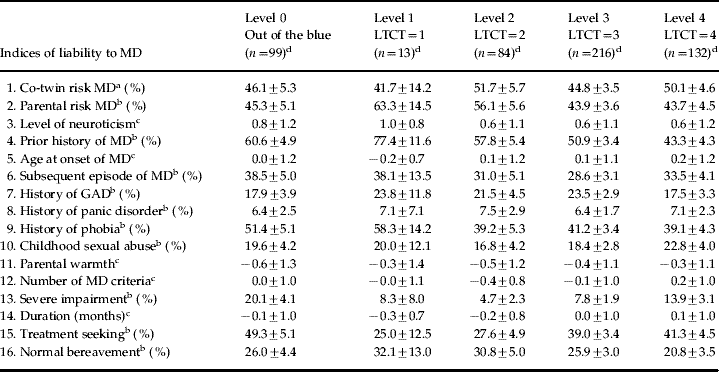
We next examined 15 indices of MD liability in approximate order of importance: (1) risk of MD in co-twin; (2) risk for MD in parents; (3) level of neuroticism; (4) prior history of MD; (5) age at onset of MD; (6) subsequent history of MD; history of other internalizing disorders: (7) GAD; (8) panic disorder; and (9) phobias; a history of early environmental adversities shown to be depressogenic including (10) childhood sexual abuse; and (11) low parental warmth; and the clinical severity of index episode as reflected by (12) number of criteria; (13) duration; (14) severe impairment; and (15) treatment seeking. The mean or proportion of these indices met by each of the five groups of subjects with MD is shown in Table 3.
Descriptive statistics for the indices of liability to major depression (MD) in groups of subjects differing by the level of psychosocial adversity experienced prior to the depressive onset

LTCT, Long-term contextual threat; GAD, generalized anxiety disorder.
a Prevalence adjusted for co-twin sex.
b Prevalence adjusted for sex.
c Standardized with mean=0 and standard deviation=1.
d Sample size for each variable may be smaller than n because of missing values.
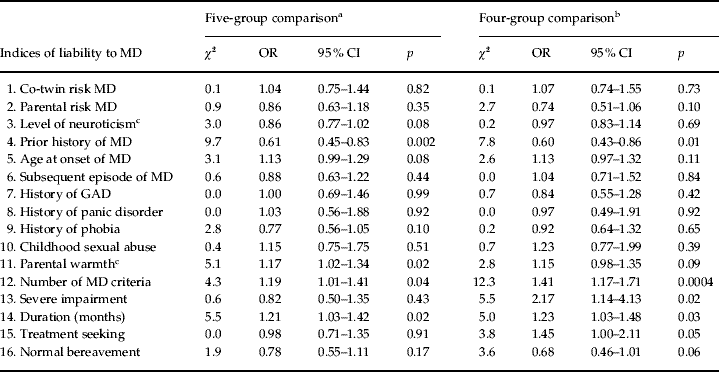
As seen in Table 4 (left side), we found no significant differences across our five groups in 11 of these indices (nos 1, 2, 3, 5, 6, 7, 8, 9, 10, 13 and 15). Two indices [prior history of MD (no. 4) and parental warmth (no. 11)] perform as is predicted by the context-dependent theory. That is, individuals who developed MD in high-stress situations less frequently had a prior history of depressive episodes and had higher levels of parental warmth than those developing MD in low-stress conditions. Two indices run counter to the suggestion of the context-dependent theory. Subjects whose depression arose in the setting of high adversity reported more symptomatic criteria (no. 12) and had longer durations of their depressive episode (no. 14).
The relationship between indices of the liability to major depression (MD) and the level of psychosocial adversity experienced prior to the depressive onset

OR, Odds ratio; CI, confidence interval; GAD, generalized anxiety disorder.
OR>1 indicates increasing levels in individuals who developed MD in the setting of severe psychosocial adversity.
a Includes subjects who confirmed that their depressive episode arose (i) ‘out of the blue’ and in response to stressful life events (SLEs) with (ii) low, (iii) low moderate, (iv) high moderate and (v) severe levels of long-term contextual threat (LTCT).
b Includes subjects who confirmed that their depressive episode arose in response to SLEs with (i) low, (ii) low moderate, (iii) high moderate and (iv) severe levels of LTCT.
c Variable is standardized so the OR reflects changes in s.d. units.
Because individuals who report ‘out of the blue’ depressive episodes might in some ways be unusual, we repeated these analyses excluding them, examining our four groups of depressed individuals whose onset was associated with SLEs differing in their level of LTCT. As seen in Table 4 (right side), no significant differences were found in these four groups on 10 of the 15 validators. One index [prior history of MD (no. 4)] was in the direction predicted by the context-dependent theory. Four indices ran counter to the predictions of this theory. By all measures examined, the depressive episodes were more severe in subjects whose depression arose in the context of high levels of adversity.
We also examined the proportion of individuals in each group who met the DSM-IV criteria for ‘normal grief’. If these criteria were successful in determining which depressive syndromes were context dependent, we would predict that the proportion of subjects meeting these criteria would be lowest in those with an ‘out of the blue’ episode and highest in those whose depressive episode arose in the setting of high levels of adversity. In both the five- and the four-group analyses (Table 4), no significant differences were seen in the proportion of individuals who met these ‘normal grief’ criteria. However, the observed trend (which was close to significant in the four-group analyses) was opposite to that predicted, with the lowest proportion of cases meeting ‘normal grief’ seen in those whose MD arose at high levels of stress (Table 3).
Comparison of individuals with MD episodes in the context of high levels of adversity with the general population
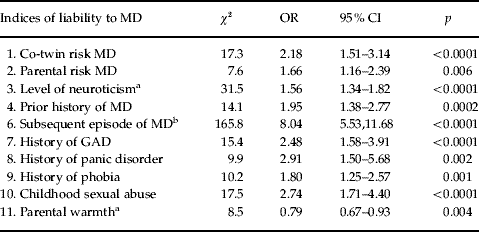
The context-dependent model for the diagnosis of MD also predicts that individuals who experience MD in the setting of high levels of psychosocial adversity should differ only modestly from the general population with respect to their liability to MD. This is because most of them should not be suffering from true MD, but instead have a non-disordered depressive reaction. We tested this hypothesis by comparing with our entire twin sample those cases who experienced MD in the setting of severe LTCT (n=132). We compared these two groups on all liability indices that could be meaningfully measured in a general population sample, many of whom would never have had a depressive episode. As shown in Table 5, inconsistent with the prediction of the context-dependent model for the diagnosis of MD, those who developed MD in the setting of high levels of stress differed substantially and consistently from the population from which they were selected on all indices, including having higher risk for MD in co-twin and parents, higher levels of neuroticism, greater history of prior and subsequent depressive episodes, higher risk for co-morbid anxiety disorders, and higher chance of prior exposure to childhood sexual abuse and low parental warmth.
Differences in indices of the liability to major depression (MD) between individuals with an onset of MD in the setting of high levels of adversity (SLE severe LTCT) and all other subjects in the population-based twin cohort

SLE, Stressful life event; LTCT, long-term contextual threat; OR, odds ratio; CI, confidence interval; GAD, generalized anxiety disorder.
OR>1 indicates increasing levels in individuals who developed MD in setting of high levels of psychosocial adversity.
a Variable is standardized so the OR reflects changes in s.d. units.
b To calculate risk for future depressive episodes in the other subjects in the cohort, simulation was used to assign starting points for the risk period that had the same distribution as the months of recovery for our depressive cases.
Discussion
The aim of this study was to evaluate whether the diagnosis of MD should be made dependent on the psychosocial context in which the disorder arises or in a context-independent manner. Our approach involved selecting, from a large epidemiological sample, individuals who met DSM-IV criteria for MD in the past year and who reported that their episode either arose ‘out of the blue’ or occurred in reaction to an SLE that was coded independently according to its level of LTCT. We first asked whether a wide range of potential indices of liability to MD were associated significantly with the level of adversity to which the depressed individuals were exposed. The context-dependent model, we suggest, should predict that individuals with depressive episodes occurring in high-stress conditions would score lower on indices of liability to MD than individuals whose depression arose in the context of little or no adversity. This prediction was, in general, not confirmed. The results from two liability indices, history of prior depression and level of parental warmth, were consistent with the context-dependent model. However, these results stand in contrast to the findings for many other salient indices, including genetic risk in co-twin and parents, levels of neuroticism and risk for future depressive episodes, which did not differentiate between groups of depressed subjects. Furthermore, two symptoms of severity of the depressive episode produced results contrary to predictions of the context-dependent model. Depressive episodes related to high threat events were neither milder nor briefer than those associated with low levels of stress. When these comparisons were repeated without the cases of MD that arose ‘out of the blue’, the overall pattern was very similar, with even less support for the context-dependent model. Then we examined only subjects who experienced a depressive episode due to a severe threat event. They scored substantially higher than others in this large epidemiological cohort on all indices of liability to MD.
Although our design had several methodological strengths, advocates of the context-dependent approach could point out two limitations. First, we had no ability to determine among individuals who experienced depressive symptoms in response to severe adversity what proportion might have had ‘true’ MD and happened to have an episode precipitated by stress. Certainly, someone with ‘real’ MD is not protected against developing an episode when exposed to adversity (just as someone with real panic disorder is not protected against panicking in response to danger). Therefore, if the context-dependent model for MD is correct, admixed among the individuals with non-disordered ‘depressive reactions’ in response to high levels of adversity would be some proportion of truly affected individuals. However, this proportion would have to be so high that explaining our results as consistent with the context-dependent model (because of an admixture of disordered and non-disordered cases among individuals with depression arising in high stress conditions) seems implausible.
Second, we used a relatively basic concept of context dependence that we operationally defined as the level of threat associated with the SLE that occurred just prior to the episode onset. Context dependence could also be conceptualized in a different way, along the lines of ‘understandability’ as articulated by Jaspers (Reference Jaspers1963). Here the task becomes determining, after taking into account the entire biographical situation, whether the emergence and evolution of the depressive episode from the experienced adversity is understandable using normal emphatic processes. This approach would involve determining whether the symptoms, duration and severity of the episode arose in a psychologically coherent manner from the stressful life experience. This kind of finer-grain clinical assessment was neither available to us nor typical in epidemiological designs. Therefore, we have no basis on which to determine whether an individual whose MD episode arose after a highly threatening SLE had an episode that was closely linked psychologically to, and could be understood in the context of, that event. We only know that the event and episode occurred in close temporal proximity and the individual described the event as contributing to the onset of the depression.
Our results can be seen as a continuation of an older literature on ‘reactive’ or ‘situational’ MD. Our results are consistent with a range of these earlier studies, for example in suggesting that situational and non-situational depressed patients do not differ in personality (Joffe et al. Reference Joffe, Levitt, Bagby and Regan1993) or recovery rates (Hirschfeld, Reference Hirschfeld1981). Hirschfield (Reference Hirschfeld1981, p. 302) concluded that ‘The evidence … does not support the validity of a distinct subtype of depression defined on the basis of clinical judgment of precipitating events.’ Our results are also congruent with two previous family studies. McGuffin et al. (Reference McGuffin, Katz and Bebbington1988) reported little difference in the risk for depression in relatives of depressed probands whose disorder had arisen following life events or chronic difficulties versus unrelated to adversity. Coryell et al. (Reference Coryell, Winokur, Maser, Akiskal, Keller and Endicott1994) found higher rates of MD in the relatives of probands with recurrent situational MD versus those with non-situational MD. However, our findings are inconsistent with an old clinical tradition that postulates critical differences between ‘reactive’ and ‘endogenous’ depression (Mendels & Cochrane, Reference Mendels and Cochrane1968).
Implications
In DSM-IV, any syndrome that is ‘merely an expectable … response to a particular event’ is not considered a disorder. Should this apply to depressive episodes occurring in response to high levels of adversity? Despite the caveats noted above, our analyses are not supportive of this position. Rather, they suggest that, like schizophrenia but unlike panic attacks, MD is best diagnosed in a context-independent manner focusing on symptoms and signs.
In a recent book, Horwitz & Wakefield (Reference Horwitz and Wakefield2007) argue that applying DSM criteria to both clinical and epidemiological samples results in large number of false-positive cases, particularly in individuals who have ‘normal sadness’ in response to adversity. The relevance of our results to their position is a function of the approach taken to the conceptualization of ‘normal sadness’. Read in a commonsense way, if by ‘normal sadness’ they meant a depressive syndrome arising in a normal individual in the setting of severe adversity, then our findings are directly relevant. In contradiction to the position they advocate, we found little evidence that cases of MD arising in the setting of severe adversity represent a non-disordered ‘normal sadness’ rather than MD. However, read another way, their concept of ‘normal sadness’ invokes a Jasperian sense of understandability (Kendler, Reference Kendler2008) that is not well addressed by our research design. Other research approaches are needed that can assess a range of validators for depressive illness in a representative sample of patients with ‘thick’ clinical evaluations that would permit an assessment of whether their depression arose in an understandable or ‘normal’ way from their environmental experiences.
Put in a broader context, our results raise core questions about the appropriateness of a central feature in our nosology that attempts to separate ‘normal’ or ‘adaptive’ responses to stress from pathological responses on the basis of the context in which these responses arise. An alternative approach is to simply classify the behavior or associated mental state as ‘normal’ or ‘abnormal’ based on its phenomenology. Our findings in this report are more supportive of this latter approach. However, only further research can determine the reproducibility and generality of our results.
Limitations
In additions to the concerns raised above, these results should be interpreted in the context of four further methodological concerns. First, our subjects are native-born, white, Virginia twins who may not be representative of other cultural or ethnic groups. Second, we performed many statistical tests with no correction for multiple testing. Some significant differences probably arose by chance. Third, results more favorable to the context-dependent theory of MD might arise if we had studied more severe life events, such as occur in natural disasters or war. Our results are limited to the psychosocial adversity typically experienced in civilian US populations. Fourth, because the results of our first analyses comparing five groups of depressed subjects were largely negative, their value depends on their power. For dichotomous variables, we had 80% power to detect an odds ratio of 1.36 between adjacent categories (Whitehead, Reference Whitehead1993). Power would be greater for continuous variables. These analyses were adequately powered to detect moderate but not small differences between groups.
Acknowledgments
This work was supported in part by National Institutes of Health (NIH) grants MH-40828 and MH-49492. These funders played no role in the design and conduct of the study; collection, management, analysis, and interpretation of the data; and preparation, review, or approval of the manuscript. Dr C. Gardner performed the power analyses.
Declaration of Interest
None.