Surgical site infections (SSIs) are the most common hospital-acquired infectionReference Magill, Edwards and Bamberg 1 and can result in substantial patient morbidity. Understanding and mitigating patient-specific and surgery-specific SSI risk factors can help prevent SSI.Reference Umscheid, Mitchell, Doshi, Agarwal, Williams and Brennan 2
Prolonged operative duration is a known risk factor for SSI in hip and knee arthroplasties,Reference Mangram, Horan, Pearson, Silver and Jarvis 3 – Reference Namba, Inacio and Paxton 11 but the association between short operative durations and SSI outcomes has not been extensively studied. While performing outbreak investigations in our community hospital network, we observed an increased SSI rate after knee arthroplasty procedures performed by one orthopedic surgeon with very short operative durations compared with his peers. Based on this observation, we sought to systematically evaluate the association between short operative duration and risk of SSI; our a priori hypothesis was that short operative durations would be associated with increased SSI rates due to poor surgical technique or more frequent breaches in infection control practices. To test this hypothesis, we analyzed surveillance data from community hospitals to determine the association between shorter operative durations and SSI outcomes in hip and knee arthroplasties. We also examined the association between surgeon median operative durations and SSI outcomes to determine whether the risk of SSI changed with a surgeon’s typical operating speed.
METHODS
We performed a retrospective cohort analysis of prospectively collected SSI surveillance data on hip and knee arthroplasties from hospitals participating in the Duke Infection Control Outreach Network (DICON). DICON is a network of more than 40 community hospitals in 5 states throughout the southeastern United States that has been described previously.Reference Anderson, Miller and Chen 12 Trained infection preventionists at each hospital collect surveillance data using a standardized database employing National Healthcare Safety Network (NHSN) definitions. DICON liaison infection preventionists validate a subset of surveillance data each month.
Adults (age ≥18 years) who developed SSIs by NHSN criteriaReference Horan, Andrus and Dudeck 13 following first-time, clean knee or hip arthroplasties performed between January 1, 2008, and December 31, 2012, were included in the analysis (N=67,718). During the study period, postoperative surveillance for a deep incisional SSI or organ-space SSI continued for 1 year. Postoperative surveillance for a superficial incisional SSI continued for 30 days. A total of 43 hospitals had complete exposure and outcome data and contributed to the study.
Separate log-binomial regression models were created to estimate the association (1) between operative duration (independent variable) and SSI outcome (dependent variable) and (2) between surgeon median operative duration (independent variable) and SSI outcome (dependent variable) in hip and knee arthroplasties. Operative duration is defined as the time between skin incision and skin closure; it was modeled in three categories based on the variable’s overall distribution: (1) operative durations shorter than the 25th percentile, (2) operative durations between and including the 25th and 75th percentile, and (3) operative durations longer than the 75th percentile. This distribution was selected for 2 reasons following exploratory analyses. First, operative duration was best represented as a categorical variable and the selected cutoff points corresponded with the overall trend of SSI risk across operative duration. Second, the National Nosocomial Infections Surveillance risk index uses the 75th percentile as a cutoff point to designate procedures with longer duration as having higher risk for SSI.Reference Culver, Horan and Gaynes 4 Surgeon median operative duration was modeled similarly to operative duration: (1) surgeon median operative durations shorter than the 25th percentile, (2) surgeon median operative durations between and including the 25th and 75th percentile, and (3) surgeon median operative durations longer than the 75th percentile. Hip arthroplasties and knee arthroplasties were evaluated in separate models for 4 models. American Society of Anesthesiology (ASA) score and patient age were considered potential confounders of the relationship between operative duration and SSI and between surgeon median operative duration and SSI. Patient age was modeled as a continuous variable. ASA score was modeled as a binary variable (1–2 vs 3–5).Reference Culver, Horan and Gaynes 4 Bivariate analyses were performed to examine relationships between potential confounders, operative duration, surgeon median operative duration, and SSI risk. Backward selection was performed for final model selection. Confounders that changed the exposure β coefficient more than 10% were retained in the final model.
We then performed multiple sensitivity analyses to evaluate the association between short operative duration and risk of SSI while using different definitions for short operative duration and inclusion/exclusion criteria. First, we altered the categories for operative duration so that short operative times were lower than the 20th percentile. Second, we altered the categories for operative duration so that short operative times were lower than the 10th percentile. Third, we looked at operative duration as a continuous variable. Fourth, we excluded outlier operative duration observations and looked at operative duration as a categorical variable as initially described. Other than the alteration noted for each sensitivity analysis, model development was performed using the methods described above for each model.
Statistical analyses were performed using SAS software, version 9.3 (SAS Institute, Cary, North Carolina). This study was approved by the Duke University and the University of North Carolina at Chapel Hill Institute Review Boards.
RESULTS
Knee Arthroplasty Results
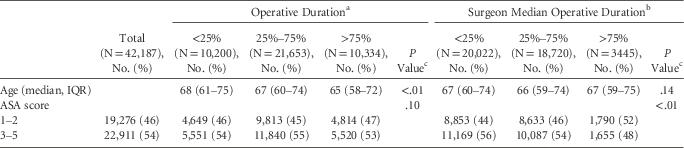
A total of 42,187 knee arthroplasties performed by 314 surgeons (Table 1) were included in the study. The overall SSI rate during the study period was 1.03 SSIs per 100 procedures. The median operative duration for knee arthroplasties was 83 minutes (interquartile range [IQR], 64–106 minutes). The median age of patients undergoing knee arthroplasty was 67 years (IQR, 59–74).
Distribution of Potential Confounders Among Operative Duration and Surgeon Median Operative Duration for Knee Arthroplasties

NOTE. IQR, interquartile range; ASA: American Society of Anesthesiology.
a Knee arthroplasty operative duration: <25%=<64 min; 25%–75%=64–106 min; >75%=>106 min.
b Surgeon median operative duration: <25%=<79 min; 25%–75%=79–20 min; >75%=>120 min.
c P value given by Wilcoxon rank sum for age, by χ2 test for American Society of Anesthesiology score.
Operative duration and SSI risk in knee arthroplasties
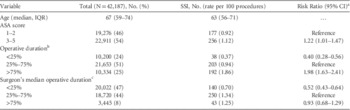
The unadjusted risk of SSI in knee arthroplasties with an operative duration shorter than the 25th percentile was 0.40 times the risk of SSI in knee arthroplasties with an operative duration between the 25th and 75th percentile (RR, 0.40; 95% confidence interval [CI], 0.28–0.56; P≤.01). The unadjusted risk of SSI in knee arthroplasties with an operative duration longer than the 75th percentile was 1.26 times the risk of SSI in knee arthroplasties with an operative duration between the 25th and 75th percentile (RR, 1.26; 95% CI, 1.18–1.34; P≤.01). Patients with shorter operative durations were older and did not differ in terms of their ASA scores (Table 1). Patients who developed SSIs after knee arthroplasty were younger, had higher ASA scores, and had longer operative durations (Table 2). However, none of these potential confounders changed the association between operative duration and SSI outcome in knee arthroplasties.
Surgeon median operative duration and SSI risk in knee arthroplasties
The unadjusted risk of SSI in knee arthroplasties performed by a surgeon whose median operative duration was shorter than the 25th percentile was 0.52 times the risk of SSI in knee arthroplasties performed by a surgeon whose median operative duration was between the 25th and 75th percentile (RR, 0.52; 95% CI, 0.43–0.64; P≤.01). The unadjusted risk of SSI in knee arthroplasties performed by a surgeon whose median operative duration was longer than the 75th percentile was not significantly different than the risk of SSI in knee arthroplasties performed by a surgeon whose median operative duration was between the 25th and 75th percentile (RR, 0.93; 95% CI, 0.68–1.29; P=.68). Surgeons who had a shorter median operative time compared to their peers operated on patients with higher ASA scores (Table 1). Patients who developed SSI after knee arthroplasty were younger, had higher ASA scores, and had their arthroplasty performed by a surgeon who had a typical median operative duration (Table 2). However, none of these potential confounders changed the association between surgeon median operative duration and SSI outcome in knee arthroplasties.
Hip Arthroplasty Results
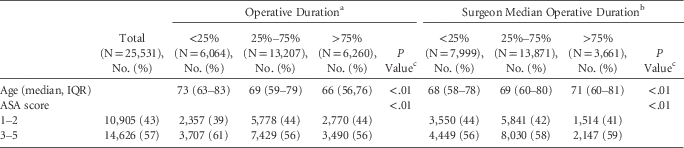
A total of 25,531 hip arthroplasties performed by 446 surgeons (Table 3) were included in the study. The overall SSI rate during the study period was 1.33 SSIs per 100 procedures. The median operative duration for hip arthroplasties was 80 minutes (IQR 61–105 minutes). The median age of patients undergoing hip arthroplasty was 69 years (IQR, 59–79).
Distribution of Operative Duration, Surgeon Median Operative Time, and American Society of Anesthesiology Score with Surgical Site Infection Outcome in Knee Arthroplasties

NOTE. SSI, surgical site infection; IQR, interquartile range; ASA, American Society of Anesthesiology.
a Unadjusted risk ratio with 95% confidence intervals.
b Knee arthroplasty operative duration: <25%=<64 min; 25%–75%=64–106 min; >75%=>106 min.
c Surgeon’s median operative duration: <25%=<79 min; 25%–75%=79–120 min; >75%=>120 min.
Operative duration and SSI risk in hip arthroplasties
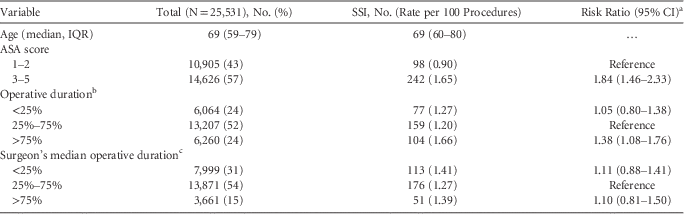
The unadjusted risk of SSI in hip arthroplasties with an operative duration shorter than the 25th percentile was not significantly different than the risk of SSI in hip arthroplasties with an operative duration between the 25th and 75th percentile (RR, 1.05; 95% CI, 0.80–1.38; P=.70). The unadjusted risk of SSI in hip arthroplasties with an operative duration longer than the 75th percentile was 1.11 times the risk of SSI in hip arthroplasties with an operative duration between the 25th and 75th percentile (RR, 1.11; 95% CI, 1.03–1.21; P=.01). Patients with shorter operative durations tended to be older and to have higher ASA scores (Table 3). Patients who developed SSIs after hip arthroplasty had higher ASA scores and longer operative durations (Table 4). In the multivariate analysis, patient age confounded the relationship between operative duration and SSI risk for hip arthroplasties. After adjusting for patient age, short operative duration was not associated with SSI outcome for hip arthroplasties (RR, 1.04; 95% CI, 0.79–1.37; P=.77), whereas long operative duration was associated with increased risk of SSI (RR, 1.12; 95% CI, 1.03–1.21; P=.01).
Surgeon median operative duration and SSI risk in hip arthroplasties
The unadjusted risk of SSI in hip arthroplasties performed by a surgeon whose median operative duration was shorter than the 25th percentile was not significantly different than the risk of SSI in knee arthroplasties performed by a surgeon whose median operative duration was between the 25th and 75th percentile (RR, 1.11; 95% CI, 0.88–1.41; P=.37). The unadjusted risk of SSI in knee arthroplasties performed by a surgeon whose median operative duration was longer than the 75th percentile was not significantly different than the risk of SSI in knee arthroplasties performed by a surgeon whose median operative duration was between the 25th and 75th percentile (RR, 1.10; 95% CI, 0.81–1.50; P=0.55). Surgeons performing hip arthroplasties who had a shorter median operative time compared to their peers tended to operate on younger patients and patients with higher ASA scores (Table 3). Patients who developed SSI after hip arthroplasty had higher ASA scores (Table 4). None of these potential confounders significantly changed the association between surgeon median operative duration and SSI outcome in hip arthroplasties.
Sensitivity Analyses
We performed multiple sensitivity analyses using different definitions of short operative duration. None of the results provided above were meaningfully altered during any of our sensitivity analyses (data not shown).
DISCUSSION
Our a priori hypothesis was incorrect: short operative duration was not associated with a higher SSI risk after hip and knee arthroplasties in this cohort of nearly 70,000 patients who underwent first-time, clean hip and knee arthroplasties. In fact, we found that short operative duration was protective against SSI after knee arthroplasties: patients whose knee arthroplasties were performed in <1 hour had just over half the SSI risk of patients whose knee arthroplasties were completed within 64–106 minutes. Interestingly, there was no association between short operative duration and SSI outcome for hip arthroplasties. Conversely, patients undergoing a knee or hip arthroplasty procedures that had an operative duration >75th percentile had a higher risk of SSI, which is consistent with prior research.Reference Mangram, Horan, Pearson, Silver and Jarvis 3 – Reference Namba, Inacio and Paxton 11 To our knowledge, no other study has investigated the relationship between short operative duration and SSI risk in hip and knee arthroplasties.
Our study was developed after we observed that one surgeon involved in an SSI outbreak after knee arthroplasties had shorter median operative times than his peers in our network of community hospitals. We explored the association between surgeon median operative duration and SSI outcomes in an attempt to examine operative duration as a surgeon-specific factor rather than as a singular procedure-specific factor. Surgeons performing knee arthroplasties who had a median operative duration <79 minutes had a significant protective association with SSI outcome compared to surgeons who took longer to perform knee arthroplasties, but this same relationship was not observed for surgeons performing hip arthroplasties.
This retrospective analysis has limitations. First, our results were derived from surveillance data in community hospitals and may not be generalizable to other practice settings. However, we believe our cohort of hospitals to be representative of a typical hospital in the United States. Second, we were unable to adjust for some potential confounders such as body mass index, specific patient comorbidities, and differences in operating room practices among hospitals because these data are not currently included in our surveillance database. Third, the surveillance data in the surgical database do not distinguish between initial and revision surgeries; thus, we included only the first hip arthroplasty and the first knee arthroplasty per patient in the database. However, the large number of arthroplasties in this study likely buffers against influential selection bias.
Finally, surgeon experience is a known risk factor for SSIReference Katz, Losina and Barrett 14 – Reference Lau, Perruccio, Gandhi and Mahomed 17 and may have a direct impact on operative duration. We considered using volume of surgeries as a marker of surgeon experience. However, surgeons in our community hospitals may also operate in hospitals that do not participate in our network; thus, the volume of surgeries performed in our network may not reflect an individual’s total surgical volume. Furthermore, we are unable to obtain information on other important components of surgeon experience including age and/or years from training. Interestingly, surgeons with higher median operative durations than their peers performed fewer total procedures than surgeons with short or typical median operative times. It is possible that surgeons with less experience tend to perform longer surgeries, thereby increasing their SSI risk.
In conclusion, short operative durations were not associated with a higher SSI risk for knee or hip arthroplasty procedures in our analysis. In contrast, our findings provide further support to the theory that SSI risk increases with the length of time that the surgical wound is open.
Distribution of Potential Confounders Among Operative Duration and Surgeon Median Operative Duration for Hip Arthroplasties

NOTE. IQR, interquartile range; ASA: American Society of Anesthesiology.
a Hip arthroplasty operative duration: <25%=<61 min; 25%–75%=61–105 min; >75%=>105 min.
b Surgeon’s median operative duration: <25%=<70 min; 25%–75%=70–104 min; >75%=>104 min.
c P value given by Wilcoxon rank sum for age, by χ2 test for American Society of Anesthesiology score.
Distribution of Operative Duration, Surgeon Median Operative Time, and American Society of Anesthesiology Score with Surgical Site Infection Outcome in Hip Arthroplasties

NOTE. SSI, surgical site infection; IQR, interquartile range; ASA, American Society of Anesthesiology.
a Unadjusted risk ratio with 95% confidence intervals.
b Hip arthroplasty operative duration: <25%=<61 min; 25%–75%=61–105 min; >75%=>105 min.
c Surgeon median operative duration: <25%=<70 min; 25%–75%=70–104 min; >75%=>104 min.
ACKNOWLEDGMENTS
Financial support: DJA was supported by National Institute of Allergy and Infectious Diseases (NIAID)/National Institutes of Health (NIH) (grant no. K23AI095357).
Potential conflicts of interest: All authors report no conflicts of interest relevant to this article.