INTRODUCTION
Teeming herbivores and deep shade challenge seedling trees in tropical rain forests. The responses of plants to herbivory and shading have been little investigated, though they have implications for community assembly (Fine et al. Reference FINE, MESONES and COLEY2004). Plants minimize the impacts of herbivores and shading through resistance and tolerance. Plants resist herbivory by allocating resources to physical and chemical defence (Coley & Barone Reference COLEY and BARONE1996), whereas they tolerate herbivory by minimizing its consequences and accelerating the repair of damaged tissues (Strauss & Agrawal Reference STRAUSS and AGRAWAL1999). Shading, on the other hand, is tolerated via functional traits including efficient sunfleck use and long leaf life spans (Valladares & Niinemets Reference VALLADARES and NIINEMETS2008). Plants cannot resist shading, except by growing vertically out of the understorey, which is the basic strategy of shade-intolerant species (Pearson et al. Reference PEARSON, BURSLEM, GOERIZ and DALLING2003).
The interacting effects of shading and herbivory on plant growth continue to be debated. The ‘resource-availability’ hypothesis (Coley et al. Reference COLEY, BRYANT and CHAPIN1985) suggests that it is more difficult to replace damaged tissues when resources are limiting, so plants should suffer most from defoliation in low-light conditions (Baraza et al. Reference BARAZA, GÓMEZ, HÓDAR and ZAMORA2004). On the other hand, the ‘light starvation’ hypothesis suggests that shaded plants may be so close to their photosynthetic compensation points that their growth rates are near zero even in the absence of herbivory, explaining findings that the impacts of herbivory are greater in well-lit than shaded conditions (Howe Reference HOWE1990). We tested these two hypotheses to better understand intraspecific variation in plant performance.
At the interspecific level, we tested three hypotheses to explain trade-offs in responses to shading and herbivory. These relationships have not yet been evaluated, in part because previous studies have not included enough species. The ‘carbon reduction’ hypothesis suggests that responses to the two factors are similar, as both reduce carbon-acquisition rates. This hypothesis predicts risk tolerance to vary among plants, from those that effectively tolerate shading and herbivory, to ones strongly affected by both (Grime Reference GRIME1977). Second, the ‘allocation trade-off’ hypothesis predicts an inverse relationship between tolerance of shade and herbivory. Plants adapted to shaded conditions allocate substantially to herbivore resistance (Coley et al. Reference COLEY, BRYANT and CHAPIN1985), and physiological trade-offs limit their allocation to tolerance (Leimu & Koricheva Reference LEIMU and KORICHEVA2006). Thus, shade-tolerant plants, once damaged, may tolerate damage poorly. Third, the ‘differing stresses’ hypothesis predicts uncorrelated responses to shading and herbivory, because shading is a chronic condition, whereas grazing mammals or out-breaking insects impose an acute stress. Finally, to better understand the functional bases of interspecific variation in plant performance, we correlated growth responses against the functional traits of wood density and seed size.
We tested multiple working hypotheses (sensu Chamberlain Reference CHAMBERLAIN1880) regarding the impacts of shade and defoliation on plant growth by studying seedlings of ten species of Dipterocarpaceae in Malaysian Borneo (Hector et al. Reference HECTOR, PHILIPSON, SANER, CHAMAGNE, DZULKIFLI, O'BRIEN, SNADDON, ULOK, WEILENMANN, REYNOLDS and GODFRAY2011). At the intraspecific level, we weighed the support for the mutually exclusive ‘resource availability’ and ‘light starvation’ hypotheses. At the interspecific level, we tested the ‘carbon reduction’, ‘allocation trade-off’ and ‘differing stresses’ hypotheses, the three of which are also mutually exclusive.
METHODS
The experiment was conducted at the Malua Research Station in the Malua Forest Reserve in Sabah, Malaysian Borneo (5° 5′ N, 117° 38′ E; Hector et al. Reference HECTOR, PHILIPSON, SANER, CHAMAGNE, DZULKIFLI, O'BRIEN, SNADDON, ULOK, WEILENMANN, REYNOLDS and GODFRAY2011). Annual rainfall at Danum Valley Field Centre (~60 km away) averaged 2825 mm between 1985 and 2006, with peak precipitation occurring between December and February. Mean temperature over the same period was 26.8 °C (Saner Reference SANER2009).
Seeds of ten species of Dipterocarpaceae were collected from local forest reserves during non-mast-fruiting events. The Dipterocarpaceae are best known for their heavy, high-quality timber, but the members of the family vary widely in wood density, seed size and shade tolerance (Ashton Reference ASHTON1982, Meijer & Wood Reference MEIJER and WOOD1964, Newman et al. Reference NEWMAN, BURGESS and WHITMORE1996, Reference NEWMAN, BURGESS and WHITMORE1998). Species were selected to represent a variety of genera and span a wide range of seed size and wood density (Table 1). Seeds were sown into soil collected from the nearby selectively logged forest in a nursery in a large clearing under shade cloth that transmitted 10% of ambient light. Soils surrounding the research station are mostly clay-rich orthic acrisols of the Bang association (Saner et al. Reference SANER, LOH, ONG and HECTOR2012).
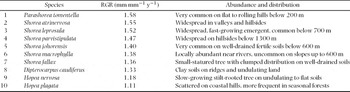
Species used and natural history about them, ordered by decreasing relative growth rate (RGR) in this study in median conditions of shading and defoliation. Nomenclature follows Ashton (Reference ASHTON1982). Data on abundance and distribution are derived from Meijer & Wood (1964), Ashton (Reference ASHTON1982) and personal observations of the authors.

In August 2007, after approximately 6 mo in the nursery, 60 seedlings of each species, all of which were independent of maternal seed reserves, were randomly allocated to one of three shading treatments by transplanting them into shadehouses covered by a single, double or triple layer of shade cloth. When constructed, in 2004, these shadehouses allowed 33%, 11% and 3% transmission of ambient light, respectively (Philipson et al. in press). By the time of the current experiment, however, uneven weathering of the shade cloth had progressed to the point that a categorical description of light availability was no longer appropriate. Thus, we used a quantum sensor (Licor 189, LiCor USA) to determine the light availability in each shade house, which ranged between 0.7% and 47.0% (median: 11.3%) and spanned the range observed in the surrounding selectively logged forest (Saner et al. Reference SANER, PHILIPSON, ONG, MAJALAP, EGLI and HECTOR2010). During transplantation, seedlings were transplanted into 30-cm bags to avoid root binding and were separated by at least 35 cm to reduce inter-seedling shading.
After 2 wk of acclimation to the experimental light conditions, we simulated herbivory with a one-time defoliation treatment. Dipterocarp seedlings typically experience low rates of herbivore damage (0.07–4.4% mo−1; Eichhorn et al. Reference EICHHORN, COMPTON and HARTLEY2006), which are generally too slight to significantly reduce growth rates (Eichhorn et al. Reference EICHHORN, NILUS, COMPTON, HARTLEY and BURSLEM2010). We imposed more intense levels of defoliation to ensure that an effect of defoliation would be detectable. As such, our defoliation treatment could be considered an analogue of acute leaf loss resulting from mechanical damage or outbreaks of insects or pathogens. Seedlings were randomly assigned to one of four levels of defoliation. Every leaf was cut with scissors laterally through the midrib to remove 0%, 25%, 50% or 75% of laminar area. Basal stem diameter was assessed using callipers with two perpendicular measurements, which were averaged. Diameter measurements were repeated three times, at the start of the experiment and after 2 and 4 mo.
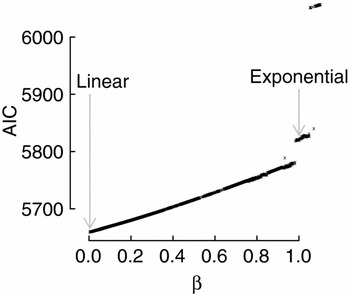
Flexible nonlinear models such as the power-law are preferred for modelling plant growth, because relative growth rate (RGR) frequently slows as plants increase in size (Paine et al. Reference PAINE, MARTHEWS, VOGT, PURVES, REES, HECTOR and TURNBULL2012). The power-law generalizes the exponential model by adding a third parameter, β, to accommodate slowing RGR (Philipson et al. in press). In this study, with only three observations on each seedling, however, traditional approaches to fit power-law models failed. We used an alternative, likelihood-profile approach to determine the best value of β. First, we selected the most parsimonious random- and fixed-effects structures for an exponential-growth model on the basis of Akaike's information criterion (AIC). Stem diameter was predicted as a function of date, defoliation treatment and shading, grouped by individuals within species in a mixed-effects model. Then, we repeatedly fitted power-law models with the same fixed and random effects structure, iterating over values of β from 0 to 1.1 with a step size of 0.001. The power-law model collapses to the exponential when β = 1. A value of β = 0, corresponding to a linear model of growth, was clearly preferred on the basis of AIC (Figure 1). Accordingly, we analysed the data using a linear mixed model. To evaluate the degree to which defoliation disproportionately affected shaded or well-lit seedlings, we tested for a significant three-way interaction among defoliation, shading and date. We also compared models with differing random effects structures to evaluate the support for predicted interspecific trade-offs in growth responses to shading and simulated herbivory. Relative growth rates were assessed at a standardized stem diameter of 4.05 mm, the median stem diameter across all seedlings, which all species attained. Relationships between functional traits and growth responses to shading were evaluated using standardized major-axis regression. All analyses were conducted in R 2.13.1 using the libraries ‘lme4’ and ‘smatr’ (Warton et al. in press).
Akaike's Information Criterion (AIC) for mixed-effect models of dipterocarp seedling growth that vary in values of the scaling exponent β.

RESULTS
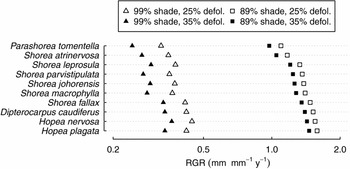
The stem diameter of seedlings increased substantially over the course of the 4-mo experiment, from 3.6 ± 1.0 mm (mean ± SD) to 5.99 ± 2.49 mm. Standardized at the median stem diameter of 4.05 mm, the mean relative growth rate (RGR) over the ten species was 1.39 ± 0.15 mm mm−1 y−1 (Table 1, Figure 2). Only 16 of the 600 (2.7%) seedlings died before the end of the experiment, mostly in the 75% defoliation and deep-shade treatment combination. The dead seedlings were approximately evenly divided among species, but the paucity of dead seedlings precluded formal survival analysis.
Relative growth rates (RGR) of seedlings from ten species of Dipterocarpaceae under varied intensities of defoliation and shading. RGR is shown at median conditions of shading and defoliation (89% and 25%, respectively), as well as in conditions 10% darker and more defoliated than the median. Species are sorted by RGR in median conditions. RGR is shown on a log-transformed axis to emphasize the percentage change in RGR resulting from increased defoliation and shading.

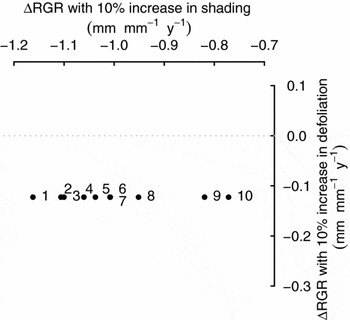
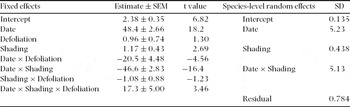
Defoliation interacted with shading intensity within species, reducing RGR by 21.6% in shaded conditions and 8.9% in well-lit conditions, as compared with the RGR of non-defoliated seedlings (Figure 2). The effect of shading was approximately eight times greater than that of defoliation; shade 10% darker than the median reduced RGR by 1.1 mm mm−1 y−1, whereas 10% defoliation reduced RGR by 0.14 mm mm−1 y−1 (Figure 2). We proposed three hypotheses for interspecific trade-offs in growth responses to shading and defoliation; the data provided no support for an interspecific trade-off in growth responses (Figure 3). Rather, species varied in their response to shading, but not to defoliation, as the best model included the interacting random effects of date and light availability, but not date and defoliation (Table 2). Thus, the effects of defoliation reduced the RGR of all species similarly, consistent with the ‘differing stresses’ hypothesis.
Interspecific trade-offs between growth responses to shading and to defoliation. The responses of ten species of dipterocarp trees to shading and defoliation are indicated by points, which are numbered in correspondence with species as indicated in Table 1. RGR was calculated at a standardized stem diameter of 4.05 mm, the median size of seedlings in the experiment.

Summary of the linear mixed-effect model of the growth responses of ten dipterocarp species to defoliation and shading. The model preferred on the basis of AIC includes a three-way interaction between observation date, defoliation and shading, indicating that defoliation has a stronger effect on growth in shaded conditions than well-lit conditions. Furthermore, the best model included a species-level random-effects term for shading, but not defoliation, indicating that species responded similarly to defoliation, whereas there was significant interspecific variation in responses to shading.

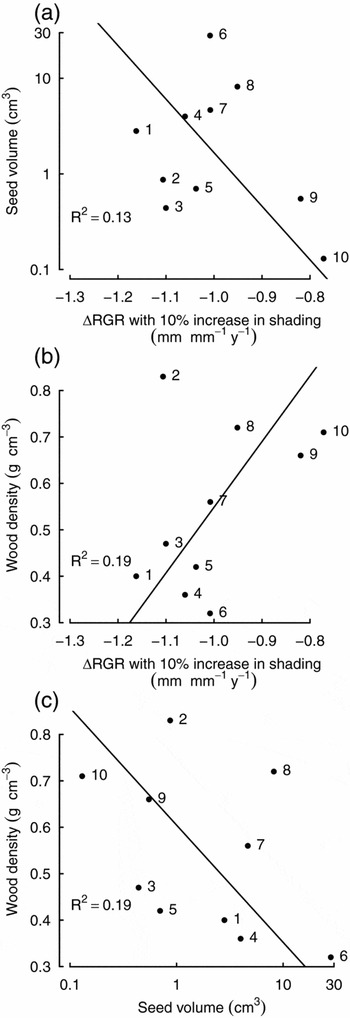
To better understand the interspecific trade-off between growth rates and shade tolerance, we examined the standardized major-axis relationships between species-specific growth responses to shading, RGR and functional traits. Growth responses to shading were inversely related to seed volume, and positively related to wood density (Figure 4a, b). Wood density and seed volume were inversely interrelated (Figure 4c). All of the relationships were significant, though they explained a fairly small amount of variance.
Relationships between species growth responses to shading, wood density and seed volume. The effects of shading on growth were strongest on species with larger seeds (a), and less-dense wood (b). Seed volume and wood density were inversely related (c). Lines indicate single major axis regressions, all of which are significant (P ≤ 0.001). Points are numbered in correspondence with species as indicated in Table 1. Seed volumes from Newman et al. (Reference NEWMAN, BURGESS and WHITMORE1996, Reference NEWMAN, BURGESS and WHITMORE1998) and Meijer & Wood (1964). Wood densities from Saner (Reference SANER2009) and Chave et al. (Reference CHAVE, COOMES, JANSEN, LEWIS, SWENSON and ZANNE2009, and references therein). Multiple values for wood density were available for most species, and are represented here by a mean over studies. Seed volume is presented on log-transformed axes.

DISCUSSION
The effects of shading and defoliation were synergistic rather than additive within species, because defoliation more strongly reduced relative growth rates (RGR) in shaded conditions than in well-lit conditions. On average, shading more strongly reduced RGR than did defoliation. Whereas previous studies have focused on one or few species (Blundell & Peart Reference BLUNDELL and PEART2001, Howe Reference HOWE1990, Rogers & Siemann Reference ROGERS and SIEMANN2002), we studied ten, allowing us to test for an interspecific relationship in growth responses to shade and defoliation. Species varied in their responses to shading, but were all similarly affected by defoliation, precluding an interspecific trade-off between tolerance of defoliation and herbivory. Moreover, species growth responses to shading were significantly correlated with seed volume and wood density.
We found the effects of defoliation to be most detrimental in deeply shaded conditions, as predicted by the resource-availability hypothesis (Table 2, Coley et al. Reference COLEY, BRYANT and CHAPIN1985). In studies involving natural herbivores, this pattern could result from covariance between herbivore abundance or plant palatability and light availability (Blundell & Peart Reference BLUNDELL and PEART2001, Salgado-Luarte & Gianoli Reference SALGADO-LUARTE and GIANOLI2010). For experiments like ours, in which herbivory is manually simulated, however, the most parsimonious explanation is that foliage lost in shaded conditions is too expensive to replace (Baraza et al. Reference BARAZA, GÓMEZ, HÓDAR and ZAMORA2004). Our result is also consistent with the results of a concurrent study of non-structural carbohydrates (NSC) in seedlings of six species of dipterocarp at the same site. NSC concentrations in seedlings grown in 97% shade were one-fifth to one-half those of seedlings grown in 70% shade (Saner Reference SANER2009). We infer that, having insufficient NSC pools, deeply shaded seedlings were unable to tolerate defoliation through compensatory growth (Kobe Reference KOBE1997). Our defoliation treatment removed far more leaf area than that typically consumed by insect herbivores on dipterocarp seedlings (Eichhorn et al. Reference EICHHORN, COMPTON and HARTLEY2006). Our treatment thus simulated the acute, intensive loss of leaf area such as that caused by mechanical damage, mammalian browsers, or outbreaking insects. This suggests that, under natural conditions, shade more strongly affects individual performance than does herbivory. We note in passing that, because shading and defoliation were evaluated on the same scale (0–100%), the magnitudes of their effects were comparable. It is reasonable to equate these scales, because equivalent reductions in leaf area and light availability both reduce a plant's rate of carbon acquisition in the same way, assuming that the costs of shading-induced changes in allocation can be discounted (Zangerl et al. Reference ZANGERL, HAMILTON, MILLER, CROFTS, OXBOROUGH, BERENBAUM and DE LUCIA2002).
Our use of stem diameter as a measure of individual performance may influence the inference that shading is more important than defoliation. The use of a direct measure of performance, such as lifetime seed production, would have been optimal (Maschinski & Whitham Reference MASCHINSKI and WHITHAM1989), but is impractical for long-lived trees. Rather, we assessed radial growth because it is an important predictor of individual performance at later ontogenetic stages (Landis & Peart Reference LANDIS and PEART2005, Zuidema et al. Reference ZUIDEMA, BRIENEN, DURING and GÜNERALP2009). Height growth can also be highly sensitive to shading and herbivory, and is particularly relevant for seedlings in closed-canopy forests where light availability decreases steeply from the canopy to the forest floor (Montgomery & Chazdon Reference MONTGOMERY and CHAZDON2002). Moreover, mammalian browsers often reduce seedling height by consuming twigs along with leaves. Nevertheless, stem diameter is a more reliable metric of stature than is seedling height. Shading can lead to etiolation (Dudley & Schmitt Reference DUDLEY and SCHMITT1996) and low-intensity herbivory can stimulate height growth, especially when apical meristems are damaged (Blundell & Peart Reference BLUNDELL and PEART2001). Thus, plasticity and compensatory growth can obscure the relationships among growth, shading and defoliation. More practically, there is less measurement error associated with diameter than with height. Therefore, stem diameter is a more reliable predictor of future performance than is height for seedlings.
Our application of the defoliation treatment may also affect the inference that shading more strongly affects RGR. Because we did not damage meristems along with the removal of leaf area, we may have underestimated the detrimental effects of herbivory. Furthermore, insects are more likely to be the most important herbivores on dipterocarp seedlings (Eichhorn et al. Reference EICHHORN, COMPTON and HARTLEY2006), but the damage they inflict is difficult to simulate, since herbivory is more than the loss of leaf area. In particular, herbivory can induce the production of phytochemicals, with attendant costs and consequences for the plant (Coley & Barone Reference COLEY and BARONE1996, Zangerl et al. Reference ZANGERL, HAMILTON, MILLER, CROFTS, OXBOROUGH, BERENBAUM and DE LUCIA2002), which we could not duplicate with a pair of scissors.
On average, the effect of shading on RGR was stronger than that of defoliation, as has previously been observed (Lentz & Cippolini Reference LENTZ and CIPOLLINI1998, Salgado-Luarte & Gianoli Reference SALGADO-LUARTE and GIANOLI2010, but see Myers & Kitajima Reference MYERS and KITAJIMA2007). Because damaged leaves can be replaced, the relative impact of defoliation should diminish with time. In contrast, most shade in closed-canopy forests is cast by adult trees, which have relatively slow dynamics, meaning that seedlings experience shading as a chronic condition with effects that are likely to intensify through time. It is surprising, therefore, that shading had a stronger effect than did defoliation, given the relatively short duration of our experiment. This suggests that, for seedlings recruiting in continually shaded conditions, shading would much more strongly affect RGR than does defoliation, though the latter may occasionally be acute. Although herbivory has been shown to affect species distributions in a variety of ecosystems (Fine et al. Reference FINE, MESONES and COLEY2004, Louda & Rodman Reference LOUDA and RODMAN1996, Rogers & Siemann Reference ROGERS and SIEMANN2002), we infer that shading more strongly affects the spatial distribution of dipterocarps in South-East Asian forests than does herbivory. This interpretation agrees with previous reports that dipterocarp seedlings can tolerate the loss of up to 90% leaf area without significant increases in mortality (Bebber et al. Reference BEBBER, BROWN and SPEIGHT2002, Becker Reference BECKER, Sutton, Whitmore and Chadwick1983, Blundell & Peart Reference BLUNDELL and PEART2001) and is consistent with a study of three species of Neotropical pioneer trees, which found no evidence that differential herbivory generated patterns of species distribution (Pearson et al. Reference PEARSON, BURSLEM, GOERIZ and DALLING2003). Nevertheless, longer-term studies and the inclusion of a wider variety of environmental conditions would be necessary to confirm this interpretation.
Species that were relatively insensitive to shading tended to have denser wood and smaller seeds than did species that were highly sensitive to shading (Figure 4). The relationship with wood density is consistent with those of a study conducted in five Neotropical forests (Poorter et al. Reference POORTER, WRIGHT, PAZ, ACKERLY, CONDIT, IBARRA-MANRIQUEZ, HARMS, LICONA, MARTÍNEZ-RAMOS, MAZER, MULLER-LANDAU, PEÑA-CLAROS, WEBB and WRIGHT2008). The patterns with seed size, on the other hand, are contrary to the expected positive relationship between seed size and shade tolerance (Valladares & Niinemets Reference VALLADARES and NIINEMETS2008), though they agree with a recent global analysis showing no consistent pattern between seed size and RGR (Turnbull et al. in press). The difference from previous expectations may stem from the fact that our estimates of RGR were standardized to a stem diameter of 4.05 mm, the median stem diameter across all seedlings. Doing so accounts for the slowing of RGR over ontogeny caused by the accumulation of structural non-photosynthetic biomass, and allows for reliable comparisons among species that differ in initial size (Paine et al. Reference PAINE, MARTHEWS, VOGT, PURVES, REES, HECTOR and TURNBULL2012). We suggest that the relationship of the functional traits with shade tolerance is driven by their relationships with RGR, and of RGR with growth responses to shading. Structural equation modelling could be useful for elucidating the causal pathways between these functional traits and shade tolerance (Shipley et al. Reference SHIPLEY, LECHOWICZ, WRIGHT and REICH2006). Altogether, our results confirm the correlation of wood density, but not seed size, with shade tolerance (Valladares & Niinemets Reference VALLADARES and NIINEMETS2008).
We predicted three possible interspecific relationships of plant growth responses to shading and defoliation. Because all species responded similarly to defoliation, there was no evidence of an interspecific trade-off (Figure 3), lending no support to the ‘carbon reduction’ hypothesis, which predicts that species would respond similarly to various stresses, such as defoliation and shading (Grime Reference GRIME1977). Likewise, there was no support for the ‘allocation trade-off’ hypothesis, which predicts an inverse relationship between growth responses to shading and defoliation. The lack of support for this hypothesis may result from the ten species we examined following a mixed strategy of herbivore defence – investing simultaneously in resistance and tolerance – as other species have occasionally been shown to do (Núñez-Farfan et al. Reference NÚÑEZ-FARFÁN, FORNONI and VALVERDE2007). Alternatively, the observed lack of a trade-off is consistent with the ‘differing stresses’ hypothesis, which suggests that plants may cope with shading and defoliation in differing ways. Seedlings in closed-canopy forests tend to experience shade as a chronic, systemic condition, whereas herbivory tends to be an acute condition experienced by localized tissues, particularly expanding leaves (Coley & Barone Reference COLEY and BARONE1996, Eichhorn et al. Reference EICHHORN, COMPTON and HARTLEY2006). Plants may use differing traits to respond to each stress. Higher root : shoot ratios, lower leaf mass per unit area, lower leaf area ratios and substantial stores of non-structural carbohydrates are among the many functional traits that contribute to shade tolerance (Kitajima Reference KITAJIMA1994, Kobe Reference KOBE1997, Valladares & Niinemets Reference VALLADARES and NIINEMETS2008), whereas the latter is particularly important for compensatory leaf production following herbivory (Myers & Kitajima Reference MYERS and KITAJIMA2007). Depending upon the interspecific correlations among these traits, plant growth responses to defoliation and shading may be uncorrelated.
The lack of support for interspecific trade-offs in this study may also have resulted from the narrow phylogenetic and ecological range of the species we considered. We examined the growth responses of ten species of a single family of tropical trees. Had wider gradients of taxonomy or growth form been considered, an interspecific trade-off between shade and herbivore tolerance may have emerged. Given the maturation of the relevant literature, conclusive evidence for such a trade-off may best be detected through meta-analysis of multiple studies, including the current one. The responses of plants to shading and herbivory, stresses which pervade the understorey of closed-canopy tropical forests, are of great interest, as they jointly affect the growth rates of individuals and thus shape species distributions and community assembly. The uniform growth response to defoliation across species suggests that shading more strongly affects species distributions than does variation in the intensity of herbivory.
ACKNOWLEDGEMENTS
We thank Julia Born, Charles Godfray, Glen Reynolds, Loh Yen Yee, and the staff at the Malua Research Station for their many contributions. This study was made possible by Swiss National Science grant number 121967 to A. H. Comments from two anonymous reviewers strengthened the manuscript. This constitutes contribution number 8 from the Sabah Biodiversity Experiment.