1. Introduction
In Waters (Reference Waters2009), I attempted to capture the ‘state of the art’ in theorising, practice and research activity about the management of innovation in English language education (ELE). Here I will reprise a number of the areas in that review, to identify where the field would benefit from further enquiry about how to successfully effect ELE innovation management. In doing so, I will attempt to explain why I regard each of the proposed areas of further investigation as important and, in outline terms, how such additional research might be conducted.
In what follows, three main areas for this research agenda will be outlined: i) investigations to do with the further application of established theoretical frameworks; ii) others involving concepts from innovation theory which have yet to be applied to ELE; and iii) studies which seek to explore what have so far been relatively under-researched aspects of ELE innovation activity. This said, the topics for further research which I indicate are far from comprehensive, due to the space available. However, I hope that they nevertheless provide a sufficiently clear and representative indication of the possibilities.
2. Further application of existing theoretical frameworks
As explained in Waters (Reference Waters2009: 422–424), a convenient framework for conceptualising the overall nature of the innovation management process is provided in Fullan (Reference Fullan2007: 65–69). From this perspective, innovating can be seen as comprising ‘three broad phases’: i) initiation (deciding to proceed with an innovation), ii) implementation (attempting to put the innovation into practice), and iii) institutionalisation (working towards achieving innovation sustainability). Existing research on the management of innovation in ELE has likewise focused primarily on one or more of these main stages. In doing so, a variety of theoretical frameworks have been used, some originally developed within mainstream innovation studies, others derived from work within ELE itself. However, so far, both the number and range of uses of such constructs in ELE research have been relatively limited. The first set of research tasks to be discussed in this paper is therefore concerned with proposals for making wider use of existing research tools of this kind.
2.1 Research tasks relating to the innovation initiation phase
Research into innovation management practices at the initiation stage is especially important, because the focus here is on attempting to ensure that the innovation design is as appropriate as possible to the requirements of the intended end-users. This is obviously a sine qua non of any attempt to innovate successfully.
2.1.1 Innovation contexts
An important body of existing research and theorising relating to the innovation initiation stage focuses on the effects on innovation adoption of a conceptual understanding of the innovation context. The overall concerns in this area are with the importance of i) identifying the characteristics of the innovation situation, and ii) attempting to take them into account in a way that will maximise the likelihood of innovation success.
As the well-known subsystems model in Kennedy (Reference Kennedy1988: 332) indicates, any innovation context can be seen as comprising a number of overlapping, hierarchically-arranged layers (cultural, political, etc.), all of them influencing the kind of innovation that will be appropriate in pedagogical terms. So far, however, relatively little systematic research into the effect on innovation in ELE of contextual factors of these kinds has been conducted. How more can be done in this respect is therefore illustrated in what follows, with a particular focus on aspects of one of the innermost and most immediate parts of Kennedy's hierarchy: the institutional subsystem.
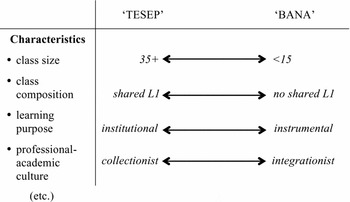
The main body of existing research in this area has involved distinguishing between two ELE teaching institution ‘archetypes’, namely BANA (British, Australasian and North American) and TESEP (tertiary, secondary and primary) (Holliday Reference Holliday1994a: Chs 1 & 5; Holliday Reference Holliday1994b; but also see Holliday Reference Holliday2005: 2–4 for a critique of some aspects of this conceptualisation). The former comprise private sector institutions (e.g. English language schools or centres) located mostly (though not exclusively) in BANA territories, while the latter comprise state sector institutions located in those parts of the world where English is a taught as a foreign or second language.
The two types of institution tend to differ in some of their basic characteristics, such as class size (relatively large in the case of TESEP institutions, typically much smaller in BANA ones) and linguistic composition (in most TESEP settings, students share the same L1, but in BANA classes, English is often the only lingua franca). The overall purpose of learning in the two kinds of institutions also differs, being largely institutional (education system needs-based) in the case of TESEP entities, and mainly instrumental (learner communication needs-based) in BANA settings.
Another important way in which the two institutional types tend to differ is in terms of their respective dominant professional-academic cultures – the paradigm of educational values and related practices to which teachers in each of the two types of institution typically adhereFootnote 1. TESEP teachers are seen as generally favouring a collectionist educational orientation, which results in a ‘[d]idactic, content-based pedagogy’ (Holliday Reference Holliday1994a: 72). BANA teachers, on the other hand, are regarded as more likely to adopt an integrationist educational perspective, leading to the use of a more ‘[s]kills-based, discovery-oriented, collaborative pedagogy’ (ibid.).
It is important to note that the characteristics of any real-life ELE institution are unlikely to correspond exactly to the features of this conceptual model. Rather, the BANA and TESEP concepts should be seen as idealisations, forming opposite ends of a continuum, on which particular institutions can be located at varying points, depending on the degree to which their characteristics tend towards one or other end of the spectrum for each of the features, as shown in Figure 1.
Some institutional characteristics continua (Holliday Reference Holliday1994a: Chs 1 & 5; Reference Holliday1994b)

In Holliday (Reference Holliday1994a: Ch. 5) and Holliday (Reference Holliday1994b), the particular configuration of such characteristics for a particular ELE institution is seen as strongly affecting the kind of innovation that will be appropriate within it. In addition, it is also argued that, since most ELE innovations are developed with a BANA-like institutional environment in mind, attempting to implement them in a TESEP-oriented context is likely to result in ‘tissue rejection’. Many of the remaining parts of Holliday (Reference Holliday1994a) provide a very detailed, thorough ethnographic working through of how (inter alia) these two sets of theoretical concepts throw light on why attempts to introduce BANA-oriented ELE teaching innovations into TESEP institutions in several parts of the world have been largely inappropriate and unsuccessful. However, there do not appear to be any published reports of other ELE innovation management research studies which have made explicit use of these concepts, a lacuna which the first research task is intended to address.
Research task 1: Use the BANA-TESEP conceptual framework to analyse the characteristics of an ELE institution. Then use the findings to identify the implications for adoption of a proposed or actual innovation aimed at that kind of institution.
Such an investigation would begin by attempting to identify the main features of the institution in question by using the full framework of ELE institutional characteristics described by Holliday (Reference Holliday1994a: Chs 1 and 5; Reference Holliday1994b). Relevant data could be generated via questionnaire surveys, classroom observations, interviews with teachers and other personnel, and so on. It should be noted that in this part of the research, characteristics of importance may emerge which have not so far been accounted for by research and theorising, or even a novel institutional archetype, and such findings would obviously be very welcome additions to developing further understanding in this area of ELE innovation management.
Next, a proposed or actual ELE innovation should be analysed in terms of its degree of ‘fit’ with the features identified, e.g. the class size needed to operate it, the kind of teaching methodology it involves (also see section 2.1.2 below). The higher the degree of fit, the greater the likelihood of the innovation being adopted, and vice versa. (Note: although not making direct reference to the BANA-TESEP framework, papers such as Carless (Reference Carless2002), on attempts to introduce task-based learning into Hong Kong state-sector primary schools, provide an excellent general model for the kind of research being proposed.)
2.1.2 Innovation attributes
Another important area of theorising which has been used in innovation management research and is of particular relevance to the initiation stage is concerned with the extent to which the fundamental attributes of an innovation correspond with those which research studies have shown tend to either favour or hinder potential for adoption. The best-known list of such characteristics is in Rogers (Reference Rogers2003: 15–16; also 180–188). For example, his research indicates that the greater the relative advantage (likely degree of benefit) that end-users perceive an innovation is likely to provide, the greater the probability that they will adopt it. Other criteria of this kind which have been used outside as well as within ELE innovation management research (some of them subsuming Rogers’ list) include those in Kelly (Reference Kelly and Galton1980), Henrichsen (Reference Henrichsen1989: 82–86; also see White et al. Reference White, Martin, Stimson and Hodge1991: 180–188), Stoller (Reference Stoller1994) and Markee (Reference Markee1997: Ch. 2); an overall summary is also provided in Waters (Reference Waters2009: 426–428).
Analyses of ELE innovations using this perspective comprise
i. the attempted introduction of the ‘Oral Approach’ in post-war Japan (Henrichsen Reference Henrichsen1989: 136–144; see 2.3 below)
ii. innovations of various kinds located within the context of US Intensive English Programmes (Stoller Reference Stoller1994)
iii. a range of recent major language teaching innovations (e.g. ‘task-based language teaching’) and the author's own university language centre-based ELE curriculum and teacher development innovation (‘CATI’) project (Markee Reference Markee1997: Ch. 2, Parts II and III passim)
iv. an attempt to use new assessment procedures to produce a ‘washback’ effect on English language teaching methods in Sri Lankan high schools (Wall Reference Wall2005).
However, this appears to be the sum total of published research reports which attempt to analyse the potential for adoption or rejection of ELE innovations in this way.
Furthermore, one of the additional main innovation attributes in Rogers (Reference Rogers2003) – re-invention, ‘the degree to which an innovation is changed or modified by a user in the process of its adoption and implementation’ (p. 180) – does not appear to have been referred to directly in any of the ELE innovation management literature, except perhaps in the form of the flexibility/adaptability factor in Henrichsen (Reference Henrichsen1989: 85). However, as Rogers (Reference Rogers2003) explains, there is evidence that ‘a higher degree of re-invention leads to a faster rate of adoption . . . [and] a higher degree of sustainability of an innovation’ (p. 183). This occurs because:
The general picture that emerges from studies of re-invention is that innovation is not a fixed entity. Instead, people who use an innovation shape it by giving it meaning as they learn by using the new idea (2003: 187–188).
Thus, despite the relative lack of attention the re-invention attribute has received so far, it seems highly relevant to innovation in a field such as ELE, given the relative heterogeneity of the settings around the world in which it occurs and the consequent need for innovations which can be adapted to a variety of local circumstances. The next research task is intended to encourage further work involving the use of this and the other innovation attributes.
Research task 2: Analyse a proposed or existing ELE innovation in terms of its attributes, including its potential for re-invention, and consider the implications of the findings for the likely or actual degree of adoption of the innovation.
Suitable candidates for analysis of this kind might be local initiatives, in the form of new curricula, coursebooks, teaching approaches (especially those involving e-technology – also see section 4.3 below), methods of testing, administrative systems and so forth, on the one hand and, on the other, any of the more widespread recent ELE innovations, such as Content and Language Integrated Learning (Klippel Reference Klippel2008), task-supported learning (Ellis Reference Ellis2003: 28–30), English as a Lingua Franca (Jenkins, Cogo & Dewey Reference Jenkins, Cogo and Dewey2011) and portfolio-based assessment (Little Reference Little2002). It would be important, of course, for such studies to involve the full range of main stakeholder perspectives, including, if possible, those of learners. It would also be particularly useful if such analyses (especially those involving local innovations) were carried out both prospectively (before implementation) and retrospectively (after implementation), to increase understanding of the predictive value of this kind of study in managing innovation in ELE.
2.2 Research tasks relating to the innovation implementation phase
Numerous research reports from both outside and within ELE show that, however well the innovation context has been investigated, and however appropriate to it the innovation design, adoption is often unsuccessful because an underdeveloped innovation implementation strategy is deployed (Ibrahim Reference Ibrahim, Lewin and Stuart1991; Li Reference Li1998; Goh Reference Goh1999; Hall & Hord Reference Hall and Hord2001; Trowler Reference Trowler2003: Ch. 4; Fullan Reference Fullan2007: Ch. 5; Wedell Reference Wedell2009). Once again, therefore, there is a need for further study of how this part of the ELE innovation management process can be made more successful.
Probably the best-known conceptualisation of overall approaches to innovation implementation is the set of three change strategies in Chin & Benne (Reference Chin, Benne, Bennis, Benne and Chin1970) (also see Kennedy Reference Kennedy1987). These comprise the power coercive strategy (the use of authority to enforce change), the rational-empirical strategy (explanation of why change is needed), and the normative-re-educative strategy (change via collaborative problem-solving). The first two can be seen as mainly top-down and unidirectional, whereas the third is bottom-up and interactive in nature.
As Kennedy (Reference Kennedy, Doyle and Goh1999: 1) argues, in large-scale educational innovation, because of the need for system-wide standardisation, a top-down approach to innovation implementation is unavoidable. However, as Trowler (Reference Trowler2003: 126–127) points out, research shows that, in such situations, a top-down approach, while necessary, is unlikely to be sufficient, because it tends to underestimate the importance of human agency in the innovation implementation process. On the other hand, as he also goes on to say (Reference Trowler2003: 134), other studies show that bottom-up approaches to innovation implementation suffer from a number of drawbacks as well, such as characteristically attributing an unrealistic level of agency to ‘grass-roots’ personnel. Trowler concludes by mentioning that research also indicates that the optimum implementation strategy is one which synthesises top-down and bottom-up approaches, resulting in ‘a third perspective’, characterised as directed collegiality or implementation as evolution, whereby there is a process of mutual adaptation, i.e. ‘adaptation of the innovation to fit the local setting and adaptations by local users to fit the innovation’ (Reference Trowler2003: 136–137).
So far as is known, research into ELE innovation implementation which has made significant reference to Chin & Benne's framework comprises only Kennedy (Reference Kennedy1987) and Goh (Reference Goh1999). In the former, the successful use of the normative-re-educative strategy in the context of a small-scale teacher-cum-curriculum development project located within a Tunisian university is described. Goh (Reference Goh1999) gives an account of the use of a similar approach in the design and running of a school-based professional development programme, one aimed at increasing the level of implementation by teachers of a nationwide curriculum development project in Malaysia, which had originally been delivered in a predominantly top-down manner (cf. Lee Reference Lee2007: 277–282). In Goh's study, therefore, there is an attempt to examine the effects of a combination of top-down and bottom-up approaches to innovation implementation in a manner similar to that advocated in Trowler.
However, these accounts appear to be the only ones to date which make explicit use of a change strategies-based theoretical framework to investigate the implementation of ELE innovations. Further studies of this kind, based on a range of additional settings, are therefore desirable, especially in order to explore to what extent a mixture of both top-down and bottom-up processes is seen as more effective than the presence of only one or the other kind, and if so, what appears to be the optimal mutual configuration of the two approaches (i.e., what proportions of each might be most effective, how might they best be integrated). The next two closely-related research tasks are therefore aimed at addressing such concerns.
Research task 3.1: Analyse the nature of a proposed or actual ELE innovation implementation strategy in terms of the extent to which it is i) top-down, and ii) bottom-up in orientation, and, as appropriate, iii) in what ways the two orientations are configured in relation to each other.
Research task 3.2: In the light of the above, analyse the views of the end-users about the extent to which the chosen strategy is or was perceived to affect adoption of the innovation in question.
In the first of these tasks, information should be gathered from the innovation management team and other relevant sources about the main features of the implementation approach being used, and then analysed to determine which elements of it are relatively i) top-down, and ii) bottom-up in orientation.
For example, a request to teachers to use new coursebooks incorporating the innovation (e.g. a novel way of teaching grammar), accompanied by a meeting in which the reasons for adopting the new approach are explained, would involve a relatively top-down implementation strategy. On the other hand, a workshop in which the new teaching approach was introduced and discussed, and which then also gave teachers opportunities to review the strengths and weaknesses of sample lessons based on the approach, as well as to devise others of their own, would constitute a relatively bottom-up implementation strategy. An integration of both kinds of strategies would occur if, for example, the new materials and the rationale of the approach were first of all introduced, and then there was work on how the ideas might be adapted to fit different teaching situations. Such a blending of strategies might be seen as top-down in overall terms, but also involving a closely linked bottom-up element as well. Then, in the second of the tasks, through, for example, focus group discussions, views should be elicited from potential or actual end-users of the innovation about what they feel are or were the perceived strengths and weaknesses of the main features of the implementation strategy, in terms of how each of them might help or hinder their adoption of the innovation.
2.3 Research tasks relating to the innovation institutionalisation phase
For true innovation adoption to occur, the innovation initiation and implementation phases must, of course, be followed by a further, institutionalisation stage, in which the innovation is enabled to take on an integral existence as part of the ‘fabric’ of the ‘host’ system into which it has been introduced, a process often referred to as achieving sustainability.
However, despite the importance of this stage, it appears to have been relatively neglected as far as research in ELE innovation management is concerned. This situation may be understandable, given the typical short-termism of educational innovation projects around the world in general (Fullan Reference Fullan2007) and in ELE in particular (Markee Reference Markee1997: 177). However, this is an obviously undesirable state of affairs, and some ways of increasing research activity in this area are therefore proposed in what follows.
First and foremost, although the institutionalisation phase of the innovation process occurs last in chronological terms, there are clear indications in the research literature that the key to developing a successful institutionalisation strategy is for it to be thought through from the start of the innovation project. For example, for Marpaung & Kirk (Reference Marpaung and Kirk1997), although the logic of the innovation development process usually appears to take the form of beginning with programme, resource and staff development, their experience of managing a major civil service ELE project in Indonesia indicated that, to maximise the possibility of sustainability, it was always necessary to bear in mind that institutional development was actually the most important priority.
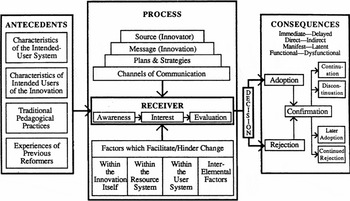
Both outside and within ELE, the best developed research framework for identifying factors within an innovation project that are likely to influence the potential for innovation institutionalisation is the hybrid model (Henrichsen Reference Henrichsen1989: Ch. 3; White et al. Reference White, Martin, Stimson and Hodge1991: 180–188)Footnote 2. This framework begins (Henrichsen Reference Henrichsen1989: 79–81) (see Figure 2) by first of all attempting to account for the Antecedents to the innovation (i.e., the existing features of the innovation situation, including their historical development – cf. section 2.1.1 above). Using this part of the model involves the identification of variables relating to i) the Characteristics of the Intended-User System (i.e., the sociocultural nature of the host educational system), ii) the Characteristics of Intended Users of the Innovation (i.e., those of teachers and other intended users), iii) Traditional Pedagogical Practices (dominant existing ways of teaching) and iv) Experiences of Previous Reformers (what can be learned, both positively and negatively, about earlier reform attempts in the context in question). Accounting for variables of these kinds is seen as the first stage in the process of creating greater understanding of the innovation situation, and of thereby also increasing the potential for long-term innovation adoption.
The Hybrid Model (Henrichsen Reference Henrichsen1989: 80)

The second main part of the model – the Process component (Henrichsen Reference Henrichsen1989: 81–94) – continues the analysis of the innovation situation in terms of a number of further elements, this time with a primary focus on identifying the main factors that are likely to facilitate or hinder the innovation diffusion and implementation processes. These include, firstly, factors Within the Innovation Itself – the attributes of the innovation – cf. 2.1.2 above; secondly, factors Within the Resource System – those relating to the body responsible for ‘promoting’ the innovation, such as its capacity (qualitative and quantitative capability); thirdly, factors Within the User System – Centralisation of Power and Administration (to what extent the organisation of the educational system is ‘localised’, and so on); and fourthly, Inter-Elemental Factors – those which operate ‘between’ elements, e.g. the degree of proximity of the Resource and User systems. Careful analysis of all these factors is once again seen as an essential preliminary to planning for sustained innovation adoption.
Finally, in the third main part of the model – the Consequences component – the innovation situation is further analysed in terms of the types of ‘decisions and outcomes’ about innovation adoption which may occur. The former can range from, for example, Optional decisions (made relatively independently) to Authority ones (which ‘come from “above”’). Potential Outcomes are seen as, for example, ‘immediate’, ‘delayed’ (occurring later), and so on. Once again, such features of the innovation situation must be taken into account if the innovation is to be sustainable in the long term.
An extensive illustration of the nature and effects on innovation success of all of these kinds of variables is provided in Henrichsen (Reference Henrichsen1989): Chs. 4 and 5, in relation to the 1956–1968 Japanese ‘ELEC’ (‘Oral Approach’) English Language Education Curriculum reform project. In terms of research into factors affecting sustainability in ELE innovation projects, the overall conclusion to be drawn is that the proactive and in-depth identification and analysis of innovation situation variables of the kind encompassed by the Hybrid Model is likely to significantly enhance the potential for the long-term success of an innovation. However, as already indicated (see 2.1.2 above), very little further research involving the use of the Hybrid Model has been carried out. The following research tasks are therefore intended to fill this gap.
Research task 4.1: Using the appropriate elements in the Hybrid Model, carry out an analysis of an innovation situation in order to identify the factors that are most likely to affect the sustainability of ELE innovation initiatives within it.
Research task 4.2: Use the results of the analysis in research task 4.1 to show how the sustainability of a proposed or actual ELE innovation within the situation in question might be or has been affected.
The first of these tasks should involve a systematic analysis of the innovation situation in terms of as many as possible of the elements comprising the three main parts of the Hybrid Model. Some of these features can be conceptualised using frameworks discussed earlier. Thus, for example, in the Antecedents part of the model, the BANA-TESEP distinction between types of ELE teaching institutions (see 2.1.1 above) can be used to analyse parts of the ‘characteristics of the intended-user system’, and the ‘integrationist’ vs. ‘collectionist’ professional ‘cultures’ feature in particular can be used to illuminate aspects of the ‘characteristics of intended users of the innovation’ and ‘traditional pedagogical practices’. It would also be important to pay particular attention to the ‘experiences of previous reformers’ aspect, to identify (inter alia) what factors affecting previous innovation attempts appear to have had the strongest influence on innovation sustainability.
Similarly, in the Process part of the model, conceptualisations of innovation characteristics such as those discussed in section 2.1.2 above (which include but also extend beyond those in the Hybrid Model) can be used to analyse the ‘within the innovation itself’ aspect of ‘factors which facilitate/hinder change’. All the other variables can be similarly analysed using the theoretical concepts which Henrichsen himself provides.
Then, in the second task, on the basis of this analysis, either i) recommendations can be made in terms of innovation design and innovation management plans for maximising the potential for sustainability of an innovation in the situation in question (and in other similar ones), or ii) it can be shown how the nature of the factors identified have affected the sustainability of a prior or an existing innovation in the situation in question or in other, similar ones.
3. Application of theoretical frameworks existing outside ELE
In addition to the relatively few studies of the kind just discussed, there are also a number of well-established research-based innovation concepts from mainstream innovation management, which, despite having been described in publications such as Kennedy (Reference Kennedy1988), White (Reference White1988), Markee (Reference Markee1997) and Lamie (Reference Lamie2005), have yet to be used to any significant extent in research concerned with ELE innovation management. There follows an outline of some of these theoretical frameworks and research tasks related to them.
3.1 Innovation management roles
In Kennedy (Reference Kennedy1988: 334–336) (cf. Waters Reference Waters2009: 437), a model is provided (based on Lambright & Flynn Reference Lambright, Flynn and Agnew1980) for conceptualising the roles that can be played by the main participants in the innovation management process, as follows:
adopters: those who sanction the innovation (e.g. government officials);
implementers: those directly responsible for putting the innovation into practice (e.g. teachers);
clients: those who are intended to be the primary beneficiaries of the innovation (e.g. students);
suppliers: those responsible for providing the resources for the innovation (e.g. materials writers);
entrepreneurs: those with overall responsibility for managing the implementation of the innovation (e.g. ‘innovation managers’);
resisters: those in opposition to the innovation (Waters Reference Waters2009: 437).
It should be noted that the meaning of the term ‘adopter’ here is different from that in the rest of the innovation literature (see 3.2 below), and that in the educational innovation literature the term ‘entrepreneur’ is not usually used. Also, some ‘players’ may be involved in more than one role, such as when teachers act both as ‘suppliers’ (e.g. of teaching materials) and ‘implementers’ (teachers of the new materials).
As Kennedy (Reference Kennedy1988: 335) explains, how the roles are configured with respect to one another can have an important effect on the potential for innovation adoption. For example, if suppliers in the form of materials writers are in a mainly top-down relationship with implementers such as teachers, the scope for innovation re-invention (see 2.1.2 above) is likely to be insufficient. Lambright & Flynn's system can therefore be a useful heuristic for throwing further light on ELE innovation management practices through research of the following kind.
Research task 5: Analyse a proposed or actual innovation situation to determine the roles played by the main categories of participants in the innovation management process, how relationships between the roles are configured and the likely or actual effects of the findings on innovation adoption.
The first stage in carrying out such an investigation is to attempt to assign the roles in Lambright & Flynn's framework to each of the main categories of personnel involved in the innovation project. However, it may well be the case that other roles can be identified, beyond those mentioned by Lambright & Flynn (e.g. ‘evaluators’), and these should also be accounted for, of course. In fact, since Lambright & Flynn's categories originate from outside (English language) education, one of the main benefits of this research task is to expand our conceptual understanding of the roles typically involved in ELE-specific innovation projects.
Having established which roles are played by whom (or what), their inter-relationships should be identified next. In other words, an analysis should also be undertaken of the nature of the innovation management administrative structure linking the roles together, in terms of, for example, the degree of top-down control or delegation of responsibility between different roles. Finally, information should be gathered from role-players about their perceptions of the efficacy of the ways roles are defined and configured in relation to each other: for example, is the amount of interaction between teacher trainers and teachers considered appropriate, including how this may vary according the stage in the training/support? In this way it should be possible to identify to what extent innovation management roles and relationships have been configured to maximise the potential for innovation adoption.
3.2 ‘Adopter categories’ and the ‘innovation adoption curve’
Rogers (Reference Rogers2003): 282–285 and 23 (also see e.g. Markee Reference Markee1997: 57–58; Waters Reference Waters2009: 438–439) provides a categorisation of types of potential innovation adopters (in this case, in the normal sense of ‘those who are in a position to decide whether to use or reject an innovation in part or in whole’), and shows how their differences affect the rate and pattern of innovation adoption. Important subsidiary concepts also discussed by Rogers (Reference Rogers2003) include i) the importance of the early adopters category, because of the knock-on effect its members have on influencing adoption by the other categories, and ii), the necessity of achieving a critical mass of total adopters for an innovation to become self-sustaining.
Research task 6.1: Analyse an innovation situation to identify potential or actual early adopters and the innovation management strategies proposed or used for enlisting their support for the innovation.
Research task 6.2: Analyse an innovation situation in order to identify how a critical mass of adopters might be or has (or has not) been achieved, and evaluate the implications of the findings for innovation management.
In carrying out task 6.1, the first stage would be to attempt to identify who, among the population of potential adopters, can be classified as conforming to the early adopter category. Such personnel are characterised in the literature on the topic as being regarded by other potential adopters as having a sound track record in terms of their judgements about the value of proposed innovations. Information should therefore be elicited from a variety of sources about who seem to be regarded as possessing these qualities.
The ways in which these persons have (or have not) been ‘recruited’ by the innovation managers should then be identified. For example, they may have been consulted at an early stage in the innovation process to sound out their views about the innovation prototype, so that any necessary modifications could be made to it before full roll-out, and/or they may have become encouraged to take part in disseminating information about the innovation and providing support to other adopters via training activities of various kinds. Finally, information should also be gathered about how helpful or otherwise these aspects of innovation management activity have been perceived to be in terms of influencing wider adoption of the innovation.
Task 6.2 may partly subsume the previous task, in the sense that recruitment of early adopters is arguably one of the key strategies involved in attempting to create an innovation adoption ‘multiplier effect’. However, the innovation situation can also be analysed for evidence of other ways in which the innovation management approach has attempted to popularise the innovation. This might include, for example, the methods for communicating information about the project, such as newsletters, presentations, press releases and, increasingly, the use of electronic media such as websites, e-mail and Twitter messages. It would also involve identifying who in the innovation situation, in addition to ‘early adopters’, are regarded as key contacts in terms of being willing to communicate information about, and promote adoption of the innovation, such as officials of various kinds, leading academics, professional associations, and so on, and how their co-operation was enlisted. It would also be important to study the time-scale and extent of training and other forms of support provided to the population of potential adopters, to what degree they involved only one or two teachers per teaching institution or whether a ‘whole-school’ approach was adopted. Again, data can also be generated regarding perceptions of the efficacy of all these activities in terms of creating a critical mass of adopters.
3.3 The innovation transition curve
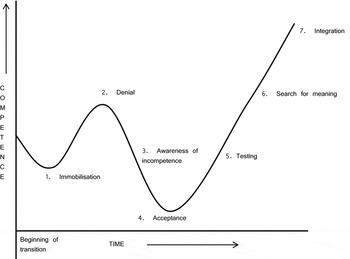
The Transition Curve (Scott & Jaffe Reference Scott and Jaffe1990; see also Bridges & Mitchell Reference Bridges and Mitchell2000; Bridges Reference Bridges2002; Waters Reference Waters2009: 444–445; cf. Fullan Reference Fullan2001: 40–41, regarding the ‘implementation dip’) is a conceptualisation of how the transition process – that of being exposed to and either rejecting or learning to cope with an innovation – is typically experienced. From the transition curve perspective, innovation implementers go through a series of psychological stages during the transition process, affecting their levels of competence in handling it.
As shown in Figure 3, these stages are characterised as follows:
Immobilisation: emotional and cognitive ‘paralysis’ in the face of the change, resulting in a lowering of competence;
Denial: attempting to cope by shutting out the change, causing a temporary (but illusory) rise in competence (cf. Fullan Reference Fullan2007: 28–29, regarding ‘false clarity’);
Awareness of incompetence: acknowledgement of the reality of the change, but uncertainty about how to deal with it, resulting in increased lowering of competence;
Acceptance: willingness to ‘let go’ of the past and attempt to come to terms with the change;
Testing: experimentation with ways of coping with the change, causing increase in competence;
Search for meaning: attempting to achieve a deeper understanding of the change, resulting in further increase in competence;
Integration: full assimilation of the change.
The Transition Curve (Waters Reference Waters and Johnson2005: 221)

A conceptual framework like this can throw light on the innovation process as experienced at different junctures by innovation implementers, thereby helping to guide innovation management interventions aimed at supporting implementers’ efforts. For example, at the testing stage, it is usually important to provide clear, structured guidance about what coping successfully with the change is likely to involve in practical terms, such as (in the case of ELE) sample lesson plans and/or teaching materials which incorporate the innovation.
Research task 7.1: With reference to a completed or on-going innovation implementation situation, gather data from implementers to identify to what extent their experiences correspond(ed) to the main stages in the ‘transition curve’.
Research task 7.2: Identify which kinds of innovation management interventions were actually used and/or were felt might have been used in conjunction with the each of the stages identified in the data, and evaluate their actual or potential effectiveness in influencing innovation adoption.
In the first of these tasks, using the transition curve stages as a heuristic, data should be gathered from innovation end-users about their perceptions about which of the stages they have experienced during the innovation implementation process. Because of its potential for increasing understanding of this aspect of innovation management in the ELE context in particular, of special value in this part of the research would be evidence of any additional stages not already included in the existing transition curve conceptualisation, as well as repeated absence of any of them.
The second task would involve generating data from the same research participants about what innovation management interventions were felt to have been helpful or otherwise in facilitating their passage through the various transition process stages identified in task 7.1, and why, and the perceived knock-on effect on the potential for innovation adoption (a similar enquiry could be made about other possible interventions that did not occur). These data can then be used to throw light on the relative success of the different innovation management interventions that were used (and perceptions of the potential for success of others that might have been), and what lessons there might be for the further development of ‘best practice’ in this aspect of ELE innovation management.
4. Research involving gaps in types of ELE innovations studied so far
In addition to gaps in the use of conceptual frameworks from innovation theory of the kind just discussed, it is also the case that certain types of ELE innovations have been under-represented or overlooked in terms of research activity (Waters Reference Waters2009: 451).
4.1 Innovations occurring in certain geographical locations
First, in large parts of the world, such as continental Europe, Latin America and the Middle East, the study of the management of ELE innovations is not ‘on the map’ as far as research reports are concerned. In other words, there are very few if any published items of this kind available (especially recent ones). This means that it is currently not possible to look for similarities and differences between findings from those parts of the world and others where such research has been conducted more frequently, and, in this way, to expand understanding of the field. In order to address this gap, the next research task is proposed.
Research task 8: Using one or more theoretical constructs of the kind described in earlier parts of this paper, investigate the management of a proposed or actual ELE innovation located in a part of the world currently under-represented in research of this kind. Then compare the findings with those relating to the management of similar innovations in other locations, to identify the implications for developing understanding of ELE innovation management.
In particular, such a task might seek to throw further light on how socio-cultural factors specific to the parts of the world in question tend to influence ELE innovation management there; (inter alia) aspects of the Hybrid Model (Henrichsen Reference Henrichsen1989) (see section 2.3 above) would provide a useful framework for this part of the study.
4.2 Commercial/private-sector innovations
By far the majority of the research literature on the management of ELE innovation has been concerned with public sector institutions or ‘not-for-profit’ organisations. Investigations of innovations produced by commercial bodies, such as private language schools, publishers, training agencies and examination boards are noticeable by their absence. This means that potentially useful information that could be obtained by comparing and contrasting ELE innovation management approaches across the two sectors is currently unavailable. This is all the more regrettable because it is arguably the commercial sector which, in order to remain competitive, is likely to operate to a greater extent at the ‘sharp edge’ of ELE innovation, and therefore be more involved in high-stakes innovation management, with all the related pressures to ensure successful adoption.
Research task 9: Using one or more theoretical constructs of the kind described in earlier parts of this paper, investigate the management of a proposed or actual commercial/private-sector ELE innovation. Then compare the findings with those relating to the management of similar innovations in the public sector to identify the implications for developing further understanding of ELE innovation management.
Studies in this area might help, in particular, to throw new theoretical light on the considerations that lie behind commercial coursebook innovation. Theoretical frameworks of the kind discussed in section 2.1 above seem particularly pertinent in this respect.
4.3 Innovations involving electronic technology
A further currently under-developed area of research concerns the management of ELE innovations involving electronic technology. Recent years have seen an explosion in the use in ELE of on-line learning, the electronic whiteboard, mobile computing, and so on, yet very little has so far been investigated from a management-of-innovation perspective (though see Bax Reference Bax2003; Lee Reference Lee2007). Yet this would seem especially important, given the well-attested ‘overhyping’ of the efficacy of innovations involving technology in other areas of education (Lim & Hang Reference Lim and Hang2003).
Research task 10: Using one or more theoretical constructs of the kind described in earlier parts of this paper, investigate the management of an ELE innovation involving the use of electronic technology and how it affected adoption of the innovation.
It would be especially useful in research of this kind to focus on to what extent innovation management has been successful in effecting the adoption of technological changes in pedagogy which involve only superficial-level ‘change as substitution’ (Marris Reference Marris1974: 20), on the one hand, or deep-level ‘change as growth’ (Marris Reference Marris1974: 21–22), on the other.
4.4 Successful ELE innovations
Most of the ELE innovation management research literature, like its counterparts in other areas of education, tends to concentrate on analysing and attempting to learn lessons from innovations which have been relatively unsuccessful (Fullan Reference Fullan2007; Murray Reference Murray2008). There is much of value in this approach, of course, and it is also, no doubt, a reflection of the fact that the majority of educational innovations, in all fields, tend to fall short of the mark (Markee Reference Markee1997: 6). However, research which focuses on only partial success or failure of innovation can obviously only provide guidance for the future by inferring what, with the benefit of hindsight, might have worked better. Thus, research which looks at successful innovation may be capable of providing more reliable guidance about what is likely to work on a future occasion in a similar situation. Also, although the ELE literature does contain a number of relatively small-scale research success stories (e.g. Kennedy Reference Kennedy1987; Markee Reference Markee1997), to the best of my knowledge there are no accounts so far of successful ELE innovation management projects at the large-scale (e.g. nationwide) level (though see Goh Reference Goh1999), and there is therefore a particular need for such studies.
Research task 11: Using one or more theoretical constructs of the kind described in earlier parts of this paper, investigate the management of a successful (preferably large-scale) ELE innovation – one which has resulted in widespread and sustained adoption – to identify the main factors that appeared to affect its success and the implications for developing further understanding of ELE innovation management.
As Fullan (Reference Fullan2007: 18; cf. Adey Reference Adey2004: Ch. 11) argues:
The main reason that change fails to occur in the first place and on any scale, and is not sustained when it does, is that the infrastructure is weak, unhelpful, or working at cross-purposes. By the infrastructure I mean the next layers above whatever unit we are focusing on. In terms of successive levels, for example, a teacher cannot sustain change if he or she is working in a negative school culture; similarly, a school can initiate and implement successful change, but cannot sustain it if it is operating in a less than helpful district; a district cannot keep going if it works in a state that is not helping to sustain reform.
In undertaking Research Task 12, and in the light of Fullan's observations, it is thus reasonable to enquire in particular into the extent to which the successful adoption of ELE innovations correlate with a ‘whole-system’ approach to innovation management.
5. Conclusion
ELE is nowadays increasingly innovation-oriented. In order for this activity to be as appropriate and effective as possible, it is obviously important for it to be properly informed by the findings of innovation research, both from outside as well as within ELE itself. However, as has been shown, the number of studies of proposed or actual ELE innovations which adopt an innovation theory perspective is relatively few, and there are a sizeable number of gaps in terms of the theoretical frameworks which have been used and the types of innovations which have been studied. It is therefore hoped that the agenda for further research outlined in this article will contribute in some small way to remedying these shortcomings.
Acknowledgement
I am very grateful to the Editor, Graeme Porte, for his very helpful feedback on earlier drafts of this article.
Dr. Alan Waters was, until his recent retirement, a Senior Lecturer in the Department of Linguistics and English Language at Lancaster University, England. He has taught EFL, trained teachers and supervised research students in the UK and several other parts of the world. He has also published a number of books and articles on a range of ELT topics. His main current research interest is the management of innovation in language education.