INTRODUCTION
There are two primary foci in research on corporate governance. One is concerned with the principal-agent conflict between shareholders and professional managers, and the other is concerned with the principal-principal conflict between controlling shareholders and minority shareholders. The principal-agent conflict arises from the separation of firm ownership and control caused by ownership dispersion (Berle & Means, Reference Berle and Means1932). When the ownership of a firm is dispersed among numerous small shareholders while the control of the firm is concentrated in the hands of professional managers, the latter may pursue personal interests at the expenses of the shareholders who have little incentive or power to monitor and influence management decisions (Jensen & Meckling, Reference Jensen and Meckling1976; Shleifer & Vishny, Reference Shleifer and Vishny1997). The principal-principal conflict arises from the separation of control rights and cash flow rights caused by ownership concentration. When the firm has one or a few large shareholders whose ownership gives them effective control over the firm, these controlling shareholders may pursue private interests that exceed their share of cash flow rights at the expense of minority shareholders (La Porta, Lopez-de-Silanes, Shleifer, & Vishny, Reference La Porta, Lopez-de-Silanes, Shleifer and Vishny2000; Young, Peng, Ahlstrom, Bruton, & Jiang, Reference Young, Peng, Ahlstrom, Bruton and Jiang2008). Thus, the ownership structure of the firm is central to corporate governance research and fundamental to understanding the effective control and governance of the firm.
Over the last three decades, significant changes have occurred to the ownership structure of firms in China. Under the old centralized state planning system, the majority of firms were state-owned enterprises (SOEs), in which the government had exclusive ownership and exerted tight control over enterprise decisions (Child, Reference Child1994; Henley & Nyaw, Reference Henley and Nyaw1986). Since the start of economic reforms in the late 1970s, the Chinese government has been exerting great effort to reform SOEs and encourage the development of the private (nonstate) sector. One major development was the establishment of the Shanghai Stock Exchange (SHSE) and the Shenzhen Stock Exchange (SZSE) in the early 1990s, which have experienced fast growth and played an important role in the reform of large SOEs through share-issue privatization (Sun & Tong, Reference *Sun and Tong2003; Tenev & Zhang, Reference Tenev and Zhang2002). According to the statistics released by the China Securities Regulatory Commission (CSRC), there were 2,489 domestic firms listed in these two stock exchanges in December 2013. As a result, firms in China can be classified into two broad sectors on the basis of whether they are listed in the stock exchanges – the listed sector and the nonlisted sector.
These dynamic changes in the ownership structure of Chinese firms have brought up the issue of corporate governance and drawn increasing attention from students of corporate governance during the past decade (Walder, Reference Walder2011). An increasing number of empirical studies about corporate governance in China, primarily at firms in the listed sector, have appeared in scholarly journals across the fields of management, finance, accounting, and business in general, investigating a wide range of topics such as ownership structure, boards of directors, executive pay and turnover, earnings management, and changes in government regulations about investor protection (e.g., Allen, Qian, & Qian, Reference *Allen, Qian and Qian2005; Berkman, Cole, & Fu, Reference *Berkman, Cole and Fu2010; Chen, Firth, Xin, & Xu, Reference *Chen, Firth, Xin and Xu2008; Conyon & He, Reference *Conyon and He2012; Jiang, Lee, & Yue, Reference *Jiang, Lee and Yue2010; Krug & Hendrische, Reference *Krug and Hendrischke2008; Nee, Opper, & Wong, Reference *Nee, Opper and Wong2007; Shen & Lin, Reference *Shen and Lin2009; Tian & Lau, Reference *Tian and Lau2001; Wang, Wong, & Xia, Reference *Wang, Wong and Xia2008). Some journals, such as the Journal of Corporate Finance and Corporate Governance: An International Review, have devoted special issues to research on corporate governance in China.
Given these developments, it is time to conduct a review of the literature on corporate governance in China to take stock of knowledge from prior studies and also to suggest gaps in this knowledge to guide future research. We focus on two interrelated issues in this review using the framework in prior reviews of corporate governance (e.g., Shleifer & Vishny, Reference Shleifer and Vishny1997; Walsh & Seward, Reference Walsh and Seward1990; Young et al., Reference Young, Peng, Ahlstrom, Bruton and Jiang2008). The first issue is what internal and external corporate governance mechanisms have been empirically investigated as well as the relative level of attention/coverage they have received. The second issue is the effectiveness of these governance mechanisms in addressing the principal-agent conflict or the principal-principal conflict in the Chinese context. We hope that the findings of our review can stimulate research interest in this highly dynamic area that has been coevolving with the economic reforms and institutional developments in China.
BACKGROUND: CHANGES IN FIRM OWNERSHIP STRUCTURE IN CHINA
The ownership structure of Chinese firms has changed significantly over the last three decades. Before the economic reforms started in the late 1970s, the majority of firms were owned and tightly controlled by the state under the old centralized state planning system (Henley & Nyaw, Reference Henley and Nyaw1986). To promote economic development, the Chinese government has taken a two-pronged approach. One is to grow the private sector, and the other is to reform the SOEs. To grow the private sector, the Chinese government has gradually changed laws and regulations to allow and encourage the formation of enterprises taking a variety of ownership forms, including township and village enterprises, collectively owned enterprises, international joint ventures (IJVs), foreign-owned enterprises, and individual or family-owned enterprises. The private sector has grown rapidly and become a major force driving China's economic growth (Allen et al., Reference *Allen, Qian and Qian2005; Song, Storesletten, & Zilibotti, Reference Song, Storesletten and Zilibotti2011). For example, although the private sector contributed only 22% of China's total industrial output just before the economic reforms in 1978, its share of contribution has increased steadily, reaching roughly 50% by 1990 and 75% by 1999. Over the period 1996–2002, the private sector grew at an annual rate of 14.3% in total industrial output and employed over 70% of all nonagricultural workers (Allen et al., Reference *Allen, Qian and Qian2005).
Within the state sector, the reform process has gone through two major stages (Tenev & Zhang, Reference Tenev and Zhang2002). During the first stage (1978–1992), the Chinese government took a series of steps to gradually introduce market forces into this sector while keeping its ownership largely unchanged. For example, SOE managers were given increasing discretion over major operation and investment decisions regarding input, output, and pricing, accompanied by incentive contracts (Child & Lu, Reference Child and Lu1996; Grove, Hong, McMillan, & Naughton, Reference Grove, Hong, McMillan and Naughton1994). Toward the end of this stage, the government gave managers of most SOEs a free hand to run their operations through the implementation of a ‘contractual management system’ (cheng bao zhi 承包制). In October 1992, the government announced the establishment of a ‘modern enterprise system’, in which enterprise structure, ownership, and management are based on the principles of corporations, leading to the second stage of SOE reform through corporatization (gong si hua 公司化). The Company Law, promulgated in 1993, provided the legal foundation for the corporatization of SOEs. In the process, the guiding policy was to ‘take a firm grip on the large SOEs and let go of the smaller ones’ (zhua da fang xiao 抓大放小). Under this policy, the government continued to keep a strong ownership position in the large SOEs, while selling off its ownership in the smaller ones to managers, workers, or outside investors (Sun & Tong, Reference *Sun and Tong2003; Tenev & Zhang, Reference Tenev and Zhang2002).
In the process of corporatization of large SOEs, China has developed a sector of listed firms that are publicly traded in stock exchanges. The experiment of reforming SOEs through shareholding transformation (gu fen hua 股份化) started in 1984 on a very small scale, when 11 SOEs became shareholding enterprises (Tenev & Zhang, Reference Tenev and Zhang2002: 16). In the early 1990s, two stock exchanges, SHSE and SZSE, were formally established. There were 53 firms listed in these two stock exchanges at the end of 1992, and all were former SOEs (Wang, Xu, & Zhu, Reference Wang, Xu and Zhu2004). Since then, the listed sector has experienced fast growth as the government sped up corporatization of large SOEs through share-issue privatization. The number of listed firms increased to 2,489 and the total market capitalization reached over RMB 23,907 billion at the end of 2013 (CSRC, 2013). Most of these firms are either former SOEs or spin-offs from large SOEs in which the SOEs still retain a large block of shareholding, particularly among firms that were listed before 2005 (Jiang et al., Reference *Jiang, Lee and Yue2010). The rest are domestic firms from the private sector, as foreign firms are not allowed to be listed in the SHSE and SZSE.
Thus, the economic reforms have brought significant changes to firm ownership in China, leading to a variety of ownership forms away from the tight ownership and control by the state in the past. Even within the state sector, the state has gradually changed from exerting direct control over enterprise decisions to acting more as the owner of the newly corporatized SOEs (Walder, Reference Walder2011). These changes in ownership structure have resulted in a fairly high degree of separation of ownership and enterprise control and, thus, created potential for the principal-agent conflict or principal-principal conflict in many firms, particularly in the listed sector. As a result, corporate governance in China has become a prominent issue (Tenev & Zhang, Reference Tenev and Zhang2002; Walder, Reference Walder2011). It has attracted increasing attention from organizational scholars, as evidenced by the increase in the number of studies that have been published in recent years on this topic. In the next section, we report our review of empirical research on corporate governance in China.
METHOD
Our review focuses on empirical studies that are published in peer-reviewed scholarly journals in English. We first selected a list of journals that are most likely to publish research on corporate governance. In addition to 20 management journals, we also included a number of highly influential accounting and finance journals (e.g., Accounting Review, Journal of Accounting Research, Journal of Finance, and Journal of Financial Economics), general business journals (e.g., Asia Pacific Business Review, Journal of International Business Studies, and Journal of Business Research), and Corporate Governance: An International Review, a journal specifically devoted to corporate governance research.
We searched each of the selected journals using the ABI/Inform database for empirical studies on corporate governance in China published by December 2013. We first identified articles that contain ‘China’ or ‘Chinese’ and at least one of the following words in the title, abstract, or keywords: corporate governance, corporate control, stock market, regulation, owner, ownership, shareholder, investor, board of director, executive, top manager, top management, or chief executive officer (CEO). Our search generated 204 articles. We then went through each of these articles and dropped nonempirical articles as well as empirical studies that focused on IJVs, overseas Chinese firms (including those in Hong Kong, Macau, and Taiwan), or foreign direct investments in China. We also excluded empirical studies that are purely about the social ties and networks of top managers (e.g., Li, Yao, Sue-Chan, & Xi, Reference Li, Yao, Sue-Chan and Xi2011; Liu, Tang, & Tian, Reference Liu, Tang and Tian2013; Peng & Luo, Reference Peng and Luo2000) or top management team composition and processes (e.g., Chen, Liu, & Tjosvold, Reference Chen, Liu and Tjosvold2005; Li & Li, Reference Li and Li2009; Qian, Cao, & Takeuchi, Reference Qian, Cao and Takeuchi2013). We included some of these studies in our review only if they address the principal-agent conflict or the principal-principal conflict caused by separation of ownership and control.
Using the above procedure, we identified a total of 132 empirical studies about corporate governance in China, with 79 of them (60%) containing ‘corporate governance’ in the title, abstract, or keywords. We found only 12 studies published before 2005. In contrast, a total of 63 studies (48%) were published during 2010–2013, suggesting a surge of this research in recent years. With respect to journal outlets, these studies were published in 23 different journals, led by the Corporate Governance: An International Review (24 articles), Asia Pacific Journal of Management (19 articles), Management and Organization Review (15 articles), and Journal of Corporate Finance (10 articles).Footnote [1]
Although corporate governance is an important issue to both listed firms and nonlisted firms, we found that the large majority (104 studies or 79%) of the 132 studies identified focused on corporate governance of the listed firms and only a very small number of studies (10 studies or 7%) focused on nonlisted firms. There were 18 studies (14%) that focus on firms that crossed the two sectors. We first report the results of our review on the listed firms and then those on the nonlisted firms.
RESULTS: CORPORATE GOVERNANCE MECHANISMS OF LISTED FIRMS
A number of external and internal mechanisms have been proposed to address corporate governance at the publicly traded firms (La Porta et al., 2000; Shleifer & Vishny, Reference Shleifer and Vishny1997; Walsh & Seward, Reference Walsh and Seward1990; Young et al., Reference Young, Peng, Ahlstrom, Bruton and Jiang2008). External mechanisms include the legal/regulatory system and market forces. The former refers to laws and regulations designed to protect shareholder rights and interests (La Porta et al., 2000; Young et al., Reference Young, Peng, Ahlstrom, Bruton and Jiang2008). The latter refer to competitions in the product market, managerial labor market, and capital market that function to select out managers who are incompetent or are engaged in self-interested behavior at the expenses of shareholders (Fama, Reference Fama1980; Jensen & Meckling, Reference Jensen and Meckling1976). Internal mechanisms generally refer to the monitoring and control performed by the boards of directors on behalf of shareholders, including designing performance-based incentive contracts to align the interest of managers with shareholders (Shleifer & Vishny, Reference Shleifer and Vishny1997; Walsh & Seward, Reference Walsh and Seward1990).
Central to this research is the ownership structure of the publicly traded firms, especially regarding the role of large shareholders. Given that the principal-agent conflict arises from the separation of firm ownership and managerial control due to ownership dispersion, the presence of large shareholders has been proposed as an important internal governance mechanism because the large shareholders have strong financial incentives to monitor and influence management decisions (Shleifer & Vishny, Reference Shleifer and Vishny1997). However, when there are one or a few large shareholders who own a significant share of the firm's stocks, these controlling shareholders cannot only effectively influence firm decisions but also the appointment and replacement of top managers. Minority shareholders are left with little influence over firm decisions, even if their collective ownership is greater than that of the controlling shareholders. Although a high level of ownership concentration can help resolve the principal-agent conflict in developing economies where legal protection of shareholder rights is weak (La Porta, Lopez-de-Silanes, Shleifer, & Vishny, Reference La Porta, Lopez-de-Silanes, Shleifer and Vishny1998), controlling shareholders may also abuse their control rights to pursue private interests, leading to a principal-principal conflict (i.e., expropriation of minority shareholders by controlling shareholders). To mitigate this principal-principal conflict, many scholars emphasize the importance of external mechanisms such as legal protections of minority shareholder rights and market forces (Faccio, Lang, & Young, 2000; La Porta et al., Reference La Porta, Lopez-de-Silanes, Shleifer and Vishny2000). The board of directors as an internal governance mechanism is suggested to be ineffective when there is no strong institutional support in law and market developments (Young et al., Reference Young, Peng, Ahlstrom, Bruton and Jiang2008).
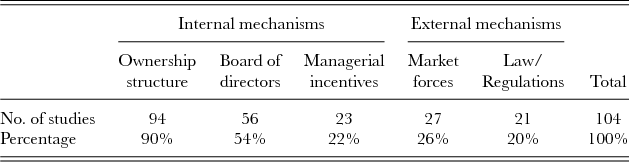
Our review suggests that both internal and external mechanisms have been investigated in China. However, they receive significantly different levels of attention/coverage among the 104 studies that exclusively focus on the listed firms (see Table 1). Among the internal mechanisms, 94 studies (or 90% of the 104 studies) investigate ownership structure. Boards of directors receive the second most attention (56 studies or 54%), followed by managerial incentives (23 studies or 22%). Among the external governance mechanisms, 27 studies (26%) investigate market forces and 21 studies (20%) investigate law/regulations.
Corporate governance mechanisms examined in the listed firms

Internal Mechanism: Ownership Structure
The listed sector was originally created to facilitate SOE reforms through share-issue privatization, and it has experienced important changes in ownership structure over the last 20 years since its inception in 1990. In the beginning, the share-issue privatization of SOEs was partial in that, on average, the government sold only about 30% of the shares of an SOE to individual and institutional investors in the stock market while keeping the rest under the control of the central or local government, government agencies, and other state-owned legal entities (Sun & Tong, Reference *Sun and Tong2003). Only shares sold to individual and institutional investors were freely tradable, while shares directly or indirectly owned by the state were not tradable. This practice lasted until 2005 when the CSRC unveiled a policy aimed at converting state-owned nontradable shares into tradable shares (Haveman & Wang, Reference *Haveman and Wang2013). As a result, the proportion of state-owned nontradable shares to total issued shares dropped from 63.5% in February 2005 (Jiang et al., Reference *Jiang, Lee and Yue2010) to less than 10% in December 2013 (CSRC, 2013).
The rules on foreign ownership in the listed firms have also changed over time. There are two broad categories of shares issued by listed firms in China: domestic shares and overseas shares. Domestic shares are shares issued by domestically listed firms and are further divided into A shares and B shares. A shares are issued by almost all listed firms and were restricted to domestic investors until July 2003 when the government started to allow foreign investors to trade in the A-share market (Ting, Yen, & Chiu, Reference *Ting, Yen and Chiu2008). B shares are issued by a small number of domestically listed firms and were restricted to foreign investors using foreign currency until June 2001 (Wang et al., Reference Wang, Xu and Zhu2004). Overseas shares are issued by Chinese firms listed in overseas stock exchanges, including H shares by firms listed in the HKSE, N shares by firms listed in the NYSE and NASDAQ, and S shares by firms listed in the Singapore Stock Exchange. Over the years, an increasing number of Chinese firms have sought foreign investors by becoming listed in overseas stock exchanges. By December 2013, there were 106 firms that issue B shares and 185 firms listed in overseas stock exchanges (CSRC, 2013).
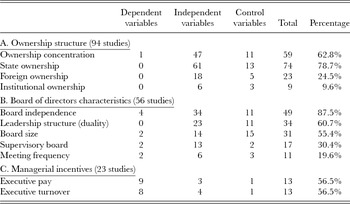
There are several important features about the ownership structure of the listed firms. The first is a high level of ownership concentration, especially by the largest shareholder. The average percentage of shares held by the largest shareholder is 43.7% from 1996 to 2004 (Jiang et al., Reference *Jiang, Lee and Yue2010: 6) and is 39.4% from 2000 to 2010; in contrast, the average ownership by the second and the third largest shareholders during the same period is only 9.1% and 3.7%, respectively (Conyon & He, Reference *Conyon and He2012: 581). The second feature is the dominance of state ownership, either in direct control by government agencies or by state-owned assets management bureaus/companies under the State-Owned Assets Supervision and Administration Commission. According to some accounts, the average of total state ownership is around 60% (Jiang et al., Reference *Jiang, Lee and Yue2010; Wang, Guthrie, & Xiao, Reference *Wang, Guthrie and Xiao2012: 259). The last feature is the low level of shares owned by financial institutions and foreign investors (Allen et al., Reference *Allen, Qian and Qian2005; Conyon & He, Reference *Conyon and He2012; Jiang et al., Reference *Jiang, Lee and Yue2010). These features have influenced the focus of the empirical studies, as panel A of Table 2 shows that ownership concentration and state ownership are of interest to a large majority (62.8% and 78.7%, respectively) of the 94 studies that investigate ownership structure.
Governance variables investigated in the listed firms (23–94 studies)

Ownership concentration
Ownership concentration is both an internal governance mechanism to resolve the principal-agent conflict (La Porta et al., Reference La Porta, Lopez-de-Silanes, Shleifer and Vishny1998) and a cause of the principal-principal conflict (Johnson, La Porta, Lopez-de-Silanes, & Shleifer, Reference Johnson, Porta, Lopez-de-Silanes and Shleifer2000; Young et al., Reference Young, Peng, Ahlstrom, Bruton and Jiang2008), particularly in emerging economies, such as China, where legal protection of shareholder rights is weak. The proposition of ownership concentration as a governance mechanism to resolve the principal-agent conflict suggests that large shareholders have more incentive and power to monitor and discipline management and to pursue performance-enhancing strategies. On the other hand, the proposition of ownership concentration as a cause of principal-principal conflict suggests that the large shareholders are more likely to engage in expropriation of minority shareholders as the gap between their control rights and cash flow rights increases. The expected relation between ownership concentration and expropriation is complex. In general, it is expected to be inverted U-shaped when ownership by the largest shareholder varies across a wide range (e.g., from 10% to 90%), reaching a peak when the largest shareholder obtains control with the lowest level of ownership required. However, empirically, the observed relation can be linear, either positive or negative, depending on the level of ownership concentration among the sampled firms.
There are 59 studies that include ownership concentration in empirical analysis, but only one study (Wu, Xu, & Yuan, Reference *Wu, Xu and Yuan2009) treats it as a dependent variable (DV) and investigates the impact of legal protection of investors on it over time and across regions. The remaining 58 studies are interested in its impact, using it either as an independent variable (IV, 47 studies) or a control variable (CV, 11 studies). For these 58 studies, we group the outcome investigated into four categories – financial performance (21 studies), expropriation of minority shareholders (15 studies), composition of boards of directors and executive compensation (14 studies), and strategic decisions (10 studies). Together, these studies report some interesting findings about the impact of ownership concentration on corporate governance in China.
Many studies infer the impact of ownership concentration on corporate governance by investigating its relation with firm performance. The evidence shows that the relation between ownership concentration and firm performance depends on the type of performance investigated. For operational performance, such as operational efficiency, profits, and ROA, studies generally report a positive relation (Deng & Wang, Reference *Deng and Wang2006; Du, Reference *Du2013; Huyghebaert & Wang, Reference *Huyghebaert and Wang2012; Lu & Yao, Reference *Lu and Yao2006; You & Du, Reference *You and Du2012). For example, after controlling for state ownership – another important feature of ownership structure in the listed firms – Wang, Guthrie, and Xiao (Reference *Wang, Guthrie and Xiao2012) find that ownership concentration has a strong positive relation with profitability, net profits, and operating margins, regardless of whether it is measured by the ownership of the largest top 3, top 5, or top 10 shareholders. For stock market–based performance measures, such as Tobin's q and shareholder returns, the findings are mixed. Although most studies report a negative association (Fan, Wong, & Zhang, Reference *Fan, Wong and Zhang2007; Hovey, Li, & Naughton, Reference *Hovey, Li and Naughton2003; Hu, Tam, & Tan, Reference *Hu, Tam and Tan2010; Huang & Zhao, Reference *Huang and Zhao2008; Shan & McIver, Reference *Shan and McIver2011), there is evidence of a positive (Huyghebaert & Wang, Reference *Huyghebaert and Wang2012; Xu, Zeng, & Zhang, Reference *Xu, Zeng and Zhang2011), a U-shaped (Lin & Su, Reference *Lin and Su2008), or an inverse U-shaped relation (Luo, Wan, Cai, & Liu, Reference *Luo, Wan, Cai and Liu2013). Given the consistent findings of a positive relation between ownership concentration and operational performance, the mixed findings on stock market–based performance are intriguing. We notice that studies of market performance often take different approaches to calculate the market value of nontradable shares, which account for a large proportion of the total shares outstanding and vary significantly across firms and over time (CSRC, 2013; Jiang et al., Reference *Jiang, Lee and Yue2010; Lin & Su, Reference *Lin and Su2008). The different approaches used in the measurement of firm market value might have contributed to the mixed findings.
The empirical findings on the relation between ownership concentration and expropriation of minority shareholders also are mixed, depending on the specific measures of expropriation used. Several studies measure expropriation by intercorporate loans, through which controlling shareholders siphoned tens of billions RMB from about one third of the listed firms during 1996–2006 (Jiang et al., Reference *Jiang, Lee and Yue2010), or dividend payouts that reduce free cash flow for the private consumption by managers and controlling shareholders (Jensen, Reference Jensen1986). The evidence shows that ownership by the controlling shareholder is negatively related to expropriation (Huang, Shen, & Sun, Reference *Huang, Shen and Sun2011; Jiang et al., Reference *Jiang, Lee and Yue2010). When expropriation is measured by financial fraud or earnings management, most studies find ownership concentration to be an insignificant factor (Chen, Firth, Gao, & Rui, Reference *Chen, Firth, Gao and Rui2006; Cheng, Aerts, & Jorissen, Reference *Cheng, Aerts and Jorissen2010; Ding, Jia, Li, & Wu, Reference *Ding, Jia, Li and Wu2010; Hsieh & Wu, Reference *Hsieh and Wu2012; Jia, Ding, Li, & Wu, Reference *Jia, Ding, Li and Wu2009). However, there is evidence suggesting that a high level of ownership concentration reduces the likelihood of a firm to provide misleading or fraudulent financial information to minority shareholders (Ding, Zhang, & Zhang, Reference *Ding, Zhang and Zhang2007; Hou & Moore, Reference *Hou and Moore2010; Liu & Lu, Reference *Liu and Lu2007). When expropriation is measured by less direct or less obvious indicators, such as related-party transactions or the price premium of nontradable share transfer, evidence is also mixed (Haveman & Wang, Reference *Haveman and Wang2013; Huyghebaert & Wang, Reference *Huyghebaert and Wang2012; Luo, Wan, & Cai, Reference *Luo, Wan and Cai2012). Because indirect measures such as the above may not hurt the interests of minority shareholders (they can benefit minority shareholders when motivated by economic reasons), findings of this kind should be interpreted with caution. Overall, there is no strong evidence that a higher level of ownership concentration in the listed firms either exacerbates or mitigates the expropriation of minority shareholders by the controlling shareholders.
Because greater ownership concentration gives controlling shareholders more influence, there is strong evidence that ownership concentration has a significant impact on internal governance mechanisms such as boards of directors and managerial incentives. For example, controlling shareholders’ ownership is found to be positively related to their representation on the board of directors and the board of supervisors (Chen, Qi, & Lin, Reference *Chen, Qi and Lin2011; Hu et al., Reference *Hu, Tam and Tan2010) and negatively related to the representation of independent directors (Chen & Al-Najjar, Reference *Chen and Al-Najjar2012; Su, Xu, & Phan, Reference *Su, Xu and Phan2008). Although a decrease in the representation of independent directors can weaken board independence and increase the risk of expropriation of minority shareholders by controlling shareholders, this may not be the case in China where independent directors are generally considered to be ineffective in governance (Liang, Li, Yang, Lin, & Zheng, Reference *Liang, Li, Yang, Lin and Zheng2013; see further discussion later). Instead, controlling shareholders can effectively monitor and discipline management either through their representatives on the boards or directly through their ownership power. Studies consistently find ownership concentration to relate negatively to the level of executive pay (Chen, Liu, & Li, Reference *Chen, Liu and Li2010; Conyon & He, Reference *Conyon and He2011, Reference *Conyon and He2012; Cordeiro, He, Conyon, & Shaw, Reference *Cordeiro, He, Conyon and Shaw2013; Firth, Fung, & Rui, Reference *Firth, Fung and Rui2007; Markoczy, Sun, Peng, Shi, & Ren, Reference *Markoczy, Sun, Peng, Shi and Ren2013) and positively with CEO turnover (Pi & Lowe, Reference *Pi and Lowe2011; You & Du, Reference *You and Du2012). Overall, our findings confirm that controlling shareholders with greater ownership have more influence over board composition and managerial incentives.
Last, a number of studies show that ownership concentration has a significant impact on firm strategies. For example, it relates negatively to divesture (Wu, Xu, & Phan, Reference *Wu, Xu and Phan2011) and takeover (Li & Qian, Reference *Li and Qian2013) but positively to unrelated diversification (Zhou & Delios, Reference *Zhou and Delios2012), innovation (Xu & Zhang, Reference *Xu and Zhang2008), and export intensity (Lu, Xu, & Liu, Reference *Lu, Xu and Liu2009). It also influences corporate social responsibility (Jia & Zhang, Reference *Jia and Zhang2011, Reference *Jia and Zhang2013; Li and Zhang, Reference *Li and Zhang2010). Although innovation and export are generally value enhancing (Lu et al., Reference *Lu, Xu and Liu2009; Xu & Zhang, Reference *Xu and Zhang2008), the impacts of unrelated diversification, divesture, and corporate social responsibility on firm performance are far less clear in the Chinese context. Thus, we find it difficult to interpret the findings about the relations between ownership concentration and firm strategies from a corporate governance perspective, an issue explicitly acknowledged by Zhou and Delios (Reference *Zhou and Delios2012) in their study of unrelated diversification.
Overall, research on ownership concentration clearly shows that controlling shareholders with greater ownership can significantly influence firm decisions, including the composition of boards of directors, managerial incentives and CEO turnover, and strategic decisions. However, there is no conclusive evidence that firms dominated by a controlling shareholder are more likely to engage in the expropriation of minority shareholders. In addition, although evidence is mixed about the impact of ownership concentration on performance in the stock market, studies generally find it to be positive on operational performance. There is little research on the antecedents of ownership concentration, with the exception of Wu et al. (Reference *Wu, Xu and Yuan2009). Wu et al. (Reference *Wu, Xu and Yuan2009) find that better legal protection of investors is associated with a decrease of ownership concentration in non-state-controlled firms but not in state-controlled firms. Their finding suggests that to better understand the impact of ownership concentration on governance, we need to pay attention to the identity of the controlling shareholders.
State ownership
The role of state ownership in corporate governance in the listed firms is complicated. State ownership is generally portrayed as being less effective in corporate governance for several reasons (Shleifer & Vishny, Reference Shleifer and Vishny1997; Megginson & Netter, Reference Megginson and Netter2001). First, representatives of the state (government bureaucrats) have less incentive to monitor management decisions, because their personal interest is not linked to management decisions as strongly as that of private owners. Second, in addition to economic objectives, the state pursues social and political objectives, such as provision of employment and social stability, that may not be in the interest of private investors who seek economic returns. Last, state ownership may shelter a firm from the enforcement of regulatory changes designed to improve the protection of minority shareholders (Berkman et al., Reference *Berkman, Cole and Fu2010). Therefore, from this perspective, state ownership is predicted to weaken internal corporate governance, exacerbate the expropriation of shareholders who seek economic returns, and thus to be negatively related to financial performance.
On the other hand, given that the state is the driving force in SOE reforms, it would not be surprising if the state decides to pursue economic objectives in the listed sector while leaving the pursuit of social and political objectives to SOEs in the unlisted sector. Indeed, a major reason behind the creation of the stock exchanges was to improve the economic performance of the listed former SOEs (Sun & Tong, Reference *Sun and Tong2003; Tenev & Zhang, Reference Tenev and Zhang2002). In the absence of a well-functioning legal and market system, a dominant or large state ownership can be beneficial to the firms and private shareholders for several reasons. First, compared with ownership diffusion in complete privatization, having the state as a large shareholder can help to monitor and control management decisions (Jefferson, Reference Jefferson1998; Lin, Cai, & Li, Reference Lin, Cai and Li1998). Second, a large state ownership may signal the state's confidence in the firm's future performance (Mok & Hui, Reference *Mok and Hui1998). Third, it sends a credible signal to private investors that it will pursue economic objectives by retaining a large ownership (Perotti, Reference Perotti1995). Last, the state as a large shareholder gives the firm political connections and, consequently, favorable treatments in the input and output markets (Calomiris, Fisman, & Wang, Reference *Wang2010; Carney, Shapiro, & Tang, Reference *Carney, Shapiro and Tang2009). Thus, from this perspective, state ownership in the listed sector is expected to be related positively to internal corporate governance and economic performance and negatively to expropriation of minority shareholders.
Because of its dominance in the listed firms and the debates about its role in corporate governance and firm performance, state ownership receives the most attention among the 94 studies that examine ownership structure in the listed sector. There are 74 studies that include it as a variable in empirical analysis. The large majority (61 studies) include it as an IV, and the rest (13 studies) use it as a control. None treats it as an outcome. We group the outcomes investigated into the following four categories: financial performance (34 studies); expropriation of minority shareholders (15 studies); internal governance mechanisms, such as boards of directors and managerial incentives (17 studies); and strategic decisions (8 studies).
Overall, the empirical evidence is rather mixed regarding the relations of state ownership and these outcomes. With respect to firm performance, measured by either accounting-based or stock market–based indicators, the relation is found to be positive (Calomiris et al., Reference *Calomiris, Fisman and Wang2010; Du, Reference *Du2013; Fan, Huang, & Zhu, Reference *Fan, Huang and Zhu2013; Huyghebaert & Wang, Reference *Huyghebaert and Wang2012; Xu & Zhang, Reference *Xu and Zhang2008; You & Du, Reference *You and Du2012), negative (Lin & Su, Reference *Lin and Su2008; Peng, Zhang, & Li, Reference *Peng, Zhang and Li2007; Sun & Tong, Reference *Sun and Tong2003; Zou & Adams, Reference *Zou and Adams2008), nonlinear (Gang, Reference *Gang2007; Wei, Xie, & Zhang, Reference *Wei, Xie and Zhang2005), or insignificant (e.g., Bailey, Huang, & Yang, Reference *Bailey, Huang and Yang2011; Li & Naughton, Reference *Li and Naughton2007; Nee, Opper, & Wong, Reference *Nee, Opper and Wong2007; Poon & Chan, Reference *Poon and Chan2008; Tian & Lau, Reference *Tian and Lau2001; Wang & Judge, Reference *Wang and Judge2012). Further, the impact of state ownership on performance changes over time. For example, Carney et al. (Reference *Carney, Shapiro and Tang2009) find that state ownership was positively related to ROA in 1999 but became insignificant in 2004.
With respect to expropriation, there is evidence that state ownership relates negatively to intercorporate loans (Jiang et al., Reference *Jiang, Lee and Yue2010), earnings management (Cheng et al., Reference *Cheng, Aerts and Jorissen2010; Ding et al., Reference *Ding, Zhang and Zhang2007), and financial fraud (Yuan, Yuan, & Deng, Reference *Yuan, Yuan and Deng2008), suggesting that the state is less likely to engage in expropriation. However, there is evidence that state ownership relates positively to related-party resource transfers/transactions (Huyghebaert & Wang, Reference *Huyghebaert and Wang2012; Shan, Reference *Shan2013) and financial fraud (Firth, Rui, & Wu, Reference *Firth, Rui and Wu2011; Hou & Moore, Reference *Hou and Moore2010). There are also studies that find state ownership to be unrelated to various indicators of expropriation such as fraud/earnings management (Ding et al., Reference *Ding, Jia, Li and Wu2010; Liu & Lu, Reference *Liu and Lu2007), dividend payout (Huang et al., Reference *Huang, Shen and Sun2011), and auditor switching (Lin & Liu, Reference *Lin and Liu2009).
With respect to internal corporate governance mechanisms, such as executive pay and turnover, the findings are also mixed. For example, the relation between state ownership and executive pay is either negative (Adithipyangkul & Zhang, Reference *Adithipyangkul, Alon and Zhang2011; Conyon & He, Reference *Conyon and He2011, Reference *Conyon and He2012; Firth et al., Reference *Firth, Fung and Rui2007) or insignificant (Chen et al., Reference *Chen, Liu and Li2010; Firth, Fung, & Rui, 2006a; Markoczy et al., Reference *Markoczy, Sun, Peng, Shi and Ren2013). The same is true about the relation between state ownership and executive turnover. Some studies find it to be negative (Pi & Lowe, Reference *Pi and Lowe2011; Shen & Lin, Reference *Shen and Lin2009; You & Du, Reference *You and Du2012), but others find it to be insignificant (Chang & Wong, Reference *Chang and Wong2009; Firth, Fung, & Rui, Reference *Firth, Fung and Rui2006b). There is also evidence that state ownership is not significantly related to board structure such as independence, size, or board meeting frequency (Chen & Al-Najjar, Reference *Chen and Al-Najjar2012; Ding et al., Reference *Ding, Jia, Li and Wu2010).
Last, with respect to strategic decisions, state ownership is found to be positively related to process innovation and diversification (Zhou & Delios, Reference *Zhou and Delios2012; Xu & Zhang, Reference *Xu and Zhang2008), negatively related to product innovation and divesture (Wu et al., Reference *Wu, Xu and Phan2011; Xu & Zhang, Reference *Xu and Zhang2008), mixed on corporate social responsibility (Jia & Zhang, Reference *Jia and Zhang2011, Reference *Jia and Zhang2013; Li & Zhang, Reference *Li and Zhang2010), and unrelated to export propensity or intensity (Lu et al., Reference *Lu, Xu and Liu2009). These findings are difficult to interpret from a corporate governance perspective with respect to whether firms with a higher level of state ownership are more likely to pursue value-enhancing or value-destroying strategies.
Given the theoretical and empirical complexity involved, it is hardly surprising to have such a high level of mixed findings about the impact of state ownership. There are several plausible explanations. The first is about the difficulty in the calculation of state ownership, which consists of both state shares and state-owned legal person shares, because the official classification scheme provided in company annual reports often fails to consistently and unambiguously identify the identity of state shareholders (see Delios, Wu, & Zhou, Reference *Delios, Wu and Zhou2006 for a detailed discussion of this issue). Second, because state shareholders can be agencies of the central government, local government, state-owned assets management bureaus, and SOEs, it may not be reasonable to assume that these state shareholders behave in the same manner and then sum up their ownership as a single category of ‘state ownership’ (see Jiang et al. Reference *Jiang, Lee and Yue2010 for the difference between the central and the local government in expropriation; and Sun & Tong Reference *Sun and Tong2003 and Zou & Adams Reference *Zou and Adams2008 for the difference between state shares and state-owned legal person shares in performance effect). Third, because of the significant changes in the institutional environment over time, the impact of state ownership might have changed as well, as demonstrated by Carney et al. (Reference *Carney, Shapiro and Tang2009). Last, similar to research on ownership concentration, there is the endogeneity issue in which the level of state ownership is influenced by other factors that may also affect the outcomes under study. Without a good understanding about the causes of the variation in the ownership by various state owners, it is difficult to theorize about the impacts of different types of state ownership on corporate governance and firm performance.
Institutional and foreign ownership
The ownership by institutional investors and foreign investors is very low relative to ownership by the controlling shareholders and the state. For example, ownership by all institutional investors, including mutual funds, social security funds, and pension funds, was only 3.75% at the end of 2004 (Jiang et al., Reference *Jiang, Lee and Yue2010: 3; also see Yuan, Xiao, Milonas, & Zou Reference *Yuan, Xiao, Milonas and Zou2009: 566); ownership by foreign investors was only about 2% at the end of 2010 (Conyon & He, Reference *Conyon and He2012). Although institutional investors and foreign investors may value good corporate governance more than domestic individual investors, it is unlikely that they can effectively influence corporate governance given their small numbers. In a qualitative study, Yuan et al. (Reference *Yuan, Xiao, Milonas and Zou2009) found that most of the institutions are passive investors and that the role of the active ones in the firm's corporate governance is quite limited. Although there is some evidence that firms with higher mutual fund ownership are less likely to submit value-decreasing equity offering proposals (Chen, Ke, & Yang, Reference *Chen, Ke and Yang2013), other studies show that institutional ownership has no effect on the harmonization of accounting practices with the International Financial Reporting Standards (IFRS) (Chen & Cheng, Reference *Chen and Cheng2007), financial fraud (Chen et al., Reference *Chen, Firth, Gao and Rui2006), board independence (Chen et al., Reference *Chen, Qi and Lin2011), or corporate social responsibility (Li & Zhang, Reference *Li and Zhang2010). Overall, the evidence is mixed (Carney et al., Reference *Carney, Shapiro and Tang2009; Chen et al., Reference Chen, Chen and Huang2013; Wei et al. Reference *Wei, Xie and Zhang2005), suggesting that institutional investors are not necessarily more informed investors or more effective monitors.
Research on foreign ownership has taken two approaches. One is to directly measure the percentage of ownership by foreign investors (e.g., Conyon & He, Reference *Conyon and He2012; Lu et al., Reference *Lu, Xu and Liu2009; Wei et al., Reference *Wei, Xie and Zhang2005). Another is to use a dummy variable indicating whether a firm issues foreign shares such as B shares, H shares, N shares, etc. (Bailey et al., Reference *Bailey, Huang and Yang2011; Chen et al., Reference *Chen, Liu and Li2010; Firth et al., Reference *Firth, Fung and Rui2007; Shen & Lin, Reference *Shen and Lin2009; Zou & Adams, Reference *Zou and Adams2008). There is evidence that foreign ownership is positively associated with executive compensation (Chen et al., Reference *Chen, Liu and Li2010; Conyon & He, Reference *Conyon and He2012; Cordeiro et al., Reference *Cordeiro, He, Conyon and Shaw2013; Firth et al., Reference *Firth, Fung and Rui2006a, 2007), executive turnover under poor firm performance (Shen & Lin, Reference *Shen and Lin2009), and board meeting frequency (Ding et al., Reference *Ding, Jia, Li and Wu2010). However, the evidence is mixed about its relation with earnings management and financial fraud (Chen et al., Reference *Chen, Firth, Gao and Rui2006; Liu & Lu, Reference *Liu and Lu2007). Most studies find foreign ownership to be insignificant in predicting firm performance (Bailey et al., Reference *Bailey, Huang and Yang2011; Shan & McIver, Reference *Shan and McIver2011; Shen & Lin, Reference *Shen and Lin2009; Sun & Tong, Reference *Sun and Tong2003; Yeh, Shu, Lee, & Su, Reference *Yeh, Shu, Lee and Su2009) or expropriation of minority shareholders (Shan, Reference *Shan2013). Overall, research suggests that foreign ownership and institutional ownership have not yet become a major force in corporate governance in China.
Internal Mechanism: Boards of Directors
The listed firms have a two-tier board structure that consists of a board of directors and a board of supervisors (see Xiao, Dahya, and Lin, Reference *Xiao, Dahya and Lin2004 for a detailed description). We find a total of 56 studies that examine the role of boards in corporate governance (see Panel B of Table 2). These studies investigate board independence (49 studies), leadership structure (or CEO duality, 34 studies), board size (31 studies), and board meeting frequency (11 studies). Seventeen studies focus on the board of supervisors.
Board independence, size, and meeting frequency
As of the end of 2010, boards on average have 37% of their members as independent directors, increasing from 6% in 2001 (Conyon & He, Reference *Conyon and He2012). The largest increase in independent directors occurred in 2002 and 2003, when the CSRC required the listed firms to have one third of board members be independent by June 30, 2003 (Chen & Al-Najjar, Reference *Chen and Al-Najjar2012). Although these ‘independent’ directors meet the requirements specified by the CSRC, they may not be truly independent because many of them are nominated by the controlling shareholders (Li, Parsa, Tang, & Xiao, Reference *Li, Parsa, Tang and Xiao2012). Given both their low presence (Conyon & He, Reference *Conyon and He2012) and the influence of the controlling shareholders over board composition (Chen et al., Reference *Chen, Qi and Lin2011; Li et al., Reference *Li, Parsa, Tang and Xiao2012; Su et al., Reference *Su, Xu and Phan2008), independent directors are perceived by investors as ineffective in corporate governance. For example, none of the eight institutional investors interviewed by Li et al. (Reference *Li, Parsa, Tang and Xiao2012) considered independent directors as an important factor influencing their investment decisions.
Such a perception is corroborated by empirical findings. Although some studies find board independence to relate positively to executive turnover (Firth et al., Reference *Firth, Fung and Rui2006b; Lau, Fan, Young, & Wu, Reference *Lau, Fan, Young and Wu2007; You & Du, Reference *You and Du2012) and negatively to expropriation (Shan, Reference *Shan2013), earnings management (Liu & Lu, Reference *Liu and Lu2007), and financial fraud (Chen et al., Reference *Chen, Firth, Gao and Rui2006), most studies find it to be insignificant in executive compensation (Chen et al., Reference *Chen, Liu and Li2010, Reference *Chen, Qi and Lin2011; Conyon & He, Reference *Conyon and He2011, Reference *Conyon and He2012; Markoczy et al., Reference *Markoczy, Sun, Peng, Shi and Ren2013), strategic decisions (Chen & Cheng, Reference *Chen and Cheng2007; Jia & Zhang, Reference *Jia and Zhang2011; Li, Wright, & Scholes, Reference *Li, Wright and Scholes2010; Wu et al., Reference *Wu, Xu and Phan2011; Yeh et al., Reference *Yeh, Shu, Lee and Su2009), financial fraud (Ding et al., Reference *Ding, Jia, Li and Wu2010; Firth et al., Reference *Firth, Rui and Wu2011; Huyghebaert & Wang, Reference *Huyghebaert and Wang2012; Jia et al., Reference *Jia, Ding, Li and Wu2009), or firm performance (Du, Reference *Du2013; Gang, Reference *Gang2007; Hu et al., Reference *Hu, Tam and Tan2010; Li & Naughton, Reference *Li and Naughton2007; Shen & Lin, Reference *Shen and Lin2009; Tian & Lau, Reference *Tian and Lau2001; Xu, Zeng, & Zhang, Reference *Xu, Zeng and Zhang2011).
Similarly, most studies find board size or meeting frequency to be an insignificant factor in executive compensation (Chen et al., Reference *Chen, Qi and Lin2011; Conyon & He, Reference *Conyon and He2012), executive turnover (Lau et al., Reference *Lau, Fan, Young and Wu2007; Shen & Lin, Reference *Shen and Lin2009), financial fraud and expropriation (Chen et al., Reference *Chen, Firth, Gao and Rui2006; Ding et al., Reference *Ding, Jia, Li and Wu2010; Firth et al., Reference *Firth, Rui and Wu2011; Hou & Moore, Reference *Hou and Moore2010; Jia et al., Reference *Jia, Ding, Li and Wu2009; Shan, Reference *Shan2013), strategic decisions (Firth, Lin, & Zou, Reference *Firth, Lin and Zou2010; Li, Fetscherin, Alon, Lattemann, & Yeh, Reference *Li, Fetscherin, Alon, Lattemann and Yeh2010), and firm performance (Buck, Liu, & Skovoroda, Reference *Buck, Liu and Skovoroda2008; Gang, Reference *Gang2007; Hu et al., Reference *Hu, Tam and Tan2010; Singh & Gaur, Reference *Singh and Gaur2009; Zhang, Zhang, & Zhang, Reference *Zhang, Zhang and Zhang2010). Among the few studies that find significant results, the findings are mixed. For example, although Li and Naughton (Reference *Li and Naughton2007) and Fan et al. (Reference *Fan, Wong and Zhang2007) find a positive relation between board size and firm performance, Huyghebaert and Wang (Reference *Huyghebaert and Wang2012) find the opposite. Taken together, these findings cast serious doubts about the effectiveness of the boards of directors in corporate governance in China.
Leadership structure
Board leadership structure refers to whether the CEO and the board chair positions are combined (often referred to as CEO duality) or separated. Unlike most U.S. firms, in which the CEO holds the board chair position (Krause & Semadeni, 2012), only about 15% of the Chinese firms have such a combined leadership structure. Duality has been argued to enhance the CEO's power, weaken corporate governance, and lead to CEO entrenchment, particularly when ownership is dispersed (Hermalin & Weisbach, Reference Hermalin and Weisbach1998). Given that the listed firms in China are characterized by ownership concentration and the dominance of controlling shareholders, this agency argument may not apply because CEOs with duality may still have limited power over the large controlling shareholders who usually can decide whether to combine the CEO and board chair positions. The empirical evidence is largely consistent with this prediction, showing that duality does not decrease CEO turnover (Chang & Wong, Reference *Chang and Wong2009; Lau et al., Reference *Lau, Fan, Young and Wu2007) or increase CEO compensation (Chen et al., Reference *Chen, Liu and Li2010, Reference *Chen, Qi and Lin2011; Conyon & He, Reference *Conyon and He2011, Reference *Conyon and He2012; Markoczy et al., Reference *Markoczy, Sun, Peng, Shi and Ren2013). Other studies also find no evidence that duality increases financial fraud and earnings management (Chen et al., Reference *Chen, Firth, Gao and Rui2006; Firth et al., Reference *Firth, Rui and Wu2011; Liu & Lu, Reference *Liu and Lu2007; Yuan et al., Reference *Yuan, Yuan and Deng2008) or decreases firm performance (Huang & Zhao, Reference *Huang and Zhao2008; Li & Naughton, Reference *Li and Naughton2007; Shen & Lin, Reference *Shen and Lin2009). In addition, there are studies showing duality to be positively related to firm performance (Berkman et al., Reference *Berkman, Cole and Fu2010; Peng, Reference *Peng2004; Peng et al., Reference *Peng, Zhang and Li2007; Tian & Lau, Reference *Tian and Lau2001), contrary to the agency prediction about the impact of CEO duality. Although several studies find that duality is negatively related to board independence and executive turnover (Chen & Al-Najjar, Reference *Chen and Al-Najjar2012; Firth et al., 2006b; Shen & Lin, Reference *Shen and Lin2009; You & Du, Reference *You and Du2012; Zhang, Ji, Tao, & Wang, Reference *Zhang, Ji, Tao and Wang2011), their findings may have been an artifact of ownership concentration given its significant impact on the composition of the boards of directors (Chen et al., Reference *Chen, Qi and Lin2011; Li et al., Reference *Li, Parsa, Tang and Xiao2012; Su et al., Reference *Su, Xu and Phan2008). Overall, there is little evidence that duality increases CEO power and weakens corporate governance in the listed firms in China.
Supervisory boards
The supervisory boards, on average, have only about four members, who are mostly inside employees (Conyon & He, Reference *Conyon and He2012). Similar to the perceptions about the boards of directors, most people perceive the supervisory boards to be ineffective in corporate governance because of the strong influence of controlling shareholders (Dahya, Karbhari, Xiao, & Yang, Reference *Dahya, Karbhari, Xiao and Yang2003; Shan, Reference *Shan2013; Xiao et al., Reference *Xiao, Dahya and Lin2004). Empirical evidence is consistent with this perception, showing that supervisory boards are not significantly associated with executive compensation (Chen et al., Reference *Chen, Liu and Li2010, Reference *Chen, Qi and Lin2011; Conyon & He, Reference *Conyon and He2012), firm performance (Buck et al., Reference *Buck, Liu and Skovoroda2008; Gang, Reference *Gang2007; Hu et al., Reference *Hu, Tam and Tan2010), expropriation (Shan, Reference *Shan2013), or firm decisions such as auditor switching and corporate social responsibility (Jia & Zhang, Reference *Jia and Zhang2011; Lin & Liu, Reference *Lin and Liu2009). Thus, like the boards of directors, the supervisory boards have not yet become an effective internal corporate governance mechanism.
Internal Mechanism: Managerial Incentives
Managerial incentives are designed to reward or punish managers on the basis of firm performance. They generally include pay and termination of employment (i.e., turnover). We find a total of 23 studies that examine managerial incentives. Among them, 13 studies (56.5%) examine executive pay and 13 studies (56.5%) examine turnover. Unlike other governance mechanisms that are overwhelmingly treated as IVs or CVs, the majority of studies on managerial incentives treat executive pay and turnover as the DV (see Panel C of Table 2).
Overall, the findings suggest that managers of the listed firms are rewarded or punished based on firm performance. For example, firm performance is generally found to be positively related to executive pay (Buck et al., Reference *Buck, Liu and Skovoroda2008; Chen et al., Reference *Chen, Liu and Li2010; Conyon & He, Reference *Conyon and He2011, Reference *Conyon and He2012; Cordeiro et al., Reference *Cordeiro, He, Conyon and Shaw2013; Firth et al., Reference *Firth, Fung and Rui2007) and negatively related to executive turnover (Chang & Wong, Reference *Chang and Wong2009; Firth et al., 2006b; Lau et al., Reference *Lau, Fan, Young and Wu2007; Pi & Lowe, Reference *Pi and Lowe2011; Shen & Lin, Reference *Shen and Lin2009; You & Du, Reference *You and Du2012; Zhang et al., Reference *Zhang, Ji, Tao and Wang2011). Moreover, financial fraud also increases the risk of CEO turnover (Firth et al., Reference *Firth, Rui and Wu2011). Given that the boards of directors are generally ineffective in corporate governance and that ownership concentration has significant impact on board composition and managerial incentives (Chen et al., Reference *Chen, Liu and Li2010; Conyon & He, Reference *Conyon and He2011, Reference *Conyon and He2012; Cordeiro et al., Reference *Cordeiro, He, Conyon and Shaw2013; Firth et al., Reference *Firth, Fung and Rui2007; Li et al., Reference *Li, Parsa, Tang and Xiao2012; Pi & Lowe, Reference *Pi and Lowe2011; You & Du, Reference *You and Du2012), as we pointed out above, controlling shareholders are likely to play an important role in holding managers accountable for firm performance. Meanwhile, there is evidence that the sensitivity of executive pay to firm performance tends to be low (Firth et al., Reference *Firth, Fung and Rui2006a) and that executive turnover often does not lead to an increase in firm performance (Firth et al., Reference *Firth, Fung and Rui2006b; Shen & Lin, Reference *Shen and Lin2009; Wang, Reference *Wang2010). Future research may examine not only what factors cause executive turnover but also what happens to executives after they step down from the job.
External Mechanisms: Laws/Regulations
The Chinese government, particularly the CSRC, has been constantly promulgating new laws and regulations that are intended to improve legal protection of minority shareholders from expropriation by managers and controlling shareholders (Chen et al., Reference Chen, Chen and Huang2013; Wu, Xu, & Yuan, Reference *Wu, Xu and Yuan2009). Some of these regulations are found to be the primary driving forces in the adoption of organization practices that are in the interest of shareholders, such as auditor independence and auditing standards patterned after the International Standards on Auditing (DeFond, Wong, & Li, Reference *DeFond, Wong and Li2000), harmonization of accounting practices with the IFRS (Chen & Cheng, Reference *Chen and Cheng2007), performance-enhancing asset restructuring activities (Cheng et al., Reference *Cheng, Aerts and Jorissen2010), and appointments of independent directors (Chen & Al-Najjar, Reference *Chen and Al-Najjar2012). Some other regulations improved enforcement against corporate fraud (Hou & Moore, Reference *Hou and Moore2010), the propensity of auditors to issue modified audit opinions (Chen, Sun, & Wu, Reference *Chen, Sun and Wu2010), reduction in earnings management (Hsieh & Wu, Reference *Hsieh and Wu2012), and expropriation by controlling shareholders through intercorporate loans (Jiang et al., Reference *Jiang, Lee and Yue2010). There is also evidence showing that shareholders reacted positively to regulatory changes designed to increase the voting rights of minority shareholders and those to regulate intercorporate loans and related-party transactions, especially among shareholders of firms with weaker internal governance mechanisms (Berkman et al., Reference *Berkman, Cole and Fu2010). These findings suggest an improvement in the legal/regulatory mechanism.
Meanwhile, there is evidence that some regulations designed to improve protection of minority shareholders failed to bring about the intended changes or generate positive shareholder reactions (Calomiris et al., Reference *Calomiris, Fisman and Wang2010; Huang et al., Reference *Huang, Shen and Sun2011). For example, a series of regulations issued by the CSRC between 2001 and 2005 to stop intercorporate loans were largely ignored by the listed firms and their controlling entities, because market regulators had no jurisdiction over the controlling entities that were typically unlisted large SOEs (Jiang et al., Reference *Jiang, Lee and Yue2010). Shareholders also did not expect that the regulators would enforce the new rules on firms with strong government ties or political connections (Berkman et al., Reference *Berkman, Cole and Fu2010). Moreover, there is evidence that shareholders reacted negatively to regulatory changes on the sale of state-owned shares in the listed firms and reacted positively to a subsequent announcement to cancel the policy, suggesting that shareholders view the costs of noncompliance with the new rules to be outweighed by the benefits of political ties (Calomiris et al., Reference *Calomiris, Fisman and Wang2010). These findings suggest that state ownership in the listed firms can compromise the effect of the legal/regulatory mechanism on corporate governance, an issue we pointed out earlier in our review of state ownership.
External Mechanism: Market Forces
Research on market forces as external governance mechanisms has focused primarily on the functioning of the credit market and the role of audit and credit rating. The credit market can operate as an effective external governance mechanism when it allocates credits/loans on the basis of economic performance. However, research findings do not suggest this to be the case in China where major banks are controlled by the government and may lend to avert unemployment or social instability (Song et al., Reference Song, Storesletten and Zilibotti2011). In fact, firms with poor financial performance and high managerial expenses are more likely to obtain bank loans and report poor subsequent performance (Bailey et al., Reference *Bailey, Huang and Yang2011). State-owned banks also impose fewer restrictions on capital expenditures of poorly performing firms and firms with greater state ownership (Firth, Lin, & Wong, Reference *Firth, Lin and Wong2008). Moreover, shareholders react negatively to bank loan announcements, particularly when borrowers are rated poorly on credit worthiness (Bailey et al., Reference *Bailey, Huang and Yang2011), suggesting that shareholders have no confidence in the banks as an effective external governance mechanism. There is also some evidence of improvement. Hsieh and Wu (Reference *Hsieh and Wu2012) report the banking industry reform in 2003, which established the China Banking Regulatory Commission and launched a set of policies to restructure the banking industry. This reform enhanced banks’ role in corporate governance by improving information transparency and making banks become more engaged in monitoring borrowers’ financial performance.
External credit rating and auditing can play an important role in corporate governance by reducing information asymmetry between managers and shareholders or between controlling and minority shareholders by providing certification to a firm's financial status or statements. There is evidence that credit rating and auditing have started to play such a role in China. For example, the frequency of modified audit reports increases significantly subsequent to the adoption of a new set of auditing standards patterned after the International Standards of Auditing (DeFond et al., Reference *DeFond, Wong and Li2000). Firms with high intercorporate loans to their controlling shareholders are far more likely to receive a modified audit report (Jiang et al., Reference *Jiang, Lee and Yue2010). Poon and Chan (Reference *Poon and Chan2008) find that unfavorable credit ratings and downgrades are associated with negative shareholder reactions. Gul, Kim, and Qiu (Reference *Gul, Kim and Qiu2010) find that auditor quality issued by the international Big Four auditors relates negatively to stock price synchronicity with the market movement. These findings suggest that shareholders value the information provided by external credit rating agencies and have more confidence in firm financial statements certified by credible auditors.
Although external credit rating and auditing can provide information to shareholders, research shows that they have little direct impact on firm performance (Huyghebaert & Wang, Reference *Huyghebaert and Wang2012; Shan & McIver, Reference *Shan and McIver2011) or firm conducts such as harmonization with IFRS (Chen & Cheng, Reference *Chen and Cheng2007), financial fraud (Chen et al., Reference *Chen, Firth, Gao and Rui2006; Firth et al., Reference *Firth, Rui and Wu2011), intercorporate loans (Jiang et al., Reference *Jiang, Lee and Yue2010), and compensation to tradable shareholders during the conversion of nontradable shares to tradable shares (Firth et al., Reference *Firth, Lin and Zou2010). In addition, firms can manage audit opinions by choosing auditors who are more inclined to issue favorable reports, such as switching from large, nonlocal auditors to small, local auditors that are more susceptible to the firms’ influence when they receive modified audit opinions (Chan, Lin, & Mo, Reference *Chan, Lin and Mo2006; DeFond et al., Reference *DeFond, Wong and Li2000; Lin & Liu, Reference *Lin and Liu2009). These findings suggest that credit rating and auditing alone are not adequate to make firms become more investor friendly without the support of other external and internal governance mechanisms. Consistent with this interpretation, Ting et al. (Reference *Ting, Yen and Chiu2008) found that audit opinions became a significant factor in predicting firm default risk only after the Chinese government started to allow qualified foreign institutional investors to operate in the stock market. There is also evidence that firms are less likely to switch to a lower quality auditor when they have stronger internal corporate governance (Lin & Liu, Reference *Lin and Liu2009). Thus, research in this area may further investigate impacts of other external and internal governance mechanisms on the role of credit rating and auditing in corporate governance.
Between-region differences within China
One of the most striking features of the Chinese economy is the unbalanced development in different geographic regions. Research on external corporate governance mechanisms attends to this important issue, especially regarding the difference in law enforcement and market development (e.g., Chen et al., Reference *Chen, Firth, Gao and Rui2006; Firth et al., Reference *Firth, Rui and Wu2011; Hou & Moore, Reference *Hou and Moore2010; Wang, Wong, & Xia, Reference *Wang, Wong and Xia2008). These studies suggest that regional differences have significant impact on corporate governance. Compared with firms in regions with more developed legal and economic institutions, firms in regions with less developed institutions are more likely to prop up earnings by using abnormal sales to their controlling owners (Jian & Wong, Reference *Jian and Wong2010), engaging in expropriation of minority shareholders through related-party transactions (Huyghebaert & Wang, Reference *Huyghebaert and Wang2012; Xu, Zeng, & Zhan, Reference *Xu, Zeng and Zhang2011), and hiring local auditors who are susceptible to their influence (Wang et al., Reference *Wang, Wong and Xia2008). In contrast, firms in more developed regions are less likely to manipulate their financial statements, are more likely to be detected if they engage in manipulation, and are punished more severely by shareholders when they are found guilty of financial fraud (Firth et al., Reference *Firth, Rui and Wu2011). They are also more likely to link executive compensation to stock market returns (Cordeiro et al., Reference *Cordeiro, He, Conyon and Shaw2013). These findings demonstrate the importance of external mechanisms, such as law enforcement and market development, in corporate governance.
RESULTS: CORPORATE GOVERNANCE MECHANISMS OF NONLISTED FIRMS
Compared to listed firms, corporate governance of nonlisted firms, including both SOEs and private firms, receives far less attention in research. Despite the relatively small number of studies, this research reveals some important differences between SOEs and private firms due to the presence or absence of state ownership. The first is that SOEs are (perceived to be) less subject to the discipline of external governance mechanisms such as government regulations and market forces. For example, although new legislation has been passed to improve governance in the banking system in recent years, industry participants have serious doubts about the enforcement of the new laws (such as the bankruptcy law) upon state-owned banks, particularly the large ones (Nolan, Reference *Nolan2010). Relatedly, the ability of SOEs to survive is generally attributed to government protection and better access to credits through loans from state-owned banks, despite their lower operational efficiency and productivity than private firms (Liu & Siu, Reference *Liu and Siu2011; Song et al., Reference Song, Storesletten and Zilibotti2011).
The second difference is about the goals. Because private firms face intense market competition and have difficulty obtaining loans from state-owned banks, they must run efficiently to survive (Allen et al., Reference *Allen, Qian and Qian2005). As a result, private firms are highly market oriented and focus on economic goals. In contrast, the government still requires SOEs to carry out activities for social and political purposes, such as provision of employment and social stability, making these SOEs less market oriented (Liu, Li, & Xue, Reference *Liu, Li and Xue2011; White, Hoskisson, Yiu, & Bruton, Reference *White, Hoskisson, Yiu and Bruton2008). The difference in goals might contribute to their difference in investment decisions and performance. SOEs are less likely to invest in new, high-technology projects (Li & Tang, Reference *Li and Tang2010), more likely to invest in lower return projects (Liu & Siu, Reference *Liu and Siu2011), and lag behind in reinvestment of firm earnings (Cull & Xu, Reference *Cull and Xu2005) as well as in hiring and training practices (Zhu, Cooper, De Cieri, & Dowling, Reference *Zhu, Cooper, Cieri and Dowling2005). SOEs generally have lower performance than private firms (Dougherty & McGuckin, Reference *Dougherty and McGuckin2008; Li, Xia, Long, & Tan, Reference *Li, Xia, Long and Tan2012; Park, Li, & Tse, Reference *Park, Li and Tse2006; Yiu, Wing, & Hong, Reference *Yiu, Wing and Hong1999).
The above findings suggest that internal corporate governance mechanisms are more critical and difficult to implement in SOEs than in private firms. Because SOEs are to a large degree sheltered from external governance mechanisms, such as market forces, internal governance mechanisms become more critical. Meanwhile, because SOEs have social and political goals as well as economic goals, the assessment of managerial performance at SOEs is more complex and challenging than at private firms that focus primarily on economic goals. SOE managers may take advantage of this complexity to engage in expropriation of firm assets for private personal interests. The low compensation of SOE managers relative to their counterparts in the listed firms and private firms (Ding, Akhtar, & Ge, Reference *Ding, Akhtar and Ge2006) may give them more incentive to pursue personal interests at the expense of SOEs (Huang & Snell, Reference *Huang and Snell2003).
In addition to differences between SOEs and private firms, there are a few studies that show variation in internal corporate governance within each sector. Within the state sector, SOEs with more formalized internal governance mechanisms tend to be more market oriented (Li, Sun, & Liu, Reference *Li, Sun and Liu2006). Within the private sector, firms with more formal and informal internal governance mechanisms tend to engage in more international venturing (Luo, Zhao, Wang, & Xi, Reference *Luo, Zhao, Wang and Xi2011), more formalized human resource management practices (Ding, Lan, & Warner, Reference *Ding, Lan and Warner2004), and less expropriation of minority shareholders (Chen, Reference *Chen2005; Sun, Mellahi, & Liu, Reference *Sun, Mellahi and Liu2011). There is also evidence that small and medium-sized enterprises (SMEs) dominated by a single owner tend to convert research and development into product innovation more efficiently than SMEs with multiple owners (Deng, Hofman, & Newman, Reference *Deng, Hofman and Newman2013), suggesting the importance of ownership structure in the private sector. However, little research directly examines the causes of the variation in internal governance within each sector. An exception is the qualitative study by Krug and Hendrischke (Reference *Krug and Hendrischke2008), which suggests that owners, managers, and other stakeholders in the private sector negotiate the appropriate forms of corporate governance in their local context to cope with political and market uncertainty while inducing investment and commitment. More research is needed to understand the antecedents and consequences of the variation in internal corporate governance within the state sector and the private sector, respectively.
DISCUSSION AND DIRECTIONS FOR FUTURE RESEARCH
Our review shows that a variety of internal and external governance mechanisms have been examined in the context of China, particularly among the listed firms. With a few exceptions, the large majority of the studies focus on the effectiveness of these governance mechanisms by linking them to outcomes such as firm performance, expropriation of minority shareholders, executive pay/turnover, and strategic decisions. Moreover, because ownership concentration and state ownership are the most prominent features of the ownership structure in the listed firms, they receive the lion's share of attention. However, the empirical findings do not present a clear picture about their impacts on corporate governance. Although most studies find that controlling shareholders with greater ownership have more influence over the boards of directors and managerial incentives, the findings are mixed about their impacts on organizational performance and the expropriation of minority shareholders. The same holds for the effect of state ownership. Given that (1) the other internal governance mechanisms, such as institutional ownership, foreign ownership, boards of directors, and managerial incentives, are generally found to be insignificant predictors of organizational outcomes and that (2) the impacts of external governance mechanisms, such as law/regulations and market forces, are influenced by the level of state ownership, we conclude that ownership concentration and state ownership remain central to understanding corporate governance in China.
To further understand the impacts of ownership concentration and state ownership on corporate governance, future research needs to not only pay more attention to the social identity of the controlling shareholders (private vs. state) but also distinguish between different types of state shareholders. Moreover, more research is needed to understand the antecedents of ownership structure. It is generally difficult to gain a deep understanding about the effectiveness of various governance mechanisms without knowing why they are there and how they got there. Thus, future research can investigate how institutional forces, organizational characteristics, and characteristics of the controlling shareholders interact with each other to influence the changes in ownership structure and other governance mechanisms over time.
Theoretical Grounding
Examining the above fundamental issues will require multiple theoretical perspectives. Currently, agency theory is usually applied to study corporate governance practices in a transitional economy. Many researchers, especially those studying emerging economies and comparative governance systems, have expressed doubts on the success of this transplant since the beginning (Lau et al., Reference *Lau, Fan, Young and Wu2007). Several recent review articles have pointed out the deficiency of this oversimplified and narrowly focused agency approach in both developed and emerging economies (Bebchuk & Weisbach, Reference Bebchuk and Weisbach2010; Filatotchev & Boyd, Reference Filatotchev and Boyd2009). To address this issue, these researchers suggest using theories and perspectives besides agency theory to explain the origin and the effectiveness of governance models, such as institutional theory, stewardship theory, resource-dependence theory, resource-based view, power perspectives, and behavioral theories, among others. A more holistic approach with multiple perspectives often gives greater insight into a complex phenomenon such as corporate governance in a fast changing emerging economy (Filatotchev & Boyd, Reference Filatotchev and Boyd2009). In our review of the literature, we see some good applications of different theoretical perspectives, especially in studies that address the emergence and development of governance mechanisms (e.g., Krug & Hendrischke, Reference *Krug and Hendrischke2008; Li & Tang, Reference *Li and Tang2010; Peng, Reference *Peng2004; Sun, Mellahi, & Liu, Reference *Sun, Mellahi and Liu2011). More research is needed in this direction to advance our understanding about the origin and the effectiveness of corporate governance mechanisms in China.
Agenda for Future Research
The Chinese context
To fully understand corporate governance in China, we need a more systematic approach that includes appropriate, novel, and interesting research questions and theoretical perspectives. Moving in this direction, the Chinese context is on the top of the agenda. The Western economic system upon which agency theory is built is not what China had in the past or will have in the near future. Thus, it will be difficult to move forward both theoretically and empirically without understanding the contextual issues in China. For example, ‘market’ is central in the Western economic system and plays an important role in corporate governance, as shown in research on the market for corporate control and the managerial labor market (Shleifer & Vishny, Reference Shleifer and Vishny1997; Walsh & Seward, Reference Walsh and Seward1990). In China, despite the recent development toward a market-oriented economic system, our review suggests that the role of market forces is still very limited in corporate governance. The market for corporate control has not been fully developed due to regulations and restrictions on the trading of state shares and state-owned legal person shares (Calomiris et al., Reference *Calomiris, Fisman and Wang2010). In addition, having SOE managers as government officials also slows the development of a managerial labor market, because the evaluation of these managers is based on not only economic performance but also social and political considerations. Thus, the ‘state’ is still a major player, even in publicly listed firms. The role of the state is not just reflected in the shares owned in a firm, but also in many other aspects such as public policies, legal enforcement, social networks, and political objectives (Walder, Reference Walder2011). Hence, the influences of state in the study of corporate governance mechanisms shall not be limited to the ‘ownership’ construct. It is also important to disentangle the governance role from the other roles of the state (such as political endorsement and resource provision). Further, the role of the state can differ importantly between listed firms and nonlisted firms.
Similarly, the roles of directors in China have to be revisited. Independent directors are generally assumed to play a monitoring role in traditional research. Recently, researchers have become increasingly interested in the relationship between CEOs and directors from a social and psychological perspective (Westphal & Zajac, Reference Westphal and Zajac2013). In China, the social relationship (generally captured by the term guanxi) is much more complicated and is part of the Chinese culture (Chen, Chen, & Huang, Reference Chen, Chen and Huang2013). Independent directors are more likely to be ‘friends’ of the chairman, owners, and executives. Thus, it is questionable they will play an effective monitoring role. In addition to who they are, it is equally important to study what they think (strategic mindset), what they possess (resources and social/political capital), and what they do in critical times (such as poor firm performance or crisis). This kind of inquiry will require insights from institutional, social psychological, and power theories, with cultural theories as the backdrop. Given that the rich Chinese ‘context’ is not yet well researched and integrated in prior studies, one way to advance this line of research is to bring contextual variables into future theoretical and analytical frameworks that are more China driven (Bruton & Lau, Reference Bruton and Lau2008).
Conceptualization of corporate governance
Relatedly, researchers need to be very careful in conceptualizing corporate governance in the Chinese context. The principal-agent conflict caused by ownership dispersion has been at the heart of corporate governance research from the traditional agency perspective, which emphasizes the role of the board of directors in resolving this conflict. However, the principal-agent conflict may not be central to many firms in China that are characterized by ownership concentration. Given this feature, a good starting point is for researchers to ask the exact meaning of ‘corporate governance’ in the Chinese context where there is not much separation of ownership and management control at many firms. In addition, it may be less a ‘within-firm’ concept and more a ‘state-firm’ or ‘society-firm’ issue because of the unique sociopolitical system and the strong collectivism orientation of the Chinese culture. Although many studies we reviewed examined the principal-principal conflicts caused by ownership concentration, they generally conceptualized ‘principals’ from a shareholder perspective and, thus, still treated governance as a within-firm issue. In contrast to this narrow conceptualization, corporate governance in China may mean how the state directs and monitors firm behavior for common good (such as social development and stability) and how firms in all sectors should behave properly in view of expectations from the public and society at large (cf., Ding et al., Reference *Ding, Jia, Li and Wu2010; Jia & Zhang, Reference *Jia and Zhang2011; Walder, Reference Walder2011). This conceptualization will take the ‘owner’ construct to a higher level, which includes all major stakeholders besides shareholders. As such, the applicability of the traditional approach in corporate governance should be reassessed in this large transitional economy with unique Chinese characteristics.
Outcomes of corporate governance
A reconceptualization of corporate governance in the Chinese context will require selecting the outcome variables accordingly. In addition to the traditional accounting and market-based financial performance measures, strategic decisions or orientation have been used as the outcome variables in some studies. Among them, innovation as an organizational outcome clearly is getting more attention now. On the other hand, social performance, such as corporate social responsibility, seems to be understudied from the corporate governance perspective. Given the many product safety problems of Chinese firms in recent years and the increasing social concerns about environmental issues, such as air and water quality, the effect of corporate governance on a firm's social performance is a relevant question (Tsui & Jia, Reference Tsui and Jia2013). Future research may devote more attention to examining which corporate governance mechanisms influence social performance and whether a properly governed firm will outperform other firms in both social and economic performance in the Chinese context.
Sample and data issues
Our review shows that the extant studies are primarily focused on the listed firms. More research is needed to understand corporate governance of firms in the nonlisted sector, such as SOEs and private firms. For example, given that SOEs can be owned by the central government, regional government, or local government, researchers can study what performance targets these different levels of government set for SOEs, how they design governance mechanisms and evaluate performance, and what factors influence the effectiveness of these mechanisms (Walder, Reference Walder2011). In private firms, because the ownership structure varies greatly (including family firms, joint ventures, business groups, etc.), the complexity of governance varies accordingly. For family firms, the owners often dominate the top management team and board positions or are closely connected to top managers and directors. However, for joint ventures and business groups, the ownership, top management team and board composition, and stakeholder relationships are generally far more complicated. Effort should be taken to reconceptualize the meaning of corporate governance in these different types of firms. Further, researchers can compare how various internal and external governance mechanisms develop and evolve between these firms, including the market for corporate control and the managerial labor market, which has not received much attention in the extant research. In this way, we may be able to obtain a more complete understanding of the Chinese governance phenomenon.
Another group of firms that deserve attention are those listed in overseas stock markets, such as Hong Kong, Singapore, and the United States. The number of these firms is no longer small and is fast growing. Although many of them are subsidiaries or holding companies of those listed in China, they are subject to different regulations and disclosure requirements. In addition to examining whether overseas listing influences governance and performance of the domestically listed firms (Bailey et al., Reference *Bailey, Huang and Yang2011; Chen et al., Reference *Chen, Liu and Li2010), future research can investigate the motives behind overseas listing (Hung, Wong, & Zhang, Reference *Hung, Wong and Zhang2012), the selection of overseas stock markets and the modes to be listed, and corporate governance after becoming listed.
Last, we suggest researchers adopt longer sample periods. Most studies we reviewed have a sample period of less than five years. Such a short panel is not sufficient to detect long-term effects and to absorb or smooth out confounding effects due to institutional development, changes in disclosure requirements, and economic disturbances. With the availability of a longer period of data, we should be able to better analyze and understand how governance mechanisms develop and work in China over the years.
CONCLUSION
Corporate governance issues of Chinese firms have been extensively examined from the traditional agency approach. To advance the field, multiple perspectives should be employed to better understand this complex phenomenon. China is changing quickly, and firms have to react quickly to environmental changes. Close cooperation of top managers, board members, and large owners is necessary to make firms competitive in a fast changing economy. A strong control may sacrifice efficient and effective firm responses. Thus, we may have to develop a new meaning for ‘corporate governance’ in the Chinese context in future research. A China-driven framework will likely give us new insights into the reconceptualization of Chinese governance systems, and perhaps this approach is also relevant to other emerging economies. To this end, we have offered a few ideas to set this agenda for future research.
*Studies included in our review.