Introduction
The search for extrasolar Earth-like planets is one of the main goals of present research. More than 200 extrasolar planets are known to orbit around main-sequence stars, including several multiple-planet systems. Most of them are giant planets, with hydrogen and helium as the main constituents, have atmospheres too turbulent to permit the emergence of life, and have no underlying solid surfaces or oceans that could support a biosphere. The existence of Earth-type planets around stars other than the Sun is strongly implied by various observational findings including: (1) the steep rise of the mass distribution of planets with decreasing mass, which implies that more small planets form than giant ones; (2) the detection of proto-planetary disks (with masses between 10 and 100 M Jupiter) around many Solar-type stars younger than ≈3 Myr; and (3) the discovery of ‘debris disks’ around middle-aged stars, the presumed analogues of the Kuiper Belt and zodiacal dust (Marcy et al. Reference Marcy, Butler, Fischer, Vogt, Wright, Tinney and Jones2005; Santos et al. Reference Santos, Benz and Mayor2005, and references therein). Lineweaver & Grether (Reference Lineweaver and Grether2003) conclude that 25–100% of Sun-like stars harbour planets.
Even if the detection of Earth-mass planets seems beyond current technical feasibility, we can apply computer models to investigate known exoplanetary systems to determine whether they could host Earth-like planets with surface conditions sufficient for the emergence and maintenance of life on a stable orbit. Such a configuration is described as ‘dynamically habitable’. Kasting et al. (Reference Kasting, Whitmire and Reynolds1993) calculated the habitable zone (HZ) boundaries for the luminosity and effective temperature of the present Sun as R inner=0.84 AU and R outer=1.37 AU, respectively. They defined the HZ of an Earth-like planet as the region where liquid water is present at the surface. According to this definition, the inner boundary of the HZ is determined by the loss of water via photolysis and hydrogen escape. The outer boundary of the HZ is determined by the condensation of CO2 crystals out of the atmosphere that attenuate the incident sunlight by Rayleigh scattering. The critical CO2 partial pressure for the onset of this effect is about 5–6 bar.
In this paper, we adopt a somewhat different definition of the HZ as already used in previous papers (Franck et al. Reference Franck, Kossacki and Bounama1999, Reference Franck, Block, von Bloh, Bounama, Schellnhuber and Svirezhev2000a,Reference Franck, Kossacki and Bounamab). Here, habitability (i.e. the presence of liquid water at all times) does not just depend on the parameters of the central star, but also on the properties of the planet itself. In particular, habitability is linked to the photosynthetic activity of the planet, which in turn depends on the planetary atmospheric CO2 concentration, and is thus strongly influenced by the planetary geodynamics. This leads to additional spatial and temporal limitations of habitability, as the stellar HZ (defined for a specific type of planet) becomes narrower with time owing to the persistent decrease of the planetary atmospheric CO2 concentration.
Earth-like planets are formed from elements heavier than hydrogen and helium. These elements are called ‘metals’ and were not produced in the Big Bang but result from fusion inside stars and have been gradually built up over the lifetime of the Universe. Observations of extrasolar planetary systems indicate that the presence of giant extrasolar planets at small distances from their host stars is strongly correlated with high metallicity of the host stars. The presence of these close-orbiting giants will disturb the presence of Earth-like planets in the HZ. Therefore, there is a selection effect: with too little metallicity there is not enough material to form Earth-like planets; with too much metallicity giant planets destroy Earth-like planets.
The panspermia hypothesis (see, e.g., Hoyle & Wickramasinghe Reference Hoyle and Wickramasinghe2000) was formulated by such eminent scientists as Arrhenius (Reference Arrhenius1908) at the beginning of the last century. This hypothesis proposes that life originated on a planet other than Earth and that this life was transferred to Earth via interplanetary or interstellar transport. The probability of interstellar panspermia (Wallis & Wickramasinghe Reference Wallis and Wickramasinghe2004) depends on several factors. First of all, the emitting planet must be habitable because it must be a source of viable microorganisms. Second, the microorganisms must survive the interstellar journey. This depends strongly on their survival rate. The target planet must also at least be habitable to allow seeding by a single organism. In a Gaian perspective a habitable planet is related to the instability of a terrestrial planet in a dead state, i.e. a small perturbation by a seed forces the system to a state with a globally acting biosphere. Therefore, interstellar panspermia events are related to the average density of stellar systems containing habitable planets. This number can be derived from the planet formation rate (PFR) of Earth-like planets and the convolution of this value with the probability of being habitable. The consideration of the fraction of ejected rocks that really contains viable organisms and the fraction of rocks containing viable organisms that survive the capture of another planet would further decrease the number of interstellar panspermia events. These two additional pre-factors (see, e.g., Mileikowsky et al. Reference Mileikowsky, Cucinotta, Wilson, Gladman, Horneck, Lindegren, Melosh, Rickman, Valtonen and Zheng2000) have such values that they would not change the order of magnitude of interstellar microbial transfer.
Integrated system approach
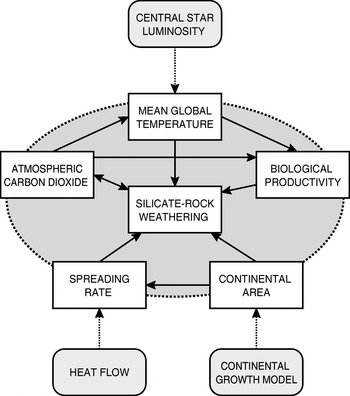
In our calculation of the HZ we follow an integrated system approach. On Earth, the carbonate–silicate cycle is the crucial element for long-term homeostasis under increasing Solar luminosity. In most studies (see, e.g., Caldeira & Kasting Reference Caldeira and Kasting1992), the cycling of carbon is related to present tectonic activity and to the present continental area as a snapshot of the Earth’s evolution. On the other hand, on geological timescales, the deeper parts of the Earth are considerable sinks and sources for carbon. In addition, the tectonic activity and the continental area change noticeably. Therefore, we favour the so-called geodynamical models that take into account both the growth of the continental area and the decline in the spreading rate (Franck et al. Reference Franck, Block, von Bloh, Bounama, Schellnhuber and Svirezhev2000a). Our numerical model couples the stellar luminosity, the silicate-rock weathering rate, and the global energy balance to allow estimates of the partial pressure of atmospheric and soil carbon dioxide, P atm and P soil, respectively, the mean global surface temperature, T surf, and the biological productivity, Π, as a function of time (Fig. 1). The main feedback loop stabilizing the planetary climate is given by silicate-rock weathering: an increase in the luminosity leads to a higher mean global temperature, causing an increase in weathering. Then more CO2 is extracted from the atmosphere weakening the greenhouse effect. Overall the temperature is lowered and homeostasis is achieved.
Box model of the integrated system approach (Franck et al. Reference Franck, Cuntz, von Bloh and Bounama2003). The arrows indicate different forcings (dotted lines) and feedback mechanisms (solid lines).

The biological productivity, Π, can in principle amplify the weathering rate by increasing the CO2 partial pressure in the soil. Then P atm has to be replaced by the partial pressure of CO2 in the soil, P soil=P soil(Π, P atm). In our model, biological productivity is considered to be solely a function of the surface temperature and the CO2 partial pressure in the atmosphere:
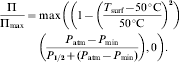
Here, Πmax denotes the maximum biological productivity, which is assumed to amount to twice the present value, Π0 (Volk Reference Volk1987). P 1/2+P min is the value at which the pressure-dependent factor is equal to 1/2, and P min is fixed at 10−5 bar, the presumed minimum value for C4-photosynthesis (Pearcy & Ehleringer Reference Pearcy and Ehleringer1984; Larcher Reference Larcher1995). The evolution of the biosphere and its adaptation to even lower CO2 partial pressures are not taken into account in our model. For a given P atm, Eq. (1) yields the maximum productivity at T surf=50°C and zero productivity for T surf ⩽0°C and T surf ⩾100°C. There exist hyperthermophilic life forms with a temperature tolerance well above 100°C. In general, these are chemoautotrophic organisms not included in this study. At this point we should emphasize that all calculations are carried out for a planet with mass and size equal to that of the Earth, and an Earth-like radioactive heating rate in its interior.
The HZ around an extrasolar planetary system is defined as the spatial domain where the planetary surface temperature stays between 0 and 100°C, and where the atmospheric CO2 partial pressure is higher than 10−5 bar to allow photosynthesis. This is equivalent to a non-vanishing biological productivity, Π >0, i.e.

According to the definition in Eq. (2), the boundaries of the HZ are determined by the surface temperature extrema, T surf=0°C and T surf=100°C, or by the minimum CO2 partial pressure, P atm=10−5 bar. Therefore, the specific parameterization of the biological productivity (Eq. (1)) plays a minor role in the calculation of the HZ. In the approach used by Kasting et al. (Reference Kasting, Whitmire and Reynolds1993) the HZ is limited only by climatic constraints invoked by the luminosity of the central star, whereas our method relies on additional constraints. First, habitability is linked to the photosynthetic activity of the planet. However, it should be pointed out that recent discoveries have revealed the vast extent to which psychrophiles inhabit the cold, dark, marine sediments of the deep sea floor and deep marine basalts, and to which the hyperthermophilic archaea inhabit the deep-sea hydrothermal vents and the hot, crustal rocks of the deep, dark lithosphere. Consequently, the anaerobic chemolithotrophs and chemoheterotrophs that never encounter the photic zone may eventually be responsible for a much larger portion of the terrestrial biosphere than the photoautotrophs. Hence, it must be recognized that the photosynthetic link selected may impose an overly strong constraint on the HZ that would result in an underestimation of the number of habitable planets. From our point of view photosynthesis is most relevant for the direct detection of life on extrasolar terrestrial planets. The Terrestrial Planet Finder (TPF) and Darwin space missions of NASA and ESA plan to detect O2 or its photolytic product O3 as a biosignature of life (De Marais et al. Reference Des Marais, Harwitt, Jucks, Kasting, Lin, Lunine, Schneider, Seager, Traub and Woolf2003) built up by oxygenic photosynthesis. Second, habitability is strongly affected by the planetary geodynamics. In principle, this leads to additional spatial and temporal limitations of habitability.
Methodology
To calculate the PFR it is necessary to estimate the star formation rate (SFR). Cosmological simulations result in an exponentially decaying SFR with intermittent spikes (Nagamine et al. Reference Nagamine, Fukugita, Cen and Ostriker2001). Based on observational data, Lineweaver (Reference Lineweaver2001) fits the SFR for the universe to an exponentially increasing function for the first 2.6 Gyr after the Big Bang followed by an exponential decline. He uses this fit to quantify star metallicity as an ingredient for the formation of Earth-like planets. The metallicity, μ, is built up during cosmological evolution through stars, i.e.

Then the PFR can be parameterized as

where p E is the probability that Earth-like planets are formed and p J is the probability for hot-Jupiter formation with orbits at which they would destroy Earth-like planets. The pre-factor 0.05 reflects the assumption that 5% of the stars are between 0.8 and 1.2 M Solar. The relation between metallicity and the probability p E(1 – p J) is a so-called Goldilocks problem: if the metallicity is too low, there is not enough material to build Earth-like planets; if the metallicity is too high, there is a high probability of forming hot Jupiters. Taking all these effects into account, one can derive the time-dependent PFR (Lineweaver Reference Lineweaver2001).
The number of stellar systems containing habitable planets in the Milky Way, N hab(t), can be calculated with the help of a convolution integral,

where p hab is the probability that a stellar system hosts a habitable Earth-like planet at time Δt after its formation. This can be done with the help of our HZ definition (Eq. (2)) as shown in detail in von Bloh et al. (Reference von Bloh, Franck, Bounama and Schellnhuber2003).
Results
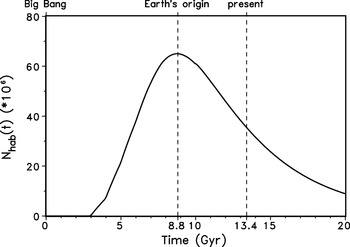
The results for the calculation of the number of stellar systems containing habitable planets in the Milky Way, N hab(t), are presented in Fig. 2. Evidently, N hab(t) has a distinct maximum at 8.5 Gyr after the Big Bang. Here we assume an age of the Universe of 13.4 Gyr, which fits well into the different values ranging from 11.5 to 15.6 Gyr given in the literature (Chaboyer et al. Reference Chaboyer, Demarque, Kernan and Krauss1996; Cowan et al. Reference Cowan, Pfeiffer, Kratz, Thielemann, Sneden, Burles, Tytler and Beers1999; Dauphas Reference Dauphas2005). It must be noted that the age of the Universe is still somewhat poorly constrained while the age of the Earth is in the relatively well-defined range of 4.45 to 4.6 Gyr (Zhang Reference Zhang1998; Baker et al. Reference Baker, Bizzarro, Wittig, Connelly and Haack2005; Workman & Hart Reference Workman and Hart2005). The value N hab(t=13.4 Gyr) of about 107 is of the same order of magnitude as produced by other calculations (Franck et al. Reference Franck, Block, von Bloh, Bounama, Garrido and Schellnhuber2001). On the basis of the above results and the results of Melosh (Reference Melosh2001) we can define the average number of interstellar lithopanspermia events in the Milky Way in a time interval of T, N(t):

Equation (6) can be solved under the condition that N hab(t) does not change significantly in the interval [t, t+T],

where N 0 is the rate of rock fragments ejected from the stellar system (15 yr−1), υe is the ejection velocity (5.1 pc Myr−1), σc is the capture cross-section (1 AU2), V MW is the disk volume of the Milky Way (V MW≈1.57×10¹⁴ lyr3), and τ is the survival time of living material in space. Equation (6) has been derived from Melosh (Reference Melosh2001), where the exchange rate of meteoritic material between stellar systems has been estimated. In our approach the star density has been replaced by the density of stellar systems in the Milky Way containing habitable planets, and the survival time was taken as an additional parameter. For an infinite survival time (τ→∞) we obtain the following result:
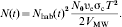
The value of τ can be calculated directly from the interstellar transit time with a survival chance of 10%, τ0.1, as τ=–τ0.1/ln 0.1. There exist different estimations of τ0.1 in the range from 1 Myr (Parson Reference Parson1996) to 45 Myr (Weber & Greenberg Reference Weber and Greenberg1985), and even to 250 Myr (Vreeland et al. Reference Vreeland, Rosenzweig and Powers2000). The last value is rather optimistic because it is derived from bacteria included in ancient salt crystals found on Earth. The possibility and probability of natural transfer of viable microbes has been investigated by Mileikowsky et al. (Reference Mileikowsky, Cucinotta, Wilson, Gladman, Horneck, Lindegren, Melosh, Rickman, Valtonen and Zheng2000). In their Table IIIb, Mileikowsky et al. give survival times under the conditions of Galactic Cosmic radiation and natural radioactivity for interplanetary lithopanspermia. We can apply these values for interstellar lithopanspermia too. Depending on the shield thickness and the natural radioactivity we can derive a value for τ0.1 in the range of 0.1 to 40 Myr. As found in von Bloh et al. (Reference von Bloh, Franck, Bounama and Schellnhuber2003) the maximum number, N max, of interstellar lithopanspermia events tends to 104.
Number of stellar systems containing habitable planets, N hab, as a function of cosmological time for the Milky Way (Von Bloh et al. Reference von Bloh, Franck, Bounama and Schellnhuber2003).

Discussion
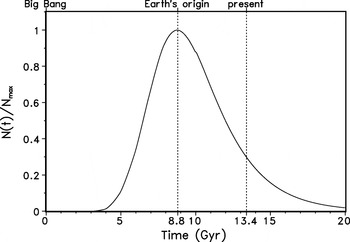
In Fig. 3 the number of interstellar lithopanspermia events N(t) rescaled to N max over the time after the Big Bang is plotted. Since N(t)/N max is proportional to the square of N hab(t), the maximum around the time of Earth’s origin (8.5 Gyr) is even more pronounced. If at all, interstellar panspermia was most probable at this time. This supports the idea that panspermia might have caused a kick start to the processes by which life originated on Earth: there is palaeogeochemical evidence of a very early appearance of life on Earth leaving not more than approximately 1 Gyr for the evolution of life from the simple precursor molecules to the level of the prokaryotic photoautotrophic cells (Schidlowski Reference Schidlowski, Gopalani, Gaur, Somayajulu and MacDougall1990; Mojzsis et al. Reference Mojzsis, Arrhenius, McKeegan, Harrison, Nutman and Friend1996; Brasier et al. Reference Brasier, Green, Jephcoat, Kleppe, Van Kranendonk, Lindsay, Steele and Grassineau2002).
Number of interstellar panspermia events in the Milky Way, N(t), rescaled to N max as a function of cosmological time (Von Bloh et al. Reference von Bloh, Franck, Bounama and Schellnhuber2003).

All our calculations are based on a co-genetic origin of a central star and its planetary system. This is in good agreement with recent results, which suggest that the formation of planetary systems occurs within a few million years after formation of the star (Yin et al. Reference Yin, Jacobsen, Yamashita, Blichert-Toft, Télouk and Albarède2002; O’Brien et al. Reference O’Brien, Morbidelli and Levison2006).
Another consequence of our results is the relation to the mediocrity principle (Darling Reference Darling2001). The mediocrity principle is the notion that there is nothing special about the Earth. The traditional formulation by Copernicus is as follows: in the geocentric view the Earth was the centre of the Solar System, but the heliocentric view of the world tells us that the Earth is a relatively ordinary planet orbiting a relatively ordinary star in a galaxy where planetary systems are quite common. This can be seen clearly in Fig. 2. There was a maximum number of systems with habitable Earth-like planets at the time of Earth’s origin, so the Earth is nothing special.
The same conclusion can be derived from an investigation of the dynamic habitability for Earth-like planets in 86 known extrasolar planetary systems (von Bloh et al. Reference von Bloh, Bounama and Franck2006). In this case ‘dynamic habitable’ stands for an Earth-like planet on a stable orbit in the HZ. According to von Bloh et al. (Reference von Bloh, Bounama and Franck2006) about 50 of the investigated systems have a non-vanishing dynamical HZ and the Solar System is a relatively ordinary system with a width of the dynamical HZ of about 0.7 AU. At least 18 of the investigated systems have better conditions, i.e. a larger width of the dynamical HZ. This is also a strong corroboration of the mediocrity principle.
Acknowledgement
The authors want to thank an unknown reviewer of the manuscript for his constructive comments.