1 Introduction
Between May and November 2012, a questionnaire was posted on the blog of the Bridging the Unbridgeable project, a research project at the Leiden University Centre for Linguistics which analyses English usage guides and usage problems as well as attitudes to English held by linguists, language professionals such as editors and text writers (‘prescriptivists’), and the general public. The aim of the questionnaire was to investigate the attitudes of blog readers to three disputed sentences: I could of gone to that party, Their errors will likely be in their use of style words and He only had one chapter to finish. The features in question, could of for could have, the use of likely instead of very likely and the placement of only as a sentence adverb rather than as a modifier of a noun phrase, had not been highlighted to avoid potentially biased responses (see further Tieken-Boon van Ostade Reference Tieken-Boon van Ostade2013). Not surprisingly, because of its most obviously non-standard form, the largest number of responses that came in concerned the first of these sentences, and they produced the most emotional accounts at the same time. One British informant, for instance, called the use of could of a ‘truly horrible example of chav-speak at its worst’. What was surprising, though, was that among the many responses to the could of sentence, four informants also referred to the use of have went:
(1) Some of my students also say, and write, ‘I have went.’Footnote 2(62-year-old American female English professor)
(2) I hear people say have went, not have gone (64-year-old American female teacher)
(3) I would probably be more likely to say, ‘I could have went to the party. . .’ (27-year-old American female teacher)
(4) Where I live, people will say, ‘I could have went to that party.’ (55-year-old American female teacher)
All four informants, moreover, were women, who further identified themselves as native speakers of American English and as teachers. Whereas the older women all referred to others using have went – their students, people from around where they live – the youngest teacher who responded, aged 27, actually indicated that she would use have went herself. In her account she even went so far as to suggest that she believed there to be a difference in meaning between have went and have/of gone:
(5) I envision myself continuing the sentence with a reasoning of why I didn't go to the party. For example, ‘I could have went to the party, but I had another commitment.’ The sentence is unacceptable, because I think it should read ‘have went’ instead of ‘of gone’. When something is gone, I think of it as empty. I wouldn't say, ‘I gone to the store’. I would say, ‘I went to the store’. Went implies going to a certain place.
Since it had not been part of the original focus of the survey, the anonymous questionnaire did not ask for any more specific geographical origins than nationality, but the informant who produced example (1) did specify that she teaches ‘in Oklahoma, USA’.
The use of have went already received criticism three hundred years ago, with the first eighteenth-century grammarian who labelled it ‘not proper or usual’ being James Greenwood, in 1711 (Greenwood Reference Greenwood1711: 138, 140, Sundby et al. Reference Sundby, Bjørge and Haugland1991: 230). James Harris, the author of the influential philosophical grammar Hermes (Reference Harris1751), criticised have went in even stronger terms:
It would be well therefore, if all Writers, who endeavour to be accurate, would be careful to avoid a Corruption, at present so prevalent, of saying, it was wrote, for, it was written; he was drove, for, he was driven; I have went, for, I have gone, &c. in all which instances a Verb is absurdly used to supply the proper Participle, without any necessity from the want of such Word. (Harris Reference Harris1751: 186n)
The grammarians’ comments are part of the eighteenth-century effort to bring order into what was perceived as the chaos of the strong verb system (Tieken-Boon van Ostade Reference Tieken-Boon van Ostade2011: 120−8), resulting in today's standard verbal paradigm go − went − gone (for a full list, see e.g. Ritchie Reference Ritchie2013: 223−31). As a result, any continuing use of have went was relegated to the realm of non-standard English.
In the light of this development, the question arises as to how we are to interpret the evidence from the attitudes survey. Are the older informants commenting on local practice that needs to be corrected in students’ written work as the informant in (1) suggests? But what about the much younger informant in (3), who admits to using have went herself: would she correct usage in her students’ writings at all? Somewhat alarmingly perhaps, because she identified herself as a teacher, she seems unaware of the status of have went in present-day standard English. Does her comment suggest that have went is becoming more common today, even among teachers? From a more general perspective, moreover, since the problematical usage of have went was only raised by informants who identified themselves as native speakers of American English, is have went today typically characteristic of particular varieties of American English only? Given the orientation of this special issue, these are the key questions that we will consider here, and we will do so by drawing on data from historical and modern corpora of British and American English, as well as on information obtained from surveys and a number of face-to-face interviews. But first, in view of the general focus of the Bridging the Unbridgeable project, we will consider the question of whether have went is a usage problem.
2 Have went in usage guides across the ages
Usage problems are features of usage that are considered problematical, such as the distinction between lie and lay, fly and flee, teach and learn, less and few, amount and number, and many others (see Ilson Reference Ilson and Greenbaum1985: 166–7). They are listed in usage guides – handbooks which offer guidance on questions of linguistic correctness. Usage guides are described as a genre by Weiner (Reference Weiner, Stanley and Hoad1988), who notes that they cover a wide range of linguistic features, including perceived problems of spelling, punctuation, phonology, morphology, syntax and lexis. According to Weiner they also include ‘sociolinguistic considerations’ (1988: 173; cf. Busse & Schröder Reference Busse, Schröder, Houswitschka, Knappe and Müller2006: 461). Usage guides are neither grammars nor dictionaries, constituting a text type of their own (see Busse & Schröder Reference Busse, Schröder, Römer and Schulze2009). An archetypal example is Fowler's Modern English usage (1926), revised by Sir Ernest Gowers in 1965, by Robert Burchfield in 1996 and, most recently, by Jeremy Butterfield in 2015. Fowler (1926), however, was by no means the earliest usage guide to appear: the tradition goes back to 1770 when Robert Baker's Reflections on the English language was published (Leonard Reference Leonard1929; Tieken-Boon van Ostade Reference Tieken-Boon van Ostade2008, Reference Tieken-Boon van Ostade2011). In America, the tradition started a little later. To our present knowledge, a usage guide first appeared there as late as 1847, namely, Seth T. Hurd's Grammatical corrector, or Vocabulary of the common errors of speech, published in Philadelphia. Though arising at different times in history, the birth of the genre on either side of the Atlantic originated in response to a similar need for linguistic guidance in the wake of ongoing changes: social and geographical mobility due to the Industrial Revolution in England and large-scale mid-nineteenth-century immigration into America (Tieken-Boon van Ostade Reference Tieken-Boon van Ostade and Dossena2015).
Both Baker and Hurd deal with the questionable use of have went, but while Baker merely considers participial went and comparable verb forms to be ‘not English’ (1770: 30−1), Hurd provides a detailed geographical account of where he believed have went to be particularly frequent. The occurrence of have went, he notes, ‘is a gross and very common error in the southern part of Ohio, in Pennsylvania, and to some extent throughout the Middle and Southern States’ (1847: 42). What is more, he found it
not among the illiterate only, but among the educated, with whom it is an unpardonable blunder, as they must know it is a palpable violation of one of the plainest principles of the language. (Hurd Reference Hurd1847: 42)
There are many other features in Hurd's usage guide in which geographical locations are mentioned, as in his discussion of the use of balance for remainder, about which he notes that ‘[t]his erroneous use of the term prevails mostly in the Middle and Southern States’ (1847: 21), while on disremember used for forget or do not remember he writes that it is ‘also very common in Pennsylvania’ (Reference Hurd1847: 31). Hurd's explicit geographical focus is unusual within the usage guide tradition (see Tieken-Boon van Ostade forthcoming).
To ascertain what other usage guides discuss have went we drew upon HUGE, a database of usage guides and usage problems developed by Robin Straaijer in the context of the Bridging the Unbridgeable project.Footnote 3 The database contains 77 usage guides and a selection of usage items, mostly grammatical ones (currently 123 items), and it allows for single or combined searches by author, title, publication details and usage problem, including studies on the usage guides and usage problems in the database. A full-text search for have went produced twelve hits, referring to usage guides published between 1770 and 2003. Apart from Baker (Reference Baker1770, Reference Baker1779) and Hurd (Reference Hurd1847), we also found the following:
The grammar of English grammars (Brown 1851)
Five hundred mistakes of daily occurrence (Anon. 1856)
Live and learn: A guide for all, who wish to speak correctly (Anon. 1856?)
The verbalist (Ayres 1911)
A desk-book of errors in English (Vizetelly Reference Vizetelly1920)
The written word (Anon. 1977)
Webster's dictionary of English usage (1989)
The plain English guide (Cutts 1995)
Common errors in English usage (Brians Reference Brians2003).
With the exception of Baker's Reflections and The plain English guide, which were published in London and Oxford, respectively, it is striking that all these titles are American publications. Live and learn, for instance, reads that have went is:
not a very common error, but it is a very great one, and I should not have thought it could come within the range of the class for which this book is written, but that I have heard the fault committed by people of even tolerable education; one might as well say, ‘I should have was at the theatre last night,’ instead of ‘I should have been at the theatre,’ etc., as say, ‘I should have went,’ instead of ‘I should have gone’. (Anon. 1856?: 93−4)
The book was published in New York, so the author, whoever he was, may merely have referred to local usage when he wrote that he had ‘heard the fault committed by . . .’. Have went, in other words, proved more common than he had originally thought, and also, as Hurd had noted before him, he found it to be widespread among different types of users as well. Vizetelly only attributes the usage to ‘some illiterate people’ (1920: 226),Footnote 4 as does Webster's dictionary of English usage: ‘In the speech of the less educated . . . the two forms [went and gone] are often interchanged’ (1989: 479). The most recent usage guide in the list, Brians’ Common errors in English usage, merely notes that have went is a form that ‘often trips people up’ (Brians Reference Brians2003: 93).
The above overview shows that have went was considered to be a usage problem from the earliest days of the usage guide tradition onwards, though it seems to have been associated more with American than with British English. If Hurd's observations were accurate, usage during the nineteenth century was particularly frequent in Ohio, Pennsylvania and the Middle and Southern States. Moreover, as already noted regarding example (1) from an educated informant participating in the attitudes survey, it is today in any case common in Oklahoma. Historically, usage was apparently not restricted to the uneducated or illiterate, as both Hurd and the author of Live and learn noted. We will test all these claims by studying the occurrence of have went in a variety of databases, British and American ones, modern as well as historical.
3 Methodology: types of data analysed
Drawing on different types of data and using a range of analytical approaches, we took as our starting-point a number of recent pilot face-to-face interviews conducted under the auspices of the Bridging the Unbridgeable project with randomly selected speakers of American English from Ann Arbor, Michigan, ranging in age from around 20 to 70 (Kostadinova in progress). These interviews showed that have went was indeed recognised as being used, but they also indicated that speakers have diverse attitudes towards the variant, ranging from not finding the usage problematical at all to strong condemnation of the form. One woman in her early 20s confirmed the point raised by the informant who produced the comment in (5) above, saying: ‘They would be different, but they would both mean the same thing’. What she is suggesting here seems to reflect a distributional difference between have went and have gone, which we will analyse in section 4.3. The two variants are apparently perceived as having the same conceptual meaning but a different stylistic one (see Leech Reference Leech1974: 10−27). In other words, speakers interpret certain differences between the two forms because usage is colloquial and dialectal. This nuance could be perceived as a difference in meaning.
Because usage of have went today is typically characteristic of non-standard English and is accordingly criticised in – particularly American – usage guides (section 2), we decided to study speakers’ attitudes towards the variant in further detail. To this end, we drew on two types of data to try to understand the contexts of use of the construction, as well as its social evaluation by speakers. The first part of the analysis relied on instances of have went usage obtained from historical and present-day language corpora and the second on data obtained from the online attitudes survey already mentioned.
Drawing on the pilot interviews, we created a short survey to explore speakers’ awareness of and attitudes towards have went. Announced in the English Today issue of March 2014 (Tieken-Boon van Ostade Reference Tieken-Boon van Ostade2014), the survey, which was conducted online, served to target speakers’ attitudes towards the construction. The first part of the survey contained five test sentences featuring the non-standard variant have went, as in (6)−(10). These sentences, similarly to those used for the interviews, were obtained from a Corpus of Contemporary English (COCA)Footnote 5 concordance search for have went (see below) and were simplified where needed to avoid unnecessary distractions for the respondents.
(6) I think I could have went down
(7) You should have went to college
(8) It may have went too long
(9) I definitely would have not went to his office
(10) The press would have went wild and crazy
As in the original survey reported on in section 1, have went was not highlighted. The respondents, who were asked to provide details about their age, gender, geographical background and profession, were invited to evaluate the sentences descriptively, with the open question: ‘What is your opinion of the language used in the sentences?’. Additionally, informants were asked ‘Who uses have went in your experience?’, a question designed to get a better understanding of speakers’ regional and social associations with this usage. Our aim was to obtain information on the kinds of attitudes speakers have towards non-standard constructions like the one under investigation here that might signpost particular tendencies of usage (cf. Preston Reference Preston and Preston1999: xxiv). The answers were subsequently analysed and the findings related to the socio-demographic backgrounds of the respondents.
For our corpus-based analysis of actual usage of have went as opposed to have gone we made use of data provided by COCA (450 million words) for American English and the British National Corpus (BNC) (100 million words) for British English, principally because both of them include data on spoken usage where we expect have went predominantly to occur. To provide a historical perspective, we also consulted several historical corpora, such as the Corpus of Historical American English (COHA, 400 million words) as well as the Corpus of Late Modern English Prose, the Corpus of Late 18th-Century Prose, the Old Bailey Online, and British Newspapers 1600−1950, the latter providing historical data for England and elsewhere, written (letters, newspapers) as well as spoken (trial records, reported comments). We subsequently carried out a detailed analysis of the instances found for present-day American English in COCA.Footnote 6 The results for have went, 94 in all,Footnote 7 were compared to a randomly selected sample of 100 hits from the total number of COCA occurrences of have gone (10,014, raw figure: see footnote 7) in order to test the claim that have went and have gone may have slightly different meanings (see section 1). The analysis of these data was based on work done on the meaning of (mainly) lexical items by Sinclair and others (see e.g. Louw Reference Louw, Baker, Gill and Tognini-Bonelli1993; Sinclair Reference Sinclair2003, Reference Sinclair2004; Hoey Reference Hoey, Lüdeling and Kytö2009; Stubbs Reference Stubbs2009). The principal tenets of this approach presuppose that lexical items, or, as in our case, different verb forms, derive their meaning not only from their place in the linguistic system but also from the context in which they tend to occur. We were particularly interested in identifying morphosyntactic environments that potentially constrain the use of have went and have gone. By applying this approach to two participial variants of the same lexical verb, go, we hope to be able to identify differences in their patterning that might not be readily visible or intuitively discernable. Having studied the frequency of the forms in COCA, we analysed the morphosyntactic environments of the two forms, or more precisely their colligational patterns, that is, any tendencies for the two phrases to co-occur with particular grammatical categories (Sinclair Reference Sinclair2003, Reference Sinclair2004). We further considered aspects of what is known as the semantic prosody of have went and have gone. Colligation refers to ‘the occurrence of a grammatical class or structural pattern with another one, or with a word or phrase’ (Sinclair Reference Sinclair2003: 171), while semantic prosody covers the semantic environment of the variants and refers to ‘the consistent aura of meaning with which a form is imbued by its collocates’ (Louw Reference Louw, Baker, Gill and Tognini-Bonelli1993: 157); when words occur together, according to Sinclair, they ‘make special meanings that relate not so much to their dictionary meanings as to the reasons why they were chosen together’ (2003: 178). In other words, semantic prosody can be understood as ‘the pragmatic interpretation selected by the writer/speaker for the whole utterance, reflected in the choices s/he makes’ (Hoey Reference Hoey, Lüdeling and Kytö2009: 980).
4 Results
4.1 The survey
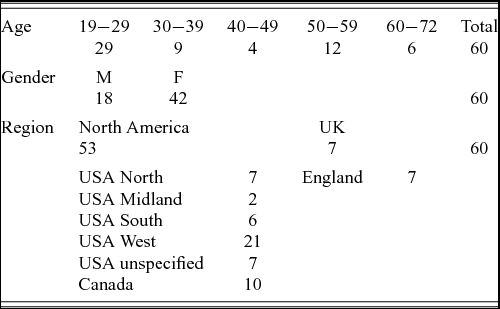
The survey, which had been available online since March 2014 (see section 3), was closed when we started to write the present article. By that stage, 70 respondents altogether had completed the survey, 60 of whom were native speakers of some English variety; their answers form the basis of our subsequent analysis. Table 1 supplies the respondents’ socio-demographic details.
Socio-demographics of the survey respondents
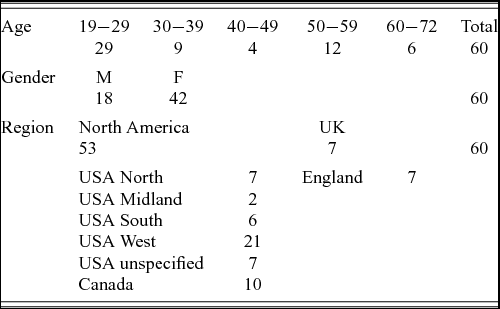
The informants’ ages ranged between 19 and 72, with the majority coming into the age group 19−29. Female respondents predominate. As far as regional background is concerned, the majority of the respondents were from the US, although if we look at the particular regions they are from, there is a rather uneven representation of the various parts of the US. In eight responses, have went was neither identified as a grammatical mistake nor as a dialectal or colloquial usage; these were therefore left out of consideration. The remaining responses were classified according to the answers provided for all five sentences (as in (6)–(10) above). As many as 33 respondents described the use of went as incorrect and (in most cases) suggested gone as the correct variant, as in example (11). Most of the answers provided were short, clear and unemotive, as in (12), while (13) expresses strong disapproval.
(11) Went should be replaced with gone
(12) Incorrect
(13) ugh
Twelve respondents refrained from commenting that have went might be a mistake or even that they considered it acceptable only in certain circumstances as in example (14). In a few cases, respondents mentioned that have went reflected rural, dialectal or colloquial usage, as (15)–(17) demonstrate:
(14) Fine
(15) non-standard, especially uneducated or rural
(16) Sounds like an American dialect – meaning is clear
(17) Colloquial, not grammatically correct
A third group comprises 15 respondents who differed across the five sentences in that some of them identified have went as a grammatical error, while others said that the usage was correct, as in (18) and (19), both from the same respondent but for different sentences. This group also included respondents commenting on the meaning and style of the sentences rather than on their grammar, as exemplified in (20), which relates to the sentence in (8) above.
(18) Gone to college would be correct
(19) This is acceptable
(20) The person is undecided on whether the event's length was too long
That have went was either qualified as incorrect or identified as an American dialectal feature suggests two related processes going on in relation to its earlier historical development: the ousting of variant forms from the verbal paradigm as a result of the standardisation process and the restriction of the non-standard variant to regional varieties.
As far as attitude variation is concerned, overall there does not seem to be any relationship between the types of answers given and the variables age, gender, geographical background or profession. The only confident conclusion we can therefore draw is that while have went is considered incorrect in the majority of cases, it is also believed to exist in certain varieties of English or to be used by certain groups of people. Being perceived as incorrect, its occurrence is labelled ‘uneducated’, ‘rural’ and as ‘poor language use’ or ‘colloquial’ at best. This lends considerable support to the status of have went as a specifically American usage problem (see section 2), largely because our research showed that it was perceived to be a variant that largely occurred in certain varieties of non-standard American English and because it is primarily discussed in usage guides published in America. Furthermore, have went is a fairly salient mistake for most respondents, which agrees with the usage guides which discuss the variant.
Responses to the question ‘Who uses have went in your experience?’ were also quite telling with regard to the social associations of this variant, once again confirming that speakers in general hold attitudes towards this variant that are pretty similar to the ones discussed in usage guides. While about a third of the informants (21 respondents) reported that they had never heard this usage before, two-thirds identified the usage with particular groups of people. By far the most prevalent association was that of lack of education, and informants assigned this usage to ‘uneducated people’, ‘people who have not been taught correct English’, ‘uneducated young people living in lower income areas’, ‘people who are not as educated but are from a wide age range and different ethnicities’, ‘less well educated people – people who speak with more of a regional accent’, and the like. Usage was particularly associated with ‘young adults’, ‘teenagers’, ‘people under 40’ and ‘college students’. A few respondents singled out rural or lower-income areas as the whereabouts of have went users, as well as language varieties such as American colloquial English, African American English, Southern US English, British English and Australian English.
These attitudes bear an interesting resemblance to the ones expressed by Hurd (Reference Hurd1847) and other writers of usage guides (see section 2). While the strong social connotations of the contemporary attitudes surveys associate this variant with young uneducated speakers from rural areas, usage is more likely to be more widespread than that. Furthermore, the usage is also noted by Murray and Lee Simon (Reference Murray and Simon2004: 223), who write that the levelling of the preterite and the past simple forms of irregular verbs, of which have went is an instance, is a colloquial American English feature found in the eastern US, but also in the North, the Midwest and the West. The fact that our American informants are from a wide variety of regions coupled with the fact that there does not seem to be any correlation between their regional background and whether or not they ever heard the variant in question, may indicate that have went is indeed a panlectal North American variant, as dialectologists like Murray and Lee Simon (Reference Murray and Simon2004) have also argued it to be.
4.2 Corpus evidence
4.2.1 British English
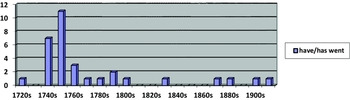
Starting with the historical perspective, we first searched the Corpus of Late 18th-Century Prose, the Corpus of Late Modern English Prose, the Old Bailey Online and the collection British Newspapers 1600−1950, for the occurrence of have went (and have gone). The Corpus of Late 18th-Century Prose comprises c. 300,000 words of autograph letters written between 1761 and 1790 addressed to Richard Orford, a steward at Lyme Hall, Cheshire (van Bergen & Denison Reference van Bergen, Denison, Beal, Corrigan and Moisl2007); the Corpus of Late Modern English Prose contains about 100,000 words of text taken from diaries and letters by different writers from the Late Modern period (Denison Reference Denison, Kytö, Rissanen and Wright1994). Not a single instance of have or has went was found in either corpus, compared to 7 and 13 instances of have/has gone, respectively. The Old Bailey Online contains records of trials held at the central London criminal court between 1674 and 1913 and includes witness statements in the first person from the 1710s onwards (Old Bailey Online: Research and Study Guides). This fully searchable database is thus a valuable resource for evidence of spoken usage from the period by men and women from the lower classes (criminals, witnesses) and by more highly educated speakers (judges, lawyers). Searching the database produced 28 instances of have went and 5 of has went, with the first example occurring in 1729 (I would have went up Stairs, recorded from Joanna Wakefield of St Martin's in the Fields who was indicted for stealing a watch). The last example occurs in 1911 in the utterance: He may have went to get hold of the man, recorded from Alice Streggall of 51, Martindale Road who acted as a witness.Footnote 8Figure 1 shows the chronological distribution of all the examples attested since the early eighteenth century.
Instances of have went retrieved from the Old Bailey Online

Most of the instances (29/33) were from the language of defendants and witnesses; three of the remaining ones marked as being from the Court or ‘Council’ were found in the 1740s, the fourth one being from 1796 (she might then have went away with the things?). Compared to the data for have/has gone (4,281 + 1,250 instances, raw figures) usage of the construction is only marginal, but it is evident that though have went was once more common across the board (in the 1740s), usage was typically found amongst criminals and witnesses called upon to testify. Compared to the findings from the two prose corpora it is safe to conclude that have went, if attested at all, was characteristic of spoken usage around the time covered by the two corpora consulted above, and that it was largely non-standard.
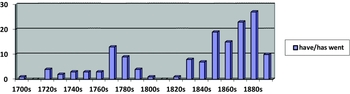
Though the language of newspapers reflects written usage, the collection called British Newspapers 1600−1950, which includes three million pages of historical newspapers and related texts published nationally as well as regionally, contains a fair amount of spoken language, mostly as part of articles catagorised as news. Searching the database for have went and has went produced 131 and 22 instances, respectively,Footnote 9 though not all are representative of spoken usage. Again, these are only marginal figures compared to the occurrence of have gone (163,400) and has gone (114,915).Footnote 10 To chart usage across the period covered by the newspaper collection, we arranged all the examples chronologically in figure 2.
Instances of have went retrieved from British Newspapers 1600−1950

When compared to the figures in figure 1, the newspaper collection at first sight shows very different results, with a peak in usage during the eighteenth century occurring later than in the Old Bailey records, and, instead of a general phasing out of the construction in the years following, showing a steady increase in have went from the 1820s onwards. These figures, however, are not easy to interpret, since the increase in frequency for the eighteenth century may simply reflect the growth in newspaper publishing: according to Görlach (Reference Görlach2001: 207), ‘there were twelve London newspapers by 1712 and 52 by 1801’. If we look further at the provenance of the newspapers in which the instances occur, a different picture emerges: of the 153 instances retrieved, 59 are from newspapers published in London, 23 from Belfast, 21 from Glasgow, 15 from Dublin, 8 from Edinburgh and Bristol, 4 from Aberdeen, 3 each from Birmingham and Exeter, 2 from Portsmouth, and 1 each from Bangor, Ipswich, Leeds, Liverpool, Manchester, Oxford and Preston (Lancashire). Again, these figures may merely reflect the increase in publication of provincial newspapers during the Late Modern English period (Görlach Reference Görlach2001: 207). It is, however, striking that down to the 1850s, of the 61 instances encountered until then, 48 occur in London newspapers, while from the 1860s onwards, London is represented only by 11 out of the 92 instances recorded. If these figures are anything to go by, we might be able to conclude that have went was becoming increasingly characteristic of dialectal usage.
Some examples illustrating this are given in (21)–(22), which contain other non-standard features besides have/has went:
(21) and sure enough he have went, Miss Edina and I found out as he've went by one o’ they trains (1876, Manchester)
(22) it has went off, ladies and gents, and so has three fingers of my right hand (1885, London)
Some journalists reporting the events they recorded indirectly commented on the non-standard nature of the construction by using italics or quotation marks, as in:
(23) I have went forth (1859, Edinburgh)
(24) he said he ‘might have went’ (1872, London)
(25) he has ‘went in’ for the horse show (1878, Dublin)
(26) I thought it would have ‘went’ down and died (1880, Bristol)
(27) Every day during the week the Queen has ‘went out’ with . . . (1889, London)
A more direct comment was made in relation to the instance in (28):
(28) I should have went to the theatre (1879, London).
The sentence is part of a discussion of grammatical errors in an anonymous discussion of a book by Parry Gwynne, called A word to the wise (1852), and it includes other usage problems, such as between you and I, the use of which for that and set for sat, and I done. Two other instances are worth commenting on in the light of our article:
(29) Some hyena has went and given me away on my dodge! (1879, Aberdeen)
(30) and concluded she really ‘ought to have went’ (1887, Preston)
The instance in (29) is identified in the article in which it appears as a quotation from the Detroit Free Press, while the one in (30) is from an article describing a visit to America. As in the above examples, the quotation marks in (30) express a critical attitude towards the reported speaker's language, who is referred to as ‘a society lady’.
A final point worth making is that in 9 instances have went collocates with ashore, as in:
(31) the Ben Acre . . . has went ashore (1882, Dublin)
The instances were found between 1867 and 1888, in newspapers published in Belfast (4), Glasgow (3) and Dublin (2), all of them in sections providing shipping news. It seems that went ashore in these instances functions as a lexical unit that can be put in the perfect by the addition of a form of have. The instances are clearly typical of dialectal usage.
4.2.2 American English
To start again with a historical perspective, our search of COHA produced 29 instances of have went and 25 of has went (0.14 per million words). The occurrences of have went show a peak for the 1910s, which, however, may be a corpus artefact. Nevertheless, two instances from this decade stand out, both from the novel A daughter of the land by Gene Stratton-Porter (1918):
(32) . . . remember that you should say, ‘have gone,’ instead of ‘have went’?
(33) So Adam seldom said: ‘have went,’ or made any error in speech that Agatha had once corrected.
Speaking correctly was evidently an issue in the novel, and it is interesting to see that two of the usage guides proscribing have went, Ayres (1911) and Vizetelly (Reference Vizetelly1920), were published around this time (see section 2). The COHA instances are mostly labelled FIC and represent direct speech, even those labelled NEWS, MAG and NF (non-fiction). One of the NEWS examples actually provides an overt comment on the use of have went:
(34) but now, as one excited young expert put [it] they have went . . . (1952, Christian Science Monitor)
The historical spread of has went does not show any pattern over the years; all except two instances are labelled FIC and represent direct speech. The one instance labelled non-fiction represents first-person narrative. The last instance in the list, labelled MAG, is worth commenting on:
(35) The governments attention to the poor has went from benine concern to malignant neglect (Time, 1976)
The sentence occurs in a critical article in Time Magazine on the fallen standards of university students.
As for present-day American English, our COCA search showed that have went (94 instances) and has went (10) (0.23 per million words) is more frequent than it is in its historical counterpart, COHA, though usage is still only occasional: it is far less frequent than have/has gone (17,591 instances altogether, or 39.09 per million words; raw figures). Most of the COCA instances were categorised as spoken usage (87), with 9 instances being labelled NEWS, 4 FIC, 2 MAG and 2 ACAD. The ACAD instance of have went, however, proved to be an example of spoken usage; the label only seems to have been motivated by the fact that the speaker was a student:
(36) Student 2: I don't know – but I – he could have left. This was obviously in a small town. He could have went somewhere bigger (Dropping in a mouse Reading poetry with our students, 2003)
The four fictional instances all represent spoken usage, too. The ACAD example for has went is perceived to be non-standard, as the context bears out:
(37) Erl Rily has went to the hospitle to hev an operation (Indian play, 2008)
It is unclear what movitated the label, but instances like these show that the labels in the corpus cannot be taken at their face value and that the instances always need to be checked manually.
4.2.3 American and British English compared
The COHA data confirm our findings for British English: have went had become a marginal form by the Late Modern English period. As for present-day usage, the COCA search showed that have went became somewhat more frequent, though usage is still relatively rare compared to the standard forms with gone. Searching the BNC, however, produced only 5 instances of have went and 1 of has went (0.06 per million words), which amounts to considerable less than that which COCA reveals for American usage. All BNC instances reflect spoken usage, two of them being possibly Irish, one Scottish and a fourth northern English.Footnote 11 Usage of have gone in the BNC (4,527 instances altogether, or 45.27 per million words; raw figures) was slightly higher than for American English (COCA). Have went thus indeed seems to be a rather constrained variant, and more so in British usage, where it is much rarer and occurs only in non-standard cases, than in American English. This confirms the responses obtained in the interviews with the American informants, which showed that while some were perfectly aware of the existence of the variant, others appeared critical of its use.
4.3 Collocational patterns
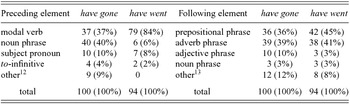
In section 4.2.1 we discussed the fact that in the course of time, have went came to collocate specifically with ashore in local British newspapers reporting shipping news. Coupled with American native speakers’ observations of the potentially different meaning of have went from standard have gone discussed in section 1, we decided to consider the COCA data in more detail. Analysing the morphosyntactic environments of have went vs. have gone revealed significant differences in their colligational constraints (section 3). Have gone displays a much greater variety in terms of elements which can precede or follow the form. As table 2 illustrates, such elements are predominantly noun phrases (40%), modal verbs (37%) and subject pronouns (10%), while have went was found much more often with modal verbs (84%) and much less frequently with noun phrases and subject pronouns.
An overview of the most common elements preceding or following have gone/have went based on an analysis of COCA data

Some examples illustrating these differences are (38) – (43):
(38) Ms. Simpson's statements have gone from being not only untrue to absurd and ridiculous
(39) The money would have gone toward transportation and park projects
(40) I have gone sailing twice in my boat
(41) I thought it could have went either way
(42) Parents have went down there, grandparents
(43) I have went through hell and high waters over this boy
The most striking difference in the patterning of the two constructions is thus the strong colligational association of have went with modal verbs as preceding elements, much more so than for have gone. Most frequently occurring modal verbs are would (43%), should (17%) and could (15%).
We found a different pattern when looking at the elements following the forms in a sentence (see Table 2). Both have gone and have went are followed mostly by prepositional phrases, 36% and 45%, respectively, which function as adverbial adjuncts, as illustrated by (44) and (45). The other equally frequent element following both phrases is the adverbial phrase, mostly functioning as an adverbial adjunct (46), or as part of a phrasal verb (47).
(44) We can all say it would have been a big difference and we should have went in that direction, but no one knows.
(45) He could have gone to Canada, run away, done a lot of things.
(46) If I would have went out there, I would have been right in the middle of this stuff.
(47) They could have went out to eat, like, at West End.
On a semantic level of analysis, with respect to clause meaning specifically, have went is predominantly used in sentences denoting modal meanings associated with the accompanying modal verbs. Thus, they express hypothetical actions or events, as in (48), and refer to possibility or optionality as (49) does – when, for instance, considering the likelihood of different options concerning past events – or to different levels of probability, as in (50). Needless to say, such meanings are often fuzzy and these categories are not always easily distinguishable; nonetheless, the general tendency is for have went to occur in clauses whose meaning is largely affected by the meaning of the modal verb used. These meanings thus mostly express epistemic modality (Huddleston & Pullum Reference Huddleston and Pullum2002: 180), referring to modal remoteness in the past (Huddleston & Pullum Reference Huddleston and Pullum2002: 149, 198). In several cases (16%), have went occurs in non-modal clauses that refer to a (recent) past action or state of affairs – see (51). Have gone, on the other hand, is more prevalent as a marker of the perfective aspect of an action (52), or with reference to current states of affairs, events or processes (53).
(48) If I had heard screams or shouts, I would have went into that bathroom
(49) That way, he wouldn't have went on television and attacked the opponent
(50) I may have went to high school with direct cousins of mine and they never knew it
(51) I have good friends that I feel that I know very well and their children have went bad
(52) I would say they're a bit surprised that the headlines have gone on for nearly four weeks
(53) So, crude oil prices have gone up dramatically around the world
As for the occurrence of go in verbal idioms (go bonkers, go to the ends of the earth, go cold turkey, go public), both have went and have gone were attested in such phrases, as in (54)–(57). When have went did not occur as part of a phrase, the most frequent meaning of the main verb was simply that of expressing a movement from one place to another (30%). Have gone is much more versatile in this respect, and is used to express things like motion (58), a change of state (59) or an act of saying (60).
(54) If the tackle would've happened to him, he’d have went bonkers
(55) She would have went to the ends of the Earth for anything he wanted
(56) The Poles have gone cold turkey with a movement toward an open market
(57) Other social media companies, most of which have gone public in the last year, saw their shares plummet
(58) He could have gone to Canada, run away, done a lot of things
(59) Ms. Simpson's statements have gone from being not only untrue to absurd and ridiculous
(60) I'm sure that women out there have gone, ‘What's the first step? Where do I begin?’
Finally, our semantic prosody analysis did not show any striking differences between the two variants. Both seem to be used predominantly in neutral contexts as in (61) and (62) or mildly negative ones, as in (63) and (64). The only sense in which the two constructions have a different semantic prosody is related to the marked tendency of have went to occur in modal clauses. In this sense have went has a semantic prosody of modal remoteness, such as the expression of past probability, hypothetical events or that of remote conditionals, which is not the case with have gone as a comparison between examples (61) and 63) with (62) and (64) demonstrate:
(61) They could have went out to eat, like, at West End
(62) I have gone sailing twice in my boat
(63) The press would have went wild and crazy and, you know
(64) Melitta Schiller's achievements have gone virtually unremarked
In addition to the differences in colligational constraints, the two variants are also markedly distinct in their stylistic aspects. In addition to the fact that have went was shown to be a heavily constrained variant of have gone, exclusively occurring in and being associated with spoken informal and dialectal discourse in American English, have gone was found to cover the entire spectrum of uses, meanings and registers, while have went largely seems to be restricted to a modal, predominantly spoken context, and is rarely used for the present perfect.
5 Conclusion
Have went was first perceived as a usage problem by the normative grammarians of the eighteenth century, and it has been attested in usage guides from the earliest days of the genre onwards, first in England (Baker Reference Baker1770) and nearly eight decades later in America as well (Hurd Reference Hurd1847). However, if we go by our analysis of the usage guides that discuss the item, it appears to have developed into a particularly American usage problem over the years. What is more, it was perceived as such by a number of our informants, some of whom volunteered the information regarding its particular association with US regional varieties themselves. Our corpus analysis confirmed the restricted usage of have went, showing that it was never very frequent to begin with, but that usage had once been more widespread. In the course of time it became increasingly part of non-standard English, even developing a specific collocation within the genre of shipping news (have/has went ashore), though this seems to have been restricted to local British usage only. COHA produced 450 hits for went ashore, and COCA 60, but these instances never collocated with have or has. We did find that in American English have went has a different distribution from the more standard alternative have gone, which confirms comments in this respect made by some of our American informants (section 1).
If have went developed into a dialectal feature in British English without becoming a usage problem, whereas today it is both treated and perceived as exactly that by speakers of American English, how can these different developments be explained? One explanation might be that have went is a feature of various non-standard varieties of American English, including African American Vernacular English (AAVE), as was indeed remarked upon by one of the people that were interviewed (section 4.1; see also Wolfram Reference Wolfram2004). AAVE is, according to Milroy & Milroy (Reference Milroy and Milroy1999: 93), ‘widely considered to be of very inferior status’, and it may indeed be the presence of have went in this as well as other non-standard varieties of American English that has made people highly sensitive to its status in language. Webster's dictionary of English usage quotes the writer Flannery O'Connor (1925−64) commenting in a letter dated 4 May 1955 that ‘[t]he people on our place always say, “we gone to see it,” or “we gone and done it,” when the action is past—never “went” when “went” would be correct’ (1989: 479). At the time, Flannery O'Connor was living in Milledgeville, Georgia (American National Biography Online, s.v. ‘Flannery O'Connor’), so she is evidently recording local non-standard usage here. The use of gone as a past tense form is likewise a feature of AAVE in addition to being attested in ‘rural Southern white varieties’ (Wolfram Reference Wolfram2004: 330). In this light it is interesting to see that our 27-year-old American teacher who happily admitted to using have went, ‘wouldn't say, “I gone to the store”’ (example (5)). While not so much concerned with the current status of have went, it is with this other feature of non-standard usage that she evidently drew the line. It would thus seem that there is a perceived difference in hierarchy between certain non-standard features of American English grammar.