Significant outcomes
CGRP levels are elevated in the hippocampus, frontal cortex and amygdala in an established genetic rat model for depression.
Early stress does not affect CGRP levels.
Chronic treatment with antidepressants does not alter CGRP levels.
Limitations
Translation from animal research to the human situation is notoriously difficult.
While we found differences in CGRP, we did not investigate the levels of katacalcin or of the CGRP receptors.
We did not evaluate the behaviour of the animals in this particular study.
We only investigated two antidepressants, both working on monoamine transporters but not included more novel ones (ketamine, agomelatine).
Introduction
Depressive disorders are a leading cause of disability, with the most recent (2015) global burden of disease study recording a more than 18% rise in the last decade (1). One major reason for this tremendous burden is that a substantial proportion of patients (up to 30%) do not adequately respond to the currently available antidepressant treatments (2,3), and in those that do respond, there is a substantial delayed onset of action. So far, the rational development of novel antidepressants has been hampered by a significant lack of knowledge on the aetiology and pathology.
While genetic factors have long been known to be involved in the aetiology of depression, family, twin and adoption studies have shown that genetic factors per se do not cause depression but merely increase the vulnerability. Thus, the heritability based on twin studies has been reported to be around 40% (4), although studies have suggested that heritability may increase with repeated assessment (5,6), presumably because this leads to a more homogeneous group of (chronic) patients. However, even these studies suggest a heritability well below 100%, indicating that non-genetic factors also play an important role. In this respect, most studies have found that early stressful life events, including childhood trauma and physical abuse significantly enhanced the risk of developing depressive disorders, especially in genetically vulnerable individuals (7).
While less well investigated, these results are mirrored by studies in rodents. For example, mice with a genetic reduction in the serotonin transporter show a “depression-like” increase in immobility in the tail suspension test (8). Likewise, we recently found that rats with the same genetic reduction in the serotonin transporter were more susceptible to repeated maternal separation (MS) (Ellenbroek et al. in preparation). One of the most useful genetic models of depression is the Flinders-sensitive line (FSL) rat. Compared to its control, the Flinders-resistant line (FRL), these rats show multiple depression-like characteristics (9,10). More relevant for our present work, several studies have found that FSL rats are more sensitive to the long-term effect of early stressful life events, where low maternal care increased depressive-like behaviour in the forced swim test (FST) (11), as does repeated MS (12). In addition to behavioural effects, gene–environmental interactions were also reflected in numerous biochemical changes. For example, in a recent study we found that MS significantly increased neurotensin levels in the nucleus accumbens, hippocampus and entorhinal cortex in FSL but not in FRL (13). In addition, MS reduced neurotensin levels only in the amygdala of FSL rats. On the other hand, studies investigating neuropeptide Y (NPY) changes after MS found no strong evidence for a gene–environment interaction (14). These data show that the FSL/FRL rats represent a feasible model for investigating gene–environment interaction and therefore can be helpful in identifying new targets for drug therapy.
In the present paper, we focused on calcitonin gene-related peptide (CGRP). This 37-amino acid peptide is a product of the calcitonin gene which also encodes for calcitonin and its carboxyl-terminal flanking peptide katacalcin (15). CGRP is widely distributed in the brain, with cell bodies predominantly in the mid- and hindbrain, including the hypothalamus (perifornical and premamillary nucleus), posterior thalamus and parabrachial nucleus and terminal regions including most of the forebrain and the limbic system, including the prefrontal cortex, amygdala, hippocampus and nucleus accumbens (16). Two CGRP receptors have been identified, both with a widespread distribution throughout the brain (17). CGRP has been implicated in the regulation of pain and more specifically in headache and migraine (18). However, in line with its widespread distribution, CGRP is involved in several additional behavioural processes, including olfaction, auditory information procession, learning, feeding and motor activity (19).
In addition, CGRP seems to be involved in a number of neurological and psychiatric disorders, including dementia (20), Parkinson’s disease (21) and depressive disorders. With respect to the latter, an increase in CGRP was observed in the cerebrospinal fluid (CSF) (22) and plasma (23) of patients with major depression (23). Animal research also provides some evidence for a role of CGRP in depression-like behaviour. For instance CGRP-like immunoreactivity (LI) is elevated in hippocampus and frontal cortex of FSL rats (14). A recent paper also found central administration of CGRP to enhance depressive-like behaviour in the FST in mice (24), although the opposite has also been described (25). Cumulatively, these data suggest that CGRP may be involved in the pathophysiology of depression. However, very little is known about the effects of antidepressants on CGRP in the brain. Therefore, we investigated the effects of repeated administration of the tricyclic antidepressant nortriptyline (NOR) and the selective serotonin reuptake inhibitor escitalopram (ESC) on CGRP levels in specific brain regions in the FSL and FRL rats. A cohort of FSL and FRL rats was subjected to repeated MS in order to investigate possible gene–environment effects.
Methods
All methods have been previously described in great detail in our publications. Consequently, in the current paper, we are presenting only the main features of the procedures and refer the readers to the references for more details.
Animals
Adult FSL and FRL females from the rat colonies maintained at the animal facility at the Karolinska Institutet were mated with sexually experienced FSL and FRL males, respectively. Two weeks later, the males were removed and the dams were checked for delivery twice daily (08.00 and 16.00). The day of delivery was denoted as postnatal day (PND) 0.
The housing conditions were the same for all animals throughout the study. The animals had free access to water and food (Lactamin R36, Stockholm, Sweden) and were housed three to four per cage under standard conditions of humidity in temperature-controlled rooms (23°C ± 1°C) and 12-h light/dark cycle (lights on at 7.00 a.m.). The experimental procedures were carried out during the light phase. All animal procedures were approved by the Ethical Committee on Animal Experiments and were conducted in conformity with the Karolinska Institutet’s Animal Care Guidelines.
Experimental groups
All experiments were carried out using male FSL and FRL rats. While it is well known that there are sex difference in depression in humans, studies in rats have typically been done in males. Since this was a first exploratory study, we decided to include only males for this study. Rats were both bred and housed under normal standard conditions (non-MS) or were exposed to MS (see below). From PND 43 onwards, rats from both groups were given either saline or one of the two antidepressant drugs for 30 days in their food. On the last day of treatment (PND 73), all rats were sacrificed and brains rapidly removed for CGRP analysis.
MS procedure
The MS procedure has previously been described (12,14,26–28). In brief, litters were randomly assigned to either of the two conditions: MS and non-MS. In the MS group, pups are briefly handled before being separated from the dam for daily from PND2 to PND14, by removing the dam from the home cage. The pups were placed in clean cages (15×15 cm filled with shredded paper bedding) in an incubator for 3 h. From PND 2 to 5 the incubator was set at 32°C, after which it was reduced to 30°C until PND14. At the end of the MS procedure, the pups were returned to the home cage, after which the dam was returned as well. Control rats (non-MS group) were left undisturbed until weaning, except for the routine cleaning of the cages twice weekly. All pups were weaned by removing the dams from their home cages on PND 23. After weaning, the siblings were separated by gender and housed in groups of three to four animals per cage. Only male rats were included in the study.
Drug treatment
On PND 43, the animals were randomly assigned to 30-day dietary treatments where ESC (0.33 g/kg chow pellet for the first 3 weeks and 0.41 g/kg chow pellet during the rest of the experiment), NOR (0.22 g/kg chow pellet for the first 3 weeks and 0.33 g/kg chow pellet during the rest of the experiment) or vehicle had been admixed to food pellets. (The diet was prepared by Lactamin AB, Sweden, according to instructions from H. Lundbeck A/S, Denmark; pellets containing drug/vehicle were shipped to H. Lundbeck A/S for blind quality controls and found to meet the specifications.) Animals were kept on their respective diet until the end of the experiment on PND 73. The doses were based on previous extensive work testing dose–response behavioural effects followed by drug determinations in plasma and brain at Lundbeck AS and at the Department of Clinical Pharmacology at Karolinska Institutet (12,29–32).
Brain tissue content
On day 73, the animals were sacrificed with focused high-energy microwave irradiation. The technique has previously been described to result in increased recovery of peptides (33). The brains were removed, immediately frozen in –40°C isopentane and dissected into frontal cortex, amygdala, hypothalamus and hippocampus. Samples were stored at –80°C until peptide analysis. Number of animals was eight to nine per group.
Peptide extraction
Briefly, CGRP-LI was extracted from tissues by homogenisation with a Polytron tissue homogeniser, followed by 5 min of ultrasonication and boiling for 10 min in 1 M acetic acid. The homogenates were centrifuged at 4 °C, 3000g for 20 min, the supernatants were collected and pellets reconstituted in distilled H2O, followed by the identical sonication, boiling and centrifugation procedure. The two supernatants were pooled and freeze-dried and stored at –80°C until radioimmunoassay (RIA). The samples were reconstituted in assay buffer before RIA (26,27,34).
Peptide RIA
Briefly, calcitonin gene-related LI in brain samples was quantified by RIA using CGRP standard (synthetic CGRP, Cat.No. 6006, rat) and CGRP rabbit antiserum (Cat.No. RAS 6006, rat), (Peninsula Laboratories, England) and 125I-Bolton Hunter-labelled NT (Amersham International, England). The antisera were used at a final dilution that binds 30% of the labelled CGRP (zero binding). The assay was run in duplicates as follows: 100 μl standards and 100 μl samples were incubated with 100 μl of antibody at 4 °C for 48 h. Following this incubation, 100 μl of labelled peptide was added (6000 cpm/100 μl) and the solution was incubated for additional 24 h. Free and antibody-bound peptide were separated using 50 μl SAC-Cel (Anti-Rabbit Solid Phase Second Antibody Coated Cellulose Suspension; IDS, Bolton, UK). Samples were left at room temperature for 30 min. The reaction was blocked with 1 ml distilled H2O. Samples were centrifuged at 3000g for 20 min at 4 °C, the supernatants were decanted and the pellets were counted in a gamma counter for 3 min. The detection limit of the CGRP assay was 1.9 pmol/l and the intra- and inter-assay coefficients of variation were 5% and 14%, respectively. More details can be found in our previous papers (33,35–37).
Statistical analyses
Three-way analysis of variance (ANOVA) was used in order to test the interaction between genetic (FSL vs. FRL), environment (non-MS vs. MS) and treatment (vehicle, NOR vs. ESC) using the SPSS software (v23, IBM). In case of statistically significant main or interaction effect (p <0.05), follow-up ANOVA and/or post hoc test were done to identify the source of the significance. All data are presented as the means±SEM.
Results
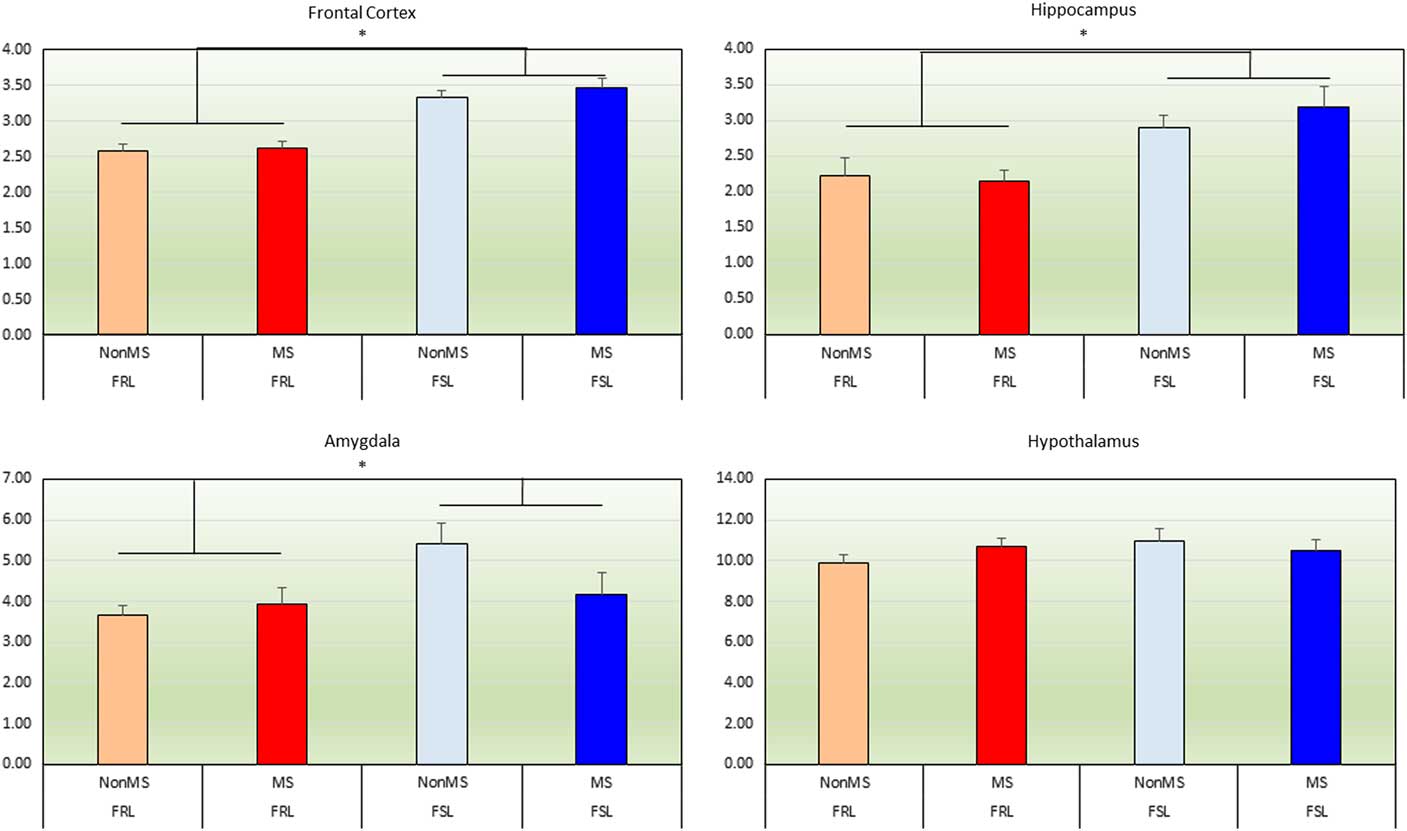
Results are displayed in Table 1 and in Fig. 1. A three-way ANOVA found significant main effects of genetics for the frontal cortex [F(1,82)=47.4, p <0.001], hippocampus [F(1,82)=20.1, p <0.001] and amygdala [F(1,82)=5.2 p <0.05] but not hypothalamus (p >0.35). However, no significant main effects were found for the environment factor or the treatment factor. In the amygdala, there was a tendency for gene–environment interaction [F(1,82)=3.3, p=0.07] and in the frontal cortex a significant interaction was found between gene and treatment [F(2,82)=3.25, p <0.05].
CGRP brain levels

CGRP, calcitonin gene-related peptide; FSL, Flinders-sensitive line; FRL, Flinders-resistant line; MS, maternal separation.
Represented are the mean concentration (±SEM) of CGRP (in pmol/g protein) for each of the treatment conditions.
Calcitonin gene-related peptide (CGRP) protein levels (in pmol/g protein) in the frontal cortex, hippocampus, amygdala and hypothalamus in Flinders-sensitive and -resistant line (FSL and FRL) rats. Represented are mean values±SEM. As there were no main effects of treatment, the results were collapsed over the different treatment conditions (see Table 1 for the values for the individual treatment conditions).

Figure 1 shows the CGRP levels in the different brain regions. As there were no significant treatment effects, the results were collapsed over the different treatment groups. The figure shows that CGRP-LI was significantly increased in FSL rats in three out of four brain areas, independent of early environmental challenge.
Discussion
This study was undertaken to investigate whether chronic antidepressant drug treatment affected CGRP levels in key brain regions in a gene–environment interaction model of depression. Two salient results were obtained: (i) significantly increased levels of CGRP in the frontal cortex, the hippocampus and the amygdala were found under baseline conditions and (ii) neither NOR nor ESC normalised the increased CGRP levels. Given that increased CGRP levels have been associated with depression in humans (22) and depression-like characteristics in rodents (24), this opens the possibility that CGRP antagonists might provide a novel approach to treat major depressive disorder (MDD) especially in patients not responsive to current treatments. In order to substantiate this hypothesis, more research is needed. Specifically, this would require testing the behavioural effects of drugs that reduce CGRP levels.
Our data are in line with previous findings of an increase in CGRP-LI in the frontal cortex and hippocampus of FSL rats (14), although, in contrast to that paper, we also found a significant increase in the amygdala. However, the effect in the present study is only small and may have reached significance because of increased power. Somewhat surprisingly, we did not find evidence for an effect of MS on brain CGRP-LI. In a previous study, a significant main effect of MS was found for the hippocampus and a gene–environment interaction for the amygdala (14). Likewise, other studies have shown that CGRP levels are susceptible to early environmental manipulation. Thus, we have previously showed that a single 24 h period of maternal deprivation significantly reduced CGRP-LI in the hippocampus (35). However, in that study non-depressed male Wistar rats were used, and the MS procedure was only single MS on PND 9. Interestingly, under such conditions CGRP-LI levels were highly sensitive to physical rearing conditions, that is, animals reared on grid floors or normal plastic floor with saw dust bedding.
In a recent paper, it was shown that the prenatal environment also influences CGRP levels (24). The authors crossed Balb/cJ mice with C57BL/6 J mice and found that the F1 hybrids showed increased depression-like behaviour in the FST, but only when they were gestated by C57BL/6 J dams. More relevant for the present discussion, the authors showed that compared to animals reared by Balb/cJ dams, those reared by C57BL/6 J showed a reduction in DNA methylation of the CGRP promoter region in the hippocampus. As DNA methylation is traditionally linked to reduced DNA transcription, these data suggest higher CGRP levels in the hippocampus. In line with this, the authors found an increase in depression-like behaviour in mice after intra-cerebroventricular administration of CGRP (24).
Potentially our most important finding of the present paper is the lack of effect of two antidepressants on CGRP-LI levels in the brain. This lack of effect was consistently observed in all brain regions, in both FSL and FRL and in animals exposed to MS as well as controls. In this respect, previous data from our lab have shown that the same dosing schedule of ESC significantly reduces depression-like behaviour in the maternally separated FSL rats (12), suggesting that the lack of effect was not due to inadequate dosing.
NOR is a tricyclic antidepressant that primarily inhibits the noradrenaline transporter (although it also has some affinity for the serotonin transporter) (38), while ESC is a selective inhibitor of the serotonin transporter. However, both are effective antidepressant drugs in at least a subpopulation of patients. Several lines of research have shown an interaction between CGRP and both serotonin and noradrenaline. Coexistence between CGRP and serotonin in the raphe nuclei of monkeys has been reported (39). While there is less evidence of coexistence between 5-HT and CGRP in rodents, CGRP-positive terminals have been reported in close proximity with 5-HT-positive cells in the dorsal raphe (40), suggesting a possible direct interaction between 5-HT and CGRP. This is further supported by data showing that 5-HT1B/D agonists commonly used in migraine treatment reduce CGRP levels (41). Likewise, the analgesic tapentadol inhibits CGRP release, an effect that can be completely prevented by coadministration of the 5-HT3 antagonist ondansetron (42).
There is also some evidence that CGRP interacts with the noradrenergic system. Thus, CGRP influences the release of noradrenaline in the hypothalamus (43), and CGRP knockout mice have elevated urinary and plasma levels of noradrenaline (44).
In spite of these links between CGRP and noradrenaline and serotonin, the current data show that the increased CGRP levels in the FSL rats are not affected by blocking of the serotonin or noradrenaline transporters. This is intriguing as the FSL is generally accepted as a valid genetic model for depression (9,10). FSL rats show increased rapid eye movement sleep, decreased locomotor activity, reduced body weight and increased immobility in the FST (12,45), indicating good face validity. Moreover, the depression-like phenotype of FSL is exacerbated by environmental stressors such as MS (12), low maternal care (11) and chronic mild stress (46), suggesting the model also shows aspects of construct validity. Perhaps most interesting for the present paper is, however, the finding that chronic antidepressants normalise many of the behavioural deficits in FSL rats (9,12), thus adding substantial predictive validity. Given this, the failure of both NOR and ESC to reverse the CGRP elevation in FSL rats suggest that CGRP might be an interesting novel target for treatment-resistant patients. While it is currently unknown how CGRP is related to depression, elevated CGRP levels have been reported in CSF of MDD patients (22). Interestingly, enhanced CGRP is associated with a phenomenon termed central sensitisation, often discussed in relation to migraine (47). In that model, CGRP enhances peripheral as well as central glutamate signalling, among others in the amygdala. This enhanced transmission is in part due to a CGRP-induced increase in glutamate release. In addition, CGRP phosphorylates α-amino-3-hydroxy-5-methyl-4-isoxazolepropionic acid (AMPA) and N-Methyl-D-Aspartate (NMDA) receptors, thus increasing conductance through these receptors. In recent years, there has been an increased interest in the role of glutamate in depression, in part resulting from the antidepressant effects of ketamine, an NMDA antagonist (48). Studies using the FSL rats have also highlighted the potential role of the glutamatergic system. Thus, MS leads to an increase in the NR1 subunit of the NMDA receptor and the GluR2/3 subunits of the AMPA receptors (49). In addition, L-acetylcarnitine shows a reduction in immobility in the FST in the FSL rats, by enhancing the transcription of mGlu2 receptors (50,51). One of the characteristics of ketamine, which was mimicked by l-acetylcarnitine in the FSL rats, is its rapid onset of action, and therefore, we could speculate that CGRP antagonists may share this advantage. Currently, several CGRP antagonists are in clinical trials for the treatment of migraine, while several others are in preclinical development stages (52,53). While several of these were shown to be beneficial for the treatment of migraine, some compounds have been discontinued for possible liver toxicity (18). Nonetheless, the clinical assessment of CGRP antagonists for depressive disorders treatment will benefit from the clinical trials currently in progress for migraine.
In summary, we found that in the FSL rats, a well-established genetic model of depression, CGRP levels are elevated in the frontal cortex, hippocampus and amygdala CGRP levels, were not influenced by early MS. Most importantly, NOR and ESC failed to normalise the elevated CGRP levels in depression in the FSL rats. Since the current study did not evaluate the behavioural changes seen in FSL rats either alone or after chronic treatment with either of the antidepressants, further research is needed to investigate the functional role of CGRP in depression. Specifically, it would be of interest to evaluate the potential antidepressant effects of CGRP antagonists in FSL rats.
Acknowledgements
The authors wish to acknowledge A Mörk; Lundbeck A/S, Copenhagen, Denmark, for generous help in preparing the ESC and NOR diet.
Financial Support
This work was supported by the Swedish Medical Research Council grant (AAM, no. 10414), the EC GENDEP project (AAM no. LSHB-CT-2003-503428) and the Lundbeck Foundation (AAM).
Statement of Interest
None.