


Introduction
The diagnosis of chronic fatigue syndrome (CFS) is made on the basis of ongoing and severe fatigue, which results in a significant reduction in functioning and is not explained by exertion or another medical condition (NICE, 2007). Patients may experience a number of additional symptoms such as pain, post-exertional malaise, cognitive problems, nausea and dizziness (NICE, 2007). Approximately 1–2% of children and young people are affected by CFS (Brigden et al., Reference Brigden, Loades, Abbott, Bond-Kendall and Crawley2017) and from middle adolescence onwards, CFS is more prevalent in females at a ratio of 2:1 (Crawley, Reference Crawley2014).
CFS impacts significantly on young people’s lives; for example, adolescents with CFS miss significant periods of school as a result of their fatigue, and struggle to return to full-time education (Crawley and Sterne, Reference Crawley and Sterne2009; Sankey et al., Reference Sankey, Hill, Brown, Quinn and Fletcher2006). The rates of recovery from CFS in adolescents tend to be much more favourable than those in adults, with treatment trials showing that around two-thirds of adolescents treated using cognitive behaviour therapy (CBT) are much improved at 6 months follow-up (Lloyd et al., Reference Lloyd, Chalder and Rimes2012; Nijhof et al., Reference Nijhof, Bleijenberg, Uiterwaal, Kimpen and van de Putte2012). Despite this, the evidence points towards significant and chronic impairment in functioning in a substantial minority (approximately one-third) of adolescents with CFS who do not improve, even with treatment (Brigden et al., Reference Brigden, Loades, Abbott, Bond-Kendall and Crawley2017).
Cognitive and behavioural factors are postulated to contribute to the maintenance of CFS (Browne and Chalder, Reference Browne and Chalder2006; Butler et al., Reference Butler, Chalder, Ron and Wessely1991; Chalder et al., Reference Chalder, Deary, Husain and Walwyn2010; Knoop et al., Reference Knoop, Prins, Moss-Morris and Bleijenberg2010; Lloyd et al., Reference Lloyd, Chalder and Rimes2012). Cognitive factors include beliefs about the dangers of undertaking activity (fear avoidance beliefs) and beliefs about self-efficacy, whilst behavioural factors include avoidance of activity, prolonged rest and all-or-nothing behaviour (that is, periods of high activity followed by periods of inactivity), also referred to as booming-and-busting. Adults with CFS endorse these beliefs (Cella et al., Reference Cella, White, Sharpe and Chalder2013; Stahl et al., Reference Stahl, Rimes and Chalder2014) and their cognitive interpretations of the meaning of symptoms have been found to be related to physical and psychological outcomes (De Gucht et al., Reference De Gucht, Garcia, den Engelsman and Maes2017). Importantly, unhelpful beliefs mediate change during CBT (Chalder et al., Reference Chalder, Goldsmith, White, Sharpe and Pickles2015; Stahl et al., Reference Stahl, Rimes and Chalder2014).
To further refine and improve the existing, relatively effective cognitive behavioural approach to treatment for adolescents with CFS, we need to better understand the maintenance of the illness. Some measures of beliefs and coping in CFS exist and have been used in studies examining CFS in adolescents. For example, Richards et al. (Reference Richards, Turk and White2005) used an adapted version of an Exercise Beliefs Questionnaire to investigate beliefs about activity and exercise in CFS. A 4-item version of this questionnaire was originally used in an adult randomized controlled trial of CBT versus relaxation (Deale et al., Reference Deale, Chalder, Marks and Wessely1997). Beliefs were found to change in the CBT but not the relaxation group (Deale et al., Reference Deale, Chalder and Wessely1998). Items were chosen as they were in keeping with the cognitive behavioural model of CFS (Surawy et al., Reference Surawy, Hackmann, Hawton and Sharpe1995; Wessely et al., Reference Wessely, Butler, Chalder and David1991). Although the scale appeared to have some predictive validity and has been used in adults and adolescents with CFS, the psychometric properties of the measure were not reported and the brevity of the measure limits the richness of the resultant data.
Other options include the Illness Perceptions Questionnaire (Weinman et al., Reference Weinman, Petrie, Moss-Morris and Horne1996) and the Illness Management Questionnaire (Ray et al., Reference Ray, Weir, Stewart, Miller and Hyde1993), which have been used in previous studies of adolescents with CFS (Gray and Rutter, Reference Gray and Rutter2007; Haines et al., Reference Haines, Loades and Davis2019). However, although psychometric evaluations have been carried out in adult populations (Ray et al., Reference Ray, Weir, Stewart, Miller and Hyde1993; Weinman et al., Reference Weinman, Petrie, Moss-Morris and Horne1996), extensive psychometric evaluation has not been carried out in adolescents with CFS. A review of available patient-reported outcome measures for use in paediatric CFS highlighted the lack of psychometric data and the need for rigorous evaluation of measures (Haywood et al., Reference Haywood, Collin and Crawley2014). Therefore, a valid and reliable measure of cognitive and behavioural responses to the symptoms of CFS in adolescents is required.
In the absence of age-appropriate measures for use in adolescents, existing adult measures can be adapted if necessary. The potential shortcoming of this approach is that measures developed for use in adults may not capture issues of relevance to adolescents specifically. The alternative is to develop measures from scratch, specifically for use in this population. Whilst this bespoke approach has the benefit of maximum developmental appropriateness, it is time consuming and limits the extent to which findings can be compared with the adult literature. As the cognitive and behavioural models of CFS in adolescents draw on the same cognitive and behavioural responses of CFS in adults, we opted to evaluate an existing measure, the Cognitive and Behavioural Responses Questionnaire (CBRQ), which was developed and validated for use in adults (Moss-Morris and Chalder, Reference Moss-Morris and Chalder2003; Ryan et al., Reference Ryan, Vitoratou, Goldsmith and Chalder2018).
The CBRQ is a 40-item self-report questionnaire (Ryan et al., Reference Ryan, Vitoratou, Goldsmith and Chalder2018). Psychometric evaluation to date has found it to have seven subscales; five are cognitive subscales that assess fear avoidance, catastrophizing, damage beliefs, embarrassment avoidance and symptom focusing. Of these, the first four cognitive subscales assess thinking patterns, whilst the fifth, symptom focusing, assesses attentional processes. The remaining two subscales pertain to behavioural patterns capturing avoidance/rest and all-or-nothing behaviours. The development of the CBRQ was reported in a Conference abstract (Moss-Morris and Chalder, Reference Moss-Morris and Chalder2003) and has subsequently been used to assess cognitive and behavioural responses in adults with CFS after treatment (Chalder et al., Reference Chalder, Goldsmith, White, Sharpe and Pickles2015; Stahl et al., Reference Stahl, Rimes and Chalder2014). Ryan et al. (Reference Ryan, Vitoratou, Goldsmith and Chalder2018) aimed to rectify the absence of published formal psychometric evaluation. They found the CBRQ to be valid and reliable in this population, with satisfactory internal consistency (α ≥ 0.76) and low to moderate correlations with measures of physical and occupational functioning, fatigue, anxiety and depression (Ryan et al., Reference Ryan, Vitoratou, Goldsmith and Chalder2018). Both 7-factor and 8-factor solutions showed a good fit, and the authors opted for the former on the basis of parsimony. A shortened 18-item (6 subscale) version, developed on the basis of exploratory and confirmatory factor analyses, was found to have good psychometric properties (α ≥ 0.67) in adults (Ryan et al., Reference Ryan, Vitoratou, Goldsmith and Chalder2018).
However, despite its potential utility in furthering the understanding of the maintenance of fatigue and in examining the mechanisms of change, the psychometric properties of the CBRQ have not been explored in adolescents with CFS. Therefore, the aim of the current study was to undertake a psychometric evaluation of the original and the shortened version of the CBRQ in adolescents with CFS, using the subscales generated from factor analyses with adults with CFS (Ryan et al., Reference Ryan, Vitoratou, Goldsmith and Chalder2018). This was achieved firstly, by examining reliability (internal consistency). Secondly, we examined validity; as there are no other established measures of cognitive and behavioural responses to fatigue, we utilized other measures of impairment (fatigue, functioning, mood and anxiety) which we would expect to be moderately (but not strongly) correlated with the total score on the cognitive and behavioural responses scale. Specifically, we expected that:
Higher levels of fatigue, and more anxiety and depression symptoms would be associated with more unhelpful cognitive responses to symptoms (convergent validity) based on previous literature (Ebata and Moos, Reference Ebata and Moos1991; Garber et al., Reference Garber, Weiss and Shanley1993; Jolly and Dykman, Reference Jolly and Dykman1994).
Similarly, higher levels of fatigue, anxiety and depressive symptoms would be associated with more avoidance/resting behaviour.
Embarrassment avoidance would be more likely to be associated with school and social functioning (convergent validity) than physical functioning (discriminant validity).
Disability and mood would not be strongly correlated with all-or-nothing behaviour as based on qualitative research (Hareide et al., Reference Hareide, Finset and Wyller2011; Parslow et al., Reference Parslow, Anderson, Byrne, Shaw, Haywood and Crawley2018) we expected this behavioural pattern may enable the individual to preserve their mood (discriminant validity).
Measures of disability (physical, social and school functioning) would be associated with behavioural avoidance-rest patterns (convergent validity).
Method
Participants
From August 2010 to January 2012, adolescent (age 11–18 years) consecutive attenders at two specialist CFS units in London were invited to participate as part of a research study. Data collection continued at one site as a routine audit of clinical practice until October 2017. In total, across both sites, 207 adolescents attended an initial assessment, 135 of whom had a confirmed diagnosis of CFS. One hundred and twenty-one (89.6%) of those with a CFS diagnosis participated in the study.
Measures
Demographic information and self-reported percentage school attendance were recorded.
Cognitive and Behavioural Responses Questionnaire
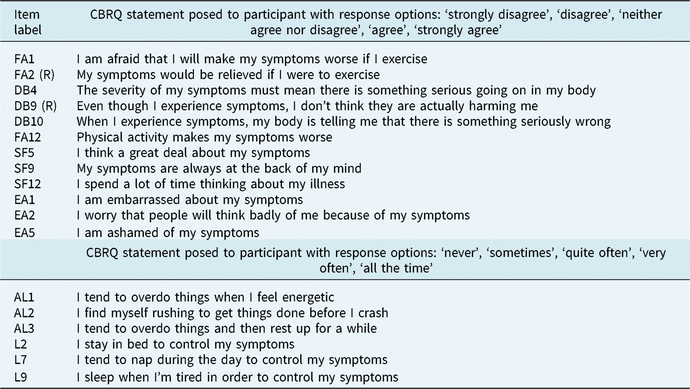
Adolescents completed the 40-item CBRQ (Ryan et al., Reference Ryan, Vitoratou, Goldsmith and Chalder2018). Each item is presented as a statement (e.g. ‘Physical activity makes my symptoms worse’) and respondents are asked to respond on a 5-point Likert scale; for the cognitive items, 0 = strongly disagree, 4 = strongly agree, and for the behavioural items, 0 = never, 4 = all the time (see Table 1). Two items (FA2 and FA9) are reverse scored, and higher scores indicate more unhelpful cognitive and behavioural responses. Scores on each item are summed to generate total scores for each of the seven subscales that form the 40-item CBRQ. In adults, the 18-item, shortened version of the CBRQ (CBRQ-S) had better psychometric properties than the 40-item version (Ryan et al., Reference Ryan, Vitoratou, Goldsmith and Chalder2018). The 18 items are scored in the same way as in the 40-item version, and form six subscales. In the current study, we evaluated both the 40-item version and the 18-item version (see Table 1 for the 18-item version; see Supplementary Material Table S1 for the 40-item version).
Items included on the 18-item CBRQ-S

AL, all-or-nothing behaviour; EA, embarrassment avoidance subscale; FA, fear avoidance subscale; DB, damage beliefs subscale; L, avoidance/resting behaviour; SF, symptom focusing subscale. Items denoted ‘R’ are reverse scored.
The following measures were used to assess construct validity, both convergent and discriminant validity. Where measures were available that have previously been used in adolescents with CFS, or validated for use in adolescents, these were selected.
Fatigue
The Chalder Fatigue Questionnaire (CFQ; Chalder et al., Reference Chalder, Berelowitz, Pawlikowska, Watts, Wessely, Wright and Wallace1993) consists of 11 items assessing the severity of mental and physical fatigue. Each item is rated on a 4-point scale with reference to the past month. Higher scores indicate more severe fatigue. The CFQ has been used extensively in samples of adolescents with CFS, including in treatment trials (Brigden et al., Reference Brigden, Beasant, Hollingworth, Metcalfe, Gaunt, Mills and Crawley2016; Lloyd et al., Reference Lloyd, Chalder and Rimes2012). Cronbach’s alpha in this sample was .89.
Physical functioning
The Short Form 36 Physical Functioning Scale (SF36PFS; Ware and Sherbourne, Reference Ware and Sherbourne1992) is composed of 10 items, each of which describe activities of daily living. Respondents are asked to indicate the extent to which they are limited by their health in each activity on a 3-point scale. Higher scores indicate better functioning. This measure is considered to be valid and reliable and has been used previously in adolescents with CFS (Chalder et al., Reference Chalder, Deary, Husain and Walwyn2010; Stulemeijer et al., Reference Stulemeijer, de Jong, Fiselier, Hoogveld and Bleijenberg2005). Cronbach’s alpha was .91.
School and social adjustment
The Work and Social Adjustment Scale (WSAS; Mundt et al., Reference Mundt, Marks, Shear and Greist2002) contains five items that respondents are asked to rate on a 9-point scale: their functioning in work, domestic, social and leisure activities and close relationships. ‘School/college’ was substituted for ‘work’ in this study, hence the scale will be referred to as the School and Social Adjustment Scale (SSAS). Higher scores indicate more impairment. Cronbach’s alpha was .81.
Anxiety
The State Trait Anxiety Inventory (STAI; Spielberger, Reference Spielberger1983) is made up of 40 items which assess, on 4 points, the extent of felt anxiety, both state anxiety experienced in response to specific threats or stressors (STAI-S), and trait anxiety which is sensitivity to threat more generally (STAI-T). Higher scores indicate more anxiety. The STAI has been used previously in adolescent CFS samples (Smith et al., Reference Smith, Martin-Herz, Womack and Marsigan2003). Cronbach’s alpha was .93 (STAI-S) and .92 (STAI-T).
Depression
The Children’s Depression Inventory (CDI; Kovacs, Reference Kovacs1992) is composed of 27 items, each rated on 3 point scales, which enquire about depressive symptoms including negative mood, ineffectiveness, anhedonia, low self-esteem and interpersonal problems, over the last fortnight. Higher scores indicate lower mood. The CDI has previously been used in adolescents with CFS (Nijhof et al., Reference Nijhof, Bleijenberg, Uiterwaal, Kimpen and van de Putte2011).Cronbach’s alpha was .90.
Procedure
All 11- to 18-year-olds who were offered an initial assessment at a specialist CFS unit were invited to participate. The questionnaires, and a letter of invitation explaining the use of this data for research and audit purposes, were enclosed with the initial assessment appointment letter and posted to all these patients. At the appointment, the study was discussed, and a patient information sheet shared. Older adolescents (age 16–18 years) or parents of younger adolescents (age 11–15 years) consented to participation in the study. Young adolescents gave their assent, in addition to parental consent.
Data analysis plan
Complete data on the CBRQ at initial assessment were available for 105 of 121 participants, and no item had more than 4.1% missing values. Due to the low percentages of missing values, no imputation method was undertaken. Participants with missing data were excluded analysis-by-analysis to use all available data.
Reliability
The seven subscales were scored using the approach taken in existing studies as shown in Table 3 (Chalder et al., Reference Chalder, Goldsmith, White, Sharpe and Pickles2015; Ryan et al., Reference Ryan, Vitoratou, Goldsmith and Chalder2018; Stahl et al., Reference Stahl, Rimes and Chalder2014) and a total score was calculated. With respect to the internal consistency, Cronbach’s alpha (Cronbach, Reference Cronbach1951), Cronbach’s alpha if item deleted (AID), and item-total correlations (ITC) were computed within each subscale. AID and ITC were computed to identify potential problematic items in terms of internal consistency.
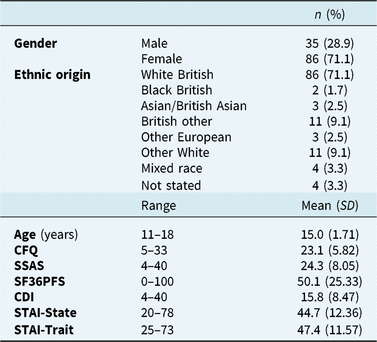
Participant demographics and clinical characteristics

CDI, Children’s Depression Inventory; CFQ, Chalder Fatigue Questionnaire; SF36PFS, Short Form 36 Physical Functioning; SSAS, School and Social Adjustment Scale; STAI, State-Trait Anxiety Inventory.
Validity
The correlations between the CBRQ total score and each CBRQ subscale score, and the total scores of the SF36PFS, SSAS, CFQ, STAI-S and CDI scales were examined to assess the construct (discriminant and convergent) validity. The correlation was considered to be strong if r > 0.7, moderate if r > 0.5, and weak if r > 0.3 (Rumsey, Reference Rumsey2015).
SPSS 24 (SPSS Inc., Chicago, IL, USA) and Stata 15.0 (StataCorp., 2017) software were used in the analysis.
Results
The sample consisted of 121 adolescents with CFS, mean age 15 years (SD 1.71), of whom 86 were female (71.1%). Most of the participants were White British (see Table 2 for details).
Reliability (internal consistency)
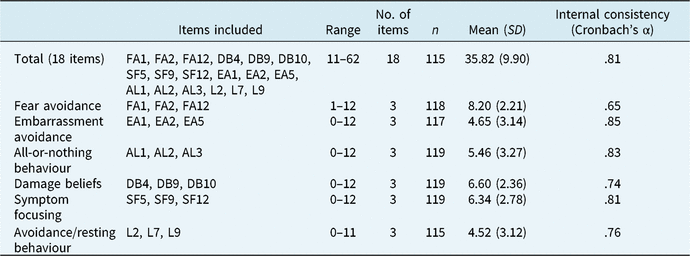
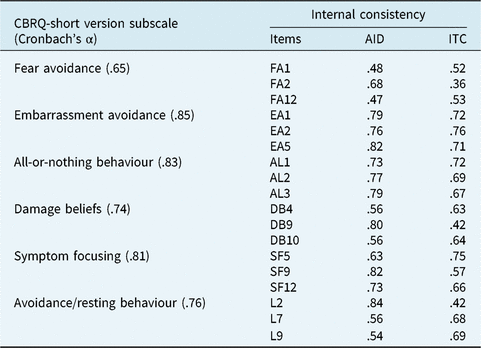
Cronbach’s α coefficient for the 40-item scale was 0.91, and for the CBRQ-S (18-item scale) was 0.81. The item-total correlations within each subscale for the 40-item scale ranged from 0.12 to 0.85, and for the CBRQ-S from 0.36 to 0.76. Cronbach’s α for each subscale on the 40-item CBRQ was ≥ 0.70, and ≥ 0.65 on the CBRQ-S (see Tables 3 and 4 for CBRQ-S, and Supplementary Material Tables S1 and S2 for the 40-item CBRQ).
18-item CBRQ-S subscale descriptive statistics, internal consistency and stability

AL, all-or-nothing behaviour; EA, embarrassment avoidance subscale; FA, fear avoidance subscale; DB, damage beliefs subscale; L, avoidance/resting behaviour; SF, symptom focusing subscale.
18-item CBRQ reliability indices at item level

AID, alpha if item deleted; ITC, item-total correlation.
Construct validity
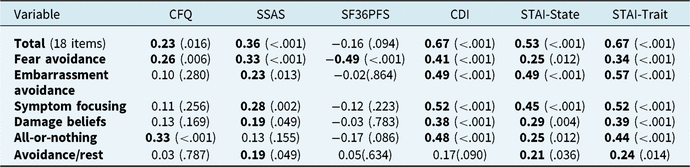
Increased anxiety and depression symptoms were weakly to moderately correlated with more unhelpful cognitive responses to symptoms (see Table 5 for CBRQ-S, and Supplementary Material Table S3 for the 40-item CBRQ). However, contrary to our expectations, fatigue was not strongly associated with unhelpful cognitive responses to symptoms, nor with more avoidance/resting behaviour. As predicted, embarrassment avoidance was more strongly associated with school and social functioning (convergent validity) than physical functioning (discriminant validity), although the association between embarrassment avoidance and school and social functioning was weak. As expected, disability was not strongly correlated with all-or-nothing behaviour, but contrary to expectations, all-or-nothing behaviour was weakly correlated with mood. As hypothesized, measures of disability (physical, social and school functioning) were more strongly associated with behavioural avoidance-rest patterns (convergent validity) than with all-or-nothing patterns.
Pearson’s correlation coefficient r (p-value) between CBRQ-S and selected measures

CDI, Children’s Depression Inventory; CFQ, Chalder Fatigue Questionnaire; SF36PFS, Short Form 36 Physical Functioning; SSAS, School and Social Adjustment Scale; STAI, State-Trait Anxiety Inventory.
Discussion
We undertook a psychometric evaluation of both the 40-item version and the 18-item version of the CBRQ in adolescents with CFS. As both versions were comparable, we present the data from the briefer version in the main paper as it minimizes the participant burden, and the data from the longer version as Supplementary Material. In summary, we found the 40-item CBRQ and the 18-item CBRQ-S to have good internal consistency and satisfactory construct validity. Some subscales were more reliable than others.
It was notable that the fear avoidance subscale did not perform as efficiently as expected, with lower consistency between items within the subscale. This could reflect a lack of understanding of the questions, which indicates that items may need to be worded differently for this population. The two reverse-coded items, one of which was in the fear avoidance subscale, and the other in the damage beliefs subscale, both scored particularly low on item-total correlations. Future research could undertake a factor analysis to explore which items cluster together in adolescents specifically, given that the subscales used in the current study were based on a factor analysis conducted in adults (Ryan et al., Reference Ryan, Vitoratou, Goldsmith and Chalder2018).
We consider the CBRQ to have good face validity (Ryan et al., Reference Ryan, Vitoratou, Goldsmith and Chalder2018). The items appear to reflect aspects of thought and behaviour that may be amenable to change. Correlations were in the expected directions with the CBRQ subscales correlating with measures of depression, anxiety and school and social functioning (i.e. measures of disability and distress). Beliefs have been found to correlate with disability and distress in other long-term conditions including adolescents with chronic pain (Gauntlett-Gilbert and Eccleston, Reference Gauntlett-Gilbert and Eccleston2007) and fibromyalgia (Schanberg et al., Reference Schanberg, Kredich, Keefe, Lefebvre and Gil1996). In the current study, correlations were in the expected directions, with, for instance, school and social functioning being associated with all CBRQ subscales (convergent validity) apart from all-or-nothing behaviour (discriminant validity). This makes sense as those who engage in all-or-nothing behaviour, doing lots on some days and very little on others, might well be better able to preserve their school and social functioning to some extent. This pattern is described by adolescents with CFS in qualitative studies (Hareide et al., Reference Hareide, Finset and Wyller2011; Parslow et al., Reference Parslow, Anderson, Byrne, Shaw, Haywood and Crawley2018). Engaging in avoidance/rest behaviour more consistently and endorsing embarrassment avoidance beliefs was associated with poor school and social functioning, which again, would be expected (convergent validity). Determining the predominant activity pattern may have important treatment implications, as a predominance of all-or-nothing behaviour is likely to require activity stabilization prior to gradually increasing activity levels (Heins et al., Reference Heins, Knoop, Burk and Bleijenberg2013). The behavioural subscales of the CBRQ may provide a means to gather information about activity pattern as part of the assessment process.
However, scores on the CBRQ subscales were not significantly correlated with fatigue or with physical functioning. The exception was fear avoidance which was associated with both fatigue and physical functioning, and all-or-nothing behaviour which was associated with fatigue. The fact that fear avoidance correlates with fatigue and physical functioning implies that fear avoidance may be key in a model of CFS in adolescents. Similarly, all-or-nothing behaviour may be central in understanding the perpetuation of fatigue in this context. It is a more surprising finding that the CBRQ total score did not correlate with physical functioning (SF36PFS), even though it did correlate with school and social functioning. It may be that the items on the SF36PFS, designed to assess activities of daily living in adults (e.g. the item ‘lifting or carrying groceries’), are not as relevant to adolescents. An item such as ‘lifting or carrying a heavy school bag’ may be more appropriate. However, despite this, the reliability of the scale was high in the current study.
In the future, the CBRQ may provide a useful way to examine the extent to which cognitive and behavioural factors maintain fatigue, and the mechanisms of change during treatment for CFS. Adolescence is the developmental stage where individuals develop autonomy and independence from their parents. In this context, beliefs may not be stable, and may change more rapidly than in adults. Furthermore, parental illness beliefs may continue to be important in influencing the illness beliefs and coping of adolescents (Chalder et al., Reference Chalder, Deary, Husain and Walwyn2010), particularly as being ill may have disrupted normal adolescent development and impacted on the process of individuation (Taylor et al., Reference Taylor, Loades, Brigden, Collin and Crawley2017). Therefore, parental illness beliefs as well as those of adolescents themselves will be important to investigate in future studies.
Strengths and limitations
Our consecutive recruitment of adolescents presenting to a specialist CFS unit is likely to have limited selection bias, although our sampling was restricted to those attending specialist services. Therefore, the results might not be generalizable to those who are too severely affected to attend, or those who are mildly affected and are managed in primary care. We recruited more females than males, which is expected, based on the epidemiology of CFS from adolescence onwards (Crawley, Reference Crawley2014).
We opted to evaluate a measure of cognitive and behavioural responses to symptoms that was originally developed for adults. As such, it is possible that cognitions or behaviours specific to the developmental period of adolescents were missed. As there is no existing measure of cognitive and behaviour responses to symptoms in adolescents, there was no direct comparator available for assessing construct validity. Although this lack of comparable measures poses a problem for psychometric analysis, it also highlights the need for the current study. The psychometric properties of the CFQ and the SSAS, used to assess validity, have also not been established in adolescents. Finally, we did not examine test–retest reliability or sensitivity to change, which will be important to establish prior to using the CBRQ as an outcome measure in treatment trials.
Conclusion
Our study found that both the 40-item and the 18-item versions of the CBRQ were reliable (internal consistency), with some evidence of validity in adolescents with CFS. To minimize unnecessary burden for fatigued adolescents, the 18-item version would be favourable, given that it performed as well as the 40-item version. More psychometric evaluation is required including sensitivity to change and factor structure in adolescents. Our findings suggest that the CBRQ could be a promising measure to use for assessing cognitive and behavioural responses to symptoms. Understanding more about these responses will enable a more comprehensive assessment in clinical practice at an individual level.
Financial support
This study did not receive any direct funding.
Conflicts of interest
T.C. is the author of several self-help books on chronic fatigue for which she has received royalties. T.C. (King’s College London, KCL) has received ad hoc payments for workshops carried out in long-term conditions. KCL have received payments for T.C.’s editor role in the Journal of Mental Health. K.R. has co-authored a book with T.C. called Overcoming Chronic Fatigue in Young People, for which she receives royalties. M.L., S.V. and S.A. have no conflicts of interest to declare.
Supplementary material
To view supplementary material for this article, please visit https://doi.org/10.1017/S1352465819000390.
Author ORCID
M. E. Loades, 0000-0002-0839-3190
Acknowledgements
M.L. receives salary support from the National Institute for Health Research (NIHR) Doctoral Research Fellowship Scheme. T.C. and S.V. acknowledge the financial support of the Department of Health via the National Institute for Health Research (NIHR) Specialist Biomedical Research Centre for Mental Health award to the South London and Maudsley NHS Foundation Trust (SLaM) and the Institute of Psychiatry at King’s College London. This paper represents independent research funded by the National Institute for Health Research (NIHR) Biomedical Research Centre at South London and Maudsley NHS Foundation Trust and King’s College London. The views expressed are those of the authors and not necessarily those of the NHS, the NIHR or the Department of Health and Social Care. The authors would like to thank all the young people and their families who took part in this study, and Kate Lievesley who contributed to data collection.
Ethical statement
The authors have abided by the Ethical Principles of Psychologists and Code of Conduct as set out by the APA: http://www.apa.org/ethics/code/. This research was approved by an NHS research ethics committee (LREC, reference no. 08/H0807/107), and the Research and Development departments at the South London and Maudsley (SLaM) NHS Trust, and Great Ormond Street Hospital. The clinical audit committee of the Psychological Medicine Clinical academic group of SLaM also approved the collection of routine outcomes.




Comments
No Comments have been published for this article.