1 Introduction
Tags are widely acknowledged as an important feature of colloquial English and thus have been the subject of a good deal of research. For instance, question tags found in Present-day British English (PDBE) such as It's going to be the dirtiest election that there's even been, isn't it? and She's been to the library, hasn't she? have been investigated by Tottie & Hoffmann (Reference Tottie and Hoffmann2006), amongst others. By contrast, right-dislocated lone pronoun tag (ProTag) constructions such as those in (1) have received little attention in spite of being present in corpora of PDBE.Footnote 2
(1)
(a) iti's gonna be <pause> the dirtiest election that there's ever been, thisi. (BNC-KCF/255)
(b) We've often seen heri in the library, heri. (BNC-KCM/994)
The dearth of work on ProTag constructions generally may be due to their more limited distribution because, even though for some speakers sentences such as those in (1) are perfectly natural, in other varieties (1a) and (1b) are not acceptable.
ProTags appear in Early Modern English (EModE), as the examples in (2) illustrate, but they too have received very little attention.
(2)
(a) Thisi may haue credit, and chimes reason, thisi! (Jonson, NI 2.5.113)
(b) chiron wei hunt not wei, with horse nor hound (Shakespeare, Tit 2.25)
The most obvious difference between ProTags in EModE and PDBE relates to case. Compare the forms of the personal pronoun in bold in (1b) and (2b). In EModE, the default form of the pronoun is the subjective/nominative rather than the objective/accusative as it is in PDBE; see Denison (Reference Denison and Britton1996).
The ProTag construction, if discussed at all in the literature, tends to warrant brief and passing mention only, being characterised as ‘a pleonastic pronominal … repeated at the end of the sentence for the sake of emphasis’ (Partridge Reference Partridge1953: 29; see also Schlauch Reference Schlauch1959: 99) or as a means by which ‘the subject pronoun gets special emphasis by its being repeated in the same form at the end of the utterance’ (Visser Reference Visser1963: 56). This article presents the first systematic investigation of the form and functions of the ProTag construction in a historical variety of English. As such, its primary aim is to document its defining characteristics in EModE. We will also consider its development between EModE and PDBE in relation to regular mechanisms of language change.
In this study, we investigate pronouns used as tags in EModE by examining the works of Jonson, Marlowe and Shakespeare. In section 2, we provide an introduction to the ProTag construction by reviewing its form and functions in PDBE according to the most comprehensive work on this topic to date, viz. Mycock (Reference Mycock2019). After describing our corpus and outlining our methodology (section 3), we begin by determining the formal properties of this construction and its functions in EModE (section 4). We then compare our findings for ProTags with those of Tottie & Hoffmann (Reference Tottie and Hoffmann2009) for tag questions in EModE (section 5). The properties of ProTag constructions in EModE are then compared with those of ProTag constructions in PDBE in order to evaluate the extent to which they are similar and to learn more about their development (section 6). Finally, we present our conclusions (section 7). The results of this research provide us with new insights into the form, functions and development of tag constructions.
2 Introducing ProTag constructions
Prior to Mycock (Reference Mycock2019), the ProTag constructionFootnote 3 in English had been the subject of sociolinguistic research (for example, Snell Reference Snell2008; Moore & Snell Reference Moore, Snell, Gregersen, Parrott and Quist2011) and received brief mention in some grammars of varieties of British English (for example, Biber et al. Reference Biber, Johansson, Leech, Conrad and Finegan1999; Shorrocks Reference Shorrocks1999), but systematic investigation of its form and functions was lacking. The history of this construction has received even less attention, with the result being that what is known about the existence of ProTags and their features in earlier varieties is limited and partial. In this article, we set out for the first time the defining characteristics of the ProTag construction in EModE and then compare it to its counterpart in PDBE in order to determine the extent to which they differ, and hence how the construction has changed over this period. We begin with a review of Mycock's (Reference Mycock2019) findings in relation to PDBE in order to introduce what is likely to be an unfamiliar construction and to highlight those features of it which may be subject to variation and therefore must be considered in any research on it, including this study of ProTags in EModE.
2.1 Form
Based on searches of four corpora comprising written data (GloWbE, Davies Reference Davies2013; NOW, Davies Reference Davies2016–), spoken data (DECTE, Corrigan et al. Reference Corrigan, Buchstaller, Mearns and Moisl2012–) or a combination of the two (BNC 2007), which include data from either the standard dialect plus a range of non-standard dialects potentially (BNC, GloWbe and NOW) or a single non-standard dialect (DECTE), Mycock (Reference Mycock2019) identifies defining properties of the ProTag construction in PDBE in relation to its three key components: the ProTag, the anchor and the anchor point, illustrated in (3).
(3)

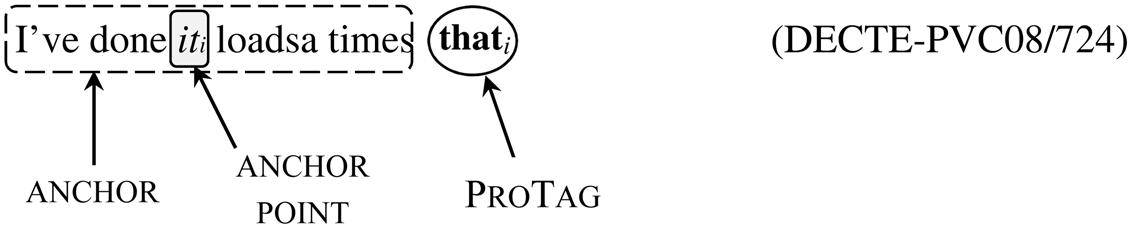
The ProTag (given in bold in examples throughout this article) can be any demonstrative or personal pronoun except for it in PDBE (that or this is used instead, as shown in (3)). Personal pronouns used as ProTags appear in the default objective (non-nominative) case; see (1b). The availability of personal ProTags appears to be restricted to certain regional and/or social varieties, though which ones precisely is as yet unclear; demonstrative ProTags, in particular that, appear to be more widely available.
The mood of the clause to which a ProTag is appended (the anchor) can be declarative, as in (3), interrogative or exclamative. There is no evidence that the anchor can be imperative in PDBE. Mycock (Reference Mycock2019) excludes from consideration examples of the type You little raver, you (BNC-BP7/1552) because they have been classified as a distinct type of construction. Biber et al. (Reference Biber, Johansson, Leech, Conrad and Finegan1999) state they are exclamatives that superficially resemble vocatives, while Corver (Reference Corver2008) assigns the anchor in such examples to the category evaluative vocative.Footnote 4 We likewise exclude examples such as thou knaue thou (Shakespeare, 1H4 3.3.106) from our study of EModE.
The ProTag's antecedent (the anchor point, given in italics in each example) is concordant with the ProTag with respect to person, number and gender features, though not necessarily identical in form, as (3) shows. The anchor point need not be overtly realised but when it is, overwhelmingly it is itself a pronoun. The anchor point is usually the subject, as in (1a), but examples were also identified in which it is the direct object, as in (1b) and (3), the indirect object or a possessor.
2.2 Functions
Unlike other right-dislocated nominal expressions, ProTags do not provide clarification of their antecedent's referent, nor do they represent afterthoughts (Mycock Reference Mycock2019: 254–5). Rather they represent a type of pragmatic marker appearing in the ‘right periphery’ position, the same as question tags (see Traugott Reference Traugott2016).Footnote 5 In classifying the functions of ProTag constructions, Mycock (Reference Mycock2019) adopts (with a minor emendation) the functional classification of tag questions proposed in Barron et al. (Reference Barron, Pandarova and Muderack2015: 501), a work which builds on the insights of previous influential analyses of tag-question functions including Holmes (Reference Holmes1995), Algeo (Reference Algeo, Ricks and Michaels1990), Tottie & Hoffmann (Reference Tottie and Hoffmann2006, Reference Tottie and Hoffmann2009), Axelsson (Reference Axelsson2011) and Kimps et al. (Reference Kimps, Davidse and Cornillie2014).Footnote 6 Mycock (Reference Mycock2019) tested whether Barron et al.'s (Reference Barron, Pandarova and Muderack2015) taxonomy can be used to classify the functions of ProTag constructions and found that the categories were ‘not just applicable … but sufficient’ (Mycock Reference Mycock2019: 267). Mycock concludes that ProTag constructions in PDBE display a subset of the functions identified by Barron et al. for tag questions, and thus that tag constructions share a set of core functions. The five possible functions of ProTag constructions in PDBE belong to one of two major categories: ‘Statement’ or ‘Desired Action’. Below we provide a definition of each sub-function with illustrative examples from Mycock (Reference Mycock2019). ProTags are inherently multifunctional. In each case, the example's primary function in context is identified. This does not preclude it having other non-primary functions.
Statement: used to give information; the primary knower (see Kimps et al. Reference Kimps, Davidse and Cornillie2014) is the speaker; does not expect a response.
Stating a fact/opinion: communicates facts or expresses the speaker's personal beliefs, assessments, and attitudes (positive or negative) towards a topic or the addressee.
(4) I’m a floating voter, me. (BNC-KPM/561)
Acknowledging response: acknowledges the addressee's preceding assertion, signalling interpersonal accord.
(5) A: Erm, you see the quality.
B: It's good quality, that. (BNC-KSN/648)
Challenging: represents an attack; the subject of the attack is teased, mocked, contradicted, threatened, accused, or reproached in order to gain power by undermining their positive face.
(6) God I'd kill her I’d get rid of her me (DECTE-PVC15/559)
Mycock (Reference Mycock2019) found it necessary to emend Barron et al.'s (Reference Barron, Pandarova and Muderack2015) definition of the ‘Challenging’ function. As originally used to classify tag-question functions, ‘Challenging’ was specified as involving a direct attack on the addressee. However, Mycock (Reference Mycock2019) identified ProTag constructions which were consistent with this definition in all respects except for the fact that the attacks involved were indirect. Notice how in (7) the ProTag construction used by the mother represents an indirect attack on the accused.
(7) A grieving mother pointed an accusing finger across a courtroom at the man accused of murdering her daughter and shouted: ‘He is mine, him.’ (BNC-K4E/820)
The mother does not address the accused directly; she does not shout ‘You are mine, you’ (meaning I shall kill you myself). Nonetheless, this woman is threatening the man in the dock in order to undermine his positive face. Thus, this ProTag construction's primary function is ‘Challenging’. Returning to the use of the ProTag construction in (6), the context makes clear that this is an example where the threatened individual is not even present. Regardless, it is still the case that the speaker, by issuing this threat, seeks to gain power by undermining that person's positive face in front of others who know them.
Conversational joking: enables the speaker ‘to “present a personality, share experiences and attitudes, and promote rapport” in an entertaining fashion (Norrick Reference Norrick2003: 1345)’ (Barron et al. Reference Barron, Pandarova and Muderack2015: 505); may involve irony or understatement and be accompanied by laughter. Notice how the speaker in (8) jokingly characterises her decision not to leave home as childish and the accompanying laughter.
(8) I wasn't going to move away. I I didn't want to leave my Mam and my Dad. That sounds proper kiddie that <laughter> doesn't it! ‘I don't want to leave my Mam.’ No but I actually didn't want to leave my Mam I think it'd be too much for us <pause> and I couldn't really afford it and (DECTE-2010-24/12)
Desired action: Commissive or directive used in the exchange of goods and services (rather than information).
Give: offers, advice, suggestions. In (9), a teacher B gives advice to a student A.
(9) A: Oh zero eight, yeah sorry zero eight.
B: Yeah, okay. That's the only thing to watch, that. (BNC-FM4/1137)
We shall consider the functions of ProTags in EModE, testing the version of Barron et al.'s (Reference Barron, Pandarova and Muderack2015) taxonomy adopted by Mycock (Reference Mycock2019) against our data, in section 4.2. As we shall see, the set of functions we identified was similar but not identical to that identified in PDBE by Mycock and thus has been subject to change.
3 Data and methodology
Mycock's (Reference Mycock2019) findings indicate that the ProTag construction is relatively rare in PDBE. The scant reference to this construction in the literature on EModE leads one to suspect that the same is likely to be true of this earlier variety of English. There is also the issue that tags are overwhelmingly a feature of spoken English, making the study of tags in historical varieties even more of a challenge. The closest available approximation to speech is text from contemporary drama, with comedy in particular representing an important source (Culpeper & Kytö Reference Culpeper and Kytö2000). It was this type of data that was the basis for Tottie & Hoffmann's (Reference Tottie and Hoffmann2009) research on tag questions in English in the sixteenth century.Footnote 7
We decided to focus our searches for ProTags on dramas by playwrights in which tag question use was relatively common on the basis that these were most likely to yield examples of other tag constructions. In this way, we sought to optimise the possibility of identifying a set of examples that would give a fuller picture of the form and functions of ProTag constructions as they occurred in EModE despite the likelihood that this construction would occur relatively infrequently. Works by Jonson, Marlowe and Shakespeare provided 55 per cent (n = 75, out of a total of 136) of all of the examples of tag questions identified in Tottie & Hoffmann's (Reference Tottie and Hoffmann2009) study,Footnote 8 so preliminary work was undertaken to determine whether ProTag constructions were also a feature of these playwrights’ works. An initial search revealed examples of ProTags in the works of all three. For this first systematic investigation of ProTags in EModE, we have therefore chosen to focus on the dramas of Jonson, Marlowe and Shakespeare. Our corpus is smaller than the one investigated by Tottie & Hoffmann (Reference Tottie and Hoffmann2009) because of this narrower scope, concentrating as it does on fewer playwrights and a smaller total number of plays (69 versus 197). This reflects the more labour-intensive nature of our task, which necessarily involved searching for and analysing individual words, viz. all instances of nominative personal pronouns and demonstrative pronouns, in the dramatic works of these three playwrights, rather than strings of words that together form multiword tags. Our results provide an interesting point of comparison with previous work on the history of question tags, and augment and extend our knowledge of tag constructions more generally in the history of English.
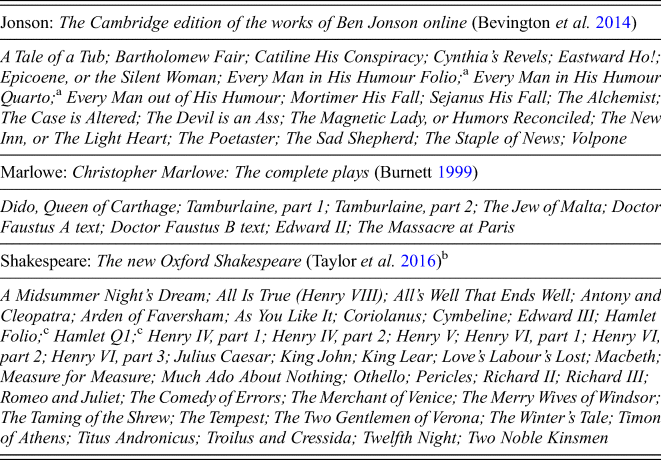
Focusing on these three playwrights gives a corpus of 69 plays that represents the period from around 1587 (the earliest possible date of performance for Marlowe's Dido, Queen of Carthage) to 1637 (Jonson's death). Whilst the plays attributed to Marlowe and Jonson are generally accepted without contention, recent scholarship on collaborative authorship has nuanced the Shakespearean canon. To reflect these most recent studies, and to take a maximalist approach to inclusion in our corpus, we include the complete plays attributed to Shakespeare in the New Oxford Shakespeare (Taylor et al. Reference Taylor, Jowett, Bourus and Egan2016). A full list of the works included in our corpus is provided in table A1 in the Appendix.
Any linguistic corpus compiled from early modern literary texts is fraught with the challenges negotiated by the practice of textual criticism. Rather than a single, authoritative source for these texts, we are faced with an array of versions, editions and states, many of which have legitimate but mutually exclusive claims to authority.Footnote 9 To give a notoriously problematic example, the single work Hamlet has three main texts: a quarto edition published in 1603 (known as Q1), a second quarto published in 1604 (Q2) and the text contained in the ‘First Folio’ of 1623 (F1). Thought to be based on three different sources (either manuscripts or a performance of the play), each text contains substantial differences, adding, omitting or altering material now thought to be key parts of the play. The Folio text, for instance, contains some 1,400 lines not found in Q1.
Textual criticism has offered various theories and methods as to how we might derive a single Hamlet, or a single edition of any text, from its many available iterations. Traditionally, this has prioritised the reconstruction of a text that most accurately reflects the author's intent. To reach this point, a range of evidence can be applied, from internal matters of literary style and perceived quality, to historical, documentary evidence. The final product is often a conflation of several sources, giving the modern reader an ‘ideal’ text: a new text for which there may be no exact historical precedent. Whilst these modern editions are useful tools for readers, dramatists and literary scholars, as later creations they are not appropriate for historical linguistic studies.
This study therefore follows the rationale behind the school of textual criticism known as ‘unediting’ (see Marcus Reference Marcus1996; McLeod Reference McLeod1981). Unediting acknowledges that centuries of editorial convention and tradition impose on a text certain ideological or linguistic features not found in their time. In returning to the text's earliest incarnations, practitioners of unediting read texts in their native historical contexts. This is especially pertinent due to the nature of our object of study. As is the case for PDBE, descriptive studies of EModE have neglected the ProTag construction, or omitted it entirely. It is absent, for instance, from Abbott's otherwise thorough A Shakespearean Grammar (Reference Abbott1884). In this work, we seek to raise awareness of the ProTag as a linguistic feature not only in the works of these three playwrights but also in EModE more generally.
This study's corpus therefore comprises the earliest available texts of the plays, and does not rely on modern editions except for standardising line numbers for reference purposes. In doing so, we do not intend to present these first editions as purely authorial: they are likewise subject to the influence of those involved in producing the editions such as typesetters or transcribers. However, the fact of these non-authorial influences is not problematic for linguistic study: by selecting the earliest available texts, we guarantee that the corpus is reflective of contemporaneous usage, and not influenced by a more recent editor. Whether these texts faithfully reflect the authorial intent of Jonson, Marlowe and Shakespeare or not, they are certainly examples of EModE. For this reason, we also included co-authored works such as Eastward Ho! in our corpus (written by Jonson, George Chapman and John Marston).
The theoretical rationale behind using the earliest available texts is supported by a practical exigency: the database used for the source texts, EEBO-TCP, prioritises first editions, often ignoring later editions of the text.Footnote 10 The Text Creation Partnership (TCP) is an on-going project that creates fully searchable electronic texts transcribed from early printed books; EEBO-TCP is the part of this project that uses books digitised on the Early English Books Online database (EEBO) as its source – so far, roughly 50 per cent of EEBO books have been encoded. Transcribed by humans, EEBO-TCP is more accurate than texts created with Optical Character Recognition software. As literal transcriptions of their source texts, EEBO-TCP makes no editorial intervention, representing, for instance, typographical errors as they appear in the digitised books.
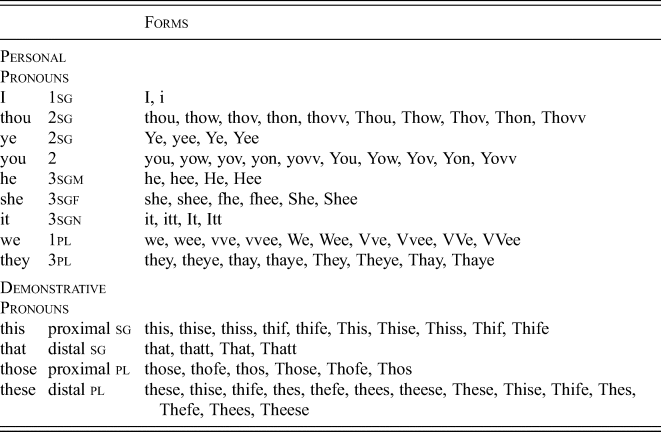
To search for ProTags, the selected editions were identified in EEBO, and the link to their EEBO-TCP text followed, giving the entire text in a single browser window. A browser extension called Multi-highlight was used to highlight all demonstrative and nominative-form personal pronouns in the text.Footnote 11 This extension allows the user to input multiple search strings, and highlights them all at once in the browser. One pronoun was searched at a time, but with multiple variants of spelling. This accounted for spelling and orthography variants common to EModE, for example yow for ‘you’. Given EEBO-TCPs literal transcription of the original text, we also checked for common typographical variations such as a double v for w, and errors such as yon for ‘you’.Footnote 12 A full list of the variant forms searched for is given in table A2 in the Appendix.
Once searched, Multi-highlight highlights each form in a different colour, allowing the user to scroll through the entire text and easily locate and check each pronoun. If a pronoun was identified as a potential ProTag, it was collected into a spreadsheet. These were later read more closely, referring to the context as necessary, and confirmed or rejected as ProTags. Each ProTag was located in a standard edition of the playwrights’ works to allocate it line and scene numbers for reference purposes. These data are available via the Oxford University Research Archive (www.ora.ox.ac.uk). The editions used are The New Oxford Shakespeare (Taylor et al. Reference Taylor, Jowett, Bourus and Egan2016), The Cambridge Edition of the Works of Ben Jonson Online (Bevington et al. Reference Bevington, Butler and Donaldson2014) and Christopher Marlowe: The Complete Plays (Burnett Reference Burnett1999).
A further type of search result involved an ambiguity that required evaluation on a case-by-case basis. In EModE texts, I is an acceptable spelling variant for aye, which in modern spelling editions is routinely changed to ay or aye, as suggested by Foakes in his edition of King Lear (Reference Foakes1997). In the prefatory explanation of his editorial methodology, Foakes explains that ‘Some unusual spellings are noted, especially where they may suggest the way a word was pronounced, but common variants such as “I” for “Ay” … are not recorded unless some ambiguity seems to be involved.’ Despite this editorial tendency towards aye, many examples are entirely consistent with I being a 1sg nominative pronoun used as a ProTag. For instance:
(10)
(a) I will not trust you, I, Nor longer stay in your curst company. (Shakespeare, MND 3.2.342)
(b) I doe defie him, I, (Jonson, Devil 5.8.139)
Whilst many modern editions follow Foakes’ policy and change such instances of I to ay or aye, some retain such examples as pronouns. Frequently, an editorial note explicitly stating the ambiguity follows either decision. To give one example:
(11) And I commend them I, that can vse art, With such iudiciall practise. (Jonson, Case 4.6.18)
Example (4) is followed in the Cambridge University Press online edition of Jonson's works with the note ‘“I”… can be understood as “ay” or “I”’ (Commentary note 19). Such editorial uncertainty, possibly related to the editors’ lack of familiarity with ProTag constructions, shows that the ambiguity remains unresolved, and they ultimately defer the responsibility of interpretation from the editor to the reader. We have therefore considered each of the ambiguous I/aye examples in their dramatic contexts, and retained those that exhibit the features of ProTags consistent with the fundamental insights in Mycock (Reference Mycock2019) but to be defined specifically for EModE in section 4. We hope that the new context offered by this research may help inform future editors’ decisions regarding this particular ambiguity.
4 Results
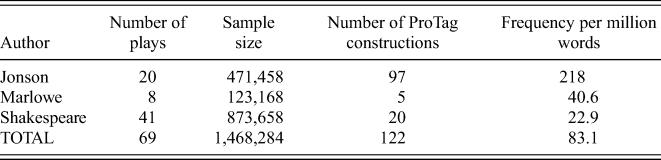
Our search of the dramas of Jonson, Marlowe and Shakespeare, a corpus of over 1.4 million words, identified 122 examples of the ProTag construction, an overall frequency per million words (fpmw) of 83.1. The ProTag construction in EModE is therefore relatively rare, as predicted. In table 1 we provide details of the occurrence of ProTag constructions. Marlowe and Shakespeare show fpmw counts of 40.6 and 22.9, respectively, while Jonson is a much more frequent user of ProTag constructions (fpmw count of 218). This is also in line with expectations: Tottie & Hoffmann (Reference Tottie and Hoffmann2009) found Jonson to be the most prolific user of tag questions in their corpus of sixteenth-century drama.
Occurrence of ProTag constructions in the dramas of Jonson, Marlowe and Shakespeare: an overview

Having established that ProTag constructions are present in our corpus, we turn next to the features of their constituent parts, namely the lone pronoun that can be used as a tag – the ProTag; the anchor – the syntactic unit to which the tag is attached; and the anchor point – the element in the anchor with which the ProTag is corerefent.
4.1 Formal properties of the ProTag construction
4.1.1 The tag
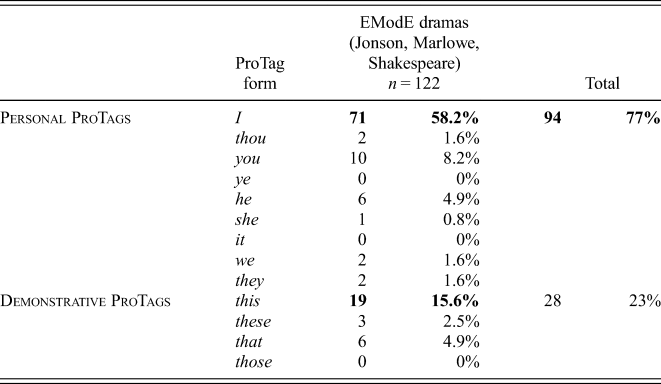
The results of our EModE corpus search for pronouns used as tags are presented in table 2. High proportions appear in bold.
ProTags in the dramas of Jonson, Marlowe and Shakespeare

We did not find any occurrences of it, ye or those being used as ProTags. Instead of it, a demonstrative singular pronoun is used as a ProTag when the antecedent is 3sgn:
(12)
(a) S'lud, iti's a Hogs Cheeke and Puddings in a Peuter field thisi (Jonson, EMO 3.1.191)
(b) iti doth vtterly annule, and annihilate, thati. (Jonson, Epicene 5.3.136)
Mycock (Reference Mycock2019: 258) suggests that a ProTag may need to at least have the capacity to bear stress. The lack of ProTag it may have its roots in the fact that it was originally the weak subject form of the 3sgn pronoun, its strong counterpart being hit; see Nevalainen (Reference Nevalainen2006). Further research into earlier varieties of English is required to test the hypothesis that it is the origin of it as a weak form which has led to this ‘gap’.
Use of ye as a ProTag is not attested, though examples of ProTag you are found. This may reflect the fact that you was in the process of becoming the default nominative 2nd person formal pronoun in the sixteenth century, replacing ye (see Nevalainen Reference Nevalainen2006: 80), and/or the extent to which the two forms were capable of receiving stress.Footnote 13
Finally, there are no examples of ProTag those in our corpus. However, we do not regard this as convincing evidence that those was not a possible ProTag in EModE. We note not only that there are far fewer examples of the distal compared to the proximal singular demonstrative ProTag (for that, n = 6; for this, n = 19), but also that there are only three examples of the proximal demonstrative plural these. Given that in EModE singular distal demonstrative ProTags are rare, and plural proximal demonstrative ProTags are rarer still, it is important not to read too much into the lack of ProTag those examples in our study. Further research is required to shed light on the question of whether such a ProTag was possible in EModE.
4.1.2 The anchor
The anchor to which a ProTag attaches can be a clause or a phrase. In (13) we see examples in which the anchor is a simple clause.
(13)
(a) Alas, you’r simple you (Jonson, EMO 2.3.146)
(b) They are prettie waking dreames; these. (Jonson, East. Ho! 5.1.69)
A complex clause can also be the anchor for a ProTag. If the anchor point for the ProTag appears in the matrix clause, the ProTag can appear either after the subordinate clause or after the matrix clause. This is true whether the subordinate clause is finite (14a, b) or non-finite (14c, d).
(14)
(a) I told you I, [he was a franticke foole], (Shakespeare, TS 3.2.12)
(b) I think [you are made of Ingenuitie], I (Jonson, EMO 3.3.108)
(c) I come not, I, [to reade a lecture here in Britaine] (Marlowe, JOM Prologue.28)
(d) Nay, we haue no Art [to please our friends], we. (Jonson, EMO 4.4.13)
With respect to phrases that can be anchors, we identified examples of noun phrases (15a), adjective/adverb phrases (15b) and prepositional phrases (15c) acting as anchors. Each of these could be analysed as instances of ellipsis (involving omission of subject and verb), reflecting a style reminiscent of speech.
(15)
(a) Noun phrase
The Bretherens mony, this. (Jonson, Alch. 5.4.109)
(b) Adjective or Adverb phrase
Very dreadful that! (Jonson, Epicene 3.5.67)
(c) Prepositional phrase
At's prayers, Sir, hee, Good man, (Jonson, Alch. 2.2.29)
Most of our examples have an anchor whose mood is declarative (16), but interrogative anchors such as those in (17) are also found.
(16) Declarative
Faith no, she saw the Gentleman as bright as noon-day shee (Jonson, EMO 5.2.98)
(17) Interrogative
(a) Yes/no
Doe you heare, You, Goodman slaue? (Jonson, Poet. 3.4.14)
(b) Wh-question
Why do you heare? you. (Jonson, EMI 1.4.109)
There are no examples of exclamative anchors in our corpus. We note that Mycock (Reference Mycock2019: 260) only identified one example in her study of PDBE corpora which totalled over 980 million words. Exclamative seems to be a rare anchor mood type in English ProTag constructions, if it occurs at all.
Mycock (Reference Mycock2019: 260) reports a lack of evidence that an imperative can be an anchor in a PDBE ProTag construction. In our EModE data, there appears to be one example:
(18) Imperative
Auoid these fumes, these superstitious Lights,
And all these coos'ning Ceremonies; You. (Jonson, Sej. 5.1.199)
One might query whether (18) is an example of an imperative anchor given that ‘all early grammarians [of EModE] give the imperative with the subject’ (Rissanen Reference Rissanen and Lass1999: 277) and the subject does not appear in the anchor. However, Wallis (Reference Wallis1653 [1972]: 348, cited by Rissanen Reference Rissanen and Lass1999: 277) states that the subject is ‘very often’ omitted from imperatives.Footnote 14 Thus (18) is consistent with having an imperative anchor.
4.1.3 The anchor point
The anchor point and the coreferential ProTag have the same values for person, number and gender features (19a, b), though a demonstrative ProTag can have as its anchor point a personal pronoun (13b), repeated here as (19c).
(19)
(a) Sbloud hei keeps High men, & Low men, hei; (Jonson, EMO 3.1.374)
(b) thesei shalbe to you In place of Parents, thesei your Fathers, Thesei, And not vnfitly: (Jonson, Sej. 3.1.79)
(c) Theyi are prettie waking dreames; thesei. (Jonson, East. Ho! 5.1.69)
The anchor point can also be covert. This is true of both personal ProTags (20a) and demonstrative ProTags (20b).
(20)
(a) fortie times and not so few, hee. (Jonson, EMO 4.3.228)
(b) Very well this. (Jonson, East. Ho! 4.2.169)
When the anchor point is overt, it is itself a pronoun. A possible exception to this generalisation is nothing in (21), but it cannot be ruled out that the anchor point for the ProTag in this example is the 3sgm subject pronoun because in EModE a demonstrative pronoun could still be used to refer to a human (see, for instance, Rissanen Reference Rissanen and Lass1999: 195).
(21) Alas! hee can do nothing! this! (Jonson, Devil 4.4.78)
With respect to its grammatical function, overwhelmingly the anchor point is the subject. However, despite the characterisation present in the literature that the ProTag is a repeated subject pronoun (see section 1), this is not the only possibility. In (22), we see that the anchor point is the direct object.
(22) I shall forestall theei Lord Vlysses, thoui: (Shakespeare, T&C 4.6.231)
Example (22), in addition to the examples in (12) and example (19c), also shows that the anchor point and ProTag need not be identical in form despite previous characterisations.
The anchor point can appear either in a subordinate clause (23a) or a matrix clause (23b, c). When the anchor point is in the matrix clause, the ProTag can appear after either the subordinate (23b) or the matrix clause (23c); see also (14).
(23)
(a) I dare be sworne [heei scornes thy house] heei. (Jonson, EMI 1.3.25)
(b) Sblood, Ii thinke [he feeds her with Porridge] Ii: (Jonson, EMO 2.2.138)
(c) Ii tell thee Ii, [that thou hast marr'd her gowne]. (Shakespeare, TS 4.3.113)
The most common embedding verb in complex sentences with a ProTag attached is think.Footnote 15
The works of Jonson and Marlowe also include examples in which a 1sg ProTag appears after the head noun and before the modifying clause in a relative clause construction:
(24) I am none of these common pendants [sic] I, That cannot speake without propterea quod. (Marlowe, ED2 2.1.52)
In all cases, such examples appear in blank verse. It may be that the inclusion of a ProTag in this particular position is related to meter.Footnote 16
In this section, we have discussed the formal properties of ProTag constructions in our EModE data. Our next task is to determine what the functions of these constructions are.
4.2 Functions
Mycock (Reference Mycock2019) argues that the extremely strong tendency for the anchor point to be a pronoun, if it is not indeed elided, is related to information structure. Pronouns represent ‘old’ information. It may well be that the ProTag construction in English has, more specifically, a topic-marking function. We have seen that there are very strong tendencies for the anchor point to be a pronoun and for it to bear the grammatical function subject in EModE (section 4.1.3), consistent with acknowledged default properties of topichood, and that a non-subject anchor point is possible even when the anchor includes a subject that is also a pronoun: both I and thee in (22) are possible anchor points for a ProTag, but it is the 2sg object that is selected. Ultimately the speaker determines what will be the anchor point for reasons that cannot solely be syntactic. This fits with the characterisation of the ProTag as being a means of topic marking.
Beyond possibly acting as a topic marker, the lone pronoun tag is a seemingly meaningless addition until one considers the functions that the entire ProTag construction can have. We have classified the functions of the ProTag constructions found in our corpus of EModE dramas according to the version of Barron et al.'s (Reference Barron, Pandarova and Muderack2015) functions adopted in Mycock (Reference Mycock2019); see section 2.2 for details. For each example, we determined a primary function. We also assigned a secondary function whenever one was clearly identifiable, in recognition of the inherent multifunctionality of ProTag constructions. Functions were determined on the basis of each ProTag construction's discourse context.
4.2.1 Statement
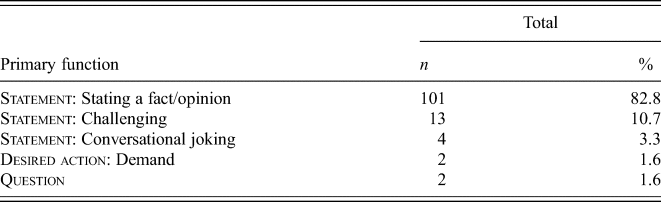
Three sub-functions of the ‘Statement’ function are attested in our EModE corpus. Of these three, ‘Stating a fact/opinion’ was the most common; see table 3.
(25)
(a) Tis good Tobacco this! (Jonson, Alch. 2.6.78)
(b) Ile rather loose his friendship I, then graunt. (Marlowe, ED2 1.4.237)
(c) I doe not like these seuerall Councels, I. (Shakespeare, R3 3.2.73)
ProTag constructions in the works of Jonson, Marlowe and Shakespeare classified according to function

The existence of ‘Challenging’ as a function of EModE ProTag constructions is supported by commentary notes such as that which states that (26c) involves ‘pleonastic repetition of “these” for sarcastic emphasis’ (Bevington et al. Reference Bevington, Butler and Donaldson2014).
(26)
(a) Out I defie thee I, desembling wretch (Jonson, EMI 5.1.49)
(b) Come? come, you are a foole, you (Jonson, Poet. 2.1.124)
(c) These are my brothers consorts these, these are his Cumrades, his walking mates, (Jonson, EMI 1.4.122)
The line in (27) represents an example of ‘Conversational Joking’. This ProTag construction is spoken by a tailor, who is understating his ability to satisfy his customers, despite the fact that immediately preceding this, he is complimented with: By my troth sir ’tis very rarely well made, I neuer saw a suite sit better I can tell on. This promotes rapport between the tailor and his customer by having the tailor entertainingly presenting himself as a modest artisan.
(27) Nay, we have no Art to please our friends, we. (Jonson, EMO 4.4.13)
4.2.2 Desired action
The category ‘Desired action’ is defined as being a commissive or directive that is used in the exchange of goods and services, distinct from an exchange of information. This is divided into two subcategories: ‘Give’ (offers, advice, suggestions) and ‘Demand’ (requests, commands). We identified examples of only the latter in our EModE data, including:
(28) Falstaff: you will not doe it? you?
Pistol: I doe relent: what would thou more of man? (Shakespeare, MWW 2.2.23)
4.2.3 Question
We turn next to a function that ProTag constructions in PDBE have not been identified as having: ‘Question’. This function is defined thus: tag questions ‘in this category … seek information and “project a next turn, in which the information sought after will be provided” (Kimps et al. Reference Kimps, Davidse and Cornillie2014: 67) … the addressee is deemed to be the primary knower’ (Barron et al. Reference Barron, Pandarova and Muderack2015: 502). In using a tag construction with this function, the speaker requires the addressee to respond by providing the information that the speaker seeks. Axelsson (Reference Axelsson2011: 138) provides a relevant example of a tag question with the ‘Question’ function:
(29) Hey, look, you are going to be OK, aren't you?
Yes, sorry – my way of talking. […] (BNC-A0F/1375–6)
While the ‘Question’ function pairs naturally with a tag question, it is perhaps surprising to find it associated with a ProTag construction. However, in a number of examples in the corpus an anchor with declarative syntax combines with a ProTag which is followed by a question mark, indicating that a ProTag construction in EModE can have ‘Question’ as a primary or other function. Punctuation had not been fully standardised at this point, but the co-occurrence of ProTag and question mark in (30), combined with the response that it receives, is consistent with the ProTag construction being used with the primary function of ‘Question’ in EModE.Footnote 17
(30) Lict.: You would make a rescue of our prisoner, Sir, you?
Tuc.: I, a rescue? away inhumane Varlet. (Jonson, Poet. 3.4.27–8)
That the combination of ProTag and ‘Question’ function is apparently unexpected seems to be reflected in the way in which some editors have subsequently dealt with such examples. For instance, in the 2014 Cambridge edition of Jonson's works Naturall, slid it may be supernatural, this? (Jonson, Case 1.2.12) is presented thus: Natural? ’Slid, it may be supernatural, this. The latter retains the ProTag construction but transfers the question function away from it.
Table 3 shows the relative frequency of ProTag constructions’ primary function in our corpus. The ‘Statement’ subcategory ‘Stating a fact/opinion’ is by far the most commonly attested, followed by the other two ‘Statement’ subcategories (‘Challenging’ and ‘Conversational joking’). ‘Conversational joking’ is, however, a relatively rare primary function, and the same is true of the final two categories (‘Desired action: Demand’ and ‘Question’).
5 ProTag constructions and tag questions in EModE: a comparison
We can compare our findings on the ProTag construction in the works of Jonson, Marlowe and Shakespeare with those of Tottie & Hoffmann (Reference Tottie and Hoffmann2009) on tag questions in order to obtain a more complete picture of tag constructions in EModE drama. The focus of Tottie & Hoffmann (Reference Tottie and Hoffmann2009) is tag questions in the sixteenth century, and as such they only examine a subset of works by Jonson and Shakespeare included in our corpus. In the discussion of tag question and ProTag construction use in the work of these authors which follows, we consider only those works analysed in Tottie & Hoffmann (Reference Tottie and Hoffmann2009) in order to make a direct comparison.
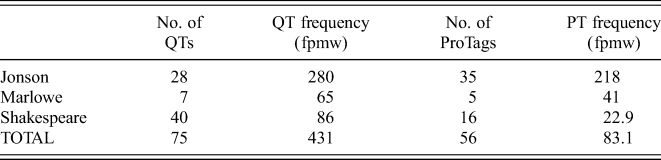
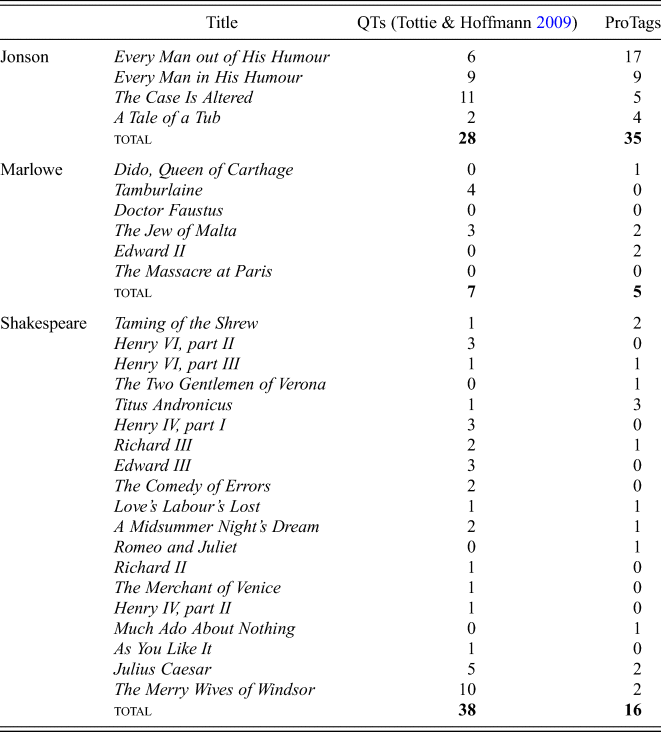
First, we observe that ProTag constructions are less frequent than tag questions in the plays examined in both our study and Tottie & Hoffmann's; see table 4.Footnote 18 (A full play-by-play breakdown is provided in table A3 in the Appendix.)
ProTag constructions and tag questions (QTs) in the works of Jonson, Marlowe and Shakespeare considered in Tottie & Hoffmann (Reference Tottie and Hoffmann2009)

Jonson is the most prolific user of both tag constructions out of the three playwrights, with a fpmw count of 218; this is also the case for question tags (Tottie & Hoffmann Reference Tottie and Hoffmann2009: 152). Tottie & Hoffmann observe that this may be due to the greater proportion of prose in Jonson's works. Certainly, the majority of the ProTag constructions in Jonson's dramas appear in prose (74%, n = 72). In Shakespeare's works, the majority appear in blank verse (80%, n = 16). Overall, 61 per cent of all ProTag examples in our corpus appear in prose, with most of the remainder appearing in blank verse (38%; 1% appear in rhyming verse). Another relevant factor is likely to be that the bulk of Jonson's plays are comedies. Hoffmann (Reference Hoffmann2006) shows that tag questions are more frequent in comedies compared to tragedies since at least the mid sixteenth century. There is some evidence that this may also be the case for ProTags in EModE: 84 per cent of examples identified in our corpus (n = 102) appear in comedies.
Tottie & Hoffmann (Reference Tottie and Hoffmann2009) supply a detailed comparison of tag questions in the works of Jonson and Shakespeare, the two most prolific users of this construction in their study. For the purposes of providing a similarly detailed comparison of two different types of tag construction in EModE, we do the same here for ProTag constructions. Tottie & Hoffmann (Reference Tottie and Hoffmann2009) discovered that Jonson's use of tag questions was distinct with respect to the distribution of polarity types compared to Shakespeare. In prose, Jonson uses a high proportion of negative anchors with positive question tags (for example, you are not Pageant Poet to the City of Millaine sir, are you. Jonson, Case 1.1.45; cited by Tottie & Hoffmann Reference Tottie and Hoffmann2009: 135) compared to Shakespeare, who uses only positive anchors with negative question tags in prose (for example, You serue Octauius Caesar, do you not? Shakespeare, JC 3.1.280; cited by Tottie & Hoffmann Reference Tottie and Hoffmann2009: 135). If we compare the polarity type of the anchor in tag questions and ProTag constructions, a difference in distribution emerges.
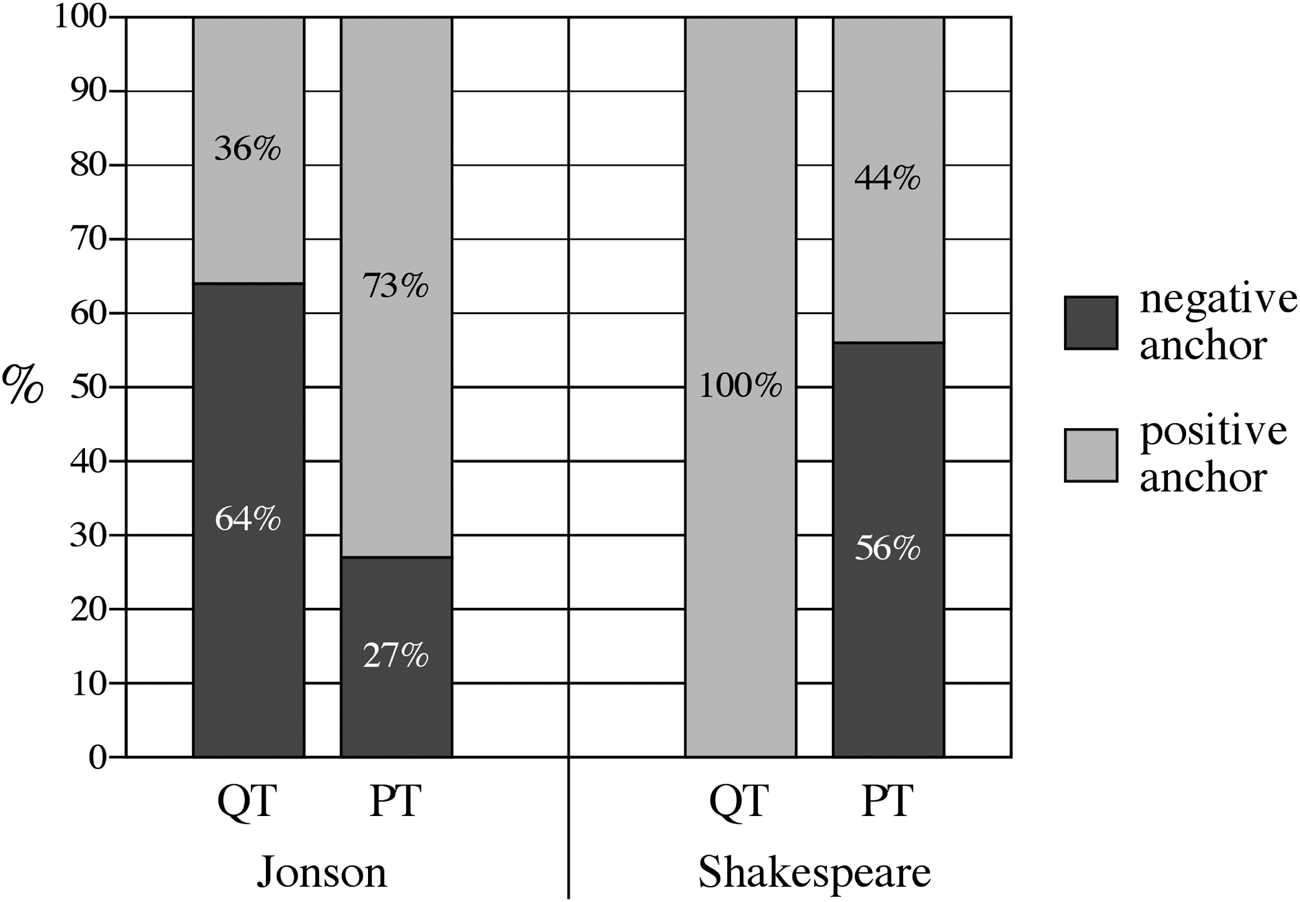
The data in figure 1 show that in Johnson's prose, QTs (tag questions) occur more frequently with a negative anchor (64%) than ProTags do (27%); ProTags therefore occur more frequently with a positive anchor (73%) than QTs (36%) do. By contrast, in Shakespeare's prose QTs only appear with a positive anchor, while ProTags occur more frequently with a negative anchor (56%). Thus, one tag type is paired more frequently with an anchor of a particular polarity type, but that pairing varies by playwright.
Anchor polarity types in prose for tag question (QT) and ProTag (PT) constructions in the sixteenth-century works of Shakespeare and Jonson considered in Tottie & Hoffmann (Reference Tottie and Hoffmann2009)

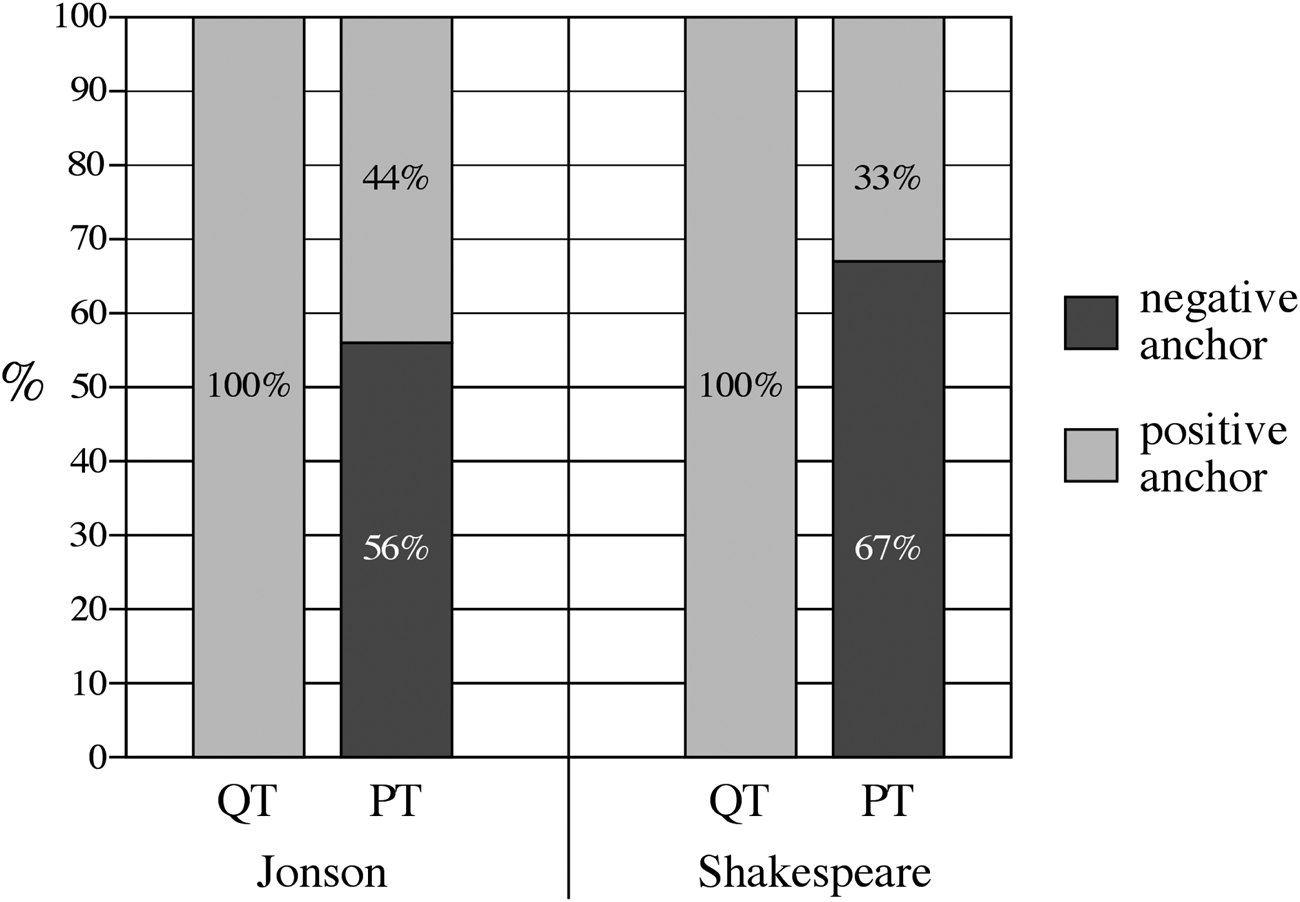
In blank verse (figure 2), neither Jonson nor Shakespeare has negative anchors in tag questions. Thus, Shakespeare never has a negative anchor in a tag question, whereas Jonson has a majority of negative anchors in tag questions, but only in prose. Both writers do, though, pair ProTags with negative anchors in blank verse, more so than with positive anchors. In the case of ProTag constructions in blank verse then, the same trend is observed in the works of both playwrights: negative anchors occur only with ProTags and not with QTs.
Anchor polarity types in blank verse for tag question (QT) and ProTag (PT) constructions in the sixteenth-century works of Shakespeare and Jonson considered in Tottie & Hoffmann (Reference Tottie and Hoffmann2009)

We make no claims here about why Jonson and Shakespeare's use of tag constructions should vary in the ways that they do with respect to polarity and the prose/blank verse distinction, but report this observation in order to highlight possible dimensions of variation. Our research indicates that interaction with polarity ought to be considered in relation to both ProTag constructions and tag questions in future research in order to understand more fully the properties and distribution of tag constructions as a whole.
We have seen that ProTag constructions are part of the grammar of EModE, just as tag questions are. Next, we consider how ProTag constructions have changed over time by comparing our EModE data with the results of Mycock's (Reference Mycock2019) study of ProTag constructions in PDBE.
6 ProTag constructions from EModE to PDBE
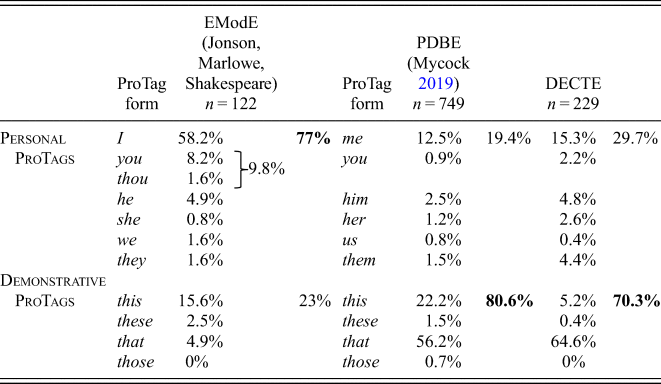
When we compare the formal properties and functions of ProTag constructions in EModE with their counterparts in PDBE, two differences are particularly striking, setting aside the difference in default pronoun case mentioned in section 1. The first is the relative proportions of personal and demonstrative ProTags in the two varieties. The second is the range of functions that ProTag constructions have in each variety. In EModE, personal ProTags occur more frequently than demonstrative ProTags (77% to 23%, respectively); see table 5. Compared to our results for EModE, the pattern in PDBE according to Mycock (Reference Mycock2019) is practically the reverse. Mycock (Reference Mycock2019) reports a far higher proportion of demonstrative ProTags compared to personal ProTags in PDBE: 80.6% to 19.4%. This difference could possibly be due to most of her corpus data being written rather than spoken, and to the fact that the distribution of the ProTag construction appears to be restricted. However, Mycock (Reference Mycock2019) interrogated one corpus comprising only spoken data from a region in which both personal and demonstrative ProTags are clearly available: the Diachronic Electronic Corpus of Tyneside English (DECTE; Corrigan et al. Reference Corrigan, Buchstaller, Mearns and Moisl2012–). If we isolate the results from the DECTE corpus, as in table 5, we find the same pattern of relative frequency exists in slightly different proportions: 70.3 per cent demonstrative ProTags to 29.7 per cent personal ProTags.
ProTags in our EModE corpus, in PDBE (Mycock Reference Mycock2019) and in DECTE (Corrigan et al. Reference Corrigan, Buchstaller, Mearns and Moisl2012–, as reported in Mycock Reference Mycock2019)

When we consider frequency within the group of demonstrative ProTags, the occurrence of that also differs between EModE and PDBE. In EModE this appears more frequently than that (this = 15.6%, that = 4.9%), whereas in the PDBE corpora and in DECTE, that is by far the most common demonstrative ProTag (56.2% and 64.6%, respectively).
Compared with our EModE data, therefore, Mycock's (Reference Mycock2019) PDBE data, whether entirely spoken (DECTE) or majority written, exhibit a clear difference in relation to the occurrence of demonstrative versus personal pronouns as tags and with respect to the relative frequencies of the two singular demonstrative ProTags. Why should this be? It is not the case that singular demonstratives are in competition with a 3sgn personal ProTag as no such form is attested in EModE or PDBE: a singular demonstrative can clearly have a 3sgn anchor point; see (5).
We hypothesise that singular demonstrative ProTags have expanded in terms of their possible referents between EModE and PDBE. Specifically, we propose that singular demonstrative ProTags were restricted to referring to entities in EModE, but in PDBE they can refer to entities and other types of semantic objects such as propositions as well. That is, they have developed a textual or discourse deictic use. The distinction can be rather difficult to tease apart, but in PDBE examples such as the one in (31) the referent of the ProTag appears to be something other than an entity.
(31) Brian Jackson was very pleased with himself. From his promising interview with the redoubtable Mrs Fitton, he had driven directly to Mansfield Memorial Hospital with medical records in mind. Initiative, that. (BNC-C8D/3779)
Along with what appears to be its core speaker-oriented (subjective) function (‘Stating a fact/opinion’) and other hearer-oriented (intersubjective) functions (‘Challenging’, ‘Conversational joking’; ‘Desired action’) in EModE and PDBE, it appears that in PDBE the ProTag Construction additionally has a discourse-oriented use, exemplified in (31), which creates textual coherence. Narrog (2016) identifies increased discourse-orientation as a strong tendency in meaning change and the final stage of grammaticalisation following speaker-orientation (subjectification) and hearer-orientation (intersubjectification). Extension of the possible referents of singular demonstrative ProTags between EModE and PDBE to include parts of the discourse supports the developmental pathway proposed by Narrog (2016).
The possibility of singular demonstrative ProTags referring to elements other than specific entities may also provide a reason for their much greater frequency compared to plural demonstrative ProTags in PDBE (78.4% compared to 2.2% of all occurrences in Mycock's study). The predominance of that over this in PDBE is likely related to the fact that ProTags are turn medially or turn finally located discourse-pragmatic variables. If, as we have proposed, a ProTag can refer to a previous portion of the discourse, the use of the distal demonstrative singular pronoun to refer to what has gone before is expected without ruling out completely the occurrence of a proximal ProTag with a similar kind of referent.
Another area in which PDBE differs from EModE relates to the possible functions of ProTag constructions. In the EModE data, we identified ProTag constructions with the functions ‘Desired action: Demand’ and ‘Question’. Neither of these functions was identified in the Mycock (Reference Mycock2019) study of PDBE data. They are, of course, possible functions of tag questions in PDBE; recall that the classificatory system we have adopted was proposed by Barron et al. (Reference Barron, Pandarova and Muderack2015) to account for tag-question functions in British English and Irish English. Thus our research indicates that, in terms of their possible functions, ProTag constructions could be argued in some ways to have had more in common with tag questions in EModE than in PDBE as both could be used with the ‘Question’ function in the earlier variety.
Two functions of ProTag constructions are attested in PDBE that we did not find in our EModE data: ‘Statement: Acknowledging response’ and ‘Desired action: Give’. We note that both are rarely attested functions in PDBE: in a search of over 980 million words, ‘Acknowledging response’ accounted for 0.9 per cent of all examples (n = 7) and ‘Desired action: Give’ accounted for 0.1 per cent of all examples (n = 1) (Mycock Reference Mycock2019). Further research is required to determine if ProTag constructions could ever be used with either of these functions in EModE.
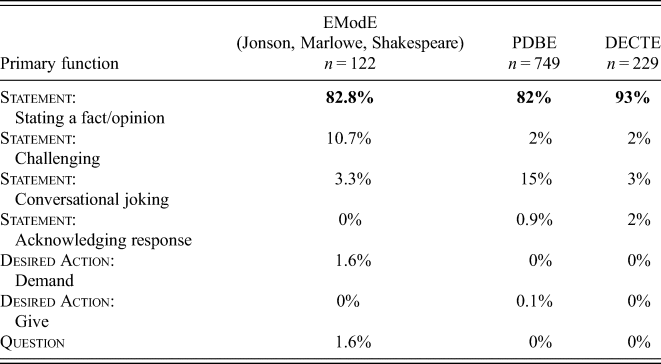
Given the differences in the types and quantity of data available, one should be cautious of drawing conclusions about the functions of ProTag constructions in EModE and PDBE based on their relative frequency. However, what is clear from the data presented in table 6 is that by far the most common primary function in both varieties is ‘Statement: Stating a fact/opinion’.
ProTag constructions’ primary functions in our EModE corpus, in PDBE (Mycock Reference Mycock2019) and in DECTE (Corrigan et al. Reference Corrigan, Buchstaller, Mearns and Moisl2012–, as reported in Mycock Reference Mycock2019)

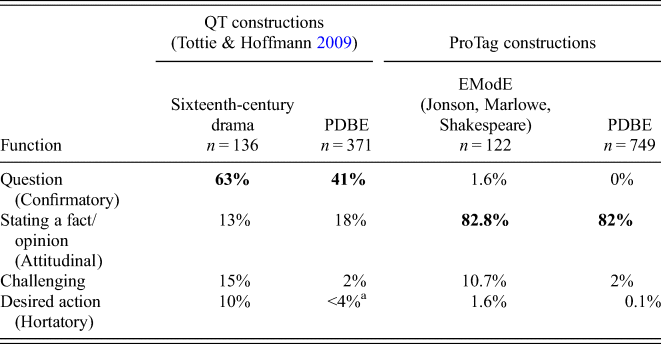
If we assume that ‘Statement: Stating a fact/opinion’ is equivalent in Tottie & Hoffmann's (Reference Tottie and Hoffmann2009) functional classification system to the category ‘Attitudinal’ (defined as expressing the speaker's attitude and therefore a subjective function); and that the ‘Challenging’ category is the same in both systems, that Hortatory (defined as having a directive function by Tottie & Hoffmann) is equivalent to ‘Desired action’, and that ‘Confirmatory’ (defined by Tottie & Hoffmann as clearly seeking and receiving an answer without any strong affective function) is equivalent to ‘Question’ (making these intersubjective functions), we can make a comparison of the functions of tag questions and ProTag constructions in EModE and PDBE; see table 7.
Tag question and ProTag construction functions in EModE and PDBE

a Because of low numbers, hortatory QTs were included in the category ‘Other’ which represented 4 per cent of the total.
The data in table 7 indicate that tag question and ProTag constructions were predominantly used with different functions in EModE, and that the same is true in PDBE. The strength of the association of ProTag constructions with one particular primary function, ‘Stating a fact/opinion’, may explain why the ‘Question’ function was lost. If ProTag constructions occurred only rarely with the ‘Question’ function, this function may have fallen out of use.
In summary, we have identified two main differences in the ProTag construction's form and functions between EModE and PDBE: (i) in EModE personal ProTags are much more frequent than demonstrative ProTags, but in PDBE this situation is reversed; and (ii) ProTag constructions have a different range of possible functions in PDBE than in EModE, notably in EModE ‘Question’ is a possible function of both tag questions and ProTag constructions.
7 Conclusions
This investigation of the works of Jonson, Marlowe and Shakespeare has verified that lone pronoun tag (ProTag) constructions were available in EModE. It has also revealed that previous descriptions of ProTags in this variety of English have been partial at best. We found evidence that non-subject anchor points are possible and we have been able to classify in more detail the functions of this construction, going beyond the previous characterisation of ProTags being present for the purpose of ‘emphasis’.
In terms of the kinds of pronouns available as ProTags, EModE and PDBE are comparable. ProTags in EModE and PDBE also have in common an apparent topic-marking function, which accounts for the strong tendency for anchor points to be both subjects and pronouns themselves.
Setting aside the predictable difference in form arising from the change in default case for pronouns from the subjective/nominative in EModE to the objective/accusative in PDBE, there is a striking difference in the relative frequency of demonstrative compared to personal ProTags between the two varieties. In our study of EModE 77 per cent of the examples are personal ProTags, while in Mycock's (Reference Mycock2019) study of PDBE 80.6 per cent are demonstrative ProTags. (Indeed, Marlowe and Shakespeare only employ personal ProTags in their dramatic works.) We propose that the extension of possible referents for singular demonstrative ProTags, so that they are not restricted only to entities but may also have a discourse deictic use, represents a key factor in this change from EModE to PDBE. This is in line with Narrog's (Reference Narrog, Van Olmen, Cuyckens and Ghesquière2016) proposal that increased discourse-orientation is a strong tendency in the final stage of grammaticalisation.
There was evidence of other differences in form as well. For instance, an imperative anchor is attested in EModE, but this has not been reported as possible in PDBE. This suggests that ProTag constructions in EModE were less constrained than their PDBE counterparts. The data also indicate that polarity of the anchor may have had some influence over the distribution of ProTag constructions compared with tag questions in EModE, though the precise nature of the interaction appears to vary from playwright to playwright and to depend on meter.
With respect to functions, we detected differences too. Most significantly, the data show that in EModE ProTag constructions could be used with ‘Question’ as a primary or secondary hearer-oriented/intersubjective function. This aligns them with tag questions in EModE and PDBE but distinguishes them from ProTag constructions in PDBE, meaning that their use was less restricted in EModE in this respect. Overall though, the most frequent function of ProTag constructions appears to be stable: in both EModE and PDBE by far its most common function is ‘Stating a fact/opinion’, i.e. a speaker-oriented/subjective function.
ProTags are an example of a discourse-pragmatic variable that appears to have a long history in English. Einenkel (Reference Einenkel1916: 132) states that ‘the emphatic repetition of the pronoun at the end of the sentence is probably of Nordic origin; in Swedish the idiom is still commonplace’,Footnote 19 and provides examples of apparent ProTags in Old English (Ic liuie naut, ic, ac crist liueð in me ‘I live not, I, but Christ liveth in me’, Homilies I). Our research represents the first systematic investigation of the history of the ProTag construction. In doing so, it lays the foundations for future research into even earlier stages of its development, and facilitates future comparisons with similar constructions in Scandinavian languages, with which the English construction may share a common ancestor.
Appendix
Lists of the works of Jonson, Marlowe and Shakespeare that were included in our study of ProTag constructions in EModE

All forms used to search for and identify personal and demonstrative ProTags in the corpus

Occurrence of ProTag constructions and tag questions in the works of Jonson, Marlowe and Shakespeare that were considered in Tottie & Hoffmann's (Reference Tottie and Hoffmann2009) study of sixteenth-century tag questions