INTRODUCTION
Ghost shrimps are a group of benthic, burrowing decapods that inhabit either marine or brackish habitats (Dworschak, Reference Dworschak2005; Tsang et al., Reference Tudge, Poore and Lemaitre2008; De Grave et al., Reference De Grave, Pentcheff, Ahyong, Chan, Crandall, Dworschak, Felder, Feldmann, Fransen, Goulding, Lemaitre, Low, Martin, Ng, Schweitzer, Tan, Tshudy and Wetzer2009). They are generally found as bioturbators in soft-bottom sediments of intertidal or subtidal areas (Felder, Reference Felder2001), but several species have also been reported in deep water (Dworschak & Cunha, Reference Dworschak and Cunha2007; Lin et al., Reference Lin, Komai and Chan2007; Komai & Fujiwara, Reference Komai and Fujiwara2012). Recent studies from both molecular and morphological perspectives have revealed that the traditional Thalassinidea is not monophyletic and it needs to be divided into two major clades ranked as infraorders (Robles et al., Reference Robles, Tudge, Dworschak, Poore, Felder, Martin, Crandall and Felder2009; Dworschak et al., Reference Dworschak, Felder, Tudge, Schram and von Vaupel Klein2012). Poore et al. (Reference Poore, Ahyong, Bracken-Grissom, Chan, Chu, Crandall, Dworschak, Felder, Feldmann, Hyzny, Karasawa, Lemaitre, Komai, Li, Mantelatto, Martin, Nguyen, Robles, Schweitzer, Tamaki, Tsang and Tudge2014) recommended to apply the name Axiidea de Saint Laurent, 1979 and Gebiidea de Saint Laurent, 1979 to these two infraorders. We hereby follow this recommendation.
The callianassid Paraglypturus was established by Türkay & Sakai (Reference Tsang, Lin, Chu and Chan1995) to accommodate its type species P. calderus Türkay & Sakai, Reference Tsang, Lin, Chu and Chan1995. This genus was originally compared with Glypturus Stimpson, 1859 (Türkay & Sakai, Reference Tsang, Lin, Chu and Chan1995). Later Sakai (Reference Sakai1999) transferred Paraglypturus from the subfamily Callianassinae to the subfamily Eucalliacinae Manning & Felder, 1991, and additionally reassigned the following four species to Paraglypturus: Calliax punica de Saint Laurent & Manning, 1982, Callianassa novaebritanniae Borradaile, 1900, Calliax sakaii de Saint Laurent & Le Loeuff, 1979, and Callianassa tooradin Poore & Griffin, 1979. Ngoc-Ho (Reference Ngoc-Ho2003) partially revised the taxonomy of the genera in Eucalliacinae, recognizing Calliax, Eucalliax and Paraglypturus as valid and establishing a new genus Calliaxina for Calliax punica, Callianassa novaebritanniae, Calliax sakaii, three of the four species assigned to Paraglypturus by Sakai (Reference Sakai1999); only Callianassa tooradin was tentatively placed in Paraglypturus. Sakai (Reference Sakai2005) did not recognize Eucalliax and Calliaxina, but also excluded C. tooradin from Paraglypturus, restricting the genus to its type species, P. calderus. Finally, Sakai (Reference Sakai2011) greatly changed his classification of Eucalliacinae, recognizing all genera proposed by previous authors, including himself; Paraglypturus was retained as a monotypic genus.
Based on cladistic analysis of morphological characters, Tudge et al. (Reference Türkay and Sakai2000) estimated that Paraglypturus calderus is sister to all other callianassid species, but recent studies have placed Paraglypturus more definitively in Eucalliacinae of Callianassidae (De Grave et al., Reference De Grave, Pentcheff, Ahyong, Chan, Crandall, Dworschak, Felder, Feldmann, Fransen, Goulding, Lemaitre, Low, Martin, Ng, Schweitzer, Tan, Tshudy and Wetzer2009; Dworschak et al., Reference Dworschak, Felder, Tudge, Schram and von Vaupel Klein2012; WoRMS-Editorial-Board, 2014). Paraglypturus is distinguished from other genera of Eucalliacinae by the absence of paired lateral spines on the frontal margin of the carapace and the presence of a distinct exopod on the third maxilliped (Mxp3) (Sakai, Reference Sakai2011).
In the present study, we describe and illustrate a new species of Paraglypturus found in a hydrothermal vent field of the Tonga Arc in the south-western Pacific Ocean. Although the sequence of the full mitochondrial genome of the present new species has already been published online under the name Paraglyptus tonganus (cf. Kim et al., Reference Kim, Kim, Ahn, Ju, Min and Kim2016), that article was not intended to publish the name. Consequently, the name mentioned in Kim et al. (Reference Kim, Kim, Ahn, Ju, Min and Kim2016) should be considered to be a nomen nudum. This new species appears to be the first record of a ghost shrimp from the Tonga Arc region, and also the second species in the genus Paraglypturus.
MATERIALS AND METHODS
Samples were collected from a hydrothermal vent field (volcano #19; referred from the International Seabed Authority GIS map [http://www.mapserver.isa.org.jm/GIS]) of the Tonga Arc (24°48′S 177°00′W; water depth 544 m) during environmental baseline studies conducted using the research vessel RV ‘Sonne’ in February 2012. All specimens were sampled using a TV grab, and the type locality was recorded with still photographs and video recordings mounted on the remotely operated vehicle ‘ROPOS’ (Canadian Scientific Submersible Facility). The samples were immediately preserved in 95% ethanol and then stored at −80°C for morphological and molecular studies.
Each specimen was examined and dissected under a stereomicroscope (Model SZX-7; Olympus, Tokyo, Japan). Measurements of specimens were made using a digital vernier caliper. The total body length (TL) was measured from the base of the rostrum to the posterior border of the telson. The carapace length (CL) was measured from the tip of the rostral lobe to the midpoint of the posterodorsal margin of the carapace.
Illustrations were prepared with the aid of a drawing tube attached to a stereomicroscope (Olympus SZX-12), scanned, and inked digitally using a WACOM™ digitizer and Adobe® Illustrator® software. Morphological terminology generally follows Dworschak et al. (Reference Dworschak, Felder, Tudge, Schram and von Vaupel Klein2012). Abbreviations used herein are as follows: Mx, maxilla; Mxp, maxilliped; P, pereiopod; Plp, pleopod. The description of the new species is based on the dissected female holotype. All type specimens have been deposited in the National Institute of Biological Resources (NIBR), Incheon, Republic of Korea.
RESULTS
SYSTEMATICS
Order DECAPODA Latreille, 1802
Suborder PLEOCYEMATA Burkenroad, 1963
Infraorder AXIIDEA de Saint Laurent, 1979
Family CALLIANASSIDAE Dana, 1852
Subfamily EUCALLIACINAE Manning & Felder, 1991
Genus Paraglypturus Türkay & Sakai, Reference Tsang, Lin, Chu and Chan1995
Paraglypturus tonganus sp. nov.
(Figures 1–5)
Paraglypturus tonganus sp. nov., paratype (NIBRIV0000300189, TL 22.0 mm, CL 6.8 mm), female (ovigerous), from a hydrothermal vent field of the Tonga Arc: habitus, lateral view. Scale bar = 5 mm.

Paraglypturus tonganus sp. nov., holotype (NIBRIV0000300187), female: (A) carapace, dorsal view; (B) left Mxp2, lateral view; (C) left Mxp3, lateral view; (D) ischium of left Mxp3, mesial view. Scale bars: A–C = 5 mm; D = 3 mm.

Paraglypturus tonganus sp. nov., holotype (NIBRIV0000300187), female: (A) right P1, mesial view; (B) right P1, lateral view; (C) left P1, lateral view; (D) left P1, mesial view; (E) left P2, lateral view; (F) left P3, lateral view; (G) left P4, lateral view; (H) left P5, lateral view. Scale bars: A–H = 5 mm.

Paraglypturus tonganus sp. nov., holotype (NIBRIV0000300187), female: (A) ramus of left Pl1, posterior view; (B) right Pl2, posterior view; (C) left Pl3, anterior view; (D) left Pl4, posterior view; (E) left uropod, ventral view; allotype (NIBRIV 0000300188), male: (F) right Pl1, posterior view. Scale bars: A = 3 mm; B–E = 5 mm; F = 1 mm.

The uropod of Paraglypturus tonganus (paratype, NIBRIV0000300191), left side: (A) dorsal view, dorsal plate fringed distolaterally by dense setae; (B) ventral view, a yellow circular structure (arrow) at the centre of the uropodal endopod.

TYPE MATERIAL
Holotype: female (NIBRIV0000300187, dissected, TL 43.0 mm, CL 14.0 mm), ovigerous; Tonga Arc, south-western Pacific Ocean (24°48′S 177°00′W; water depth: 544 m); collected using a TV-grab during the voyage of the RV ‘Sonne’, coll. S.-J. Kim, 3 February 2012.
Allotype: 1 male (NIBRIV0000300188, TL 21.0 mm, CL 6.5 mm). Same data as the holotype.
Paratypes: 2 females (NIBRIV0000300189, TL 22.0 mm, CL 6.8 mm; NIBRIV0000300190; TL 22.0 mm, CL 6.7 mm) and 1 male (NIBRIV0000300191, TL 33. mm, CL 10.0 mm). Same data as the holotype.
DIAGNOSIS
Carapace without anterolateral row of setal pores. Branchiostegite thin and semitransparent. Mxp2 endopod dactylus with thick and stiff serrate setae at apex. Mxp3 subpediform; dactylus subovate with truncate distal margin; exopod well developed, flagellum-like. P1 chela about 2.3 times as long as carpus in larger cheliped; chela about 2.5 times as long as carpus in smaller cheliped. Plp1 uniramous, biarticulate, mesially convex in female; uniramous, uniarticulate, distal margin bilobed with a median concavity in male. Uropodal endopod with a yellow circular structure in centre of the ventral surface.
DESCRIPTION
Female (holotype). Carapace (Figures 1 & 2A) with frontal margin evenly convex, without a trace of rostrum and paired lateral projections. Dorsal surface lacking rostral carina and dorsal oval; no cardiac prominence; without anterolateral row of setal pores, while with many short setae along its lateral and posterior border. Branchiostegite thin and semitransparent. Linea thalassinica complete, extending to posterior margin of carapace, straightly parallel to horizontal plane of carapace. Cervical groove distinct and running curved anterolaterally, located slightly behind midlength of carapace.
Eyestalks weakly flattened dorsoventrally, reaching distal margin of antennular article 1, laterally toward blunt tip. Cornea large and globular, and brown-coloured, located subterminally and distolaterally. Antennular peduncle unarmed, article 1 slightly longer than article 2, which is longer than article 3. Antennal peduncle exceeding antennular peduncle; scaphocerite small, rounded plate with a blunt tip (Figure 2A).
Mandible with three-segmented palp. Mx1 with biarticulate palp (endopod), distal segment deflexed. Mx2 bilobed with simple palp; scaphognathite broad. Mxp1 with slender palp; epipod large and triangular. Mxp2 (Figure 2B) with simple and slender exopod reaching beyond carpus of endopod; endopod dactylus with thick and stiff serrate setae at apex; epipod greatly reduced to rudimentary bud, bearing rudimentary, non-lamellate, bud-like podobranch; arthrobranch absent.
Mxp3 (Figure 2C) subpediform; ischium 1.5 times as long as its width, proximoventral angle produced into roundly triangular lobe, crista dentata (Figure 2D) consisting of a sinuous row of sharp teeth; merus slightly shorter than ischium, unarmed. Carpus shorter than merus. Propodus subquadrate, broadly convex on mesial surface. Dactylus subovate with truncate distal margin, bearing dense stiff setae distally and distal part of lateral surface. Exopod proximal segmented, with multi-articulated flagellum reaching to distal part of merus.
P1 chelate, asymmetrical. Larger cheliped (Figure 3A, B) with both ischium and merus unarmed, merus slightly broader and longer than ischium. Carpus 0.8 times as long as merus, 1.3 times as broad as its length, mesial surface with uncalcified proximal part ventrally below articulation with merus. Chela massive, sim 2.3 times as long as carpus. Palm approximately as long as its width. Propodus fixed finger thick, cutting edge having a small tooth proximal to a shallow concavity at midlength, and irregular denticles in its distal part. Dactylus movable finger thick, 0.6 times as long as palm, twice as long as its width; lateral surface with a submarginal row of several setal tufts along cutting edge.
Smaller cheliped (Figure 3C, D) with both ischium and merus unarmed, merus approximately as long as ischium, 1.3 times as long as its width, convex on dorsal and ventral margins. Carpus 0.8 times as long as merus, and 0.8 times as long as its width, mesial surface with uncalcified part as in larger cheliped. Chela 2.5 times as long as carpus; Propodus fixed finger simple, cutting edge smooth, lateral surface with row of setal tufts along cutting edge. Dactylus movable finger thick, as long as palm, having a low, obtuse tooth proximally on cutting edge; lateral surface with row of setal tufts reaching from environs of cutting edge to dorsal margin.
P2 (Figure 3E) chelate, all segments unarmed. Merus longest, with numerous setae in proximal two-thirds of sinuous ventral margin. Carpus triangular, broadest distally. Chela as long as carpus; lower portion of propodus with setal patches; prehensile margins of both fingers corneous, straight edge over most of length; upper margin of dactylus straight.
P3 (Figure 3F) simple, all segments unarmed. Carpus subtriangular. Propodus ~0.5 times length of carpus, dorsal margin nearly straight, dorsodistal margin rounded, and ventral margin concave, proximal heel rounded, not produced beyond ventrodistal margin of carpus; lateral surface setose. Dactylus small, subtriangular, ~0.5 times length of propodus.
P4 (Figure 3G) simple, all segments unarmed. Merus longest, with gently convex dorsal margin. Propodus broadened distally, 1.6 times as long as its width, 0.7 length of carpus; lateral surface masked by dense short setae except for naked midline. Dactylus less than 0.5 length of propodus.
P5 (Figure 3H) subchelate, all segments unarmed. Merus longest. Propodus about 0.7 length of carpus, slightly convex on dorsodistal margin, and fixed finger very short. Dactylus 0.3 times as long as propodus, curved, without any hook-like process on opposable margin.
Pleomere 1 subtriangular in dorsal view; pleuron produced posterolaterally. Pleomere 2 subquadrate in dorsal view; pleuron produced posterolaterally, with few setae near rounded posterolateral angle. Pleomeres 3–5 quadrate in dorsal view, pleura produced posterolaterally in rounded lobe partially overlapping third pleuron, with circular patches of fine setae in posterior third of pleomere 3, in midlength of pleomeres 4–5. Pleomere 6 broadened anteriorly with rounded lateral margins in dorsal view; mid-dorsal groove distinct in posterior fourth, and posterolateral notch visible also in posterior fourth; paired posterior transverse and paired median lines of setae present. Relative lengths of pleomeres 1–6 and telson are 1.2:1.4:1.0:1.0:1.1:1.3:0.7.
Plp1 (Figure 4A) uniramous, biarticulate; distal segment gradually tapering distally, mesial margin convex in proximal half, lateral margins slightly sinuous. Plp2 (Figure 4B) biramous, foliaceous, endopod and exopod broad, appendix interna finger-like. Plp3–5 (Figure 4C, D) biramous, foliaceous; exopod slender, ~4 times as long as its width. Endopods triangular, 1.5 times as long as its width, shorter than exopod, and with stubby appendix interna on mesial margin.
Telson 1.5 times as broad as its length, tuft of setae on anterior fourth of dorsal mid-line, and pair of setal tufts on posterolateral margin. Uropodal endopod (Figures 4E & 5A, B) 1.3 times as long as its width, oval, much longer than telson, and with weak median dorsal carina, and with a yellow circular structure located on centre of ventral surface; exopod broadly subovate, approximately as long as its width, upper dorsal plate well developed, fringed distolaterally by dense setae; posterolateral part of exopod covered with thick, spiniform setae.
Male (allotype). Males are almost identical to females except sexual characteristics. Plp1 (Figure 4F) uniramous, uniarticulate (biarticulate in female); ~2 times as long as its width, distal margin bilobed with a median concavity, distally with a row of setae. Plp2 (similar as in females) biramous, foliaceous; exopod elongated, ~3 times as long as its width; endopod 1.2 times as long as its width, shorter than exopod; appendix masculina strap-shaped, distally with a row of setae, attached proximally to a long appendix interna posteriorly. Plp3–5 as in females.
COLOUR
Body and appendages are ivory-whitish overall, and its dorsal (outer) surface and setae are light brown (or yellowish). Eye cornea appears brownish.
DISTRIBUTION AND HABITAT
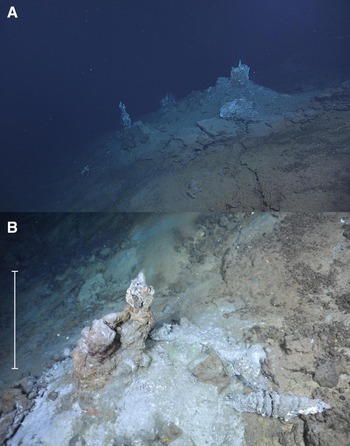
The type locality of the new species is an active vent field on the summit area of the eastern volcanic cone of volcano#19 in the Tonga Arc of the south-western Pacific Ocean, at a depth of 544 m. This area is mainly composed of small active chimneys and diffuse vents (Figure 6). The vent field includes Zinc (Zn)-rich vent crusts, Ht sludge and dactite. The hydrothermal environment had the following conditions: average salinity, 34.8; plume temperature, up to 240°C; and seawater temperature around the vent field, 10.0–11.5°C.
Photographs of the type locality in the Tonga Arc of the south-western Pacific Ocean where Paraglypturus tonganus sp. nov. was collected: (A) overview of the surrounding areas where P. tonganus was found; (B) appearance of an active chimney. Scale bar = 50 cm.

ETYMOLOGY
The proposed specific name tonganus is derived from the type locality, ‘Tonga Arc’.
REMARKS
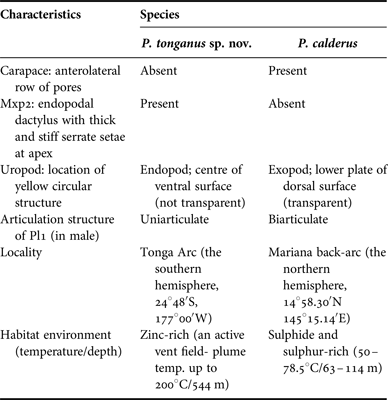
The genus Paraglypturus is represented only by its type species, P. calderus (Sakai, Reference Sakai2005; Sakai, Reference Sakai2011; WoRMS-Editorial-Board, 2014). The new species P. tonganus is morphologically very similar to P. calderus, but differs from the latter in the following characteristics: (1) an anterolateral row of setal pores on the carapace (absent in P. tonganus vs. present in P. calderus), (2) thick and stiff serrate setae on the endopodal dactylus of Mxp2 (present in P. tonganus vs. absent in P. calderus), (3) location of a yellow circular structure on the uropod (ventral surface on the endopod in P. tonganus vs. dorsal surface on the exopod in P. calderus), and (4) the articulation structure of the first pleopod in males (uniarticulate in P. tonganus vs. biarticulate in P. calderus) (Table 1).
Comparison of Paragypturus tonganus sp. nov. and P. calderus.

In P. calderus, the yellow transparent circular structure is present in larger specimens but absent in smaller ones (Türkay & Sakai, Reference Tsang, Lin, Chu and Chan1995). In contrast, the yellow circular structure in P. tonganus is not transparent, and it is present in both larger (CL > 15 mm) and smaller (CL < 10 mm) specimens. The yellow circular structure does not have a definite boundary or division line (Figure 5A, B).
The type specimens of P. calderus were collected at a shallow depth (63–114 m) from the sulphide and sulphur-rich sediments in a hot water environment (pore water: temperature, 50–78.5°C) in the Marianas (Türkay & Sakai, Reference Tsang, Lin, Chu and Chan1995), whereas the new species, P. tonganus, was collected from the Zn-rich vent crust in a high temperature active vent field at a water depth of 544 m (Table 1). Additionally, although not described for P. calderus by Türkay & Sakai (Reference Tsang, Lin, Chu and Chan1995), the left-right asymmetry of cheliped size appears in all specimens of the new species, regardless of sex. No discernible pattern is present with respect to cheliped size and left-right direction.
ACKNOWLEDGEMENTS
The authors would especially like to thank Dr Peter C. Dworschak and Dr Gary C. B. Poore for constructive comments on the manuscript.
FINANCIAL SUPPORT
This work was supported by grants from the R&D project titled ‘Exploration of seafloor hydrothermal deposits in Tongan Waters (PM57063)’ by the Ministry of Oceans and Fisheries of Korea, and from Inha University.