AUNTIE ABENA'S FUNERAL
At the final funerary ritesFootnote 1 (ayie keseε)Footnote 2 for Auntie Abena held in North London, members of the Ghanaian diaspora in London came together to celebrate the life of this distinguished Ghanaian woman. One of the ‘pioneers’ in London's Ghanaian diaspora, Auntie Abena was a founder and active member of several ethnic, civic and religious associations. She was a woman held in high esteem by fellow Ghanaians for her contribution to Ghanaian associational life, her knowledge of Akan traditions and cultural values, and her standing within the Ghanaian Methodist Fellowship in London. Gathered in the large hall of a local school were members of Ghanaian associations and Methodist Christian fellowships, alongside members of Auntie Abena's abusua, her Ashanti matriclan. Mourners and groups were identified by their dresses and uniforms, as well as their associational banners, clearly displayed on their tables. I attended the funerary rites in the company of members of SUWMA, the Susanna Wesley Mission Auxiliary, who were there to pay tribute to their patron.
For this occasion the SUWMA women, renowned among Ghanaian Methodists for their many uniforms, were wearing a black and purple dress with a cloth wrapped around the waist in a style called ‘Housewife’. With no make-up and jewellery, SUWMA members displayed their sympathy (yaa kɔ) to Auntie Abena's abusua through the distinctive values of female modesty and decency. Throughout the evening they took centre stage by leading the wider Ghanaian Methodist Fellowship in worship and prayer, singing famous Methodists hymns and other Christian asore nyom in Twi and Fante. One of SUWMA's prominent members, gifted in African lyrics, εbibi nyom,Footnote 3 stood up on several occasions during the evening and sang these songs.
Despite their keen participation, in the course of the funeral the women also displayed an irreverent attitude to their publicly approved role as Ghanaian Methodist women. One member told me prior to the meeting, ‘We came here to have a good time too.’ And, indeed, throughout the night they had a good time. Breaking conventional Methodist rules about alcohol consumption that are strictly enforced in Ghana, several members of SUWMA spent the night drinking Guinness Export, calling out to the waitress loudly and insistently: ‘Bra, Bra, Guinness Baako, mepaakyew … Come, come get me a Guinness please!’ In a half-hearted attempt to hide her monumental consumption, one of the women kept on throwing the empty bottles under her chair, with the result that an hour later there were twenty empties scattered on the floor beneath her. This amused the other SUWMA members a great deal. When a friend and patron of the fellowship asked the woman to explain why she was drinking so much, she replied: ‘Ahh, I just came back from Ghana. And as you know, there you can't drink anything … so I am here now and I want to enjoy myself.’ Her comment distinctively captures the irreverence which SUWMA members feel towards Christian and Ghanaian discourses of femininity, with their stress on female modesty, piety, abstention and motherhood. But it also shows how living in the diaspora, with all its constraints, allows more space for self-expression and the assertion of female power and authority.
On the one hand, then, the association and its members conform to Christian values and widely accepted Ghanaian constructions of womanhood. On the other hand, flouting expectations of pious femininity, they claim a unique, elevated position within the church. Their transgressive hedonism can thus be read as a performative assertion of their claims to respect, recognition and leadership beyond the narrow parameters of gendered modesty.Footnote 4 Many of the women are senior church leaders and respected members of the diaspora. Some are successful professional career women and economically independent. Their association is simultaneously about growing spiritually and promoting the Christian faith, ‘making the Methodist Church grow’ as one member puts it – while being recognized as successful, cosmopolitan, glamorous, middle-class women. It is this duality that I want to draw out in the present article by showing how members of the association negotiate and construct their subjectivities within both the Methodist Church and the Ghanaian diaspora, while they also negotiate their relationship with the Methodist Church in Ghana.
The association and its members face the challenge of achieving full recognition within the setting of the still predominantly patriarchal Ghanaian Methodist Church. Their flamboyant and often transgressive public conduct attracts criticism at times from other members of the Ghanaian diaspora, male and female alike. As I show in this article, this hostility to SUWMA is not only confined to verbal criticism but is expressed in boycotts of SUWMA activities.
Centrally, I argue that transgression among SUWMA women is a marker of distinction (Bourdieu Reference Bourdieu1986) and in this sense is not a ‘weapon of the weak’ (Scott Reference Scott1985).Footnote 5 SUWMA is in fact renowned both in Ghana and in the UK as an exclusive club of high-class women drawn from professional and entrepreneurial elites. These women party, banter irreverently and enthusiastically, drink, feast, and display elaborate and exquisite robes, all as markers of their distinction. Significantly, however, SUWMA members’ public displays of irreverence come alongside the performance of religious and traditional gender roles. These include donating conspicuously in church, working hard, and displaying piety and modesty on select occasions. One member captures the ethics of SUWMA:
What I like is the atmosphere, I like the devotions, the prayers they enrich me spiritually, but I also like the actions, what we do, how we contribute … we at SUWMA we mean business, but we can't do things without a joke or two. We are a light-hearted bunch of ladies.
Transgression is thus not intended to subvert the church order, but to negotiate members’ worth beyond the limitations imposed by the church's implicit patriarchal ideology. The women prove their worth by maintaining and renovating the Ghanaian Methodist community both locally and transnationally. In this sense SUWMA members’ transgression acquires a collective dimension for the Ghanaian Methodist Church. Gaining distinction within the British Methodist Church helps bring distinction to the Ghanaian Methodist diaspora in the UK, and projects a positive image of Ghanaian Christians in Britain.
It needs to be said that negotiating their way through the patriarchal setting of the church is not an exclusive problem of SUWMA or of Ghanaian Methodist women more generally. A growing literature on Christian women fellowships in Ghana and elsewhere in Africa highlights their irreverent attitude towards church constructions of pious femininity.Footnote 6 In Ghana, Birgit Meyer (1999) proposes that spirit possession allows Ewe women to express a counter-discourse to Christian family ideals, without denying authorship, whereas Paul Gifford (2004) views Pentecostal churches in Ghana as providing a space for recognition, leadership and self-esteem for women while discarding old and enforcing new patriarchal discourses on marriage and modesty. Against that, Soothill's (2007) analysis of remarkable figures in Ghanaian Pentecostalism shows how women in Charismatic churches in Accra are empowered not ‘because they provide opportunities for communal solidarity but because they provide access to the spiritual power of prophetic individuals’.Footnote 7 The most authoritative voice in this growing literature on African women's Christianity is undoubtedly that of Deborah Gaitskell (1990, 1995, 2000a, 2000b). Writing on the emergence and consolidation of these fellowships, Gaitskell shows that the fellowships became a path towards women's empowerment within the church in the then racially divided South Africa, while at the same time they conformed to traditional and Christian gendered discourses. The present article builds on her recognition of the role of Anglican and Methodist church women in building bridges across the racial divide in apartheid South Africa and their contribution to the post-apartheid transition (Gaitskell Reference Fumanti2004).
Like these South African Methodist women, in Britain the women of SUWMA have tried to build bridges and recognition between black and white. They do so by ambitiously entering the current internal debate in the British Methodist Church on multiculturalism, ethnicity and social cohesion, a debate which echoes and mirrors wider contemporary debates on multiculturalism and citizenship in contemporary Britain (see Fumanti 2009). Typically, they do so with their unique style of humour and banter. Significantly, too, they have redefined their place in the history of British society by appropriating an archetypical Englishwoman, Susanna Wesley, as a central focus of veneration, the ‘mother of Methodism’.
In appropriating her persona, they reconstruct church narratives and reinvent them, endowing them with new significance while at the same time authorizing their elite position in the diaspora community. They negotiate their presence within the Methodist Church, claiming legitimacy as modest, pious Ghanaian Methodist women, while simultaneously subverting the limitations of this patriarchal construction. They achieve this double message by publicly asserting themselves, and through their activities. In order to fully appreciate these features of SUWMA in the London Ghanaian diaspora, a brief history of its background in Ghana is called for.
‘THE LADIES’ CLUB': THE EMERGENCE OF PROFESSIONAL WOMEN IN THE GHANAIAN METHODIST CHURCH
The Susanna Wesley Mission Auxiliary (SUWMA) was born under a different name in Sekondi, western Ghana, in 1959 as the ‘Ladies’ Club’. The founder, Mrs Grant, the wife of a Methodist minister, brought together a group of local professional women, nurses and teachers, with the stated aims to help maintain the cleanliness and order of the church premises; to provide assistance, both material and spiritual, to the minister; to evangelize in the region; to assist the needy and give children a Christian education; and to help schools and local hospitals.Footnote 8 The Ladies’ Club also aimed to promote women's advancement in society by teaching them practical working skills in order to enable them to be self-employed and economically independent. The club was therefore conforming to the much-praised Christian values of motherhood and domesticity, generosity and piety, and as such was formally accepted by the local minister in 1960. Their motto was Dofoo, mo ma yendɔ (Beloved, let us love). Yet soon after its foundation the club came under attack from sections of the Ghanaian Methodist hierarchy and from other women in the Ghanaian Methodist Church.Footnote 9 The reasons were numerous. Since their early conversion women had been organized under the Women's Fellowship, and this new club attracted criticism for its name. Excluded women complained openly that the club's name was discriminatory, on grounds of status, as it attracted only professional women. But there were also issues of age at stake, and the reshaping of generational relationships in post-independence Ghana.Footnote 10 As one member of SUWMA told me in the course of an interview: ‘When the club was formed all the older [and less highly educated] women who were part of the Women's Fellowship complained: “Ladies’ Club? What is this name? Are we not also ladies?” ’Footnote 11 Through its name the Ladies’ Club, it seems, aimed to distance itself from the older generation of Methodist women and to renegotiate the role of women in the Ghanaian Methodist Church and in Ghanaian society as large – as professional, educated and economically independent women.12
The formation of the club in 1959 was also a significant time in Ghana's history soon after independence, when a new black middle class of professionals, civil servants and educationalists was emerging. The women in Sekondi who formed the Ladies’ Club belonged to this emerging elite. They were professionals in their mid-twenties and early thirties. Some were not married, some divorced and others single mothers. The Club was therefore quite scandalous, seen in terms of the accepted conventions of the time. The members of the Ladies’ Club were viewed as dangerous, immoral and predatory women.Footnote 13 As a Ghanaian Methodist in London told me: ‘Yes, you know, they were so glamorous, they wanted to show off, and then some were not married, so other women were scared and were saying that these women wanted married men and so on. Mmaa wei, daso ɔde nkrofoo kunu mu akye? (“Are these women still following others’ husbands?”).’14
Despite working within the structure of the Methodist Church, abiding by its rules and subject to its defined hierarchical roles, and despite the fact that – as in the South African Manyano caseFootnote 15 – the presidency of the club was given to the minister's wife, the controversy around the Ladies’ Club went on for nearly forty years. During this time the club grew in numbers, opening up branches all over Ghana.
In 1998 the club was formally accepted as a women's Christian fellowship in the Ghanaian Methodist Church. To be accepted, the name had to be changed, and the Ghanaian connexional president suggested the name of Susanna Wesley. This choice was made on the grounds that Susanna Wesley, the mother of John and Charles Wesley, was a strong example of an ideal Christian woman. The daughter of an Anglican minister, she married an Anglican minister and had 19 children. She is recognized as the ‘Mother of Methodism’ not because she ever wrote a sermon or contributed to Methodist ideology, but because she gave birth to John and Charles Wesley and raised them as good Christians.
The exemplary life of this eighteenth-century British woman is part of the official narrative of SUWMA, widely accepted in Ghanaian Methodism: Susanna Wesley was a great example of piety and motherhood. She raised all her children, taught them good Christian values, had time for all of them and supported her husband even during the difficult times of his incarceration. As a member of SUWMA told me: ‘She stuck by his side … incredible if you think today, these women, they divorce so easily.’Footnote 16 Susanna Wesley has therefore become a model of motherhood for members of the Susanna Wesley Fellowship.17
Yet, as I aim to show, members of SUWMA in the UK have appropriated this official narrative of Susanna Wesley as a mother of Methodism, and reinvented it in a way that speaks more widely to their positioning and subjectivities as British Ghanaian Methodist women in the diaspora.
SUSANNA WESLEY MISSION AUXILIARY (SUWMA-UK BRANCH)
Susanna Wesley Auxiliary UK was formed in 2003 through the initiative of a group of professional Ghanaian women and British-born Ghanaians. The majority of these women are nurses, civil servants and business women. Their ages range between 35 and 65, with the majority being in the age range 55–65. Each woman has a distinctive personal history of arrival in the UK. Some came to Britain more than 40 years ago, some arrived more recently and a handful were born in the UK. Their legal status as permanent residents or citizens, working visa holders and British passport holders has been very important in shaping the fellowship's engagement with the themes of citizenship.18
Within the London Ghanaian diaspora, numbering some 46,500 Ghanaian-born residents according to the 2001 census,Footnote 19 those with legal documents and permanent jobs form a privileged group. Within this context, members of SUWMA form an elite cohort in the Ghanaian Methodist Church in London. Some of the women are married with children, some are single mothers, and some are divorced or have remarried. Some have married outside their ethnic group, a not very common practice among Ghanaians in the British diaspora, especially more recent migrants. Their husbands are usually Caribbean or other black Africans.
Under the leadership of ɔbaa panin Footnote 20 Auntie Ekua, SUWMA-UK established itself as a force to be reckoned with in the broader Ghanaian Methodist Fellowship. Auntie Ekua is a pioneer of the Ghanaian diaspora and a successful transnational trader who travels regularly to Naples, Italy and Bangkok to import cloth, dresses and shoes to sell in the UK. She arrived from Kumasi in the Ashanti region in the early 1970s, following her husband who had been in London for a number of years. ‘I thought we would stay only a few years, but we are still here.’ At first Auntie Ekua looked after her young children, but after her husband died she started trading with Ghana. ‘I came from a family of traders,’ she told me. ‘Starting slowly,’ she said, her trade has grown over the years. Auntie Ekua dismisses it as ‘something on the side … otherwise you can't survive in London, innit?’ But she is also very proud of her achievements and of her cosmopolitanism. Knowing that I come from Italy she was quick to tell me ‘Italian shoes, and shirts, are the best quality … I go to Naples. … I know the best places there, I only bring quality stuff over here, not cheap stuff … only good stuff … not Chinese or African stuff. …’ As for Thailand, she brags, ‘I know Bangkok from A to Z.’21
As in its Ghanaian counterpart, of which Susanna Wesley UK is the recognized branch, members of the fellowship assist Ghanaian ministers in their ministry in the UK, keep the church premises clean and orderly – especially the Westminster Central Hall in London where the Ghanaian Methodist Fellowship worships once a month – and teach children in the church. Susanna Wesley has a children's section and a welfare section aimed at helping members in times of need, especially during funerals and other life crisis occasions. ‘This is the happiness of the association. If I join and I fall I will be picked up,’ says Auntie Abena, a Ghanaian nurse from Cape Coast who has been in London for over 30 years. SUWMA is also divided into subgroups or ‘houses’, each house named after an exemplary biblical woman: Ruth, Martha, Esther and Mary, thus reproducing once again the language of piety, domesticity and Christian motherhood. The fellowship is under the spiritual leadership of the Ghanaian chaplain's wife, who acts as ‘Mother of SUWMA’, while her husband is the ‘Father’. In this sense SUWMA is similar to all the other Ghanaian fellowships in the UK, and to most other Ghanaian associations. These Methodist fellowships – Christ's Little Band, the Choir, the Men's Fellowship, and the Woman's Fellowship – all have similar aims and fall under the umbrella of the Ghanaian Methodist Fellowship in the UK, of which the Reverend DaviesFootnote 22 is the chairman and chaplain.
The Ghanaian Methodist Fellowship, established in 2003, falls under the authority of the British Methodist Church. In London it is under the authority of the chairman of the London District, which unites under its umbrella different ‘ethnic’, regional or national fellowships, provides spiritual and material assistance to members and encourages them to worship in their local languages – in the case of the Ghanaians, Ga, Fanti and Twi. Although the different regional fellowships all fall under the umbrella of the Ghanaian Methodist Fellowship they are hardly united. There is a great deal of competition among the various associations, a feature of associational life that, I was told, had been imported from Ghana.Footnote 23 This is often represented through agonistic dressing on ceremonial occasions (see Fumanti 2009), but is also expressed in the way events are organized. A successful event, especially the inauguration of a fellowship, should attract a large crowd and should include a whole series of performances, usually of hymns sung by the association's choir. Above all, it should be able to raise large-scale funds for charity.
It is donations that elicit the greatest expression of what might be seen as a Ghanaian version of potlatching.Footnote 24 People go to great lengths to display their generosity and wealth. For example, at the inauguration of the Ghanaian men's fellowship, ties and shirts were auctioned at hugely inflated prices, with a shirt fetching £120. In these events members should dress elegantly and their costumes display their elegance. Fellowships try to outperform each other, and this is especially so during inaugurations and anniversaries. In the case of the Susanna Wesley Auxiliary inauguration, many congregants had ostracized their show. This left the members deeply embittered. Only a handful of people had turned up for the inauguration play on the life of Susanna Wesley. This contrasted greatly with the turn-out to the other fellowships’ inaugurations, which drew large crowds. So too, in their recently held ‘Jubilee Walk’ across London, organized by SUWMA to raise funds for the Ghanaian Methodist Fellowship and other charitable events in Ghana, nobody apart from the Ghanaian chaplain attended the walk. In response the Vice-President of SUWMA commented: ‘When do they ever come and support us?’
According to members of SUWMA this poor attendance had to do with jealousy: ‘There are people out there who want to bring the name of the fellowship down,’ the president reminded the members in the course of one of their monthly meetings. ‘We need to show commitments and action,’ she exhorted them. She later explained to me that
setting up SUWMA was hard, we went through a lot of trials and tribulations … we need to make sure that others and especially our members understand the meaning of SUWMA … so we are going to close the recruitment of new members for a while.
Exclusivity and distinction are important and so it is important not to mix with the wrong crowd and those who don't have SUWMA interests at heart. For this reason SUWMA members in turn have started to boycott others’ events. The conflict reflects both ‘a clash of personalities’ with other members of the Methodist diaspora and existing prejudices held against SUWMA within the Ghanaian Methodist Church.
Members of the Susanna Wesley Methodist Auxiliary embrace the Christian model of womanhood and motherhood, of piety and domesticity, but at the same time their lifestyles challenge its fundamental premises, either through their marital status or their class and occupation. They display their self-conscious distinction in their sartorial flamboyance.Footnote 25 Hence, they pride themselves on the different range of costumes they possess. At the last count they had 16 different official dresses (atadeε)! But they also wear jeans and T-shirts imprinted with the name of the fellowship on other occasions.
DISTINCTION AND ‘BLING’ CULTURE
A well-known feature of Ghanaian consumer culture both in Ghana and the diaspora is the importance attributed to dress in the performance of status and subjectivity (see Fumanti Reference Gott2009; Manuh Reference Manuh1998; Perani and Wolff Reference Perani and Wolff1999; Preston Reference Preston1990; Ross Reference Higgs1998). As Gott (2007, 2009) underlines in her analysis of fashion and wealth in Asante, this is a highly gendered discourse:
Fashion, with its changeability and aesthetic appeal, has become an important component in women's display of African-print cloth. Within Asante, the desire to appear fashionably attired in prestigious cloth is generally regarded as a distinctly female characteristic. (Gott Reference Gott2009: 161)
Asante women, Gott argues, respond to this discourse (what she calls the Asante display imperative) by accumulating a large number of beautiful and expensive cloths:
Given the long-established nature of Asante culture's emphasis on high-status display, it is not surprising that women are expected to demonstrate their capacity to acquire and accumulate good-quality African-print cloth. (Gott Reference Gott2009: 158)
SUWMA women respond to this imperative as high-status, wealthy, middle-class and professional women. Their dresses are beautifully designed, mostly of Hollandaise cloth,Footnote 26 each suited for a different occasion and many printed with the images of Susanna Wesley and of the founder of the Ladies’ Club in Sekondi.Footnote 27 The women usually wear the dresses with expensive jewellery – diamond rings, golden necklaces – and with stylish designer sunglasses, which they keep on even inside the church during services. They always desire to be, in the word of one SUWMA member, ‘glamorous women’. They are very proud of their attire and often compliment each other on their appearance: ‘εfata wɔ paa’ (‘Your dress suits you’).Footnote 28 To add to this ostentation, cars are also an important symbol of the women's wealth and success.
Such signs of distinction make the fellowship rather exclusive and limit its access for other, less wealthy women who want to become members. A friend lamented that she could not join SUWMA because purchasing all those materials and having them made up into dress costumes would cost her a fortune. SUWMA women enjoy a certain economic and social freedom that other women in the Ghanaian diaspora don't have. The very fact of residing legally in the country adds to this freedom. But the freedom comes at a price and needs to be constantly renegotiated both with Ghana and within the diaspora.Footnote 29 Abena, a Ghanaian woman in her forties working as an HR manager in a London university tells me:
Yes, it is right to say that we have experienced a certain level of freedom, to an extent a celebration of our feminism in this country, which has resulted in a lot of our traditional values being undermined. You know, our children are suffering and they are confused, our marriages are suffering because Ghanaian culture pronounces that the man is the dominant figure in the family, and here the females have equal rights. Sometimes we have more rights in certain situations. The pressure is huge. You need to manage both places, here and back home in Ghana.
On the official visit of the Ghanaian president of SUWMA Ghana, members of SUWMA-UK were criticized by the guest of honour for not wearing the correct outfits, and instead ‘showing off’ unnecessary jewellery and make-up:
We need to be modest, and look simple … no make-up, maybe just a little lipstick, no jewellery, apart from a pearl necklace and pearl earrings … otherwise we look like Christmas trees … and the dresses are too many.
Yet after the president went back to Ghana, the dress code remained unaltered; the women still have sixteen dresses, and only adopted on the surface the suggestion about the jewellery. In fact, they have reappropriated her comments and given them a different gloss. While the President of SUWMA Ghana had spoken of modesty, these women, ever preoccupied with being seen to be glamorous, said somewhat jokingly to a mixed congregation of white and Caribbean Methodist women: ‘Basically, we are wearing the pearls because they are glamorous. If you allow me to say, even Queen Elizabeth wears pearls and Joan Collins too.’
Humour and banter play a great part in the activities of SUWMA. Indeed, attending their meetings is always fun. On the one hand, procedures at meetings are highly structured and rigidly formal, framed in the language of officialdom inherited from Ghana. The members each have a booklet printed in Ghana by SUWMA Ghana in which the 52 weeks in the year are divided and for every week there is a programme to be followed, and certain biblical readings and hymns to be sung. This clearly inscribes the continuity between Ghana and Britain in performative and material terms. The continuity is particularly strongly invoked in certain gendered discourses in the diaspora. On the other hand, there is space for transgression and playful banter, subverting these discourses. Before and during their monthly meetings the women allow time to rehearse funny stories from home, teasing each other and at time poking fun at their husbands. One woman rehearses to the amusement of everybody the story of her husband's lack of dancing skills:
My husband and I last week went to this event in North London. He is a senior member in an association … . He started dancing, they told him to sit down after a few minutes because he was causing an embarrassment … asa bone… he is a bad dancer.
SUWMA members are also famous for their body shake, known as the ‘SUWMA shake’, which they do rhythmically while dancing during service. This is a fun performance that women have introduced in the diaspora as distinctive of SUWMA-UK and it sets them apart from any other associations. The SUWMA parties are full of banter and jokes and outrageous performances. On one occasion, in which they celebrated the sixtieth birthday of a member, the women danced in a circle holding their breasts and calling out the names of those who in virtue of their endowment belonged to what these women called the ‘Wonder Bra Club’.
Another ongoing joke within SUWMA refers to a dream narrated by one of the women.Footnote 30 Dreams are very important in Akan culture (dayε); they are narrated to an audience and interpreted by experts if they are deemed to have a relevant meaning (Meyerowitz Reference Meyerowitz1951). The dream on this occasion was an interesting one because the woman recalled it with great humour and did not seem at all embarrassed by my presence or that of my assistant, nor by the fact that she happened to be sitting inside a church during a spiritual retreat. In her dream she was walking along when President Kufuor of GhanaFootnote 31 touched her on her shoulder: ‘“Hey, I saw you at the Westminster Central Hall. You SUWMA are doing very well, you know” … “Oh, thank you” … So we are walking and as we arrive at a stream the man pulls me up and helps me cross!’ She mimicked the gesture to peals of laughter and shouts of jubilation from the other women. ‘Hey, so we got across and he asked me: “Where are you going?” I told him I am going home. So he said: “Why don't you come home with me?” ’ All the other women laughed. ‘So we got there and he took me to his room, he showed me his furniture, and then … we made love all night.’ ‘Hey, hey, hey,’ shout the women. ‘You know, the next day I was happy the whole day and if someone would have slapped me I would have let them do so.’
More than the dream itself, its irreverent telling in a pious setting is indicative of the complex subjectivities of these elite women. It also, of course, makes a claim to recognition for their work in the Methodist Church from no less venerated a person than the President of Ghana, arguably the most elevated man in Ghana. But at the same time it is a dream that expresses free sexuality, told by a married woman who is not afraid to share the dream with her friends at a church meeting.
COMMEMORATING THE MOTHER OF METHODISM
SUWMA is different from the other Ghanaian Methodist fellowships, not only because of the status of its women, or their glamour, bling and banter, but because it has set itself the target of not just being another fellowship under the Ghanaian Methodist Fellowship. It aims to become a women's fellowship within the British Methodist Church; to empower and equip Methodist women in the church, and reach out beyond the limits of ethnicity set by ethnic origin. In this sense Susanna Wesley, the eponymous ancestress of the fellowship, is not just an example of a mother, but is, as they put it, ‘the Mother of Methodism’. She is the mother of all Methodists, whatever their ethnic origins. She is the unsung female heroine. ‘Without her there would not have been any Methodism,’ the women say, and this requires public recognition: ‘It is time that people knew what a great woman she was and what she did for Methodism,’ I was told. Members of the Susanna Wesley Auxiliary bask in the aura of this woman, reflect upon her life, and use her example as encouragement to them to live exemplary lives. Like the charismatic women in Accra studied by Soothill (2007), SUWMA women empower themselves by sharing in the spiritual power of a remarkable Christian woman. At every meeting they read the SUWMA pledge and prayer of Susanna Wesley and speak of her example of Christian motherhood.
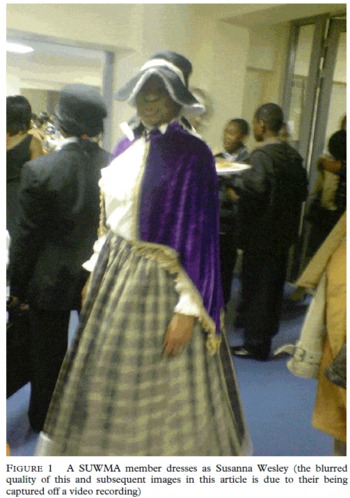
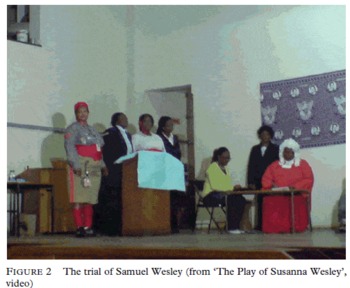
Members of SUWMA pay tribute to this unsung British heroine through prayers, charitable work and moral conduct, as well as through a number of annual events, such as the ‘Life of Susanna’ play and the visit to the tomb of Susanna Wesley in the Wesley Chapel cemetery on City Road in London. The first event, which usually takes place in November, is a re-enactment of the life of Susanna Wesley seen through the eyes of these Ghanaian women. The atmosphere of the whole play is charged with jokes, banter and irreverent behaviour, with surreal dialogues and improbable costumes. A great deal of space in the play is given to the courtship and marriage of Susanna Wesley, and her role as wife and mother. In the course of the play Susanna, historically a British woman, emerges as a Ghanaian woman sharing with the SUWMA women distinctive Akan cultural practices. For example, Twi is used in the play, and her courtship and marriage are re-enacted according to traditional Akan marriage customs (ware) in which the payment of the bridewealth must be exchanged in the course of the engagement party (kɔ kɔ kɔ). This is one of the most significant scenes in the play.
After a long and tentative courtship the Reverend Samuel Wesley, impersonated like every other male character in the play by a woman, takes a decisive step towards marriage. He sends members of his family to meet Susanna Wesley's parents. Sitting opposite each other, in the guise of a traditional engagement party, the two families exchange greetings and courtesies before discussing the wedding plans.
‘What is the purpose of your visit?’ asks Susanna Wesley's father. ‘We are here for Susanna's hand,’ replies Samuel's aunt. She then introduces formally every member of her visiting party. ‘This is the man who is coming to ask for the hand of your daughter’ (pointing at Samuel's father). ‘This is auntie Grace … and that fat man over there is our abusua paanin.’Footnote 32 This last remark, very disrespectful and impossible in real circumstances, causes uproarious laughter in the audience. ‘Thank you, you are all welcome. Everything is fine with us as you can see. There is a play at church on Saturday. After the play we can perform the wedding,’ says Susanna's father with assurance. His wife, looking rather puzzled, interrupts him to remind him about something very important, ‘But Reverend, aren't you supposed to do something here? Tell the elders.’ ‘Ahh, don't worry,’ replies her husband and, reaching under his chair, he picks up a piece of paper off the floor. This is the ‘list’.Footnote 33 Susanna's father passes the list to the groom's family, which in turns entrusts the abusua paanin with it. He folds the list and carefully places it inside a black leather bag. The two families stand up and exchange parting greetings. The curtain is drawn for the end of the scene.
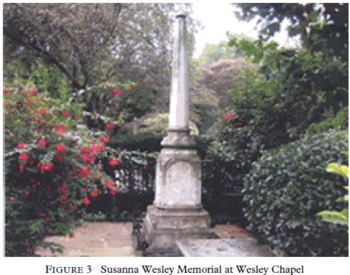
The second event, usually taking place in August, is the annual pilgrimage to Susanna's tomb on City Road. In opposition to the play, this is a very moving event as the women, wearing their associational cloth, conduct a funeral service at her tomb. In a sombre mood, they lay several wreaths of flowers, sing Methodist hymns in Twi and English, recall the life of Susanna Wesley and pray for her. The memorial service also becomes an occasion to do charity work and every year the women bring donations for the Wesley Chapel. In 2008 the yearly pilgrimage acquired a further dimension. In their efforts to contribute actively and make an impact on the life of the British Methodist Church, the SUWMA women decided to collect money for the restoration of Susanna Wesley's monument, which stands in the grounds of the Wesley Chapel. They have been relentless in their efforts to raise funds for a full renovation of what the SUWMA president hailed as ‘the only monument in the world to this dynamic woman’.
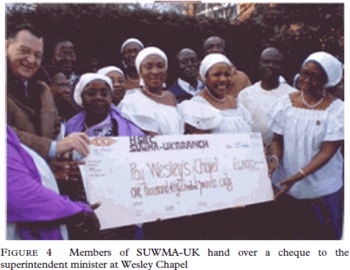
In mobilizing the assistance of their patrons, and fundraising in their local churches with speeches and through the distribution of information leaflets, SUWMA have been successful in their mission. In December 2008, they donated £1800 to the Wesley Chapel for the restoration of the monument.
In the process of honouring the memory of Susanna Wesley, members of SUWMA-UK have also given her memory a modern interpretation. She has been reconstructed mythologically as a modern, progressive African woman. In their speeches they often describe her as a ‘dynamic woman’, an expression commonly used in Africa today to describe the contribution women have made to the development of Africa and to the socio-economic progress of the continent. Introduced through the language of international development,Footnote 34 the label is often reserved for someone who straddles different spheres. It is a recurrent term in women's biographies and in almost every public presentation across sub-Saharan Africa. A dynamic woman is a wife and mother, but also a woman who engages in community work, an active member of the church, an entrepreneur. In a word, she is someone who makes a long-lasting contribution to public life and who helps build community. In this sense Susanna Wesley's history has been reinvented as the history of ‘a dynamic woman’: a ‘modern’ African woman. Her contribution to the church should therefore, according to SUWMA members, be made to shine forth. Almost unknown in Britain, Susanna Wesley has been appropriated by the Ghanaian Methodist Church, and then reinvented a second time by SUWMA-UK in London. Members of the Susanna Wesley Auxiliary see themselves as dynamic women and innovators. They want to leave a long-lasting impact not only in the Ghanaian diaspora but also within the British Methodist Church in the UK, and they do so by reaching out and building bridges. Their efforts are intended to redefine the role of African migrants in current debates on citizenship and ethnicity in Britain.
UPSETTING THE CONVENTONS: SUWMA-UK, THE BRITISH METHODIST CHURCH AND THE ROLE OF AFRICAN MIGRANTS IN BRITAIN
SUWMA-UK has tried to take a leading role in the debate on ethnicity, multiculturalism and the place of ‘ethnic’ fellowships within the Methodist Church. Elsewhere I show how Ghanaians have positioned themselves in this debate by sharing a message that encourages good moral conduct and exemplary lives as the ideal model of cohesion in British society. I call this ‘virtuous citizenship’ to stress how membership in the Methodist Church in Britain and Ghana mediates for Ghanaian Methodists a sense of citizenship, based on moral and ethical ideas of virtuous performance (see Fumanti 2010, in press). But, living in this country and being part of British Methodism is not enough for the women of the Susanna Wesley Auxiliary. These women aim to make an impact and be recognized within British Methodism and they do so by building bridges and at the same time upsetting well-established structures.
In order to acquire recognition the fellowship's members renegotiate and reposition themselves in a dialogue of identities as Ghanaian and British women. SUWMA-UK members celebrate their commonalities with British middle-class women, not just in the love of consumption, but in what they perceive as some positive values of British culture. By sharing the workplace with British women, as well as the space of the association with a number of second-generation British Ghanaian women, these women recognize the values of self-reliance, determination and the capacity to think independently and fend for oneself, as important traits of British culture. Mary, a second-generation British Ghanaian, comments on the way a female friend in the Methodist Church praises her ways as ‘British’: ‘You know because I have been brought up here, I think independently to provide for myself and I suppose that is the English side in me. My best friend always tells me, and says to me, “abrofɔ sεm, your English ways”, she loves my English ways.’Footnote 35 Mary's capacity to think independently and provide for herself – her English ways – are often associated, as I indicated earlier, with the discovery and celebration of a certain level of freedom, by Ghanaian women, and more generally by other Africans in the UK.Footnote 36 Women see this as a challenge and a tension that needs a ‘constant balance’, and which is tempered by upholding modesty, piety and motherhood. But it has equally great potential as a mode in which to transgress dominant discourses and upset taken-for-granted conventions, allowing these women to acquire distinction in the Ghanaian and British Methodist Church.
This was evident when Susanna Wesley Auxiliary UK for the first time attended the meeting of the Women's Network. As the chaplain of SUWMA told me prior to the meeting:
This Women's Network used to be an exclusively white-women only … you know, women with their nice hats and tea with cucumber sandwiches … . Now things have changed a bit but it is still mostly a white woman's place. … So we want to access that, [to] build our role in there … and contribute to the life of the British Methodist Church … reach out to other women. … We want to upset that. … You know, these days Methodist churches would be empty if it wasn't for us Africans, and especially Ghanaians, and so we really want to have our role recognized … we want to make an impact.
In front of a congregation of elderly Englishwomen, with a few Caribbean, the chaplain of SUWMA introduced the history of the fellowship and explained that, among its many aims, SUWMA really wants to expand its reach: ‘But mostly our dream is to link up with the women's network and contribute to the activities of the network.’ She explained their aim by outlining in detail their interpretation of Susanna Wesley's dynamic character as the source of legitimacy for their claim: ‘She wasn't just the mother of John and Charles Wesley but a very dynamic woman too.’ The President of SUWMA then took the stage and told the audience about their planned activities:
This year we will travel to churches and promote our club. We want to teach the children good values, [good] manners and cookery, and bring them up as good Christians. … But mostly we want to encourage you to form your [own] branches of SUWMA in your local churches because in this way we can see them mushroom and become a global church organization. We want to travel to different churches and encourage the formation of our organization.
She then described her dress, explaining who the people were whose pictures were printed on the cloth, and the meaning of the pearl necklace. In doing so she invoked an idea of modesty: ‘We wear a bit of lipstick but nothing else … we don't want to look like clowns.’ It was this moment, perhaps, which expressed most clearly the ambivalent attitude women had to their role as pious women. No mention was made of their usual bold and irreverent bawdiness and bling culture. Members of SUWMA stood up and, clapping their hands, delivered their characteristic rhythmic chant, SUWMA, SUWMA, SUWMA, SUWMA. There was time for a traditional Adua Ashanti dance and for two Christian songs. At the end of the performance the audience applauded very timidly and looked rather quiet. For all the efforts only one woman, an elderly Caribbean lady, asked a question on the meaning of the dance. But there was no enquiry on how to form a branch of the association.
Although they saw the meeting as a success, the women of SUWMA expressed their dissatisfaction with the mute response. Nevertheless they were determined to go forward with the plan: ‘It will take time but we will go and visit other congregations and let people know about us. … We will also let people know about Susanna Wesley, because, believe it or not, there are many English people who don't know who she is … and even British ministers!’
In their effort to promote the work of their fellowship in Britain members of SUWMA-UK are not only trying to assert their sense of Britishness by building bridges and crossing the ethnic divide in the Methodist Church, but are also maintaining and renovating their vital link with SUWMA Ghana. This vital link is nurtured through reciprocal visits of SUWMA members from the UK to Ghana. Many SUWMA-UK members still hold an affiliation to a SUWMA branch in Ghana, and vice versa, as the example of the SUWMA Ghana president's visit shows. Once a year the executive of SUWMA travels to Ghana to attend the Methodist Church connexional conference and the national SUWMA conference. This continuous relationship ensures the constant updating of news between the two countries. The news from Ghana is read in the course of the meetings, assuring that SUWMA-UK members are kept informed of official events and successful initiatives organized by SUWMA Ghana branches. For their part SUWMA-UK members tend to replicate some of these activities, in particular raising money for charities, both in Ghana and the UK, visiting nursing homes, or evangelizing and promoting the activities of the fellowship, as in the example above. However in the British context the fellowship's activities are imbued with new meaning. On the one hand, they help to renew and renovate the religious transnational community; on the other, they enter actively into the Methodist Church's internal debate on ethnicity and multiculturalism, while upsetting existing structures.
SUWMA is rather unique in the wider panorama of Ghanaian Christian, ethnic and civic associations, which tend to be far less engaged and willing to participate in the British debate on multiculturalism. This may be due partly to the legal or economic status of many Ghanaian migrants in the UK. It is expressed in the suspicion with which researchers are treated, in a context in which many people don't have ‘papers’ or have overstayed their visas. People are naturally very distrustful and afraid to talk.
Most Ghanaian migrants work in several jobs during the day, often travelling vast distances across London from one job to another. They put a great deal of effort into saving money sent home as remittances. More recently the Ghanaian chaplain has started to sensitize the congregation to the plight of migrants, especially Ghanaians, who live in Britain illegally and are excluded and exploited. Following a 2008 march through central London, ‘From Strangers into Citizens’, which he attended, he asked the congregation if they wanted to link up with the other associations organizing the march. In a message, in which, on the one hand, he praised the ‘virtuous model of citizenship of the Ghanaians’, and, on the other hand, encouraged a direct intervention in the British public sphere, he invited the congregation to think about the plight of migrants and do something about their fellow Ghanaians. Soon the Ghanaian Methodist Fellowship will join ‘Strangers into Citizens’ and introduce free consultation, with a barrister for Ghanaians who want to review their immigration status. The women of SUWMA in this respect, although linked with Ghana in more than one way and having kin both in London and back home, enjoy greater mobility than the overstayers.
CONCLUSION
Members of SUWMA-UK negotiate their ambiguous position as powerful women in the Ghanaian Methodist diaspora by maintaining an irreverent relationship to certain widely prevalent constructions of gender within the church and Ghanaian society. If, on the one hand, they maintain and bring forward an image of piety, modesty, and Christian motherhood, on the other hand they renegotiate what it means to be a successful and influential diasporic Ghanaian Methodist woman through their glamorous outfits, their banter, and engagement with wider debates on ethnicity and social cohesion within the British Methodist Church. They are committed to living life to the full in Britain, while maintaining their transnational commitments to the church and fellowship in Ghana. At the anniversary of one Methodist fellowship in 2008, a member of SUWMA told me of the great preparations ahead of next year's SUWMA fifth anniversary: ‘Next year it is going to be big. We are going to shake Westminster Central Hall!’ With the usual irreverence she rounded off her statement with the SUWMA trademark triple shout of ‘Shake! Shake! Shake!’ accompanied by a body shake. It is this irreverence, the ability to transgress accepted boundaries, that allows the SUWMA members to gain distinction while at the same time renewing both locally and transnationally the wider Ghanaian Methodist community.
ACKNOWLEDGEMENTS
This article was initially presented at the annual AEGIS conference in Leiden in July 2007 and then at Keele University in October 2008. I wish to thank Ben Page, Bruno Riccio, Stephan Miescher and Valentina Mazzucato (Leiden) and Pnina Werbner, Jane Parish and other participants at the seminar (Keele) for their invaluable comments. My gratitude goes to Pnina Werbner and Richard Werbner for their comments on earlier versions of this article and for their unwavering support in the course of this research. I also wish to thank Alfred Nimako for his assistance in the course of the research and Yaa Adjei-Bohyen for her invaluable help with the translation of my video recordings. Medase paa paa. I wish also to thank the ESRC UK for its generous support.
A SUWMA member dresses as Susanna Wesley (the blurred quality of this and subsequent images in this article is due to their being captured off a video recording)

The trial of Samuel Wesley (from ‘The Play of Susanna Wesley’, video)

Susanna Wesley Memorial at Wesley Chapel

Members of SUWMA-UK hand over a cheque to the superintendent minister at Wesley Chapel