By the end of the First War of Scottish Independence (1296–1328), the cult of St Columba, the patron saint of the Scottish kingdom, was eclipsed by that of St Andrew the Apostle. St Columba's relics had been a symbol of Scottish power since the Scots had defeated the Picts in the ninth century and had moved the relics from Iona to Dunkeld, in the heart of the mainland.Footnote 1 Scottish royalty had themselves acknowledged St Columba as their patron and had supported his cult from the ninth through the twelfth centuries. But over the course of the twelfth century, St Columba's support from royalty faded as St Andrew's cult grew in significance.
Still, St Andrew's status as a symbol of the Scottish kingdom, represented even today by his cross on the Scottish flag, was by no means settled in the thirteenth century. The cult of St Andrew began to receive consistent royal favour after King Alexander I (c.1078–1124) gave land and funds for a new Augustinian priory at St Andrews.Footnote 2 Nevertheless, although King Alexander I initiated a new phase in the cult of St Andrew, he continued to support the cult of St Columba.Footnote 3 Within the church, one of the greatest influences on St Andrew's cult was the early thirteenth-century bishop of St Andrews, William Malveisin, who developed a programme of architecture, liturgy and music – represented by the collection of polyphony in W1 – in order to ensure and support St Andrew's role in the politics of Scotland.Footnote 4 In this article, I examine the powerful influence of the music and liturgy at St Andrews cathedral on the image of St Columba in his fourteenth-century Office at Inchcolm Abbey.
The only surviving source with musical notation for the Office of St Columba is incomplete. Nonetheless, GB-Eu MS 211/IV provides vital insight into the devotional practice surrounding these two pivotal saints in Scottish history.Footnote 5 Since 1987, when Isobel Woods Preece convincingly demonstrated the manuscript's provenance at Inchcolm Abbey, it has been referred to as the Inchcolm Antiphoner and drawn the attention of Scottish historians and early music performers.Footnote 6 In the quest to find the medieval origins of a uniquely Celtic style of music, Preece, Ann Buckley and others have examined this office in honour of St Columba for some sign of music that was distinct from that of the prevalent Sarum Use.Footnote 7 Preece identified several of the chants as contrafacta of Sarum or Roman chants. A handful of the chants in the office she considered to be unique and suggested that they shared common features with Hibernian chants identified by Bruno Stäblein, or Celtic chants, as Ann Buckley later called them.Footnote 8
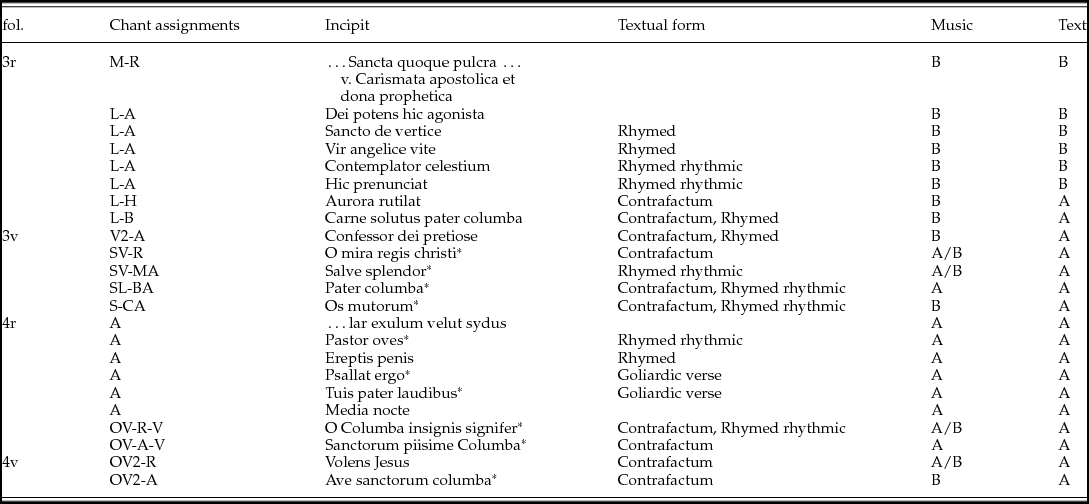
Rather than offering a rare relic of a lost Scottish chant repertory, the Office for St Columba in the Inchcolm Antiphoner actually exemplifies the musical and literary tools used in the ongoing struggle for recognition as Scotland's predominant patron saint. None of the chants Preece examined are, in fact, unique. Even Preece's ‘unique’ chants are demonstrably either contrafacta of Sarum chants or chants sung at St Andrews Cathedral (Table 1).Footnote 9 Furthermore, the office in its current form was the work of at least two scribes over several decades, possibly centuries. Preece dated the manuscript to the early fourteenth century, but parts of the office, including those she identified as the oldest chants, were edited by a fifteenth-century hand. The office is, thus, a witness to the role of music in shaping the idea of St Columba and his followers in the late thirteenth century, and how that musical idea shifted again in the fifteenth century. The contrafacta in the office provide a new background on which to paint the legacy of St Columba in the age of Europeanisation in Scotland.Footnote 10
Incomplete Office of St Columba in the Inchcolm Antiphoner, GB-Eu MS 211/IV.

*Chants that Preece identified as lacking any source chant beyond an incipit.
Fragments of the office
The Office of St Columba comes to us in a manuscript fragment with at least two layers of scribal work. It was first catalogued in the collection of the great Scottish antiquary David Lang (1793–1878), without any indication of its origins. The two surviving bifolios of the Inchcolm Antiphoner contain the chants of Vespers and Matins for the Feast of Corpus Christi in addition to the Office of St Columba beginning in the middle of Lauds and ending with the octave. The manuscript dates from sometime after 1264 when the Feast of Corpus Christi was instituted. The incomplete Corpus Christi Office is a variation of the prototype of the office known as Sacerdos in eternum, attributed to Thomas Aquinas and recorded in F-Pn lat. 1143 in the late thirteenth or early fourteenth century. The Corpus Christi Office generally follows the office in F-Pn lat. 1143, but has unique melodies for the hymn Sacris sollempniis and the responsories Accepit Ihesus and Qui manducat, suggesting that it had been copied into the Inchcolm Antiphoner before the standard Sacerdos in eternum office was widely used in the mid-fourteenth century.Footnote 11 I have identified the main text hand (hereafter A) as Northern Textualis Libraria, typical of the later insular medieval book hands.Footnote 12 The later date of the editor's hand (hereafter B) is suggested by three features. First, visible erasures can be observed at staff line breaks where staff lines are redrawn, or, in the case of Magnificat antiphon Ave sanctorum Columba, where the erasure of the music also blurred the top of the text. Second, the hand has a distinctive slant. The editor uses a crossed ‘x’, and both the open and the closed ‘a’, rather than the box ‘a’ of the original hand. The crossed ‘x’ in particular points towards a significantly later hand, potentially fifteenth century.Footnote 13 Third, the editor writes the B♭ clef with a tail, where the original hand A puts none. The work of scribes A and B has been listed in Table 1.
Although, in all probability, scribes A and B worked at least several decades (if not a century) apart, they both were responsible for copying contrafacta for this Office for Inchcolm Abbey.Footnote 14 Most of the texts copied by scribe A are in some form of rhymed verse, many of them also rhythmic couplets. Two are in Goliardic verse typical of Latin song. These aspects all point to composition after the twelfth century, when rhymed, rhythmic poetry became the standard for new offices.Footnote 15 In particular, the Office for St Thomas of Canterbury from around 1170 seems to have been the first to introduce Goliardic verse in a saint's office.Footnote 16 But the melodies, especially the longer chants copied by scribe A and edited by scribe B, are mostly contrafacta of common chants from other offices of the Temporale and Sanctorale. As may be seen from Table 1, scribe B rewrote all the texts and music of the Lauds chants, except for the hymn and canticle antiphon.Footnote 17 No other text was altered, but five further melodies were rewritten, and four edited. Although scribe B altered several melodies, by referring to the source chant (see, e.g., Volens Jesus, Sanctorum piissime and Ave sanctorum Columba, discussed in the section on contrafacta) the original texts copied by scribe A indicate they are contrafacta. Thus, the contrafactum technique was central to the original construction of the office.
The Contrafacta Chants
It was not unusual for saints’ offices to be constructed from contrafacta, often from other, more widely known saints’ offices.Footnote 18 But the source chants adapted for St Columba were gathered from an assortment of offices for Sundays and saints’ days, rather than from another complete office. Each of the melodies linked St Columba – by association with their source texts – with potent symbols of divine power, symbols of God's covenant from the Old Testament, or apostles from the New Testament. The resulting office may thus seem a patchwork affair at first sight, particularly compared to newly composed saints’ offices from the twelfth century and later. But on closer investigation, in the context of the shifting hagiographical landscape of the thirteenth and fourteenth century in Scotland, the contrafacta appear to rebuild the cult of St Columba on the musical foundation of Old Testament signs and New Testament apostles, and, in particular, upon the special apostle to the Scots, St Andrew.
The Vespers responsories that survive in the manuscript were drawn from the Sundays leading up to the season of Lent in the Sarum Use. In each of them, Columba is cast as one of the figures of God's fulfilment of the Old Testament covenant made with Abraham as described in the pre-Lenten sequence of Old Testament readings.Footnote 19 The clearest example of these is the responsory for second Vespers on the octave of Columba's feast. Preece identified the responsory Volens ihesus v. Deferens autem as a contrafactum of the Sarum responsory Volens Noe v. Deferens autem (cao602530), a Matins responsory for Sexagesima Sunday (Ex. 1).Footnote 20 Volens Noe is one of a group of chants for the Matins Office that relate the story of Noah's ark, in which God saved creation from utter destruction during forty days of flooding by commanding Noah to build an ark and fill it with every kind of living creature (Genesis 8). When the flooding subsided, Noah sent out a dove, which eventually returned carrying an olive branch, demonstrating that there was dry land.
The contrafact Volens ihesus and its source Volens Noe.

In the original chant, Volens Noe, Noah's dove is a messenger who, by demonstrating that the waters had subsided, heralds a sign of God's mercy on Noah and his family. The recitation of Noah's story on Sexagesima Sunday, the Sunday two weeks before the beginning of Lent, was a way of preparing the community for the forty-day fast ahead. The story was, likewise, a reminder of the sign of God's mercy that lay at the end of Lent: Christ's crucifixion and Resurrection. Noah's dove, often interpreted as the Holy Spirit, was, thus, itself a figure of the Messiah in the context of Sexagesima.Footnote 21 In the contrafactum, the dove in the story of Noah's ark is interpreted as a figure of Columba (meaning dove in Latin). Instead of a green olive branch, in Columba's mouth was a song, the sign of God's mercy. In his life of Columba, Adomnán (c.624–704) records that St Columba's voice itself was miraculous – audible at a far greater distance than any other – and thus itself a sign of God's miraculous work. Adomnán also records that certain lay people in Ireland and Britain were saved from the assaults of enemies when they sang praises of St Columba in the Irish language.Footnote 22 In the contrafactum columba is multivalent. Columba's miraculous voice relieves sorrows, but he is also cause for singing, to which the chant itself bears witness. The Inchcolm canons, singing the merits of Columba, and echoing back to Noah's dove, themselves participate as a sign of God's mercy. The signifying power of the song as a sign of God's mercy may explain why the composer took particular care in this chant to mimic the sounds of the words in the source chant as well as the melody. The aural recitation of words with music had salvific power.
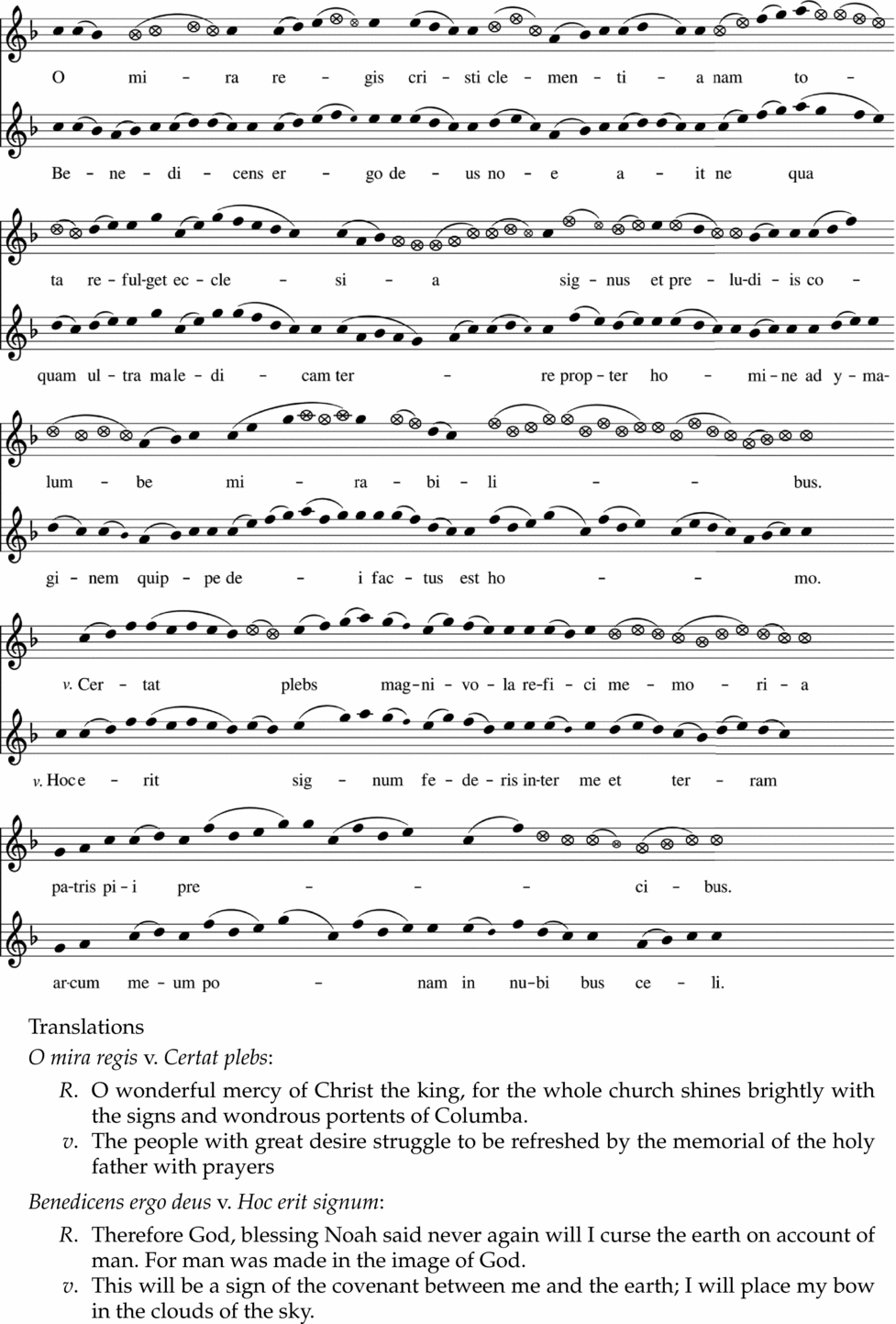
In O mira regis, the responsory for second Vespers on the actual feast day, Columba is again held up as a sign of the covenant through the story of Noah. O mira regis is a contrafactum of another responsory from Matins of Sexagesima, Benedicens ergo deus v. Hoc erit signum (cao600283) (Ex. 2).Footnote 23 The latter comes at the end of the third nocturn in insular manuscripts, concluding the final part of the Noah story in which God promised Noah never again to send a flood to destroy the earth and placed a rainbow in the sky as a sign of the covenant.Footnote 24 The new text does not directly mimic the source text, and the later editor of the music made significant changes to the melody, some of which obscure the relationship with Benedicens. Nonetheless, the new chant has the same basic melodic shape outlining the transposed mode 6. The final phrase of the respond – the longest phrase edited by scribe B – expands from the figure f–d–e out to g–c in a gesture that closely mimics that of the source chant, as most of his alterations do. Where they depart from Benedicens, scribe B's alterations add or change a note to emphasise the final, fourth and fifth of the mode (c, f and g), as on clementia, tota and ecclesia. In Benedicens ergo, the rainbow is the sign of God's mercy, since it symbolises God's promise never again to flood the earth. In O mira regis, St Columba's signs and portents (signis et preludiis) are presented as the signs of God's mercy, for ‘the whole church is illuminated by them’. Like the Old Testament signs of the covenant that point to the Christ as the Messianic fulfilment of God's promise in the Pre-Lenten season, St Columba's miraculous works reveal him as an imitator of Christ, like the rainbow and the dove signifying God's promise and its ultimate fulfilment in Christ.
Parallel transcription of O mira regis (GB-Eu MS 211/IV, fol. 3v) and its source, Benedicens ergo deus (Worcester Antiphoner, GB-WO F.160, fol. 39r). Whited-out noteheads indicate the alterations of the later scribe.

The remaining responsory for Vespers on the octave, O columba insignis signifer (Ex. 3), refers to another of the covenant signs from the Old Testament, Abraham's circumcision. Dixit autem dominus ad abraham (cao600597) was the responsory sung at the end of the first nocturn on Quinquagesima Sunday in the Worcester Antiphoner or at the beginning of the second nocturn in the Barnwell and Penpont Antiphoners.Footnote 25
Parallel transcription of O Columba insignis signifer v. Tibi preceteris (GB-Eu MS 211/IV, fol. 4r) and Dixit autem dominus ad abraham v. Ex te namque (GB-WO F.160, fol. 40r).

Although sung in response to a sermon on the sacrifice of Isaac, Dixit autem dominus ad abraham is drawn from an earlier Genesis text (Genesis 17:4, 10–11), in which God reveals to Abraham that he will be the father of many nations. The text of this responsory for the Sunday before Lent recalls God's covenant with the Israelites and the coming of the promised Messiah, prefigured in the sacrifice of Isaac. Although not specifically mentioned in the chant, the sign of the covenant in Genesis 17:10 is male circumcision.Footnote 26 In the contrafactum, St Columba is a sign bearer (signifer), one of the circumcised. But the comparison with Abraham, the father of all Christians as he was described in the letter to the Hebrews and frequently remembered in the medieval period, has further import in the context of fourteenth-century Scotland. Like Abraham, St Columba was a spiritual father, namely of the Christianised Scottish kingdom. His claim to patronage, when cast as a figure of Abraham, reached back even further than the apostle Andrew's ancient claim, to the very seed of Scottish Christianity.
Columba is hailed in this responsory as one of the distinguished offspring of Abraham. In the verse, Columba holds a special place before all others, and is compared to the one ‘in whom all gentiles will be blessed’ in the original chant. Columba is not only one of the many sons of Abraham, he is the foremost of those who follow Christ, one who bears the sign of God's covenant and one who reflects its fulfilment in Christ. In these responsories, Columba's saintly authority is established at the very beginning of salvation history, in the earliest signs of God's salvific work in the Old Testament. By linking the covenant signs in the Old Testament with Columba, the author refashioned Columba, casting him as manifestation of the iconic symbols of the Old Testament.
The longer antiphons in Columba's Office were composed or revised to use melodies of well-known votive antiphons or antiphons that refer to an apostolic figure. Carne solutus is a contrafactum of the famous antiphon for Lenten Compline and the Office of the Dead, Media vita in morte (cao003732).Footnote 27 In Carne solutus, Columba has escaped the threat of death and punishment described in Media vita and has joined the heavenly chorus in the eschatological song cited at the heart of the Mass, ‘Sanctus, sanctus, sanctus’. Pater Columba decus morum is modified from the votive antiphon for the Trinity, Te jure (cao005120), taking advantage of the two-part structure and the triadic movement to fit the rhymed rhythmic poetry of the Columba text.Footnote 28 Os mutorum, the commemorative antiphon for the Sunday within the octave, similarly adapts an antiphon to fit the eight lines of rhymed rhythmic poetry for St Columba:
A. Os mutorum lux cecorum pes claudorum porrige lapsis manum firma vanum et insanum corrige
A. Mouth of the dumb, light of the blind and foot of the lame, stretch out a hand to the fallen, strengthen the unreliable and correct the mad.
The source antiphon, Ponens Petrus (cao004304), offered not only a regular return to the final c in this transposed mode 8 antiphon, but also referred to one of the miraculous wonders wrought by the apostle St Peter: the raising of Tabitha from the dead (Acts 9:40–1). Columba's own miracles – making the dumb speak, the blind see and the lame walk – are thus framed in the contrafactum as apostolic works done specifically for the Scots. The apostolic connection introduced through this contrafactum sets up the comparison in the final two Magnificat antiphons on the octave between St Andrew and St Columba. Though a seemingly random assortment of contrafacta, they demonstrate the potency of the source chant for St Columba's new celebration, strengthening his own position as God's chosen saint for the Scots.
As noted in the opening of this article, in the early fourteenth century the most powerful symbol of God's special provision for the Scottish kingdom was St Andrew. Apart from St Peter and St James, St Andrew was the only apostle whose relics had travelled to a location in Western Europe by his own design, according to a twelfth-century legend.Footnote 29 As the author of the foundation account of St Andrews priory recorded, some Scots even believed that St Andrew had appeared in Scotland in the flesh.Footnote 30 The political and historical power of the relics of St Andrew are manifest in a letter of Pope Boniface VIII to Edward I, King of England, in which, among other historical details, he invokes the Scots’ conversion to Christianity by Saint Andrew's relics, by which they also claimed ecclesiastical independence from the English church.Footnote 31 The composer of the new Office for St Columba also recognised the powerful position of St Andrew for the Scottish church. By using for St Columba the music associated with St Andrew and his church, he drew on the power of St Andrew's cult to strengthen the cult of St Columba.
The final two antiphons for the Magnificat at first and second Vespers of the Octave, Sanctorum piissime (Ex. 4) and Ave sanctorum Columba piissime (Ex. 5), are contrafacta of antiphons for St Andrew's feast known only in sources from St Andrews Cathedral and Wells Cathedral, also dedicated to St Andrew. Preece identified Sanctorum piissime as one of the unusual chants in the Columba Office, possibly pre-Norman. Sanctorum piissime has a surprising number of small recurring units, but, unlike the other chants of the office, it is not cast in the rhythmic, rhyming form of chant poetry popular in the thirteenth century. The recurring units do not occur at phrase endings, as others identified by Preece, but rather in the middle of the phrase, sometimes overlapping an ending phrase with an opening phrase, such as on ‘solamine fratres’, where the a–g–a–f figure used at the cadences on itinere connects to the triad outline.Footnote 32 The textual and musical phrases sometimes overlap, as at Celi fulmine romani iuris urbem predicis casuram, in which there seems to be a cadence in the middle on f, but the textual phrase continues to the C ending casuram. In the phrase beginning globi and ending itinere, the cadences on solamine and itinere match, but both accentuate paroxytone instead of proparoxytone syllables. Compared to chants in the earlier portion of the office, which have clearly accented rhymed poetry emphasised by the musical cadences, Sanctorum piissime presents a distinct asynchronous approach to text and music relationships.
Words of Sanctorum piissime Columba and Sanctorum mitissime Andrea.

Transcription of Ave sanctorum Columba piissime (GB-Eu MS 211/IV, fol. 4v) with hypothetical placement of Ave sanctorum Andrea mitissime (GB-Wc DC/F/1 21.3r).

The asynchronous character of Sanctorum piissime may reflect the attempt of the cantor to write a long new text that closely resembles an older chant. The thirteenth-century antiphoner F-Pn lat. 12036 made for St Andrews Cathedral in Scotland shares the same textual incipit and a similar closing for a Magnificat antiphon for the octave of the Feast of St Andrew.Footnote 33 Sanctorum mitissime Andrea (Ex. 4) was not used in the Sarum Use, but an alternative Magnificat antiphon offered in F-Pn lat. 12036, Domine Jesu Christe magister, was. Like Sanctorum piissime Columba, the chant for St Andrew's feast is much longer than typical Magnificat antiphons, and contains several short rhyming phrases in the middle, although it maintains a rhyming metrical structure throughout, unlike the chant for Columba.
Unfortunately, F-Pn lat. 12036 contains no music for Sanctorum mitissime Andrea, but the only other source of the text does include a musical incipit that matches the unique opening of Sanctorum piissime Columba. A fifteenth-century copy of an office in honour of the St Andrew's translation survives on a folio used to bind an account book at Wells Cathedral in the late sixteenth century (GB-Wc DC/F/1 21.3r).Footnote 34 This and the other offices on the folio were clearly added as amendments to an office book for a church related to Wells, since they are all for local saints and out of calendrical order. The translation office celebrated the translation of St Andrew's relics to Constantinople by Constantine and has nothing to do with St Andrew's relics in Scotland.Footnote 35 Nonetheless, these two centres of devotion to St Andrew shared this unusual antiphon for St Andrew. The presence of Sanctorum mitissime Andrea in F-Pn lat. 12036 indicates that it was certainly known in St Andrews in the early thirteenth century, whereas it is not clear when it entered the liturgy at Wells Cathedral. Given the awkward setting of the text Sanctorum piissime Columba compared to the neat metrical verse in Sanctorum mitissime Andrea, the text for St Andrew was probably the original. Perhaps the version for St Andrew was in fact, as Preece speculated, a ‘remnant of a Celtic tradition’.Footnote 36 But it is just as likely that it was a Norman chant brought to Scotland by Bishop Turgot when he was bishop of St Andrews.Footnote 37 For the composer of Sanctorum piissime Columba, its importance lay in its unique connection with St Andrew.
The final antiphon for the octave of Columba's feast, another Magnificat antiphon for Vespers, also draws from an antiphon for St Andrew used at St Andrews and Wells, Ave sanctorum Andrea (Ex. 5). The two texts share the same text in the first and third lines, with minor adjustments. They are both mostly in lines of twelve syllables with proparoxytonic endings, and they share the same rhymes at the end. A shared musical incipit further confirms a musical relationship between the two, although they may have lacked this originally. The later editor of the Inchcolm Antiphoner completely erased the original melody, drew new staff lines, and rewrote the entire melody. Whether he was rewriting it to reflect another version of Ave sanctorum Columba or whether he was rewriting the older tune using the same incipit but reflecting his own ideals of chant melodies, it is impossible to say at this point.Footnote 38
The model chant Ave sanctorum Andrea (Ex. 5) was certainly known in Scotland. Although not in the antiphoner from St Andrews discussed earlier, nor in the Aberdeen Breviary, the textual incipit is listed among the chants in the liturgy for St Andrew in a letter by James Haldenston, prior of St Andrews (1417–43). Many of Haldenston's references are to common chants for the office, included in the office in F-Pn lat. 12036.Footnote 39 But he also quoted parts of Andreas christi famulus, an unidentifiable prose Andrea tutor Scotiae which – as we see from its title – is about St Andrew in Scotland, and the antiphon Ave sanctorum Andrea mitissime. It is only in passing that Haldenston remarks on the antiphon Ave sanctorum Andrea mittisime, which, according to him, is to be said from the highest step in the cathedral by all priests, probably indicating that it was a votive antiphon sung after Compline.Footnote 40 Although Haldenston's letter provides only a textual incipit, no sources other than the Wells Translation Office and the Inchcolm Office contain the same incipit; it is likely therefore that Haldenston was referring to the same antiphon. The canons at Inchcolm Abbey would certainly have known of the importance of Ave sanctorum Andrea mitissime at St Andrews Cathedral, since some of the canons held positions at both institutions, such as Walter Bower who was a canon of St Andrews priory around 1400 to 1410 and then abbot of Inchcolm Abbey.Footnote 41
Like Sanctorum piissime Columba, the melody for Ave sanctorum Columba piissime emphasises triadic movement especially above the final, c in this transposed mode 8. The range extends up to the octave in the second half, and long melismas highlight the important words of the lines, each of which end with a cadence on the final or on g on the climactic higher register in the third to last line. In terms of fitting the structure of the text with the music, the melody of Ave sanctorum Columba pissime is far more closely synchronised with the text than Sanctorum piissime Columba. Perhaps this was the later editor's main purpose. The musical incipit, combined with the close textual relationship, forged a connection between St Columba and the then more influential Scottish saint, Andrew. Example 5 offers a hypothetical placement of the text, demonstrating that the music could very well have fit for both texts, and in any case the texts are closely aligned.
A curious connection between the Inchcolm Office and the famous St Andrews book of polyphony, W1 (D-W Cod. Guelf. 628 Helmst.), further exemplifies how the composer of the Inchcolm Office used the more successful cult of St Andrew, and even the great music of the cathedral dedicated to him, to strengthen the praise of St Columba and to increase his status. One of the commemorative antiphons in the middle of the octave week in the Columba Office adapts the text of the third strophe of a conductus. Psallat ergo comes from Sonet vox laetitie, a two-voice conductus with three verses found only in W1 and F (I-Fl Pluteo 29.1) (Ex. 6).Footnote 42 The Inchcolm Office continues the theme found in other commemorative antiphons addressing St Columba as shepherd, but the text also includes a warning to the choir on the fourth day of his octave, nearing the end of his celebration. The choir is instructed to celebrate Columba attentively and with concern for their future salvation. In the following antiphon, Tuis pater laudibus, which has no known source but is also in Goliardic verse, the warning is even more pronounced as the choir is threatened with the whip should it slacken in its praise.
Psallat ergo and its source text.

The music of Psallat ergo is unrelated to the Notre Dame conductus, but the text is clearly adapted from the final verse and maintains the same poetic structure. The conductus text is not unusual in its cautionary note, although in the Columba version it is slightly more hopeful in asking Columba's protection at the final judgement. Why this particular text of all conductus should have found its way into the feast of St Columba is something of a mystery. It is not found in any other office, inscription, or incipit. This seems to be the only place the text was copied or adapted outside of the conductus.
W1 itself may provide some insight into how this particular text found its way into the Columba Office. On the folio opposite Psallat ergo, a letter draft addressed to a cleric of St Andrews, James, was copied upside-down. The short introductory section of the letter also names the sender and the bearer of the letter. The bearer of the letter, Thomas Bel, was a precentor of Brechin Cathedral and a canon of Dunkeld Cathedral in the 1250s through the 1270s.Footnote 43 The cleric James was in the household of Bishop David de Bernham in the 1250s, and thus the letter was likely written some time in the 1250s.Footnote 44 The possibility that Thomas Bel himself copied the letter into W1 is particularly intriguing. The draft appears in the middle of a quire in the middle of the manuscript, an odd choice of placement if he was merely looking for scrap parchment. What seems more likely is that the manuscript was already open to this page when the scribe, perhaps Thomas Bel himself, found a need to draft a letter. But why might he be studying this particular page? If indeed the scribe was Thomas Bel, who had both musical knowledge as precentor of Brechin and a particular interest in expanding the Office of St Columba, the patron saint of Dunkeld Cathedral, he may have been consulting W1 with the idea of finding a text appropriate for St Columba. Claiming a text from the music book of St Andrews for Columba would have been another method of demonstrating Columba's connection to the powerful cult of St Andrew.
This connection between St Columba and the famous manuscript designed to increase the prestige of the centre of devotion to St Andrew again invites the comparison of the two saints. Sonat vox laetitie does not refer to St Andrew or any saint, but it was representative of the musical splendour created for his cathedral and likely contributed to the growth of St Andrew's cult. As the singular adaptation of a conductus verse within the Columba Office, Psallat ergo reflects the same source and motivation as the two contrafacta of antiphons for St Andrew, harnessing music of the influential cathedral and its patron for St Columba. At the same time, the contrafacta of pre-Lenten chants point to a still more ancient authority than St Andrew. They root St Columba's authority in the Old Testament signs of God's covenant, and cast St Columba as a figure of Abraham, the first father. St Columba's spiritual fatherhood was then manifest in the same miraculous works as the first apostles, making him a more ancient counterpart to the other Scottish saint, the Apostle Andrew.
Scottish chant?
Preece suggested that the Inchcolm Antiphoner provides the only surviving Scottish chants that pre-dated the Sarum Use.Footnote 45 The Inchcolm Antiphoner is not only important for its connection to the Scottish saint, especially during the time when his cult was under threat. It is the only fully notated office for a Scottish saint that was likely composed in Scotland.Footnote 46 As such it has the potential to provide a unique witness to a distinct chant practice in Scotland. Preece found that the majority of the chants for Columba's feast were in fact contrafacta or closely related Roman or Sarum chants.Footnote 47 But she connected the remaining five melodies with gestures in what Bruno Stäblein identified as remnants of the Celtic chant tradition in two antiphons preserved in a thirteenth-century breviary.Footnote 48 As I have demonstrated, the ‘small-scale repetitions’ and rhyming cadences identified by Preece were either in the source chant or produced by extending a musical passage to fit the new text. Although Preece qualified her suggestion that the Columba chants ‘might be a later branch of the same tree’, scholars and musicians alike have seized upon the suggestion that they are ‘as distinctive melodically as were the organisation and practices of the Celtic church’.Footnote 49
The idea of discovering through a single chant source an idiomatic Scottish chant practice is problematic, to say the least. The evidence of Scottish medieval music is too scant to draw any conclusions about a widespread distinctive musical style in Scotland; as Warwick Edwards has pointed out, however, Scottish liturgy had been influenced by outside sources – English practices especially – long before the Sarum Use was codified.Footnote 50 What does survive in this isolated quire from Inchcolm Abbey is a thirteenth-century musical perspective on sanctity, patronage, veneration and Scottish history.
If there is some sense in which the chants are Scottish, it is not in their musical idiom. Nonetheless, they praise a saint who was hailed as the ‘Hope of the Scots’ in the commemorative antiphon for Sunday. Even though the composer of the Office relied on Sarum chants for the music, he was, nonetheless, in some sense composing a self-consciously Scottish celebration of his saint. Thomas Owen Clancy has argued in Spes Scottorum that hailing Columba as the hope of the Scots was not only a historical claim, but also a patriotic one.Footnote 51 Columba would save Inchcolm Abbey from the enemies of the Scottish kingdom, the English. The office texts placed the canons in a particular historical, religious and political context. When they sang the Office of St Columba they were part of a race and kingdom under the care of St Columba, hailing St Columba with melodies familiar to many across the Scottish kingdom and beyond. The new St Columba for all of Scotland was built on the solid foundation of common Sarum chants and chants from St Andrews for the other Scottish saint, St Andrew.
Conclusion
The Inchcolm Office expands our understanding of medieval chant in Scotland beyond the identification of Scottish characteristics in chant that seek to prevail against the encroaching Sarum Use. The composer and later editor of the office were in fact very interested in grafting St Columba into the current liturgical practice. They did so by writing new texts and using common chants that not only updated his office, but also established his authority by casting him as an apostle and an embodiment of the divine grace witnessed in the Old Testament signs of the covenant. Drawing St Columba into a musical network of connections with authoritative figures, not the least of which was the Apostle Andrew, was foundational to the composer's method. To renew the cult of St Columba, he reused music connected to powerful saints, narratives, and liturgical moments.
With knowledge of the hagiographical context of the Inchcolm Office and the connections between the texts and music for St Columba and St Andrew, and the manuscripts that bear them, we can catch a glimpse of some of the ways saints were brought to life through the liturgy. These connections were the intimate secrets of liturgical adepts – those who could recall songs of Noah's dove and Abraham's seed, Peter's miracles and Andrew's mildness. St Columba's miraculous works were not only a sign of his sanctity, they also reflected the apostolic work of Peter, who himself repeated the resurrection of the dead performed by Jesus Christ. St Columba was even a sign of the power of St Andrew himself, whose advantageous claim over Scottish history would make him the most important of Scottish saints, even to this day. For the canons of Inchcolm, the two Scottish saints, one by birth and one by mission, would be liturgically intertwined.