Introduction
The Canadian population is ageing. Canadian Census data indicate that the proportion of the population 50–74 years of age has increased dramatically in the past two decades, from 20.7 per cent of the population in 1991 to 29.1 per cent in 2011 (Statistics Canada 2012). These ageing trends have important implications for labour markets in Canada and elsewhere in the developed world. The policy interest in the labour market participation of older workers has reversed over the last 20 years. While during the 1990s policy makers were focused on encouraging older workers to retire early from the labour market to make way for younger cohorts, keeping older workers in the labour market has now been identified as one of the major policy challenges in many developed countries (Siegrist et al. Reference Siegrist, Wahrendorf, von dem Knesebeck, Jurges and Borsch-Supan2007; The Commonwealth of Australia 2010). This change in direction is to help relieve the increasing pressure being placed on publicly funded pensions, which stems from an imbalance in the ratio of those in and not in the labour force. This in turn, has arisen (in part) due to the increasing number of years between the age of eligibility for retirement benefits and life expectancy (currently 18 years for men and 21 years for women) (European Foundation for the Improvement of Living & Working Conditions 2006; Organisation of Economic Co-operation and Development 2006, 2009; Siegrist et al. Reference Siegrist, Wahrendorf, von dem Knesebeck, Jurges and Borsch-Supan2007).
Labour market policy responses to ageing trends in many countries have focused on either abolishing mandatory retirement (e.g. most Canadian provinces) or increasing the age at which the population is eligible for publically funded retirement benefits (e.g. Australia, Canada and France). However, relatively little attention has been paid to understanding and addressing the potential health-related barriers faced by older workers in order to stay at work (Minton, Pickett and Dorling Reference Minton, Pickett and Dorling2012; Schofield et al. Reference Schofield, Shrestha, Passey, Earnest and Fletcher2008). Data from the 2007 Canadian General Social Survey demonstrated that workers with the lowest levels of self-rated health were the ones most likely to want to stay in the labour market until 65 years of age, with this group also the most likely to report their retirement income would be barely adequate or inadequate (Schellenberg and Ostrovsky Reference Schellenberg and Ostrovsky2008).
The decline in various aspects of physical and cognitive function and increases in chronic conditions with age is well documented (Costa and Sartori Reference Costa and Sartori2007; Ilmarinen Reference Ilmarinen2001; Savinainen et al. Reference Savinainen, Nygard, Korhonen and Ilmarinen2004; Schultz and Kopec Reference Schultz and Kopec2003). A report from the Health Council of Canada, focusing on seven long-term chronic conditions (arthritis, cancer, chronic obstructive pulmonary disease, diabetes, heart disease, hypertension and mood disorders) reported that one-third of Canadians have one or more of these conditions, with 11 per cent having two or more conditions (Health Council of Canada 2007). While the prevalence of some chronic conditions has been stable over the last 20 years, others are increasing rapidly. For example, Type 2 diabetes and hypertension prevalence rates have both increased substantially, exceeding previous predictions, due in part to the rapid increases in population levels of obesity (Lipscombe and Hux Reference Lipscombe and Hux2007; Tu, Chen and Lipscombe Reference Tu, Chen and Lipscombe2008). Rates of arthritis have also increased above what would be predicted based on demographic changes alone (Perruccio, Power and Badley Reference Perruccio, Power and Badley2006). The co-occurrence of chronic conditions (multi-morbidity) is also a growing concern at the population level (Britt et al. Reference Britt, Harrison, Miller and Knox2008; van den Akker, Buntinx and Knottnerus Reference van den Akker, Buntinx and Knottnerus1996). More than half of Canadians with arthritis or hypertension have another chronic condition, while 75 per cent of people with diabetes or heart disease have another chronic condition (Health Council of Canada 2007).
A relatively large body of research has examined the impact of specific chronic conditions on labour market participation, in particular arthritis (Gignac et al. Reference Gignac, Cao, Lacaille, Anis and Badley2008; Gignac, Sutton and Badley Reference Gignac, Sutton and Badley2007; Kaptein, Gignac and Badley Reference Kaptein, Gignac and Badley2009) and diabetes (Detaille, Haafkens and van Dijk Reference Detaille, Haafkens and van Dijk2003; Latif Reference Latif2009; Weijman et al. Reference Weijman, Kant, Swaen, Ros, Rutten, Schaufeli, Scharbracq and Winnubst2004). Although numerous, each of these studies has restricted their focus to only one condition of interest, not allowing direct comparisons across conditions in relation to labour market participation, or the assessment of how combinations of conditions might increase the risk of labour market exit. When studies have included more than one health condition, they have used one of three approaches. The first approach is to sum the number of chronic conditions and to examine if the number of conditions is related to health status or other health-related outcomes (Park Reference Park2010; Schofield et al. Reference Schofield, Shrestha, Passey, Earnest and Fletcher2008). The weakness of this approach is that all chronic conditions are assumed to have a similar, and additive, impact on the outcome of interest, despite this assumption having not been established (de Groot et al. Reference de Groot, Beckerman, Lankhorst and Bouter2003; Fortin et al. Reference Fortin, Lapointe, Hudon, Vanasse, Ntetu and Maltais2004). A second approach is to identify one condition of interest (e.g. diabetes) and then to examine other conditions in addition to this ‘index’ condition. While this approach offers advantages over the additive approach, it does not allow for an examination of other combinations of conditions outside the index condition. A third approach is to use statistical methods to group specific combinations of chronic conditions (see Cornell et al. Reference Cornell, Pugh, Williams, Kazis and Parchman2007; Holden et al. Reference Holden, Shuffham, Hilton, Muspratt, Ng and Whiteford2011; John, Kerby and Hagan Hennessy Reference John, Kerby and Hagan Hennessy2003) as examples of these types of approaches). One can then examine if combinations of these conditions have a greater impact on the outcome of interest than they do in isolation (i.e. synergistic effects).
In general, relatively little research has examined if specific combinations of chronic conditions have a greater impact on labour market participation than the additive effect of each condition in isolation. An exception is a study from the United States of America which compared the impact of arthritis and cardiovascular disease on work attachment and work restrictions. This study reported differences in the impact of these two conditions, with respondents with arthritis more likely to remain at work (albeit with limitations), while respondents with heart disease often stopped work more abruptly (Verbrugge and Juarez Reference Verbrugge and Juarez2008). In addition, the impact of having both arthritis and heart disease on limitations at work, or being unable to work, was greater than the impact of having one of these conditions in isolation (Verbrugge and Juarez Reference Verbrugge and Juarez2008).
The effect of chronic conditions on labour market participation may also differ across education and gender groups (Christensen et al. Reference Christensen, Kriegbaum, Hougaard, Mortensen and Diderichsen2008; Holland et al. Reference Holland, Nylen, Thielen, van der Wel, Chen, Barr, Burstrom, Diderichsen, Andersen, Dahl, Uppal, Clayton and Whitehead2011; Ilmarinen Reference Ilmarinen2006; Minton, Pickett and Dorling Reference Minton, Pickett and Dorling2012; Sandqvist and Henriksson Reference Savinainen, Nygard, Korhonen and Ilmarinen2004). Workers with chronic conditions may be more likely to be able to stay at work when the physical requirements of their job are low, or they have autonomy over occupational tasks and schedules (Ilmarinen and Rantanen Reference Ilmarinen and Rantanen1999; Shultz et al. Reference Shultz, Wang, Crimmins and Fisher2010). Physical job demands and worker autonomy are differentially distributed across both gender and educational groups, with workers with lower levels of education more likely to be working in physically demanding occupations (Cubbin and Smith Reference Cubbin and Smith2002; Oh and Shin Reference Oh and Shin2003); and women and workers with lower levels of education more likely to have lower job control (Punnett and Herbert Reference Punnett, Herbert, Goldman and Hatch2000; Smith et al. Reference Smith, Frank, Mustard and Bondy2008; Vermeulen and Mustard Reference Vermeulen and Mustard2000). In addition, it is important to understand whether the relationships between chronic conditions and labour market participation have changed over time, with a recent study in the United Kingdom demonstrating that the relationship between good health and labour market participation has increased between 1973 and 2009 for both men and women (Minton, Pickett and Dorling Reference Minton, Pickett and Dorling2012).
The objective of this paper is to examine the relationship between seven physical chronic conditions and labour market participation using three cross-sectional population-based surveys in Canada. Specifically we examine:
1. the relative impact of different chronic conditions on age-related differences in labour market participation;
2. whether specific combinations of chronic conditions have greater risk of non-labour market participation above the independent effects of these conditions separately; and
3. whether the relationship between chronic conditions and labour market participation differs for men and women, across educational groups, or over time.
We hypothesise:
1. that individual chronic conditions will differ in their impact on labour market participation;
2. that certain combinations of chronic conditions on labour market participation will be greater than the individual effects of each condition;
3. that the impact of chronic conditions on labour market participation will be the greatest for respondents with lower job autonomy (women and respondents with lower levels of education); and
4. that the impact of chronic conditions on labour market participation will have increased over time.
Methods
This study used secondary data from the 2000–01, 2003 and 2005 cycles of the Canadian Community Health Survey (CCHS). Each CCHS uses a multi-staged, stratified sampling frame to target individuals aged 12 and over, living in private dwellings within Canada. People living on Indian reserves or Crown lands, residents of institutions, full-time members of the Canadian Armed Forces and residents of certain remote regions are excluded from the sampling frame. The household response rates for 2000–01, 2003 and 2005 CCHSs have been 91, 87 and 85 per cent, respectively; with corresponding selected-person response rates being 92, 93 and 94 per cent (Statistics Canada 2003, 2005, 2006). For the purpose of this paper, we restricted our sample in each cycle to those respondents who were 25–74 years of age, as respondents older than 74 were not asked questions about labour market participation, and respondents under age 25 often combine labour market participation with study or are not in the labour market (N = 95,020 in the 2000–01 CCHS, 96,839 in the 2003 CCHS and 23,181 in the 2005 CCHS). The smaller number of respondents in the 2005 cycle of the CCHS is a result of only a random third sub-sample of the 2005 CCHS being asked questions on labour market participation. Approval for the secondary data analyses was obtained through the University of Toronto, Health Sciences I Ethics Committee.
Main outcome: labour market participation
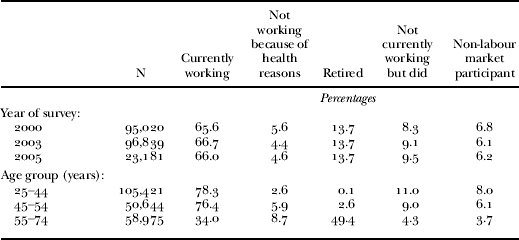
Labour market participation was assessed with three questions: if the respondent had worked in the previous 12 months; if they had a job in the last week; and for those not working the main reason for not working (response options included their own illness or disability; retired; caring for children/parents; attending school plus other categories). From these responses we defined five types of labour market participation: (1) current labour market participant; (2) non-labour market participant due to health reasons; (3) retired; (4) currently not working, but did work in the previous 12 months; and (5) non-labour market participant (did not work in the previous 12 months, did not want to work and was not retired). For the purpose of our analyses we focused on respondents who were not currently working due to health reasons versus those who were current labour market participants (N = 128,662 over the three survey cycles) (Table 1).
Labour market participation categories by survey cycle and broad age group
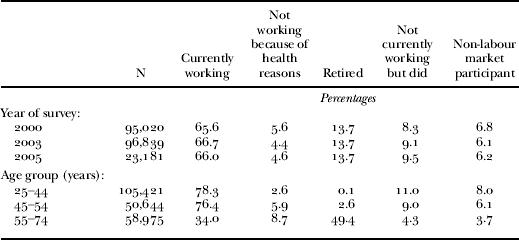
Notes: Respondents to the 2000–01, 2003 and 2005 Canadian Community Health Surveys (N = 180,930). Percentages reported in the table are weighted for probability of selection into the sample and initial survey non-response.
Main independent variable: physical chronic conditions
Respondents to the CCHS were asked about the presence of up to 21 different chronic conditions. These conditions are defined as those which are medically diagnosed and have lasted, or are expected to last, for six months or more. For the purpose of this analysis we focused on seven conditions which have been associated with either ageing or differences in labour market participation. These were: hypertension, heart disease, diabetes, arthritis, back problems, migraines and thyroid conditions.
We also explored the impact of multiple conditions on labour market experiences. To define combinations of chronic conditions we initially performed an exploratory factor analysis using the polychoric correlation matrix of all seven conditions. This analysis found two groupings of chronic conditions: arthritis, cardiovascular disease, hypertension and diabetes; and arthritis, back pain and migraines. Thyroid conditions did not load on to either factor. The complex loading of arthritis with both other inflammatory conditions and with other pain-related conditions has also been reported previously in an Australian sample (Holden et al. Reference Holden, Shuffham, Hilton, Muspratt, Ng and Whiteford2011). From this analysis we defined three different common chronic condition combinations to examine: arthritis and back pain; arthritis and heart disease; and heart disease and diabetes.
It should be noted that mental health conditions were not included in our analyses. The exclusion of mental health conditions was necessary due to the limited availability of comparable measures of mental health conditions across each of the cycles of the CCHS examined.
Potential moderators of the relationship between chronic conditions and labour market participation
We examined whether the relationship between chronic conditions and labour market participation was consistent across education, gender and survey period (time). Education was assessed with two questions in each CCHS. Respondents were asked what the highest grade of elementary or high school was that they had ever completed. Those who had completed further education after school were additionally asked about the highest degree, certificate or diploma that they had obtained. From these responses we categorised education into the following groups: secondary education not completed; secondary education completed; post-secondary diploma or certificate completed below bachelors level; and university education at bachelors level or higher.
Covariates
We additionally adjusted our regression models for age (grouped); body mass index, which was calculated using self-reported weight and height and separated into four groups based on the Canadian weight classification system (Health Canada 2003): underweight (<18.5); normal weight (18.5–24.9); overweight (25.0–29.9) and obese (>30.0); province of residence; whether the respondent lived in an urban or rural area; household income adequacy, which is categorised into four groups based on total household income and number of people who reside in the household; and marital status and presence of children in the household; as well as each of the moderators described above.
Analyses
Our original sample of respondents aged 25–74 years of age who were either labour market participants, or not working because of health reasons, totalled 140,892. Of this sample, 675 (0.48%) were missing information on one or more chronic conditions, and an additional 18,111 (12.85%) were missing information on other covariates, leaving a final sample of 122,106 (86.67% of our original sample). A regression analysis examined the relationship between age, gender, education and survey year on having missing responses to one or more of our study variables. This analysis found respondents in the 2005 survey, those between 55 and 74 years of age, female gender, and less than secondary school education were more likely to have item-level non-response on study covariates.
Initial descriptive analyses examined the prevalence of currently working and not being able to work due to health reasons across age, survey and chronic condition groups. Logistic regression models then examined the relationship between study covariates (age, gender, education, body mass index, household income, marital status and the presence of children, province of residence, geographical location) and the probability of not being able to work due to health reasons compared to our reference category of currently working. A second model additionally included each of the seven chronic conditions. We then ran a series of models stratified by the potential moderators: gender, survey year and educational level. We examined if differences in estimates for chronic conditions and labour market participation varied across gender, survey year and education groups using methods to compare logistic coefficients as previously described by Allison (Reference Allison1999) and Austin and Hux (Reference Austin and Hux2002). These comparisons found no differences in the effects of chronic conditions on labour market participation across survey years or educational groups, and only one difference between men and women, which was the effect of migraines on not working due to health reasons (with the effect being stronger among men than women). As such, we have only presented here the effects of chronic conditions in our full sample, with adjustment for each of the potential moderators (gender, education and survey year).
We then examined if the three particular combinations of conditions we specified were greater than their individual effects of each on labour market participation. To do this we specified an interaction between two conditions to examine whether the combination of two conditions was greater than their independent effects (referred to as a biological or additive interaction). We formally tested for the presence of biological interactions between conditions using the Synergy Index, which is preferred to other measures such as the relative excess risk due to interaction (RERI) or attributable proportion (AP) in the case of multivariate regression analyses (de Mutsert et al. Reference de Mutsert, Jager, Zoccali and Dekker2009). Estimates of the Synergy Index and associated confidence limits were calculated using methods outlined by Hosmer and Lemeshow (Reference Hosmer and Lemeshow1992) and expanded upon by Andersson et al. (Reference Andersson, Alfredsson, Kallberg, Zdravkovic and Ahlbom2005).
We also estimated the population attributable fraction (PAF) of not working due to health reasons which is attributed to each chronic condition. This was done using the general formula: PAF = pd × [(HR adj − 1)/HR adj]; where pd is the prevalence of each health condition in the population not working due to health reasons and HR adj is the hazard ratio from our fully adjusted model (Hennekens and Buring Reference Hennekens, Buring and Mayrent1987). It should be noted that to calculate the PAF we used an odds ratio in place of the hazard ratio. The PAF can be interpreted as the fraction of not working due to health reasons that would be eliminated if a given chronic condition were eliminated.
To account for the complex sample design of the CCHS, and in line with guidelines from Statistics Canada, the confidence intervals around each point estimate were adjusted using a bootstrap technique (Yeo, Mantel and Liu Reference Yeo, Mantel and Liu1999). In addition, all analyses were weighted to account for the probability of selection into the original sample and non-response.
Results
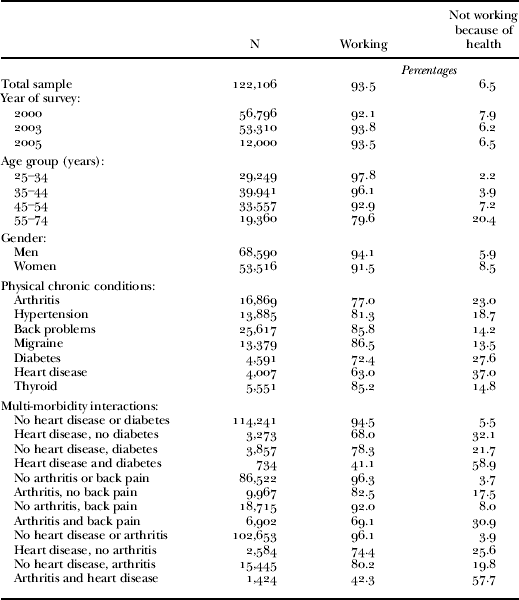
Table 2 presents descriptive information of working and not working due to health reasons across our main study variables. Of our sample, 6.5 per cent of respondents were not working due to health reasons. The prevalence of not working due to health reasons increased with age, was higher among women than men, and was higher in the presence of chronic conditions and common combinations of chronic conditions. Across chronic conditions the prevalence of not working due to health reasons was highest among respondents with heart disease (37%) and lowest among those with migraines (13.5%). No differences in the prevalence of not working due to health reasons were observed across the three survey cycles.
The prevalence of working and not working due to health reasons across main study variables

Notes: Respondents to the 2000–01, 2003 and 2005 Canadian Community Health Surveys. Percentages reported in the table are weighted for probability of selection into the sample and initial survey non-response.
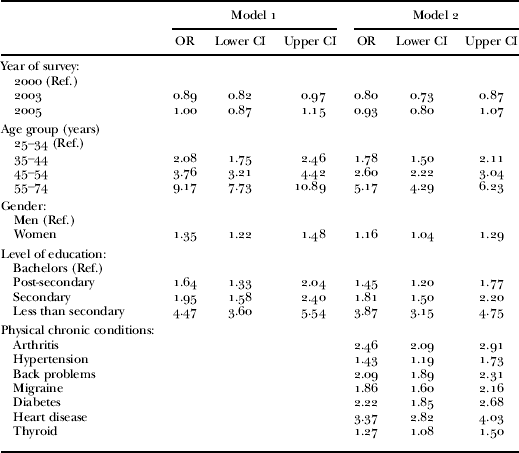
Table 3 presents the adjusted odds ratios and confidence limits for not working due to health reasons across selected study variables, without and with adjustment for chronic conditions. Older age, female gender and lower education were associated with a higher probability of not working due to health reasons, prior to adjustment for chronic conditions. After adjustment for chronic conditions the relationships between age, gender and education were attenuated, but still associated with an elevated odds of not working due to health reasons. The highest odds of not working due to health reasons was associated with cardiovascular disease with the smallest effect being for thyroid conditions.
Adjusted odds ratios (OR) and 95% confidence intervals (CI) for not working due to health reasons versus working by study variables before and after adjustment for chronic conditions
Notes: Canadian Community Health Surveys 2000–01, 2003 and 2005. Models adjusted for all variables in the table as well as body mass index, province of residence, whether the respondent lived in an urban or rural area, household income adequacy, and marital status and presence of children in the household. Percentages reported in the table are weighted for probability of selection into the sample and initial survey non-response. Ref.: reference category.
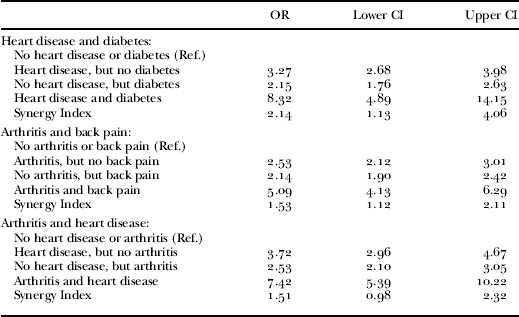
Table 4 presents the results for tests of biological interaction associated with not working due to health reasons across three different combinations of chronic conditions (heart disease and diabetes, arthritis and back pain, and arthritis and heart disease). The effect of having both heart disease and diabetes; and arthritis and back pain were greater than the effects of having each of these conditions in isolation. There was also evidence of a biological interaction between arthritis and heart disease, however, the confidence limits of the Synergy Index for this combination of conditions crossed one.
Odds ratios (OR) and 95% confidence limits (CI), as well as Synergy Index estimates for the presence of a biological interaction between conditions, for not working due to health regions
Notes: Estimates reported in the table are weighted for probability of selection into the sample and initial survey non-response. In the absence of a biological (additive) interaction, the Synergy Index and confidence limits will be less than 1.00. Estimates are adjusted for age, gender, education, year of survey, body mass index, province of residence, whether the respondent lived in an urban or rural area, household income adequacy, and marital status and presence of children in the household. Ref.: reference category.
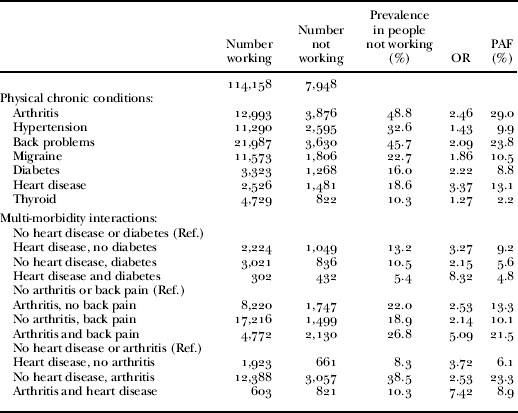
Table 5 presents the PAF values for each chronic condition and the combinations of chronic conditions from our fully adjusted models. The highest PAFs for not working due to health reasons was for arthritis (29%) followed by back problems (24%), with the lowest PAF observed for thyroid conditions (2.2%).
Population attributable fractions (PAFs) associated with not working due to health reasons across different chronic conditions and combinations for chronic conditions
Notes: Estimates reported in the table are weighted for probability of selection into the sample and initial survey non-response. OR: odds ratio. Ref.: reference category.
Discussion
The objectives of this paper were to examine the relationship between a variety of physical chronic conditions and labour market participation using three Canadian cross-sectional surveys between 2000 and 2005. In particular, we wanted to specifically examine the relative impact of different chronic conditions on age-related differences in labour market participation; whether specific combinations of chronic conditions had synergistic effects on non-labour market participation; and whether the relationship between chronic conditions and labour market participation differed for men and women, across educational groups, or over time. We found that each of the seven chronic conditions we examined were associated with not working due to health reasons, however to different extents. Heart disease was associated with the largest odds ratio for not working due to health reasons, but arthritis was associated with the greatest PAF. Differences in the prevalence of chronic conditions attenuated, but did not fully explain labour market participation differences across age, gender or educational groups. We found no differences in the effects of chronic conditions on labour market participation across survey years or educational groups, and only one difference between men and women. This was that the impact of migraines on labour market participation was stronger among men than women (results not shown but available on request). Our analyses examining synergistic effects (biological interactions) between chronic conditions found that combinations of heart disease and diabetes, and arthritis and back pain were particularly associated with not working due to health reasons.
The results of this study, however, should be interpreted given the following limitations. Our data resource was cross-sectional surveys conducted over three time periods. As such we cannot make conclusions about the timing between the onset of each health condition and the separation from the labour market due to health reasons (e.g. in our data source it is possible that the departure of the labour market due to health reasons preceded the initial onset of a given chronic condition). In addition, we were unable to include similar measures of mental health conditions in our analyses, although these conditions are likely to be strongly associated with not working due to health reasons. Some authors have suggested caution in the interpretation of biological interactions in general (Lawlor Reference Lawlor2011; Thompson Reference Thompson1991). These concerns centre on the ability to replicate findings from these analyses and the ability to understand the underlying causal mechanism leading to the biological interaction. Finally, all information in the CCHSs is self-reported, which may lead to inflated associations between chronic conditions and labour market participation due to common method variance. It should be noted, however, that previous studies have shown a good correspondence between self-reports from the CCHS and with diagnoses generated through administrative physician billing and hospitalisation databases for chronic conditions such as diabetes and hypertension (Hux et al. Reference Hux, Ivis, Flintoft and Bica2002; Tu et al. Reference Tu, Campbell, Chen, Cauch-Dudek and McAlister2007). Our study also has a number of strengths. These include large population-based samples with relatively low unit and item-level non-response, and the methods used to both group chronic conditions and to examine specific combinations of chronic conditions and labour market participation.
Similar to previous studies we found that older age, female gender and lower levels of education were associated with an increased likelihood of labour market participation limitations (Christensen et al. Reference Christensen, Kriegbaum, Hougaard, Mortensen and Diderichsen2008; Holland et al. Reference Holland, Nylen, Thielen, van der Wel, Chen, Barr, Burstrom, Diderichsen, Andersen, Dahl, Uppal, Clayton and Whitehead2011, Minton, Pickett and Dorling Reference Minton, Pickett and Dorling2012). In our sample the relationship between age and the probability of not working due to health reasons demonstrated a direct gradient, although the odds ratio increased sharply among respondents 55–74 years of age. Similarly, while each lower level of education was associated with an increased probability of not working due to health reasons, the odds ratio increased substantially between respondents with secondary education and those with less than secondary education. While adjustment for chronic conditions attenuated the odds of not working due to health reasons for age, gender and educational groups, there was still a substantial increased risk of not working due to health reasons in these groups. This excess risk could be due to these groups having more adverse working conditions (e.g. higher level of general work stress or lower levels of autonomy at work) which might be associated with leaving the labour market due to health reasons. Unfortunately, we did not have information on working conditions (psycho-social or otherwise) in our data set for respondents who were not working at the time of the survey, and therefore could not explore these hypotheses further in our analyses.
Contrary to our hypotheses, we did not find that the effects of chronic conditions differed across gender or educational groups. A previous study from Holland et al. (Reference Holland, Nylen, Thielen, van der Wel, Chen, Barr, Burstrom, Diderichsen, Andersen, Dahl, Uppal, Clayton and Whitehead2011) had reported that the presence of general health-related restrictions in activity and non-labour market participation was greatest among respondents with the lowest levels of education. However, we did not find that the labour market participation impact of any of the chronic conditions included in this study differed across educational groups. This difference may be due to our use of the presence of specific medically diagnosed chronic conditions (whether they limited activities or not), while Holland and colleagues used restrictions in activities due to any health reason. It is possible that the relationship between chronic conditions and activity restrictions due to health reasons may differ across educational groups (Thomas and Frankenberg Reference Thomas, Frankenberg, Murray, Salomon, Mathers and Lopez2002). Taken together, our results suggest that although women and respondents with lower education may have more rigid demands placed upon them at work, this does not result in these groups being more likely to leave the labour market due to health reasons as a result of the chronic conditions examined in this study.
Unlike Minton, Pickett and Dorling (Reference Minton, Pickett and Dorling2012) who reported the negative impact of limiting long-term illnesses on staying at work increased between 1973 and 2009 in Great Britain, we did not find any differences in the effect of chronic conditions over the three time periods we examined. While this might be due to differences in the measures used in our study and the study of Minton, we feel it is more likely due to the shorter time period examined in our study. Unfortunately inconsistencies in the questions used in health and labour market surveys in Canada precluded an examination of our study question over a longer time period.
Our results suggest care should be taken when examining the impact of different chronic conditions on labour market participation. We found that the impact of different chronic conditions on not working due to health reasons differed across our sample, with heart disease associated with the highest probability of not working (odds ratio (OR) 3.37, 95% confidence interval (CI) 2.82–4.03) and thyroid conditions associated with the lowest probability (OR 1.27, 95% CI 1.08–1.50). Our finding that heart disease had a stronger association with labour market exit than other chronic conditions is consistent with other research in this area (Schofield et al. Reference Schofield, Shrestha, Passey, Earnest and Fletcher2008). Given these differences in the effects of chronic conditions on labour market exit due to health reasons, using a simple sum of conditions (e.g. 0, 1, 2, 3+ conditions), which assume all conditions are associated with a similar risk of not working, would not have been an optimal method to examine this question in our sample. Further, we found that particular combinations of chronic conditions (heart disease and diabetes, arthritis and back pain, and arthritis and heart disease to a lesser extent) were synergistic in their effects on labour market participation, suggesting that particular efforts should be directed towards people with these co-morbid condition combinations.
In conclusion, in this paper we have demonstrated that chronic conditions impact on labour market participation rates in Canada, although to differing extents. In addition, certain combinations of conditions are associated with synergistic effects. The conditions examined in this paper, as well as the combinations of conditions, are more likely to be present among older workers. The chronic condition with the largest effect on labour market exit due to health reasons was heart disease. However, the higher prevalence of arthritis in the population aged 25–74 resulted in this condition having the greatest population attributable fraction associated with labour market exit due to health reasons. As such, policy efforts to increase the participation of older workers in the labour market in Canada and elsewhere need to take into account and develop strategies to reduce the impact of these two conditions in particular, as well as back problems, on labour market participation.
Acknowledgements
This work was supported by a grant from the Canadian Institutes for Health Research (#232178). Peter Smith was supported by a New Investigator Award from the Canadian Institutes of Health Research while undertaking this work, and is currently supported by a Discovery Early Career Researcher Award from the Australian Research Council. The financial sponsors played no role in the design, execution, analysis and interpretation of data, or writing of the study. Approval for the secondary data analyses was obtained through the University of Toronto, Health Sciences I Ethics Committee.