Background
Global tobacco use causes nearly six million deaths annually, representing nearly 9% of global deaths, and up to half of those exposed to tobacco smoke will die prematurely (World Health Organization, 2011). Tobacco use is a key driver of the global non-communicable disease crisis, accounting for one in six non-communicable disease deaths (Beaglehole et al., Reference Beaglehole, Bonita, Horton, Adams, Alleyne and Asaria2011). If current trends continue, tobacco is expected to cause over eight million deaths globally by 2030 (World Health Organization, 2011) and one billion deaths in this century (World Health Organization, 2011; Wipfli & Samet, Reference Wipfli and Samet2009). The brunt of this pandemic will be borne by low and middle income countries (LMICs) where tobacco use continues to increase (World Health Organization, 2011) and populations grapple with the double burden of communicable and non-communicable diseases (Bygbjerg, Reference Bygbjerg2012). Further, within LMICs, tobacco use is more prevalent among the poor (Wipfli & Samet, Reference Wipfli and Samet2009), resulting in increased morbidity and mortality, and perpetuating the cycle of poverty by diverting family resources to tobacco purchases and health care (Lando et al., Reference Lando, Hipple, Muramoto, Klein, Prokhorov and Ossip2012; Mackay Reference Mackay2012; Ossip Reference Ossip2013).
The benefits of tobacco cessation in preventing or attenuating tobacco-attributed morbidity and mortality have been well demonstrated (US Department of Health and Human Services, 2010), and the World Health Organization (WHO) Framework Convention on Tobacco Control (FCTC) provides evidence-based steps for countries to prevent uptake and reduce prevalence of tobacco use (World Health Organization, 2003; 2011). Indeed, the percentage of ex-smokers in high income countries has increased over the past few decades. For example, quit ratios (percentage of ever smokers who have quit) in the United States have been reported alternately as 51.1% overall (CDC, 2009) or 48.7% for males and 50.5% for females, and over 50% for the United Kingdom (57.1% males, 51.4% females) (Giovino et al., Reference Giovino, Mirza, Samet, Gupta, Jarvis and Bhala2012). However, ex-smoker prevalence remains markedly lower in LMICs relative to high income countries (Jha & Peto, Reference Jha and Peto2014; Jha, Ranson, Nguyen, & Yach, Reference Jha, Ranson, Nguyen and Yach2002; Storr et al., Reference Storr, Cheng, Alonso and Angermeyer2010). An analysis of WHO Mental Health Survey data estimated that the prevalence of former smokers in most LMICs was about half of that in high income countries (Storr et al., Reference Storr, Cheng, Alonso and Angermeyer2010). Similarly, a recent 16 country study found that quit ratios among ever daily smokers were 25% or less in 6 out of 11 LMICs but in only 1 out of 5 high income countries (Giovino et al., Reference Giovino, Mirza, Samet, Gupta, Jarvis and Bhala2012). Finally, a recent study of 13 LMICs reported ex-tobacco user prevalence ranging from 3.0%–24.0% (Palipudi et al., Reference Palipudi, Gupta, Sinha, Ander, Asma and McAfee2012). The low prevalence of ex-tobacco users in LMICs poses at least two problems. First, low quit rates pose significant health risks to the growing number of users and to those exposed to tobacco smoke. Second, the lack of ex-users provides few role models for encouraging current users to quit.
Latin America and the Caribbean Region (LAC) mirror this global trend, with approximately 250,000 annual adult deaths from tobacco (Wipfli & Samet, Reference Wipfli and Samet2009). LAC countries have increasingly signed and ratified the FCTC (Bianco, Champagne, & Barnoya, Reference Bianco, Champagne and Barnoya2005), but the DR remains the sole country in the region not signatory to this treaty. Our prior trial indicated a low population prevalence of ex-users in economically disadvantaged DR communities (0.3%–10.3% across communities) (Ossip-Klein et al., Reference Ossip-Klein, Fisher, Diaz, Quiñones, Sierra and Dozier2008) and a corresponding lack of a culture of quitting (Dozier et al., Reference Dozier, Ossip-Klein, Diaz, Chin, Sierra and Quiñones2006).
Increasing the prevalence of former users is a key indicator of population cessation (Jha et al., Reference Jha, Ranson, Nguyen and Yach2002). Although we previously reported a low prevalence of ex-users in economically disadvantaged communities in the DR, the current report presents the first quantitative examination of factors associated with the ex-user status. Identifying such factors can guide intervention as part of the larger tobacco control efforts in a country where systematic data have been lacking.
Method
Baseline surveillance data were used from our cluster randomized controlled trial of tobacco cessation and secondhand smoke interventions in the DR (‘Proyecto Doble T’; PDT). Human subjects approval was obtained from one US (University of Rochester) and two DR Research Subjects Review Boards. The DR Office of the First Lady provided permission to work with Community Technology Centers (CTCs) in participating communities.
Study Population
The project conducted household surveillance surveys in seven economically disadvantaged DR communities from January–June, 2011. These included 4 remote and 3 central (municipal district or adjacent to municipal areas) communities, ranging in size from approximately 3,000–12,000 residents. Three were tobacco-producing. The four remote communities had participated in our prior trial (Dozier et al., Reference Dozier, Ossip-Klein, Diaz, Chin, Sierra and Quiñones2006; Reference Dozier, Ossip, Diaz, Sierra-Torres, Quiñones de Monegro and Armstrong2009; Reference Dozier, Diaz, Guido, Sierra-Torres, Quiñones de Monegro and Diaz2014; McIntosh et al., Reference McIntosh, Sierra, Dozier, Diaz, Quiñones and Primack2008; Ossip-Klein et al., Reference Ossip-Klein, Fisher, Diaz, Quiñones, Sierra and Dozier2008; Torres et al., Reference Torres, Guido, Quiñones de Monegro, Diaz, Dozier and McIntosh2014).
Approximately 175 randomly selected homes per community (total N = 1,177 homes) completed the surveillance administered through in-person household interviews. A single adult (age ≥18 years) provided data on all household members, yielding data on a total of 2,680 adult household members across the seven communities.
Household Selection
Local CTC Site Managers created maps and master lists of all homes. The US team generated a randomly selected list of these homes for the CTC Site Managers and local Data Collectors who were hired and trained by the US- and DR- based project teams. Data Collectors sequentially approached households on this list until the full sample was obtained. A range of 147–291 households were approached in each community, with an overall completion rate of 80.3% (60.5%–92.1% across communities). Reasons for noncompletion were: vacant home (36.0%), no home at address on map/demolished/under construction (21.6%), refused (17.6%), no one home (14.4%), and other (10.4%; occupant died, not mentally competent, did not speak Spanish).
Data Collector Training/Oversight
Data collector training was comparable to that used in our prior trial (Ossip-Klein et al., Reference Ossip-Klein, Fisher, Diaz, Quiñones, Sierra and Dozier2008). Local CTC Site Coordinators and Data Collectors were employed to reflect Community Based Participatory Research principles (Israel, Schulz, Parker, & Becker, Reference Israel, Schulz, Parker and Becker1998; Reference Israel, Schulz, Parker and Becker2001; Riley, Jossy, Nkinsi, & Buhi, Reference Riley, Jossy, Nkinsi and Buhi2001), and to decrease barriers to participation that could occur with Data Collectors unfamiliar to the communities. Each local team included one Site Manager (7 total) and 3–4 Data Collectors (27 total). Local Site Managers were typically also Site Coordinators for the CTCs that served as bases for the current project. Potential Data Collectors were identified by Site Managers and CTC Management Boards, and were 18 years old with at least a high school education.
Training for Site Managers and Data Collectors took place in two phases. First, all attended a central training conducted jointly by the DR and US project teams. Training included: (1) a 1–1/2 hour DR- and US-RSRB approved bioethics training based on the Belmont Report provided by a DR faculty and ethics committee member from the Pontificia Universidad Católica Madre y Maestra; (2) didactic and interactive sessions on basic survey methodology, obtaining consent, survey administration, reporting requirements, and supervised role plays of interviews. Site Managers and Data Collectors who had participated in our prior trial shared implementation examples. Teams were provided with training manuals that included project policies, performance expectations, and data collection procedures. A supplemental session was held with Site Managers on supervising Data Collectors, monitoring surveys for completeness, entering data into a database, and reporting to the DR project team. The second phase was conducted in each community. Immediately prior to launch, the DR team conducted on-site refresher training, and provided oversight of survey administration during the first two days. The DR project team returned weekly until completion to assess progress and oversee data entry by Site Managers. The DR project team conducted random household checks to verify survey administration and also checked any households where survey forms were questionable. During survey administration, Site Managers assigned homes to Data Collectors, confirmed that households were approached per protocol, tracked number of homes surveyed, and checked consent documentation and surveys for completeness. Incomplete forms were returned to the Data Collectors for completion. Site Managers held regular debriefing sessions with Data Collectors and maintained ongoing telephone contact with the DR project team, who, in turn, had weekly conference calls with the US team.
Procedure
Using the randomly selected list of homes provided by the Site Managers, Data Collectors approached homes sequentially until the full sample was obtained. Following the DR and US IRB approved protocol, Data Collectors targeted the first available adult (age ≥18) who could answer questions for all household members. Data Collectors identified themselves as being from PDT and the local CTC to conduct surveys on tobacco use and exposure to secondhand smoke. They described the length and content of the surveys, explained that participation was voluntary and participants could refuse to answer specific questions or withdraw at any time without risk, and obtained and documented verbal consent. Verbal consent was approved in lieu of written consent to respect cultural differences in concerns about the implication of providing written consent in the DR. Data Collectors provided participants with business-sized cards describing the survey and listing contact information for questions or concerns. If the first available adult refused or did not have time, Data Collectors attempted to identify an alternate adult household member. If none was available and the first adult was unable to schedule another time, Data Collectors moved to the next home on the list and documented why this household was not surveyed. As per DR IRB regulations, the project could not pay participants, but was allowed to provide a small appreciation gift (a towel embroidered with PDT) after the interview was completed. Also as per DR regulations, Data Collectors did not inform participants of this gift until they had completed the surveys.
Data Management
Surveys were stored in locked CTC files in each community. Site Managers entered survey data into a password protected Microsoft Access® database. DR project team members transferred the surveys to locked containers and downloaded the password protected database onto a secured project laptop or encrypted thumb drive, and transported both to project headquarters in Santiago. Surveys were placed in locked files at project headquarters. One sub-team of DR project members entered any survey data not entered in the communities; a second sub-team visually verified all entered data. The dataset was then sent to the US team and cross checked with the master list of household surveys for consistency and completeness. Incomplete or erroneous records were returned to the DR team for corrections and final verification by US and DR teams.
Measures
The survey was based on the baseline surveillance from our prior project, which was guided by prior US and global research including our own qualitative work (Dozier et al., Reference Dozier, Ossip-Klein, Diaz, Chin, Sierra and Quiñones2006). Items were drawn from the 2003 National Health Interview Survey, International Tobacco Control Policy Survey, 2002 World Health Survey, CEASE (Fong et al., Reference Fong, Cummings, Borland, Hastings, Hyland and Giovino2006; US Department of Health and Human Services, 2003; World Health Organization, 2002; Winickoff et al., Reference Winickoff, Nabi-Burza, Chang, Finch, Regan and Wasserman2013), the Global Adult Tobacco Survey (GATS; http://nccd.cdc.gov/gtssdata/Ancillary/Documentation.aspx?SUID=4&DOCT=1), as well as the Dominican Republic 2002 National Census and the Ficha Familiar (a DR demographic tool used to gather household health data by SESPAS, the Ministry of Health and Social Welfare). To ensure equivalence, the survey was originally developed in English, translated into Spanish, then back translated into English using the Brislin back translation method (Brislin, Reference Brislin1970). The instrument was pre-tested by the US and DR teams for readability, skip patterns, formatting, and content, and pilot tested by the DR team in 30 households in a comparable DR community. Pilot households included 20 with no tobacco users, 5 with ≥1 ex-user, and 5 with ≥1 user. Items that were not readily understood by community members were modified for the final surveys.
The following surveillance variables for all adult (ages 18+ years) household members were used, based on prior research and conceptual relationship with ex-user status:
-
1. Demographics – sex; age: 18–24, 25–44, 45–64, 65+ years; marital status: married/civil union, other; employment: yes, no; education: none/< primary, <secondary, completed secondary, > secondary; literacy – able to read and write: yes, no; religion: Catholic, other;
-
2. Tobacco use/exposure – do you/they use or have you/they used tobacco products – coded as non-user, current user, ex-user; type of tobacco used; presence of household smokers: any, none; presence of household ex-users; ratio of ex-users to ever users (quit ratio);
-
3. Health conditions/symptoms – ever diagnosed by a health care provider with high blood pressure, asthma, other pulmonary problems, heart problems, cancer/tumour; have respiratory symptoms, chronic cough (more than two weeks); conditions and symptoms were also aggregated to code for any health conditions: yes, no;
-
4. In addition, two variables were included on community type: remote vs. central location, whether the community grew tobacco. Finally, data on overall household resources (e.g., electricity, potable water) are provided to characterize the communities for descriptive purposes only.
Data Analysis
Descriptive data (percentages, ranges across communities) were examined for the total sample. Pearson chi-square statistics were computed to test for differences between ex-users and current users among ever users (defined as ex-users + current users; N = 681), with variables that significantly differed between current and ex-users at p ≤ 0.10 identified as candidate variables for multivariable analysis. Multicollinearity was then examined using Spearman rank correlation and Phi coefficients to determine whether any combination of candidate variable pairs was correlated at ≥0.80 (no multicollinearity was detected and all variables were included in the multivariable analysis). Finally, independent factors associated with ex-user status were examined in a generalized linear mixed model (GLMM) assuming the logit link function. In the model, hierarchical clustering of subjects within households and households within communities were accounted for. The model a priori controlled for whether the community was tobacco-growing, which was associated with individual smoking status in our prior work (Ossip-Klein et al., Reference Ossip-Klein, Fisher, Diaz, Quiñones, Sierra and Dozier2008). Data were analysed using SAS® Version 9.3., using GLIMMIX for multivariable analysis.
Results
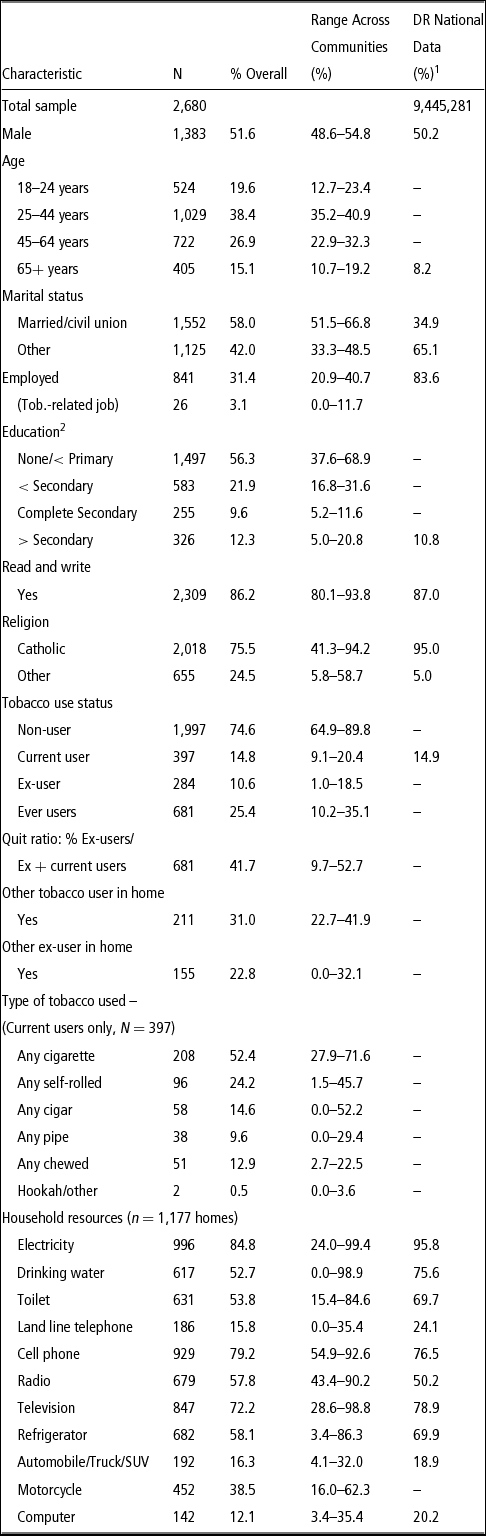
Table 1 presents subject characteristics for the overall sample, including the range across communities, with comparison to national data where available. Overall, the sample was reasonably well distributed across sexes and age groups. Over three-quarters of the sample (78.2%) had less than a secondary education, and 56.3% has less than a primary education. However, consistent with national census data, 86.2% could read and write. Over half were married or in a civil union (58.0%), and three-quarters were Catholic (75.5%), with considerable variability across communities in religion. The most striking differences in relation to national data reflected the economically disadvantaged status of the study communities. For example, only about one-third were employed (vs. 83.6% nationally). In additional, household resources were overall lower, and varied widely across communities. For example, 84.8% of households overall reported electricity (vs. 95.8% nationally), and this ranged from 24.0%–99.4% across communities. Similarly, just over half reported potable drinking water (52.7%; vs. 75.6% nationally), and this ranged from 0.0%–98.9% across communities.
Sample characteristics for seven Dominican Republic communities (adults ≥ 18 years)

1Based on: IX Censo Nacional de Población y Vivienda 2010, Informe General (http://censo2010.one.gob.do/index.php?module=articles&func=view&ptid=2&p=5); ENDESA 2013: Dominican Republic Demographics & Health Survey 2013 (http://dhsprogram.com/pubs/pdf/GF35/GF35.pdf); US Central Intelligence Agency World Factbook (https://www.cia.gov/library/publications/the-world-factbook/geos/dr.html); American Cancer Society, The Tobacco Atlas–4th Ed. (http://tobaccoatlas.org/uploads/Images/PDFs/Tobacco_Atlas_2ndPrint.pdf); Pan American Health Organization (http://ais.paho.org/hia_cp/en/2007/Dominican%20Republic%20English.pdf; http://www.paho.org/saludenlasamericas/index.php?option=com_content&view=article&id=34&Itemid=34&lang=pt); World Bank (http://data.worldbank.org/country/dominican-republic); all data accessed between 11/17-11/19/14; where not reported, comparable national data or categories were not found.
2Education not included in subsequent analyses because of small cell sizes for the subset of ever users with greater than primary school education.
Overall tobacco use prevalence was 14.8% (range: 9.1%–20.4%), and 25.4% overall had ever used tobacco (10.2%–35.1%). Prevalence of ex-users was low at 10.6%, also with considerable variability across communities (range 1.0%–18.5%). Ex-users represented 41.7% of ever users (quit ratios: 9.7%–52.7% across communities). About half of current tobacco users smoked cigarettes (52.4%, range 27.9%–71.6%), though up to about half used self-rolled tobacco (45.7%) and/or cigars (52.2%), and about one-quarter used chewed tobacco (22.5%) or pipes (29.4%) in some communities. Only two reported use of hookah or other products.
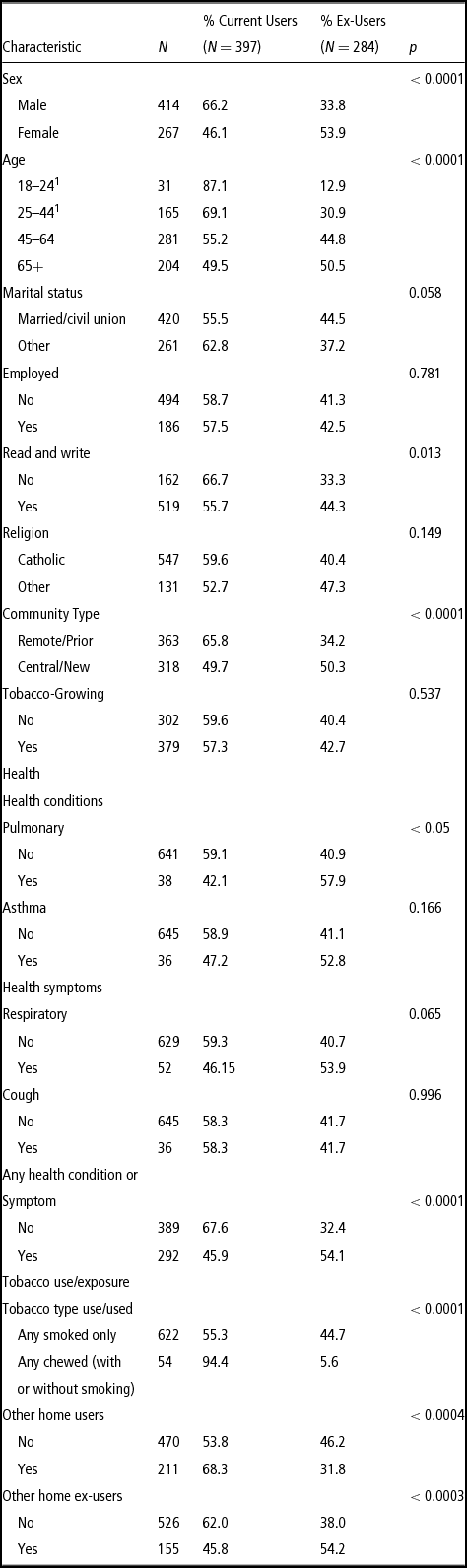
In bivariate analyses (Table 2), among ever users, females were significantly more likely to be ex-users relative to males (X2(1) = 27.0; p < 0.0001), as were older vs. younger adults (X2(3) = 26.1; p < 0.0001), and those who could read and write vs. not (X2(1) = 6.1; p = 0.013), were from central vs. remote communities (X2(1) = 18.2; p < 0.0001), had pulmonary diseases (X2(1) = 4.3; p < 0.05) or any health conditions or symptoms vs. not (X2(1) = 32.4; p < 0.0001), used only smoked tobacco vs. any chewed (with or without smoked tobacco; X2(1) = 31.3; p < 0.0001), did not have any other home tobacco users vs. did (X2(1) = 12.4; p < 0.0004), and had other home ex-users vs. did not (X2(1) = 12.9; p < 0.0003). Using a p < 0.10 cutoff for inclusion in the multivariable analysis, respondents who were married or in a civil union (vs. any other) and those with respiratory symptoms (vs. without) were more likely to be ex-users. Employment status, religion, community tobacco-growing status, asthma, and chronic cough did not significantly differ between current and ex-users.
Bivariate analyses: differences between current and ex-users among ever users (n = 681)

1Age groups 18–24 and 25–44 combined for subsequent multivariable analysis because of small cell sizes for 18–24 current users and ex-users.
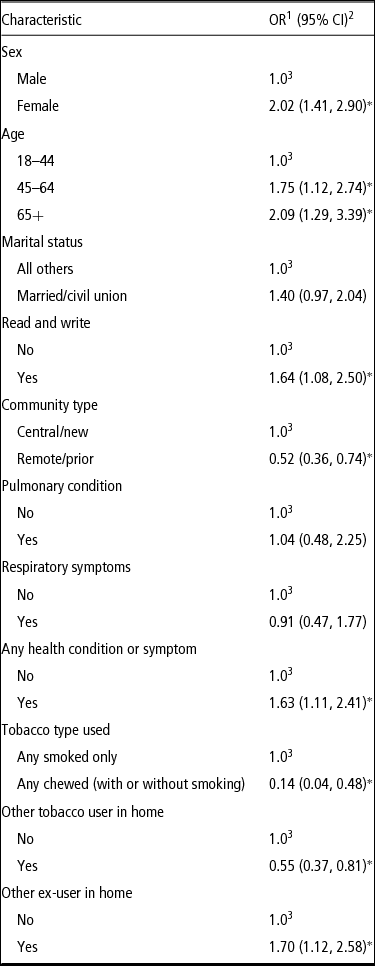
Table 3 presents point estimates and corresponding 95% confidence intervals for odds ratios (OR) indicating the association between demographic, tobacco use/exposure, health, and geographic variables and ex-user status among ever users, adjusting for hierarchical clustering of subjects within households and households within communities. Among ever users of tobacco, females (vs. males; OR 2.02, 95% CI 1.41, 2.90), older adults (45–64, 65+ vs. 18–44; OR 1.75, 95% CI 1.12, 2.74; OR 2.09, 95% CI 1.29, 3.39, respectively), those who could read and write (vs. not; OR 1.64, 95% CI 1.08, 2.50), those with any health condition or symptom (vs. without; OR 1.63, 95% CI 1.11, 2.41), and those with at least one other ex-user in their home (vs. without; OR 1.70, 95% CI 1.12, 2.58) were over 60% to over two times as likely to be ex-users. Ever users from remote communities (vs. central; OR 0.52, 95% CI 0.36, 0.74), those who used any chewed tobacco (alone or with smoked tobacco, vs. smoked only; OR 0.14, 95% CI 0.04, 0.48), and those with other tobacco users in the home (vs. not; OR 0.55, 95% CI 0.37, 0.81) were significantly less likely to be ex-users. Notably, use of any chewed tobacco was associated with 86% lower likelihood of being an ex-user.
Factors associated with being an ex-tobacco user among ever users: multivariable results from the generalized linear mixed model (n = 674)

1OR: odds ratio (with all factors accounted for in the model); 295% CI: 95% confidence interval; 3reference group; *p < 0.05.
Discussion
We have previously reported a low prevalence of ex-tobacco users in economically disadvantaged Dominican Republic communities; this paper provides an examination of factors associated with being ex-users, in order to inform interventions. Overall prevalence of ex-users was low at 10.6%, ranging from 1.0%–18.5% across communities. Similarly, the quit ratio, defined as the ratio of ex-users to ever users, was low at 41%, again with considerable community variability (9.7%–52.7%). This is in contrast to the quit ratio in the United States, where just over half of ever users have quit (51.1%; CDC, 2009). This low level of quitting is consistent with our prior qualitative work indicating little or no exposure to tobacco control interventions prior to our project, and the absence of a culture of quitting (Dozier et al., Reference Dozier, Ossip-Klein, Diaz, Chin, Sierra and Quiñones2006).
The observed quit ratios were somewhat higher than those in several other LMICs (Giovino et al., Reference Giovino, Mirza, Samet, Gupta, Jarvis and Bhala2012; Jha & Peto, Reference Jha and Peto2014; Jha et al., Reference Jha, Ranson, Nguyen and Yach2002; Storr et al., Reference Storr, Cheng, Alonso and Angermeyer2010), which is promising. However, some prior reports calculate quit ratios based on ever daily smoking (Giovino et al., Reference Giovino, Mirza, Samet, Gupta, Jarvis and Bhala2012), a variable that was not available from the current survey that asked about any tobacco use. There is evidence that quit rates for nondaily smokers may be higher than for daily smokers (Schauer, Malarcher, & Berg, Reference Schauer, Malarcher and Berg2014; Tindle & Shiffman, Reference Tindle and Shiffman2011), thus the gap between our reported quit ratios and those of high income countries is potentially greater than observed. Our observed ex-user rates (1.0%–14.2% across communities) were overall somewhat higher than those reported in our prior trial for the four communities that participated in both trials (0.3%–10.3%). Similarly, the quit ratios for ever users in the current study (9.7%–41.0% across communities) were somewhat higher than those in our prior trial for these four communities (1.0%–30.6%) (Ossip-Klein et al., Reference Ossip-Klein, Fisher, Diaz, Quiñones, Sierra and Dozier2008). This reflected increases in the two most rural communities, no change in one community, and a decrease in one community. Although ex-user prevalence for remote communities was lower than for central communities in the current trial, this increase from the prior trial suggests a positive trend in the most rural communities.
Prior research has demonstrated the association between community and policy variables (e.g., worksite smoking bans) on quitting (Shang, Chaloupka, & Kostove, Reference Shang, Chaloupka and Kostove2014). The current study found a number of demographic, health, tobacco use, home environmental, and geolocation variables associated with being an ex-user, and suggest targets for additional intervention efforts. Women, older adults (ages 45+ years) and those who could read and write were more likely to be ex-users. Prior research has demonstrated that older adults are more likely to succeed when they make a quit attempt (Ferguson, Bauld, Chesterman, & Judge, Reference Ferguson, Bauld, Chesterman and Judge2005; Hatziandreu et al., Reference Hatziandreu, Pierce, Lefkopoulou, Fiore, Mills and Novotny1990), and may be motivated by the salience of health problems. In the current study, those with any health condition or symptom were more likely to have quit. The lower prevalence of ex-users among those who were illiterate is also consistent with prior research by our group and others indicating higher tobacco use prevalence in disadvantaged groups (Ossip-Klein et al., Reference Ossip-Klein, Fisher, Diaz, Quiñones, Sierra and Dozier2008; Palipudi et al., Reference Palipudi, Gupta, Sinha, Ander, Asma and McAfee2012). It is particularly notable that, even within economically disadvantaged communities, those who were relatively more disadvantaged were less likely to have quit.
Those who used any chewed tobacco (with or without smoking) were less likely to quit, as were those who lived in more remote vs. centrally located communities. Though overall quit ratios were low and suggest the need for continued broad-based tobacco control interventions, outcomes may be further improved by including targeted interventions for males, younger tobacco users, those who cannot read and write, those who use chewed tobacco, currently healthy users, and those living in remote areas. Finally, ever users living with other tobacco users were less likely to quit, and those with other ex-users were more likely to quit, which is consistent with research in other populations (Chandola, Head, & Bartley, Reference Chandola, Head and Bartley2004; Goren, Annunziata, Schnoll, & Suaya, Reference Goren, Annunziata, Schnoll and Suaya2014; Lee & Kahende, Reference Lee and Kahende2007). Prior research has demonstrated an impact of media messaging on quit. To the extent that quitting can influence other household tobacco users, messaging regarding quitting to serve as a role model for other family members may resonate, particularly in cultures that place high value on the role of family (Perez & Cruess, Reference Perez and Cruess2014).
There are several limitations to the current report. Data are based on self-report, which may underestimate tobacco use, particularly when tobacco use is viewed as socially unacceptable overall or for particular subgroups (Dietz et al., Reference Dietz, Homa, England, Burley and Tong2001; Dozier et al, Reference Dozier, Ossip-Klein, Diaz, Chin, Sierra and Quiñones2006; Jung-Choi, Khang, & Cho, Reference Jung-Choi, Khang and Cho2012). Underestimates may also have resulted from engaging a single household member to report on variables for all household members. Though results must be viewed with caution, these are standard methods used by other similar population-based studies (Giovino et al., Reference Giovino, Mirza, Samet, Gupta, Jarvis and Bhala2012). In addition, in the current trial, local Site Managers and Data Collectors were hired in an attempt to decrease participants’ discomfort in responding to surveys delivered by strangers to the community. Finally, the study targeted only seven economically disadvantaged communities, and generalizability to other communities or the entire Dominican Republic is unknown.
Overall, the current study presents a first quantitative look at characteristics of ex-tobacco users in the Dominican Republic and suggests targets for intervention. As with other LMICs, quit ratios are below those of high income countries, with considerable variability across communities. As tobacco-attributable morbidity and mortality continue to increase, particularly in LMICs, cessation remains the most effective means of reducing this public health crisis (Jha & Peto, Reference Jha and Peto2014). Aiming for broader regulatory approaches as recommended in the FCTC (World Health Organization, 2002; 2003; 2011) while developing and testing culturally tailored interventions may create a culture of quitting, particularly in LMICs like the Dominican Republic that do not have a history of national tobacco control.
Acknowledgements
The authors wish to acknowledge the expert advice provided by our International Advisory Committee: Drs. Estaban Avendaño (Costa Rica), Eduardo Bianco (Uruguay), Paul McDonald (New Zealand), and Essie Torres (US). We all express appreciation to our community partners and to staff at Centro de Atención Primaria Juan XXIII in the Dominican Republic.
Financial Support
Funding support was provided by the US National Cancer Institute at the National Institutes of Health (grant number R01CA132950; Ossip, PI). The content is solely the responsibility of the authors and does not necessarily represent the official views of the National Cancer Institute or the National Institutes of Health.
Conflicts of Interest Statement
None.
Ethical Standards
The authors assert that all procedures contributing to this work comply with the ethical standards of the relevant national and institutional committees on human experimentation and with the Helsinki declaration of 1974, as revised in 2008. Approval for this project was provided by Institutional Review Boards at the University of Rochester in the US, and by the Comite Independiente de Etica de Investigacion del Cibao and the Consejo Nacional de Bioética en Salud in the Dominican Republic.