




No CrossRef data available.
Article contents
Intra-specific host sharing in the manipulative parasite Acanthocephalus dirus: does conflict occur over host modification?
Published online by Cambridge University Press: 23 August 2004
Abstract
The acanthocephalan parasite Acanthocephalus dirus induces a colour change in the intermediate host, the aquatic isopod Caecidotea intermedius, which increases transmission to definitive hosts (creek chub, sunfish). We examined the potential for conflict to occur between infective (cystacanth) and non-infective (acanthor, acanthella) stages of A. dirus over the level of colour modification that should be induced when these stages share a host. Using a field survey, we showed that host sharing by infective and non-infective stages was relatively common and that infective and non-infective stages differed in their effects on colour modification. Non-infective stages induced a colour change over 40% of the body, whereas infective stages induced a colour change over 80%. Thus, conflict could occur between stages over the level of modification that should be induced. We then showed that mixed-stage infections induced a colour change in the host that was consistent with the level of modification induced by the infective stage. We discuss the potential significance of these results to patterns of host modification and their effects on stage-related survival in nature.
Information
- Type
- Research Article
- Information
- Copyright
- © 2004 Cambridge University Press
INTRODUCTION
Parasite-induced host modification is common in nature and typically involves either a behavioural or morphological change in the intermediate host that increases transmission to the definitive host (see Poulin & Thomas, 1999; Moore, 2002 for recent reviews). This type of modification is especially prevalent in acanthocephalan infections of isopods and amphipods in which the host often undergoes both colour and behaviour changes (e.g. Moore, 2002). In addition, it appears that both the timing and type of modification can be adaptive because they occur when the parasite has developed into the cystacanth stage (infective to the definitive host, e.g. Bethel & Holmes, 1974) and in a manner that increases the probability of encountering definitive hosts (Bethel & Holmes, 1977; Hechtel, Johnson & Juliano, 1993).
In cases where only one parasite is present in the host, predictions concerning the timing and type of host modification are relatively easy to generate (see above). However, when multiple parasites share a host, predictions can become complex because they are influenced by the effects of both cooperation and conflict occurring between parasites (Brown, 1999; Lafferty, 1999; Lafferty, Thomas & Poulin, 2000; Poulin, 2002). Previous studies have examined the potential for both conflict and cooperation to influence host modification when host sharing is inter-specific (Cézilly, Gregoire & Bertin, 2000; Poulin, Nichol & Latham, 2003). We examined the potential for one of these interactions (conflict) to influence modification when host sharing is intra-specific.
The acanthocephalan parasite Acanthocephalus dirus is commonly found in the Midwestern region of the United States where it infects the aquatic isopod Caecidotea intermedius during the larval stage and one of several freshwater fishes (e.g. creek chub, sunfish) during the adult stage (Seidenberg, 1973; Camp & Huizinga, 1980; Amin, 1984). Infection of C. intermedius occurs when the isopod consumes eggs along with its food and lasts 2–3 months, during which time the parasite develops through the non-infective acanthor and acanthella stages and into the infective cystacanth stage (Oetinger & Nickol, 1982a). While present in the isopod, A. dirus induces a change in the colour of the host (from dark- to light-coloured), which increases conspicuousness to visually-hunting predatory fishes (Camp & Huizinga, 1979). We examined the potential for conflict to occur between infective and non-infective developmental stages over the level of colour modification.
The relationship between A. dirus and C. intermedius is ideal for studying intra-specific conflict for three reasons. First, host sharing is common in nature (Seidenberg, 1973; Camp & Huizinga, 1979; Oetinger & Nickol, 1981), and is rarely inter-specific (Oetinger & Nickol, 1981). Thus, intra-specific relationships can be studied independently of the potentially confounding effects of interactions with other species. Second, infective and non-infective stages of A. dirus are often found sharing a host (Johnson, 1994; Weil, 2002); hence there is opportunity for conflict to occur between stages. Third, the level of colour modification appears to correlate with development of the larval stages (Seidenberg, 1973). If it is the case that non-infective and infective stages of A. dirus differ significantly in their effects on the level of colour modification, there is potential for conflict to occur over the level that should be expressed when these stages share a host. The manner in which this conflict is resolved is likely to determine survival of the non-infective stages since they are unlikely to survive consumption by the definitive host. We examined the potential for conflict to occur between infective and non-infective stages of A. dirus in two ways. First, we used a field survey to quantify the occurrence of mixed-stage infections (infective, non-infective stages) in nature. We then examined the relationship between body colour and infection status (uninfected, non-infective stage, infective stage, mixed-stage infections).
MATERIALS AND METHODS
The organisms used in this study were collected from Buffalo Creek located approximately 60 km northwest of the university campus in Lake County, Illinois. Buffalo Creek is a low-order stream in which the macroinvertebrate community is dominated by C. intermedius. Preliminary collections from this site revealed that A. dirus prevalence was high in both the intermediate host (C. intermedius, 70%, n=33) and the definitive hosts (creek chub, Semotilus atromaculatus, 50%, n=18; sunfish, Lepomis spp., 67%, n=15).
Potential for conflict
To assess the potential for conflict we quantified the occurrence of mixed-stage infections (i.e. non-infective and infective stages) by collecting monthly samples of C. intermedius between June and December 2001. This time-period corresponds with the typical development from non-infective (acanthor, acanthella) to infective (cystacanth) stages in A. dirus (Seidenberg, 1973; Camp & Huizinga, 1980). During each sampling period we captured isopods by both hand-picking organisms from the underside of small rocks and by running a hand-net through the submerged vegetation. All isopods were then transported to the laboratory, frozen, dissected and both the number and developmental stages of A. dirus present recorded (following the protocol of Oetinger & Nickol, 1982a). For each sample, we calculated prevalence, intensity (following the protocol of Bush et al. 1997), percentage host sharing and percentage mixed-stage infection.
Colour modification
To determine whether infective and non-infective stages differed in their effects on colour modification we quantified the relationship between infection status and colour pattern of C. intermedius. We then examined the effect of mixed-stage infection on colour patterns. Isopods were collected at random from Buffalo Creek during September and December 2002 (see Table 1), transferred to the laboratory and frozen at −5 °C. Colour scores were then obtained for every isopod by estimating the percentage of the body that lacked pigmentation. For each individual, a sketch was made in which the areas that lacked pigmentation were recorded. These illustrations were then used to estimate a colour score (%) for each individual, in which a high value indicated significant colour modification. All colour scores were assigned by the same individual (TCS) to minimize variation due to subjective scoring, and were made without knowledge of the infection status of the isopod (one score per isopod).
Table 1. Summary of the A. dirus – C. intermedius relationship in Buffalo Creek (2001) (Sample sizes for both C. intermedius and A. dirus are shown for each month (columns 2 and 3). The percentage values shown for Acanth[ratio ]Cyst represent the non-infective (acanthor, acanthella) and infective (cystacanth) stages respectively and were calculated using the values shown in column 3 (N, A. dirus) as denominators. The values associated with potential conflict (mixed-stage) are shown in bold italics.)

Following colour scoring, the body length of each isopod was recorded (anterior margin of the cephalothorax to the posterior margin of the abdomen). The isopod was then dissected and the number and developmental stages of parasites recorded. To examine the relationship between infection status and colour patterns we compared colour scores between the following groups: (1) uninfected, (2) acanthor/acanthella (non-infective stage), (3) cystacanth (infective stage), and (4) acanthor/acanthella plus cystacanth (mixed-stage). Tests for normality on both untransformed and transformed data (arcsine transformation) showed that the assumptions of these tests were not met for all groups (using Systat 10.0). Thus, we used the Kruskal–Wallis test followed by nonparametric multiple comparisons to compare colour scores between groups (Zar, 1999). Critical values were adjusted, to account for multiple comparisons, using the sequential Bonferroni technique (Rice, 1989).
To determine whether variation in colour scores could have been influenced by factors other than the developmental stage of the parasites we used regression analysis to examine the potential effects of parasite intensity (square root transformed) and isopod body size (length) on colour scores for each infected group (i.e., acanthor/acanthella, cystacanth, mixed-stage).
RESULTS
Potential for conflict
Table 1 summarizes the variation in parasite–host dynamics that occurred over the 7-month period in Buffalo Creek. From the samples we dissected a total of 619 C. intermedius and identified the developmental stages of 1053 larval A. dirus. We found that on average prevalence was 54% (S.E.=7·1), intensity was 2·0 (S.E.=0·31) and that intra-specific host sharing occurred in 57% (S.E.=8·9) of infections. In terms of parasite development, we found that the population underwent a relatively synchronous pattern of development from dominance of non-infective stages (acanthor, acanthella) between June and August to dominance of the infective stage (cystacanth) between September and December. Mixed-stage infections were most common between August and October when they made up an average of 40% of infections.
Colour modification
We measured infection status and colour scores for a total of 178 C. intermedius (Fig. 1). Statistical analysis revealed that there was a significant effect of infection status on colour scores (H3=66·2, P<0·001). Multiple comparisons then showed that uninfected isopods had lower colour scores than all 3 of the infected groups (acanthor/acanthella, Q4=4·5, P<0·001; cystacanth, Q4=6·6, P<0·001; mixed-stage, Q4=7·4, P<0·001) and that acanthor/acanthella infections scored lower than both cystacanth (Q4=3·4, P<0·002) and mixed-stage infections (Q4=7·0, P<0·001). In contrast, there was no detectable difference in colour scores between cystacanth and mixed-stage infections (Q4=0·6, P>0·5).

Fig. 1. Effect of single- and mixed-stage infection on colour modification in Caecidotea intermedius. Shown are median values for each group (plus upper and lower quartiles) with sample size shown in italics. Acanth. represents scores for both acanthor and acanthella-stage parasites. Letters above bars indicate differences between groups, with shared letters indicating no difference.
Regression analysis showed that there was no detectable relationship between body length and colour scores in any of the infected groups (acanthor/acanthella, r2=0·02, n=65, P=0·3; cystacanth, r2=0·02, n=24, P=0·5; mixed-stage, r2=0·003, n=61, P=0·7). Similarly, there was no relationship between parasite intensity and colour scores for both cystacanth and mixed-stage infections (r2=0·007, n=24, P=0·7; r2=0·01, n=61, P=0·4, respectively), and only a very weak relationship between intensity and colour scores for the acanthor/acanthella stage (r2=0·08, n=65, P=0·02).
DISCUSSION
Several recent studies have examined the potential importance of host sharing in manipulative parasites (e.g. Thomas, Renaud & Poulin, 1998; Brown, 1999; Lafferty, 1999; Lafferty et al. 2000; Poulin, 2002). In some cases, host sharing is beneficial because it results in a cooperative manipulation effort (Poulin et al. 2003) or provides one parasite (a non-manipulator) with the opportunity to ‘hitch-hike’ with another (manipulator) (Thomas et al. 1998). However, in other cases host sharing can be costly and these costs can generate a conflict between parasites over both the timing and type of host modification (e.g. Lafferty, 1999; Lafferty et al. 2000). Previous work has provided evidence of a conflict occurring between different species over host modification (e.g. Cézilly et al. 2000). We provided evidence of a potential conflict occurring over host modification when different developmental stages of the same species share a host. Below, we discuss the potential implications of these results to patterns of host modification and stage-related survival in nature.
Previous studies have shown that larval stages of A. dirus induce colour changes in C. intermedius (Seidenberg, 1973; Camp & Huizinga, 1980; Oetinger & Nickol, 1981, 1982a,b), which begin as early as 30 days after infection (Oetinger & Nickol, 1982b), and are most dramatic when the parasite develops into the infective cystacanth stage (Seidenberg, 1973). Our results were consistent with this type of relationship in that colour changes were evident during the non-infective stage (40% colour score) and most pronounced in the infective stage (80% colour score). This difference between non-infective and infective stages in the level of colour modification induced establishes the potential for conflict to occur over colour modification whenever these stages share a host. Analysis of the colour patterns that occurred when infections were mixed-stage showed that the pattern of colour modification appeared to be determined by the infective stages. Since there is no evidence that non-infective stages of A. dirus survive in definitive hosts (e.g., Camp & Huizinga, 1980; Amin, 1984) this effect could have drastic fitness consequences to these stages.
The relevant question next is whether or not the potential conflict outlined above translates into a real conflict in nature. That is, does the colour change induced by mixed-stage infections result in a greater risk of predation than the change induced by acanthor/acanthella-stage infections? Previous studies have shown that both parasite-induced colour changes (e.g. C. intermedius, Camp & Huizinga, 1979; Asellus aquaticus, Brattey, 1983; Gammarus pulex, Bakker, Mazzi & Zala, 1997), and changes in the level of background matching (Asellus aquaticus, Hargeby, Johansson & Ahnesjö, 2004) can increase the risk of predation by predatory fishes. Thus, it seems likely that the 80% colour change induced by mixed-stage infections would increase the risk of predation beyond that caused by the 40% change induced by non-infective stages. However, this relationship needs to be examined under field conditions to determine whether a conflict exists in nature.
Also relevant to this potential conflict is the effect that the different stages have on behaviour modification. Previous studies have shown that C. intermedius infected with A. dirus undergo a change in behaviour in which the isopods become hyperactive and decrease their use of hiding places (Camp & Huizinga, 1979; Hechtel et al. 1993; Johnson, 1994). In addition, there is evidence that infected isopods are attracted to areas that contain fish (Hechtel et al. 1993). Thus, effects on colour should operate in conjunction with effects on behaviour to increase predation risk. Intriguingly, it has been shown that the effects of A. dirus on behaviour are induced during the non-infective stage (acanthor/acanthella) and show no additional increase when the parasite develops into the infective cystacanth stage (Johnson, 1994). Given this information, the stage-related differences in colour described above could play a critical role in determining variation in predation risk in nature.
The mechanism underlying the ability of cystacanth-stage larvae to dominate in mixed-stage infections is currently unknown. However, it is likely that this effect will be tied to the mechanism of colour modification. Oetinger & Nickol (1981, 1982a,b) suggested that the colour changes induced by A. dirus were due to pigmentation dystrophy in which the developing larvae either interfere with or regulate the pigmentation process. They also proposed that this effect was caused by competition between the developing larvae and the isopod for amino acids required in the pigmentation process. If this is the case, then the ability of cystacanth-stage larvae to control the level of colour modification could be a simple consequence of intra-specific competition over access to amino acids. Previous work on inter-specific host sharing has shown that advanced development can provide a competitive advantage in inter-specific interactions (e.g. Holmes, 1962). If the cystacanth-stage larvae can dominate the non-infective stages either directly (interference) or through monopolization of the resource (exploitative) they could control the level of colour modification that is induced in the host.
Host sharing may not only be detrimental to the larval parasites in terms of conflict over host modification but also in terms of negative effects on body size. Previous studies in acanthocephalans have shown that the presence of conspecific larvae can influence body size during the cystacanth stage (e.g. Pomphorhynchus laevis, Dezfuli, Giari & Poulin, 2001; Leptorhynchoides thecatus, Steinauer & Nickol, 2003). This type of effect can have significant fitness consequences because cystacanth size can determine establishment success in the definitive host (Steinauer & Nickol, 2003). At this time it is unclear whether intra-specific competition results in negative effects on body size in A. dirus.
Poulin (2002) has suggested that in order to understand the dynamics of parasite–host relationships it will be important to adopt a more rigorous quantitative approach that integrates information from both optimality and game theory. The results presented here provide the foundation upon which such an approach can be adopted in this system. We have quantified the level of host-modification associated with larval development and shown that mixed-stage infections could be detrimental to non-infective stages. If it is the case that mixed-stage infections have significant fitness consequences we can generate quantitative predictions concerning strategic responses that should evolve in non-infective stages. For example, Poulin (2002) and Brown (1999) have proposed that parasites should decrease allocation to energetically costly manipulation effort when other parasites are present; hence increase the energy available for other functions. If larval A. dirus can adopt a flexible strategy in response to other parasites we should expect to see energy reallocated towards development by non-infective stages when these stages share a host with infective stages. Through this reallocation they could increase the likelihood that larval development is complete when the isopod is consumed by the definitive host. Future work in this system will address the fitness consequences of mixed-stage infection and the potential for strategic responses to occur in non-infective stages.
Funding was provided by the University Research Council, the Undergraduate Research Assistantship Program (V.M.R., D.T.R.) and the Department of Biological Sciences at DePaul University. Preparation of the manuscript was completed during a University Research Leave sponsored by DePaul University (T.C.S.). Josh Gutierrez, Mellisa Patenio, Katie Rodi, Whitney Ward and Kevin West assisted in data collection. The manuscript was improved by comments from Laurel Knapp and discussion with Gabriel and Bridget Sparkes.
References
REFERENCES
AMIN, O. M. (
1984).
Variability and redescription of Acanthocephalus dirus (Acanthocephala: Echinorhynchidae) from freshwater fishes in North America.
Proceedings of the Helminthological Society of Washington
51,
225–237.Google Scholar
BAKKER, T. C. M.,
MAZZI, D. &
ZALA, S. (
1997).
Parasite-induced changes in behavior and color make Gammarus pulex more prone to fish predation.
Ecology
78,
1098–1104.CrossRefGoogle Scholar
BETHEL, W. M. &
HOLMES, J. C. (
1974).
Correlation of development of altered evasive behavior in Gammarus lacustris (Amphipoda) harboring cystacanths of Polymorphus paradoxus (Acanthocephala) with the infectivity to the definitive host.
Journal of Parasitology
60,
272–274.CrossRefGoogle Scholar
BETHEL, W. M. &
HOLMES, J. C. (
1977).
Increased vulnerability of amphipods to predation owing to altered behavior induced by larval acanthocephalans.
Canadian Journal of Zoology
55,
110–115.CrossRefGoogle Scholar
BRATTEY, J. (
1983).
The effects of larval Acanthocephalus lucii on the pigmentation, reproduction, and susceptibility to predation of the isopod Asellus aquaticus.
Journal of Parasitology
69,
1172–1173.CrossRefGoogle Scholar
BROWN, S. P. (
1999).
Cooperation and conflict in host-manipulating parasites.
Proceedings of the Royal Society, B
266,
1899–1904.CrossRefGoogle Scholar
BUSH, A. O.,
LAFFERTY, K. D.,
LOTZ, J. M. &
SHOSTAK, A. W. (
1997).
Parasitology meets ecology on its own terms: Margolis et al. revisited.
Journal of Parasitology
83,
575–583.CrossRefGoogle Scholar
CAMP, J. W. &
HUIZINGA, H. W. (
1979).
Altered color, behavior and predation susceptibility of the isopod Asellus intermedius infected with Acanthocephalus dirus.
Journal of Parasitology
65,
667–669.CrossRefGoogle Scholar
CAMP, J. W. &
HUIZINGA, H. W. (
1980).
Seasonal population interactions of Acanthocephalus dirus (Van Cleave 1931) in the creek chub, Semotilus atromaculatus, and the isopod, Asellus intermedius.
Journal of Parasitology
66,
299–304.CrossRefGoogle Scholar
CEZILLY, F.,
GREGOIRE, A. &
BERTIN, A. (
2000).
Conflict between co-occurring manipulative parasites? An experimental study of the joint influence of two acanthocephalan parasites on the behaviour of Gammarus pulex.
Parasitology
120,
625–630.CrossRefGoogle Scholar
DEZFULI, B. S.,
GIARI, L. &
POULIN, R. (
2001).
Costs of intraspecific and interspecific host sharing in acanthocephalan cystacanths.
Parasitology
122,
483–489.CrossRefGoogle Scholar
HARGEBY, A.,
JOHANSSON, J. &
AHNESJÖ, J. (
2004).
Habitat-specific pigmentation in a freshwater isopod: adaptive evolution over a small spatiotemporal scale.
Evolution
58,
81–94.CrossRefGoogle Scholar
HECHTEL, L. J.,
JOHNSON, C. L. &
JULIANO, S. A. (
1993).
Modification of antipredator behavior of Caecidotea intermedius by its parasite Acanthocephalus dirus.
Ecology
74,
710–713.CrossRefGoogle Scholar
HOLMES, J. C. (
1962).
Effects of concurrent infections on Hymenolepis diminuta (Cestoda) and Moniliformis dubius (Acanthocephala). II. Effects on growth.
Journal of Parasitology
48,
87–96.Google Scholar
JOHNSON, C. L. (
1994).
Modification of antipredator behavior in a parasitized isopod: energy demand or host manipulation? M.S. thesis,
Illinois State University.
LAFFERTY, K. D. (
1999).
The evolution of trophic transmission.
Parasitology Today
15,
111–115.CrossRefGoogle Scholar
LAFFERTY, K. D.,
THOMAS, F. &
POULIN, R. (
2000).
Evolution of host phenotype manipulation by parasites and its consequences. In
Evolutionary Biology of Host–Parasite Relationships: Theory Meets Reality
(ed. Poulin, R., Morand, S. & Skorping, A.), pp.
117–127.
Elsevier Science Publishers,
New York.
MOORE, J. (
2002).
Parasites and the Behavior of Animals.
Oxford University Press,
Oxford.
OETINGER, D. F. &
NICKOL, B. B. (
1981).
Effects of acanthocephalans on pigmentation of freshwater isopods.
Journal of Parasitology
67,
672–684.CrossRefGoogle Scholar
OETINGER, D. F. &
NICKOL, B. B. (
1982 a).
Developmental relationships between acanthocephalans and altered pigmentation in freshwater isopods.
Journal of Parasitology
68,
463–469.Google Scholar
OETINGER, D. F. &
NICKOL, B. B. (
1982 b).
Spectrophotometric characterization of integumental pigments from uninfected and Acanthocephalus dirus-infected Asellus intermedius.
Journal of Parasitology
68,
270–275.Google Scholar
POULIN, R. (
2002).
Parasite manipulation of host behaviour. In
The Behavioural Ecology of Parasites (
ed. Lewis, E. E., Campbell, J. F. & Sukhdeo, M. V. K.), pp.
243–257.
CABI Publishing,
New York.CrossRef
POULIN, R. &
THOMAS, F. (
1999).
Phenotypic variability induced by parasites: extent and evolutionary implications.
Parasitology Today
15,
28–32.CrossRefGoogle Scholar
POULIN, R.,
NICHOL, K. &
LATHAM, D. M. (
2003).
Host sharing and host manipulation by larval helminths in shore crabs: cooperation or conflict?
International Journal for Parasitology
33,
425–433.Google Scholar
RICE, W. R. (
1989).
Analyzing tables of statistical tests.
Evolution
43,
223–225.CrossRefGoogle Scholar
SEIDENBERG, A. J. (
1973).
Ecology of the acanthocephalan, Acanthocephalus dirus (Van Cleave, 1931), in its intermediate host, Asellus intermedius Forbes (Crustacea: Isopoda).
Journal of Parasitology
59,
957–962.CrossRefGoogle Scholar
STEINAUER, M. L. &
NICKOL, B. B. (
2003).
Effect of cystacanth body size on adult success.
Journal of Parasitology
89,
251–254.CrossRefGoogle Scholar
THOMAS, F.,
RENAUD, F. &
POULIN, R. (
1998).
Exploitation of manipulators: ‘hitch-hiking’ as a parasite transmission strategy.
Animal Behaviour
56,
199–206.CrossRefGoogle Scholar
WEIL, K. A. (
2002).
Effects of an acanthocephalan parasite (Acanthocephalus dirus) on reproduction and sexual conflict dynamics in a freshwater isopod (Caecidotea intermedius). M.S. thesis,
DePaul University.
ZAR, J. H. (
1999).
Biostatistical Analysis, 4th Edn.
Prentice Hall,
New Jersey.

Table 1. Summary of the A. dirus – C. intermedius relationship in Buffalo Creek (2001)
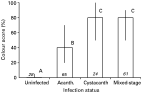
Fig. 1. Effect of single- and mixed-stage infection on colour modification in Caecidotea intermedius. Shown are median values for each group (plus upper and lower quartiles) with sample size shown in italics. Acanth. represents scores for both acanthor and acanthella-stage parasites. Letters above bars indicate differences between groups, with shared letters indicating no difference.
 You have
Access
- 26
- Cited by