1. Does Hebrais(ti) Mean Aramaic?
Despite the etymology and the usual meaning of the cognate adjective Ἑβραῖος ‘Hebrew’, the standard lexicon of New Testament Greek (BDAG) claims that the phrase τῇ Ἑβραΐδι διαλέκτῳ ‘in the Hebrew language’ in Acts refers not to Hebrew but to ‘the Aramaic spoken at that time in Palestine’.Footnote 1 Two of the most prominent English translations agree. Although Acts 21.40–22.2 uses the expression τῇ Ἑβραΐδι διαλέκτῳ to refer to Paul's address to the crowd, the New International Version translates using ‘Aramaic’:
ὁ Παῦλος ἑστὼς ἐπὶ τῶν ἀναβαθμῶν κατέσεισεν τῇ χειρὶ τῷ λαῷ. πολλῆς δὲ σιγῆς γενομένης προσεφώνησεν τῇ Ἑβραΐδι διαλέκτῳ λέγων· Ἄνδρες ἀδελφοὶ καὶ πατέρες, ἀκούσατέ μου τῆς πρὸς ὑμᾶς νυνὶ ἀπολογίας. ἀκούσαντες δὲ ὃτι τῇ Ἑβραΐδι διαλέκτῳ προσεφώνει αὐτοῖς μᾶλλον παρέσχον ἡσυχίαν.
Paul stood on the steps and motioned to the crowd. When they were all silent, he said to them in Aramaic, ‘Brothers and Fathers, listen now to my defense.’ When they heard him speak to them in Aramaic they became very quiet. (NIV)
The NRSV does call the language ‘Hebrew’ in its translation, but a footnote explains, ‘That is, Aramaic.’
We should expect there to be sound reasons for interpreting a word contrary to its etymological meaning and its normal usage. After all, Ἑβραΐς is simply a feminine form of the adjective normally meaning ‘Hebrew’. It is the masculine form of this word that Paul used when calling himself a ‘Hebrew of Hebrews’ (Phil 3.5). And Ἑβραϊστί means ‘in Hebrew’ both etymologically and as used by authors before and after the first century. For example, the prologue to Ben Sira says, ‘what was originally expressed in Hebrew (αὐτὰ ἐν ἑαυτοῖς Εβραϊστὶ λεγόμενα) does not have exactly the same sense when translated into another language’ (RSV). When Rev 9.11 says that Abbadon is a ‘Hebrew’ name, it uses Ἑβραϊστί (ὄνομα αὐτῷ ῾Εβραϊστὶ ᾿Αβαδδὼν καὶ ἐν τῇ ῾Ελληνικῇ ὄνομα ἔχει ᾿Απολλύων). Rev 16.16 uses it to explain that Armageddon is the name of the place ‘in Hebrew’ (τὸν τόπον τὸν καλούμενον ῾Εβραϊστὶ ῾Αρμαγεδών).
In this article I first review the reasoning behind rendering Ἑβραΐς/Ἑβραϊστί as ‘(in) Aramaic’, then identify patterns in ancient names for Hebrew and Aramaic, in which I show that Ἑβραΐς/Ἑβραϊστί (henceforth ‘Hebrais(ti)’) never refers unambiguously to Aramaic but only refers to the Hebrew language. Because this question of the meaning of Hebras(ti) has in past scholarship been combined with questions of the vernacular of Palestine, of language of Jesus and of the original languages of the gospels,Footnote 2 I must clarify at the outset that I am not arguing that Hebrew was more commonly used than Aramaic in Palestine in the first century.Footnote 3 I am not arguing that Jesus taught in Hebrew rather than in Aramaic. And I am certainly not arguing that Matthew originally wrote his gospel in Hebrew. Those are indeed fascinating questions, but they must be set aside until after the meaning of Hebrais(ti) has been ascertained as closely as possible.Footnote 4
2. The Case for Aramaic
As the bibliography at the end of the BDAG lexical entry indicates, Gustaf DalmanFootnote 5 and Theodore ZahnFootnote 6 (along with Arnold MeyerFootnote 7) were the scholars who entrenched in biblical scholarship the idea that Hebrais(ti) means ‘Aramaic’.Footnote 8 They made a persuasive argument that Aramaic was the main language used in first-century Palestine. Dalman provided eight reasons for his view: (1) Aramaic targumim were necessary because Hebrew was no longer understood; (2) Semitic words in Greek documents look more Aramaic than Hebrew (for example, Pharisaioi); (3) there are two rabbinic references to Aramaic being spoken in the temple,Footnote 9 (4) the first-century ‘Roll concerning Fasts’ is in Aramaic; (5) the Mishnaic formulae for marriage documents are Aramaic; (6) Aramaic script was in use rather than paleo-Hebrew, (7) Mishnaic Hebrew appears to be nothing more than Hebraised Aramaic, and (8) Aramaic was at times called ‘Hebrew’.Footnote 10 Dalman accounted for this last point by suggesting that because the Hebrew people normally used Aramaic rather than Hebrew, Aramaic could be called the language of the Hebrew people, or the Hebrew language.
Dalman's and Zahn's conclusions were reasonable considering the evidence they had to work with at the time. However, their ideas were a product of their times in two ways: (1) they were influenced by nationalistic assumptions that a people has one language; and (2) they did not have the benefit of the last hundred years of research on the targumim,Footnote 11 the MishnahFootnote 12 and the Dead Sea Scrolls.Footnote 13 The origin of the ‘Aramaic only’ view has recently been exposed in detail by the Eskhults and Guido Baltes.Footnote 14 In the last century a few scholars used the new discoveries to challenge the old consensus.Footnote 15 Still, the most influential voices in biblical scholarship have adopted the arguments of Dalman and Zahn unrevised even after the discoveries of the Dead Sea Scrolls. Footnote 16
I do not intend to argue in this paper against Dalman's first seven points, although many of them have also been seriously undermined.Footnote 17 It is his final point that I wish to take up: that the language name ‘Hebrew’ could at times be used for Aramaic.
The standard argument that Ἑβραΐς means Aramaic in Acts depends on two premises: first, Hebrais(ti) could refer to either Aramaic or Hebrew, and second, Hebrew was not a spoken language at that time. If these two are true, Hebrais(ti) must mean Aramaic rather than Hebrew in Acts 21–2. Logically speaking, only one of the two premises needs to be disproven for the argument to fail. It is the first of these premises that I address in this article. I challenge the view that Hebrais(ti) could mean Aramaic at that time by showing that Aramaic was clearly and consistently distinguished from Hebrew, and by accounting for evidence usually adduced to the contrary.
The argument that Hebrais(ti) can refer to Aramaic in the first century is based mainly on the evidence that several Aramaic-looking words given in Greek are explicitly called Hebrais(ti). These words are considered Aramaic for three reasons: (1) they are etymologically Aramaic words, or (2) they are words ending in Greek alpha (apparently representing the Aramaic postpositive article), or (3) they are otherwise unknown in Hebrew texts. This body of Aramaic-looking words explicitly called Hebrais(ti) consists of four words, all in John's gospel: they are Βηθζαθά (according to Sinaiticus) spelled Βηθεσδά in Alexandrinus or Βηθσαϊδά in Vaticanus or Βελζεθά in Bezae at John 5.2,Footnote 18 Γαββαθά in John 19.13,Footnote 19 Γολγοθά in John 19.17Footnote 20 and ῬαββουνίFootnote 21 in John 20.16. Even if we include words that are said to be ‘in the language of the Hebrew people’ (and I do not question that the Hebrew people may have spoken more Aramaic than Hebrew), only three more Aramaic-looking words are added to these four: Josephus (Ant. 1.33) says that the word σάββατα is κατὰ τὴν ῾Εβραίων διάλεκτον ‘according to the language of the Hebrews’; about the ‘fiftieth day’ Josephus (Ant. 3.252) says that ‘Hebrews call it Asartha’ (Ἑβραῖοι ἀσαρθὰ καλοῦσι) and Philo (Decal. 159) says about Passover, Ἑβραῖοι πατρίῳ γλώττῃ Πάσχα προσαγορεύουσι ‘Hebrews call it Pascha in the ancestral language’ (also in Spec. Laws 2.145).
If, as it seems at first glance, several first-century writers could give the name Hebrew to words that are actually Aramaic, it would appear at the very least that the names for the two languages were being used indiscriminately. If this is the case, we should be open to the possibility that when the author of Acts says that Paul spoke in the ‘Hebrew’ dialect, the language Paul used was actually Aramaic.Footnote 22
3. Testing the Premise that Hebrais(ti) Means Aramaic
This fundamental premise behind the lexical entry and the modern translations (namely that Hebrew and Aramaic were not clearly distinguished) is a premise that can be tested, by examining the ancient usage of names for Hebrew and Aramaic to see whether they were distinguished or not. It is this question that is the focus of the current article: whether ancient authors consistently distinguished between Hebrew and Aramaic. If it can be demonstrated that Hebrew and Aramaic are consistently distinguished and only Hebrew is certainly called Ἑβραΐς or Ἑβραϊστί, then we can no longer justify translating Hebrais(ti) as ‘Aramaic’.
To test this premise, I examined all specific references to the Hebrew and Aramaic languages in all extant Greek, Hebrew and Aramaic texts up to the third century. I included adverbs such as Ἑβραϊστί and Συριστί ‘Syrian’, adjectives such as עברית ‘Hebrew’, ארמית ‘Aramaic’, Συριακή ‘Syriac’, Ἑβραΐς, as well as more general adjectives such as Ἑβραϊκός, Ἑβραῖος, Συριακός ‘Syriac’ and Χαλδαῖος ‘Chaldean’, when these were used in conjunction with a word denoting language (such as φωνή, διάλεκτος, γλῶσσα). I purposely discounted references which did not name the language (for example, Josephus’ ‘ancestral language’) but stated only what the Hebrew people called something. Such references can be of only secondary value, as circumstantial evidence. If (as the traditional view holds) the Hebrew people spoke Aramaic, either one of the two languages could be the one in view in such statements.
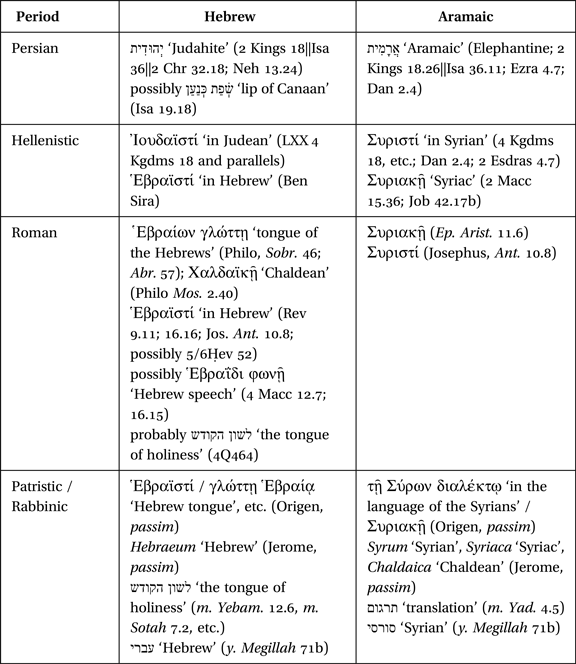
I found a general consistent distinction made between names for Aramaic and Hebrew. Table 1 summarises these names chronologically.
In what follows, I restrict my discussion to instances that are useful to determine whether Hebrais(ti) is (a form of) ‘Aramaic’ or something different. Statements that mention Hebrais(ti) without indicating which language is meant cannot help us. For example, although Papias said Ματθαῖος μὲν οὖν Ἑβραΐδι διαλέκτῳ τὰ λόγια συνετάξατο (‘Matthew arranged the sayings in the Hebrais dialect’, apud Eusebius, Hist. eccl. 3.39.16), Hebrais here could conceivably refer to either language. Those texts that do consciously contrast the two languages are wide-ranging, including Aristeas, Josephus, 4 Kingdoms, Origen, Jerome, the Mishnah and the Jerusalem Talmud. A discussion of the usages in chronological order below will show a clear pattern that Aramaic was not called Hebrais(ti).
Attested names for Hebrew and Aramaic, chronologically arranged.
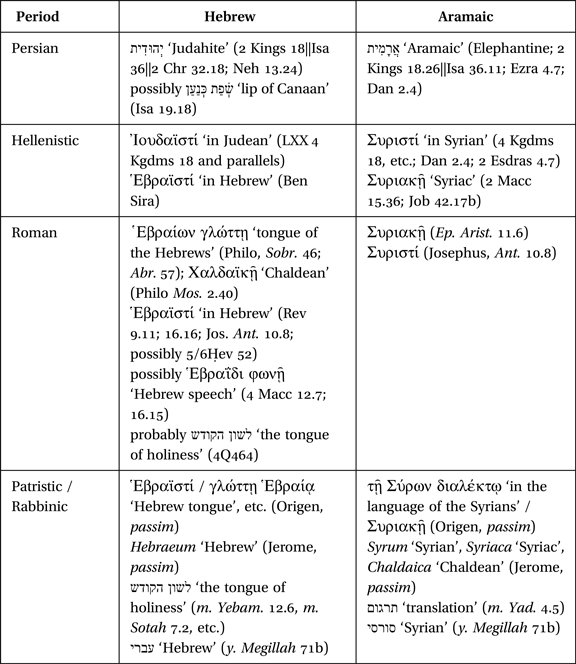
In the Persian period, the two languages were distinct. The earliest extant reference to Aramaic is found in the Elephantine papyri, where it is called ארמית, the same name used in the transitions to Aramaic in Dan 2.4 and Ezra 4.7 and also in the biblical story told in 2 Kgs 18.26 and its parallel in Isa 36.11.Footnote 23 This story explicitly makes a distinction between two ways of speaking: the Arameans are asked not to speak יְהוּדִית, which the citizens of Jerusalem could understand, but rather ארמית, which they could not.Footnote 24
In the Hellenistic period, this distinction remains. In the Greek version of the same story we find the terms Ἰουδαϊστί and Συριστί. Rapsakes is told, Λάλησον δὴ πρὸς τοὺς παῖδάς σου Συριστί, ὅτι ἀκούομεν ἡμεῖς, καὶ οὐ λαλήσεις μεθ’ ἡμῶν Ἰουδαϊστί (‘Please speak to your servants in Syriac, since we understand it, and you shouldn't speak with us in Judean,’ 4 Kgdms 18.26). Συριστί is also the word found in the Greek of Dan 2.4 and 2 Esd 4.7 to translate the Hebrew ארמית. The first attested use of Ἑβραϊστί is by Ben Sira's grandson, referring to the Hebrew language of his grandfather's work and of the Tanakh.Footnote 25 The word Χαλδαϊστί is added once to the Greek text of Dan 2.26, to refer to Belteshazzar's name. Aristeas claims the Jewish scriptures are not written in Syriac, although they are commonly thought to be: … καὶ φωνὴν ἰδίαν ἔχουσιν. ῾Υπολαμβάνονται Συριακῇ χρῆσθαι· τὸ δ’ οὐκ ἔστιν, ἀλλ’ ἕτερος τρόπος (Ep. Aris. 11). Josephus kept the two names distinct. When he retold the story from Aristeas, he wrote:
μὲν γὰρ εἶναι τῃ ἰδιότητι τῶν Συρίων γραμμάτων ἐμφερὴς ὁ χαρακτὴρ αὐτῶν καὶ τὴν φωνὴν ὁμοίαν αὐτοῖς ἀπηχεῖν, ἰδιότροπον δὲ αὐτὴν εἶναι συμβέβηκεν
though their script seemed to be similar to the peculiar Syrian writing, and their language to sound like the other, it was, as it happened, of a distinct type. (Antiquities 12.15; trans. R. Marcus, LCL)
He retold the story from 4 Kgdms 18 as follows:
ταῦτα δὲ τὸν ῾Ραψάκην ἑβραϊστὶ λέγοντα, τῆς γὰρ γλώττης εἶχεν ἐμπείρως, ὁ ᾿Ελιάκειμος φοβούμενος, μὴ τὸ πλῆθος ἐπακοῦσαν εἰς ταραχὴν ἐμπέσῃ, συριστὶ φράζειν ἠξίου.
As Rapsakēs spoke these words in Hebrew, with which language he was familiar, Eliakias was afraid that the people might overhear them and be thrown into consternation, and so asked him to speak in Aramaic. (Antiquities 10.8; trans. R. Marcus, LCL)
Josephus changed the Ἰουδαϊστί (or יהודית) of 4 Kingdoms to Ἑβραϊστί, and kept Συριστί for Aramaic. This change from Ἰουδαϊστί to Ἑβραϊστί is significant because it is not what one would expect if Josephus thought Ἑβραϊστί could refer to Aramaic. Josephus consciously chose to call it Ἑβραϊστί, precisely when a contrast between Hebrew and Aramaic was desired. In his mind, Ἑβραϊστί was the most appropriate name for the language he wished to distinguish from Aramaic. Philo is the only one to provide ambiguous evidence; usually he would call the language of the Bible ‘Chaldaic’. Mos. 2.26 is typical; Philo wrote, ‘of old the laws were written in the Chaldaic tongue’ (τὸ παλαιὸν ἐγράφησαν οἱ νόμοι γλώσσῃ Χαλδαϊκῇ), as also in Mos. 2.31 and 40.
The evidence presented above indicates that the trend up to and including the first century is that Aramaic was normally distinguished from the ancestral language of the Jews. Besides Ἑβραϊστί, that language was also called Canaanite and Judean, and besides אֲרָמִית, Aramaic was called Syrian and Chaldean. The one exception to this trend is Philo, who uses the word Χαλδαϊκῇ to refer to the biblical texts, but even he never uses Ἑβραΐς to refer to Aramaic.
In the centuries immediately following the New Testament, we again have evidence from both Christian and Jewish sources that the two languages were distinguished. In Table 1 I noted just two of the most prominent writers to contrast Hebrew (that is, Ἑβραϊστί or Hebraeum) with Aramaic (that is, Συριακῇ, Syrum or Chaldaica). A typical example can be seen in Origen, Cels. 3.6:
… πῶς οὖν τὸ μετὰ τοῦτο οὐχὶ μᾶλλον τῇ Σύρων ἐχρῶντο διαλέκτῳ ἢ τῇ Φοινίκων, ἀλλὰ τὴν ἑβραΐδα ἑτέραν παρ’ ἀμφοτέρας συνεστήσαντο;
… how did it happen that after so doing they did not rather adopt the Syrian or Phoenician language, instead of preferring the Hebrew, which is different from both? (trans. F. Crombie, ANF)
The Latin writers are no different. In Nom. hebr., Jerome would typically comment regarding words he considered Aramaic, ‘It is Syriac, not Hebrew’, as for example, Abba pater. Syrum est, non Hebraeum (Nom. hebr. 63.20). Augustine, writing from a region where Punic was spoken, noted that cognatae quippe sunt linguae istae et vicinae, Hebraica, Punica, et Syra (‘For the Hebrew, Punic and Syriac are cognate and neighbouring languages’).Footnote 26 When Origen encountered the colophon of the Greek version of Job, with its mention of a ‘Syriac’ book about Job, he had to appeal to geography to explain how a book of Job, which should be Hebrew, might possibly be called Syriac. He wrote:
Συριακὴν νῦν τὴν ῾Εβραίων διάλεκτον καλεῖ, ἐπειδὴ καὶ Συρίαν τὴν ̓Ιουδαῖαν, καὶ Σύρους οἱ πολλοὶ τοὺς Παλαιστινοὺς ὀνομάζουσιν
Now it calls the dialect of the Hebrews Syriac, since the masses call Judea Syria and Palestinians Syrians.Footnote 27
Likewise, the rabbis regularly called Hebrew עברי or sometimes לשון הקדש and Aramaic אֲרַמִּי or סורסי or sometimes תרגום. The two were contrasted, never equated or confused. For example, in Midrash Tanchuma Shmini 5, Yehuda Ha-Levi says, ‘In Hebrew it is called yayin; in Aramaic hemar’ (אָמַר רַבִּי יְהוּדָה הַלֵּוִי בְּרַבִּי שָׁלוֹם, בְּלָשׁוֹן עִבְרִי שְׁמוֹ יַיִן, וּבְלָשׁוֹן אֲרַמִּי חֲמַר). In the Mishnah Aramaic is called תרגום in m. Yad. 4.5 תרגום שבעזרא ושבדנייאל , מטמא את הידיים. (‘Targum [ = Aramaic] which is in Ezra and which is in Daniel makes the hands unclean’). In the Jerusalem Talmud the languages are explicitly distinguished by their appropriateness for various occasions, and include Latin:
לא יהא לשון סורסי קל בעיניך. שבתורה ובנביאים ובכתובים הוא אמור. … ארבעה לשונות נאין להשתמש בהן העולם. ואילו הן לעז לזמר רומי לקרב סורסי לאיליי עברי לדיבור. ויש אומרים אף אשורי לכתב
Do not let Syrian be light in your eyes. For it is spoken in the Torah and in the prophets and in the writings … Four languages are suitable for the world to use. These are: the foreign language [ = Greek] for song; Roman [ = Latin] for battle; Syrian [ = Aramaic] for elegy; Hebrew for speech. Some say even Assyrian for script. (y. Megillah 71b)
It is not until the fourth century that we find hints that the two languages might both be called ‘Hebrew’: Epiphanius normally distinguished Hebrew from Syriac,Footnote 28 although a few of his explanations are puzzling, notably his mention of a ‘deep language’ in Pan. 26.1.5: ‘They give the name Noria to Pyrrha. For since fire is translated noura in Hebrew, not according to the deep language, but in the Syrian dialect (for fire among Hebrews is called hesath according to the deep language)’ (Pan. 26.1.5).Footnote 29 He mentioned parts of the New Testament translated into Hebrais, including the Gospel of John (Pan. 30.3.8) and Acts and Matthew (Pan. 9.9.4), which are not extant, although we do know of Aramaic translations.Footnote 30 Also, around 600 ce, Joannes Moschus did call the vernacular of Palestine Ἑβραϊστί (Prat. spir. 136). But this evidence of Ἑβραΐς used to refer to Aramaic does not bear much weight since it is so distant from the first century, and even if accurate at its time, would reflect only the reality obtaining centuries after the Bar Kokhba revolt and the changes its aftermath wrought in Palestinian Jewish culture because of the expulsion from Jerusalem and movement of Jews to Galilee.
4. Hebrais(ti) Never Clearly Means Aramaic
There are therefore only a few ancient statements preventing the immediate conclusion that in the first century Aramaic was always clearly distinguished from Hebrew. These are, on the one hand, Philo's assertion that the Bible is written in Chaldean, and on the other hand, the Aramaic-looking words said to be Hebrew by John, Philo and Josephus. Of these three authors, John is the only one who appears to call Aramaic ‘Hebrew’. Except for these seven Aramaic-looking words (Βηθζαθά/Βηθεσδά/Βηθσαϊδά/Βελζεθά, Γαββαθα, Γολγοθα, Ραββουνι, σάββατα, ἀσαρθά, Πάσχα) a consistent distinction was made between Hebrew and Aramaic. This fact alone indicates that it was not normal for Aramaic to be called ‘Hebrew’, and that should temper the BDAG lexicon's claim that these passages refer ‘to the Aramaic spoken at that time in Palestine’.Footnote 31 Yet as Randall Buth and Chad Pierce have now demonstrated, none of even these seven words is certainly Aramaic.Footnote 32 All of the anomalies to the otherwise consistent ancient distinction between Hebrew and Aramaic can be accounted for. First, John's Ραββουνι can be considered a Hebrew word according to Codex Kaufmann of the Mishnah Ta‘an. 3.8. Second, Josephus and Philo's Πάσχα and σάββατα are taken directly from the Septuagint translation of Hebrew texts, and ἀσαρθά has a final alpha simply to aid pronunciation. Third, John's three place names called Ἑβραϊστί, namely Βηθζαθά, Γαββαθά and Γολγοθά, should not be given much weight given that proper names resist translation. Therefore all the apparently Aramaic words cited could easily have been used in Hebrew speech. Finally, Philo's claim that the Bible is written in Chaldean is insubstantial, since he probably knew neither Hebrew nor Aramaic.
In light of this consistent pattern with no unambiguous counterexamples, the BDAG lexical entries for the words Ἑβραΐς and Ἑβραϊστί need to be revised to remove the assertion (or implication) that these words refer to any form of Aramaic. Rather, Ἑβραΐς, Ἑβραϊστί and other words for the Hebrew language are clearly and consistently distinguished from those for the Aramaic language; any apparent evidence to the contrary suggests at most that Aramaic might possibly be an occasional referent of these words, which as it happens (apart from John's proper names) always denote Hebrew. In consequence, the entry in future editions of Greek lexica should gloss Ἑβραΐς as ‘Hebrew’, noting not that ‘these passages refer to the Aramaic spoken at that time in Palestine’, but rather that at most it is possible that the New Testament authors might mean Aramaic. Future translations of the New Testament should also render Ἑβραΐς as ‘Hebrew’, although it would not be indefensible to reverse the NRSV footnote to read, ‘or, possibly, Aramaic’.