1. Introduction
This is a story of an ongoing search for a genre-based, social constructivist pedagogy for novice academic classrooms, an effort that has preoccupied me, and others, for more than twenty years. Because we still have not found satisfactory answers, the search continues. It is an important search, particularly as the interest in academic literacies increases throughout the world. The issues that surround it are central, not only to academic literacy but to broader questions such as the following: What is communicative competence and how can we authenticate that competence in our classrooms? How can we promote transfer of learning from our classrooms to the contexts in which students will be using the language? How can we relate the current focus on grammatical form to the variability of language in communicative contexts? Thus, what I discuss here should be seen as relevant to much of what is important to today's second/foreign language classrooms.
Since the 1980s, my research has focused upon novice academic literacies and, more specifically, on the relationships between academic literacies and genre theory. A few years ago, when I felt I was sufficiently theoretically mature, I devoted five years to the development of a genre-based textbook for first year university students – and I failed miserably in the effort. I have been more successful in developing literacy curricula for secondary students, designed to prepare them for university study (Johns Reference Johns2007).
However, all of this work has not resulted in a genre-based pedagogy that is, in my view, satisfactory for the novice tertiary student, relatively new to college or university, and naïve about academic languages, texts, and cultures. Thus, the search continues.
I have divided my discussion here into four parts. First, I present the problem and focus of my search. Then, I define and problematize the term genre. Next, I briefly present the three genre ‘schools’ – the New Rhetoric, English for Specific Purposes, and Systemic Functional Linguistics – and critique their pedagogies. Finally, I suggest two possible approaches for enhancing academic students' genre awareness and rhetorical flexibility.
2. The problem
The problem reflected in the search is a complex one; and, as I have noted, it has yet to be solved, for a variety of reasons. Here it is, in the form of a question: How can we apply ‘genre’, the most socially constructivist of literacy concepts, to novice academic classroom in ways that:
(i) are theoretically framed, but pedagogically sound and sufficiently coherent to be accessible to students,
(ii) take into consideration the complexity of genres and their varied realizations in real world contexts, and
(iii) promote rhetorical flexibility and genre awareness among students, enhancing their abilities to assess, adapt to and/or negotiate a genre to a situation?
Some of the terms in this problem statement need further explanation. Russell & Fisher (in press) distinguish between two approaches to genre pedagogy, two basic goals for a course or tutorial. The first is genre acquisition, a goal that focuses upon the students' ability to reproduce a text type, often from a template, that is organized, or ‘staged’ in a predictable way. The Five Paragraph Essay pedagogies, so common in North America, present a highly structured version of this genre acquisition approach. A much more sophisticated version, introduced in Australia but now popular elsewhere, has been devised by the proponents of Systemic Functional Linguistics (Christie Reference Christie1991; Martin Reference Martin1993; Eggins Reference Eggins2004). Using well-established pedagogies, practitioners follow a teaching/learning cycle as students are encouraged to acquire and reproduce a limited number of text types (‘genres’) that are thought to be basic to the culture (Macken-Horarik Reference Macken-Horarik and Johns2002).
A quite different goal is genre awareness, which is realized in a course designed to assist students in developing the rhetorical flexibility necessary for adapting their socio-cognitive genre knowledge to ever-evolving contexts. Though there are few genre awareness curricula, for a number of reasons (see Freedman Reference Freedman1993), I will argue here that a carefully designed and scaffolded genre awareness program is the ideal for novice students – and for other students, as well. After my many years of teaching novice tertiary students who follow familiar text templates, usually the Five Paragraph Essay, and who then fail when they confronted different types of reading and writing challenges in their college and university classrooms, I have concluded that raising genre awareness and encouraging the abilities to research and negotiate texts in academic classrooms should be the principal goals for a novice literacy curriculum (Johns Reference Johns1997).
This juxtaposition of two quite different goals, genre acquisition and genre awareness, is reminiscent of another pedagogical contrast mentioned by Henry Widdowson years ago (Reference Widdowson1984) and, later, by Flowerdew (Reference Flowerdew1993): that pedagogies are designed to either train for specific tasks (i.e., text types) or educate, to cope with an almost unpredictable future. It is my argument here that education should, in the end, be our goal for novice academic literacy courses, for a genre awareness education will prepare students for the academic challenges that lie ahead.
3. Defining ‘genre’
Why are genres important to a curriculum that educates rather than trains? To answer this question, we must first look at the nature of genres as conceptualized in the theoretical literature. First of all, genres are both social and cognitive. Theorists, particularly of the New Rhetoric school, argue that genres are located not in specific texts but instead, as socio-cognitive schemas for appropriate textual approaches to rhetorical problems (Grabe & Kaplan Reference Grabe and Kaplan1996; Bazerman Reference Bazerman, Bishop and Ostrom1997), schemas that often have to be reformulated as writer produces texts for the demands of specific contexts. Thus, an expert writer might have a genre schema for the academic abstract, but as she prepares an actual abstract for an identified conference, she must adapt her schema, and the resultant text, to the conference requirements. Novice academic readers and writers have not been initiated into communities of academic practice and repeatedly exposed to the valued genres; therefore, they have not developed appropriate academic schemas. In a useful series of case studies of students new to university, Macbeth (Reference Macbeth2006) found that these novices viewed what happened in university classrooms, and the texts that resulted, as ‘occult practices’ (p. 108), foreign to their experiences.
Secondly, genres are purposeful, or, at the very least, responsive. There seems to be general agreement among genre experts that the issue of writer purpose is essential to genre theory. We write texts to invite, to argue, to be accepted at conferences and for many other reasons. Unfortunately for our novice students, the texts they produce in their academic classrooms are not as much purposeful as responsive: their instructors assign the tasks and the students respond to them. The students' purposes, in the main, are to please their instructors and/or pass the examinations.
Not surprisingly, given the hegemonous relationships between instructors and texts, genres are named by those in power. In the genre pedagogies of Systemic Functional Linguistics (SFL), this naming is directly connected to the writer's purposes. Thus, if students want to discuss several points of view, then they employ a ‘discussion’ genre. If they want to explain historical events, then they write an ‘historical account’ (Rose Reference Rose2006). These are pedagogical genres that, according to those from the SFL school, can be acquired and broadly applied across the culture.
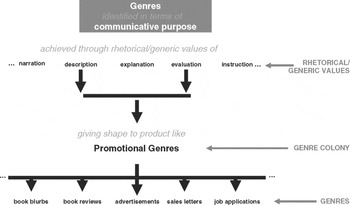
But it is important to distinguish between the naming of genres for pedagogical purposes and actual naming that takes place among communities of expert readers and writers, those who have power over names in particular situations. Bhatia (Reference Bhatia2004) distinguishes between these two types of naming by referring to common pedagogical discourses, e.g., ‘narration’, ‘description’, and ‘instruction’ as ‘rhetorical or generic values’ that ‘give shape’ to the actual community-named genres such as ‘book reviews’ or ‘job applications’ (see Figure 1, adapted from Bhatia Reference Bhatia2004: 59).
Levels of generic description (Bhatia Reference Bhatia2004).

According to this figure, Bhatia distinguishes between what he calls ‘rhetorical or generic values’ and what the New Rhetoricians call ‘rhetorical strategies’ (narration, description, definition, cause and effect, comparison) that can be exploited as organizational patterns within genres and the named genres of those in power in communities. In academic circles, named genres would include the grant proposal, the book review, the abstract, or the research article. Each of these named genres is composed by writers through the use, and often a mixture, of rhetorical strategies/generic values.
Unfortunately, student-produced genres in academic contexts are much more casually named by their instructors than are respected academic genres, probably because student texts have little or no prestige in academic communities (see Johns Reference Johns1997). It is frustrating for both students and their literacy teachers that instructors across the disciplines call many examination and out-of-class papers ‘essays’, when, in fact, the appropriate structure, register, and argumentation in these papers will vary across classes and disciplines. What is an essay? This is a very difficult question for us to answer; and because student essays do not really matter to disciplinary experts, they do not consider the question.
In many theoretical discussions, genres are clustered or grouped, but the approach to grouping depends upon the theoretical and research backgrounds of those involved. As can be seen in Figure 1, Bhatia (Reference Bhatia2004: 59) groups genres in terms of general purposes (‘promotional genres’) as does Rose (Reference Rose2006: 5). Hasan (Reference Hasan, Halliday and Hasan1985: 108) speaks of ‘genre families’, including ‘service encounters’, for example. Genres can also be grouped as ‘chains’, or ‘intertextual systems’, which draw from each other as the writers work toward a goal or related activity. One example of a genre chain comes from Chen & Hyon (Reference Chen and Hyon2005), who studied the relationships among the several genres that contributed to the promotion files of a university faculty member.
One of the most familiar characteristics of genres is that they are conventional: elements, which are sometimes called ‘central tendencies’, are repeated in texts from a genre. When we read or write in a genre with which we are familiar, and for which we have a schema, we instantiate our schema for what typifies that genre, its conventions, as we read or write, and we use our knowledge of conventions as we produce a new text. The conventions of a genre can refer to a variety of features: the text structure, the register, the relationships between the writer and the audience, the uses of non-linear material (e.g., graphs or charts), the common fonts, and even the paper type and quality.
However – and this is very important to novice students' education – genres vary considerably in terms of prototypicality (Swales Reference Swales1990), influenced by the nature of the genre itself as well as the centripetal and centrifugal forces that characterize the specific situation in which the text from the genre is produced (Berkenkotter & Huckin Reference Berkenkotter and Huckin1995). Thus, as I noted earlier, the ‘academic essay’ varies in remarkable ways across the disciplines and classrooms. The lab report, on the other hand, may be fairly conventional, so little variation in schema is required to produce a new text.
These, then, are the most important features of genres as discussed by theorists across the three schools. For the goals of genre awareness and student education, the most important of these are probably the possibilities for variation: that texts from genres can, and do, vary, sometimes radically, from situation to situation.
4. The three genre ‘schools’
Now, I move the second goal of this paper: to briefly discuss the three genre ‘schools’; and specifically, to present and critique their approaches to pedagogy.
4.1 The New Rhetoric school
According to Hyon (Reference Hyon1996), there are three theoretical traditions, each of which can illuminate our understanding of genre pedagogies. The first school I will discuss here is The New Rhetoric (NR), the North American tradition that may be the least familiar to applied linguists and second/foreign language teachers. In this tradition, the situated and social features of genres are primary. One source from which the New Rhetoricians often draw is activity theory, whose major tenet is that we cannot separate the cognitive from the social. The context in which we are working, or writing, influences how we think – and vice versa. In Reference Russell, Fisher, Giltrow and Stein1997, David Russell published an important article in which he reviewed and integrated the work on activity theory among New Rhetoricians. His goal was the following:
. . . to move toward a theory of writing useful in analyzing how students and teachers within individual classrooms use the discursive tools of classroom genres to interact (or not interact) with social practices beyond individual classrooms [including] schools, families, peers, disciplines, professions . . . In other words, I am attempting to expand and elaborate theories of social ‘context’ and formal schooling, to [better] understand the stakes involved in writing. (Russell Reference Russell1997: 505)
Using activity theory as the basis for his discussion, Russell argues that contexts for academic reading and writing are both temporarily stabilized and evolving because writers' schemas are affected by both prior knowledge and the immediate situation. Therefore, ‘genres predict – but do not determine – the nature of the text that will be produced in a situation’ (p. 522). Confronted with a specific rhetorical situation, knowledgeable writers instantiate their schemas for comparable situations, acquired during previous experiences with the genre, and then, influenced by a variety of social factors, they assess the immediate context to decide how their schemas must be revised for the new texts produced. According to New Rhetoricians, this is where a discussion of genres must begin: with the demands of the complex context in which the text is to be produced and the genre schemas of individual writers, which are in constant interaction. These theorists also discuss, at some length, the ideological nature of genres, arguing that no text is innocent (see e.g., Coe, Lingard & Teslenko Reference Coe, Lingard and Teslenko2002).
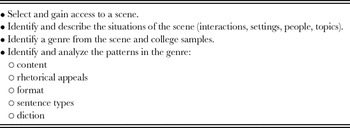
Not surprisingly, many of the New Rhetoric theorists claim that it would be difficult, if not impossible, to apply their theories to the classroom, since taking a text from its authentic context immediately obviates its situational value. Despite this warning, some brave souls have written genre curricula that begin with the situations in which genres are produced. Table 1 shows a core genre awareness activity from an undergraduate textbook by Devitt, Reiff & Bawarshi (Reference Devitt, Reiff and Bawarshi2004), based upon New Rhetoric genre theory.
Genre awareness activity (Devitt, Reiff & Bawarshi Reference Devitt, Reiff and Bawarshi2004).

As can be seen in this table, context is the first topic considered, since the text from a genre is dependent, in many ways, upon the variables in this ‘scene’ or situation. Conventions of the genre are considered only after the immediate situation is analyzed and related directly to the demands of the context.
This textbook also asks students to consider the ideology that permeates a genre, posing questions such as Who is invited to participate in the genre, and Who is excluded? and What values, goals, and assumptions are revealed?
The New Rhetoric practitioners have produced a valuable, critical work designed to develop what Russell & Fisher (forthcoming), in their discussion of new technologies and genres, would call genre awareness. These theoreticians present a message for those of us concerned with education rather than training: we cannot talk about genres without considering the immediate contexts in which texts from a genre are produced, the roles of readers and writers in those texts, their ideologies, and the communities to which they belong and many other factors influencing writers.
Not surprisingly, the New Rhetoricians have also contributed to our understanding of the complexity of writing processes. In a traditional ‘process’ class, students explore ideas and work through a drafting, revising, and editing procedure which is, for the most part, cognitive. Context and audience are not major considerations. The New Rhetoricians argue that a successful writing process is much more complex than traditional pedagogies of ‘The Process Movement’ would indicate. An important New Rhetoric volume, Bawarshi's Genre and the invention of the writer (Reference Bawarshi2003), demonstrates how a writer should shift the locus of invention, i.e., text planning and revising, from ‘an interior cognitive process located within individuals’, to ‘a situated cognitive process, located within genres’ (Bawarshi Reference Bawarshi2003: 10). Rather than ‘brainstorming’ to discover their own ideas, content, and text structure, students in academic classes are required to analyze and respond to a task they are given by their instructor. Thus, they need to be very aware of the situation and its demands as well as of their own needs, capabilities, and desires. For, as noted earlier, genre awareness is both social and cognitive.
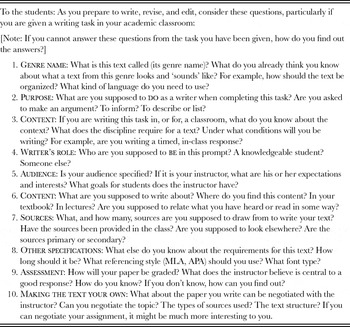
After reading Bawarshi and considering the problems with the typical writing process classroom, I prepared for novice academic students a socio-cognitive prompt analysis activity found in Table 2.
Prompt analysis for genre awareness.

In my search for a genre-awareness approach, I have found the New Rhetoricians' contributions to be very useful. However, their work is written for native speakers of English, and the pedagogical materials are quite advanced and insufficiently scaffolded for the ESL/EFL or other novice students. In addition, there is little discussion of the sentence-level, linguistic issues that must be considered when we teach diverse students. Thus, though we can benefit in many ways from studying the New Rhetoric theories, this school has not produced a pedagogy that is appropriate for novice classrooms, particularly those populated by diverse student populations. And so we move on.
4.2 English for Specific Purposes
The second tradition that Hyon discusses is the English for Specific Purposes (ESP) school, a movement devoted to research and the development of materials for diverse adult students and whose needs and genres can be specifically identified (see Johns & Price-Machado Reference Johns, Price-Machado and Celce-Murcia2001). ESP practitioners tend to be more linguistically and textually oriented than are the New Rhetoricians, as Flowerdew (Reference Flowerdew and Johns2002) notes, as many of the ESP pedagogies originated in EFL contexts. ESP practitioners generally begin their pedagogical work with the language and structure of the text rather than the context, and they tend to hypothesize about context from studies of texts.
ESP is most famous for Swales' ‘moves analysis’ in article introductions (Swales Reference Swales1990), but his underappreciated volume, Other floors, other voices (1998) is more social constructivist, for it integrates context, text, and author voices in ‘textographies’. Ken Hyland, another well-respected name in ESP, uses corpus linguistics to discover textual evidence for interactions between writers and readers in studies of metadiscourse (Hyland Reference Hyland1999), hedging (Hyland Reference Hyland1998), and author stance and engagement (Hyland Reference Hyland2005). Bhatia, in work on professional genres such as the law (Bhatia Reference Bhatia1993), has demonstrated how texts from genres are constructed in certain types of discourse communities. Paltridge's work on pedagogies and ethnographies (Paltridge Reference Paltridge2001) has been very instructive for practitioners, as well.
Much is to be gained from the ESP school, particularly the focus on the features of texts that suggest relationships between writers and audiences and the fact that ESP practitioners do not shy away from discussions of language or of pedagogies as New Rhetoricians might. However, as Samraj (Reference Samraj2004) and others have shown, the majority of ESP research and pedagogy (e.g., Swales & Feak Reference Swales and Feak2004) has been designed for diverse professionals or advanced academics. The novice undergraduate student is not often considered because, unfortunately, their needs are difficult to pin down, as are the target situations in which they will be using texts from identified genres. And so my search continues.
4.3 Systemic Functional Linguistics
The third genre tradition, ‘The Sydney School’, is based upon Systemic Functional Linguistics (SFL), with a pedagogical tradition that focuses upon the novice student: its best-known pedagogies are designed for primary, secondary, and adult immigrant students (see e.g., Macken-Horarik Reference Macken-Horarik and Johns2002). Originally located in New South Wales, Australia, the SFL practitioners have now branched out and become accessible to the world through pedagogical publications (e.g., Derewianka Reference Derewianka1990), through reading programs for the struggling student (Rose Reference Rose2006), and through teacher-friendly volumes on curriculum design (see e.g., Feez Reference Feez1998). The strengths of these SFL genre acquisition pedagogies are their accessibility to students and teachers through scaffolded curricula, analyzed and ‘staged’ pedagogical genres, and a teaching–learning cycle (see Feez Reference Feez and Johns2002). One important interest in this school is the relationship between deep learning and valued language in academic disciplines. Recently, Schleppergrell & Oliveira (Reference Schleppergrell and Oliveira2006) and Mohan & Slater (Reference Mohan and Slater2006) have related specific uses of language to content domains, such as history, giving teachers across the curriculum opportunities to show students how language, content, and texts interact.
SFL is the pedagogically most productive of the three traditions: it focuses upon the novice student; it relates text, purpose, content domain, and language; it lists, and teaches ‘key academic genres’, providing information about their central purposes, social locations, register, and stages; and it provides an accessible teaching–learning cycle.
Why not adopt an already-created SFL curriculum for novice academic students, then? Because – and this is important – the SFL pedagogies focus on genre acquisition. The claim among those in this school is that if students can control and produce a few de-contextualized ‘genres’ such as ‘exposition’, ‘discussion’, and ‘historical recount’, they can produce texts in the genres of a culture. These key genres are certainly a beginning, stepping stones for preparedness; for, as Bhatia (Reference Bhatia2004) has noted, they have the rhetorical/generic values that give shape to genres. But they are not the named genres themselves because genre (a socio-cognitive abstraction) is not found in the text itself. In addition, little or no support is provided in the pedagogies for how genre schemas must be revised to meet the demands of a specific situation. As a practitioner who has devoted many years to teaching academic literacy tasks, I am concerned about any genre pedagogy that appears to have found the pedagogical answers in the acquisition of de-contextualized texts, for genres are ‘slippery’ (Swales Reference Swales1990: 33) and evolving, and must be reformulated for shifting situations. Because of the emphasis upon the texts themselves in these pedagogies, there is little room for schema revision, consideration of reader–writer relationships, for the richness of context, and for the ideologies and hegemonies that are central to our discourse communities and their values.
5. The problem, restated
And so we return to the problem posed at the beginning of this paper: How can we apply ‘genre’, the most socially constructivist literacy concept, to academic novice classroom in ways that
(i) are theoretically framed, but pedagogically sound and sufficiently coherent to be accessible to students and teachers,
(ii) take into consideration the complexity of genres and their varied realizations in real world contexts, and
(iii) promote rhetorical flexibility and genre awareness among students, enhancing their abilities to assess, adapt to and/or negotiate a genre to a situation?
Each of the genre schools can contribute to the work of the practitioner who is attempting to educate, rather than train, novice academic students through the promotion of genre awareness and rhetorical flexibility. The New Rhetoric tradition reminds us that exploring the context and the situated nature of text, with all that this implies, must be central to our pedagogical goals. The ESP school, though it focuses upon the genres of more advanced students and professionals, branches out into constructivist areas with ‘textographies’ and studies of textual language that raise our awareness of the relationships of the writer to audiences and the sources cited. Systemic Functional Linguistics gives us textual variety related to purpose, curricular accessibility, and a better understanding of the relationships between language and deep learning in the content areas. However, if we are striving to educate, to prepare novice academic students for the unpredictability of situations that require a reformulation of genre schemas, then we can see that each of the traditions also has its limitations. So the search goes on.
6. Two promising possibilities
6.1 Interdisciplinary Learning Communities
In the last part of this paper, I would like to suggest two pedagogical possibilities that appear to be promising in this search for genre awareness and rhetorical flexibility. The first – and probably the best – choice for giving students a sense of the relationships among academic genres, classrooms, and disciplines is a learning communities program. In the best of these programs, the values, topics, genres and assessments of a single academic class become the research focus for the novice students who are exploring what it means to be an academic (Johns Reference Johns1997). For twelve years, I taught first year university students in such a program at my university, Freshman Success (see Johns Reference Johns and Leki2001 for details; see also Harklau Reference Harklau, Faltis and Wolfe1999 and Short Reference Short, Faltis and Wolfe1999, who suggest similar programs for secondary schools). As I explain in my 1997 volume, these ‘remedial’ students and immigrant students caught between languages and cultures were concurrently enrolled in my writing class and in an introductory, disciplinary class such as anthropology, history, biology, economics, or business law. The students and I studied the introductory class as an academic microcosm, a context where we could ask the questions that need to be posed about every class a student enters. Fortunately, the faculty in those classes were, for the most part, willing to be our specialist informants as we sought answers for questions such as the following:
(i) what are your principal objectives for students? What do you want students to understand, believe, know, or be able to do when they leave this class? Are these objectives related to disciplinary practice? Here are some answers we were given:
a. For history: ‘I want students to understand that all history is constructed by those who have power.’
b. For economics: ‘I want students to know, and be able to apply, the basic economic theories. They can critique the ways in which these theories are realized – but not the theories themselves.’
c. For philosophy: ‘Students should leave my class with the ability to read philosophy well. If they can read philosophical arguments, they can read anything.’
(ii) why are we reading these particular texts? How do they relate to your objectives for us and to your assessments? Here is one answer to these questions that was useful for the students.
In history (Western Civilization), they were asked to read a picturesque novel by Aridjis 1492: The life and times of Juan Cabezon of Castile (Reference Aridjis2003). In this novel, a group of ne're-do-wells, whom my students called ‘scumbags’, turned in innocent people to the Inquisitor for profit and spent most of their money in brothels. How did the students, without guidance from their instructor, respond to a text like this in a history course? They began to list all the dates and names of the characters, following the practices of their secondary school history classes. That approach was not what was intended, at all. After the students asked the teacher about her intent, they realized that they were supposed to be reading the novel to better understand ordinary people and atmosphere that surrounded the first years of the Inquisition.
(iii) Another question students asked was: what does a good response to your essay questions look like? As I noted earlier, most students had been taught one essay template in secondary school, the Five Paragraph Essay. When they attempted to follow this template and ‘the writing process’ for their timed essay questions in their biology class, they were very frustrated. In fact, almost all of my first year students failed the essay section of the first biology examination. So they learned an important lesson: ‘essay’ in academic classes doesn't always mean Five Paragraph Essay. In fact, it seldom does (see Johns Reference Johns and Johns2002a).
How did the students learn what ‘essay’ meant in that biology class? Worried about the failure rate, the instructor consulted me, and we devised a class exercise that was illuminating for us all. For this activity, the instructor selected for one essay question responses that were appropriate for four grades: an A (90%) response, a B (80%+) response, a C (70%+) response, and a D (60%+) response. Copies of these responses and the prompt were distributed, and the students worked in groups to decide which response got which grade, and why. Then, they reported their findings to the class. The instructor was surprised to discover that the students disagreed about which were the better responses because they didn't know how the responses were graded, that is, what was valued in a response. This activity provided an excellent teachable moment for the class as the instructor analyzed the prompt and discussed why each response received its grade. There's a happy ending: my students had much better scores on the second examination.
In addition to encouraging my students to act as researchers in their content classes, I worked with the instructors to devise writing assignments, graded by both of us, that were appropriate for the discipline. The most elaborate example occurred when I was co-teaching with an anthropology instructor. The research question for the required paper was the following: ‘In what ways do new immigrants adapt or assimilate into a new culture?’ The paper's structure,Footnote 1 sources, and key concepts (‘adaptation’, ‘assimilation’, etc.) were suggested by the anthropology instructor; and she provided models from student work for the desired text. Together, the anthropology instructor and I created analytical criteria which were used for peer reviews of the drafts as well as for scoring the final paper. The students and I completed a genre analysis of the models, noting the text structure, the abstract, the general academic language, the use of the key concepts, and source integration.
Then, I arranged for the students to visit a local, diverse secondary school where they met with immigrant students not of their own ethnic groups, advised them about applying to and succeeding in universities, and then interviewed them with a list of questions about adaptation and assimilation that we had created collaboratively in class. Throughout the interview process, the students recorded their methodologies: they discussed what they tried, their successes and failures, and their disappointments. The students were coached by the anthropology instructor, and me, as they wrote up their results, which required a considerable amount of re-writing and analysis. Their writing process was quite different, of course, from the typical brainstorming – drafting – peer editing – revision one from the Process Movement. After several revisions and much peer review, discussion, and reflection, the students turned in their papers: a copy of the anthropology instructor, who graded for content, analysis and use of sources, and a copy for me, who graded for their revisions and peer review as well as the text quality, coherence, and editing of the final paper.
There is much more to say about this project, but perhaps these concluding comments will suffice: The students were highly motivated and very interested in producing a text that was satisfactory to their instructors. Frustrated, at first, by the concepts and required IMRD (Introduction, Methodology, Results, Discussion) text structure, they later became confident, particularly after the interviews; and many produced papers that satisfied both the anthropology instructor and me. In the years immediately following this class, students would stop me or the anthropology instructor on campus and say, ‘Thanks for such a great class! We really enjoyed it.’; or ‘That class helped me think about all my classes. Now, I know what questions to ask.’
6.2 General EAP: disciplinary grouping of literacy responses into ‘macro-genres’
Unfortunately, learning communities – probably the ideal environment for educating and promoting genre awareness and rhetorical flexibility – are difficult to create and maintain on college and university campuses. They require leadership, administrative support, and a faculty commitment to teaching not encouraged in many tertiary institutions.
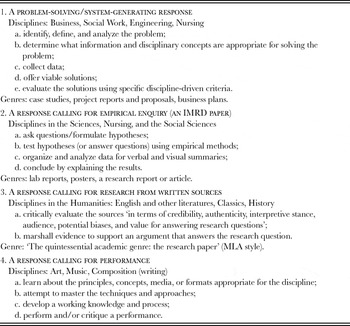
What, then, are our alternatives for a writing class or tutorials for novice academic students? Michael Carter, a writing-across-the-curriculum specialist, suggests that the ways in which academics organize and process disciplinary writing can be classified and clustered into four ‘macro-genres’ (Carter Reference Carter2007). Carter's taxonomy may provide for us a manageable framework for teaching general or basic academic literacies. Table 3 summarizes the four response types, the disciplines in which they appear, and the genres in which they are realized.
Disciplinary macro-genres (Carter Reference Carter2007).

What do we do with this contextualized taxonomy? If our purpose is to educate for a broad knowledge of academic disciplines, not just train for specific text types – and our principal goals are to enhance genre awareness and rhetorical flexibility, then this taxonomy gives us a framework. Given the Carter ‘macro-genres’, here are some thoughts about establishing a genre-based class for academic novices:
• Students need to understand that texts and assignments vary, according to discipline, classroom, instructor, and a variety of other factors. It is vital to explore the texts, and these factors, before writing a response or reading for an assignment.
• Thus, it is valuable for students to analyze, discuss, and even reproduce responses that are characteristic of a variety of disciplines, texts that represent ‘ways of knowing’, based upon the Carter scheme.
• In a genre-based class, students should be introduced to at least three of the ‘ways of knowing’. Genres based upon these ways could be analyzed, with actual examples provided.
• Students could then be required to produce at least two, and perhaps three, of these response types, found in the genres in which they are incorporated.
• At some point in the course, students could interview instructors in various disciplines about their response types, ideally by using the instructors' own writing.
• The language of texts should be taught in context, with special emphasis upon the elements that express the values of the discipline(s) (see Schleppergrell & Oliveira Reference Schleppergrell and Oliveira2006).
• Using the Carter scheme, students could frequently ask questions of texts and contexts therefore enabling them to become academic ethnographers (see Johns Reference Johns1997).
• They would also be asked to reflect upon their experiences with texts not only in classrooms but also in their other communities.
Will something like this work? Because this is a radical break from formulaic teaching of texts for genre acquisition, it is difficult to assist students to deal with ambiguity that this approach represents (Johns Reference Johns and Johns2002a). However, if they don't study textual variety and the disciplinary ideologies that infuse genres, they can, and do, fall on their faces when they attempt to read and produce texts in their classrooms.
Has this discovery of the Carter taxonomy ended the search? No, not at all. But we may be getting closer to developing an accessible framework for the novice student academic literacy class. It is my hope that readers of this paper will join me in continuing the search for ways in which our classrooms can assist students to become rhetorically flexible and genre aware.
Acknowledgements
I would like to thank the Kathleen Bardovi-Harlig, 2007 President of the American Association of Applied Linguistics, for inviting me to present this plenary, Graeme Porte for inviting me to submit the plenary, as a paper, to Language Teaching, and the anonymous reviewers for their useful comments.
Ann M. Johns is Professor Emerita of Linguistics and Writing Studies at San Diego State University, in California (USA), where she continues to teach classes for novice academic writers. She has published four books and more than 50 book chapters and articles on academic literacies and genre pedagogies, in addition to presenting plenaries and workshops in twenty countries. After completing a Senior Fulbright in South Africa (Spring 2007), she has devoted her time to curriculum and professional development for secondary teachers.