Autobiographical memory refers to the recollection of personal information involving both general knowledge about oneself (personal-semantics) and specific personal events related to the self (autobiographical-episodes) (Conway, Reference Conway2005). Personal-semantics cover general personal knowledge (e.g. “I was born in country X”). They also cover both extended events (e.g. “I spent a couple of years in country X”) and repeated events (e.g. “my summer vacations in country X”). Autobiographical-episodes refer to unique, specific time, and space events (e.g. “on my first day in country X, the airport was overcrowded and I was lost”) (Tulving, Reference Tulving2002). From this perspective, personal-semantics evidence awareness of general personal facts without contextual details, whereas autobiographical-episodes are believed to trigger the subjective reliving of previous personal events, a phenomenal state known as “autonoetic consciousness” (Tulving, Reference Tulving2002). Another feature of autobiographical-episodes is their relation to self-defining memories. Self-defining memories refer to events that are specific, vivid, affectively intense, and which include enduring concerns about oneself (e.g. “after being lost in the airport, I decided I’d never travel alone again”) (Singer et al., Reference Singer, Rexhaj and Baddeley2007). Although self-defining memories share common features with autobiographical-episodes, such as contextual specificity and phenomenological details, they differ in that they are highly relevant to personality processes (Singer et al., Reference Singer, Rexhaj and Baddeley2007). Self-defining memories are those of events associated with self-discovery, self-understanding, and self-images contributing to our life story and sense of identity (Blagov and Singer, Reference Blagov and Singer2004; Singer et al., Reference Singer, Rexhaj and Baddeley2007). Similar to their autobiographical counterparts (i.e. personal-semantics and autobiographical-episodes), self-defining memories seem to be influenced by AD.
AD appears to exert a negative effect on autobiographical components. Regarding personal-semantics, studies have highlighted the fact that, whereas general autobiographical knowledge can be relatively preserved in patients (Martinelli et al., Reference Martinelli, Anssens, Sperduti and Piolino2013), factual knowledge about one's personal past can be impaired (e.g. Addis and Tippett, Reference Addis and Tippett2004). Research has also showed a substantial shift from autobiographical-episodes to personal-semantics in AD, suggesting a transition from an experience of remembering to an experience of just knowing (e.g. Addis and Tippett, Reference Addis and Tippett2004; Martinelli et al., Reference Martinelli, Anssens, Sperduti and Piolino2013). Regarding self-defining memories, several studies have shown a relationship between autobiographical impairment and a weakened sense of self in AD (e.g. Addis and Tippett, Reference Addis and Tippett2004). More specifically, Martinelli et al. (Reference Martinelli, Anssens, Sperduti and Piolino2013) found that AD patients had difficulties retrieving self-defining memories, a pattern that was attributed to impairment in the reconstruction of autobiographical-episodes. Taken together, these results suggest that AD has a negative effect on several PS components, and to a greater extent, on autobiographical-episodes and self-defining memories as well.
This negative effect of AD on autobiographical memory may somehow be alleviated by exposure to music. In a pioneering study, Foster and Valentine (Reference Foster and Valentine2001) asked AD patients to complete an autobiographical adaptation of the Mini-Mental State Examination (MMSE, Folstein et al., Reference Folstein, Folstein and McHugh1975) while listening to Vivaldi's Four Seasons, unfamiliar music, cafeteria noise, or in silence. The participants’ autobiographical performance was significantly better in the sound conditions than in silence, and while listening to music than in the cafeteria noise. These findings were interpreted in terms of enhanced arousal. These outcomes were replicated by Irish et al. (Reference Irish2006), who assessed the Autobiographical Memory Interview on AD patients during exposure to Vivaldi's Four Seasons and in silence. Autobiographical recall was found to be significantly greater during exposure to music than in silence, a pattern that was related to a significant reduction in anxiety. The outcomes of Irish et al. (Reference Irish2006) were mirrored by those of several replication studies, which highlighted substantial autobiographical enhancement in AD patients exposed to self-chosen music (El Haj et al., Reference El Haj, Postal and Allain2012a, Reference El Haj, Fasotti and Allain2012b, Reference El Haj, Clément, Fasotti and Allain2013). These authors proposed several mechanisms to account for the positive effect of exposure to music on autobiographical recall in AD patients. For instance, El Haj et al. (Reference El Haj, Postal and Allain2012a) found that music-evoked autobiographical memories in AD patients contained more positive emotional words than those evoked in silence. Building on these findings, a replication study (El Haj et al., Reference El Haj, Fasotti and Allain2012b) found that music-evoked autobiographical memories in AD patients triggered more emotional content, had a greater impact on mood, were retrieved faster, and engaged less executive processes than memories evoked in silence; these features are characteristic of involuntary memories, or those autobiographical memories that pop up spontaneously (Berntsen et al., Reference Berntsen, Staugaard and Sørensen2013). Another account of music-evoked autobiographical memories was given by El Haj et al. (Reference El Haj, Clément, Fasotti and Allain2013), who found that these memories were characterized by fewer empty words, higher grammatical complexity, and propositional density than memories evoked in silence.
This collective body of empirical research suggests that exposure to music had a positive effect on autobiographical recall in AD patients. This pattern was attributed to arousal enhancement (Foster and Valentine, Reference Foster and Valentine2001), anxiety reduction (Irish et al., Reference Irish2006), emotional factors (El Haj et al., Reference El Haj, Postal and Allain2012a), involuntary recall (El Haj et al., Reference El Haj, Fasotti and Allain2012b), and verbal narration enhancement (El Haj et al., Reference El Haj, Clément, Fasotti and Allain2013). Although comprehensive, these accounts did not examine how exposure to music might influence the self, a crucial component of autobiographical memory in AD patients. Considering this issue, this study investigated whether exposure to music could stimulate the production of memories which contribute to self-discovery, self-understanding, and identity in AD patients.
A major characteristic of music-evoked autobiographical memories is their significance for the self. In the studies highlighting the reliable and positive effect of exposure to music on autobiographical recall, the music selection was made by the AD patients (El Haj et al., Reference El Haj, Postal and Allain2012a, Reference El Haj, Fasotti and Allain2012b, Reference El Haj, Clément, Fasotti and Allain2013). As a result, participants were likely to be inherently familiar with the music; it was probably intertwined with events that were significant to the patients’ self-images or self-beliefs. In other words, the music was possibly related to the patients’ self-defining memories. It is fair to assume, therefore, that exposure to self-chosen music was likely to trigger more self-defining memories than exposure to researcher-chosen music. To investigate this assumption, we tested the autobiographical recall of AD patients during exposure to their own-chosen music, to researcher-chosen music, and in silence. We expected AD patients would produce more self-defining memories during exposure to their own-chosen music than during exposure to researcher-chosen music or in silence.
Methods
Participants
We tested 22 participants with a clinical diagnosis of probable mild AD (16 women and 6 men; M age = 71.73 years, SD = 6.99; M years of formal education = 8.64, SD = 2.73) and 24 healthy controls (16 women and 8 men; M age = 72.88 years, SD = 7.34; M years of formal education = 9.92, SD = 2.99). AD participants were recruited from local retirement homes. The diagnosis of probable AD was made by an experienced neurologist or geriatrician according to the criteria developed by the National Institute on Aging-Alzheimer's Association clinical criteria (McKhann et al., Reference McKhann2011). Patients with mild AD were included as the later stages of the disease are associated with profound memory impairment. The healthy controls came from the local community or were spouses of AD patients; they were independent and living at home. They were matched with the AD patients according to age [t(44) = 0.54, p > 0.10], sex [X 2 (1, N = 46) = 0.20, p > 0.10], and educational level [t(44) = 1.51, p > 0.10].
The participants presented no major visual or auditory acuity disability that could prevent the completion of procedures. Exclusion criteria were: significant psychiatric or neurological illness, history of clinical depression, and alcohol or drug use. All participants freely consented to participate in the study and were able to drop out of it whenever they wished. Of the 36 AD participants originally recruited, four dropped out because of health problems and three others because of personal reasons; three participants were excluded for auditory deficiencies preventing the processing of music and two others for aphasic deficiencies preventing communication; the data related to two other participants were corrupted. Of the 28 healthy controls originally recruited, four were excluded for severe executive dysfunction (which raised neuropsychological profile questions). This decision was made on the basis of the comprehensive neuropsychological battery of tests detailed below.
Neuropsychological and clinical characteristics
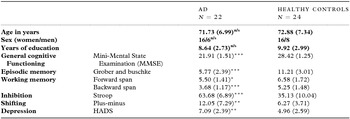
Neuropsychological functioning was evaluated for all participants with a battery-tapping general cognitive functioning, episodic memory, working memory, inhibition, shifting, and depression. General cognitive functioning was assessed with the MMSE using a total score of 30 points. Episodic memory was assessed with the episodic task of Grober and Buschke (Reference Grober and Buschke1987); the participants were presented with the names of 16 items, each belonging to a different semantic category. After immediate cued recall, the participants proceeded to a 20-sec distraction phase in which they had to count backwards from 374. This phase was immediately followed by a 2-minute free recall. The score for this phase was retained as episodic recall/16. For the working memory assessment, participants had to repeat a string of single digits in the same order (i.e. forward spans) or in the inverse order (i.e. backward spans). Inhibition was assessed with the Stroop task, and the score referred to the completion time for the interference condition minus the average completion time for word-reading and color-naming. Shifting was assessed with the Plus-Minus Task, and the score referred to the difference between the time for List 3 (shifting between addition and subtraction) and the average times for List 1 (addition list) and List 2 (subtraction list) (for more details about the neuropsychological assessment, see El Haj et al., Reference El Haj, Moroni, Luyat, Omigie and Allain2014). To assess depression, the Hospital Anxiety and Depression Scale (HADS, Zigmond, and Snaith, Reference Zigmond and Snaith1983) was administered. In this evaluation, participants had to rate seven items on a four-point scale from zero (not present) to three (considerable). The cut-off for definite depression was set at > 11/21 points. All neuropsychological and clinical scores are summarized in Table 1.
Demographic, neuropsychological and clinical characteristics of Alzheimer's Disease (AD) patients and healthy controls

Note. Standard deviations are given between brackets; the maximum MMSE score was 30 points; the maximum Grober and Buschke (Reference Grober and Buschke1987) task score was 16 points; forward and backward span performances were assessed using the number of correctly repeated digits; Stroop and Plus-Minus task scores referred to reaction time; the HADS (Hospital Anxiety and Depression Scale) cutoff was > 11/21 points; the difference with the following group was significant at: * p < 0.05,**p < 0.01, ***p < 0.001; n/s the difference with the following group was no significant.
Materials
Autobiographical recall was tested during exposure to (1) self-chosen music, (2) researcher-chosen music, and (3) in silence. Self-chosen music was defined prior to the experiment as the participants’ favorite music, regardless of style (e.g. genre, vocal/instrumental, with/without lyrics, etc.). Four AD patients were unable to express their preference for a favorite song or tune; the choice was therefore left to their relatives. Among these participants, three were able to name a favorite artist matching the choice made by their relatives, thereby confirming the reliability of the information provided about their favorite music. The selections of both AD patients and control participants included a wide variety of styles (e.g. rock, folk, jazz, etc.). However, in 18 AD patients and 19 healthy controls, self-chosen music included French popular songs. Hence, we used similar criteria for researcher-chosen music. Specifically, the French song la Bohème, performed and composed by Charles Aznavour, written by Jacques Plante and lasting 4 minutes and 5 sec, was selected on the basis of its considerable popularity with French-speaking AD patients (Basaglia-Pappas et al., Reference Basaglia-Pappas, Laterza, Borg, Richard-Mornas, Favre and Thomas-Anterion2013).
Music was played ambiently on an Apple iPhone®, using a compatible portable speaker. Because the experiment was performed in various places (i.e. participants’ homes or rooms in retirement homes) with various acoustical characteristics, the volume level was adjusted during each session. The experimenter was careful to lead the session in a quiet place where the music would be played at 60–70 decibels; this setup created an acoustical background allowing the music to be audible, yet not so loud as to prevent or disrupt communication between the experimenter and the participant.
Procedures
The participants were tested individually in three sessions: first, during exposure to self-chosen music; second, during exposure to researcher-chosen music; and finally, in silence. The sessions were counterbalanced and separated by approximately one week. To prevent research bias, participants were only informed that they were taking part in a study assessing executive performance. They were told they were taking part in chatting sessions, which were held in silence or with background music. In these sessions, participants were asked to “recount, in detail, an event in your (their) life.” This simple instruction is widely used to cue autobiographical recall in AD patients (El Haj et al., Reference El Haj, Postal and Allain2012a, Reference El Haj, Fasotti and Allain2012b, Reference El Haj, Clément, Fasotti and Allain2013). The participants were given 3 minutes to describe their memories; this time limit was made clear so participants could structure their memories accordingly and to the best of their ability. It was also used to avoid bias, such as redundancy or distractibility. This 3-minute limit has been found to be amply sufficient for autobiographical recollection in AD patients (El Haj et al., Reference El Haj, Postal and Allain2012a, Reference El Haj, Fasotti and Allain2012b, Reference El Haj, Clément, Fasotti and Allain2013).
Scoring of autobiographical recall
Autobiographical recall was scored using an adaptation of the TEMPau scale (Test Episodique de Mémoire du Passé, Piolino et al., Reference Piolino2006, Reference Piolino2007). This scale, ranging from zero to four points, allows a comprehensive evaluation of the specificity of an autobiographical event (single or repeated event), its spatiotemporal situation, and the presence of phenomenological details (perceptions, thoughts, feelings). We hence attributed, for each memory, no point (zero) was given if the participant was unable to produce any memory or give any general information about a theme (e.g. when I was a child); one point was given for the production of a memory of a repeated or extended event (e.g. I used to go to the market with my parents); two points were given if the event recalled was situated in time and/or in space (e.g. I used to go to the market with my father on Sundays to buy milk); three points were given if the event recalled was specific, lasting less than 24 hours, and situated in time and space (e.g. once, I broke the milk bottle in the market); finally, four points were attributed to the memory if the event recalled was specific, situated in time and space, and included internal sensory-perceptual-affective details (e.g. my father got angry). Since the TEMPau scale does not take into account assessment of self-defining memories, we extended this scale by attributing five points if the event was not only specific, situated in time and space with phenomenological details, but also if the event contributed to the way the participant saw herself or himself, and/or if the event was related to personality construction, concerns, or unresolved conflicts (e.g. I did not understand why my father had gotten angry until I got older myself and saw how difficult raising a child is) (for a similar scoring of self-defining memories, see Martinelli et al., Reference Martinelli, Anssens, Sperduti and Piolino2013).
The TEMPau scale, as adapted to our study, allowed us to obtain a general score for autobiographical recall ranging from zero to five points; it also allowed us to split recall into the three autobiographical components (i.e. personal-semantics, autobiographical-episodes, and self-defining memories. Personal-semantics fell in the zero-two point range, autobiographical-episodes in the three-four point range, and self-defining memories were assigned a five-point score. Based on this categorization, we were able to calculate the percentage of personal-semantics, autobiographical-episodes, and self-defining memories for each participant by dividing the number of total recalls by the number of autobiographical categories. For instance, the two memories evoked by an AD patient in silence and during exposure to researcher-chosen music were categorized as personal-semantics, and the memory evoked by the same patient during exposure to her own-chosen music was categorized as a self-defining memory. Therefore, the percentage of each autobiographical category for this participant was: personal-semantics = 66.67%, autobiographical-episodes = 0.00%, and self-defining memories = 33.33%.
To prevent scoring bias, events were rated and categorized by an independent psychologist who was blind to the hypotheses. Using Cohen's Kappa coefficient (κ) (Brennan and Prediger, Reference Brennan and Prediger1981), a high inter-rater agreement coefficient was obtained (personal-semantics: K = 0.89, autobiographical-episodes: K = 0.82 and self-defining memories: K = 0.91). Disagreements were discussed until a consensus was reached.
Results
Statistical analysis
The normal distribution of the data was assessed using (1) χ 2 tests for autobiographical performances, as evaluated in each experimental condition (i.e. silence, researcher-chosen music, and self-chosen music) with the TEMPau scale (ordinal variable), and (2) Kolmogorov–Smirnov tests for the percentage of each autobiographical category (i.e. personal-semantics, autobiographical-episodes, and self-defining memories) in each experimental condition. Both statistical tests showed that the distribution of all the variables was significantly different from a normal distribution, a pattern that was also observed in each population. Therefore, non-parametric tests were used. For autobiographical performances, (1) Friedman tests were applied to investigate differences across the three conditions, (2) post-hoc pairwise comparisons were made with Wilcoxon tests, and (3) Mann–Whitney's U-tests were used to investigate differences between the two populations across the three experimental conditions. For the three autobiographical categories, Friedman tests were used to compare percentages across the three conditions in each population (i.e. AD and healthy controls). The same tool also served to investigate differences between (1) percentages of the three autobiographical categories for each condition, and (2) percentages of each autobiographical category across the three conditions. When the latter were found to be significant, post-hoc pairwise comparisons were made with Wilcoxon tests. Finally, the percentages of each autobiographical category were compared for AD patients and healthy controls in each condition with Mann–Whitney's U-tests (e.g. differences between personal-semantics, as evoked by each population in silence). For all tests, the level of significance was set at p < 0.05; when p was between 0.05 and 0.10, we labeled this as a trend.
Similar autobiographical recall in AD patients and healthy controls during exposure to self-chosen music
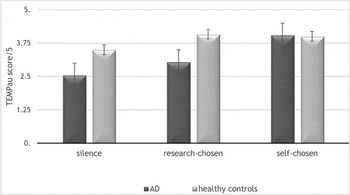
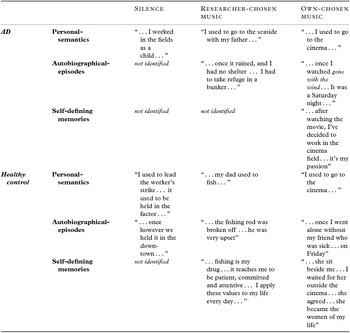
Autobiographical performances are shown in Figure 1. Quotes of the autobiographical recall for personal-semantics, autobiographical-episodes, and self-defining memories are illustrated in Table 2. For all participants, Friedman tests highlighted a trend toward differences between autobiographical scores across the three experimental conditions [χ 2(2, N = 46) = 5.79, p = 0.055]. Post-hoc pairwise comparisons with Wilcoxon tests showed a trend toward greater autobiographical recall during exposure to self-chosen music (M = 4.02, SD = 1.31) than to researcher-chosen music (M = 3.59, SD = 1.42) (Z = −1.75, p = 0.080). Wilcoxon tests also showed greater autobiographical recall during exposure to researcher-chosen music than in silence (M = 3.04, SD = 1.15) (Z = −2.72, p < 0.01), and during exposure to self-chosen music than in silence (Z = −3.44, p = 0.001). AD patients demonstrated greater autobiographical recall during exposure to their own-chosen music than to researcher-chosen music (Z = −2.44, p < 0.05), during exposure to researcher-chosen music than in silence (Z = −2.01, p < 0.05), and during exposure to their own-chosen music than in silence (Z = −3.06, p < 0.01). Healthy controls performed better (i.e. demonstrated greater autobiographical recall) during exposure to researcher-chosen music than in silence (Z = −2.04, p < 0.05). However, for those participants, no significant differences in performance were detected between exposure to self-chosen music and researcher-chosen music (Z = −0.41, p > 0.10) or silence (Z = −1.62, p > 0.10).
Autobiographical performances of Alzheimer's Disease (AD) patients and healthy controls in silence, during exposure to researcher-chosen music and to their own-chosen music.

Quotes of the autobiographical recall for an Alzheimer's Disease (AD) patient and a healthy control participants in silence and during exposure to researcher-chosen music and to his own-chosen music

Mann–Whitney's U-tests evidenced poorer autobiographical performances in AD patients than in healthy controls during silence, (Z = −2.11, p < 0.05), and during exposure to researcher-chosen music, (Z = −2.49, p < 0.01). However, no significant differences were detected between AD patients and healthy controls during exposure to self-chosen music (Z = −0.44, p > 0.10). In other words, despite their poor autobiographical recall in silence and during exposure to researcher-chosen music, AD patients performed at the same level as healthy controls during exposure to self-chosen music.
Higher percentage of self-defining memories than autobiographical-episodes or personal-semantics during exposure to self-chosen music in AD patients
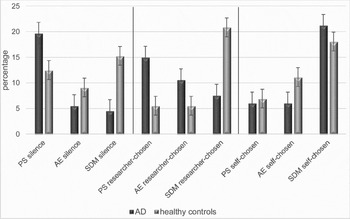
Figure 2 shows the percentages of each autobiographical category (i.e. personal-semantics, autobiographical-episodes, and self-defining memories) in each experimental condition (i.e. silence, researcher-chosen music, and self-chosen music). In AD patients, Friedman tests showed significant differences between the percentages of the three autobiographical categories across the three conditions [χ 2(8, N = 22) = 23.69, p < 0.01]. The same test also showed significant differences between the three autobiographical categories in silence [χ 2 (2, N = 22) = 7.17, p < 0.05]. Post-hoc comparisons showed neither significant differences between personal-semantics and autobiographical-episodes (Z = −1.47, p > 0.10), nor significant differences between autobiographical-episodes and self-defining memories in silence (Z = −1.00, p > 0.10); however, personal-semantics were significantly higher than self-defining memories in silence (Z = −2.35, p < 0.05). For memories evoked during exposure to researcher-chosen music, no significant differences were observed between the three autobiographical categories [χ 2 (2, N = 22) = 1.73, p > 0.10]. For memories evoked during self-chosen music, significant differences were observed between the three autobiographical categories [χ 2 (2, N = 22) = 9.09, p < 0.05]. Post-hoc comparisons showed no significant differences between personal-semantics and autobiographical-episodes (Z = 0.00, p > 0.10); however, self-defining memories were significantly higher than autobiographical-episodes (Z = −2.36, p < 0.05) and personal-semantics (Z = −2.36, p < 0.05). In other words, when exposed to their own-chosen music, AD patients produced more self-defining memories than autobiographical-episodes or personal-semantics.
Percentage of each autobiographical category (personal-semantics [PS], autobiographical-episodes [AE], and self-defining memories [SDM]) in each experimental condition (in silence, during exposure to researcher-chosen music, and during exposure to self-chosen music) in Alzheimer's Disease (AD) patients and healthy controls.

Higher percentage of self-defining memories during exposure to self-chosen music than to other conditions in AD patients
When comparing the percentage of each autobiographical category across the three conditions, significant differences were observed for personal-semantics [χ 2 (2, N = 22) = 11.45, p < 0.01]. Post-hoc comparisons revealed no significant differences between personal-semantics evoked in silence and those evoked during exposure to researcher-chosen music (Z = −1.13, p > 0.10); however, the percentages memories evoked in the latter condition were significantly higher than those of memories evoked during exposure to self-chosen music (Z = −2.44, p < 0.05); the percentages of memories evoked in silence were also significantly higher than those of memories evoked during exposure to self-chosen music (Z = −2.57, p < 0.05). For autobiographical-episodes, no significant differences were detected across the three conditions [χ 2 (2, N = 22) = 2.80, p > 0.10]. For self-defining memories, significant differences were detected across the three conditions [χ 2 (2, N = 22) = 18.72, p < 0.001]. Post-hoc comparisons revealed no significant differences between self-defining memories evoked in silence and those evoked during exposure to researcher-chosen music (Z = −1.41, p > 0.10); however, the percentages of memories evoked during exposure to self-chosen music were significantly higher than those of memories evoked during exposure to researcher-chosen music (Z = −3.00, p < 0.01), or in silence (Z = −3.32, p = 0.001). Therefore, AD patients produced more self-defining memories when exposed to their own-chosen music than when exposed to researcher-chosen music or in silence.
Similar production of personal-semantics, autobiographical-episodes, and self-defining memories in healthy controls during exposure to self-chosen music
In healthy controls, significant percentage differences were observed between the three autobiographical categories (i.e. personal-semantics, autobiographical-episodes, and self-defining memories) across the three conditions (i.e. silence, researcher-chosen music, and self-chosen music), [χ 2 (8, N = 24) = 23.38, p < 0.01]. The same tests revealed no significant differences between the three autobiographical categories in silence [χ 2 (2, N = 24) = 3.25, p > 0.10]. For memories evoked during exposure to researcher-chosen music, significant differences were observed between the three autobiographical categories [χ 2 (2, N = 24) = 10.52, p < 0.01]. Post-hoc comparisons revealed no significant differences between personal-semantics and autobiographical-episodes (Z = 0.00, p > 0.10); however, self-defining memories were significantly higher than autobiographical-episodes (Z = −2.52, p < 0.05), or personal-semantics (Z = −2.52, p < 0.05). For memories evoked during self-chosen music, no significant differences were detected between the three autobiographical categories [χ 2 (2, N = 24) = 4.08, p > 0.10]. Therefore, when exposed to their own-chosen music, healthy controls performed similarly across the three autobiographical categories.
Similar production of self-defining memories in healthy controls across the three conditions
When comparing the percentages of each autobiographical category across the three conditions, no significant differences were observed between personal-semantics [χ 2 (2, N = 24) = 4.67, p > 0.10] and autobiographical-episodes [χ 2 (2, N = 24) = 4.00, p > 0.10] or self-defining memories [χ 2 (2, N = 24) = 2.40, p > 0.10]. Hence, no significant enhancement of self-defining memories was observed in healthy controls across the three conditions.
Similar production of self-defining memories in AD patients and healthy controls during exposure to self-chosen music
We also compared the percentages of each autobiographical category between AD patients and healthy controls using Mann–Whitney's U- tests. No significant differences were detected for personal-semantics evoked in silence (Z = −1.32, p > 0.10) or those evoked during exposure to self-chosen music (Z = −0.86, p > 0.10); however, memories evoked during exposure to researcher-chosen music were significantly higher in AD patients than in healthy controls (Z = −2.09, p < 0.05). As regards autobiographical-episodes, no significant differences were detected between the two populations in silence (Z = −0.86, p > 0.10), or during exposure to researcher-chosen music (Z = −1.19, p > 0.10), or self-chosen music (Z = −1.16, p > 0.10). For self-defining memories, AD patients produced fewer memories than healthy controls in silence (Z = −2.34, p < 0.05) and during exposure to researcher-chosen music (Z = −2.34, p < 0.05); however, no significant differences were observed during exposure to self-chosen music (Z = −0.64, p > 0.10). Therefore, AD patients produced fewer self-defining memories than healthy controls in silence and during exposure to researcher-chosen music, a pattern that was reversed during exposure to their own-chosen music.
Discussion
In the literature, exposure to self-chosen music has been shown to enhance autobiographical recall in AD patients (El Haj et al., Reference El Haj, Postal and Allain2012a, Reference El Haj, Fasotti and Allain2012b, Reference El Haj, Clément, Fasotti and Allain2013). Our study aimed to interpret this effect in terms of improvement of self-defining memories production. As expected, AD patients produced more self-defining memories when exposed to their own-chosen music than when exposed to researcher-chosen music or in silence. These patients also produced fewer self-defining memories than personal-semantics or autobiographical-episodes in silence, and no significant differences were observed between these autobiographical categories during exposure to researcher-chosen music. However, exposure to self-chosen music induced more self-defining memories than autobiographical-episodes or personal-semantics. In other words, the poor production of self-defining memories, as observed in AD patients during silence, was significantly reversed during exposure to their own-chosen music.
AD affects autobiographical memory in several ways. AD patients tend to show poorer autobiographical recall than healthy controls (e.g. Addis and Tippett, Reference Addis and Tippett2004; Martinelli et al., Reference Martinelli, Anssens, Sperduti and Piolino2013). This pattern corroborates our data, which evidences poorer autobiographical recall in AD participants than in healthy controls in silence. Another effect of AD is autobiographical semanticization, or the substantial shift from autobiographical-episodes to personal-semantics over the course of the disease (Addis and Tippett, Reference Addis and Tippett2004; Martinelli et al., Reference Martinelli, Anssens, Sperduti and Piolino2013). This phenomenon was illustrated by the higher production of personal-semantics than autobiographical-episodes by our AD participants in silence. The effect of AD on autobiographical recall can also be observed with the decrease in self-defining memories; indeed, these memories require a high level of specificity (Martinelli et al., Reference Martinelli, Anssens, Sperduti and Piolino2013). Since self-defining memories are also believed to play a pivotal role in the emergence of one's identity and life story (Blagov and Singer, Reference Blagov and Singer2004), this effect may contribute to the loss of the sense of identity in these patients. Without self-defining memories, AD patients may experience the loss of memories of when they felt vital, competent, and worthy; memories that defined their identity and reminded the family of the person they once were. Without self-defining memories, AD patients may also be deprived of the ability to share their life story; telling one's story is considered an essential part of identity in healthy controls (Butler, Reference Butler1963). Taken together, these assumptions illustrate how AD patients may be prone to self-defining memories loss and its consequences, and how this deterioration may somehow be mitigated with exposure to self-chosen music.
Our AD participants produced more personal-semantics than autobiographical-episodes or self-defining memories in silence. These findings mirror those of the literature on this topic (Addis and Tippett, Reference Addis and Tippett2004; Martinelli et al., Reference Martinelli, Anssens, Sperduti and Piolino2013). Similar to poor autobiographical recall, this pattern was significantly reversed when AD patients were exposed to their own-chosen music. Indeed, this condition caused AD patients to produce more self-defining memories than autobiographical-episodes or personal-semantics, and simply more self-defining memories than did exposure to researcher-chosen music or silence. Because autobiographical recall was classified into one of three exclusive categories (i.e. personal-semantics, autobiographical-episodes, or self-defining memories), increasing of self-defining memories in AD patients in the self-chosen condition resulted in subsequent decrease in personal-semantics and autobiographical-episodes. More interestingly, when AD participants were exposed to their own-chosen music, they produced a number of self-defining memories similar to that of healthy controls. All these outcomes suggest that exposure to self-chosen music has a positive effect on self-defining memories in AD patients. This effect can be explained by several mechanisms. First, the active involvement of AD patients in the selection of their favorite music might have enhanced their cooperation and participation in the chatting session (which aimed to elicit autobiographical recall). Accordingly, environments promoting active involvement are found to produce positive effects on the behavior and mood of AD patients (Sanchez et al., Reference Sanchez, Millan-Calenti, Lorenzo-Lopez and Maseda2013). More precisely, active involvement may enhance memory performance in AD. For instance, in a study evaluating source memory (El Haj et al., Reference El Haj, Fasotti and Allain2012c), AD patients had to actively manipulate items or passively observe the experimenter doing so. Better source recall was observed in the active condition than in the passive one. In our study, AD participants might have felt more involved when exposed to their own-chosen music than to researcher-chosen music or in silence. By promoting this sense of involvement, exposure to self-chosen music might have enhanced the self-esteem of AD patients, and consequently, helped them generate positive feelings about memories of achievements, successes, or even failures.
Another account for the relationship between exposure to self-chosen music and self-defining memories enhancement in AD patients is the significance of the music selection. Since the selection is made by the participants, the music is likely to convey personal meaning or emotional value, promoting memories of crucial moments of their lives. Fitting with this assumption, familiar music has been found to promote more intense emotions, especially positive emotions, than randomly selected music in younger and middle-aged adults (Liljeström et al., Reference Liljeström, Juslin and Västfjäll2013). Empirical research on AD patients has shown that self-chosen music can trigger a substantial emotional reaction (El Haj et al., Reference El Haj, Postal and Allain2012a). The affective value of chosen music may also stem from another process. Because it was selected by the participants, the music might have been directly intertwined with self-defining memories: listening to it thus served as a retrieval cue. This assumption illustrates the encoding specificity principle, which postulates that encoding and retrieval conditions must be coordinated to maximally enhance memory (Thomson and Tulving, Reference Thomson and Tulving1970). The encoding specificity principle was found to be effective in younger adults exposed to music. Smith (Reference Smith1985) presented subjects with words in silence or while listening to music and found superior recall due to music reinstatement. Building on these findings, several replication studies evidenced better episodic recall when reinstated music was played at the same tempo/key than when it was played at another tempo/key (Mead and Ball, Reference Mead and Ball2007). Although it offers an interesting explanation, the cuing account should be interpreted with caution; indeed, we have no solid evidence that the chosen music was present during the encoding of the self-defining memories evoked by our participants.
The control participants did not demonstrate the same self-defining memories enhancement as that of AD patients when exposed to self-chosen music. Indeed, while listening to self-chosen music, the control participants showed no significant differences between self-defining memories and personal-semantics, or autobiographical-episodes. Furthermore, the controls showed no significant differences in self-defining memories production across the three experimental conditions. This apparent paradox can be overcome by shedding light on the nature of self-defining memories production in healthy controls. Singer et al. (Reference Singer, Rexhaj and Baddeley2007) compared the self-defining memories of healthy controls to those of college students. Although the students produced more summarized and less detailed self-defining memories, they did not have any particular difficulties retrieving these events. In light of these outcomes, Martinelli et al. (Reference Martinelli, Anssens, Sperduti and Piolino2013) found that healthy controls produced more episodic self-defining memories than younger adults did. This pattern indicates that older people (and younger adults) can retrieve specific autobiographical memories when these memories are highly self-relevant (for a similar view, see, Singer et al., Reference Singer, Rexhaj and Baddeley2007). Therefore, our healthy controls’ performance is not entirely a surprise: although they showed robust self-defining memories production, they did not exhibit the same sensitivity to self-chosen music as AD patients.
Conclusion, limitations, and prospects for future research
Our study suggests that autobiographical recall is enhanced in AD patients when they are exposed to their own-chosen music. This finding should be considered by clinicians and caregiving professionals interested in memory rehabilitation in AD. However, our data should be interpreted with caution because they pertain to a small number of institutionalized AD patients and because we did not correct for multiple comparisons. It is also worth noting that these self-defining memories, elicited during exposure to self-chosen music, were produced by AD patients at a mild stage of the disease; individuals in this specific population are likely to retrieve memories that are highly meaningful and relevant to their life story. Thus, before generalizing our results, future studies should attempt to replicate the effect of exposure to self-chosen music on life schemas or life periods, rather than on single memories. Future research may also use music-evoked self-defining memories as potential cues to recover other associated memories, which may constitute key identity enhancement factors in AD patients.
Conflict of interest
Dr El Haj and Dr Antoine were supported by the LABEX (excellence laboratory, program investment for the future) DISTALZ (Development of Innovative Strategies for a Transdisciplinary approach to Alzheimer disease). The LABEX did not directly shape the study objective, collection, analysis, or interpretation of data, writing the article, or the decision to submit the article for publication.
Description of authors’ roles
M. El Haj collected the data and wrote the paper. P. Antoine, JL Nandrino, and MC. Gély-Nargeot supervised the collection, compilation, and analysis of the data. S. Raffard supervised the collection of the data and assisted with writing the article.
Acknowledgments
The authors would like to thank Syl Billere for his careful reading of the manuscript.