Introduction
By the beginning of the nineteenth century, the capitalist economy was firmly entrenched worldwide. Overseas colonies produced raw materials that were transformed into higher value goods in the factories and workshops of Europe and North America. With the aid of new technologies, these products were then quickly transported to consumers across the globe, a development that rapidly led to the integration of local markets within national and international systems of exchange.Footnote 1 The aim of this article is to examine the value of ‘rubbish dump’Footnote 2 archives for assessing the place of rural households in a globalised world system. This will be achieved by mapping the global commodity networks of four rubbish dumps excavated in East Anglia. It is not our intention to present a definitive examination of rural market access at the turn of the twentieth century. Instead, this study will emphasise the research opportunities offered by rubbish dumps for exploring the global geography of consumption in the modern era. Although some researchers have mapped commodity networks on a community level,Footnote 3 there has, to the authors’ knowledge, been no real attempt to recreate global commodity networks for individual rural households. It is hoped that this article will help pave the way for studies of this sort.
Research undertaken by geographers in the past has focused on the production and manufacture of goods on a national scale and, specifically, on the ‘commodity flow’ (of goods) between manufacturer and consumer.Footnote 4 The models developed in this research offer insights into the abilities of consumers to access certain manufactured goods. Archaeological analysis inverts this approach. During the excavation of a rubbish dump, archaeologists are observing processes of waste that are the end result of consumerism. By identifying the producer of the artefacts recovered, or in the case of discarded packaging, the producer of the contents, a researcher can trace them back to temporal and geographical points of origin. Despite the distorting effects of selective disposal practices and material degradation on the archaeological data, it is possible to observe consumer choices and the broad patterns of commodity flow.Footnote 5
Once a rubbish dump has been excavated, a market access analysis of the archive of artefacts, or assumed contents of waste packaging in that archive, can be undertaken. Studies of this nature allow scholars to examine product choice in the context of supply and demand interactions and to analyse consumer decisions in relation to the distribution of goods along known or posited transportation networks. To undertake a market access analysis profitably, the artefact archive must be examined intensively to identify the manufacturer and contents of a container, which may have different footprints. The ginger beer manufacturers William and Thomas Bagge, for example, produced and sold ginger beer in King's Lynn in Norfolk, but ordered their retail bottles from Doulton of Lambeth and, later, from Bourne of Denby, Derbyshire.Footnote 6 In instances of this sort, the container will have travelled a greater distance to reach the consumer than the contents (leaving aside the fact that such containers might also have been reused a number of times prior to deposition). As well as establishing the points of origin, it is important to establish temporal data for the artefact assemblage.Footnote 7 Market access studies in the past have been undertaken on community rubbish dumps, but a major disadvantage of these is the refinement of the data. Private rubbish dumps of the sort often found in the grounds of individual rural households provide a greater level of refinement, in that the artefacts can be linked not only to a local community but to a single household and, in some cases, even to a known individual.
Archaeological excavation of nineteenth- and twentieth-century households is not a new field of research.Footnote 8 Earlier studies, however, have seldom chosen to undertake market access studies of the artefact assemblages. By mapping the origins of artefacts excavated from rubbish dumps associated with four rural households in East Anglia, the authors of the present paper demonstrate how individuals and localised networks of exchange can be linked into the global capitalist system, and how analysis of their consumer choices, set within this context, increase the scope for micro- and macro-historical research.
The sites
Because many rural areas, in the nineteenth and early twentieth centuries, had no organised waste collection, individual households often had to make their own arrangements by tipping refuse into pits or ditches within the boundaries of their property. Rubbish dumps of this sort survive all across the country and can be found with careful searching. Typically they contain the remnants of glass, ceramic and metal packaging, sometimes in layers of ash from domestic fires, where no effort has been made to separate ash, dry refuse and organic matter. Dumps that contain packaging artefacts in large quantities lend themselves well to market access analysis, but not all do. Those, for example, which contain only utilitarian ceramics, building rubble, or ash, or those that contain items discarded on one occasion (clearance deposits), which typically contain higher numbers of items that have not been discarded immediately after the point of consumption, are of less value in this exercise.
The four rubbish dumps discussed in this article were excavated as part of a wider community engagement project run by the School of History at the University of East Anglia in 2015–16 called ‘What East Anglia Threw Away’. These sites, Hempstead and Holme Hale Hall in Norfolk and Kirton and Falkenham in Suffolk, range from the 1890s to the 1920s and represent households of varying status.Footnote 9 They were not chosen because they are typical or atypical of households of their class and date, but because the large numbers of packaging artefacts contained within them made them suitable for a study that is intended to show the value of such dumps for connecting the rural to the global. The following section briefly discusses the location and history of the four households concerned.
Hempstead is a village located on fertile farmland north of the Norfolk Broads, 30 km to the north-east of Norwich and 6.4 km north-east of Stalham. The population in 1891 was 157, and the chief crops at that time were wheat, oats and barley. Just off the main road, is a Georgian rectory, which was expanded during the Victorian era. Now a private residence, the former rectory, annexed to that of nearby Lessingham, was valued at £500 gross yearly and £340 net, and was in the gift of King's College, Cambridge. Between 1895 and 1904, the rector of Hempstead was Reverend John Francis Kendall, MA, of King's College. At the time of the census in 1901, the household consisted of Kendall, his wife Julia, their six-year-old daughter Evelyn, two female teenage domestic servants and two Cambridge undergraduates, lodging over the Easter break and being tutored by Kendall. In the early 1890s, a brick-built privy with cesspit stood to one side of the rectory. In late December 2012, this cesspit was excavated by Tom Licence and Ben Ross and found to contain a quantity of rubbish deposited by the Kendalls in 1895–6.Footnote 10 It is assumed that the contents represented items, such as old sets of crockery, cleared out of the rectory shortly after the Kendalls’ arrival and mixed with domestic waste being generated at that time. The archive of artefacts excavated from this brick lined earth closet indicated that the cesspit was infilled shortly after the Kendalls arrived at the rectory in 1895.Footnote 11
Kirton, which lies 11 km south-west of Ipswich, is a small rural village in south Suffolk. The rectory is situated next to the fourteenth-century church of St Mary and St Martin's. A pond was recorded on the 1881 1st Edition County Series 1:2500 OS map at the bottom of the rectory garden. By the time of the publication, in 1904, of the 1st Revision County Series 1:2500 OS map, this feature had disappeared. In January 2016, the site was excavated by a group of volunteers, including members of the Suffolk Archaeological Field Group, villagers, and students from the University of East Anglia under the direction of Tom Licence. It was determined that the pond had been filled with domestic rubbish generated by the rector's household during the 1900s. The latest item was a ginger beer bottle dated 1906 by the pottery mark (‘Bourne, Denby, 06’).
The rector there between 1876 and 1916, and therefore at the time the pond was filled in, was Reverend Walter Parry Davies, a Welshman originally from Denbighshire. According to census returns, he maintained a large household, including – like Kendall – visiting scholars whom he would have tutored for entry to Oxford or Cambridge. In 1901, Davies headed a household of sixteen, which included his wife and three adult offspring, a visitor, seven pupils aged between sixteen and eighteen, and two female domestic servants, both in their late teens.Footnote 12
Situated 1 km to the south-west of Kirton is the small village of Falkenham, where, in March 2015, in the grounds of a farmhouse, Tom Lucking of the University of East Anglia identified a layer of buried refuse, lately exposed by the erosion of the bank of a large pond. Lucking and Licence excavated a trench and discovered that the refuse had been buried in the bottom of a disused coprolite quarry, then capped with sand and clay at a depth of 1.22 m. The pond had been created at a later date. The composition of the refuse deposit enabled it to be dated to the late 1900s. In 1899, John Everett, the owner of the farmhouse, died at the age of sixty-one. Mary, his widow, inherited the property and on her death in 1908 left the farm to her two unmarried daughters. The artefacts discarded in the pond can be linked to the death of Mary. It is assumed that the assemblage was created when her daughters cleared out their mother's accumulated possessions and other domestic waste generated at that time.
The last of the four case studies is located 1.2 km to the north-east of Holme Hale in central Norfolk. Situated to the east of the village is Holme Hale Hall. On the 1906 1st Revision County Series 1:2500 map, a saw pit is shown near the back of the house. By the publication of the 2nd Revision County Series 1:2500 map in 1928, this feature had disappeared. When the pit was excavated in May 2016 by Licence, Lucking and Gregory, a large quantity of rubbish dating to the early 1920s was found to have been tipped in, on one side, over soil that had slumped into the disused pit. During the nineteenth century, the hall was the family home of the Adlingtons.Footnote 13 On the death of Emma Jean Adlington in 1914,Footnote 14 her daughter, Mary Campbell, and her husband, Horatio George Broke, moved into the hall.Footnote 15 Fragments of armorial china found amid the rubbish linked it to the Adlington/Broke family, who were still living at the hall when the rubbish was discarded.
Methodology
After the location of the rubbish dumps had been determined by map regression, fieldwalking, vegetation and topographical analysis, the authors adopted an established methodological approach for digging historic rubbish dumps.Footnote 16 At each site, a 2 m x 2 m trench was excavated under the direction of Licence: once the turfs had been removed, the deposits were excavated in 0.1 m spits.Footnote 17 Each spit was screened through a 4 mm dry sieve on site to aid recovery, prior to the material being quantified using a Minimum Number of Individuals (MNI) count.Footnote 18 To aid this analysis, large assemblages were divided by fabric type in the case of ceramics and colour in the case of glass. The fragments were then refitted into individual vessels as far as was possible and the minimum number of vessels calculated.Footnote 19 Before the assemblage was returned to the landowners, the nature and manufacturer of the product was recorded by the excavation team.Footnote 20
To analyse the trade networks operating in the small farming settlement of Silcott in south-east Washington State, the archaeologist William Adams focused his attention on embossed bottles and table ceramics.Footnote 21 The results of his study identified six major spheres of interaction, which ranged from the local to the international. These networks bound Silcott not only into an integrated community, but also to the national economy.Footnote 22 This approach was adopted for each of the four sites discussed in this article. By focusing on manufacturers of the contents of the glass and ceramic containers (which might themselves have been made elsewhere), the authors were able to connect the four rural households to wider spheres of commercial exchange.
It is appropriate at this point to discuss sources of bias that are inevitable in a study of this nature. The greatest distortion faced by the researcher is that a rubbish dump archive is not necessarily a true reflection of everything consumed within the household. Under normal conditions, all biodegradable food products would disappear, tins and cans would corrode to the point that any branding or lettering would become illegible, paper labels would decay, and packaging made of card, paper or cloth would disappear. The condition of anything of this sort that did survive in the ground would probably rule it out for use in a study.Footnote 23 When excavating a rubbish dump, archaeologists cannot also guarantee that all the rubbish produced by a household at a single point in time has been recovered. In some instances there is evidence to suggest that more than one dump was used at the same time.
The artefacts excavated from rubbish dumps, therefore, only represent a fraction of what the household purchased. In order to undertake a comprehensive market access study, researchers need to know exactly what was consumed and in what quantity.Footnote 24 Despite this deficiency, rubbish dump archives still present a general pattern of acquisition and consumption, which is informative of itself.
The degradation of artefacts can also impact upon efforts to distinguish between the manufacturer of the container and the producer of the contents. Unless the vessel is embossed or inscribed with details of the company whose product it contained, or remnants of the label have survived, it is often not possible to identify the contents. Archaeologists, therefore, have to rely on specialist knowledge of historical packaging design, and on educated guesswork.Footnote 25 The standardisation of glass and ceramic bottles, and trademark designs for certain producers, means that it is often possible to determine the contents based on a fragment of a container, or an intact one without a label or embossing, survives.
Even when the manufacturer of the contents has been identified, the researcher still needs to exercise caution: the contents of the container when it was discarded may not have been the same as when it was first filled.Footnote 26 On this topic, Busch presents a hypothetical scenario: ‘Consider an empty soda pop bottle, embossed with a Philadelphia address, found at a house site in rural Pennsylvania. The occupant of the house might have received the bottle filled with homemade catsup from a relative in New York City.’Footnote 27 When analysing containers excavated from rubbish dumps, allowance must therefore be made for the possibility of reuse, a practice far more common in the period addressed by this article. Inevitably, this variable will complicate market access analysis in studies that are based on rubbish dump archives.Footnote 28
Researchers studying the contents of rural rubbish dumps need not assign as much weighting as those working on urban areas to the transportation of reused bottles. According to Busch, packaging was less common in rural areas than in the cities. Households, therefore, placed a greater value on keeping and reusing containers.Footnote 29 As glass and ceramic packaging gradually replaced paper and cardboard, however, containers became more commonplace in rural areas, and with an increasing quantity of packaging entering the home, households no longer had to value reuse as highly. After the introduction of automated bottling machines in the early years of the twentieth century, even the most isolated households would be likely to discard surplus containers in bulk, a development seen in the contents of a rubbish pit from the 1910s at Guston, Kent, which was found to contain a hundred intact bottles and jars.Footnote 30
The reuse of containers was not the only form of recycling that could impact the value of a rubbish dump archive. Well into the twentieth century, deposit bottles and other systems of bottle return were common in the UK, complementing the used bottle business. For low value products, such as mineral water, beer and milk, which had a geographically small catchment area, it was often practical for the manufacturer to implement a system of returnable bottles.Footnote 31 This enabled the producer to eliminate the cost of the bottle from the price of the product. By taking a deposit for the container, manufacturers could pass on the cost of the packaging to the consumer.Footnote 32 In rural areas, however, the impact of returnable systems on rubbish dump archives might be less pronounced. One reason is that individual consumers were more likely to discard bottles, in contrast to businesses and retail outlets, which tended to return them for the deposit.Footnote 33 Another reason is that the greater distances in rural areas between the origin of a product and the place of consumption acted as a deterrent to bottle return, which was only cost-effective over small distances or when consumption in bulk quantities occurred. For these reasons, the second-hand bottle trade and return systems should have had a limited negative impact on the value of rural rubbish dumps for studying market access.
In rural areas, centralised, local-authority-controlled ‘scavenging’ schemes – an early name for refuse collection – were rarely introduced before the twentieth century. In 1935, for example, Ditchingham Parish Council, in the jurisdiction of Loddon Rural District Council in Norfolk, was still refusing to implement a system of scavenging.Footnote 34 Ongar Rural District Council in Essex had put in place a scavenger for the parish of Chipping Ongar by 1907.Footnote 35 Households in parishes where scavenging was not organised, were expected to dispose of refuse in a hole in their garden, as they had been doing for centuries, although quantities of rubbish, by the 1930s, had vastly increased. The rise of the throwaway society, combined with a lack of refuse collection in rural areas, ensured that the packaging remnants of much of what was consumed in those areas at this time ended up in private rubbish dumps. As archives, they can be mined for indicators of consumer behaviour, including product preferences, brand adherence, strategies of wellbeing, and the construction of status/identity through choice of consumer purchases. The next section, however, will focus discussion on the global commodity networks of the four case studies.
Historic global commodity networks
In the analysis below, distances given by the authors are straight-line measurements between the place in which a product (but not necessarily its packaging) was manufactured and the place in which its packaging was deposited. The distance actually travelled by any product to the consumer would have been much greater. To reach the point of consumption, products could only follow supply lines defined by transportation networks, with access to markets improving all the time as networks developed.Footnote 36 For the sake of the present article, however, it is assumed that the distances travelled by the products in question differed little between the 1890s and 1920s, and that straight-line measurements are a perfectly adequate device for constructing global commodity networks.
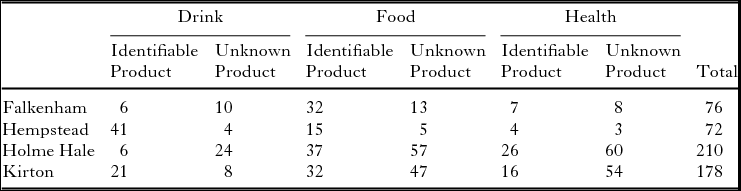
Using a variety of primary and secondary sources, the authors obtained locational information for seventy-eight different products represented by packaging remnants excavated from the four rubbish dumps (Table 1). These derived from fifty-two manufacturers, with popular products appearing in multiple instances.Footnote 37 The products, which included mineral water, toothpaste, disinfectant, coffee essence and meat paste, had originated in six countries: the UK, France, Germany, what is now the Czech Republic, Hungary and the United States. The most common type of artefact recovered from the four sites were Bovril bottles. Medicine bottles, marmalade jars, bottles of fruit juice powder and sauce bottles were also recovered in notable quantities. In the present paper, discussion will be limited to the market access for products that fall into one of the three categories: drink, food and health.Footnote 38
A summary of the products recovered from the four rubbish dumps that could be categorised as drink, food or health-related.

On mapping the manufacturers of the aerated beverages sold in bottles excavated from the four rubbish dumps, it was observed that these had all been transported more than 12 km to the consumer. This contrasted with the results from the assemblage of rubbish from the 1870s excavated at Casselden Place, Melbourne, Australia, where the aerated beverages were all supplied from the immediate vicinity.Footnote 39 The disparity between the rural case studies presented here and the urban example from Australia can be explained by the commercial decision-making process. It makes financial sense for manufacturers of mineral water to establish themselves near to a large population. Not only does this provide a market for their products, but it also supplies the necessary labour. Products consumed in rural areas are more likely to have been transported over greater distances than those consumed in urban areas.
At both Hempstead and Kirton, the majority of the discarded mineral water bottles had contained beverages sold by manufacturers located within 30 km of the households. Both rectors’ households, however, also consumed foreign imported aerated water. The household at Hempstead consumed at least one bottle of salts derived from evaporated mineral water from Carlsbad in Bohemia (modern-day Karlovy Vary, Czech Republic). To reach the place it was discarded, this bottle had travelled about 834 km. In Rev. Davies's rubbish at Kirton, three bottles of Saxlehners (unevaporated) Bitterquelle Mineral Water were found. Carbonated near its source in Hungary and bottled locally, the water had been transported over 1416 km to reach the rector's household.
Scholars have assumed that consumers regarded mineral water as a small discretionary purchase. It was believed that beverages, especially beer, ginger beer and mineral water, were manufactured and consumed within a small catchment area. Without the technology to refrigerate or pasteurise products, the importation of certain beverages from overseas was impractical for most of the nineteenth century. Local manufacturers, therefore, had a commercial advantage over their foreign competitors.Footnote 40 The evidence from rural East Anglia encourages a more nuanced interpretation of the value placed on beverages by the consumer. Although the majority of short-life span drinks drunk at the four sites in East Anglia originated from within 30 km, these households were not averse to purchasing imported, branded products from famous European sources. In the trade directories for Harleston, Norfolk, at this time, J. A. Everson is listed as an ‘importer of foreign wines, spirits and mineral waters’, and bottles for his own aerated beverages as well as bottles manufactured in Germany for German mineral waters were found in a rubbish pit of the 1870s at Brockdish Rectory, a few miles away.Footnote 41 Importers such as Everson were the suppliers in cases in which consumers wished to purchase the finest produce from abroad, which, at Brockdish, also included French Champagne and German ‘Hock’ wine.
In contrast to localised commodity networks of short-life drinks, large, national companies manufacturing long-life beverage products, such as powders and concentrates, were preferred by the four households. At Hempstead during the 1890s, the household was consuming fruit juice concentrate manufactured by the DeCarle and Son Ripe Fruit Drink Company in Norwich, by Foster Clark and Co. of Maidstone and by Gill and Co of Bristol. Products manufactured by these companies had travelled at least 25 km, 185 km and 321 km to the place of disposal, but it is noteworthy that of the twenty-one bottles recovered, eighteen bore the name of the local firm of De Carle and Son, and only two came from the Maidstone firm and one from the firm in Bristol. In Kirton and Falkenham, the preference was for Foster Clark and Co. Eiffel Tower Fruit Juice. Manufactured in Kent, the products of this firm had travelled approximately 99 km to the households. Between the 1890s (when the rubbish was deposited at Hempstead) and the 1900s (when the rubbish at Kirton and Falkenham was buried), this brand had come to dominate the market, a development that would account for the lack of local and other competitor brands in the two Edwardian sites. Fruit juice concentrate was not the only long-life beverage consumed in rural East Anglia. In the 1920s, coffee essences manufactured by Patersons and the Scottish Cooperative Wholesale Society (SCWS) were being used to make coffee at Holme Hale Hall. These had been transported at least 486 km and 491 km respectively from their place of manufacture in Glasgow. While these products are an indicator of the range of beverages that were available to consumers in rural East Anglia, it should be noted that others, such as beverages brewed at home or contained in returnable vessels, will be under-represented in archives of this sort. Milk, for example, which may have been drunk at all these locations, generated no packaging waste until c. 1920, with the introduction of milk bottles, and even then, by and large, milk bottles were returned. Letters written by Rev. John Francis Kendall reveal that beer was consumed at Hempstead rectory, but no evidence of beer consumption was found amid the rubbish.Footnote 42
In contrast to the beverages, which were transported disparate distances to the four sites, food products (including, for the sake of analysis, meat extracts which could be made into hot drinks) derived almost exclusively from locations between 100 and 200 km away from the households. London was the most common source. Marmalade, meat extract, chutney, cream, sauce and meat paste were all manufactured in the capital by companies including Bovril (using Argentinian beef), West London Dairy, Keiller, Crosse and Blackwell, and Poulton and Noel. As with the beverages, the assortment of food products reflects the wide range of consumables available in rural East Anglia. The packaging remnants excavated at the four sites also indicate that by the turn of the twentieth-century, branded food products, which were manufactured in large centralised factories, were superseding locally produced goods. Of the goods identified, only three manufacturers were local to the households:Footnote 43 four jars of Blanchflower and Sons’ fish paste (24k m) and three tins of Colman's Mustard (26 km) were found at Hempstead, and one jar of R. Seager's Marmalade (13 km) at Kirton. Even in this group, Colman's Mustard should be treated as a national brand that happened to be local. A very similar pattern was observable in the consumption of fruit juice concentrates (above), but it must be noted that local produce left fewer identifiable packaging remnants, because smaller firms were less able to afford embossing. It is therefore likely to be under-represented in the analysis.
Although the majority of food products originated from within 200 km of the place in which the relevant packaging was deposited, eleven packaging items were transported between 200 km and 300 km. These comprised of ten sauce bottles, manufactured by Lea and Perrins, Holbrook and Co. and Goodall Backhouse, and one jar of Shippam's fish paste, and all were excavated at Holme Hale Hall and Kirton. Only two products from the four rubbish dumps had been transported over greater distances. At Hempstead, a bottle of Frank Newbury's Bombay Relish, manufactured in Exeter, 421 km away, was uncovered, while a jar for Fortnum & Mason Astrakhan Caviar contained a product which, if manufactured in Russia, travelled 3,429 km to Holme Hale Hall, although it is more likely to have been prepared at the firm's factory in London. The middle- and upper-class households at Hempstead and Holme Hale respectively could afford luxury purchases, and the presence of far-travelled packaging in their rubbish (hinting at ingredients sourced from India and Russia) shows that these rural consumers were integrated into a global commodity network.
Health-related artefacts excavated from the rubbish dumps provide insights into the ailments, which individuals in the four households suffered or believed they suffered. In the artefact archive from Hempstead, there was only a small collection of health products that were identifiable from embossing on the bottle.Footnote 44 Of a total of seven, three were produced by Dinnerford (magnesia for stomach upsets), Elliman (embrocation for muscle sprains), and Cousins and Thomas (chemists local to Oxford), who were all based within 225 km of the household. The presence in a rubbish dump in rural Norfolk of a bottle belonging to a local chemist in Oxford contravenes normal patterns of consumption and disposal. It is known, however, that the rector had recently moved from the parish of Great Tew in Oxfordshire, and that his eldest children would soon attend boarding schools in Oxford.Footnote 45 It is therefore likely either that the bottle had travelled with them, to be discarded soon after their arrival (1895–6), or that one of the children had returned with a bottle of cough mixture, or similar, which they were in the process of consuming. The fourth of the seven bottles had contained Vaseline, produced by the Chesebrough Vaseline Co., which was based in New York. The prevalence of branded medicine in Hempstead's rubbish suggests that large companies, by the 1890s, were competing with the local pharmacist to a greater extent than the national food and drink brands were competing with local producers of beverages and foodstuffs. It also reveals the trust rural consumers were willing to place in recognised medicinal brands, which were advertised in respectable journals and newspapers.
In the small sample of identifiable health products recovered at Hempstead, four of the seven were brands, but at Kirton, from rubbish deposited ten years later, sixteen bore the name of the proprietor. Most of the branded or named health products found at Kirton were manufactured by firms based in London, and they included Elliman's Embrocation (also present at Hempstead), Bishop's Magnesia (Dinnerford's main competitor by the 1900s), and also, now, Boots the Chemists, and two of the most popular national toothpaste brands: John Gosnell's Cherry Toothpaste and Wood's Areca Nut Toothpaste. The presence of two milk-glass bottles for Odol tooth powder from Dresden, Germany, and a single bottle for Chesebrough's Vaseline manufactured in New York (also used at Hempstead in the 1890s) reflect the integration of Kirton rectory into an expanding global exchange network. At Falkenham, fifteen health products were excavated from the rubbish dump. Of these, seven could be linked to a specific manufacturer, none of whom were located abroad. They included Bishop, who was represented in one bottle for Bishop's Magnesia and two for Bishop's Varalettes (gout pills), Congreve (two bottles for balsamic cough elixir), and Boots the Chemists (two jars for an unidentified compound). The relatively high number of medicinal products in this particular assemblage, some of which retained part of their contents, was a factor in the interpretation arrived at by the excavators, that it represented a clearance deposit created after the death of the elderly female head of the household, Mary Everett. These discoveries demonstrate that by the mid-late 1900s, no less in a poverty-stricken farming household than in the rectory at Kirton, national brands were winning the trust of ailing consumers.
In contrast to the farm at Falkenham, where rubbish was deposited after the death of Mary Everett in 1908, Holme Hale Hall, in the early 1920s, discarded a very large number of health products. Of the eighty-six containers identified as packaging for products of this sort, twenty-six could be linked to thirteen known manufacturers, four of whom had offices in the US. That more of the bottles and jars could not be linked to a named manufacturer reflects the decline in the use of embossing and under-glaze printing on glass and ceramic packaging in the period c. 1910–20. The manufacturers included Bishop and Dinnerford (two and three bottles for magnesia respectively), Elliman (one embrocation bottle), Boots the Chemists (three bottles), and Harlene (hair restorer). All twenty-six were for national or international brands. The American imports were Chesebrough's Vaseline again, Listerine and, possibly, Sloan's Liniment and Kutnow's Powders, both of which, by that date, traded largely out of the US. In contrast to the earlier assemblages, which contained local as well as national brands, the archive from Holme Hale Hall shows that branded pharmaceuticals had come to dominate the market before 1925, while bulkier, lower-value comestibles (that is, beverages and foodstuffs) continued to be sourced locally.
In this section, the authors have briefly examined the commodity networks of four households in rural East Anglia during the late nineteenth- and early twentieth-centuries. The discussion was not intended as a definitive investigation of rural market access. Rather, the intention has been to assess the potential of rubbish dump archives for this type of analysis.
Discussion
By linking consumables to their local, regional, national or international place of manufacture, information can be obtained, which reveals how local communities interacted with the market.Footnote 46 Riordan and Adams have argued that that the study of trade networks on a national scale takes us away from the individual household into the vast fields of economics and geography.Footnote 47 This study has shown that it is possible to examine national trade networks without obscuring the household in the process.
Access to global trade networks by households was directed through the ‘local-commercial network’, which consisted of interactions between local shops and the customer. The range of products present in rural households was therefore, to a large extent, correlated to the range of products sold in rural shops, which could only stock goods in small quantities and varieties.Footnote 48 For this reason, rubbish dump archives provides an insight into the suppliers’ market access as well as that of the household. It might be hypothesised that Caley's Mineral Water, for example, could not have been consumed at Holme Hale Hall if it was not stocked in the local store or pub. Households did nevertheless have access to mail order catalogues, and adverts for branded medicines and even fruit juice concentrate encouraged consumers to send for the products in the post.Footnote 49 Adams has argued that there is no way to determine how important mail order was for local-commercial networks,Footnote 50 but by excavating large numbers of rubbish dumps in one locality and comparing the products in their archives, it might well be possible to determine the market access of local stores, while identifying rarer products likely to have been sourced from elsewhere. The analysis already undertaken in this article strongly suggests that medicinal products manufactured by Bishop, Dinnerford, Elliman, Boots the Chemist and other recurrent suppliers were sold by local stores in East Anglia.
Scholars have assumed that accessibility is dependent on the transportation network and the population being served. According to this premise, people who live in large urban conurbations have a greater access to goods and products than those living in rural areas. Economies of scale are adduced in support of the claim that shops with a small catchment population cannot afford to supply their customers with a large variety of products.Footnote 51 The four rubbish dump archives discussed in this article, however, suggest that rural shops did indeed have a global reach and could stock a wide range of products.
Not only does the excavation of rural rubbish dumps provide an insight into household market access, it is also a unique window into the lives of known individuals. At Holme Hale Hall, a red glass bottle embossed ‘ACTIENGESELLSCHAFT/ fur ANILINEFABRIKATION/ BERLIN, S.O’ was recovered. It originally held liquid that was used in the development of photographic prints. One member of the household, Mary Campbell Broke, is known to have been a keen amateur photographer.Footnote 52 It is therefore likely that this bottle belonged to her, reflecting her consumer choices. The presence of this bottle in the rubbish dump suggests that Mary printed her photographs in her own darkroom at the hall. The product also links Mary to a global commodity network. In order to engage in her passion for photography, she had to purchase chemicals manufactured in Germany in the years immediately following the First World War, when there was a cessation of trade.
The purpose of this short article is not to provide a definitive archaeological analysis of rural market access in East Anglia in the late nineteenth- and early twentieth-centuries, but rather to draw attention the potential of rubbish dumps for this type of analysis. The archives uncovered have huge research potential for connecting individual households to international systems of exchange.Footnote 53 While the focus of this article is market access in rural England, the questions asked and the archives used are globally applicable. Archaeological approaches have the potential to provide in-depth analysis of changing patterns of consumption, the impact of globalisation and the development of commodity networks in the modern period.
Acknowledgements
The authors would like to thank the owners of Hempstead Rectory, Kirton Rectory, the farmhouse at Falkenham and Holme Hale Hall, for allowing Tom Licence and his team to excavate the rubbish dumps on their property. Thanks are also due to Professor Tom Williamson for his comments on the article. The authors would also like to thank Johanne Porter, Elizabeth Stewart and Tom Lucking for help in undertaking the fieldwork.
This article is published with financial assistance from the Centre of East Anglian Studies.