INTRODUCTION
Caring for people who are dying is an integral part of primary care, as many terminally ill patients choose to spend the last phase of their lives at home (Mitchell, Reference Mitchell2002). One of the most important needs at the end of life is having a medical practitioner who is willing to discuss dying and related issues (Steinhauser et al., Reference Steinhauser, Christakis and Clipp2000; Wenrich et al., Reference Wenrich, Curtis and Shannon2001). Steinhauser et al. (Reference Steinhauser, Christakis and Clipp2000) revealed that over 85% of seriously ill patients participating in a survey of views about end-of-life care wished to know if their doctor felt comfortable discussing death and dying with them. Furthermore, an Australian study of palliative care patients, their carers (including partners, relatives, or friends) and specialist palliative care professionals unveiled a number of topics participants felt should be addressed in end-of life care. These included future physical symptoms, preferences for the place of dying, actions needed immediately after death, and existential issues (Clayton et al., Reference Clayton, Butow and Arnold2005). Participants also recommended that the dying person's fears and myths be explored, and that the final days, including the likely unconscious period, are discussed (Clayton et al., Reference Clayton, Butow and Arnold2005).
The adaptation of the dying patient to the terminal phase of illness is influenced by factors within the doctor–patient relationship (Steinhauser, 2000). Previous research suggests that terminally ill cancer patients who wish to accelerate their death were more likely to report dissatisfaction with emotional support and communication with their doctors (Kelly et al., Reference Kelly, Bumett, Pelusi, Badger, Varghese and Robertson2002) and more likely to be receiving care from doctors who report having less training in the psychological aspects of care (Kelly et al., Reference Kelly, Burnett and Pelusi2004). Furthermore, an indication of the importance of addressing emotional concerns is the finding that the wish to hasten the death has been chiefly associated with psychological symptoms such as depression (Breitbart et al., Reference Breitbart, Rosenfeld and Pessin2000) The importance to the dying patient of his/her sense of dignity has also been highlighted and is one that can be positively influenced by the clinician's response to the patient, including comfort in exploring the patient's concerns (Chochinov, Reference Chochinov2002).
Despite evidence suggesting that having a doctor who is willing to discuss death and dying is important for terminally ill persons, there is evidence that clinicians have considerable difficulty in addressing end-of-life issues with palliative care patients. General practitioners (GPs) participating in focus groups and interviews in an Australian study reported feeling that they needed support and education in talking about these issues with terminal patients (Burgess et al., Reference Burgess, Brooksbank and Beilby2004). The same study also found that GPs tend to ask closed-ended questions, which do not allow patients to explore their emotions (Burgess et al., Reference Burgess, Brooksbank and Beilby2004).
GPs have described palliative care work as rewarding, although they recognize it can be burdensome (Groot et al., Reference Groot, Vernooij-Dassen and Crul2005). Personal, relational, and organizational barriers can hinder a job that is already difficult (Groot et al., Reference Groot, Vernooij-Dassen and Crul2005), and doctors report feeling ill prepared for the tasks of caring for a dying patient (MacLeod, Reference MacLeod2001). Furthermore, major gaps in medical education in palliative care are acknowledged (Lloyd-Williams & MacLeod, Reference Lloyd-Williams and MacLeod2004). These findings increasingly point to the importance of investigating primary care medical practitioners' experiences in caring for the dying patient.
The present investigation is a descriptive and qualitative study examining the perceptions and experiences of nonspecialist GPs providing care to palliative care patients that emerge in a supervision model of clinical review that focuses on the psychological aspects of palliative care. The aim of the study was to describe these aspects as an initial step in developing interventions to provide guidance and consultation/supervision to primary care clinicians when they are treating the terminally ill.
METHOD
Sample
A convenience sample of 15 doctors was recruited for the study at the point of referral of their patient to a hospice/home care specialist palliative care service. The sample comprised 8 males and 7 females, whose ages ranged from 38 years to 61 years (M = 45 years). The number of years in general practice ranged from 6 to 30 years (M = 17 years). Twelve of the GPs reported long-term (4 years or more) clinical relationships with their palliative patient and three were described as new patients (less than 1 year). In the latter cases the clinical relationship began at the time of initial diagnosis of a terminal illness or the patient was referred with a preexisting illness.
Data Collection
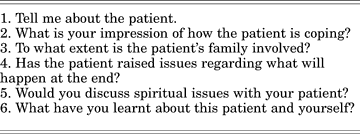
The doctors were interviewed by a consultant psychiatrist regarding the care of the specific terminally ill patient whom they referred to the home care service. The psychiatrist (F.V.) has had extensive experience in clinical case review and longstanding interest in the doctor–patient relationship and psychological aspects of advanced illness. The interviewer was blind to the patient data and details, other than that described by the doctor in the course of the discussion. A semistructured interview explored the GPs' perceptions related to the psycho-social aspects of the specific palliative care patient whom they referred to the specialist Home Care Service. Examples of the key questions used to guide the interview are in Table 1. Interviews were undertaken in the general practitioners' rooms/practice and were generally of between 1 and 2 h duration. All interviews were audiotaped and the interviewer took brief field notes.
Interview questions

The original design of the study included three separate interviews with GPs fortnightly over a 6-week period in order to examine the changes that clinicians may report over time in their care of patient as a result of the case discussion and associated learning. This was not attained in all cases due to the patient's death. Four GPs completed all three interviews, four completed two interviews, and seven completed one interview. The psychiatrist's role was to facilitate discussion and particularly to explore the clinician's understanding of and experience with this specific patient with the focus on the clinician's approach to the emotional needs of the patient and the impact on the clinician of the care of his/her dying patient.
Analysis
A total of 27 interviews with the 15 GPs were transcribed and analyzed for common themes. Words and phrases within the text were analyzed to identify convergence of key topics that were presented and were then categorized into common themes. The data were analyzed with the assistance of QSR NUDIST–Revision–4.24.
RESULTS
The following key themes emerged from the data.
Clinical Issues
All the interviews began with GPs comfortably reporting their patient's clinical history. Previous illness, presentation, initial diagnosis, physical symptoms, and prescribed treatment were all covered extensively and with ease. Nine patients were described as having had extraordinary issues relating to diagnosis (e.g., rare illnesses, sudden onset and rapid decline, perceived misdiagnosis by previous doctor, or multiple illnesses). It is noteworthy that the GPs reported that they had a greater degree of emotional involvement in these cases than their other clinical cases.
Discussions about Death
Seven GPs reported conversations with their patients about death and the process of dying. Four GPs indicated that they had broached this with their patient, although concern was often expressed about the effect this might have on their patient's morale. In one instance the topic was raised by the patient, reported as the patient saying “I don't want this existence any longer” (DR8). One doctor reported being inhibited in discussions regarding death with his/her patient by the presence of the patient's spouse during consultations (DR9).
Other examples of the reported difficulties in discussing death were: “I never really was able to talk with him about the prospect of dying” (DR5) and “No, I think its part of their business” (DR11).
Generally the doctors reported the use of euphemisms as exemplified by “this is a one-way path we're on.”
Three practitioners had broached discussions about a poor prognosis. In most of the references made to discussing (or not discussing) prognosis with the patients, reference was made to the influence given to the patient characteristics that facilitated or inhibited such discussion.
Among others reference was specifically made in three cases to obstacles in discussing prognosis: “I didn't exactly tell him (about his prognosis) but I told him in general terms that it wasn't going to be good. … I think it was made easier by the fact that he was smart enough to have worked it out” (DR7). “It's a situation, this illness, where I find it difficult” (DR2). “No [did not discuss prognosis] whether it's because he's a returned serviceman or not, whether he's got a different attitude to death and dying” (DR9).
Among the four practitioners who described having broached prognosis with the patient, a similar theme of patient characteristics emerged, as demonstrated in the following examples: “I don't mind it at all with him because he's totally comfortable about it, and we can even be humorous about it” (DR3). “I basically gave her the prognosis when I saw her and that I felt it was not going to be a good diagnosis made. So she was already primed and she was a very stoical lady” (DR10).
Relationship with the Patient
Doctor–Patient Relationship or Interaction
Twelve of the GPs reported long-term (4 years or more) clinical relationships with their palliative patient and three were described as new patients (less than 1 year). In the latter cases the clinical relationship began at the time of initial diagnosis of a terminal illness. All participants reported having positive relationships with their palliative patient and most of the GPs with long-term patients reported no change in the overall quality of this relationship after diagnosis. Eight GPs described their relationship with the patient as an attachment or friendship, six described it as a good relationship with mutual respect, and one GP described a problematic relationship but a respectful one nevertheless. Even in the two cases in which “problems in the system” (not necessarily the responsibility of the consulting GP) led to a delay in diagnosis or treatment, the doctors did not detect any anger or resentment in their patients.
Family Involvement
Spouses were frequently involved in care and the theme of responsibility to keep family involved, informed, and supported. All the GPs relayed detailed information regarding the patient's families and many saw family members as patients also.
Perception of Patient's Response and Exploration of Their Needs
Spiritual Issues
In discussions about spiritual concerns of their patients, most GPs conveyed their sense that this referred specifically to “religion,” and the majority felt that discussing religion was not part of their role as a doctor. Fourteen of the GPs reported that they would leave it to their patients to raise the topic of spiritual beliefs. They commonly reported that they would only raise these issues if they felt it was relevant and if they formed the impression this was important to the patient. Three reported that they would not raise such issues because they felt the patient “was not religious.”
Examples include: “It's probably not our brief as such. … Religion can be a minefield” (DR6). “It's not difficult for me to talk about at all. … They'd have to bring it up (DR7).
In response to probes regarding exploration of spiritual issues, reference to the practitioners own particular religious or spiritual beliefs did not emerge.
Exploration of Emotional Concerns
In general most doctors referred to the lead taken by the patient in whether emotional concerns or symptoms were explored or addressed. In some instances as detailed below, this suggests that certain patient characteristics (such as “stoicism”) may have unwittingly provided the GP the basis to avoid discussion of emotional issues and was then was relieved of potential distress that might arise in exploring these important clinical matters.
Two doctors directly referred to a need to address emotional issues with the patient. In one instance this was in response to suicidal ideation and in the presence of depression. The practitioner reported that in response the patient expressed firm religious beliefs against suicide.
In the other the doctor reported “I've asked him a few times, and there's probably a bit of resistance in him allowing me to explore it more” (DR10).
In all others there was a consistent theme of difficulty addressing emotional concerns, often expressed in terms of the patient's characteristics that impede such discussion.
The following examples are provided: “He probably wasn't someone who talked about things a lot from that regard” (DR6). “He probably doesn't fully express the emotions and all the things that he is going through” (DR7). “It was very difficult to talk about topics when she didn't want to talk about it” (DR8).
One doctor referred to the patient characteristics (hope) that made it “easier” to deal with and barriers to comprehending the patient's stance or attitude toward their situation; for example, “I think they're easier to deal with when they have hope. They're more likely to do something constructive. … But I find it difficult to understand” (DR12).
Another referred to an impression of the patient's adjustment: “He never at any stage appeared to be very distressed by the prospect of having such a major diagnosis” (DR5).
Provision of Information
In contrast to their reticence to explore emotional issues, most GPs expressed the desire to provide patients with all the necessary information relating to their illness and palliative needs, suggesting that these doctors separated the provision of information from its emotional context. Five participants reported the importance of information as a source of control for the patients.
Perception of Patient Psychological Adjustment/Coping
A common theme that emerged across interviews was the belief of GPs that their patients' responses reflected a stoical stance to which they responded by avoidance of any exploration of underlying concerns. At some level, GPs perceived that the patients' demeanor was an attempt to “protect” others around them from distress. “I think his stoicism made it easier for me initially as well, … that we were mechanical about it and not emotive” (DR7). “I think he's maintaining his autonomy, which is good.” “He says he has faith in me … but his actions indicate that he probably doesn't have as much faith in my management” (DR10). “It was very difficult to talk about topics when he doesn't want to talk about them.” “I think she was a very self-contained person. She didn't want to trouble me with anything” (DR8). “I've asked him a few times, and there's probably a bit of resistance in him allowing me to explore it more (DR11).
GP's Personal Experience in Identification with Patient
The theme of identification with the patient emerged particularly in regards to discussions of death and adjustment to illness. This was reported in terms of thoughts about one's own mortality and reflection on life. “We got on fairly well; I think we're similar age, both professionals, … almost like a peer. … You look at how you're going and access a bit how you manage those situations” (DR6). “The reality of death is one of the areas that it brought up, … that life is transient” (DR7). “This one will be tougher … because she's a similar age to what I am, so that puts me in touch with my own mortality” (DR12).
All the GPs stated that they recognized the importance of maintaining some sort of clinical distance from their patients in order to cope personally.
Maintaining a professional boundary was referred to in one instance: “Our role is to be supportive, to be still directive, but you can step back that little bit without being totally immersed in the whole situation” (DR6).
Guilt was mentioned in two cases expressed in terms of guilt relating to charging patient for treatment or in regards to not being effective in detecting the primary cancer.
DISCUSSION
The personal challenges faced by doctors in the care of patients who are severely ill and dying have been previously identified as key issues to consider in clinical practice (Meier et al., Reference Meier, Back and Morrison2001). This study examined these responses in the context of a psychologically oriented case discussion with primary care clinicians regarding the management of a specific patient. The work follows research previously undertaken by the authors indicating the significant association between a doctor's confidence and experience in psychological aspects of care and the patient's adjustment to terminal illness (Kelly et al., Reference Kelly, Burnett and Pelusi2004) and research indicating the distress experienced by doctors in their roles with palliative care patients (Kelly et al., Reference Kelly, Burnett, Badger, Pelusi, Varghese and Robertson2003).
The findings indicate the potential barriers to overcome in building confidence in addressing key communication and psychological tasks for doctors in their care of dying patients. In this instance case review was used as a vehicle to gain a more in-depth understanding of the factors influencing communication between doctor and patient in palliative care, with reference to the tasks in psychosocial care.
The findings indicate that there were common underpinning themes among this group of doctors: limited discussion of death and prognosis with the patient, obstacles to discussing emotions and psychological responses (often reported in terms of the perceived obstacles in the patients to discussing these matters), and common themes regarding the patients' perceived autonomy and stoicism. The personal impact of caring for a dying patient was often expressed in terms of the identification with the patient and one's own mortality.
There was the suggestion of a strong reliance on the “lead” taken by the patient on most sensitive matters and whether these are explored, perhaps relieving the clinician of the difficult task of raising matters that may be difficult or distressing. This was very often the case with matters such as discussing prognosis or exploring emotional distress, with the result that these issues were often not discussed or raised.
Although this is not a representative group of doctors, or of patients, these findings are of interest when examined in the context of findings from studies of the perceptions and wishes of patients and the importance of sensitive discussion about death and dying (Wenrich et al., Reference Wenrich, Curtis and Shannon2001; Clayton et al., Reference Clayton, Butow and Arnold2005; Hancock et al., Reference Hancock, Clayton and Parker2007). Such studies indicate the importance patients attach to having a clinician who is confident in discussing death and dying and the importance of such discussion in shaping the patient's adaptation to his/her illness (Steinhauser et al., 2000). Evidence from cancer patients and their families also indicates the importance of assessing the informational needs and preferences as part of clinician's communication tasks (Clayton et al., Reference Clayton, Butow and Arnold2005). Nevertheless it has also been demonstrated that health professionals have tended to overestimate patients' understanding and awareness of their prognosis and end-of-life issues (Clayton et al., Reference Clayton, Butow and Arnold2005), further supporting the need for clinicians to repeatedly check patients' understanding and preferences for information (Hancock et al., Reference Hancock, Clayton and Parker2007). It was not evident from the qualitative data presented in this current study that clinicians were confident in the tasks of clarifying such preferences or understandings.
The clinician has a critical role in sensitively exploring psychological distress if common problems such as depression, anxiety, and demoralization are to be identified and responded to. Given the common hesitancy of patients to raise such matters directly with clinicians, these findings indicate the risk that important aspects of the patients suffering can remain unrecognized through assumptions made about the patient.
Existential issues rank among the most difficult for clinicians to address despite indications that these concerns are paramount for patients (Cassell, Reference Cassell1999; Kohlwes et al., Reference Kohlwes, Koepsell and Rhodes2001). Demoralization is an increasingly recognized clinical syndrome among palliative care patients characterized by lack of meaning, hope, and purpose (Kissane et al., Reference Kissane, Clarke and Street2001) and may also manifest in clinicians who experience a loss of hope or meaning in their clinical relationship with a dying or chronically ill patient (Kissane & Kelly, 2003). The findings in this study are illustrative of the obstacles faced by clinicians exploring these aspects of the patient's experience of illness and in some instances illustrative of the emotional impact on clinicians themselves.
In light of the evidence regarding the importance of clinician factors in association with the wish to hasten death of dying patients (perhaps through confidence in exploring symptoms such as depression and hopelessness), these findings give further background to the experience and needs of clinicians that can be addressed in clinical training and case review methods in the future. Although this case review method did not provide direct training or clinical supervision, the issues that emerge suggest the potential benefits of strategies to support and train clinicians in the complex interpersonal aspects of caring for a dying patient. Case review or other methods of clinical supervision can be beneficial for clinicians, across the range of health disciplines, in addressing the tasks involved in the care for the dying (Katz & Johnson, Reference Katz and Johnson2006). The benefit of such approaches is the opportunity to provide discussion of the impact on the clinicians of the patient's illness and the tasks in caring for a dying patient and how this might in turn affect the ways in which the clinician is able to confidently initiate and sensitively explore important clinical and communication needs (Varghese & Kelly, Reference Varghese, Kelly and Gabbard1999). Despite models of group-based supervision for medical practitioners in their general work (Burton & Launer, Reference Burton and Launer2003) and the potential benefits for patient outcomes, it has been less well established for medical practitioners in the care of dying patients. It is interesting to note recent findings linking insufficient confidence in psychological aspects of palliative care with greater physician burnout (Asai et al., Reference Asai, Morita and Akechi2007). Approaches to improve skills in psychological aspects of care may also assist in maintaining clinicians' emotional well-being.
CONCLUSION
This qualitative study examined the responses of general medical practitioners with respect to a palliative care patient in their current care. The findings indicate the significant theme of impending death and the challenges facing clinicians in the discussions with patients and families about death (such as balancing opened about death with realistic hope). Other themes included the obstacles to exploring the patient's emotional responses to terminal illness and the exploration of the role of spiritual concerns for the patient and family.
These findings are of particular interest when seen in the context of the evidence from terminally ill cancer patients and their families who seek discussion about these issues with clinicians, the significance of such discussion to the patient's adaptation to his/her illness. These qualitative data point to important tasks in the training and clinical support for doctors providing palliative care and the potential benefits of clinical supervision to improving patient, family, and clinician outcomes.
ACKNOWLEDGMENTS
The project was supported by a grant from the Queensland Cancer Fund. The authors acknowledge the support of clinicians in the Mt. Olivet Hospital and Home Care Service and the generous contribution of the participating general practitioners. Dan Pelusi and Claudia Aguero assisted with the implementation and data collection.