Introduction and background
Current social-care policy in the United Kingdom (UK) prioritises the empowerment, choices and control of the users of health- and social-care services, including those who live in long-term care facilities (Department of Health 2001, 2006). In the UK, the term ‘care home’ now refers to all institutional long-term care settings for older people and there are two types: care homes with nursing (or nursing homes), which provide personal care and on-site nursing care; and care homes without nursing (or residential homes), which provide personal care only. As to the providers, 80 per cent of UK long-term care for older people is provided by the independent sector, mainly in for-profit homes with others managed by charitable organisations, and a decreasing number are run by local authorities (Laing and Buisson 2009). In 2008, at the time of data collection for this paper, the regulations and guidance for care homes were provided by the Care Home National Minimum Standards and Care Homes Regulations 2002 (Department of Health 2002). The Standards are the basis for inspection and cover aspects of choice relating to routines of daily living and autonomy (Standards 12 and 14, 2001: 14–15). Promoting resident choice and control is also part of the ethos of the recent development proposals for a National Care Service (Department of Health 2010). In addition, organisations providing long-term care services are being influenced by wider social changes relating to the legal rights, quality of life and empowerment of people who use care and health services (Thomas Reference Thomas2000).
The My Home Life report notes the importance of choice and control for the quality of life for older people living in care homes (National Care Homes Research and Development Forum 2007). Choice and control may be difficult to achieve for care-home residents, however, because of the lack of advocacy for them and their persistent exclusion from a society that questions their status as full citizens (Scourfield Reference Scourfield2007). When addressing the concept of choice, it is often associated in policy terms with ‘empowerment’ and ‘promoting independence’, terms appropriate to broad outcome-focused narratives. Indeed, the choice and control discourse tends to focus on life events and lifestyle choices deemed significant, while the more mundane areas of everyday life are overlooked (Finlay, Walton and Antaki Reference Finlay, Walton and Antaki2008). One fundamental ‘choice’ for long-term care residents is when to go to bed and to get up, and therefore the length of time spent in bed, which is particularly relevant for people with high support needs (Bowers et al. Reference Bowers, Clark, Crosby, Easterbrook, Macadam, MacDonald, Macfarlane, Maclean, Patel, Runnicles, Oshinaike and Smith2009).
A sociological approach to understanding sleep acknowledges that it is intrinsically linked to social roles and socio-structural factors (Arber, Hislop and Williams Reference Arber, Hislop and Williams2007). Schwarz (Reference Schwarz1970) discussed the rights of a sleeper which shape the behaviour of those that are awake, and argued that the control of sleep is linked to an individual's social status. This is particularly relevant when considering sleep in care homes where the bedroom is not entirely a private space (Schwarz Reference Schwarz1970). Taylor (Reference Taylor1993) linked the lack of privacy in the sleep environment to the infantilisation of people who are not in control of this aspect of their lives. Although Taylor related this syndrome to ‘total institutions’, the phenomena of residents being observed asleep and their lack of control of the sleep environment pertains in long-term care settings. In discussing sleep in institutional contexts, Williams and Bendelow (Reference Williams and Bendelow1998) noted the importance of understanding the spatial and temporal organisation of sleep, the monitoring of sleep, and issues of power, surveillance and control of sleep. In addition, sleep should be considered as a social act that is negotiated with others (Meadows Reference Meadows2005), particularly with partners, family members or others in a household. In the communal environment, sleep ‘negotiation’ occurs with not only other ‘sleepers’ but also staff and is constrained or influenced by a care home's policies and customary practices.
This paper focuses on two aspects of 24-hour care for older people living in care homes, namely the times at which they go to bed and get up, and the hours that they spend in bed at night. We make explicit the distinction between ‘time in bed’ and ‘time sleeping in bed’, and argue that residents' night-time routine is not necessarily a ‘sleep’ routine, but rather structured by the organisation of care. The activities of going to bed and getting up not only mark the intersection between night and day for residents, but also embody a potential conflict between a resident's preferences and personal routines and the care home's routines and institutional practices. Following a review of the pertinent literature, the paper examines both quantitatively and qualitatively the time that care-home residents spend in bed at night. Four main research questions are addressed:
1. How much time do care-home residents spend in bed and how does this relate to likely time spent sleeping?
2. How does a resident's level of dependence relate to bed-times and getting-up times and therefore to time spent in bed?
3. How does the organisational routine of staff shift patterns and the related staffing levels influence bedtimes and getting-up times?
4. What is the meaning of resident ‘choice’ regarding bedtimes and getting-up times given their dependency and the routines that are common in care homes?
Literature review
The night-time experience of older people living in care homes has been little researched, particularly the amount of time residents spend in bed at night. There has been more attention to the time that residents spend in bed during the day, reflecting a concern about their lack of activity. Schnelle et al. (Reference Schnelle, Cruise, Alessi, Ludlow, Al-Samarrai and Ouslander1998) carried out observations in eight Californian nursing homes between 8 am and 4 pm, and found on 35.8 per cent of the occasions that the residents were in bed. Similarly, Ice's (Reference Ice2002) observations between 8 am and bedtime (approximately 13 hours) of residents in American nursing homes found that on 28.7 per cent of the occasions they were in bed. These authors argue that this time spent in bed during the day results in residents being alone and lacking social interaction or stimulation, and that it exemplifies poor ‘sleep hygiene’ – the lack of daytime activity associated with highly disturbed night-time sleep.
Bates-Jensen et al. (Reference Bates-Jensen, Schnelle, Alessi, Al-Samarrai and Levy-Storms2004) examined indicators of the time spent in bed during the day by care-home residents in the United States of America (USA), and found that while increased frailty and physical dependence of residents related to increased time spent in bed, the strongest predictor was staffing levels. Finding more than 50 per cent of residents in bed between 7 am and 7 pm was almost six times more likely in homes with low staff levels. It is clear that the amount of time spent in bed during the day relates strongly to the home and staffing practices, not only to the frailty of the residents. Bates-Jensen and colleagues' and other researchers' (e.g. Alessi et al. Reference Alessi, Schnelle, MacRae, Ouslander, Al-Samarrai, Simmons and Traub1995) observations were only during 8–13-hour days, however, leaving a long ‘night’ of between 11 and 14 hours unobserved. It is not well understood how long residents spend in bed during such ‘long nights’, nor how much of the time is spent awake and if this also relates to staffing levels and shift patterns.
While the experiences of older people living in care homes are less well researched during the night than during the day, there is evidence that at night their sleep is frequently disturbed (Ancoli-Israel et al. Reference Ancoli-Israel, Parker, Sinaee, Fell and Kripke1989; Fetveit and Bjorvatn Reference Fetveit and Bjorvatn2002; Meadows et al. Reference Meadows, Luff, Eyers, Venn, Cope and Arber2010). Martin and Bartlett (Reference Martin and Bartlett2007) explored social aspects of sleep for older people with dementia, and discussed the importance of getting up and going to bed rituals and routines for the care staff. Getting up was particularly seen as an important activity, as it allows the care staff to spend quality time with residents and ‘set them up’ for the rest of the day. The staff were concerned that time constraints during the busy mornings curtailed the time they spent with each resident. Residents with dementia had limited choice and control over the timing of their sleep, and although the times that residents spent in bed were monitored by care staff, the focus of attention was on the residents that slept late in the morning. The paper highlighted a tendency to favour ‘institutional’ routines over individual choice and privacy with respect to sleep.
A recent Joseph Rowntree Foundation (JRF) commissioned study of night-time practice in care homes in Scotland involved observations in three homes and interviews with residents, family members, night staff and managers (Kerr, Wilkinson and Cunningham Reference Kerr, Wilkinson and Cunningham2008). Several key issues about care homes at night were identified: the lack of dementia care training for the night staff; low staffing ratios at night; high anxiety among night staff; high night-time noise levels from staff, other residents and the building; disturbances of the residents' sleep through the staff's routine checks; lack of management involvement at night; and poor communication between day and night staff. The study had an action research element that involved implementing and evaluating practice changes to improve night-time care in the three care homes.
The JRF report has informed the Care Quality Commission (CQC 2008) guidance for inspectors. This emphasises the need to enable residents' choices about when they go to bed and get up, as well as a more general requirement for adequate staffing levels to meet the residents' needs. However, the meaning of resident choice and staff flexibility in terms of bedtimes and getting up times was not explicitly addressed, and how residents viewed this aspect of their care or how day and night staff provided this care were not investigated. The JRF report notes that the night staff felt pressure to ensure a certain number of residents were up and dressed before the day staff came on duty, and that staff handovers were useful and valued but reduced the number of staff working ‘on the floor’ and available to the residents. Furthermore, it identified an underlying assumption that night-time care was about caring for residents ‘sleeping’ in bed, although residents were often not asleep during the night, especially those with dementia.
A theme running through all care homes research and the National Minimum Standards is the organisation's routines. These tend to be relatively rigid, with set meal times and staff shift patterns (cf. Eyers Reference Eyers and Paoletti2007; Kerr, Wilkinson and Cunningham Reference Kerr, Wilkinson and Cunningham2008; Valins Reference Valins2002). How shift patterns influence which hours are deemed ‘day’ and ‘night’, and the apportioning of day and night shift duties around these times, are largely taken for granted. The effects of care-home shift patterns on the work undertaken by staff and therefore on the residents' care are not clear. For example, if the night shift is from 8 pm to 8 am, are all 12 hours regarded as ‘night’ and how does this relate to the time that residents spend in bed? The National Minimum Standards are ambiguous with regards to shift patterns and staffing levels at each end of the day but expects that: ‘There are waking [awake] night staff on duty in numbers that reflect the numbers and needs of the service users and the layout of the home’ (Department of Health 2002: Section 6, Standard 27.5). It is not explicit, however, what is considered to be ‘night-time’ and what duties night staff typically are expected to do, e.g. should there be sufficient staff to help only a few dependent residents to bed or most of them?
The seemingly mundane daily activity of getting up and going to bed is a valuable focus for an examination of issues of choice among care-home residents. The timing of these activities determines how much time residents spend in bed, and touches on the sociological aspects of sleep in relation to an institutional environment. In contrast to older people living in their own homes and who are physically able to get themselves in and out of bed, the sleep patterns of care-home residents may be influenced by various organisational and structural factors, especially the fact that many residents need help with getting in and out of bed. The issue of choice of bedtimes and get up times should be framed not only in terms of one-to-one relationships of residents with care staff, but also in the wider context of typical and widely taken-for-granted organisational and staffing patterns and routines.
Methodology
The research reported in this paper is part of a larger research study, SomnIA, a United Kingdom (UK) Research Councils' funded multidisciplinary project in the New Dynamics of Ageing research programme. The project has eight work-packages and aims to understand the quality of sleep of older people living in the community and in care homes, as well as to evaluate non-pharmacological interventions to improve poor sleep. This paper reports findings from a work-package that examined the factors influencing quality of sleep in care homes.
The samples of homes and residents
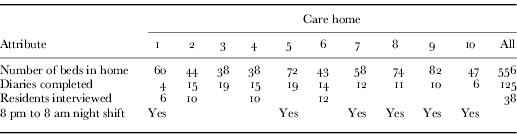
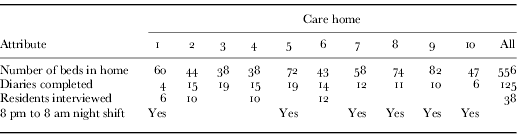
Ten care homes were purposively selected, to reflect a mixture of home ownership and comprised eight nursing homes and two residential care homes. Three homes were owned by a local authority, five by large chains, one was an independent business and one was run by a charity. Each home was registered for 35 or more residents. Across the ten care homes, a sample of 125 residents completed sleep and activity diaries. We excluded those with dementia because they needed to complete a 14-day diary to record what they had done during the day and previous night. In addition, 38 residents took part in a qualitative interview about their sleep and night-time experiences (see Table 1 for sample sizes in each of the ten care homes). All residents regarded as eligible by the care-home manager were given written information about the project and met a researcher who explained the study. The residents chose whether they wished to participate and to what extent.Footnote 1 The participating residents were a self-selected sample, as not all residents wished to or felt able to participate, so there was a bias towards more able or independent residents, with the most unwell or frail residents being less likely to participate.
Overview of data collection at the ten sampled care homes
The sleep and activities daily diary
Residents were asked to complete a daily diary for 14 consecutive days. While a few residents were able to complete this alone, the majority were visited by researchers every day to help as required. The diary included information on the activities undertaken during the day, and items relating to the evening, night and morning. These included: the times at which they went to bed, fell asleep, woke up and got up, how they woke up, and who got them ready for bed. If a resident was unable to recall an item, this was noted. Most (111, 89%) participants completed the diary on the 14 days, although across the ten homes, 14 either finished early or missed days. As stipulated in the consent form, residents were not required to give a reason for withdrawing from the study, but the most common reasons were feeling unwell or tired, hospital and other appointments, or other trips out of the home. The researchers also obtained detailed socio-demographic and health information about each participating resident, including age, gender and medication taken.
The diary data were used to identify the usual night-time routine for each resident over the 14 days. The mean bedtime and getting-up times (using a 24-hour clock) and the mean number of hours in bed were calculated for each participant across the 14 days. The differences between the time residents went to bed and fell asleep and between their waking-up and getting-up times were derived, and then the time spent in bed ‘awake’. The last estimate is conservative, however, because it does not include the time awake at night through sleep disturbances. These data were explored by analysing:
1. All 125 residents across the ten care homes as a group.
2. Residents in two groups depending on whether they got themselves ready for bed (N=56), or required support by staff to get ready for bed (N=65). This provided an indication of resident dependency in terms of night-time routines. Residents who were supported to get ready for bed at night were also supported in the morning to get up, so only this single measure was used.
3. In the six care homes that had the same 8 pm to 8 am shift pattern, residents were also separated into those who got themselves ready for bed (N=24) and those requiring support from staff (N=36).
The qualitative interviews
Semi-structured audio-recorded interviews were conducted with 38 residents (five male, 33 female) in four of the homes that were selected to include different provider organisations. Two were operated by a London Borough (one residential care, one nursing), one by a large private-sector chain (nursing), and one by a charity (nursing). The topic guide included questions about the residents' personal routines around sleep. The interviews were transcribed and analysed using Atlas.ti qualitative data analysis software. Glaser and Strauss's (Reference Glaser and Strauss1967) grounded theory inductive approach was adopted. Some of the emerging themes were related to choice of bedtimes, get-up times and the related routines.
The integration of the data
Following the separate quantitative analysis of the diary data and qualitative analysis of the interviews, the two sets of data were integrated to broaden our understanding of the time spent in bed by residents. In this way, the two methods retain their ‘paradigmatic nature but are inter-meshed with each other in the pursuit of ‘knowing more’ (Moran Ellis et al. Reference Moran-Ellis, Alexander, Cronin, Dickinson, Fielding, Sleney and Thomas2006: 51). This integrated analysis used the quantitative diary data findings as its base, before investigating those qualitative themes that enabled a fuller understanding of the factors underlying the quantitative findings. The qualitative findings presented here therefore represent one aspect of the much wider qualitative analysis.
Go to bed and get up times: analysis of the daily diaries
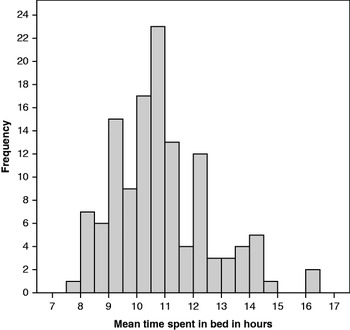
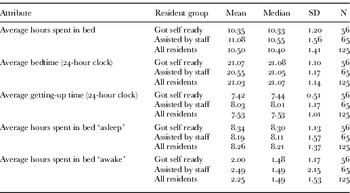
The mean time spent in bed each night by the residents across the two weeks was 10 hours 50 minutes (standard deviation 1 hour 41 minutes) (see Table 2). The median was 10 hours 40 minutes. The range of the residents' mean daily duration in bed was substantial, and 12 per cent reported more than 13 hours (see Figure 1). The residents' mean bedtimes across the two weeks varied from soon after 6 pm until around 11.30 pm. The residents' getting-up times ranged from 5 am to 10.30 am. The overall mean bedtime was at around 9 pm and the mean time of getting up was just before 8 am (Table 2). The mean total amount of time spent in bed awake per night was 2 hours 25 minutes.
Mean number of hours spent in bed per night by residents over two weeks (N=125).

Self-reported hours spent in bed, bed time, getting-up time and hours spent in bed awake, ten care homes in England over two weeks

Note: SD: standard deviation.
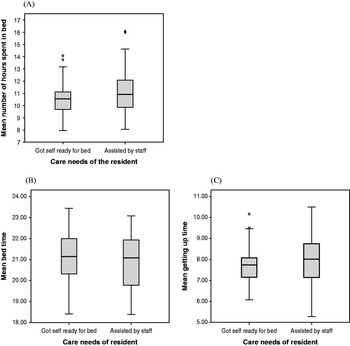
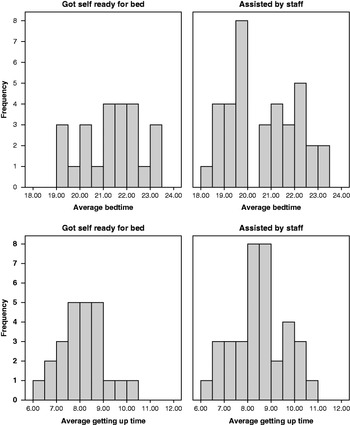
The residents were grouped by whether they were able to get themselves ready for bed (56) or if they needed assistance by staff to do so (65), broadly reflecting their level of dependency. The mean number of hours spent in bed and the average bedtimes and getting-up times were not significantly different for the two dependency groups (see Figure 2 and Table 2), but there was a significant difference in the mean time that residents reported being in bed awake. Residents who got themselves ready for bed were awake for a mean of two hours, whereas those who required assistance to get ready for bed were awake for on average 2 hours 49 minutes. The variance was significantly different between the two dependency groups for both time spent in bed (Levine's test, p<0.01) and getting-up times (p<0.05), with those residents who required assistance showing significantly more variation; that is, getting-up times were more spread out (Figure 2). The spread of getting-up times may reflect how long it takes staff to assist all the residents in their care, or more broadly the influence of the homes' staffing and routines. These effects were explored by examining the bedtimes and getting-up times of residents in the six care homes that had 8 pm to 8 am staff shifts. In these six homes, the night shift had fewer than half the number of staff working in the daytime.
Residents from ten care homes, mean hours in bed (A) and times got in (B) and out (C) of bed, grouped by care needs of resident.

Figure 3 displays the average bedtimes of residents, grouped by whether or not they required assistance by staff to get to bed. It suggests that while the bedtimes for residents who got themselves ready for bed were not greatly influenced by the staff shift change at 8 pm, among those reliant on staff, bedtimes peaked just prior to the day staff leaving between 7.30 pm and 8 pm, and there was a marked trough between 8 and 8.30 pm when the night staff began their shift. The peak getting-up time for both groups was around 8 am, but for those who could assist themselves the times were more spread between 7.30 am and 9 am. In contrast, for residents requiring assistance, there was a clear peak following the day staff shift starting at 8 am.
Mean times (24-hour clock) of bedtimes and getting-up times, residents in six care homes in England with 8 pm to 8 am night shifts.

The two-week diary data demonstrate two main points: firstly, many care-home residents spent a large number of hours in bed at night, usually several more hours than they were asleep; and secondly, there were differences in the bedtime and getting-up time patterns between those who got themselves ready for bed and those who required assistance from staff. These differences related to staff shift patterns and the lower night-time staffing levels. It cannot be ascertained from the diary data, however, to what extent the independent and the dependent residents' choices influenced the going to bed and getting-up times. It is possible that the more dependent residents ‘needed’ longer in bed and that was their preference. To understand more fully the influence of care-home routines and staffing shift patterns on going to bed and get up times, as well as the extent to which residents felt they have choice and control over these times, we draw upon the qualitative interviews with residents.
Qualitative analysis about resident bedtimes
From the interviews with residents and observations in care homes, it was notable that time spent in bed was influenced by the residents' variable health and frailty, and that some residents spent a long time in bed because of physical disabilities or medical conditions. When talking about their sleep, however, many residents referred to the lack of choice about when they got up in the morning or went to bed at night. This aspect of resident choice and ability to exercise control over their sleeping environment partly related to levels of physical and cognitive ability, and it seems very likely that some residents spent longer in bed than they would have chosen.
Choice and care-home culture: the more independent residents
Residents who do not depend upon staff for physical assistance can exercise greater flexibility over their sleep preferences and in when they go to bed and get up. Various factors influence going to bed and getting-up times, such as individual preferences, mood, tiredness and being physically uncomfortable. In addition, residents may feel that they were expected to fit in with a home's routines. For example, Nina had recently moved into the nursing home and did not require the staff's assistance when going to bed and getting up. She recalled her first evening when she was in the lounge, when a member of staff asked rhetorically, ‘Going to bed now? Time for bed’, to which Nina replied, ‘Well, no’. Being asked by staff about ‘going to bed’, especially for a resident who does not need any assistance, may give the impression that they are expected to go to bed, particularly if other residents have gone earlier. Nina's response suggests that some residents were able to choose their own sleep patterns and to reject the suggested routine. Others' choices were influenced by the culture of the home or the lack of alternative activity in the evening. When asked at what sort of time he liked to go to bed normally in the residential home, Ernest said, ‘Here I'm trying to go to sleep, go to bed by 8.30 … because everything is closing down, you know’.
Residents may perceive a ‘closing down’ atmosphere as office and managerial staff leave the building and the day staff leave at the end of the shift. In communal lounges, the ‘closing down’ ambience may be intensified because other residents are assisted to bed, leaving a large lounge bare apart from many empty chairs. Additionally, the usually busy offices and reception areas become much quieter. This lack of company and activity emphasises the social norm, that daytime ends and bedtime starts when staff begin to help residents to bed. More independent residents who are able to choose their own bedtimes may sense a winding down of the home and perceive that they should go to bed to fit in with the norm, or they may simply find that as there is little to do and no one to talk to so they ‘may as well’ go to bed; it becomes their ‘choice’, but only because there is no viable alternative.
Choice and assistance: more dependent residents
More physically frail residents are more reliant on staff for assistance to go to bed and, therefore, more likely to be affected by staff availability and the structure of the care provision. Similarly, residents with dementia, while not necessarily physically reliant on staff, rely on them for guidance as to when activities of daily living such as eating and getting ready for bed occur. Although residents with dementia or more severe cognitive impairment were not included in this study, some participants mentioned residents with dementia in their interviews and drew attention to a difference they perceived in how they were treated. One interviewee in a residential home, Flo, usually sat in the lounge in the evening with two residents who had dementia. She related that:
I have never been told to go to bed, but the lady next to me in there, she does [get told]. She has to go to bed about half eight. I would hate that. I told her once, I said, ‘They wouldn't make me go to bed at that time’.
Residents with physical disabilities are likely to require assistance from staff to help them into bed or to get up in the morning. Their time in bed is therefore affected by the availability and working routines of the care staff. These residents identified the staff workload as a reason for the extended time they spent in bed. Rather than actively seeking staff by using the call systems or buzzer, many residents passively waited their turn. Annie, for example, a nursing home resident, did not want to use the call-bell system. When asked if she just waited for staff to appear, she said, ‘Yes, they usually do, but they are very busy in the morning’. For those residents who did use the buzzer to call a member of staff at a time of their choosing, often it was not possible for a staff member to respond immediately. Mornings are particularly busy for the staff, for then they may be responding to several requests or supporting the residents that need physical help with personal care. As a nursing home resident, Margaret, put it:
Oh, I buzz for help, if I need. I can't get up on my own, unfortunately. And, of course, I have to use the frame, so if I do need, I buzz them … and they don't always come very quickly either. I mean I have had one that has come in and switched off the buzzer and would go away and not say a word.
In talking about her preferences, Margaret also made clear that she tried to take into account the busy periods for staff and to allow for the handover period by the night staff in the morning.
It depends on how I feel actually, and what the time is because they [the staff] switch over, I think it's at 8 o'clock, and it is better to wait. Either, if you wake up earlier sometimes they are very busy, you see, that is why. And so after the change over, at 8 am, the night staff have had a night of it, I think, and probably it's better [to be got up] after 8 o'clock. But mostly I just wait, until I can't wait any longer.
In Margaret's case, she waited as long as she could before calling for help, so the staff may not even have been aware that she preferred to get up earlier, and assumed that she chose to get up when she did. From the staff's perspective, they were meeting Margaret's needs, whereas it appears that she is greatly compromising her needs to fit around the shift pattern. This highlights how residents are aware of the structures of the care home and how the staff shift patterns can influence the length of time they spend in bed. If residents need support from care staff to get up in the morning, they have to wait until a member of staff is available. Many residents were reluctant to use the call-bell system except in an emergency and so waited in bed until the care staff could attend to them.
Staff availability to assist residents
The number of staff available to provide assistance to residents is structured by the shift rotas at each care home. The residential home residents had lower dependency and the day shift finished at 9.30 pm, later than at the three nursing homes, where the shift finished at 7.30 or 8 pm. As a result, the residents in the residential home had more choice of bedtimes. One of the nursing homes had a higher ratio of night staff on duty than the other three homes, which also allowed more flexibility for residents in the evening. Residents in all the care homes were aware of the shift pattern of the staff and some gave an impression that they were being encouraged to go to bed earlier in the evening, usually while the day shift staff were available. Hazel, a nursing home resident, said she was ‘not sure how it works, but they [the staff] like to get you up into your room early, so that they can go off’. Another nursing home resident, Gwen, was less content. She said:
Well as a matter of fact I don't like going to bed here, because they make you go to bed early. … Yes, I have to ask for a bit later, you know. I know they have got to have rules and regulations you know, but it is silly. I said, ‘I am not 21 or 16’. I said, ‘Give me a little break’.
Compounding the effect of the reduced numbers of staff in the evening is the need to use hoists to help some residents into bed. The four care homes all had rules which stipulated that two members of staff were required to use a hoist. Using a hoist is time consuming, and where there were only two or three members of staff on duty overnight, this meant that the majority (or all) of the available staff would be dedicated to helping one person into or out of bed, which was rarely considered possible. Two homes used a hoist only during the day shift, which meant that any residents requiring a hoist had to go to bed and get up during that shift. The other two homes were less rigid but even so the hoist was usually used only by the day-shift staff, so residents requiring a hoist were helped to bed earlier than they chose. In the next extract, Shirley talked about her good mood after an evening entertainment in the residents' lounge, when she would have liked to sit for a while in the comfortable armchair in her room (she found her wheelchair uncomfortable), but she was taken back to her room in her wheelchair and then felt that she had to go straight to bed. Her preference to stay up for a while in her room was not possible given the working practices of the staff. In her own words:
And it was a feeling that you had been out for the evening. … I didn't want to go to bed but I had to, because they have to hoist me, because I am so heavy. As they say, it's not worth them having to hoist me into there [pointed to armchair] and then coming back half-an-hour or an hour later to hoist me into bed. So I had to go to bed.
Residents compromise their own preferences
When deciding at what time to go to bed, residents may balance the potential availability of staff against their own needs and wishes. Given the handover period for the incoming night staff and the fewer staff on duty at night, there can be an extended period when very few staff are available to care for the residents. Some residents may therefore go to bed during the day shift earlier than they would like, rather than risk having to wait a long time to be helped and becoming physically uncomfortable or very tired. This situation was described by Glenda, a wheelchair user who relied on the staff for physical assistance. Her preferred bedtime unfortunately coincided with the shift handover time (9.30–10.00 pm). Glenda was given the option to go to bed either before or well after the handover, which she felt was too late. Although Glenda was already going to bed earlier than she liked, staff sometimes arrived at her room earlier than she expected. She explained:
I am written up to go to bed at half-past eight, because they go off duty at half-past nine. So they don't like doing it after half-past eight. And they will come in at … well, the other night one came into me just after 6 o'clock … and she stood in the doorway, so I looked at her. She didn't say anything. So I said, ‘Yes, what do you want?’ She replied, ‘Come to put you to bed’. I said ‘No, you haven't’. I said, ‘I am not a baby, I don't go to bed at this time’. ‘Oh, what time do you want?’ So I said, ‘I always go to bed at half-past eight, so if you come back at half-past eight, please’. She walked out without a word. Anyway she came back about ten past eight, so I thought, ‘Oh, better get on with it’.
Glenda's account exemplifies the fact that residents compromise their preferences to fit in with the home's routines. In her home, the night shift started at 9.30 pm, later than at many others but still earlier than most older people (not living in care homes) consider a ‘normal’ bedtime, but the low number of night staff still meant that Glenda's choice was dictated by the shift pattern.
Discussion
This paper has analysed data from ten care homes in South East England to provide an understanding of the organisational routines for the residents' bedtimes and getting-up times and the number of hours they spent in bed. A high proportion spent many hours in bed at night (the mean was 10 hours 50 minutes). Both the qualitative and quantitative analysis emphasised the influence of two particular factors: the level of dependency of the resident and staff shift patterns. Our findings add to the current literature on night-time care, particularly that by Kerr, Wilkinson and Cunningham (Reference Kerr, Wilkinson and Cunningham2008) which led to the recommendation of more resident choice in bedtimes and getting-up times, but they did not investigate this aspect of night-time care in depth.
The residents who required assistance from staff to go to bed and to get up tended to spend longer in bed than those who could get in and out of bed independently. The more dependent residents who required assistance had more dispersed getting-up times and a greater variance of the time they spent in bed. Our analysis suggests that the different distributions relate to staffing levels. The residents who were dependent on staff reported spending on average 2 hours 49 minutes in bed awake at night, some 49 minutes longer than the more independent residents. It is known that resident's sleep tends to be highly fragmented (Ancoli-Israel et al. Reference Ancoli-Israel, Parker, Sinaee, Fell and Kripke1989), but the current study suggests that around one-half of residents spend over two hours awake, before falling asleep or once they have woken up in the morning, not taking into account any periods of wakefulness in between. This finding raises the issue of how residents experience these hours spent awake, especially as many are less able to do things for themselves. For example, if they are unable to sleep, are they able to read or watch TV or get a drink, or do they just lie there waiting until it is time to be got up? More investigation is needed on the lived experience of these long and wakeful nights for the frailest residents, and if there are ways of supporting them.
The impact of staff levels and shift patterns on time in bed was apparent from both the diary data and the residents' interviews. The diary data for the six care homes with 8 pm to 8 am night shifts strongly suggest that the shift changes influenced the residents' going to bed and getting-up times. Firstly, there was greater variability of going to bed and getting-up times for residents who required help from staff than for those who did not, with a higher proportion of more dependent residents going to bed between 6 and 7.30 pm, and a higher proportion getting up after 10 am, suggesting that those who depended on staff were most affected. Secondly, the dependent residents reported a peak of getting up between 8 and 9 am, just after the day shift started, and a peak of going to bed between 7.30 and 8 pm, just before the day staff went off duty, with a corresponding trough between 8 and 8.30 pm when the night staff started their shift. One might argue that these peak periods correspond to a ‘natural’ or normal rhythm of the residents' day, or alternatively it can be argued that the more dependent residents were most likely to be offered help at these peak times because at these times more day staff were on duty. Our data support the second explanation, which is consistent with Bates-Jensen and colleagues' (Reference Bates-Jensen, Schnelle, Alessi, Al-Samarrai and Levy-Storms2004) finding that staffing levels were the strongest predictor of the time spent in bed in the daytime, and not the resident's health.
The most dependent residents were frequently required to fit in around the staff shift patterns, of which they were well aware. From a staffing perspective this was sometimes understandable, particularly for the residents who required a hoist and therefore two members of staff to help. Lower night-staffing levels meant that these residents were expected to get in and out of bed when the day staff were on duty, as having two night staff working with one resident left too few staff to care for the others. However, the residents' interviews suggested that some residents were expected to go to bed much earlier than they chose, and that there was little regard for what the residents wanted. In general, the expectation was that residents would adapt, rather than the staff trying to accommodate their preferences, although there were examples of residents who were able to maintain their personal routines. Care-home routines are based upon organisational factors and resources, and differ from the distinctive routines chosen by individuals. A ‘routine’ is not necessarily a negative thing: most people develop and follow routines, but these are freely adopted and can be altered if circumstances change. The critical question is whether care-home residents are able to choose their own routines about when they go to bed and get up, and how their routines are influenced by care-home practices and national policy.
The reported analysis has addressed only the residents' perspectives and not those of the care staff. The complex nature of communal living and the inter-personal relationships between staff and residents cannot be fully addressed using our methodology. We are not questioning the care decisions made by care staff; it may be that the manner in which the residents were helped to get washed, dressed and in and out of bed exemplified the positive, reciprocal relationships recommended by Brown-Wilson, Davies and Nolan (Reference Brown-Wilson, Davies and Nolan2009). Regarding the timing of that care, however, we argue the delivered care reflects an organisational structure, often based around 12-hour night shifts, that is taken for granted in the social-care system. One result is that many of the most dependent residents have to make compromises regarding the timing of their care and support. Such compromises may play a part in maintaining a positive relationship with care staff (Brown-Wilson, Davies and Nolan Reference Brown-Wilson, Davies and Nolan2009), and residents may adjust their night-time routines as part of a reciprocal arrangement, for many residents appreciate that the staff have no more control over their shift patterns than they do.
The interview data revealed that the more physically-able residents who could get themselves in and out of bed while being able to ‘choose’ when they did this were still constrained by the home's routine. Some residents described going to bed earlier than they were used to when living independently, and cited a sense that they should fit in with what the other care-home residents were seen to be doing or reasoned that anyway there was nothing else to do. Therefore, the independent residents were also influenced by the limited choices within the care environment and so tended to adapt to the care-home routine. Put simply, while some independent residents ‘chose’ to go to bed early, this was because their choice was either to go to bed or to sit alone in an empty communal lounge or their room. The timing of going to bed was indeed their choice, and they described it as such, but it had been constrained by a setting that offered few alternatives.
This study involved a self-selected sample of care-home residents, none of whom were cognitively impaired. While this might be a weakness, the data represented the most able residents and probably provided an underestimate of how much time residents spent in bed. Furthermore, the residents participating in the interviews were more able to communicate and to voice their opinions and concerns than many of the more frail or cognitively-impaired residents. It seems likely that these are also the residents most able to express their wishes to care staff. If many of these more able and independent residents felt a lack of choice and autonomy with regard to their bedtimes, then it is probable that other residents experienced even less choice, or more pressure from staff to fit in with the care-home routine and staff shift patterns and thus compromise their wishes.
Conclusions
In conclusion, there is evidence that care-home residents' going to bed and getting-up times are strongly influenced by levels of staffing and the shift patterns. Many residents spent 12 or more hours in bed at night. Particularly for the most physically-dependent residents, their choices and autonomy regarding the amount of time they spent in bed were eroded by the care-home routine, with residents going to bed and getting up only when day staff were at work. Many residents reported that they had compromised their own preferences to fit in with the home or to be helpful to the staff, but the expectation that residents adjust their own routine, sometimes to the extent that they spend hours in bed awake, is at odds with current policy priorities of service user ‘choice and control’.
In terms of care-home policy, two important issues need further consideration: night-time staffing levels and the length and timing of the night shift. Currently, many UK care homes have both a long night shift, usually of 12 hours, and low night staff ratios, working on the assumption that there is less ‘to do’ at night as residents are in bed and asleep. Twelve hours is a very long ‘night’, however, and for many residents too long to spend in bed. If a choice of going to bed and getting-up times is to be provided to all residents, including the most dependent, either night staffing levels must be higher or the night shift duration shorter. A combination of the two may be possible with some day staff working until later in the evening and some day staff starting earlier. The current, commonly adopted UK system of a 12 hour night-shift does not enable care staff to provide choice to residents. Current staffing patterns force staff and residents to compromise the residents' preferences about the times of going to bed and getting up, and leave the most frail and dependent residents with a high risk of spending many hours in bed awake.
Acknowledgements
The authors are grateful for funding from the New Dynamics of Ageing initiative, a multidisciplinary research programme supported by the United Kingdom Research Councils AHRC, BBSRC, EPSRC, ESRC and MRC (RES-339-25-0009).