INTRODUCTION
The North China Plain is one of the most important agricultural regions in China, agricultural production in this region accounts for approximately one-fifth of the total national food production. The region covers an area of 1.445 million km2, amounting to 15% of the national total. The long-term (from 1971 to 2012) average annual precipitation was 696.6 mm, mean annual temperature, 12.9 °C and mean annual accumulated temperature of more than 0 °C, 4731 °C. The total yearly sunshine duration is 2627.1 h, and the non-frost period is 195 d. In this region, a double-cropping system of winter wheat and summer maize is used. Summer maize is an important crop (Shen et al., Reference Shen, Zhao, Han, Zhou and Li2012), for which conventional tillage (such as furrow ploughing and rotary ploughing) is widely used; this aggressively disturbs the topsoil every year. In the short term, conventional tillage systems create a good soil physical environment for crop growth and development. However, in the long term, the soil structure becomes degraded and soil organic matter mineralisation is increased; this leads to soil organic matter depletion, soil compaction and soil erosion (Lenka and Lal, Reference Lenka and Lal2013). All these processes degrade well-structured soil and are not conducive to sustainable agriculture. Hence, in recent years, regions practicing double-cropping system are adopting conservation tillage systems; these systems saves water, increases soil organic matter, prevents soil erosion, mitigates greenhouse gases from the soil, improves air quality, protects wildlife habitat and biodiversity, improves production and ensures environmental safety (Fabrizzi et al., 2015; Holland, Reference Holland2004; Vogeler et al., Reference Vogeler, Horn, Wetzel and Krümmelbein2006). One such tillage system, i.e. no tillage has been widely accepted in the North China Plain.
Recent studies have shown that conservation tillage improve resources use. Fabrizzi et al. (Reference Fabrizzi, Garcia, Costa and Picone2005) showed that no tillage resulted in higher soil water storage during the critical growth stage in maize, and during most of the wheat-growing season. In the northern region of northeast China, Chen et al. (Reference Chen, Liu, Li, Li, Song, Cruse and Zhang2011) revealed that no tillage decreased surface runoff and increased soil water storage, which remarkably increased soybean grain yield on sloping farmland. These studies indicated that, unlike conventional tillage, conservation tillage could minimise soil water consumption and soil erosion. Conservation tillage has also been shown to significantly affect soil temperature and its physical properties. In the Lower Gangetic Plain of eastern India, compared to no tillage and bare soil conditions, conventional tillage and organic mulches increased soil temperature up to a depth of 0.2 m (Sarkar et al., Reference Sarkar, Paramanick and Goswami2007), a similar result was obtained by Sarkar and Singh (2007). No tillage is known to improve soil water-holding capacity by decreasing soil bulk density, increasing soil porosity and promoting the formation of soil water-stable aggregates (Yu et al., Reference Yu, Peng, Ma and Zhang2011).
There are increasing concerns regarding the rising CO2 levels in the atmosphere (Bond-Lamberty and Thomson, Reference Bond-Lamberty and Thomson2010). Fossil fuel combustion has been considered to be the major cause of the increasing CO2 levels; further, land modifications are known to significantly contribute to the increasing atmospheric CO2 (John et al., Reference John, Tyson, Rodney and Timothy2007). In addition, CO2 fluxes from agricultural soils are known to result from the complex interactions between climatic parameters and biological, chemical and physical properties of the soil (David et al., Reference David, Rattan and Marek2009). Hence, recent studies have been focusing on this aspect (Bond-Lamberty and Thomson, Reference Bond-Lamberty and Thomson2010). Few studies investigated the effects of CO2 enrichment on crop productivity under field conditions; Cure and Acock (Reference Cure and Acock1986) reviewed these studies and determined the mean responses of total dry mass and yield during CO2 doubling. Elevated concentrations of CO2 are also likely to stimulate photosynthesis and the plant growth, including the yield of agricultural crops (Kimball et al., Reference Kimball, Morris, Pinter, Wall, Hunsaker, Adamsen, La, Leavitt, Thompson, Matthias and Brooks2001). However, the effects of CO2 enrichment are highly variable across studies probably because of the differences in field conditions.
One way to mitigate the increase in atmospheric CO2 concentration is to remove it from the atmosphere by increasing carbon uptake or carbon sequestration (Caldeira et al., Reference Caldeira, Morgan, Baldocchi, Brewer, Chen, Nabulus, Nakicenovic, Robertson, Field and Raupach2004). Therefore, quantifying carbon sequestration in highly productive croplands based on the data obtained from production-scale agricultural systems is necessary.
Tillage systems could significantly affect soil properties, as well as CO2 emissions. Soil respiration is a major component of CO2 exchange between soil and atmosphere, accounting for more than two-third of the respiration capacity of the global ecological community (Zhang et al., Reference Zhang, Yang, Sun, Zhang, Luo, Zhang and Wang2012), of which farmland ecosystems are a major component; the tillage system used for planting crops has a great impact on carbon cycling. Since approximately 10% of the land is used for planting crops globally, studies investigating the ratio of CO2–C emission to grain yield in farmland ecosystems are urgently required; the results obtained might provide important information to evaluate the carbon balance of the farmland ecosystem.
Soil CO2–C emission is affected by several factors in the soil, including organic matter content, temperature, physical parameters and moisture level (Jarecki and Lal, Reference Jarecki and Lal2006; Raich and Tufekcioglu, Reference Raich and Tufekcioglu2000), as well as by agricultural practices such as tillage and residue management (Osozawa and Hasegawa, Reference Osozawa and Hasegawa1995). Relatively few studies have evaluated the effects of no tillage on the ratio of CO2–C emission to grain yield in the North China Plain (Liu et al., Reference Liu, Liu, Bian, Ma, Lang, Han and Li2014). In the study, we analysed the ability of summer maize grain to sequester carbon in the no-tillage system of the North China Plain and elucidated the relationships among the ratio of CO2–C emission to grain yield, soil CO2–C emission rate and other soil parameters.
MATERIALS AND METHODS
Experimental site
The experiment was conducted at the Agronomy Station of Shandong Agricultural University (36°10′19″N, 117°9′03″E), which is located in the North China Plain; the study site is characterized by brown loam soil. The study was initiated in 2003; the soil organic carbon content was 10.25%. The study was performed in the 2011 and 2012 summer maize-growing seasons. During these years, before the summer maize was planted, the characteristics of the surface soil (0–20 cm) were as follows: the soil organic matter content was 13.51%; total N, 1.3 g kg−1; total P, 13.6 g kg−1; rapidly available N, 91.6 mg kg−1 and rapidly available P, 15.1 mg kg−1.
Summer maize (Zhengdan 958) was planted after the winter wheat was harvested at a rate of 66,600 seeds ha−1, plant spacing was 27 cm, row was 60 cm. The seeding times were 6, June 2011 and 8, June 2012, and harvest times were 15, October 2011 and 18, October 2012. N, P2O5 and K2O were applied at the rates of 120, 120 and 100 kg ha−1, respectively, as a base fertilizer, and 120 kg ha−1 of N was used as topdressing during the jointing stage. The fertilizers were applied in a band over the rows. No irrigation was used during the summer maize-growing seasons.
Experimental design
The experiment was conducted according to a split plot design with tillage as the main plot factor and straw management as the subplot factor in a randomised complete block design with three replicates; the size of each tillage plot was 4 m × 5 m. The experiment included two soil tillage systems: no tillage (N) and conventional tillage (C). Each tillage system involved two straw managements (straw from the previous crop – winter wheat was used): straw application (S) and no straw application (N). No tillage and no straw treatment was designated as NN, and conventional tillage and no straw treatment was designated CN. In both NN and CN, straw was removed manually after winter wheat was harvested. For the straw application in the no-tillage treatment (NS), winter wheat straw was chopped into 3–5 cm long pieces and mulched on the soil surface. In the conventional tillage treatment with straw (CS), 3–5 cm pieces of winter wheat straw were incorporated into the soil during mouldboard ploughing to a depth of 20 cm; the plots were disked twice before planting. A no-tillage planter was used to plant summer maize in all the treatments.
Measurements
After the summer maize was harvested, soil samples were collected using a soil auger having a diameter of 50 mm. Five random locations were selected from each treatment plot, and samples were obtained from every 10 cm of the top 40-cm depth. The soil samples were air-dried in a shed, finely ground and passed through a 2-mm sieve after thorough mixing. The collected samples were used to determine the soil organic carbon concentration, which was determined using the potassium dichromate heating method after correction with a conversion factor (Bao, Reference Bao2000). Simultaneously, the soil samples were analysed for soil bulk density (g m−3), soil total porosity (%), capillary porosity (%), pH value and soil water content (%) by using the cutting-ring method, potential method and aluminium boxes weighing method of Bao (Reference Bao2000), respectively.
The rate of CO2–C emission was measured using an LI-8100 soil CO2 flux system (LI-COR Inc., Lincon, NE, USA) with static chambers made of polyvinyl pipe for gas sampling. Gas chamber bases were 15.7 cm in height and 25.0 cm in diameter. The chambers were inserted tightly in the ground between the rows without removing any of the surface soil. CO2 was sampled and analysed five times during each growth period, that is, at the seeding, 10 leaf collar, flowering, filling and maturity stages of summer maize. Each analysis was performed for less than 2 min on a sunny day between 09:00 and 10:00 h. Soil temperature was measured at a depth of 5 cm, and pH was measured at 0–20-cm soil depth by using a soil temperature and electric conductivity instrument (WET brand, UK). The soil bulk density was measured using the core method (Dyck and Kachanoski, Reference Dyck and Kachanoski2011). Three soil cores to 20-cm depth were obtained from each plot and cut into 10-cm segments. They were then oven-dried at 105 °C for 48 h to determine the bulk density. Total soil and capillary porosity were measured using Dyck and Kachanoski method (Reference Dyck and Kachanoski2011).
Grain yield was measured at maturity from an area of 8 m2, from the central rows of each plot. The ratio of soil CO2–C emission to grain yield (CO2–C kg ha−1) was calculated based on the relationship of grain yield per cumulative CO2–C emission at the mature stage. The cumulative CO2–C emission was calculated using the method of Liu et al. (Reference Liu, Liu, Bian, Ma, Lang, Han and Li2014) as follows:
 $$\begin{equation*}
M = \Sigma \left( {{F_{i + 1}} + {F_i}} \right)/2 \times \left( {{t_{i{\rm{ }} + 1}} - {t_i}} \right) \times 24
\end{equation*}$$
where M is cumulative emissions of CO2–C (mg cm−2); F is soil surface CO2 flux (kg CO2 ha−1 h−1); i is the sampling number; t is the day after sowing.
Statistical analysis
Results are presented as means and standard deviations. Multiple comparisons were made using the least significant difference (LSD) test at p = 0.05.
The data were statistically analysed using analysis of variance (ANOVA) by using the SPSS statistical analysis package (Version 13.0) at α = 0.05 level of significance.
RESULTS
Grain yield and ratio of CO2–C emission to grain yield
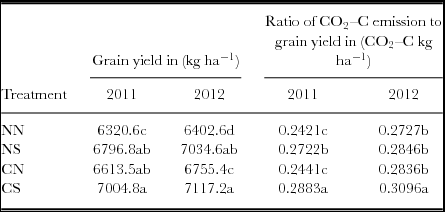
The soil CO2–C emission rates of the CS treatment resulted in the highest grain yield (7117.23 kg ha−1 in 2011, and 7004 kg ha−1 in 2012), but it was not significantly higher than that in the NS treatment, followed by the CN treatment and the lowest grain yield was observed in the NN treatment (Table 1). In 2011, the grain yield in the NN treatments was lower than those in the CS, NS and CN treatment by 714.62 kg ha−1, 631.42 kg ha−1 and 352.77 kg ha−1, respectively. Furthermore, the ratio of CO2–C emission to grain yield in the NN treatment was only 0.24 CO2–C kg ha−1, which was significantly lower than that in the CS and NS treatments (by 0.05 CO2–C kg ha−1 and 0.03 CO2–C kg ha−1, respectively). The same trend was observed in 2012 (Table 1). Therefore, CS significantly increased the grain yield and the ratio of soil respiration to grain yield of summer maize.
Grain yield and ratio of CO2–C emission to grain yield in 2011 and 2012 summer maize-growing seasons.

NN, NS, CN and CS represent no tillage with no straw application, no tillage with straw application, conventional tillage with no straw application and conventional tillage with straw application, respectively. In each column, values followed by different letters are significantly different among treatments.
Rate of CO2–C emission
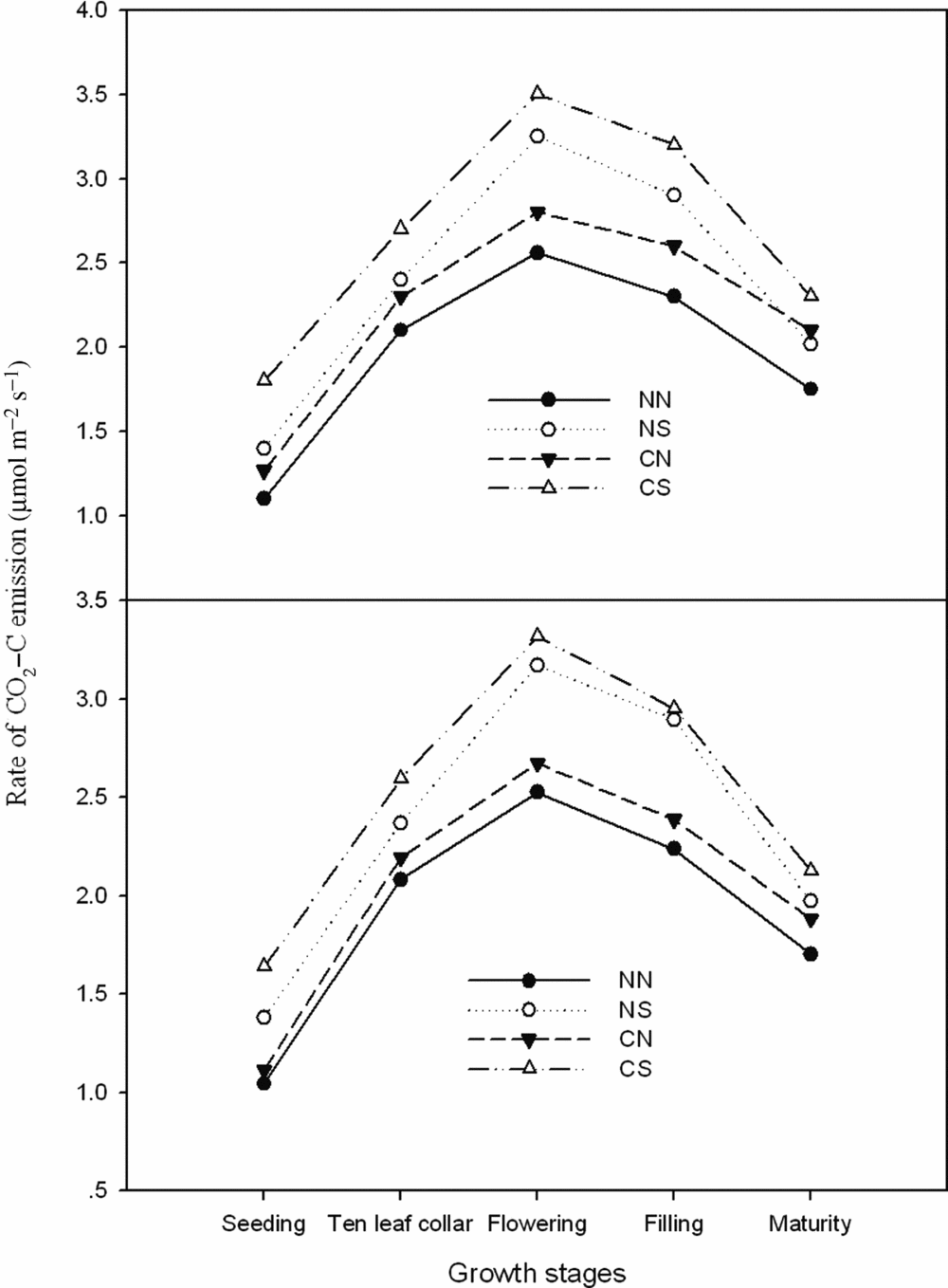
The rate of CO2–C emission is a critical parameter that reveals CO2 emissions from farmland. Under different tillage and straw application conditions, the rate of CO2–C emissions varied in the four treatments according to the developing growth stages and presented a peak curve (Figure 1). From the seeding to flowering stages, the soil CO2–C emission rate increased remarkably, and, at the flowering stage, it reached the maximum value before declining rapidly. The soil CO2–C emission rate was significantly lower in the no-tillage system than in the conventional tillage system. Further, the mean soil CO2–C emission rate in the NN and NS treatments were significantly lower than those in the CN and CS treatments by 10.0% and 12.5%, respectively, in 2011 and by 5.0% and 4.0%, respectively, in 2012. Regardless of whether tillage was used, the soil CO2–C emission rate was significantly higher when straw was applied (NS and CS treatments) than when it was not applied (NN and CN treatments). The CO2–C emission rates in the NS and CS treatments significantly increased by 20.0% and 13.6%, respectively, in 2011 and by 26.3% and 25.0%, respectively, in 2012. In both the summer maize-growing seasons, the mean soil CO2–C emission rates in the conventional tillage farmland were 1.14 and 1.09 times higher than those in the no-tillage farmland, respectively.
Soil CO2–C emission rate at different growth stages during 2011 and 2012 summer maize-growing seasons. NN, NS, CN and CS represent no tillage with no straw application, no tillage with straw application, conventional tillage with no straw application and conventional tillage with straw application, respectively.

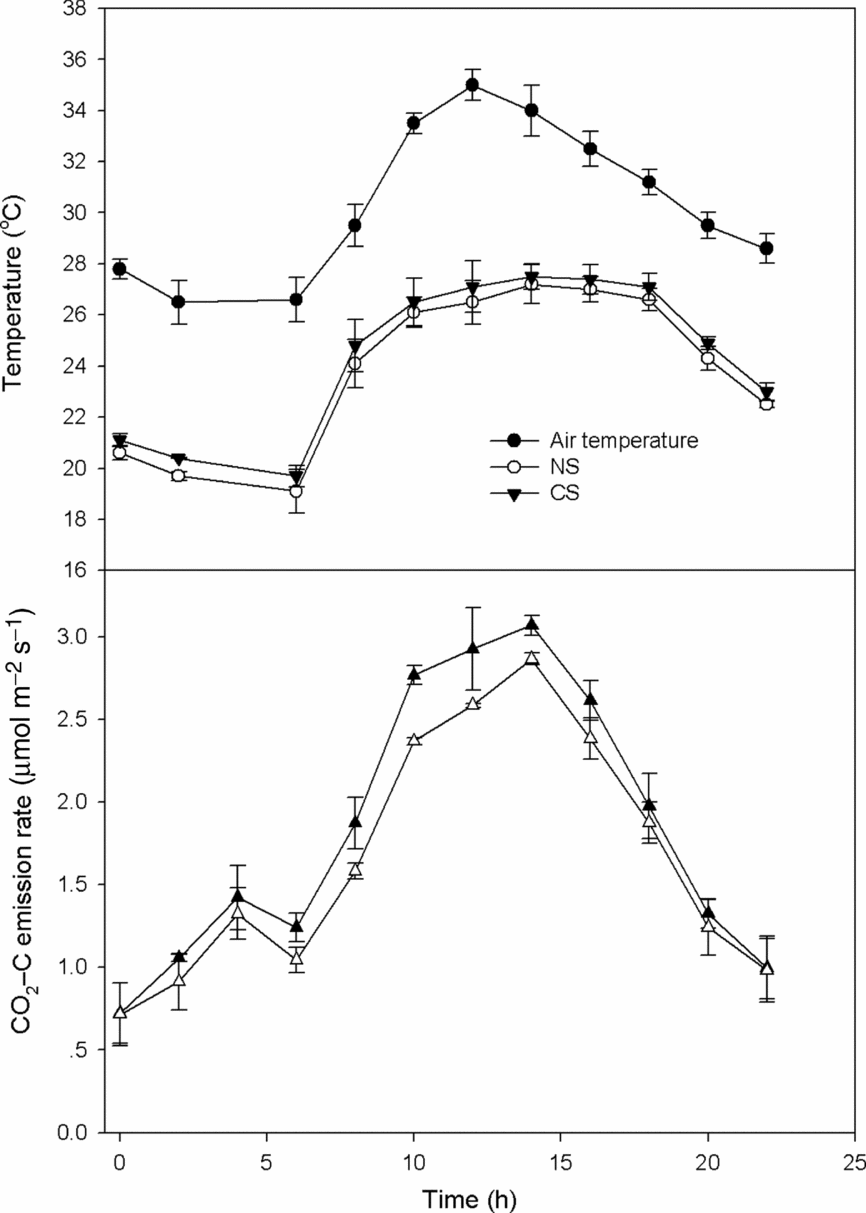
Soil tillage significantly affected soil CO2–C emission rates over a period of 1 day. The data from 15, August 2012 is shown in Figure 2; similar results were obtained on the other days. After straw application, the mean soil CO2–C emission rate in the CS treatment was higher than that in the NS treatment by 5.88%; the mean soil CO2–C emission rates for CS and NS treatments were 2.2 and 2.0 µmol m−2 s−1, respectively, from 06:00 to 20:00 h, whereas they were only 1.1 and 1.0 µmol m−2 s−1, respectively, from 18:00 to 04:00 h. This indicates that the increase in soil CO2–C emission rate was considerably greater during the day than during the night.
Temperature of air, soil in 20 cm and soil CO2–C emission rate on 15, August 2012. NS and CS represent no tillage with straw application and conventional tillage with straw application, respectively.

Soil temperature
The soil temperature increased with increasing air temperature at a depth of 20 cm (Figure 2). Although the soil temperature was considerably higher in the CS treatment than in the NS treatment, the increase in soil temperature exhibited a hysteretic effect in relation to air temperature. The highest air temperature was recorded at 12:00 h; however, the highest soil temperature in the NS and CS treatments was recorded at 14:00 h. The effect of soil tillage on soil temperature was not consistent from 08:00 to 18:00 h, and the mean soil temperature was higher by 0.4 °C in the CS treatment than in the NS treatment; however, from 20:00 to 06:00 h, was higher by 0.6 °C in the CS treatment than in the NS treatment. Therefore, the effect of tillage on soil temperature was considerably greater during the night than during the day.
Soil organic carbon
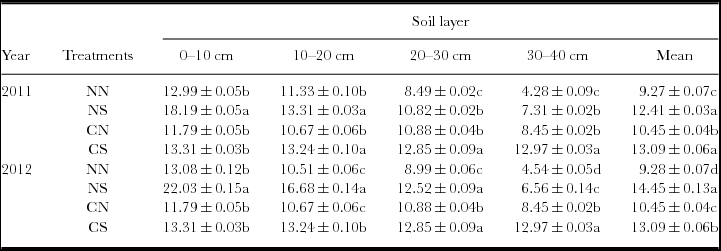
Tillage and straw application in both the summer maize-growing seasons significantly affected the soil organic carbon content; this parameter was slightly higher in 2012 than that in 2011 (Table 2). The effect of tillage and straw application was different between the soil layers. In the 0–10-cm soil layer, the soil organic carbon content in the NS treatment was significantly greater than that in the NN, CN and CS treatments by 5.20%, 6.40% and 4.88%, respectively, in 2011, and by 8.95%, 10.24% and 8.72%, respectively, in 2012. In the 10–20-cm soil layer (in both the growing seasons), the soil organic carbon content in the NS treatment was significantly greater than those in the CN and NN treatments. In the 20–30-cm soil layer (in both the growing seasons), the soil organic carbon content in the CS treatment was significantly greater than that in the NN treatment. In the 30–40-cm soil layer, the greatest soil organic carbon content was found in the CS treatment, which was significantly higher than those in the CN, NS and NN treatments. Therefore, straw application can increase soil organic carbon content in both the no-tillage and conventional tillage systems; however, it is significantly higher in the 0–20-cm soil layer and in more than 20-cm soil layer in the no-tillage and conventional tillage systems, respectively.
Soil organic carbon at maturity in 2011 and 2012 summer maize-growing seasons %.

NN, NS, CN and CS represent no tillage with no straw application, no tillage with straw application, conventional tillage with no straw application and conventional tillage with straw application, respectively. In each column, values followed by different letters are significantly different among treatments.
In the 20–30-cm soil layer (in the both growing seasons), the soil organic carbon content in the CS treatment was significantly greater than that in the NN and CN treatment. In the 30–40-cm soil layer, the greatest soil organic carbon content was found in the CS treatment, which was significantly higher than that in the CN, NS and NN treatments.
Relationship between the ratio of CO2–C emission to grain yield and soil CO2–C emission rate
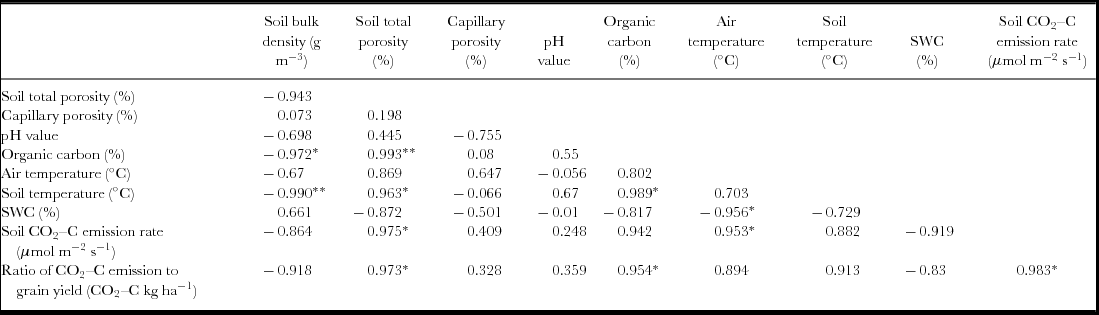
The relationships between the ratio of CO2–C emission to grain yield, soil CO2–C emission rate, soil and air temperatures and soil physical parameters were investigated (Table 3). Correlation analysis showed that the soil CO2–C emission rate (r = 0.983, p < 0.05), total soil porosity (r = 0.973, p < 0.05) and organic carbon content (r = 0.954, p < 0.05) were significantly correlated with the ratio of CO2–C emission to grain yield.
Correlation analysis of the ratio of CO2–C emission to grain yield and soil CO2–C emission rate.

DISCUSSION
The results of the present study indicated that, during the summer maize-growing seasons in the North China Plain, no tillage could significantly decreases the ratio of CO2–C emission to grain yield; this might increase the soil organic carbon content and decrease the CO2–C emission rate. Jia et al. (Reference Jia, Zhang, Chen, Mclaughlin, Zhang, Wei, Sun and Liang2015) suggested that conservation tillage is a recommended management practice for increasing the soil organic carbon pool in agricultural ecosystems. The high soil organic carbon concentration in the 0–40-cm soil layer with no tillage was attributed to soil–straw interaction, which causes low rates of mineralisation. These results are consistent with those of previous studies, which showed higher soil organic carbon concentration with no tillage than that by conventional or minimal tillage (David and Rattan, Reference David and Rattan2009; Halvorson et al., Reference Halvorson, Wienhold and Black2002; Sainju et al., Reference Sainju, Lenssen, Caesar-Thonthat and Waddell2006). Conventional tillage causes progressive homogenisation of soil organic carbon concentrations in the ploughed layers, because of the mechanical distribution of straw throughout the tillage zone.
Regardless of whether tillage was used, straw return increased the ratio of CO2–C emission to grain yield, because it increased the soil CO2–C emission rate; this finding is consistent with that of Guan et al. (Reference Guan, Wang, Song and Liu2011), while straw mulching effectively controlled the soil respiration rate and cumulative CO2 emission flux, and significantly decreased the amount of CO2 emission per unit grain yield (Liu et al., Reference Liu, Liu, Bian, Ma, Lang, Han and Li2014). So we can see that means of straw application affected soil CO2–C emission rate, and then affected the ratio of CO2–C emission to grain yield. To address this issue, several additional explorations are still needed. However, Sun et al. (Reference Sun, Zhang, Cai and Chen2009) found that conservation tillage (no tillage) decreased soil respiration compared to that by conventional tillage, with the best effects observed with no tillage plus straw (by straw mulching). This effect might be attributed to the following two reasons. First, as shown in many studies, straw application can decrease soil temperature (Li et al., 2008; Zhang et al., Reference Zhang, Li, Yu, Shi and Cheng2008); the greater the amount of straw applied, the greater is the reduction in soil temperature. Under conditions of high soil moisture, a positive correlation was observed between soil respiration rate and soil temperature (Tang et al., Reference Tang, Wang and Ruan2008). Second, straw application could increase soil moisture content. Under conditions of high soil moisture, the activities of summer maize roots and aerobic microorganisms might be inhibited. Therefore, the decomposition rate of soil organic matter as well as soil respiration rate decreased, and thus the ratio of CO2–C emission to grain yield. Further, differences in the way straw is applied will varyingly affect the ratio of CO2–C emission to grain yield.
Both soil tillage and straw application could significantly affect the physical characteristics of soil. Ji et al. (2013) showed that soil penetration resistance, bulk density and soil moisture content were significantly affected by tillage practices, and the characteristics of soil respiration were dependent on the correlation between soil respiration and soil moisture (Xie et al., Reference Xie, Fan, Qi and Hao2010). Events of frequent weather changes are increasing, and together with global climate changes, the effects of changing weather on the soil CO2–C emission rate during the summer maize-growing seasons in North China remain unclear. Therefore, elucidating these mechanisms is not only essential for understanding soil CO2–C emission rate characteristics with soil tillage and straw applications but also for obtaining theoretical and practical knowledge of crop planting techniques in the North China Plain.
In conclusion, our study results suggest that straw application through increased carbon input can increase soil CO2–C emission; however, straw application and no tillage can decrease the ratio of CO2–C emission to grain yield through an overall greater grain yield as compared to conventional treatments. Therefore, CO2–C emissions from the soil can be reduced by using strategies that increase carbon inputs into the soil and reduce the decomposition potential of soil. Therefore, we suggest that the most effective way to reduce the ratio of CO2–C emission to grain yield is to decrease soil disturbance by eliminating or reducing tillage in this region.
Acknowledgements
This work was financially supported in part by the National Nature Science Foundation of China (31101127 and 31471453).