Implications
In ruminant nutrition, intake of forage NDF is considered the major driver for eating and ruminating activity, but this study clearly demonstrated additional effects of forage intake level and content of indigestible NDF. Furthermore, results from this study showed that the ratio between eating and rumination time decreases with lower intake of forage NDF. Such information may contribute to improvement of feed evaluation systems and hence the formulation of feed rations adequate in NDF to maintain a healthy rumen.
Introduction
In ruminant nutrition, mastication during feed ingestion and rumination reduces feed particle size, promoting effective rumen fermentation, and hence NDF digestibility, and indirectly improving the rumen environment by secretion of rumen-buffering saliva (Mertens, Reference Mertens1997). The intake of forage NDF is generally considered the major driver for eating and ruminating activity, and rations for dairy cattle are therefore formulated to contain sufficient NDF to maintain a healthy rumen function (Nørgaard et al., Reference Nørgaard, Nadeau and Randby2010).
Mertens (Reference Mertens1997) introduced the concept of physically effective fiber, integrating NDF content and particle size as the most important forage features stimulating chewing activity and rumen mat formation. The NDF fraction, however, is increasingly lignified with progressing stages of plant maturity, making the NDF more resistant to physical degradation and hence increasing the need for mastication to degrade particles to the same degree (Allen, Reference Allen1996). De Boever et al. (Reference De Boever, De Smet, De Brabander and Boucque1993) found that eating and rumination time increased with increased maturity of grass silages, indicating that physical effectiveness of NDF is not constant, but rather increased by delayed harvest. It has been suggested that cows fed forage ad libitum spend a maximum of 9 to 10 h ruminating per day (Welch, Reference Welch1982; Bosch et al., Reference Bosch, Tamminga, Post, Leffering and Muylaert1992). Within that time period, the degree of particle size reduction from rumination depends on ingested feed amount, affecting the NDF mass to be ruminated as well as the passage rate from the rumen. A meta-analysis on chewing activity from grass and alfalfa forages by Nørgaard et al. (Reference Nørgaard, Nadeau and Randby2010) showed that a higher NDF intake per kg BW reduced rumination time and increased eating time per kg NDF intake. Reduced rumination time per kg NDF intake at increasing NDF intake was found by Bae et al. (Reference Bae, Welch and Smith1981) to be related to the rate of chewing during rumination, demonstrating how ruminants are able to adjust chewing efficiency to the amount of forage offered.
The physical structure value of feedstuffs in the Nordic ration formulation system, NorFor, is estimated from NDF content, feed particle size, and indigestible NDF (iNDF) content (Nørgaard et al., Reference Nørgaard, Nadeau, Randby and Volden2011), yet the significance of intake is not incorporated. The development in recent years in the intensive milk production has gone toward both higher feed intake and higher forage : concentrate ratio, driven by increased forage digestibility; for green forages obtained by earlier harvest often resulting in NDF concentrations below 40% NDF in DM. Most previous studies on physical effectiveness of NDF have been performed on forage with more than 40% NDF in DM (Nørgaard et al., Reference Nørgaard, Nadeau and Randby2010). Consequently, little is known about the physical effectiveness of NDF when pushing the lower limits of forage NDF intake by feeding highly digestible forages. The hypothesis of this study was that lower intake of NDF results in more rumination time per kg NDF intake, a smaller proportion of large feces particles, and greater apparent NDF digestibility. The objective of this study was to assess effects of increasingly restricted intake of grass-clover silages of different NDF contents on eating and rumination activity, and consequently, on fecal particle size distribution and apparent digestibility in dairy heifers. Feed intake, chewing activity and fecal particle size from the silages fed at 90% of ad libitum feeding were reported by Schulze et al. (Reference Schulze, Weisbjerg, Storm and Nørgaard2014b).
Material and methods
Forages
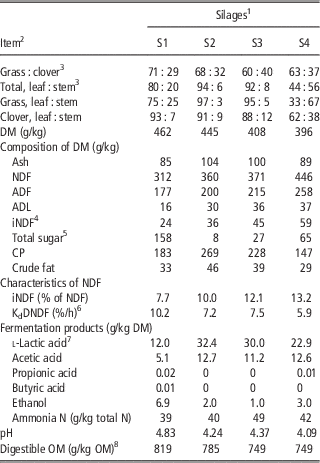
Grass-clover from a mixed sward of perennial ryegrass (Lolium perenne), red clover (Trifolium pratense), and white clover (Trifolium repens) was harvested in 2009 at Aarhus University, Foulum, Denmark (56°29′N, 9°35′E) in four different cuts for silage to represent four levels of NDF content. Silages were given abbreviations of S1 to S4 according to increasing NDF content, decreasing potential NDF digestibility and decreasing NDF degradation rate. They consisted of spring growth at an early vegetative stage, harvested on 9 May (S1), first regrowth at beginning heading stage, harvested on 22 June after 42 days regrowth (S4), early harvest third regrowth at an early vegetative stage, harvested on 7 August after 7 days regrowth (S2), and late harvest third regrowth at a late vegetative stage, harvested on 23 August after 33 days regrowth (S3). Crops were pre-wilted in the field to ~40% dry matter (DM), chopped to 19.2 mm theoretical length of cut (John Deere 6750), baled in round bales (Orkel MP 2000 Compactor; Orkel, Fannrem, Norway), and ensiled by wrapping with 11 layers of 25 µm plastic without use of ensiling additives. Botanical composition was conducted by manual separation of clover and grass and determination of the dry weight of the plants. For both grass and clover, the leaves were separated from the stems and dried separately to determine the leaf : stem ratio on a dry-matter basis (Table 1).
Characteristics and chemical composition of experimental grass-clover silages

DM=dry matter; iNDF=indigestible NDF; DNDF=digestible NDF; OM=organic matter.
1 Harvests were S1 (9 May, spring growth), S2 (7 August, 3rd regrowth), S3 (23 August, 3rd regrowth), S4 (22 June 1st regrowth).
2 Values are means of n=4 samples per silage type. All analyses were performed twice per sample at minimum.
3 Weight proportion of DM of plant parts in harvested fresh crop, determined by morphological separation of plant species and parts.
4 iNDF estimated by incubation 288 h in situ.
5 Glucose, fructose, sucrose and fructan determined by the Luff-Schoorl method.
6 Rate of degradation of potentially DNDF.
7 Total lactic acid concentration approximates two times l-lactic acid.
8 Digestible OM determined in vitro (Tilley and Terry, Reference Tilley and Terry1963).
Animals, diets and experimental design
All experimental procedures followed a protocol approved by the Research Animal Ethics Committee (The Animal Protection Law, The Danish Ministry of Justice).
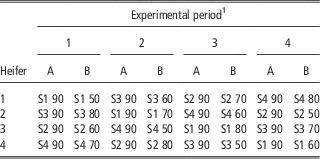
The dietary treatments consisted of one of the four silages and were, apart from mineral supplements, fed as the only source of feed to four rumen-fistulated Jersey heifers of 343±32 kg initial BW. The silages were fed in a balanced 4×4 Latin square design replicated at further restricted feeding levels following a balanced 4×4×4 Greco-Latin square design (Table 2). This allowed for testing all treatments offered at a slightly restricted (90% of ad libitum) and under further restriction (50%, 60%, 70% or 80% of ad libitum). The experimental periods were 28 days, each divided into four sub-periods. First, there was an adaptation period to the diet with ad libitum feeding offered (days 1 to 11). Second, a data collection period (days 15 to 20) with 90% of ad libitum intake offered from day 12. Third, a period of adaptation to one of four further restricted feeding levels (days 20 to 24). And fourth, a second data collection period at restricted feeding (days 25 to 28). The restricted feeding levels (50% to 90%) offered during data collection were calculated from individual ad libitum intake during days 7 to 11, allowing 10% refusals.
Experimental design, showing allocation of forage treatment (S1 to S4) and feeding levels (50% to 90% of ad libitum) to heifers during the experimental periods
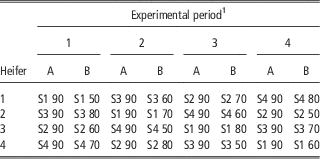
1 Each period contains two sub-periods of data collection, each preceded by an adaptation period. A is a data collection period at 90% feeding level, and B is a data collection period at 50%, 60%, 70% or 80% feeding level, in a randomized square.
Heifers were kept in individual tie stalls with rubber mats and had access to separate, automatic water bowls and troughs for forage. Live weights of the heifers were recorded before each experimental period and at the end of the experiment. Silages were fed twice daily with half the amount fed at 0800 h and half at 1530 h. Weight of orts in troughs were recorded before the morning meal. Mineralized salt blocks (biotin 12 mg/kg, manganese 190 mg/kg, iron 210 mg/kg, copper 80 mg/kg, cobalt 12 mg/kg, zinc 300 mg/kg, iodine 50 mg/kg, selenium 20 mg/kg; Brogaarden, Denmark) were available during adaptation periods. For apparent total tract digestibility measurement, a chromic oxide marker was used according to the method described by Lund et al. (Reference Lund, Weisbjerg, Hvelplund and Knudsen2007).
Data and sample collection
Silages were representatively sampled by random grab sampling throughout each bale. Samples were gently mixed, pooled into representative samples of 2 kg per bale, and stored at −20°C for later analysis. Samples of 150 g feces were collected rectally from each heifer at 0730, 1200 and 1500 h on days 15 to 17, mixed, and frozen at −20 °C for later analysis.
Eating activity was estimated from feed-intake challenges performed on day 15 during four test meals, each of 20 min duration. For this, meals consisting of 20% of the daily ration were offered in the morning at 0800 and 0825 h, and in the afternoon at 1530 and 1555 h. Feed orts were weighed after each test meal and offered to the heifers with the remaining feed ration after the second and fourth test meals. Eating time relative to feed intake was calculated (mean of the four meals), and total eating time per day was estimated by multiplying eating time per kg DM intake by DM intake. Rumination activity was recorded for 72 h continuously from day 15 at 0800 h. Jaw movement (JM) were automatically recorded by use of a jaw recorder and a modified GigaLog F logger (Controlord, La Farlede, France) logging digitized JM oscillations at 20 Hz as described by Nørgaard and Hilden (Reference Nørgaard and Hilden2004). The individual JM were clustered into crude ruminating cycles while eating, idling or licking behaviors were filtered out using the principles described by Schleisner et al. (Reference Schleisner, Nørgaard and Hansen1999). The basic chewing rate (BCR) within each cycle was calculated as the reciprocal of the most frequent time interval between successive JM, and given in JM/s. The effective daily rumination time was calculated as the accumulated duration of rumination cycles excluding inter-cycle time. Estimated total chewing time was the sum of eating and effective rumination time.
Analytical procedures
DM was determined in fresh silage, ingestive masticate, ruminal contents, and feces by drying under forced air for 24 h at 60°C. Silage and feces were freeze-dried and ground to 1.5 mm before chemical analysis. Ash was determined by combustion at 525°C for 6 h. The contents of NDF in forages and feces were analyzed using filter bags in an ANKOM apparatus (ANKOM200, 65 r.p.m. agitation; ANKOM Technology, Fairport, NY, USA) according to Van Soest et al. (Reference Van Soest, Robertson and Lewis1991). The analysis was modified by adding a thermo stable α-amylase (Termamyl; Novo Nordisk, Bagsværd, Denmark) during neutral detergent boiling. Forage NDF was subsequently analyzed for ADF and ADL according to Van Soest (Reference Van Soest1973). The NDF, ADF and ADL contents were all reported as corrected for residual ash after ADL treatment. Total sugar was analyzed by the Luff-Schoorl method (European Community, 1971). CP contents of silages were analyzed by the Kjeldahl procedure (Association of Official Analytical Chemists, 2012). Determination of crude fat in silage was performed by HCl hydrolysis followed by petroleum ether extraction (Association of Official Analytical Chemists, 2012) in a Soxtec system (Foss, Hillerød, Denmark). In vitro organic matter (OM) digestibility was performed according to Tilley and Terry (Reference Tilley and Terry1963). Analysis of silage pH and fermentation products was made from silage extracts. Water (500 ml) was added to thawed samples (50 g) and blended in a Bosch Chopper (Type: CNCM13ST1, Ballerup, Denmark). A sample of 40 ml homogenized sample was centrifuged. The pH was measured in the supernatant before stabilizing with 5% metaphosphoric acid. Concentrations of acetic acid, propionic acid, butyric acid, lactic acid, glucose and ammonia were quantified as described by Nielsen et al. (Reference Nielsen, Kristensen and Weisbjerg2007).
The content of potentially digestible NDF (DNDF), the iNDF, and the rate of DNDF degradation of the silages were assessed by incubations in situ, as described by Åkerlind et al. (Reference Åkerlind, Weisbjerg, Eriksson, Tøgersen, Udén, Ólafsson, Harstad and Volden2011). Dry and ground (1.5 mm) silage samples were incubated for 0, 2, 4, 8, 16, 24, 48, 96, 168 (38 µm pore size bags) and 288 h (iNDF, 12 µm pore size bags) in the rumen of three cows fed at a maintenance energy level in two equal daily meals. Further details on the incubation procedure are described by Schulze et al. (Reference Schulze, Weisbjerg, Storm and Nørgaard2014b). Residues for NDF determination were transferred directly to filter crucibles for analysis of ash-free NDF, using the FibertecTM 2010 (Foss) according to Mertens (Reference Mertens2002). Rate of NDF degradation was calculated by non-linear curve fitting of degradation profiles up to 168 h incubation time and corrected for DNDF, according to Åkerlind et al. (Reference Åkerlind, Weisbjerg, Eriksson, Tøgersen, Udén, Ólafsson, Harstad and Volden2011). The degradation profiles were fitted and reported without lag-time adjustment, as parallel estimations including lag time revealed that estimated lag times were <0.6 h.
Chromic oxide content of feces samples was determined colorimetrically after oxidation to chromate, as described by Schürch et al. (Reference Schürch, Lloyd and Crampton1950). Total feces output was calculated from the increase in chromic oxide in feces when compared with chromium oxide fed. Digestibility of OM, NDF and DNDF was calculated from fecal output of nutrients relative to ingested nutrients.
For determination of particle size distribution of feces, feces samples were washed and freeze-dried into particulate DM (PDM), as described by Kornfelt et al. (Reference Kornfelt, Nørgaard and Weisbjerg2013) The PDM was separated into seven fractions by dry-sieving with a vertical sieve shaker (Retsch AS 200; Retsch GmbH, Haan, Germany) using sieves of 2.360, 1.000, 0.500, 0.212 and 0.106 mm aperture, and a bottom bowl. The weight proportions of the sieving fractions were summarized into small particles (SP; <0.212 mm), medium particles (MP; 0.212 to 1.0 mm), and large particles (LP; >1.0 mm). The geometric mean particle size (GPS) was calculated based on a log-normal distribution of particle mass proportions according to Waldo et al. (Reference Waldo, Smith, Cox, Weinland and Lucas1971), described in detail by Schulze et al. (Reference Schulze, Weisbjerg, Storm and Nørgaard2014b).
Statistical analysis
One heifer was reluctant to eat during ad libitum adaptation to feed in period 1 and was excluded from that period. To ensure representation of data from all silages at all feeding levels, a fifth period was conducted as replication of period 1. Data from another heifer were excluded from period 5 because of feed refusals during data collection. The number of observations statistically analyzed were n=36. The distribution of observations within feeding levels was 90% (n=18), 80% (n=5), 70% (n=5), 60% (n=4), 50% (n=4). Within silage NDF contents in DM, the distribution of observations was 312 g/kg (n=16), 360 g/kg (n=16), 371 g/kg (n=18), 446 g/kg (n=18).
All data were analyzed using the MIXED procedure with random statement in SAS 9.2 (SAS Institute, Cary, NC, USA). A linear model was tested on individual ad libitum feed intake to determine treatment differences (n=18):
 $$Y=\mu {\plus}a\left( {{\rm treatment}} \right){\plus}b\left( {{\rm period}} \right){\plus}C\left( {{\rm heifer}} \right){\plus}e$$
where Y i is the dependent variable, μ the overall mean, a the fixed effect of treatment (S1, S2, S3, and S4), b the fixed effect of period (1 to 5) and C the random effect of heifer. Treatment effect and linear, quadratic, and cubic contrast effects of NDF content of the silages were reported. Effects were considered significant at P<0.05.
To determine effects of increasing NDF content and reduced feeding level and to evaluate their interactions, a quadratic regression model was tested on responses of chewing activity, digestibility, and fecal characteristics (n=36):
 $$\eqalignno{ Y =\mu {\plus}\alpha \left( {{\rm NDF}} \right){\plus}\beta \left( {{\rm level}} \right){\plus}\gamma ({\rm NDF}{\times}{\rm level}){\plus}\delta \left( {{\rm NDF}^{{\rm 2}} } \right) \cr \quad {\plus}\rho \left( {{\rm level}^{{\rm 2}} } \right){\plus}D\left( {{\rm period}} \right){\plus}E\left( {{\rm heifer}} \right) \cr \quad {\plus}F({\rm period}{\times}{\rm heifer}){\plus}e $$
where Y is the dependent variable, μ the overall mean and e the error term. Symbols α and δ denote the linear and quadratic slope effects of the NDF content of the silage treatments. Symbols β and ρ denote the linear and quadratic slope effects of the restricted feeding levels offered to the heifers. Symbol γ denotes the slope effect of linear interaction between NDF content and restricted feeding level (NDF×level). Random effects of heifer, period, and interaction between heifer and period were included, to deal with possible dependency between the two consecutive observations from a heifer within each period. Slope effects were considered significant at P<0.05, and the NDF×level interaction and the quadratic effects of NDF and level were removed stepwise from the model, if non-significant. Regression parameter estimates are reported with the corresponding P-values and root mean square error from Satterthwaite approximation. Quadratic effects were marked with subscript Q in the results section. Pearson’s correlations were estimated using the CORR procedure.
Results
Silages and feed intake
The S1 to S4 silages contained 312to 446 g/kg DM (Table 1). The NDF contents of all silages were low compared with previous studies that is Rinne et al. (Reference Rinne, Huhtanen and Jaakkola2002) and De Boever et al. (Reference De Boever, De Smet, De Brabander and Boucque1993).
The effect of silage NDF content on ad libitum feed intake (100%), forming the basis for the restricted feeding levels, is presented in Table 3. A greater NDF content was associated with greater ad libitum intake of silage DM intake (P<0.01) and silage NDF intake (P<0.05). Ad libitum intake of iNDF was associated with greater NDF content of silages (P<0.001). No effect of period was found on either of the feed intake responses (P>0.05; not reported). During periods of restricted feeding, practically no orts were found in the troughs before morning feeding.
Ad libitum feed intakeFootnote 1 by heifers as affected by NDF content of experimental silages

DM=dry matter; iNDF=indigestible NDF; TS=tendency to significance.
a–dWithin a row, means without a common superscript differ (P<0.05).
1 Least square means of ad libitum feed intake on days 7 to 11 in each period forming basis for restricted feeding levels during data collection. The 90% feeding level intake of DM, NDF and iNDF are reported by Schulze et al. (Reference Schulze, Weisbjerg, Storm and Nørgaard2014b).
2 Treatment details are found in Table 2.
3 Standard error of mean. For S1 and S2, n=4. For S3 and S4, n=5.
4 Probability of treatment (T) effect and linear (L), quadratic (Q) and cubic (C) contrast effects of the NDF content of the silages. Effects considered significant at P<0.05. Within a row, means without a common superscript differ (P<0.05).
*P<0.05, TS 0.05<P<0.10, **P<0.01, ***P<0.001.
Chewing activity
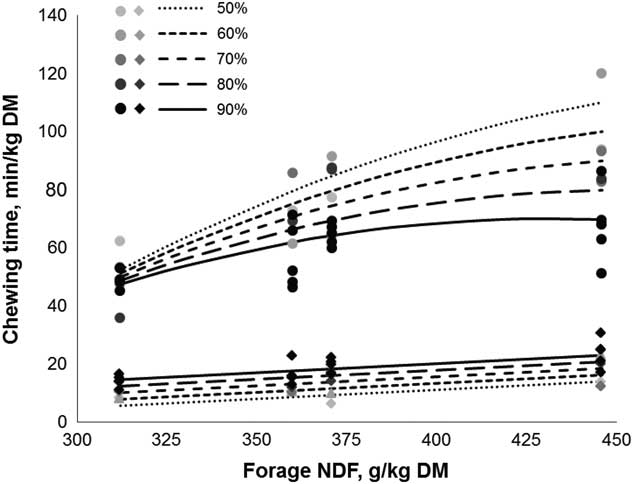
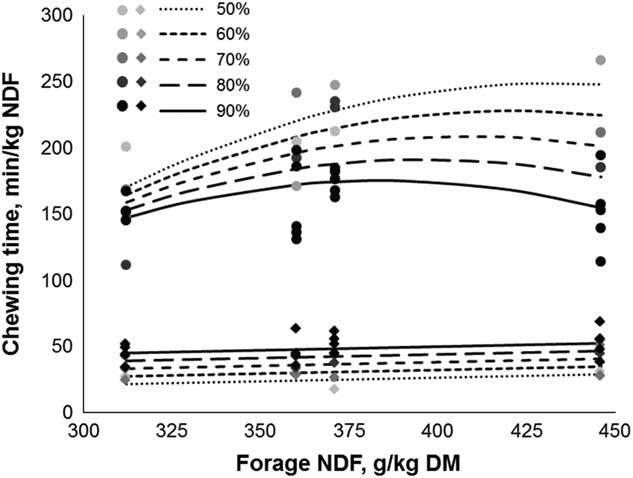
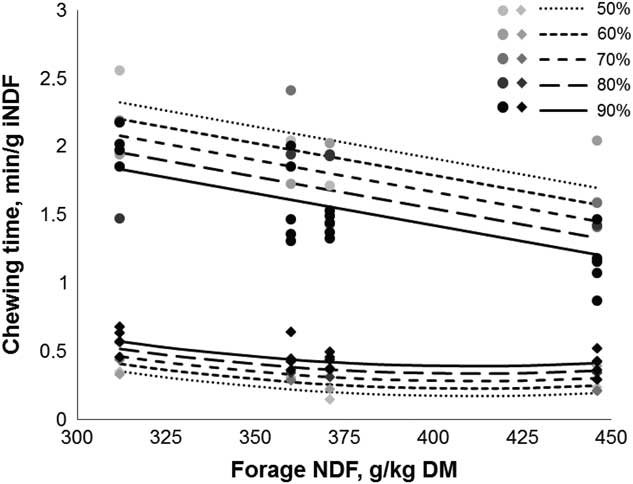
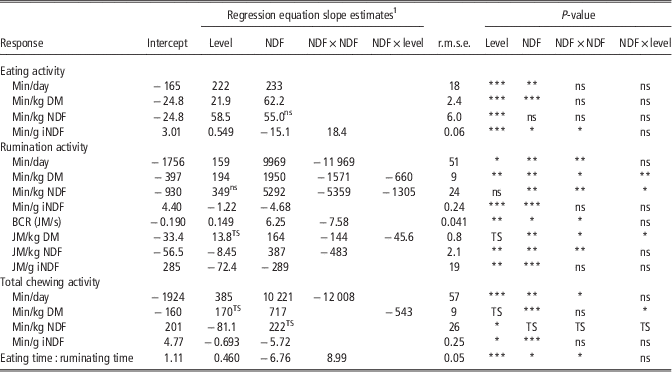
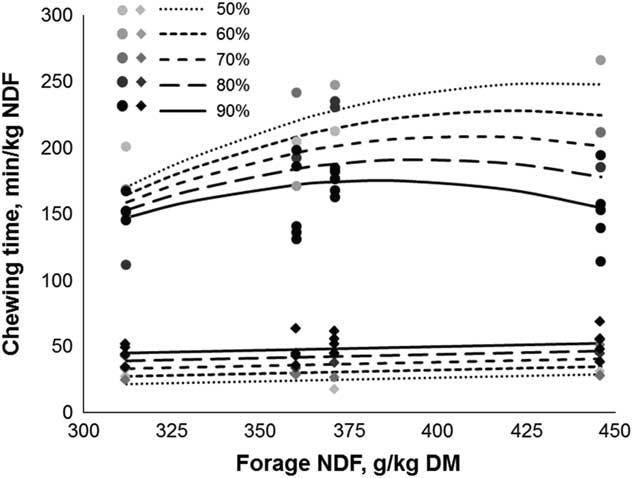
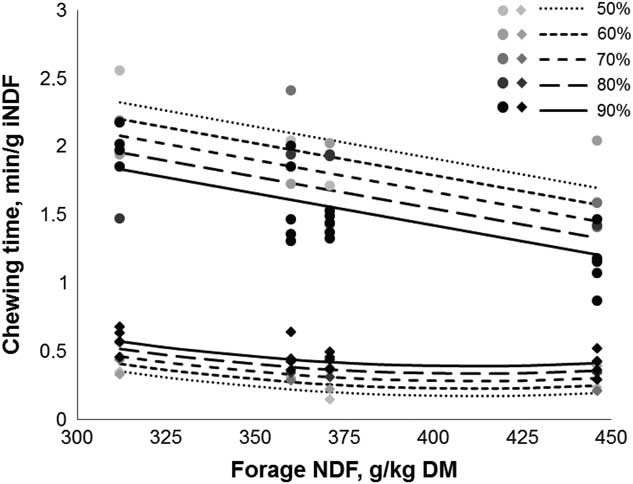
Regression equations related to chewing activity responses are presented in Table 4. Total eating time per day decreased with reduced feeding level (P<0.001) and increased with greater NDF content of the silages (P<0.01); the estimates for daily time spent eating from 50% to 90% feeding levels ranged from 20 min to 1.8 h with the S1 silage and from 50 min to 2.3 h with the S4 silage. Feeding level was associated with eating time relative to DM, NDF and iNDF intake (P<0.001). With greater NDF content of silages, eating time per kg DM intake increased (Figure 1; P<0.001), eating time per kg NDF intake was unaffected (Figure 2; P>0.1), and eating time per g iNDF intake decreased (Figure 3; P Q <0.05).
Eating time per kg dry matter (DM) intake (◆) as affected by feeding level (P<0.001) and NDF content (P<0.001), and rumination time per kg DM intake (●) as affected by feeding level (P<0.01) and NDF content (P<0.05, quadratic). Raw data on eating time and rumination time and regression lines are plotted; regression equations are found in Table 4.
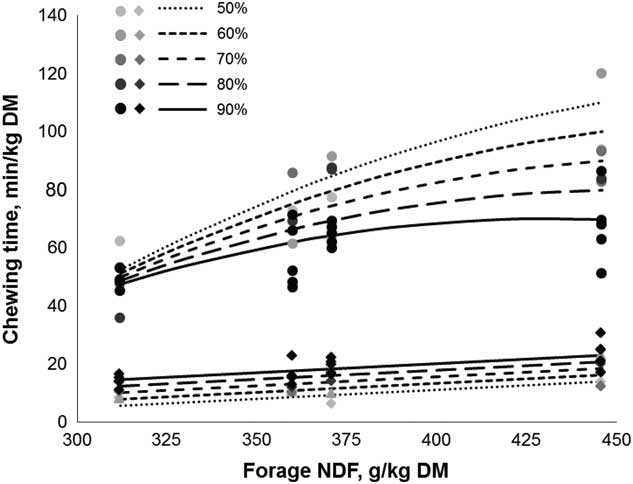
Eating time per kg NDF intake (◆) as affected by feeding level (P<0.001) and NDF content (P>0.1), and rumination time per kg NDF intake (●) as affected by feeding level (P>0.1), NDF content (P<0.01, quadratic), and the interaction between NDF content and feeding level (P<0.05). Raw data on eating time and rumination time and regression lines are plotted; regression equations are found in Table 4.
Eating time per kg iNDF intake (◆) as affected by feeding level (P<0.001) and NDF content (P<0.05, quadratic), and rumination time per kg iNDF intake (●) as affected by feeding level (P<0.001) and NDF content (P<0.001). Raw data on eating time and rumination time and regression lines are plotted; regression equations are found in Table 4.
Regression equations showing effects of feeding level (proportion of ad libitum intake) and NDF content (kg/kg DM) on chewing activity in heifers-fed grass-clover silage

DM=dry matter; iNDF=indigestible NDF; BCR=basic chewing rate during rumination; JM=jaw movement.
1 Estimated slope effects after model reduction. Effects of the fiber×level interaction and the quadratic effects of fiber and NDF were reduced from the model if non-significant (P>0.05) and regression parameter estimates were reported with the corresponding significance level. The quadratic effect of Level was non-significant for all responses in this table, and therefore not reported.
Significance levels:*P<0.05; **P<0.01; ***P<0.001; TS=tendency to significance (P<0.1); ns=non-significant (P>0.1).
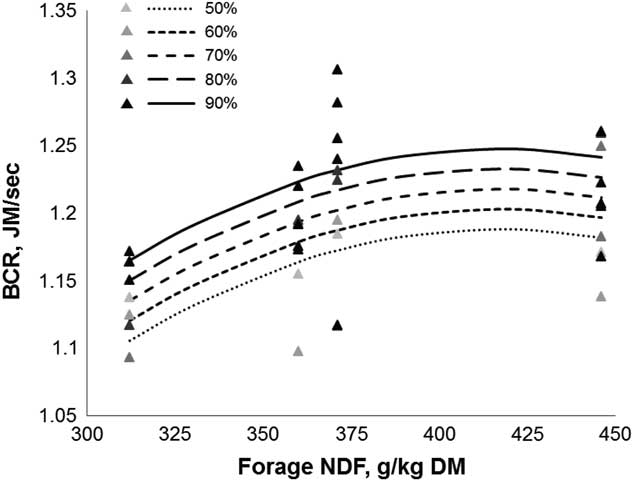
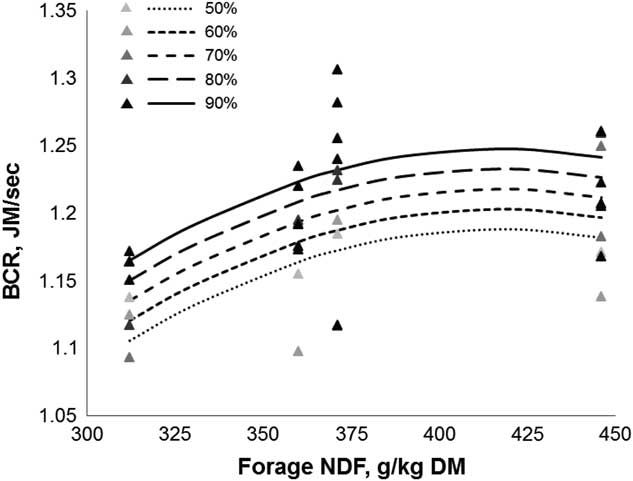
Total rumination time increased with greater NDF content (P Q <0.01) and was decreased by reduced feeding level (P<0.05), ranging from 4.5 to 7.7 h per day). Likewise, rumination time per kg DM intake increased with greater NDF content of silages (P Q <0.05). However, the relationship was dependent on feeding level (P<0.01). Generally, heifers ruminated more per kg DM intake at reduced feeding levels (P<0.01); however feeding level affected rumination time more when silages of greater NDF content were fed (Figure 1). Relative to NDF intake, rumination time also increased with increasing NDF content of silage (P<0.01), depending on feeding level (P<0.05), which affected rumination time per kg NDF intake mostly when silage of higher NDF content was fed (Figure 2). Rumination time per g iNDF intake also increased with reduced feeding level (P<0.001), but decreased with greater NDF (and iNDF) content of silages (Table 4 and Figure 3; P<0.001). The BCR (Figure 4) during rumination increased at a decreasing rate with greater NDF content of silage (P Q <0.05), and further, BCR decreased with reduced feeding level (P<0.01), showing that increasing NDF intake caused not only more total rumination time but also JMs during rumination that led to more particle size reduction.
Basic chewing rate (BCR; ▲) during rumination as affected by feeding level (P<0.01) and NDF content (P<0.05, quadratic). Raw data on BCR and regression lines are plotted; regression equation is found in Table 4.
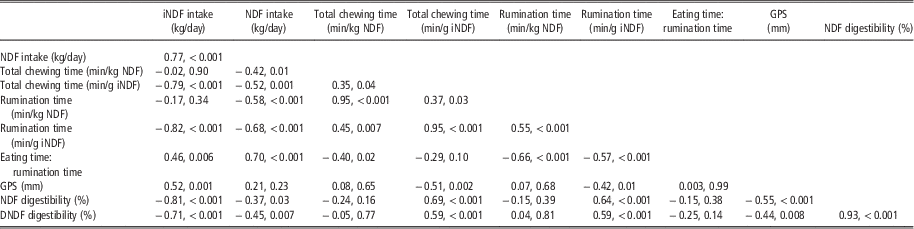
The ratio between eating time and rumination time was lower when feeding level was reduced (P<0.001); eating time comprised on average from 10% to 30% of total chewing time at the 50% and 90% feeding levels, respectively. To support this, the eating : rumination ratio was highly correlated with NDF intake (r=0.70, P<0.001; Table 5).
Pearson’s correlation coefficients (r; above) and P-values (below) between chewing time, fecal particle size and NDF digestibility from heifers-fed grass-clover silages

iNDF=indigestible NDF; GPS=geometric mean particle size in feces; DNDF=potentially digestible NDF.
The total time spent chewing never exceeded 10 h per day. Reducing the feeding level resulted in more total chewing time per kg NDF intake (P<0.05) and per g iNDF intake (P<0.05). There was an association between NDF content of silages and total chewing time per g iNDF intake (P<0.001).
Feces characteristics and apparent total tract digestibility
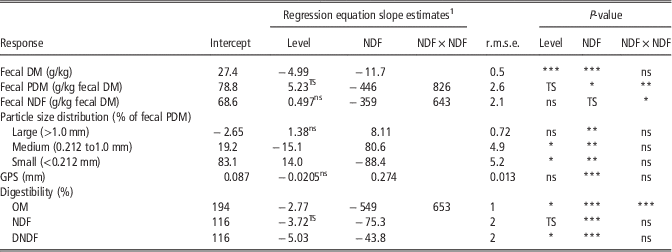
Regression equations related to digestibility and feces characteristics are shown in Table 6. Fecal NDF content was unaffected by feeding level (P>0.1). Both PDM and NDF contents in fecal DM increased at an increasing rate with greater NDF content of the silages (P Q <0.01; P Q <0.01), PDM ranging from 23% to 49% of fecal DM, and NDF ranging from 19% to 37% of fecal DM.
Regression equations showing effects of feeding level (proportion of ad libitum intake) and NDF content (kg/kg DM) on total tract digestibility and feces characteristics in heifers-fed grass-clover silage

DM=dry matter; PDM=particulate DM; GPS=geometric mean particle size in feces; OM=organic matter; DNDF=potentially digestible NDF (NDF – indigestible NDF).
1 Estimated slope effects after model reduction. Effects of the fiber×level interaction and the quadratic effects of fiber and NDF were reduced from the model if non-significant (P>0.05) and regression parameter estimates were reported with the corresponding significance level. The quadratic effect of level and the fiber×level interaction effect were non-significant for all responses in this table, and therefore not reported.
Significance levels: *P<0.05; **P<0.01; ***P<0.001; TS=tendency to significance (P<0.1); ns=non-significant (P>0.1).
Fecal particle size distribution was mainly affected by NDF content of the silages. The proportion of LP increased with greater NDF content of silages (P<0.01), however, only from 1.12% to 2.21% of PDM. The proportion of MP increased with greater NDF content of silages (P<0.01) and, conversely, the proportion of SP decreased with greater NDF content (P<0.01). The GPS was unaffected by feeding level (P>0.1) but increased linearly with greater NDF content of silages (P<0.001). Overall correlation tests (Table 5) showed that GPS became larger with a higher intake of iNDF (r=0.52, P<0.01) and smaller with increasing total chewing activity per g iNDF (r=−0.51, P<0.01). No significant correlation was found between GPS and intake of NDF or between GPS and chewing time per kg NDF intake.
OM digestibility increased with reduced feeding level (P<0.05), whereas greater NDF content decreased OM digestibility (P Q <0.001). Digestibility of NDF decreased with greater NDF content (P<0.001) and tended to increase slightly with reduced feeding level (P<0.1). Digestibility ranged from 82.6% OM digestibility, 89.8% NDF digestibility and 98.1% DNDF digestibility for the S1 silage at 50% of ad libitum feeding level to 75.3% OM digestibility, 79.3% NDF digestibility and 91.9% DNDF digestibility for the S4 silage at 90% of ad libitum feeding. The reduction in fecal GPS, was correlated with greater digestibility of NDF (r=−0.55, P<0.01) and DNDF (r=−0.44, P<0.01; Table 5). Total chewing activity per g iNDF intake was therefore also correlated with total tract digestibility of NDF (r=0.69, P<0.001) and DNDF (r=0.59, P<0.001).
Discussion
The decreasing ad libitum DM intake with greater NDF content of the silages was expected, as NDF content has by a range of studies been considered the chemical nutrient fraction most limiting to voluntary DM intake in ruminants (Allen, Reference Allen1996). The ad libitum NDF intake was 0.7% to 0.8% of BW, which was less than the expected 1% of BW by dairy heifers, suggested by Hoffman et al. (Reference Hoffman, Weigel and Wernberg2008). This indicated that intake was not physically constrained in this experiment.
The amounts of feed offered to the heifers throughout this experiment were calculated based on voluntary (ad libitum) intake of the four silages; hence, the actual DM intake at a particular restricted feeding level was higher for the S1 silage compared with the S4 silage. Within the continuous variable ‘level’ there were, therefore, as many different DM intakes as there are observations (n=36) in the experiment. Using ‘level’ in preference to simply using DM intake in the regression model takes into account the difference in ad libitum intake capacity among heifers.
Effect of feed intake and NDF content on chewing activity
The heifers spent more time ingesting the silages of higher NDF contents, likely because of greater physical resistance to degradation with increasing NDF content and lignification, as found by De Boever et al. (Reference De Boever, De Smet, De Brabander and Boucque1993). At 50% of ad libitum feeding, the heifers ate their morning ration within 1 h. In contrast, a feed ration of 90% of ad libitum fed in the morning was rarely consumed by the time of afternoon ration feeding. The decreased eating time with reduced feeding level was therefore assumed to be related to hunger, causing the heifers to consume forages more rapidly. Stereotyped oral behavior like bar-biting and tongue-rolling were observed during the trial, when heifers received the most restricted forage amounts. According to Redbo and Nordblad (Reference Redbo and Nordblad1997), restricted roughage feeding and the resulting short periods of chewing behavior induce oral stereotypies.
Forage particles require a certain amount of mechanical rupture during mastication to facilitate microbial fermentation, increase particle density and pass from the rumen (Allen, Reference Allen1996). When eating time relative to ingested amount of feed is reduced, less mechanical rupture is applied to the forage particles, and hence more rumination activity is needed to obtain sufficient forage particle size reduction. The decreased eating time and increased rumination activity with reduced feeding level found in this study clearly demonstrated this mechanism. The combination of a specific feeding level and NDF content of silage make up a specific intake of NDF to the individual heifer, and the significant interaction between NDF and feeding level on rumination per kg NDF intake indicates that rumination time per kg NDF intake was affected by NDF intake, as also shown by the negative across-treatment correlation between NDF intake and rumination time per kg NDF (r=−0.58; P<0.001). Increasing eating time and decreasing rumination time per kg NDF intake with greater NDF intake per kg BW was found in a previous meta-analysis by Nørgaard et al. (Reference Nørgaard, Nadeau and Randby2010). This was supported by Schulze et al. (2014a) where rumination time was reduced by 13 min/kg NDF intake with an increased NDF intake of 0.1% of BW (P<0.001).
Feeding silages of greater NDF content made heifers ruminate more per kg DM and NDF intake, as found in previous studies of perennial forages of different maturity at harvest (De Boever et al., Reference De Boever, De Smet, De Brabander and Boucque1993; Rinne et al., Reference Rinne, Huhtanen and Jaakkola2002; Kammes and Allen, Reference Kammes and Allen2012; Kornfelt et al., Reference Kornfelt, Nørgaard and Weisbjerg2013) with NDF contents up to 645 g NDF per kg DM (Rinne et al., Reference Rinne, Huhtanen and Jaakkola2002). The iNDF content in NDF was tested as a possible parameter in the full regression model. In the case of chewing responses, significant effects of iNDF content in NDF eliminated the significant quadratic effects of NDF content. However, since contents of iNDF and NDF were highly correlated (r=0.91), the iNDF parameter was not included in the final model. It might, however, explain the quadratic NDF effects of the above mentioned chewing responses, and suggests that stimulation of rumination time is to some extent controlled by the indigestible fraction of NDF. This agrees with Nørgaard et al. (Reference Nørgaard, Nadeau, Randby and Volden2011) and Schulze et al. (2014a) where rumination time per kg NDF was found to increase with greater iNDF : NDF ratio (P<0.01). The lignification of tissues in leaves and stems and hence the iNDF structure and brittleness differs greatly between grass and clover and between immature and mature forage (Wilson, Reference Wilson1994). The NDF resistance toward physical degradation from mastication was therefore likely affected by the great variation in grass : clover and leaf : stem ratio between the harvests in this experiment.
The combination of feeding silage of 312 g NDF per kg (S1) at 50% of ad libitum intake clearly stimulated the least daily time spent ruminating in this experiment, and because of the slower BCR found, the fewest JM were applied at the lowest NDF content and intake. The regression lines show no indication of leveling at a minimum rumination time per kg DM intake (Figure 1) or NDF intake (Figure 2) at the low NDF contents, and this experiment therefore showed no indication of a minimum need for rumination time. Rumination time never exceeded 7.6 h per day, and considering the maximum of 9 to10 h spent ruminating suggested by Welch (Reference Welch1982) and Bosch et al. (Reference Bosch, Tamminga, Post, Leffering and Muylaert1992), it is reasonable to believe the heifers were not limited in time for ruminating the consumed forage fiber to the same degree of particle size reduction. As rumination time relative to DM and NDF was more affected by feeding level at higher NDF contents, it was probably due to a greater need for mastication when NDF was more lignified, as previously discussed.
Fecal particle size and total tract forage digestibility
The increasing GPS and proportion of LP in feces found from silages of greater NDF content and higher iNDF : NDF ratio corresponds well with the reduced mastication time during both eating and rumination per g iNDF intake with greater NDF content of silages (Table 4). In contrast, Rinne et al. (Reference Rinne, Huhtanen and Jaakkola2002) found fewer particles >2.5 mm with greater NDF content of grass silages and Kornfelt et al. (Reference Kornfelt, Nørgaard and Weisbjerg2013) found fewer particles >1.0 mm with greater NDF content of red clover and white clover silages. Bae et al. (Reference Bae, Welch and Smith1981) found that particle size distribution and mean particle size were unaffected by restricting feed intake, in agreement with the present results, while Shaver et al. (Reference Shaver, Nytes, Satter and Jorgensen1988) found an increasing fecal particle size with higher feeding level. The positive correlation between iNDF intake and GPS (r=0.52; P=0.001) and the negative correlation between chewing time per g iNDF intake and GPS (r=−0.51; P=0.002), found in this study, suggests that forage iNDF content and intake constrain particle size reduction. The negative correlation between GPS and DNDF digestibility (r=−0.44; P=0.008) underlines that reduced particle size is a result of increased fiber digestion.
As with the chewing responses, iNDF content in NDF was tested as a possible parameter in the full regression model, and eliminated the significant quadratic effect of NDF content on OM digestibility. This suggested that OM digestibility decreased linearly with greater iNDF : NDF ratio. A linear decrease in DNDF digestibility with greater NDF content, and in this case also greater iNDF : NDF ratio, suggests that the DNDF fraction (determined in situ) is less available for fermentation in vivo with increasing iNDF : NDF ratio, as also indicated by a slower rate of DNDF degradation with greater iNDF : NDF ratio of the silages. Likely, the increased ad libitum NDF intake from silages of greater NDF content increased the passage rate and reduced feed residence time for rumen fermentation, resulting in the negative correlation between NDF intake and DNDF digestibility.
Feeding level is closely related to the rate of passage of feed through the digestive tract, and hence, also to feed particle residence time, exposure to degradation by rumination and fermentation, and eventually total tract digestibility of DNDF. Previous studies assessing effect of different restricted feeding levels on digestibility (Colucci et al., Reference Colucci, Chase and Van Soest1981; Okine and Mathison, Reference Okine and Mathison1991; Dias et al., Reference Dias, Patino, López, Prates, Swanson and France2011) found that OM and NDF digestibility decreased with increasing DM intake. The increased apparent total tract digestibility of OM, NDF and DNDF with reduced feeding level found in this experiment agrees with this, although the feeding level only tended to affect NDF digestibility.
Conclusions
Feeding grass-clover silages of decreasing NDF content to heifers increased chewing time relative to NDF intake, reduced mean fecal particle size, and increased DNDF digestibility. Restricting feeding levels made heifers eat for a shorter time per kg DM or NDF intake, while time for rumination and total chewing per kg DM or NDF intake were increased, causing the ratio between eating and rumination time to decrease with lower intakes of forage fiber. Particle size reduction and digestibility depended mostly on changes in NDF content, especially the iNDF content. Digestibility of NDF was negatively correlated with the mean particle size in feces.
Acknowledgements
This work was financially supported by ‘Mælkeafgiftsfonden’, Knowledge Centre for Agriculture – Cattle, the Faculty of Health and Medical Sciences at the University of Copenhagen, and the Research School in Animal Nutrition and Physiology (RAN) at the Faculty of Health and Medical Sciences, University of Copenhagen. The authors would like to thank Frank Oxvang Mortensen for technical assistance during the experiment and Ib Skovgaard for statistical support.