Introduction
The hemlock woolly adelgid (Adelges tsugae Annand) was introduced to the eastern USA from Japan sometime before 1951 when it was first documented in Virginia (Stoetzel, Reference Stoetzel, Onken, Reardon and Lashomb2002; Havill et al., Reference Havill, Montgomery, Yu, Shiyake and Caccone2006). In the 1980s, it began spreading rapidly throughout the range of hemlock causing high levels of tree mortality. It is now present in 19 eastern US states from Georgia to southern Maine where it damages two native hemlock species, eastern hemlock (Tsuga canadensis (L.) Carr.) and Carolina hemlock (Tsuga caroliniana Engelm.) (Havill et al., Reference Havill, Montgomery, Keena, Onken and Reardon2011). The first efforts to develop and implement classical biological control for A. tsugae began in the early 1990s, but increased dramatically in the early 2000s with the formation of the Hemlock Woolly Adelgid Initiative, a cooperative research and development program involving federal and state government agencies and other partners (Onken & Reardon, Reference Onken and Reardon2011). To date, the biological control program has focused mostly on two predators, Sasajiscymnus tsugae (Sasaji and McClure), a coccinelid imported from Japan, and Laricobius nigrinus Fender, a derodontid imported from western North America where A. tsugae is also native. Between 1995 and 2010, over 2 million S. tsugae were released at more than 400 sites in 16 eastern states (Cheah, Reference Cheah, Onken and Reardon2011). Between 2003 and 2010, several hundred thousand L. nigrinus adults and eggs were released at sites in 14 eastern states (Mausel et al., Reference Mausel, Davis, Lamb, Zilahi-Balogh, Kok, Salom, Onken and Reardon2011); this predator has become established at numerous eastern US sites, reduces densities of the A. tsugae winter generation (Mayfield et al., Reference Mayfield, Reynolds, Coots, Havill, Brownie, Tait, Hanula, Joseph and Galloway2015), and continues to be released. An additional derodontid species from Japan, Laricobius osakensis, is also beginning to be released in the eastern USA (Mooneyham et al., Reference Mooneyham, Salom and Kok2016). Despite the coordinated effort to control A. tsugae with S. tsugae and L. nigrinus, there is, so far, no indication that they are reducing the rate of hemlock mortality. Consequently, efforts have continued to identify additional biological control agents in Asia and western North America (Onken & Reardon, Reference Onken and Reardon2011) where there are endemic lineages of A. tsugae (Havill et al., Reference Havill, Shiyake, Lamb Galloway, Foottit, Paradis, Elkinton, Montgomery, Sano and Caccone2016).
A beat sampling survey of 116 A. tsugae infested western hemlocks (Tsuga heterophylla (Raf.) Sarg.) across 16 sites in western Oregon and Washington over 23 months resulted in the collection of over 6000 adult and immature predators representing 55 species from 43 genera, 14 families, and 4 orders (Kohler et al., Reference Kohler, Stiefel, Wallin and Ross2008). L. nigrinus was found to be the most abundant comprising 43% of all predators collected. Collectively, two species of Leucopis (Diptera: Chamaemyiidae), L. argenticollis and L. piniperda (misidentified as L. atrifacies, see Grubin et al., Reference Grubin, Ross and Wallin2011) were the second most abundant predators comprising 16% of the total. However, the ratio of immatures to adults was over three times higher for the chamaemyiids (9.2:1) compared with the derodontids (2.6:1) or hemerobiids (3.1:1), the third most abundant group, suggesting that beat sampling was less effective at collecting adult chamaemyiids and that their relative abundance may be higher than indicated by counts from beat sampling. L. nigrinus, L. argenticollis, and L. piniperda were the only adelgid-specific predators that were both frequently encountered and abundant in the survey. This was the first record of either L. argenticollis or L. piniperda collected from A. tsugae, although both species have been collected in association with other Pineus and Adelges species in other parts of North America (Ross et al., Reference Ross, Gaimari, Kohler, Wallin, Grubin, Onken and Reardon2011). A more recent study in Oregon and Washington found 2.3–3.5 times more Leucopis spp. than L. nigrinus after sampling and dissecting branches over a year (Kohler et al., Reference Kohler, Wallin and Ross2016). Laboratory, no-choice feeding trials with Leucopis spp. larvae collected from A. tsugae infested western hemlock indicated that both species can feed, survive, and develop to the adult stage on other adelgid species, although survival was always highest on A. tsugae (Grubin et al., Reference Grubin, Ross and Wallin2011).
The objective of the studies reported in this paper was to determine whether Leucopis spp. from the Pacific Northwest (PNW) could feed and complete their development on Japanese A. tsugae introduced to the eastern USA in the laboratory and under field conditions.
Materials and methods
Laboratory feeding experiment
In March 2014, western hemlock branches with A. tsugae infestations were collected in Olympia and Tacoma, WA. The branches were placed in plastic bags and shipped overnight to the USDA Forest Service, Northern Research Station (USDA-FS-NRS) laboratory in Hamden, CT. Interstate movement of this material was regulated under USDA-APHIS permit number P526P-13-03488 issued to N. Havill. Branches were examined under a dissecting microscope and Leucopis spp. larvae were removed, their length measured using an ocular micrometer calibrated with a 2 mm stage micrometer (American Optical Company, Buffalo, New York), and alternately placed into one of two treatment groups. One group received western A. tsugae on T. heterophylla, and the other received eastern (Japanese) A. tsugae on T. canadensis. Flies were placed on 5-cm-long branch tips with at least three undisturbed adelgid ovisacs with eggs. Each infested branch and fly larva was placed in a 60-ml plastic cup with a moist filter paper on the bottom. The lid of each cup had a 2-cm diameter hole covered with fine mesh.
Flies were held in a walk-in environmental chamber at 25°C, 60% relative humidity, and a photoperiod of 12:12 (L:D) h. Flies were observed every 1–3 days until they died or pupariated. Puparia were removed from the foliage and placed individually in 5-cm diameter Petri dishes and provided with a 50:50 Wheast (Planet Natural, Bozeman, Montana) and honey paste spotted onto a small square of filter paper to provide nutrition for the adult fly upon emergence. The dates that flies died, pupariated, and/or emerged as adults were recorded. Puparia that did not yield an adult fly or parasitoid were dissected to determine whether a fly or parasitoid died during development.
Branch enclosure study
T. heterophylla branches with A. tsugae infestations were collected in April and May 2015 and 2016 from several locations in Olympia, Tacoma, Vashon Island, and Whidbey Island, WA. The branches were sealed in plastic bags and shipped overnight to the USDA-FS-NRS laboratory in Hamden, CT in 2015 and transported directly to the Oregon State University, Department of Forest Ecosystems & Society in Corvallis, OR in 2016.
Foliage was held in cages to monitor for adult fly eclosion. Two types of cages were used: 60 × 60 × 60 cm3 tent-style fine mesh bugdorms (Item number BD2120, MegaView Science, Taiwan), or custom built 50 × 45 × 45 cm3 plexiglass cages with mesh insets on the top and side. Upon arrival, foliage was clipped into pieces that would fit in the cages and the stems were inserted in 22.5 × 10.5 × 8.0 cm3 floral foam blocks held in Sterilite® plastic shoeboxes (31 × 19 × 10 mm3). The floral foam was saturated with deionized water, with additional water left standing in the bottom of the shoe box to compensate for evaporation. Two shoeboxes with foliage were placed into each cage. A paste of honey and Wheast was spread on strips of yellow paper, which were taped to the inside wall of each cage. A combination of vials containing deionized water, dilute honey water, and dilute honey-Wheast water were stopped with a cotton wick and placed in each cage as well (based on Gaimari & Turner, Reference Gaimari and Turner1996). Water in the shoeboxes and the food and water vials were replenished 1–2 times per week as needed. Once cages were prepared, they were held in two walk-in environmental chambers with a photoperiod of 16:8 (L:D) h at either 15 or 17°C in 2015 and in a laboratory at room temperature in 2016.
Cages were checked every 1 or 2 days. During these checks, any arthropods other than Leucopis spp. (especially predators that might prey on emerging flies) were removed. Adult Leucopis spp. found in the cages were collected with an aspirator and moved to a collective adult cage, which was similar to the rearing cages, except a small amount of uninfested T. canadensis foliage was used instead of infested T. heterophylla foliage. Also, the foliage was placed into a 1000 ml flask filled with water and covered with parafilm® instead of floral foam in a shoe box to prevent flies from becoming trapped in the water. Consequently, flies had foliage to alight on, but they did not have a prey source on which to lay their eggs. Adult cages were held at 15°C with a photoperiod of 16:8 (L:D) h.
For two nights prior to a field release in 2015, cages with adults were removed from the environmental chambers. They were placed in a room (~23°C) near a window in case the dawn and/or dusk periods were required to stimulate mating behavior. Each day, they were removed from the chamber at approximately 04:15 p.m. and returned to the chamber at approximately 07:15 a.m. the next morning. No attempts were made to expose the adult flies to dawn or dusk lighting in 2016.
On the day of shipment to field sites, adult flies were sorted by sex based on dimorphism of the abdomens, viewed under a dissecting microscope with individual flies in 5 cm Petri dishes. Flies were then placed in separate female and male cages with vials of water, honey water, and honey-Wheast water, but no foliage. The required number of females and males for field experiments onto caged branches could then be drawn from each cage. It was not possible to determine the species of the flies prior to release because the character used to distinguish them could not be seen on live flies. L. argenticollis have several long setulae on the postpronotum, medial from the postpronotal seta, while L. piniperda have no such setulae (S. Gaimari, 2015, personal communication).
In preparation for shipment to experimental field sites, plastic aspirator vials were prepared similarly to Gaimari & Turner (Reference Gaimari and Turner1996). Adult flies were aspirated into the vials in specific sex ratios according to the experimental design. Flies were in transport to experimental field sites in insulated boxes with ice for <24 h.
Enclosed branch experiments were performed at two locations, near Grandview, TN (35.74853, −84.82871) and Skaneateles Lake, Niles, NY (42.80186, −76.30139), located near the southern and northern edges, respectively, of the invasive range of A. tsugae in the eastern USA. Flies were placed on enclosed branches in TN on 12 May 2015 and 10 May 2016. Flies were placed on enclosed branches in NY on 5 June 2015 and 27 May 2016. Ambient conditions during releases in TN and NY were 20–23°C and sunny and 22–24°C and partly cloudy, respectively.
The date for each experimental field release was timed to coincide with A. tsugae entering the progrediens nymph stage, so that if flies reproduced, the larvae could feed on eggs of the next generation (sistentes). All live A. tsugae progrediens nymphs (evidenced by fresh woolly ovisac production) 50 cm from the terminal end on each branch were counted and recorded. Prior to enclosure, treatments were assigned at random to infested T. canadensis branches. There were four treatments, each replicated on six branches in 2015 and seven branches in 2016. The treatments were: (1) enclosed branch with 2F:2M Leucopis spp., (2) enclosed branch with 6F:4M Leucopis spp. in 2015 and 5F:5M Leucopis spp. in 2016, (3) enclosed control branch without Leucopis spp. and (4) non-enclosed control branch without Leucopis spp. All branches were tapped along their length 20 times to dislodge predators prior to enclosing.
Branch enclosures were 71 × 48 cm2 bags made of fine mesh nylon netting (Item number DC3148, MegaView Science Co., Taiwan). To secure enclosures to branches, a piece of foam pipe insulation was wrapped onto the branch 50 cm from the end. The open end of the enclosure was secured around the pipe insulation with two zip ties. Flies were added to the enclosures through the zipper.
Branches from the 2015 study were collected 28 days (9 June) after experimental release in TN, and 33 days (8 July) after release in NY. Branches from the 2016 study were collected 29 days (7 June) after experimental release in TN, and 26 days (22 June) after release in NY. Branches were collected by placing a large plastic bag around each branch, clipping the branch, and sealing the plastic bag. In 2015, branches were shipped overnight with ice packs to the USDA Forest Service laboratory in Hamden, CT, where they were kept at 7°C until processed. Branches collected in 2016 were shipped overnight with ice packs to the USDA Forest Service George D. Aiken Forestry Sciences Laboratory in Burlington, VT and stored at 7°C until processed. Branches were clipped into small pieces approximately 10 cm long. All A. tsugae ovisacs, settled adults, and new T. canadensis growth were recorded. Each branch was thoroughly searched for fly offspring under a dissecting microscope. The entire contents of each mesh enclosure was thoroughly searched for fly offspring and the number of offspring in each life stage was recorded. Larvae and adults were collected into 95% ethanol and stored at −20°C. Puparia were held in individual 5 cm Petri dishes until eclosion of adults, which were then placed into 95% ethanol and stored at −20°C.
Up to 20 larvae and/or adult flies per enclosure were identified using DNA barcoding. DNA was extracted using the Mag-Bind Blood & Tissue Kit (Omega Bio-Tek, Norcross, Georgia). DNA was extracted from adults after grinding three legs removed from one side of the specimen with the remainder saved as a voucher. Larvae underwent non-destructive extraction by cutting a small slit in the side of the specimen, incubating with proteinase for at least 1 h in a microcentrifuge tube, and then spinning at 14,000 rpm to squeeze the body contents into solution. The cuticle was removed before resuming extraction and was later slide mounted as a voucher. All vouchers are deposited at the Yale Peabody Museum of Natural History (Voucher Nos. XXXX). The 658 bp portion of the mitochondrial cytochrome oxidase I gene used for DNA barcoding animals was amplified and sequenced using standard protocols (deWaard et al., Reference deWaard, Ivanova, Hajibabaei, Hebert and Martin2008).
Statistical analyses
Differences in mean initial larval length, time to pupariation, and puparial duration between eastern (Japanese) versus western A. tsugae were tested using unpaired t-tests. Differences in percent survival to pupariation, percent survival to adult, and percent parasitism of Leucopis spp. were compared using chi-square tests to compare the equality of proportions between treatments. Total number of Leucopis spp. offspring per enclosure verses initial A. tsugae ovisac populations were tested using a linear regression. Differences in the total number of Leucopis spp. offspring between enclosed densities were analyzed using a one-way analysis of variance. Statistical analyses were performed using R version 3.1.1 and RStudio v2.1 (R Core Team, 2014).
Results
Laboratory feeding experiment
Of the 102 Leucopis spp. larvae that were collected from the infested foliage and used in the experiment, 53 were reared on eastern A. tsugae and 49 were reared on western A. tsugae. There were no significant differences in initial larval size, time to pupariation, puparial duration, time to adult, percent survival to adult, or percent parasitism among the two groups reared on different populations of A. tsugae (Table 1). All parasitoids emerged during the puparial stage. These flies would have been parasitized during the egg or larval stage in the field.
Survival parameters for Leucopis spp. larvae reared on the eastern and western US populations of Adelges tsugae under laboratory conditions.

Branch enclosure study
For both years at the TN site, the mean number of Leucopis spp. offspring was 9.1 in 2F:2M treatments and 15.2 in 6F:4M/5F:5M treatments. These values were not statistically different (F = 1.36; P = 0.251). The mean numbers of larvae, puparia, and adult offspring recovered per enclosure were 3.9, 5.0, and 0.15, respectively, for the 2F:2M treatment and 5.2, 8.3, and 0.5, respectively, for the 6F:4M/5F:5M density treatment.
For both years at the NY site, the mean number of Leucopis spp. offspring was 4.2 in 2F:2M treatments and 7.7 in 6F:4M/5F:5M treatments. These values were also not statistically different (F = 1.022; P = 0.322). The mean numbers of larvae, puparia and adult offspring recovered per enclosure were 0.9, 3.2, and 0.1, respectively, for the 2F:2M treatment and 2.2, 5.4, and 0.2, respectively, for the 6F:4M/5F:5M treatment.
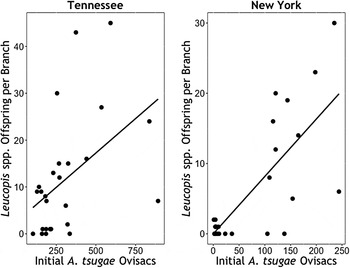
At both the TN and NY sites, the number of Leucopis spp. offspring were linearly correlated to the number of initial A. tsugae ovisacs (R 2 = 0.22 and 0.54, respectively) (fig. 1).
Number of Leucopis offspring collected verses the initial A. tsugae populations in each enclosure in TN and NY. Data are pooled for 2015 and 2016.

Both L. argenticollis and L. piniperda were recovered from the TN site, with only L. argenticollis found in 36.8% of the enclosed branches, only L. piniperda found in 47.3% and both species found in 15.7% of the enclosed branches. Only L. argenticollis was recovered from the NY site (Table 2).
Number of branches with Leucopis spp. offspring from enclosed branch studies in Tennessee (TN) and New York (NY) in 2015.

Discussion
The results of these experiments demonstrate that, under both laboratory and field conditions, Leucopis spp. from the PNW are capable of feeding and developing on a diet of the Japanese lineage of A. tsugae that was introduced to the eastern USA. There were no significant differences in survival or developmental times in the laboratory experiment between Leucopis spp. reared on A. tsugae from the two different geographic regions. This suggests that Leucopis spp. from the PNW would have suitable prey if released in the eastern USA as biological control agents for A. tsugae.
Propagule pressure, defined as the number of individuals released and the number of releases, is a key component of establishment success (Lockwood et al., Reference Lockwood, Cassey and Blackburn2005). Because the number of Leucopis spp. offspring collected did not differ significantly by the number of adult flies released, we could not draw conclusions about an optimal release density based on these experiments. This lack of significance could be explained by the relatively small difference in number of individuals between the treatments. Future work should increase the difference between the number of individuals released in each treatment, and increase the number of treatments, to better understand this relationship.
It is important for biological control agents to be able to establish on both high and low densities of their prey (DeBach & Rosen, Reference DeBach and Rosen1991). The linear relationship between Leucopis spp. offspring and initial A. tsugae populations (fig. 1) indicates that Leucopis spp. exhibit this characteristic. Leucopis spp. were able to survive and reproduce on the relatively low number of live ovisacs per enclosed branch (an average of six ovisacs per branch) found in NY during the 2016 field release.
The difference in species recovered from enclosures between TN and NY suggests that there is a temporal difference in life cycles of L. argenticollis and L. piniperda. Since both species were recovered at the TN site, but only L. argenticollis was recovered at the NY site, L. piniperda may complete its development earlier than L. argenticollis in the PNW (adults released in TN were collected earlier than the adults released in NY). This difference could be a function of niche partitioning, but more work is needed to understand phenological differences between the species in the PNW.
Because A. tsugae has two generations per year in its invaded range, it is critical that biological control efforts address both. Kohler et al. (Reference Kohler, Wallin and Ross2016) found that Leucopis spp. exhibit peak abundances coinciding with both A. tsugae progrediens and sistens egg stages in the PNW. While this study shows that Leucopis spp. can establish and reproduce during the progrediens egg stage in the invaded range of A. tsugae, it is yet unknown whether Leucopis spp. can survive and reproduce during both generations of A. tsugae in the eastern USA. Future work will focus on feeding, reproduction, and survival of Leucopis spp. during the different generations of A. tsugae in the eastern USA, particularly during A. tsugae aestivation and sistens egg stages.
For biological control to be effective, biological control agents must be able to establish and spread under conditions throughout the year and geographical extent of their target's invaded range. Results from the branch enclosure study in the field indicate that environmental conditions at both the northern and southern extremes of the area invaded by A. tsugae are within the environmental thresholds of Leucopis spp. from the PNW during the late spring and early summer. It remains to be seen whether western Leucopis spp. can tolerate environmental conditions throughout the year in the eastern USA. However, the fact that different populations of both species are already present in the eastern USA (McAlpine & Tanasijtshuk, Reference McAlpine and Tanasijtshuk1972) suggests that the Leucopis spp. from the PNW might also be able to tolerate conditions in the eastern USA throughout the year.
There is a growing body of evidence that Leucopis spp. have a high potential for impacting A. tsugae populations in their invaded range. Leucopis spp. are the only examples of successful biological control of adelgids worldwide and have been used effectively in Hawaii, New Zealand, and Chile (Rawlings, Reference Rawlings1958; Francke-Grossman, Reference Francke-Grosmann1963; Zúñiga, Reference Zúñiga1985; Culliney et al., Reference Culliney, Beardsley and Drea1988; Zondag & Nuttall, Reference Zondag, Nuttall, Cameraon, Hill, Bain and Thomas1989). A recent publication of data from the PNW demonstrates that Leucopis spp. larvae are more abundant and present for a much longer period of time than L. nigrinus larvae in their native ranges (Kohler et al., Reference Kohler, Wallin and Ross2016). The data reported here add to the evidence that Leucopis spp. warrant increased and continued study as potential biological control agents of A. tsugae in the eastern USA.
Acknowledgements
We thank Bryan Mudder for technical support during the field releases in TN, and the Skaneateles Marina along with Bob Duckett and Tracy Yardley for support in the NY field releases. We also thank the USDA Forest Service Northern and Southern Research Stations for logistical support, and the USDA Forest Service HWA Initiative and the Rubenstein School of Environment and Natural Resources for financial support. A special thanks to Ryan Colarusso for branch enclosure dissection and the Forest Health Laboratory for continued help and support.