Trait anger is a relatively enduring propensity to experience and express anger (Spielberger, Reference Spielberger1999). Because it is a characteristic of personality, trait anger reflects the general style of reacting across time and situations (Deffenbacher, Reference Deffenbacher, Spielberger and Butcher1992). Some individuals are low in trait anger. They generally stay calm even when they face provocation or frustrating events. Others, however, are high in trait anger. They may react with anger even when coping with benign situations and overreact easily. Compared to low trait anger, high trait anger is associated with psychopathological conditions like drug and alcohol dependence, anxiety, posttraumatic stress disorder, depression, dysthymia, bipolar disorder, somatization, obsessive-compulsive disorder, paranoid ideation, and psychoticism (Kassinove & Tafrate, Reference Kassinove, Tafrate and Feindler2006; Stimmel, Rayburg, Waring, & Raffeld, Reference Stimmel, Rayburg, Waring and Raffeld2005).
Anchored in the conceptualization that trait anger is a broad disposition toward anger, the State-Trait Anger Theory makes the following predictions or hypotheses (Deffenbacher et al., Reference Deffenbacher, Oetting, Thwaites, Lynch, Baker, Stark and Eiswerth-Cox1996; Spielberger, Reference Spielberger1999). Compared to persons low in trait anger, individuals with high trait anger (a) become angered by a greater number of things (elicitation hypothesis), (b) experience more frequent and intense anger when angered (frequency and intensity hypotheses), (c) react more aggressively when angered (aggression hypothesis), (d) cope less well with anger and express themselves in less positive ways (reduced positive coping hypothesis), and (e) experience more frequent and severe anger consequences (consequence hypothesis). These predictions have received considerable empirical support (e.g., Deffenbacher, Reference Deffenbacher, Spielberger and Butcher1992; Deffenbacher et al., Reference Deffenbacher, Oetting, Thwaites, Lynch, Baker, Stark and Eiswerth-Cox1996; Spielberger, Reference Spielberger1999) in samples from United States. Therefore, it is unknown whether predictions are valid in a different country or culture. If results replicate, it would strength the theory. If not, results probably depend on the idiosyncrasy of the sample or country, not on the theory, thus weakening the theoretical model. This research tested predictions in a non-English speaking country to assess the Sate-Trait Anger Theory.
Usually, individuals with high trait anger experience anger problems (Deffenbacher, Reference Deffenbacher2009; Kassinove & Tafrate, Reference Kassinove, Tafrate and Feindler2006; Tafrate, Kassinove, & Dundin, Reference Tafrate, Kassinove and Dundin2002). By anger problems we mean higher physical arousal related to anger, higher frequency of anger episodes and duration of the emotion for hours, days or more, poor behavioral and emotional control (e.g., difficulty in being patient with others and relaxing), greater aggression, and more negative consequences to the person and those around him/her, to the extent of impeding adaptive functioning at the individual, family, social and vocational levels. Anger problems do not seem unique to one gender or the other. Men and women with anger problems had on average the same frequency of anger expression (e.g., arguing and hitting objects or someone), and lack of self control. Previous studies (Alcázar, Deffenbacher, Hernández-Guzmán, & Wilson, Reference Alcázar, Deffenbacher and Byrne2011; Deffenbacher, Filetti, Richards, Lynch, & Oetting, Reference Deffenbacher, Filetti, Richards, Lynch and Oetting2003; Deffenbacher, Lynch, Filetti, Dahlen, & Oetting, Reference Deffenbacher, Filetti, Richards, Lynch and Oetting2003) did not find gender differences. However, the lack of differences may be attributable to the sample size of the studies (n = 167, 370, and 153, respectively). This research will explore gender with regard to anger problems in a larger sample (n = 783) and thereby increases statistical power.
Although anger problems are usually associated with high trait anger and may impede constructive, healthy functioning (Kassinove & Tafrate, Reference Kassinove, Tafrate and Feindler2006; Stimmel et al., Reference Stimmel, Rayburg, Waring and Raffeld2005; Tafrate et al., Reference Tafrate, Kassinove and Dundin2002), not all individuals with high trait anger recognize their anger as problematic. The recognition of a problem is reflected in identifying, admitting, and moving toward solving it (Prochaska & Norcross, Reference Prochaska and Norcross2001; Prochaska & Prochaska, Reference Prochaska and Prochaska1999). The lack of recognition is unfortunate because recognition of a problem is one of the main requirements to change or receive psychological help. If a person has anger problems but does not recognize it, s/he may continue experiencing negative consequences and affect adversely persons around him/her.
Previous research shows some characteristics that distinguish individuals who do and do not recognize their anger as problematic. Although high trait anger is usually related to negative consequences (Deffenbacher, Reference Deffenbacher2009; Deffenbacher, Lynch, et al., Reference Deffenbacher, Filetti, Richards, Lynch and Oetting2003), individuals who do recognize their anger problems experience even more than those who do not. In particular, compared to high anger individuals who do not recognize the problem, those who recognize it experience anger more frequently and intensely (higher trait anger), aggress more toward people and objects, and have difficulty controlling their angry behaviors (Alcázar, Deffenbacher, Hernández-Guzmán et al., Reference Alcázar, Deffenbacher and Byrne2011; Deffenbacher, Reference Deffenbacher2009; Deffenbacher, Filetti et al., Reference Deffenbacher, Filetti, Richards, Lynch and Oetting2003).
If the individuals who recognize their anger problems experience more negative conditions than those who do not recognize, then recognition of anger problems might be associated with the presence of more angry thoughts. That is, the nature and frequency of their thinking may influence their perception of how problematic their anger is. However, in the study of anger problem recognition, angry thoughts (cognitions) have received little attention. This study will address this gap in the literature. It is clear that cognitive processes contribute to a person’s level of high trait anger through higher rumination, tendencies to attribute hostile intentions to others, and lower use of effortful control resources to regulate hostile thoughts (Wilkowski & Robinson, Reference Wilkowski and Robinson2008). Trait anger correlates positively with pejorative labeling/denigrating (i.e., very negative, denigrating, often obscene descriptions of others), revengeful/retaliatory (i.e., thoughts of exacting revenge and getting back at others) and physically aggressive thoughts (i.e., thoughts of hurting others), and negatively with thoughts of control and positive coping (Deffenbacher, Petrilli, Lynch, Oetting, & Swaim, Reference Deffenbacher, Filetti, Richards, Lynch and Oetting2003; Snyder, Crowson, Houston, Kurylo, & Poirer, Reference Snyder, Crowson, Houston, Kurylo and Poirier1997; Wilkowski & Robinson, Reference Wilkowski and Robinson2008). Individuals with high trait anger also have a hostile attributional bias (Hazebroek, Howells, & Day, Reference Hazebroek, Howells and Day2001). Because recognition of anger problems is more closely associated with negative consequences than non-recognition (Alcázar, Deffenbacher, Hernández-Guzmán et al., Reference Alcázar, Deffenbacher and Byrne2011; Deffenbacher, Reference Deffenbacher2009; Deffenbacher, Filetti, et al., Reference Deffenbacher, Filetti, Richards, Lynch and Oetting2003), individuals who recognize anger problems may experience more negative angry thoughts and less thoughts of self-control than individuals who do not recognize their anger problems.
The study had four goals. First, it tested three hypotheses of the State-Trait Anger Theory (Deffenbacher et al., Reference Deffenbacher, Oetting, Thwaites, Lynch, Baker, Stark and Eiswerth-Cox1996; Spielberger, Reference Spielberger1999) in a sample of Mexican university students. Specifically, it was predicted that compared to low anger individuals, those with high trait anger would: (a) experience higher intensity of state anger (intensity hypothesis), (b) express their anger in more outward negative (anger-out) and physically aggressive ways (aggression hypothesis), and (c) engage in more anger suppression (anger-in) and show less anger control (control-in and -out) (reduced positive coping hypothesis). Second, it extended hypothesis testing to addressing the cognitive aspect of anger in high and low trait anger individuals. Third, we compared anger, anger expression, and angry thoughts in individuals with high trait anger who did and did not recognize their anger (i.e., described as a personal problem). For this goal we employed only individuals with high trait anger.
The rationale for the third goal is that we wanted a strong clinical analog, i.e., individuals who reported problems would not only recognize their anger as a problem, but also indicate that they wanted help with it. In having those who recognize problems not only identify anger as a problem but also indicate that they needed help for anger problems, we tried to select those most likely to enter therapy for anger reduction. This, we thought, would provide greatest clarity about potential anger management clients (i.e., what distinguishes those who may be ready for therapy for anger issues). Fourth, although men and women do not consistently differ on anger experience and expression (Archer, Reference Archer2004; Bartz, Blume, & Rose, Reference Bartz, Blume and Rose1996), we included gender to explore whether gender was related to anger generally or to recognizing anger problems.
Method
Participants
Participants were students at two private universities in Puebla, in the central region of Mexico. The initial sample (n = 1514, 584 men, 930 women; Mage = 20.58, SD = 1.99) included 27 majors (26.8% speech/communication, 16.2% law, 10.0% international relations, 8.5% psychology, with other majors below 5%). Ninety-eight percent were single and 2% married; 28% were employed and attending school with 72% attending school only; and 80% were catholic, 7% other religions, and 13% no religious affiliation. Mexican students from private universities are typically from the middle and upper socioeconomic classes. Students did not receive course credit or other incentives for participation. This research was approved by institutional review processes.
We employed two criteria to establish groups in this study. First, high (H) and low (L) anger groups were defined, respectively, as students scoring in the upper (score > 23) and lower (score < 17) quartiles of the current sample on the Trait Anger Scale (see Instruments). Second, recognizing (R) and not recognizing (NR) anger problems was determined by the answer that students gave to the question: “Which of the following phrases is a better description of you?” Options were: (a) “I think I have problems because of my anger and I need help to solve them” (R), and (b) “I do not have anger problems” (NR). Option (a) has two parts on purpose (having anger problems and needing help) to obtain a clinical analog that distinguishes characteristics of individuals who admit the problem and consider help, versus those who do not admit anger problems. From a transtheoretical perspective (Prochaska & Norcross, Reference Prochaska and Norcross2001; Prochaska & Prochaska, Reference Prochaska and Prochaska1999), option (a) places the person closer to the process of change (transtheoretical stage of preparation), while option (b) reflects lack of awareness of anger problems (stage of precontemplation).
Combining criteria yielded three groups for the study: 376 (149 men, 227 women) low anger participants not reporting problem anger (LNR), 164 (54 men, 110 women) high anger students not reporting anger problems (HNR), and 243 (95 men, 148 women) high anger participants reporting problem anger (HR).
Instruments
Multicultural Latin American Inventory of Anger Expression and Hostility (ML-STAXI)
The 44-item ML-STAXI assesses the experience and expression of anger (Moscoso, Reference Moscoso2000; Moscoso & Spielberger, Reference Moscoso and Spielberger1999). Participants rated items on 4-point scales (1 = “almost never”, 4 = “almost always”) regarding how often they felt or did the content of the item. Higher scores reflect more of the emotional or expressive characteristic. The ML-STAXI has an adequate factor structure for Mexican adults (Alcázar, Deffenbacher, & Byrne, Reference Alcázar, Deffenbacher and Byrne2011), similar to the original STAXI (Spielberger, Reference Spielberger1999). The ML-STAXI includes the following scales. The 10-item State Anger Scale (α = .82, current α = .86) assesses anger intensity (e.g., feeling furious) and what the person desires to do (e.g., feel like insulting or hitting someone) at the moment of answering the questionnaire. The 10-item Trait Anger Scale (α = .83, current α = .84) measures the general propensity to experience anger (e.g., being bad tempered and angered easily) across time and situation. The 24-item anger expression portion of the ML-STAXI contains four scales: (a) 6-item Anger-in or suppressing angry feelings and harboring grudges (α = .65, current α = .66); (b) 5-item Anger-out or the outward, generally negative expression of anger toward others such as arguing (α = .70, current α = .66); (c) 6-item Anger-control-in or the person’s attempts to maintain emotional control such as trying to relax (α = .86, current α = .86); and (d) 7-item Anger-control-out or instrumental efforts to manage one’s behavior when angry (e.g., being patient with others, α = .72, current α = .79). State and trait measures, Anger-out, and Anger-in correlate positively with each other, whereas these measures correlate negatively with Anger-control-in and Anger-control-out (Alcázar et al., Reference Alcázar, Deffenbacher and Byrne2011; Moscoso, Reference Moscoso2000).
Questionnaire about Anger Expression with Physical Aggression (QAEPA)
The QAEPA was constructed (Alcázar et al., Reference Alcázar, Deffenbacher and Byrne2011) because the ML-STAXI does not contain a measure of expressing anger through physical aggression. In response to the question “How often, being angry, do you…,” participants rated on a 10-point scale (1 = “I never do it”, 10 = “I do it more than ten times per week”) how often they engaged in three behavioral forms of physical anger expression: (a) towards others (3 items, i.e., push, hit, and throw things at someone, αs = .71 to .79, current α = .74); (b) towards the physical environment (2 items, i.e., hit objects, and damage or break things, αs = .62 to .63, current α = .66); and (c) towards self (1 item, i.e., do something to hurt your own body like cutting or biting oneself). QAEPA measures form small to moderate correlations with each other and small correlations with ML-STAXI scales (Alcázar et al., Reference Alcázar, Deffenbacher and Byrne2011), suggesting the QAEPA captures aggressive forms of anger expression that other measures do not.
Angry Thoughts Scale (ATS)
The 19-item ATS was developed to assess angry thinking in Mexican adults (Alcázar-Olán, Deffenbacher, Hernández-Guzmán, & de la Chausée Acuña, Reference Alcázar-Olán, Deffenbacher, Hernández-Guzmán. and de la Chaussée Acuña2014). In response to the question, “When you get angry, how often do you have the following thoughts…?” participants report the frequency of the thought on a four-point scale (1 = “almost never”, 2 = “sometimes”, 3 = “frequently”, 4 = “almost always”). The ATS yields three scales: (a) 10-item Anger Control Thoughts (α = .87, current α = .87) involving self-instructions that focus on anger reduction and conflict resolution (e.g., I think to solve the problem); (b) 5-item Pejorative Thoughts (α = .83, current α = .83) tapping highly negative, denigrating thoughts and insults (e.g., S/he is an idiot); and (c) 4-item Thoughts of Revenge (α = .79, current α = .79) involving thoughts of retaliation and making others suffer (e.g., I will do something against others). The factors were cross validated through confirmatory factor analysis (Alcázar-Olán et al., Reference Alcázar-Olán, Deffenbacher, Hernández-Guzmán. and de la Chaussée Acuña2014), suggesting stability of the constructs measured. Revengeful and pejorative thinking correlate highly with each other and negatively with thoughts of control, and form appropriate small to moderate correlations with trait and state anger, anger suppression, outward and physically aggressive anger expression (Alcázar-Olán et al., Reference Alcázar-Olán, Deffenbacher, Hernández-Guzmán. and de la Chaussée Acuña2014).
Procedure
Research assistants administered questionnaires during class (groups of 15–25). Instructors were present at least during distribution of questionnaires and the reading of the instructions to ensure student attention. Assistants informed students that the project would take about 20 minutes, participation was entirely voluntary, and responses were completely anonymous. No student refused to participate. When all students had completed questionnaires, the class was thanked and students dismissed.
Results
The primary analysis was 2 (Gender) x 3 (Anger group) MANOVA which employed Wilks λ. Significant multivariate effects were explored by univariate ANOVA, and significant univariate group main effects and interactions were explored by Tukey post hoc tests (ps < .05). Effect sizes (eta squared, η2) were interpreted within Cohen’s (Reference Cohen1988) criterion wherein η2 from .01 to .04 was considered small, .04 to .14 moderate, and > .14 large. We employed two criteria to protect against over-interpretation of significant, but very small effects resulting from the large sample size. To be considered meaningful and interpretable, an effect had to be (a) statistically significant and (b) meet at least the lower limit of a small effect size (i.e., η2 > .01). The statistical package for analysis was SPSS 17.
A 2 x 3 MANOVA across measures revealed significant multivariate effects for gender, λ = 0.878, F(12, 766) = 8.84, p < .001, η2 = 0.122, group, λ = 0.128, F(24, 1532) = 114.74, p < .001, η2 = 0.643, and the interaction, λ = 0.952, F(24, 1532) = 1.58, p < .05, η2 = 0.024. Multivariate effect sizes were moderate, large, and small for gender, groups, and the interaction, respectively. Univariate analyses explored all significant multivariate effects.
State anger revealed the only significant univariate interaction effect, F(2, 777) = 4.60, p < .05, η2 = 0.012. Tukey post hoc tests (ps < .05) showed that LNR and HNR males (Ms = 11.26 and 15.06) reported more state anger than their female counterparts (Ms = 10.93 and 12.99), whereas HR females (M = 14.07) reported more state anger than HR males (M = 13.62).
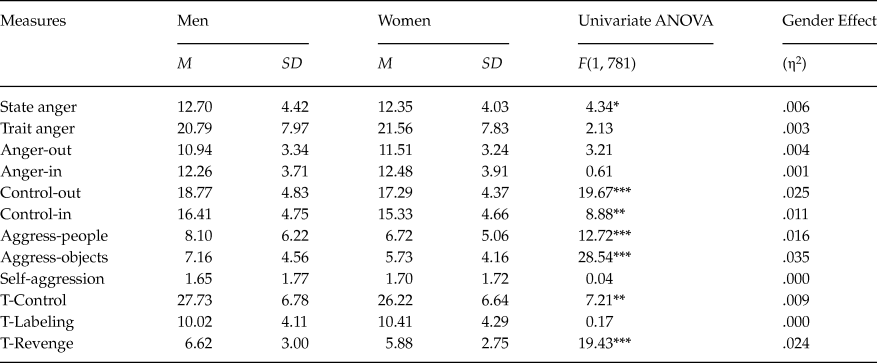
Five measures (Table 1) revealed significant gender effects that accounted for at least 1% of the variance. Men reported more thoughts of revenge and more aggression toward people and objects, but also more efforts to control angry feelings (anger-control-in) and behavior (anger-control-out) than did women. All gender effect sizes were small.
Gender Differences on Anger

* p < .05, **p < .01, ***p < .001.
Note: T-Control = Thoughts of control; T-Labeling = Thoughts of pejorative labels; and T-Revenge = Thoughts of revenge.
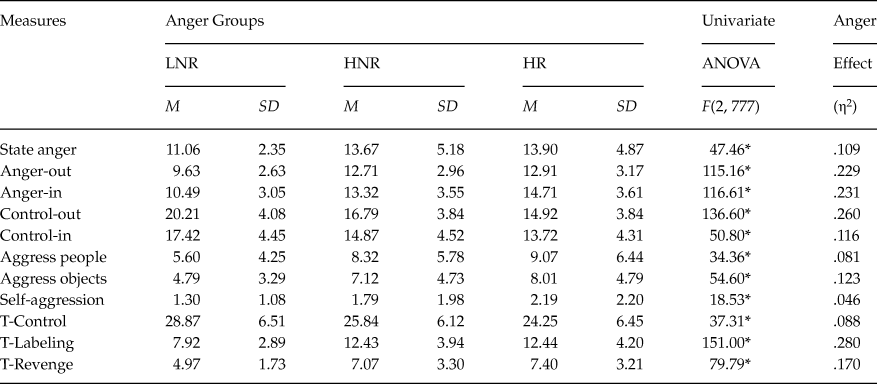
Univariate analyses revealed a consistent pattern of moderate to large anger group effects across measures (Table 2). For example, high anger groups (HR and HNR) reported greater state anger, i.e., more intense angry feelings and greater desire to insult someone, than the LNR group. High anger groups also demonstrated greater anger suppression (anger-in), more outward negative expression (anger-out), and more frequent physical aggression toward self, others, and property, and fewer efforts to control their behavior (anger-control-out) and emotions (anger-control-in). Cognitively, high anger groups reported more thoughts involving pejorative labeling/denigration and revenge and fewer thoughts about controlling their anger.
Univariate Anger Group Effects

* p < .001.
Note: LNR = Low trait anger, non-recognition of anger problems; HNR = High trait anger, non-recognition of anger problems; HR = High trait anger, recognition of anger problems; T-Control = Thoughts of control; T-Labeling = Thoughts of pejorative labels; and T-Revenge = Thoughts of revenge.
Compared to HNR, the HR group reported more anger suppression and harboring grudges (anger-in; p < .001, η2 = .035), and fewer thoughts of control (p < .05, η2 = .015) and attempts to control their angry behaviors (anger-control-out; p < .001, η2 = .054) and feelings (anger-control-in; p < .05, η2 = .016). To be included in either HR or HNR groups, participants had to be in the upper quartile on the Trait Anger Scale. This notwithstanding, it was possible that HR and HNR groups differed on trait anger and that this might, in part, distinguish why anger was or was not seen as problematic. We compared HR and HNR groups on trait anger to explore this possibility. The HR group (M = 28.82) reported a significantly higher level of trait anger than did the HNR group (M = 27.60), F(1, 403) = 11.03, p < .01, η2 = 0.028.
Gender did not interact with any of these variables nor was gender associated with group membership, χ2(2, n = 783) = 2.33, suggesting gender did not impact the tendency to report anger problems.
It is also interesting to note that the HR group or those indicating that their anger was a problem for which they wanted help was sizable. HR represented 16.1% of the total sample and 59.7% of high anger individuals, suggesting that this is a large group potentially in need of and willing to avail themselves to anger reduction intervention.
Discussion
Gender Differences
Findings of the present research are consistent with other studies where men and women are much more alike than different with regard to anger and anger expression (Archer, Reference Archer2004; Averill, Reference Averill1982; Bartz et al., Reference Bartz, Blume and Rose1996; Deffenbacher et al., Reference Deffenbacher, Oetting, Thwaites, Lynch, Baker, Stark and Eiswerth-Cox1996). Our results did not show differences for half of the variables, and gender effect sizes were small for the other half. Men reported more revengeful thoughts and aggression toward people and objects, suggesting that men, in general, might be slightly more aggressive. However, men and women did not differ on anger-out, and men reported more thoughts about anger control and efforts at behavioral (anger-control-out) and emotional (anger-control-in) control when angry, somewhat mitigating this conclusion. The near absence of interactions between gender and anger also supports the similarity of the genders on anger-related measures in this study. Thus, current findings replicate other research (Archer, Reference Archer2004; Averill, Reference Averill1982; Bartz et al., Reference Bartz, Blume and Rose1996) which suggests minimal gender differences in anger and closely related constructs. This conclusion does argue against the observation that a small proportion of men disproportionately perpetrate the most extreme forms of violence and aggression. What is supported is that within general populations and within typical aspects of anger and aggression, men and women may not differ as much as sometimes thought.
Gender did not distinguished HR and HNR groups, suggesting that gender is not associated with identifying personal anger problems. The result replicated other study involving general anger (Alcázar, Deffenbacher, Hernández-Guzmán et al., Reference Alcázar, Deffenbacher and Byrne2011) and did so with greater statistical power. Gender was not related to identifying anger while driving as a problem either (Deffenbacher, Filetti, et al., Reference Deffenbacher, Filetti, Richards, Lynch and Oetting2003; Deffenbacher, Lynch, et al., Reference Deffenbacher, Filetti, Richards, Lynch and Oetting2003).
State-Trait Theory Predictions
The present research tested three hypotheses from the State-Trait Anger Theory (Deffenbacher et al., Reference Deffenbacher, Oetting, Thwaites, Lynch, Baker, Stark and Eiswerth-Cox1996; Spielberger, Reference Spielberger1999). In particular, compared to those low in trait anger, high trait anger groups reported: (a) more state anger, supporting the intensity hypothesis; (b) more judgmental/denigrative and revengeful thinking, more outward, negative anger expression, and more physical aggressive expression toward self, others, and objects, supporting the aggression hypothesis; and (c) more anger suppression and fewer thoughts about and efforts to control of angry feelings and behaviors, supporting the reduced positive coping hypothesis.
Findings contribute to anger knowledge in two aspects. First, it is the first research with Mexican samples that extended hypothesis testing of the State Trait Anger Theory (Deffenbacher et al., Reference Deffenbacher, Oetting, Thwaites, Lynch, Baker, Stark and Eiswerth-Cox1996; Spielberger, Reference Spielberger1999) to the cognitive domain (i.e., anger-related thinking). High anger groups reported more revengeful and pejorative/denigrating thinking and less coping- or control-oriented self-instructions, which replicates patterns of angry thinking found in English-speaking samples (Deffenbacher, Reference Deffenbacher2009; Hazebroek et al., Reference Hazebroek, Howells and Day2001; Wilkowski & Robinson, Reference Wilkowski and Robinson2008), thereby extending cognitive findings to Spanish-speaking participants. However, some characteristics of the sample (e.g., middle and upper socioeconomic classes and highly educated) impede generalization of findings in Hispanic countries. Results await replication in other Mexican samples and other non-English speaking countries. Replication studies should consider individuals with low socioeconomic status, clinical samples, older and younger groups, or individuals outside of academia. Second, findings extended hypothesis testing and replication of findings in a non-English speaking country, suggesting cross-cultural applicability of State-Trait Anger Theory (Deffenbacher et al., Reference Deffenbacher, Oetting, Thwaites, Lynch, Baker, Stark and Eiswerth-Cox1996; Spielberger, Reference Spielberger1999), at least for university students. If anger is a universal emotion (Averill, Reference Averill1982; Chon, Reference Chon, Hofsten and Bäckman2002), trait anger may also be a relatively universal pattern of experiencing anger and represent an individual difference in the propensity to anger.
Characteristics Related to Problem Anger Identification
Of the high trait anger group, 61% reported that they had personal anger problems (HR) and needed help to solve them, whereas 39% did not (HNR). Characteristics that discriminated HR and HNR groups may provide clues about why the HR group finds their anger problematic. For example, although both groups had to score in the upper quartile on trait anger, the HR group reported significantly higher trait anger than the HNR group. Because of the greater trait anger, HR are prone to more frequent, intense, and lengthier episodes of anger and more frequent and, in some cases, more severe anger consequences (Deffenbacher et al., Reference Deffenbacher, Oetting, Thwaites, Lynch, Baker, Stark and Eiswerth-Cox1996). In turn, the greater frequency and intensity of anger and associated negative consequences may lead HR individuals to be more aware of their anger and see it as problematic. Elevated trait anger is also likely to be associated with greater aggression (Deffenbacher et al., Reference Deffenbacher, Oetting, Thwaites, Lynch, Baker, Stark and Eiswerth-Cox1996; Spielberger, Reference Spielberger1999), which could also contribute to identifying anger as a problem. Aggressing towards others and property may violate personal or social standards and/or lead to various negative consequences leading the person to see his/her anger as more problematic.
The greater tendency of HR participants to address anger by suppressing angry feelings and harboring grudges (anger-in) may also lead to coding anger as problematic. Anger-in is not an effective anger management strategy. The person boils and ruminates internally, often for extended periods of time. Angry thoughts and emotions are not effectively dissipated, and anger-in does not lead to effective problem-solving and behavioral outcomes. Yet, these processes likely make the person very aware of his/her anger because it is experienced intensely without positive resolution, increasing the likelihood of perceiving anger as problematic.
Another difference between high anger groups involved the theme of control. HR participants reported fewer thoughts about controlling or managing their anger and lessened tendencies to control their angry feelings (anger-control-in) and behavior (anger-control-out). This may make the person feel more out of control and less able to manage their anger. This feeling and perception of being out of control or in less control of their anger may make them feel more vulnerable and identify anger as a personal problem.
An alternative not directly addressed in this research is how HNR individuals construe and attribute their anger. HNR individuals may use their angry-related behaviors (e.g., aggression and insult) to protect themselves from what they see as an unfair, unjust and malevolent world. For them, anger helps them survive frustrating, negative experiences and contexts. They may not see their anger as a problem, but as a solution. For them, being anger is justified and the right way to act.
Individuals who admit their problem may consider change or therapy. In this study this was a large group who may consider and benefit from anger counseling (i.e., over 60% of high anger individuals and nearly one in six of all students sampled). Those who do not identify anger as problematic may delay or never consider help. Yet, at least compared to their low anger peers, the HNR group reported several troubling differences. They experienced more intense anger, engaged in more hostile/aggressive thinking and behavior, more often suppressed angry feelings, and did not think about or behave in as many anger-lowering or controlling strategies. In turn, these characteristics may lead to a reduced quality of life and greater negative consequences. While there are a number of empirically supported interventions for HR individuals who are ready for change- or action-oriented interventions like applied relaxation, cognitive restructuring, behavioral change and their combinations (Deffenbacher, Reference Deffenbacher2009; Deffenbacher & McKay, Reference Deffenbacher and McKay2000; DiGiuseppe & Tafrate, Reference DiGiuseppe and Tafrate2003), HNR individuals present a different challenge, because they do not identify problems. Perhaps, interventions such as motivational interviewing (Miller & Rollnick, Reference Miller and Rollnick2002) could be adapted to anger to see if HNR individuals can become more aware of and motivated to address anger issues in their lives.
A limitation is how the study operationalized the recognition of anger problems. First, we assessed recognition of anger problems with a single question that addressed two aspects, admitting anger problems and needing help versus not admitting anger problems. The difference between the two answers could be interpreted in multiple ways. For instance, not recognizing anger problems may mean that the person is in denial, which is more likely in some individuals with high trait anger, or that the person simply does not see his/her anger as a personal problem. Individuals with high and low trait anger may have interpreted the options differently. This research was focused on the outcome (i.e., choosing option a or b), not on the processes that individuals engaged in to conclude which choice is a better description of them. Psychological processes, meanings or reasons why the persons chose one option or the other were not explored. Future studies should consider a qualitative approach to elucidate why individuals recognize or not anger problems.
Second, the statement “I think I have problems because of my anger and I need help to solve them” is double-barreled. A person may agree with having anger problems but disagree with the need to be solved. It becomes difficult to determine what individuals see as a more apt description of themselves. However, the statement is a clinical analog designed to detect people who acknowledge anger issues and thought they needed help. Individuals who selected this option both identified anger as problematic and in need of help. This places participants in a preparation stage (Prochaska & Norcross, Reference Prochaska and Norcross2001; Prochaska & Prochaska, Reference Prochaska and Prochaska1999), willing to change their anger problems. Future research may assess the recognition of anger problems with different items and methods, increasing answer choices.
Third, the clause “I need help to solve them” may also be divided, which makes difficult to assess how committed a person is to change. Some individuals may see the problem and think they need to solve them. These persons are likely motivated to take actions by their own, and they may accept external help (e.g., therapy). However, other individuals may see the problem but think they do not need help. Qualitative research may address both aspects in persons who recognize anger problems, the need to solve them with and without help.
Fourth, recognizing problems does not necessarily translates into beginning therapy for anger management. While admitting a problem is a requirement for seeking help, other multiple factors may determine whether a person begins therapy and continues long to achieve results and maintain them. Nonetheless, having participants not only identify anger problems, but also indicate a need for help provides information about a group who may be most likely to avail themselves of formal and informal ways of addressing anger problems.
Fifth, the use of university students. Effort was made to assess across majors and classes to make the sample broadly applicable to university students. However, results may differ in other such as youth in public schools, young married couples, older individuals, or specific occupational groups. While future research needs to extend into such groups, it should not be overlooked that university students are a large, meaningful group and that one in six identified their anger as a personal problem and wanted help for those problems. This suggests a large meaningful group in which to test theory and in which to identify characteristics of individuals who experience anger problems and who may benefit from anger reduction.
Finally, another limitation is reliance on self report. Self-report is appropriate to assess internal experiences like angry feelings and thoughts and the perception of anger problems. Measures of aggression and anger expression were also self-report in nature. Different results may have emerged if assessed by alternative methods (e.g., direct observation of anger-related behavior or collateral reports from people who know the person well). Future studies would benefit from inclusion of other assessment methods.