Qiaoxiang as an Arena of Transnational Network Governance
Since the beginning of the 21st century, China’s open-door policy and going-out strategy, and particularly the Belt and Road Initiative (BRI) from 2013, have led to a new wave of Chinese emigrants and the emergence of new inland qiaoxiang 侨乡 (the hometowns of the Chinese diaspora). Current qiaoxiang studies predominantly focus on traditional coastal qiaoxiang, which have long histories of overseas emigration, such as those in Fujian and Guangdong.Footnote 1 Less attention has been paid to the formation of the new inland qiaoxiang that have emerged post-2000, such as Shaodong 邵东 in Hunan province and Shanglin 上林 in Guangxi province.Footnote 2 Compared to the traditional coastal qiaoxiang, new inland qiaoxiang do not have a tradition of overseas emigration and do not share the same advantages as their coastal counterparts in terms of geographical location and socio-economic resources. However, they do have a large number of first-generation emigrants who maintain close links with their place of origin. This contrasts with the declining connections experienced by traditional qiaoxiang with their overseas Chinese descendants.Footnote 3 This study draws on a case study of Shaodong, a county in Hunan province, to illustrate the dynamic formation of a new inland qiaoxiang from both political and socio-economic perspectives. It examines how Shaodong developed into a qiaoxiang, exploring its unique characteristics. Additionally, the study investigates the dynamics and mechanisms of the qiaoxiang’s engagement with its diaspora, as well as the transnational networks that emerge between the qiaoxiang government and its diaspora during the governance process. Finally, it discusses the contributions of this study to diaspora governance research from a qiaoxiang perspective
Diaspora governance usually refers to the policies, mechanisms and strategies used by governments, organizations and other stakeholders to manage the relationships between diaspora communities and their countries of origin.Footnote 4 In recent years, a growing body of literature has emerged that examines home state-led engagement with diaspora communities from a transnational network perspective. This literature highlights the political, economic and social benefits of such engagement through various policies, programmes and other state-sponsored mechanisms. Two main approaches dominate these studies. The first examines, from a national or central bureaucratic perspective, the sending state’s diaspora engagement policies and governing networks in the transnational field and focuses on skilled and entrepreneurial migrants.Footnote 5 The other approach conceptualizes the sending state as a multi-sited national and subnational governing entity in its interactions with the diaspora.Footnote 6 However, this approach mainly presents a top-down view of the diversity or patterns of different subnational governments in their diaspora engagement efforts and fails to capture the structure and interplay of multilevel governance in the transnational context. To address this gap, this study focuses on the subnational level from a qiaoxiang perspective and is attentive to the construction of and manifold power dynamics among the different governmental actors engaged in diaspora governance.
In Chinese diaspora governance, the qiaoxiang, as the hometown of the Chinese diaspora, is a critical subnational arena where transnational economic, social and cultural networks are actively built between local governing bodies and Chinese diaspora communities. Current studies primarily explore qiaoxiang from a singular administrative unit perspective, focusing on either the province, city, county or village.Footnote 7 In the context of administrative geography, qiaoxiang can be rescaled as a hierarchy of units, offering a nuanced, multilayered and fluid spatial view. Qiaoxiang can be classified hierarchically, from province-centred, city-centred, county-centred, town-centred and village-centred. Agencies at these various levels interact with one another rather than operating in isolation when engaging with the diaspora. However, this rescaling approach has seldom been explored.
This study proposes multilevel transnational network governance as a model for understanding how the Shaodong qiaoxiang engages with its diaspora. Based on theoretical discussions, this model is conceptualized as a structured multilevel process in which the qiaoxiang governments proactively engage new emigrants in local development by leveraging the diaspora’s social and economic resources from both their home and host countries through the building of interactive networks. This study argues two key points. The first is that diaspora governance does not just rely on the new emigrants’ primordial ties of locality, kinship and ethnicity with their hometown; it is also dynamically shaped by the multilevel networks that the qiaoxiang governments at province, municipality and county levels create with the diaspora. The second point emphasizes the transnational aspect of diaspora governance at subnational levels. Subnational units within a nation, such as cities or counties, have become an important framework for examining the influences of globalization and transnationalism.Footnote 8 This study adopts a rescaling approach to the qiaoxiang and highlights the trajectory of multilevel transnational networks at subnational levels to account for the politico-economic territorial operations involved in diaspora engagement.
The data supporting this empirical study mainly derive from primary literature and fieldwork. The primary literature includes both published materials, such as the Shaodong County Records (1978–2002) and Hunan Yearbook (1985–2019), and unpublished sources, such as the “Annual work report of the Hunan Federation of Returned Overseas Chinese” and the work summaries of overseas Shaodong associations. The multi-sited fieldwork was conducted in Changsha, Shaoyang 邵阳 and Shaodong in Hunan province from 2021 to 2023 and included participatory observation of Shaodong emigrants’ business and socio-cultural activities, as well as semi-structured interviews (online and offline) with Shaodong emigrants and local governmental officials. In addition, 84 emigrants were surveyed via questionnaire between 2022 and 2023 to gain an in-depth understanding of their living conditions, their economic ties with their hometowns and their opinions of the qiaoxiang governments. Of the respondents, 43.4 per cent were aged 35–45, 31.3 per cent were aged 18–35 and 25.3 per cent were aged 45 and above. The ratio of male to female respondents was 71:29. These figures reflect the demographic characteristics of transnational emigrants from Shaodong, who are predominantly young and middle-aged males.
New Emigrants from Shaodong
Located in the midlands of China, Shaodong county is the biggest qiaoxiang in Hunan province. Owing to its significant economic achievements, the State Council approved its upgrade to a (county-level) city in 2019. It falls under the direct jurisdiction of Hunan province and is administered by Shaoyang city.Footnote 9 The overseas migration of Shaodong people in the past two decades is inextricably linked to the city’s socio-economic development.
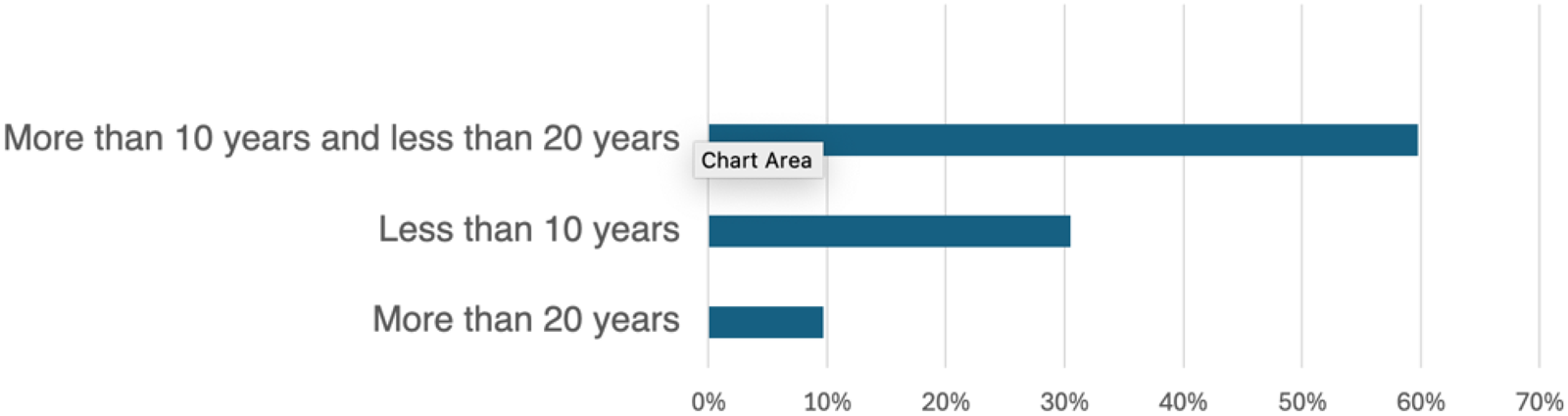
As early as the 1980s, Shaodong had established itself as an important commodity distribution centre in China, and Shaodong people had gained a reputation for their business acumen. They began to go abroad in the 1990s, as the city started to export its commodities overseas. To date, it is estimated that there are more than 100,000 people from Shaodong spread across 120 countries. Most emigration occurred in the early 21st century with the implementation of China’s going-out strategy. In our survey, 59.8 per cent of respondents reported having emigrated between 10 and 20 years ago; 30.5 per cent had emigrated less than 10 years ago. In contrast, only 9.7 per cent of respondents had emigrated more than 20 years ago (Figure 1). These figures illustrate that Shaodong developed as a qiaoxiang mostly after 2000; the launch of the BRI in 2013 further strengthened the transnational mobility of its people. According to statistical data from the Hunan Chamber of Commerce in Laos, there were approximately 40,000 Hunanese in Laos in 2012. This figure surged to 100,000 in 2015 following just three years of BRI-driven development.Footnote 10 In addition, the number of corporate members in the Hunan Chamber of Commerce in Laos grew from 234 in 2008 to 800 in 2013. A decade later, in 2023, membership had expanded significantly to 2,553 members, reflecting an increase of about three times compared to 2013 and nearly ten times the number in 2008.Footnote 11 Given that approximately 80 per cent of the Hunanese in Laos originate from Shaodong, these figures suggest that the BRI has effectively facilitated the international movement of both individuals and enterprises from Shaodong.
Shaodong Emigrants by Years since Departure

Shaodong emigrants predominantly head to South-East Asia, particularly Laos. They tend to cluster with their fellow migrants, and the areas they inhabit quickly gain local nicknames such as Shaodong Street or Shaodong Village. Engaging primarily in business, Shaodong emigrants stand out among other Hunan emigrants for their economic strength, and many hold leadership positions in Hunan business associations in Thailand, Laos, Cambodia and Vietnam. Compared to Chinese emigrants from traditional coastal qiaoxiang, emigrants from Shaodong display both similarities and differences in terms of their social backgrounds, business sectors and community organizations.
Apart from the small minority who go overseas to study or develop their skills, most new emigrants from Shaodong come from relatively low educational backgrounds. For instance, 87 per cent of the survey respondents reported having attained only a high school education or less. This grassroots social background contributes to the formation of a Shaodong emigration network based on kinship and locality. This network typically extends from a single emigrant to family members, then further to friends, neighbours and then fellows from the same hometown. The ties of kinship and locality also foster a sense of solidarity among Shaodong emigrants, facilitating mutual support in their business dealings abroad. They often travel in groups, and those with greater economic resources frequently offer credit to those in a weaker financial position. One interviewee pointed out: “By relying on the help of relatives and fellows, Shaodong people have grown a business from a cell phone wholesale dealership to a national sales network throughout Laos.” The importance of primordial networks among the overseas Shaodong community fosters a strong hometown identity. In our investigation, 81 per cent of informants reported that they returned to their hometown at least once or twice a year, sometimes even between five and ten times a year. Their place of origin serves as both a sentimental and social base for their interactions with China. In this regard, emigrants from Shaodong exhibit similarities to those from traditional qiaoxiang, where first-generation emigration was primarily rooted in kinship and locality
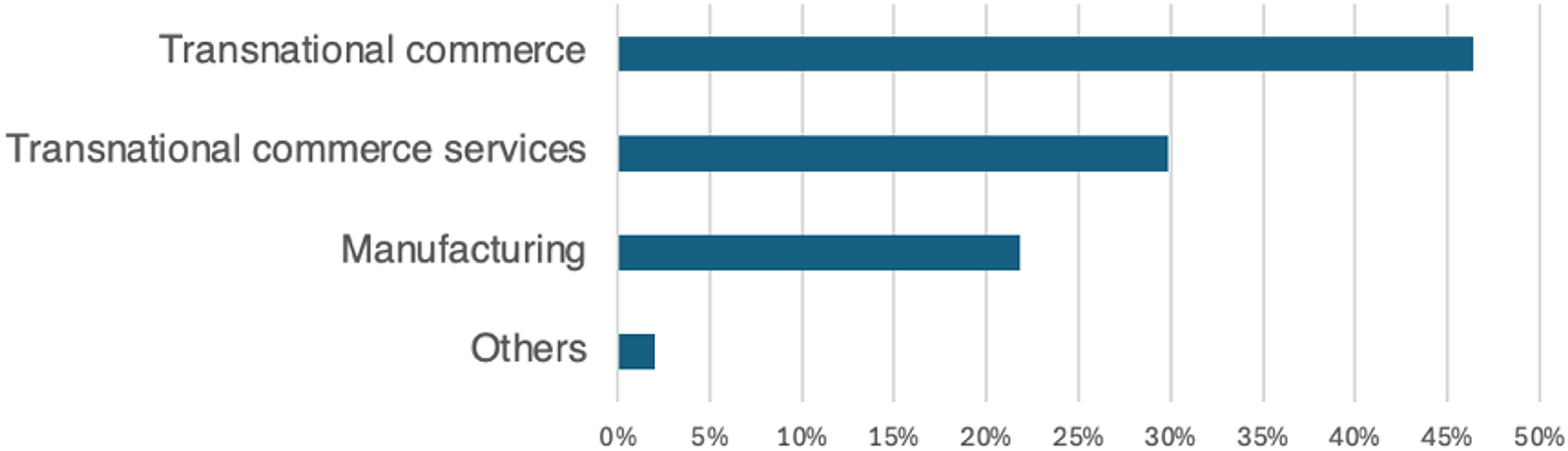
An interdependent economic relationship has formed between the Shaodong emigrants and their hometown. Shaodong is famous for manufacturing labour-intensive products such as cigarette lighters, bags and hand tools. Taking advantage of the lower prices and higher output of these products at home, those venturing overseas mainly engage in transnational commerce, selling products made in Shaodong to local markets in their host countries. Among the respondents of our survey, 46.4 per cent were engaged in transnational commerce and 29.8 per cent in a related service industry (Figure 2). The enterprises founded by first-generation Shaodong emigrants mainly consist of small and medium-sized businesses that produce low-tech and low-value-added products, as reflected in the results of our investigation. Among our 84 informants, 95.2 per cent were running a company with fewer than 50 employees. Compared to the first-generation emigrants from traditional qiaoxiang who received less economic support from their hometown, the entrepreneurial growth of Shaodong emigrant businesses is tightly tied to their hometown’s social and economic development and support. It is these close economic ties that have provided the economic foundation for the participation of these overseas Shaodong businesses in local governance.
Shaodong Emigrants by Economic Activity

Lastly, Shaodong emigrants tend to organize themselves through business associations. Among our 84 informants, 69 were members of Chinese business associations in their host countries. The overseas business associations originating from Shaodong tend to be established under the name of Hunan rather than Shaodong. This is in part owing to the role played by the Hunan provincial government in encouraging the establishment of these associations. However, it also broadens the scope of the associations to incorporate more members and thereby increase their strength, rather than just limiting themselves to members from Shaodong. This is in contrast to the many first-generation emigrants from traditional qiaoxiang, whose associations are mainly based on the local ties of village, town or county.Footnote 12 This distinction reveals that the overseas Shaodong locality-centred identity is much more fluid, transcending the different administrative geographical scopes of hometown to include county, city and province.
Members of the Shaodong diaspora hold leadership positions in many associations, including the Hunan Chamber of Commerce in Laos (founded in 2008), the Hunan Enterprise Federation in Vietnam (founded in 2011), the Hunan Chamber of Commerce in Thailand (founded in 2009), the Hunan Chamber of Commerce in Mexico (founded in 2012) and the Hunan Chamber of Commerce in Myanmar (founded in 2016). Among these, the Hunan Chamber of Commerce in Laos is notable for its large Shaodong membership. Established in Vientiane, Laos, it was the first overseas Chinese chamber of commerce to represent Hunan province. Currently, it has eight branches across different provinces of Laos and has built a large and influential organizational network nationwide. Emigrants from Shaodong constitute the most powerful group within the association, with five of the seven presidents appointed up until 2021 hailing from Shaodong. These business associations not only assist members in building networks and adapting to local society but also are key channels through which the qiaoxiang governments interact with the Shaodong diaspora.
Dynamics for Multilevel Transnational Network Governance
The multilevel transnational network governance in the qiaoxiang is dynamically shaped by several drivers: the improvement of the top-down diaspora engagement system, setting diaspora engagement as a government work priority and impetus from the new emigrants.
Specific engagement agencies serve as critical micro-foundations for the management of diaspora governance. These agencies are typically focused on “tapping” into the diaspora resources that are crucial for the development and security of the origin state, as well as “embracing” diasporas to further domestic political objectives, among other goals.Footnote 13 From the centre to the local level, Chinese governments have established corresponding diaspora engagement institutions, referred to as the “five overseas Chinese structures” (wu qiao 五侨), namely the Overseas Chinese Affairs Office of the State Council (Guowuyuan qiaowu bangongshi 国务院侨务办公室, OCAO hereafter), the All-China Federation of Returned Overseas Chinese (Zhonghua quanguo guiguo huaqiao lianhehui 中华全国归国华侨联合会), the Overseas Chinese Affairs Committee of the National People’s Congress (Quanguo renmin daibiao dahui huaqiao weiyuanhui 全国人民代表大会华侨委员会), the Hong Kong, Macau, Taiwan Compatriots and Overseas Chinese Affairs Committee of the Chinese People’s Political Consultative Conference (Zhongguo renmin zhengzhi xieshang huiyi quanguo weiyuanhui gangaotaiqiao weiyuanhui 中国人民政治协商会议全国委员会港澳台侨委员会), and the China Zhigong Party (Zhongguo zhigong dang 中国致公党). These institutions have established subnational branches within provincial governments, such as within Hunan province. With the exception of the Zhigong Party, all of these institutions have branches in Shaoyang city and Shaodong county at the corresponding administrative level. Due to limited staffing capacity, the OCAO and the Federation of Returned Overseas Chinese (FROC) in Shaodong shared the same staff (liangkuai paizi, yikuai renma 两块牌子,一套人马). In 2018, as part of the state administrative institution reforms, the Shaodong OCAO was integrated with the United Front Work Department of the Shaodong government. As a result, the staff of the OCAO and the FROC in Shaodong were separated and the two agencies took charge of different segments of overseas Chinese affairs. Following this, the first committee meeting of the Shaodong FROC was held in 2020. Recognizing the importance of Shaodong emigrants to Hunan, the Shaodong FROC increased the number of its staff from two to five. These institutional changes reflect improvements in the top-down diaspora engagement system and have reinforced Shaodong’s diaspora governance at multiple levels.
Since the reform and opening-up policy, the Chinese government has made overseas Chinese affairs a high priority.Footnote 14 The central government has established Chinese diaspora-centric platforms, such as the Global Overseas Chinese Industrial and Commercial Convention (Huaqiao huaren gongshang dahui 华侨华人工商大会) and the Overseas Chinese BRI Information Releasing Platform (Huaqiao huaren yu yidaiyilu xinxi fabu pingtai 华侨华人与一带一路信息发布平台), to facilitate the development of programmes related to the BRI.Footnote 15 With the increasing number of emigrants from Hunan and the central government’s emphasis on local diaspora governance, the Hunan provincial government has, since 2011, taken several measures to enhance its diaspora engagement. These include issuing documents – such as “Opinions on further strengthening and improving the work of FROC in the new situation” (Guanyu jinyibu jiaqiang he gaijin xinxingshi xia qiaolian gongzuo de yijian 关于进一步加强和改进新形势下侨联工作的意见) and the “Framework agreement on cooperation and co-construction between the office and provinces” (Bansheng hezuo gongjian kuangjia xieyi 办省合作共建框架协议), which was signed by the central OCAO and Hunan provincial government – and supporting the establishment of Hunan business associations abroad.Footnote 16
As municipal and county governments, Shaoyang and Shaodong align their activities with the provincial government. With backing from Hunan, both have established their own diaspora engagement agencies. For instance, Shaoyang has founded the Home of the Shaoyang Diaspora (Shaoyang qiaobao zhijia 邵阳侨胞之家), the Federation of Global Shaoyang Entrepreneurs (Quanqiu Shao shang lianhehui 全球邵商联合会) and the International Culture Communication Base for Overseas Chinese (Huaqiao guoji wenhua jiaoliu jidi 华侨国际文化交流基地). Meanwhile, Shaodong has set up the Home of the Shaodong Diaspora (Shaodong qiaobao zhijia 邵东侨胞之家) and the Overseas Chinese Entrepreneurship Base (Huaqiao chuangye jidi 华侨创业基地). Moreover, Shaodong, as the county-level city in Hunan with the largest number of outgoing migrants, has enhanced its efforts to keep track of its emigrant population as a crucial part of its diaspora governance. For instance, it has conducted several censuses of its overseas population, collecting data on geographical distribution, occupation and domestic contacts, among other things.
In addition to the proactive engagement of local governments with their emigrants, the self-motivation of Shaodong emigrants plays a crucial role in the construction of transnational network governance. Transnational entrepreneurs can be categorized into two types: necessity-driven (livelihood-oriented) and opportunity-driven (development-oriented).Footnote 17 When some overseas Shaodong entrepreneurs transition from necessity-driven ventures and begin to embark on opportunity-driven ventures, they are more inclined to seek development opportunities in their homeland. This inclination is not just based on sentimental attachment or business interests; it also stems from a desire to acquire social prestige. For first-generation emigrants, recognition by their home government for their contributions to their hometown can serve as compensation for the marginalization they experience in their host country.Footnote 18 To encourage the diaspora to give back to their hometown, qiaoxiang governments offer a variety of honours or awards. For example, the Hunan provincial government offers a “Provincial contribution award for prosperous Hunan” (Xingxiang gongxianjiang 兴湘贡献奖), the Shaoyang municipal government has a “Contribution award for prosperous Shaoyang” (Xingshao gongxianjiang 兴邵贡献奖), and the Shaodong county government awards honourable titles, such as “Leading figure in industrial development of the county” (Chanye xingxian lingjun renwu 产业兴县领军人物) and “Leading altruist in poverty alleviation” (Zuimei fupinren 最美扶贫人).
During interviews, some emigrants mentioned the importance of being “politically aware” or “politically minded” (jiangzhengzhi 讲政治). Aligning their interests with those of their hometowns was, on many occasions, a key factor influencing their interactions with the qiaoxiang governments. The case of interviewee S illustrates this point. S set up an aviation agency in 2015 to operate regular direct flights from Changsha, the capital of Hunan province, to Vientiane, the capital of Laos. S incurred losses of more than 10 million yuan shortly after opening the route and so decided to bring the flights to a halt. This decision had a direct impact on the economic and trade exchanges between Hunan and Laos. In response, the Hunan provincial government provided him with a subsidy of 100,000 yuan to encourage the continuous operation of the route. S explained: “The subsidy is really tiny, but it shows that the government recognized my value and role. I decided to keep the flights going. This is jiang zhengzhi.”Footnote 19
Multilevel Mechanisms of Transnational Network Governance
Hunan is not a typical provincial qiaoxiang with a large diaspora, and Shaodong county is one of only a few county-level qiaoxiang in the province to have emerged in the recent decades. Therefore, emigrants from Shaodong, as the largest sub-locality diaspora group in Hunan, receive significant attention from the qiaoxiang governments at various levels. Government agencies at the provincial, municipal and county levels from Hunan, Shaoyang and Shaodong have established regular political, economic and social interactions with the Shaodong diaspora through, for example, on-site visits, meetings and online communications. These interactions serve as critical mechanisms in the construction of transnational network governance.
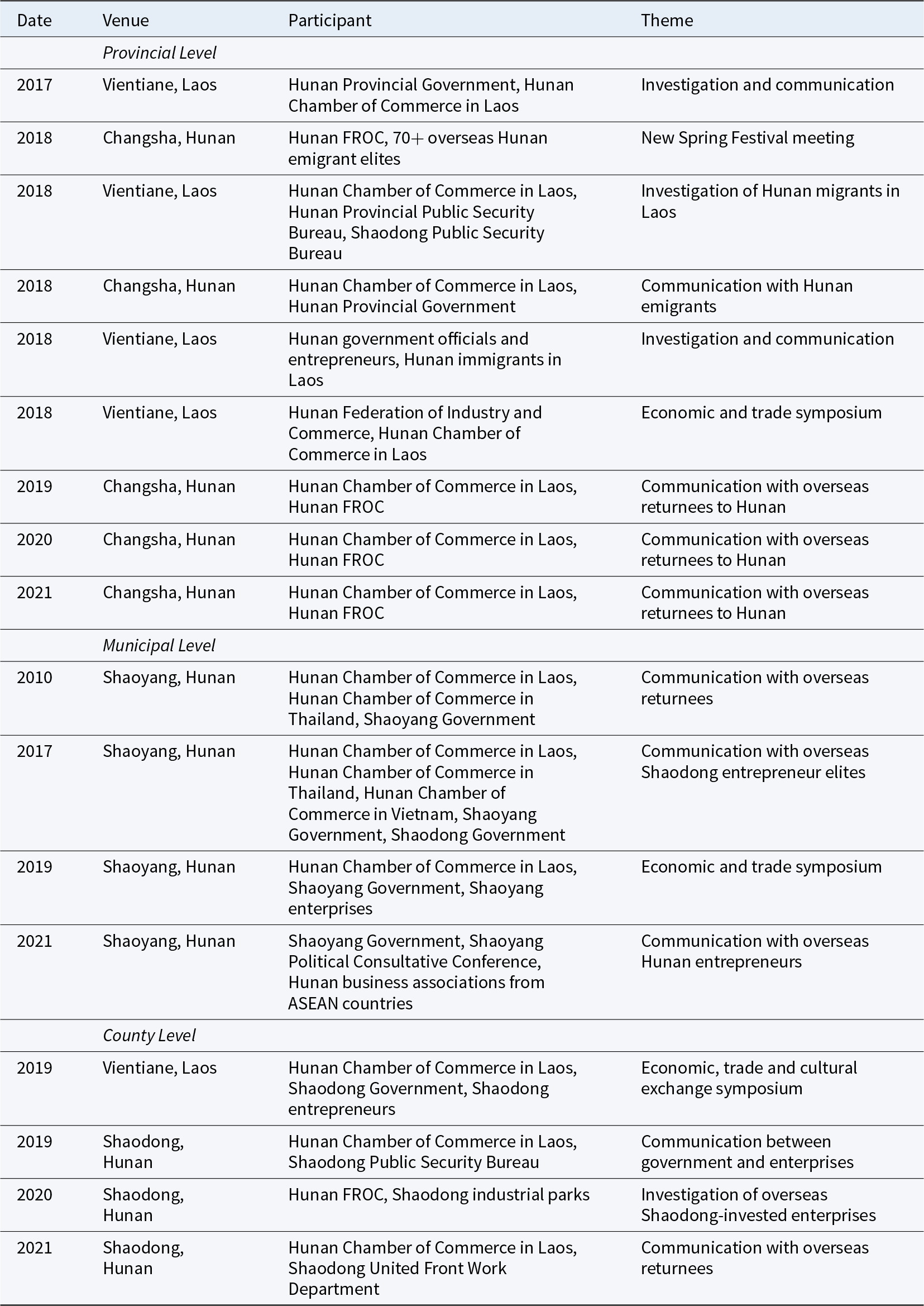
Government officials often visit emigrant communities or invite prominent members of the diaspora to return to their hometown for face-to-face meetings. Table 1 provides examples of the seminars, meetings and training sessions held both overseas and domestically for the overseas Shaodong community, organized by various administrative levels of the qiaoxiang governments. The launch of the BRI has significantly increased the frequency of these visits and meetings, with topics increasingly focused on BRI-related issues, particularly foreign trade, investment policy, analysis of overseas markets and environmental considerations, to support the international expansion of Chinese enterprises. Clearly, the ramifications of the BRI are encouraging and intensifying these engagement mechanisms between the qiaoxiang and the diaspora community. One interviewee reflected on this:
In recent years, local government officials have attached great importance to us and hold meetings with us several times a year. Especially at the end of each year, when we return to our hometown, leaders from different government agencies, such as the Administration for Industry and Commerce and the FROC, invite us to have dinner and also come to visit our enterprises.Footnote 20
Engagement Activities between Qiaoxiang Governments and Shaodong Emigrants

Source: Authors.
Additionally, qiaoxiang governments at various administrative levels are establishing their own institutional platforms to strengthen socio-economic networks with the diaspora. Notable initiatives include the “Overseas Chinese elites gathering” in Hunan (Qiaoshang qiaozhi jusanxiang 侨商侨智聚三湘), which began in 2011, and the “Return of Hunanese entrepreneurs” (Xiangshang huigui 湘商回归), which was launched in 2017 by the Hunan provincial government. Additionally, the Shaoyang municipal government initiated its “Global Shao entrepreneur conference” (Quanqiu Shao shang dahui 全球邵商大会) in 2012, and the Shaodong county government started its “Attracting fellow villagers back to build [their] hometown” programme (Yinglaoxiang jianjiaxiang 迎老乡建家乡) in 2017. These events are usually held every one to two years and actively reach out to members of the overseas Shaodong business community.
Instituting mechanisms for diaspora engagement in local affairs is an important strategy for qiaoxiang governments to reinforce ties with their emigrant communities.Footnote 21 As the overseas Shaodong business community and its economic power continue to grow, qiaoxiang governments are prioritizing their relationship with these emigrants and actively working to enhance their collaboration with prominent members of the diaspora. As one interviewee commented: “In the past, it was difficult to contact the government leaders, and we usually did not receive much attention. Later, as our economic power grew, the government began to pay attention to us and would contact us directly.”Footnote 22
Diaspora elites are often recommended to serve as representatives in local organizations, such as the Chinese People’s Political Consultative Conference (CPPCC), local people’s congress and the FROC, at different administrative levels. Our data reveal that from 2016 to 2022, the Shaodong government nominated more than 30 representatives from within the overseas Shaodong community to sit on the CPPCC, the FROC and the Federation of Industry and Commerce (FICCI) at the provincial, municipal or county level. Our survey also found that 17.9 per cent of the respondents had participated in government meetings and local affairs.
The advancement of information technology has significantly boosted the use of online communication tools, which have become vital mechanisms for the operation of multilevel transnational network governance. Qiaoxiang governments have established various online groups to foster and strengthen engagement with their overseas communities. For instance, the Shaodong government launched a WeChat group in 2018 called “Home of the Chinese diaspora” (Shaodong huaqiao zhijia 邵东华侨之家), which reaches out to more than 200 Shaodong emigrant elites in nearly 30 countries. Similarly, the Shaoyang government operates a WeChat group called “Love of the Chinese diaspora” (Shaoyang qiaobao qing 邵阳侨胞情), which connects over 300 emigrant elite members. The outbreak of the COVID-19 pandemic further strengthened these online networking mechanisms. During this period, the Shaodong government established more than 20 WeChat groups with overseas Shaodong associations to strengthen communications.Footnote 23
In short, both online and offline networking mechanisms have been created at various administrative levels, including province, municipality and county levels. The launch of the BRI has further intensified interactions between qiaoxiang governments and the overseas Shaodong community, consequently reinforcing the formation of multilevel transnational network governance.
Operation of Multilevel Transnational Network Governance
During the operation of transnational network governance, Shaodong emigrant communities engage with different levels of qiaoxiang governments in three key ways: they coordinate with governments to identify and frame governance issues and solutions, they mobilize collective actions within a transnational space to align with the government’s agenda, and they pool resources and develop strategies to adapt to changing preferences within the qiaoxiang’s social economy.
First, overseas Shaodong business leaders, in cooperation with their qiaoxiang government, play a key role in identifying and framing governance issues and finding solutions for those issues. Through regular meetings with different levels of qiaoxiang governments, as discussed above, Shaodong emigrants and associations are actively involved in the socio-economic affairs of their qiaoxiang. They apply their extensive experience and knowledge of running businesses overseas to help local enterprises branch out overseas, improve the business environment and develop solutions for socio-economic issues. The generation of local employment opportunities in a Shaodong village serves as a prime example of this collaboration:
The Shaodong government encourages us to return and contribute to our hometown. The government offered me many incentives, such as land rental subsidies and tax refunds. My father also suggested that I build a factory in our village to help resolve the local employment issue. So, even though I did not think that my hometown was the best place for my business investment, I built a factory for about 300 people in my village. Later, the village head told me that since the factory was set up, there were fewer villagers gambling and quarrelling. They began to compare who got more salary! Social conflicts and problems were really reduced.Footnote 24
Second, by leveraging the socio-economic capital accumulated in both their home and host countries, Shaodong emigrants, especially the elites and organizations, play a critical role in coordinating the qiaoxiang governments to mobilize collective actions across the borders.
Leaders of the Chinese diaspora communities (qiaoling 侨领) are viewed as crucial targets for co-optation in the Chinese government’s diaspora governance strategies.Footnote 25 Several interviewees from qiaoxiang governments expressed that these leaders are the key interlocutors with whom they liaise when network building. Consequently, qiaoling often enjoy direct and prioritized access to local governmental officials in qiaoxiang. They usually possess considerable business wealth and social standing, and many within the overseas Shaodong community hold leadership positions in overseas diaspora associations.
The socio-economic capital acquired by qiaoling in both their host and home countries is their biggest asset when it comes to engaging with qiaoxiang governments. A compelling example is the case of qiaoling H, a successful entrepreneur in Laos and a former president of the Hunan Chamber of Commerce in Laos. Owing to his active involvement in promoting economic relations between Laos and China, he was honoured with titles from both the Chinese and the Laos governments: he was made a special representative of the Hunan Provincial Government for International Friendly Exchanges and was appointed as vice-chairman of the Laos–China Business Cooperation and Promotion Committee. Propelled by the BRI developments in Laos and to strengthen the socio-economic relations between his hometown and Laos, H leveraged his social and economic resources from both countries to lobby for the establishment of a representative office of the Laos National Chamber of Commerce and Industry in Changsha, the capital of Hunan province. When one was opened in 2023, he was appointed its chief representative. By mobilizing collective actions across his host and home countries, H successfully utilized his transnational socio-economic resources to further strengthen his network building with the qiaoxiang.
Apart from the qiaoling, overseas Shaodong organizations are also instrumental in transnational network governance. They coordinate with various levels of qiaoxiang governments to establish diaspora-centred institutionalized networking platforms, such as the “Conference for friendship of the Overseas Hunanese Association” (Haiwai xiangji qiaoshetuan lianyi zonghui 海外湘籍侨社团联谊总会, CFOHA hereafter) at the provincial level and Federation of Global Shaoyang Entrepreneurs at the Shaoyang municipal level. The CFOHA, for example, was founded in 2011 through the collective efforts of overseas Hunanese associations, with Shaodong emigrants as co-organizers, working alongside the Hunan FROC. To date, over 200 organizations, including those associated with business, locality and professions, have participated in this initiative. The conference is held annually in Changsha; it attracts more than 100 representatives from associations worldwide and releases an annual work report. According to one recent report, from 2020 to 2022 the conference mobilized nearly 1,000 overseas Hunanese to engage in local business activities and facilitated investment projects valued at over 20 billion yuan.Footnote 26
Finally, qiaoxiang governments engage with the Shaodong diaspora to promote the strategic transformation of the local economy by pooling resources and aligning structural strategies. Developing industrial parks is a primary mode of economic development for the qiaoxiang. Thus, establishing local industrial parks in collaboration with overseas Shaodong entrepreneurs is a critical approach to multilevel transnational network governance. To integrate overseas Shaodong entrepreneurs into local industrial development, qiaoxiang governments at various administrative levels have initiated a series of diaspora-centred business programmes. These include the Hunan-ASEAN Investment and Trade Fair organized by Hunan province, the Overseas Chinese Tongxin Industrial Park located in Shaoyang, and the business engagement forum organized by Shaodong. Various preferential measures and policies have also been implemented, such as the establishment of seven entrepreneurship service stations for overseas returnees, subsidies for factory construction and production equipment and the creation of one-on-one service teams to support overseas enterprises in settling in these industrial parks.Footnote 27
Motivated by such incentives, overseas Shaodong entrepreneurs have invested in a series of industrial parks, such as the Longyuan Small and Medium Enterprise Venture Park (Longyuan zhongxiao qiye chanyeyuan 隆源中小企业创业园) in Shaodong, the ASEAN Technological Park, and the China–Africa Industrial Park in Shaoyang. By harnessing diaspora resources and structuring developmental strategies for the operation of industrial parks, qiaoxiang governments and their diaspora have formed a constructive engagement. The Longyuan Small and Medium Enterprise Venture Park is the first industrial park in Shaodong and focuses on the manufacture of luggage and clothing. In 2014, overseas entrepreneur L, who emigrated to Thailand in the early 2000s, invested in this venture park. With support from the local government and based out of the Shaodong industrial park, L set up the Shaodong Luggage and Apparel Import and Export Association. This venture aims to pool relevant industrial resources and leverage Shaodong’s transnational business networks to encourage local enterprises to “go out,” while also mobilizing more diasporic entrepreneurs to invest in their hometown. Under his guidance, by 2019, the association had incorporated over 50 foreign-invested enterprises (primarily funded by Shaodong emigrants), generating an annual export value of $350 million. By 2020, these enterprises accounted for 45 per cent of Shaodong’s total exports.
To strengthen overseas Shaodong entrepreneurial networks with their qiaoxiang, local governments promoted the industrial park as a centre for network building by enhancing its reputation and influence. In 2014 and 2017, Longyuan Park was consecutively recognized by the county, municipal and provincial governments as a model to emulate and was designated a provincial-level innovative enterprise incubator. Furthermore, the Shaodong government has utilized the industrial park as a reception centre for foreign business visits and training programmes.Footnote 28
Government Coordination and Competition
Multilevel governance emphasizes the interactions and relationships among various governing bodies involved in policymaking across different territorial levels.Footnote 29 It has been applied as a theoretical framework in governance studies in China, particularly concerning the vertical and horizontal diffusion of state power.Footnote 30 Based on the framework and in the context of diaspora governance of a multi-scaled qiaoxiang, this study emphasizes the coordination and competition among different levels of qiaoxiang governmental agencies in building transnational networks with overseas Shaodong communities.
Two types of coordinative government networks across territorial tiers have been established in diaspora governance: province-city-county and county-town-village. In each networking platform, the government agencies cooperate, forming a top-down operational system of governance. Within the province-city-county network, the Hunan provincial government serves as leader, and the governments of Shaoyang city and Shaodong county are the implementers and facilitators, respectively. For example, the Hunan provincial government initiated the CFOHA in 2011. In 2023, the Shaoyang government was designated as the host of the seventh CFOHA. The Shaodong government took a coordinating role in assisting upper-level administrative agencies from Hunan province and Shaoyang municipality, and was particularly effective in disseminating information about these activities to the overseas Shaodong communities and encouraging their participation in these events.
Within the county-town-village network, the Shaodong government is the key node, assisting upper-level governments while also leading townships and villages. Townships, as the lowest level of administrative unit, mainly play a connective role for the transmission of information both top-down and bottom-up. Comparatively, villages, as the smallest qiaoxiang territorial unit, have the closest contact with their overseas emigrants and are the most active agents in network building. For instance, in one of the villages in Shaodong, more than a hundred people set up businesses in Laos through the village-link network.Footnote 31 The Shaodong government effectively utilizes the villages’ advantages and initiates diaspora activities in the name of the village committee, for example by organizing investigative trips to villages for overseas emigrants and fostering a village-centred hometown identity among them.
In addition to coordination among different levels of qiaoxiang governments, competition is another key dynamic shaping the formation of multilevel transnational network governance. Unlike traditional coastal qiaoxiang, which are rich in diaspora resources across different territorial levels, Hunan province has a relatively limited number of overseas emigrants. Therefore, Shaodong’s diaspora resources have attracted the attention of governments from the provincial level to the lower municipal and county levels, leading to competition among the different administrative levels for diaspora engagement. As a governance instrument, competition plays a vital role in mediating managerial decision making across different governance contexts.Footnote 32 This study highlights how the competition for limited diaspora resources places significant pressure on qiaoxiang governments to implement beneficial policies that will improve their respective governance performances.
The establishment of the China–Africa Industrial Park illustrates this point. Located in Shaoyang, the park was proposed and funded by T, a Shaodong entrepreneur who had emigrated to Africa. When asked about why he chose Shaoyang as the site of the industrial park, he replied:
Actually, I talked about the project to the Shaodong government first. They encouraged me to locate it in Shaodong and the local government officials even accompanied me to present the project to the Hunan provincial government. The provincial government thought highly of the project but suggested it be set up in Changsha, or Shaoyang city, which has a higher and bigger platform.Footnote 33
As part of their negotiations with T to locate the industrial park in Shaoyang, the Shaoyang government enacted unprecedented beneficial policies for this project, including location incentives, tax breaks and reductions in land rental.Footnote 34 To support the development and attract more diaspora resources, the Shaoyang government organized a China–Africa Industrial Park “matchmaking” meeting during the fifth Global Shao Entrepreneur Conference and established the China–Africa Economic Co-operation Research Association. It also issued a commitment to “promote the construction of the project with the most sincere attitude, the most considerate service and the strongest guarantee.”Footnote 35 In addition, due to Shaoyang’s efforts, the industrial park was recognized as a provincial key project and granted preferential policies by the Hunan government, including priority credit and financing support.Footnote 36
Entrepreneur T elucidated on why Shaoyang was ultimately chosen as the site of the industrial park:
For us, first, the location of the industrial park is very important. Shaoyang put the industrial park on the same road as the municipal government. I think it is very well located. It also shows the local government takes it very seriously and tries to make it an influential industrial park. Second, the government offered very attractive incentive policies. Shaoyang does not hold much of a geographical advantage, so policies are the key to attracting enterprises.Footnote 37
In the face of municipal competition from Shaoyang, Shaodong county, as a subordinate unit of Shaoyang, is obviously at a disadvantage in terms of its administrative platform, economic resources and financial support. To enhance its competitiveness in attracting diaspora resources, the Shaodong government has taken a proactive stance. According to officials:
The Shaodong government will introduce more favourable policies and try to learn from the experience of other qiaoxiang and industrial parks. We continue to promote the advantages Shaodong has to offer as the hometown of overseas Shaodong communities. Shaodong is the “root” of those emigrants, and new emigrants especially have a strong hometown identity. The Shaodong business atmosphere is stronger, and the services provided are better. We will use these points to attract our emigrants back to Shaodong!Footnote 38
The case of the China–Africa Industrial Park illustrates the trajectory of multilevel governance in diaspora engagement and highlights how the coordinative and competitive relationship between government agencies empowers the diaspora’s participation and negotiation capacity in local governance. But how effective are these policies and measurements? Our investigation results reveal efficacy problems. While 32 per cent of informants indicated their entrepreneurship in their hometown was related to the local government’s mobilization efforts, only 6 per cent agreed that they had genuinely benefited from the local policies. With regard to private entrepreneurship service, only 8.3 per cent of informants had received a related service. These responses suggest that some policies and measures are formulated partially to satisfy governmental internal pressures and competition within and between local governments. In reality, the policies are often not well implemented or widely deployed. One entrepreneur interviewee echoed this point:
The environment for entrepreneurship still needs improvement. We have good government leaders. We have specific policies to encourage entrepreneurship. But it is actually hard to put them into practice. You meet a lot of unexpected problems when the policies are implemented, like excessive enforcement, rigid implementation and policy unsustainability.Footnote 39
A governmental official also admitted:
Many places in China are initiating specific programmes to attract business investment. This nationwide phenomenon is related to local governments competing for entrepreneurial resources. To gain a competitive edge, local governments have introduced some preferential policies that do not match the local business environment. Ultimately, their implementation is often not successful.Footnote 40
Conclusion
The emergence of Shaodong as a new type of qiaoxiang reflects the impact of China’s going-out strategy on Chinese overseas emigration in the 21st century. The launch of the BRI has further boosted Chinese emigration flows by facilitating the overseas expansion of Chinese capital, goods and enterprises. Shaodong emigrants, drawing on their grassroots social backgrounds and life skills, have formed a community featuring strong entrepreneurial traits, particularly in transnational commerce between their host and home countries. With regard to their hometown identity, Shaodong emigrants exhibit a fluid characteristic of locality-linked identity, which can cross from being village-centred to province-centred. Moreover, Shaodong is one of a few counties in Hunan province where diaspora resources are highly concentrated. All of these factors lay the foundation for the building of a multilevel transnational network in diaspora governance.
Unlike current analyses of diaspora governance in China, which largely focus on a singular national or subnational scale, this case study adopts a post-2000 qiaoxiang perspective to propose a rescaling approach to subnational diaspora engagement. It discloses a way to conceptualize the state’s efforts to court the diaspora across different territorial contexts and illustrates how multilevel transnational networks emerge as a significant model for qiaoxiang diaspora governance. Driven by governments’ diaspora governance strategies and the social and economic needs of overseas emigrants, online and offline interactive networking mechanisms have been established between qiaoxiang governments and overseas Shaodong communities. By taking on different tasks, such as framing governance issues, mobilizing collective actions, pooling resources and structuring strategies in alignment with local governments, the Shaodong emigrants have embedded themselves in different levels of local governance.
The multilevel transnational network in diaspora governance is characterized by both vertical and horizontal structures. Horizontally, qiaoxiang governments foster close engagement with the overseas Shaodong communities, especially the qiaoling, business associations and entrepreneurs. Vertically, the different administrative levels of qiaoxiang governments, through coordination and competition in transnational network building, integrate Shaodong emigrants into their respective strategies and practices to court the diaspora. In terms of theoretical implications, this study goes beyond the research on centralized and singularized diaspora governance at the national or subnational level. By applying a rescaling approach to qiaoxiang and analysing the multilevel cooperation and tensions between the different qiaoxiang government agencies in transnational network building, it enriches the field of diaspora governance from a decentralized and pluralistic perspective.
Acknowledgements
This research was supported by the National Social Science Fund of China (24BMZ117), the Fundamental Research Funds for the Central Universities (23NJYH04), and Shenzhen Humanities and Social Sciences Key Research Bases.
Competing interests
None.
Na REN is an associate professor at the School of International Studies/Academy of Overseas Chinese Studies in Jinan University, Guangzhou. Her research focuses on China's diaspora governance and South-East Asian Chinese society.
Sitong LONG is a graduate of the School of International Studies/Academy of Overseas Chinese Studies in Jinan University, Guangzhou. Her research focuses on China's diaspora governance