Introduction
Quitlines are a valuable population based resource for providing effective tobacco cessation services and have been determined to be significantly more effective than minimal interventions such as no counselling or self-help (Treating tobacco use and dependence 2008 update, 2008). Quitlines have the advantage of being free, anonymous, and accessible from anywhere. Quitlines can offer an array of options that augment traditional services, including proactive call-backs, mailed materials, emailed, text, and/or recorded messages, adjunctive internet programs, mobile applications, online communities, multiple levels of counselling, or any combination of these services. One of the most frequent add-ons for quitline delivery is the provision of cessation medication, and quitlines that offer medication result in higher call volume (L.C. An et al., Reference An, Schillo, Kavanaugh, Lachter, Luxenberg, Wendling and Joseph2006; Bauer, Carlin-Menter, Celestino, Hyland, & Cummings, Reference Bauer, Carlin-Menter, Celestino, Hyland and Cummings2006; Cummings et al., Reference Cummings, Fix, Celestino, Carlin-Menter, O’Connor and Hyland2006) and quit rates compared to those quitlines that do not offer medication (L.C. An et al., Reference An, Schillo, Kavanaugh, Lachter, Luxenberg, Wendling and Joseph2006; Cummings et al., Reference Cummings, Fix, Celestino, Carlin-Menter, O’Connor and Hyland2006; Tinkelman, Wilson, Willett, & Sweeney, Reference Tinkelman, Wilson, Willett and Sweeney2007).
A recent advance in quitline medication delivery is to offer combination nicotine replacement therapy (NRT) as a specific pharmacotherapy strategy to optimise cessation outcomes. It was reported (Hurt, Ebbert, Hays, & McFadden, Reference Hurt, Ebbert, Hays and McFadden2009) that combination therapy consisting of nicotine patches and short-acting NRT (i.e., gum or lozenge) is more effective than patches alone, because short-acting NRT is best used for the acute management of nicotine withdrawal symptoms and cravings in combination with longer-acting medications, such as the nicotine patch, which provides a steady state of nicotine. A great deal of evidence supports combining smoking cessation medications to improve cessation rates over those achieved by the use of individual smoking cessation medications (Carpenter M.J., Reference Carpenter, MJ, Burris, Matthew, Schnoll and Rigotti2013; Stead et al., Reference Stead, Perera, Bullen, Mant, Hartmann-Boyce, Cahill and Lancaster2012). Literature indicates that combination therapy is statistically better than mono-therapy in smoking cessation treatment as assessed by 3, 6, and 12 month abstinence rates based on a meta-analysis of several studies (Shah, Wilken, Winkler, & Lin, Reference Shah, Wilken, Winkler and Lin2008).
Combination therapy's aggregated 3, 6, and 12 month abstinence rate weighted over the studies was 39.0%, 29.3%, and 22.2% respectively, whereas that for the mono-therapy was 27.6%, 19.1%, and 14.3% (Shah et al., Reference Shah, Wilken, Winkler and Lin2008). Additional studies (Piper M.E. et al., Reference Piper, Smith, Schlam, Fiore, Jorenby, Fraser and Baker2009; Smith et al., Reference Smith, McCarthy, Japuntich, Christiansen, Piper, Jorenby and Jackson2009) similarly found the combination of the nicotine patches plus nicotine lozenge to yield higher 6 month cessation rates over various mono-therapies (40.1% vs. 34.4%; 26.9% vs. 17.7% respectively).
Research has just begun testing the effectiveness of distributing combination therapy directly through a quitline. Only one study (N = 987) examined the efficacy of a single-agent NRT versus combination NRT among quitline callers (Smith et al., Reference Smith, Keller, Kobinsky, Baker, Fraser, Bush and Fiore2013), and found a significant dependence by treatment interaction such that lighter smokers in the group receiving 2 weeks of combination NRT had a higher 7day point prevalence abstinence (PPA) rate at 6 months (57.4% vs. 34.9% for 2 weeks of combo vs. patch only) than heavier smokers (42.4% vs. 40.3%, respectively) (interaction p = 0.03) (Smith et al., Reference Smith, Keller, Kobinsky, Baker, Fraser, Bush and Fiore2013). Thus, the benefits of combination NRT were restricted to lighter smokers only; there was no benefit of combo-therapy among heavier smokers. This somewhat counter-intuitive finding contrasts with other outcomes among mono-therapy clinical trials, not within a quitline setting, where the nicotine patch and lozenge (each compared separately against placebo) generated significantly higher abstinence rates in heavy, and highly dependent smokers (Shiffman, Di Marino, & Pillitteri, Reference Shiffman, Di Marino and Pillitteri2005). Also in a different study among high dependence smokers, the 4 mg nicotine lozenge significantly reduced all affective withdrawal symptoms through the first 4 weeks of treatment, partially mediating the effect of treatment on abstinence (Shiffman, Reference Shiffman2008).
This paper replicates and extends the prior work of others (Smith, Reference Smith, Keller, Kobinsky, Baker, Fraser, Bush and Fiore2013), and presents the results of a randomised trial comparing acceptability, adherence, and quit rates among heavy smokers provided with either telephone counselling plus a 2 week supply of nicotine patches alone or telephone counselling plus a 2 week supply of nicotine patches in combination with lozenges. Outcomes included use of NRT, self-reported quit rates assessed at 7 and 30 days, changes in smoking patterns and cost per quit analyses.
Subsequent analyses examined possible moderating effects of socioeconomic status, since quitlines reach underserved populations that often have limited access to in-person cessation treatments (Lichtenstein, Zhu, & Tedeschi, Reference Lichtenstein, Zhu and Tedeschi2010). Moreover, there are well-established associations between socioeconomic status and both smoking prevalence and responsiveness to treatment. For example, within New York State (the catchment area of the current study), 28% and 13% of uninsured and insured adults smoke (McClave et al., Reference McClave, Whitney, Thorne, Mariolis, Dube, Engstrom and Prevention2010). Also, smokers with less than a high school education (another proxy measure of low SES) who received combination therapy were significantly more likely (p = 0.01) to be abstinent at 8 weeks and 6 months post quit compared to those who received mono-therapy (Piper et al., Reference Piper, Cook, Schlam, Jorenby, Smith, Bolt and Loh2010). Other evidence highlights environmental impacts such as a more pro-smoking social context experienced by low SES groups (Paul et al., Reference Paul, Ross, Bryant, Hill, Bonevski and Keevy2010), as well as experiencing less promotion of healthcare provider cessation interventions (Browning, Ferketich, Salsberry, & Wewers, Reference Browning, Ferketich, Salsberry and Wewers2008). Thus, combination NRT, when offered in the context of a quitline, may offer particular advantages to smokers from lower SES strata, which would offer significant public health implications for delivery of evidence-based cessation treatment.
Methods
Study Design
A randomised experimental design was utilised to compare two groups of heavy smokers (N = 3118): Group 1 (n = 1561) was given a free 2 week supply of nicotine patches (14 per box) and Group 2 (n = 1557) was given a free 2 week supply of both nicotine patches (14 per box) and lozenges (144 total, 72 per box). Primary outcomes (NRT use, abstinence) were assessed at 7 months. This research protocol was Institutional Review Board approved and all participants provided verbal consent. All participants received brief supportive counselling through the New York State Smokers’ Quitline (NYSSQL) and were instructed on how to correctly use both products. Instructions specified that patches were to be worn for 24 hours before replacement. Smokers in the combination group were instructed to use both products at the same time, with daily use of the patch and consistent use of the lozenge every 1 to 2 hours while awake and for management of moderate/strong cravings. Callers not eligible for NRT and those who explicitly requested to receive only the nicotine gum or only lozenges were excluded from participation in this study.
Brief supportive counselling included an initial intake and counselling call, an NRT check call and an additional follow up counselling call, as well as unlimited client initiated calls for general support. This combination of calls allowed for brief tailored coaching, behaviour change planning, medication compliance review, and relapse prevention. For many quitlines, offering succinct, front-loaded coaching, and support around critical relapse sensitive intervals makes sense given that many tobacco users slip in and out of different stages, and that the average number of calls accepted is only 2.7 (Carlin-Menter et al., Reference Carlin-Menter, Cummings, Celestino, Hyland, Mahoney, Willett and Juster2011). Online support is also becoming more integrated with phone support, providing distinct yet complementary assistance to keep tobacco-free individuals engaged with the process of remaining quit.
Study Population
Eligible smokers included a sample of 3,118 adult residents of New York State (18+ years), who self-identified as current daily tobacco users of 20 or more cigarettes, who contacted the NYSSQL between March 2010 and October 2010 seeking assistance to stop smoking. The sample was restricted to those individuals who: a) were interested in using nicotine replacement therapy to help them stop smoking; b) reported no known contraindications for using the nicotine patch or lozenge, and; c) scored either 5 or 6 on the heaviness of smoking index (HSI) (range 0–6) (Kozlowski, Porter, Orleans, Pope, & Heatherton, Reference Kozlowski, Porter, Orleans, Pope and Heatherton1994). The HSI has been found to be a simple and reliable method to screen smokers for level of nicotine dependence (Borland, Yong, O’Connor, Hyland, & Thompson, Reference Borland, Yong, O’Connor, Hyland and Thompson2010). See Figure 1 for the CONSORT (Consolidated Standards of Reporting Trials) diagram which displays participant study enrolment, excluded callers and reasons to date.
Enrolment in a randomised study comparing Nicotine Replacement Therapy (NRT) mono-therapy versus NRT combination therapy in Heavy Smokers Contacting a Quitline

Follow up Survey
We acknowledge there are different ways to follow up with participants and that ambiguity still remains on which approach constitutes a reasonable endpoint. Some consensus exists for making follow up assessments at 3 and 6 months (Hughes et al., Reference Hughes, Keely, Niaura, Ossip-Klein, Richmond and Swan2003). Therefore, our study followed up at 7 months with a conscious effort to avoid disrupting the realistic flow of follow up services in a quitline environment.
Participants were re-contacted by telephone 7 months after enrollment in the study to assess their smoking status and answer questions about quit attempts and usage of the NRT provided to them. In an effort to boost response rates, participants received a letter in advance of the 7 month telephone survey alerting them to the planned callback. Up to 15 callback attempts, at various times, were made to each of the participants. Overall a total of 1,298 (41.6%) of the study participants completed the follow up interview. Follow up response rates were similar between the mono-therapy (41.3%) and combo-therapy group (42.0%).
Outcome Measures
Nicotine patch or lozenge interest and usage was assessed by asking participants at the time of their follow up survey to report how important the offer of a free supply of nicotine medication was, how much of the free NRT provided they had used, and whether they had purchased additional NRT. Participants were also asked whether or not the NRT helped with strong cravings. The question referencing cravings was worded, ‘Do you feel the patches/lozenges helped you to deal with strong cravings?’ and the response was a simple ‘yes or no’.
Seven and 30 day point prevalence abstinence rates were assessed at the 7 month follow-up call and were computed in two ways. Consistent with recommendations of the Northern American Quitline Consortium (2009), we computed the quit rates at the time of the 7 month follow -up interview based on the achieved sample (according to protocol), under the assumption that those lost to follow up were missing at random. Additionally, we computed the rates for each group based on the assumption that those lost to follow up had all returned to smoking (a more conservative ‘intent-to-treat’ approach).
Daily amount smoked (cigarettes per day) was assessed at baseline and follow up among non-abstainers, determining the net difference in consumption and whether or not reductions of 50% or more had occurred.
Cost analyses were assessed by computing the costs per caller, the cost per quit based on the 7 month point prevalence quit rate, and the incremental cost-effectiveness ratio (Ferguson & Shiffman, Reference Ferguson and Shiffman2009) which is a measure of the added cost per attributable quit for combination therapy.
Data Analyses
All statistical analyses were completed using SPSS 21.0 software. Descriptive statistics from the intake interview were used to compare the equivalence of the two experimental groups. An ANOVA was performed for continuously measured variables (i.e., age, amounts smoked per day) and chi-square tests were used for non-continuous measures (i.e., gender, insurance status, etc.) to compare differences in the baseline characteristics of the two study groups. Additional analyses were performed using paired sample t-tests to investigate reduction in cigarette use among continuing smokers.
All responder treatment groups were verified to be comparable across demographic and tobacco-related variables after randomisation. The main outcome tested for the differences in the proportion of quitters between the two groups as assessed by the 7 month follow-up survey using chi square and logistical regression analyses. Subsequent moderator regression analyses tested for any interaction effects.
The cost per quitter enrolled in the quitline was calculated as the total cost of the NRT divided by the number of individuals who were abstinent at 7months. The incremental cost effectiveness ratio (ICER) was computed as the cost difference between the least intensive treatment group (2 weeks of nicotine patch only) and a more intensive comparison group (2 weeks of nicotine patch and 2 weeks of nicotine lozenge) divided by the difference in the quit rates of the two groups being compared. Sensitivity analyses included best and worst case costs based on quit rate differences of lower and upper bound 95% confidence intervals.
Results
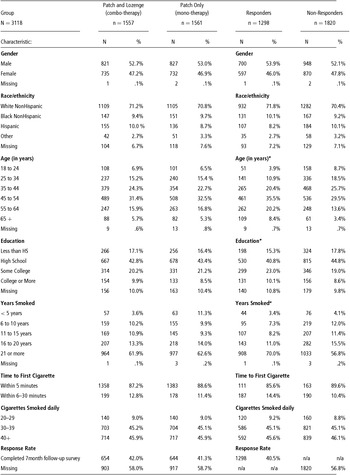
Baseline demographic and tobacco use characteristics for the 3,118 subjects who enrolled into the study (both the 1,298 subjects who completed the follow-up interview survey, and the 1,820 subjects who did not) are summarized in Table 1. There were no between group differences between mono- or combo-therapy groups. While responders and non-responders were similar across many characteristics, there were some significant differences reported. Responders were more likely to have higher percentages of participants greater than age 55 (28.6% vs. 17.0%) and lower percentages of participants aged 18 to 34 (14.8% vs. 27.2%). Responders also reported higher levels of education (33.1% vs. 27.6% having completed any college) and smoked for longer durations (81.0% vs. 72.3% with > 15 year smoking history).
Comparison of the baseline characteristics by group

*Significant differences found between groups.
Interest in, and use of NRT
The offer of the free supply of nicotine medication was rated as ‘very important’ by most subjects in both groups (87% and 85%). The vast majority of subjects (92%) used the NRT provided to them; usage was higher among those who received combination vs. mono-therapy (95% vs. 90%; p < 0.05). However, both groups were comparable when assessed for how much NRT they actually used, with similar reports of using ‘all of it’ (59% vs. 62%), ‘about half of it’ (24% vs. 20%) and ‘less than half’ (17% vs. 18%) for combo-therapy versus mono-therapy respectively. Relatively few participants of either group (16% vs. 13%; p > 0.05) reported that they obtained an additional supply of NRT beyond the free 2 week supply.
Reported craving relief was significantly greater among those who received the combo-therapy compared to mono-therapy (81% vs. 76%; p < 0.05). Specifically, more of the combo-therapy participants reported experiencing craving relief from the nicotine patches. Among those who received the lozenges, 53% reported that they helped deal with strong cravings.
Quit rates and smoking reduction
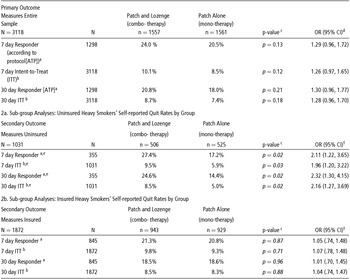
As shown in Table 2 responder quit rates according to protocol (ATP) were higher for those given combo-therapy compared to those given mono-therapy for 7 day (24% vs. 21%) and 30 day (21% vs. 18%) point prevalence abstinence, although they were not significantly different (p > 0.05). Results did not differ between ITT or ATP analyses.
New York Smokers Quitline Heavy Smokers’ Self-reported 7month Quit Rates by Group

a ATP represents responder analyses done according to protocol; b ITT represents intent to treat analyses and assumes that those lost to follow-up are current smokers at follow-up; c Results based on Chi Square analyses; d Regression analyses where patch alone is referent group, controlling for gender, age, race, HSI, and insurance status; e Significant differences between groups (p < 0 .05); f Regression analyses where patch alone is referent group, controlling for gender, age, race and HSI.
Among non-abstainers assessed at follow up (n = 997), the mean number of cigarettes smoked per day decreased an average of 29% per person in both groups. There were significantly more non-abstainers in the combo-therapy group versus the mono-therapy group (53% vs. 46%; p < 0.05) who achieved a reduction of at least 50% in number of cigarettes per day from baseline to follow up.
Insurance Status
Subsequent moderator analysis revealed a significant interaction (p < 0.05) by insurance status among responders at 7 days [OR 0.51 (0.27, 0.96)] and 30 days [OR 0.45 (0.23, 0.87)] such that combination therapy for uninsured smokers had about a doubling of quit rates when compared to uninsured smokers receiving mono-therapy, even after adjustment for dependence, demographics and other factors. Results were similar for 7 day (p = 0.05) and 30 day (p < 0.05) ITT analyses.
Table 2 sections 2a and, 2b illustrate the sub-group analyses of the uninsured and insured heavy smokers’ self-reported 7 month quit rates by group. Among responders, uninsured participants using combo-therapy reported 7 day quit rates (27.4% vs. 17.2%; p < 0.05), and 30 day quit rates (24.6% vs. 14.4%, p < 0.05) that were significantly higher compared to uninsured participants using mono-therapy. ITT analyses results were similar where uninsured participants utilizing combo-therapy reported significantly greater quit rates at 7 (10.0% vs. 6.0%; (p < 0.05) and 30 days (9.0% vs. 5.0%; p <0.05) in comparison to uninsured participants using mono-therapy.
This trend did not occur among insured responders (Table 2b), as their quit rates were much more similar between combo-therapy and mono-therapy participants at 7 days (21.3% vs. 20.8%; p > 0.05) and 30 days (18.5% vs. 18.6%; p > 0.05), with no differences between ITT and ATP analyses.
Heaviness of Smoking Index (HSI)
We observed stronger, but non-significant (p >0.05) numerical differences in quit rates among moderately heavy smokers receiving combination therapy compared to very heavy smokers. Among responders, even weaker, non-significant differences in 7 day quit rates occurred among those with greater dependence (HSI = 6; 21% vs. 20%; p >0.05). Greater, non-significant numerical differences occurred in 7 day quit rates among moderately heavy responders receiving combo-therapy versus mono-therapy (HSI = 5; 26% vs. 21%; p > 0.05). Similar findings occurred among moderately heavy smokers receiving combo-therapy versus mono-therapy as a result of the 30 day responder analyses (HSI = 5; 22% vs. 18%; p > 0.05), 7 day ITT analyses (HSI = 5; 12% vs. 9%; p = 0.06), and 30 day ITT analyses (HSI = 5; 10% vs. 8%; p > 0.05), in favour of combo-therapy.
A subsequent moderator regression analyses did not demonstrate a significant interaction between heaviness of smoking index (HSI) and treatment group at 7 or 30 days (p > 0.05). Main effects revealed a significant difference between HSI levels 5 and 6 (p < 0.05) based only on the 7 day ITT regression analyses [OR 0.70 (0.53, 0.93)], suggesting a slight association between dependence level and success with quitting.
Cost analyses
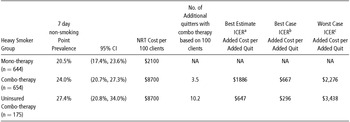
The cost of a 2 week supply of 14 patches was $21, and the cost of a 2 week supply of 144 lozenges was $66, making the cost of combined treatment $87. The overall cost per quitter (7 day point prevalence) was 3.5 times higher for the combo-therapy group than the mono-therapy group ($362.50 per quit vs. $102.44 per quit). As shown in Table 3, the incremental cost-effectiveness ratio (ICER) was calculated to be $1,886 based on the 7 day point prevalence quit rate difference of 3.5%. Best and worst case added cost per attributable quit were $667 and $2,276 based on the 7 day point prevalence quit rate differences of 9.9% and 2.9%.
Cost Analyses: Combo vs. Mono-therapy based on 7-day point prevalence quit rates

a Best Estimate ICER (Incremental cost-effectiveness ratio) is a measure of the added costs per added quit for combination therapy. ICER was computed as the cost difference between mono-therapy and combo-therapy divided by the difference in 7 day point-prevalence quit rates of the two groups being compared. For example, the incremental cost effectiveness ratio (ICER) for the group that received two weeks of combo-therapy = (87–21)/ (.240–.205) = $1886.
b Best case ICER is also an incremental cost-effectiveness ratio, based on the range of difference from the 95% confidence bounds whereas best case reflects the highest difference. For example, the ICER for the best case group that received two weeks of combo-therapy = (87–21)/ (.273–.174) = $667.
c Worst case ICER is also an incremental cost-effectiveness ratio, based on the range of difference from the 95% confidence bounds whereas worst case reflects the smallest difference. For example, the ICER for the worst case group that received two weeks of combo-therapy = (87–21)/ (.236–.207) = $2,276.
Cost estimates were lower among the uninsured participants receiving combo-therapy versus mono-therapy, given the larger differences in quit rates. For the uninsured, the ICER was calculated to be $647 based on the 7 day point prevalence quit rate difference of 10.2%. Best and worst case added cost per attributable quit among the uninsured were $296 and $3,438 based on the 7 day point prevalence quit rate differences of 22.3% and 1.9%.
Discussion
This study tested the provision of 2 weeks of either combo-therapy (nicotine patch and nicotine lozenge) or mono-therapy (nicotine patch alone) to heavy smokers calling the NYSSQL where all persons received counseling support. Smokers calling the quitline were willing to use combo-therapy and did so with good adherence. Reported craving relief was significantly greater in those who received the combo-therapy compared to mono-therapy which translated into non-significant but numerically higher quit rates measured after 7 months, although the cost per quit favours the use of mono-therapy. These results stand in contrast with previous research on combination therapy (Fagerstrom, Schneider, & Lunell, Reference Fagerstrom, Schneider and Lunell1993; Piper et al., Reference Piper, Smith, Schlam, Fiore, Jorenby, Fraser and Baker2009; Schneider, Cortner, Gould, Koury, & Olmstead, Reference Schneider, Cortner, Justice, Gould, Amor, Hartman and Olmstead2008; Schneider et al., Reference Schneider, Cortner, Justice, Gould, Amor, Hartman and Olmstead2008; Schneider et al., Reference Schneider, Koury, Cortner, Olmstead, Hartman, Kleinman and Leaf2006), and cast doubt on the use of combination therapy as delivered in this study, except among certain uninsured sub-populations.
It is possible that the lower than expected results for combination therapy are the result of providing only limited duration of therapy since smokers in our study were only given a 2 week supply of NRT in contrast to clinical studies that have given smokers up to 8 weeks of therapy (McAfee et al., Reference McAfee, Bush, Deprey, Mahoney, Zbikowski, Fellows and McClure2008). For example, absolute rates of abstinence within our trial were markedly lower than a previous trial that provided the same treatment for 8 weeks, both for combination patch and lozenge (40% vs. 24% [responders only]) and for patch alone (34% vs. 21%) (Piper et al., Reference Piper, Smith, Schlam, Fiore, Jorenby, Fraser and Baker2009). Yet, additional research has also found shorter regimens (2 weeks) of combined NRT to yield higher quit rates than 2 or 6 weeks of mono-therapy (Smith et al., Reference Smith, Keller, Kobinsky, Baker, Fraser, Bush and Fiore2013). Given scarce resources and restricted budgets, many quitlines may only be able to provide starter kits of NRT and can appreciate these and other findings that determined no added advantage in cessation rates when providing greater than two weeks of NRT (Cummings et al., Reference Cummings, Hyland, Carlin-Menter, Mahoney, Willett and Juster2011).
The greater perceived withdrawal relief reported among those receiving combo-therapy supports prior evidence that the combination of two forms of NRT produces greater craving supression than a single form (Bolt, Piper, Theobald, & Baker, Reference Bolt, Piper, Theobald and Baker2012; Ferguson & Shiffman, Reference Ferguson and Shiffman2009). Although participants were instructed to use lozenges every 1 to 2 hours, the majority of participants in our study reported using them primarily in response to cravings. Quit rates may have even been higher among those receiving combo-therapy if actual use had been as prescribed (i.e., fixed regimen of lozenge use versus use only in response to cravings as was instructed). There may have also been higher quit rates in both groups, and potentially stronger differences if more participants chose to buy more NRT after their 2 week free supply was used.
Our decision to restrict subject participation to those at the higher end of the nicotine dependence scale represents both, a strength and a limitation of this study. While our intent was to limit this study to heavily addicted smokers, it is possible that brief combination therapy may be beneficial to less dependent smokers. This is pertinent, given our observation of a slight advantage in quit rates in moderately addicted smokers compared to heavily addicted smokers who received combo-therapy. This finding mirrors the results of a recent randomised trial that found less of an effect of combination NRT for heavier smokers, defined as smoking greater than 15 cigarettes per day (Smith et al., Reference Smith, Keller, Kobinsky, Baker, Fraser, Bush and Fiore2013).
Both of these findings differ from other results (Loh et al., Reference Loh, Piper, Schlam, Fiore, Smith, Jorenby and Baker2012) that specifically found smokers who were less dependent and faced environmental risk (i.e., spouse smoked) to not benefit as much from combo-therapy as other heavier smokers. Their protocol supplied anywhere from 8 to 12 weeks of pharmaco-therapy, which may be better at reducing craving and other withdrawal symptoms that arise from dependence, and less effective at mitigating environmental threats.
Other limitations of the present study include outcomes that were based upon self reported data and modest response rates of 41% at 7 month follow-up. While the low response to the follow-up survey does limit the ability to estimate a ‘true quit rate’, the response rates were similar between experimental groups, making the impact of the experimental treatment accurately estimated. While recall bias may be a concern at this time interval, because this is a randomised study, it is expected to be the same between the two treatment conditions and any differences observed should be attributed to the experimental treatment. In this study we balanced the need for data collection against a conscious effort to avoid disrupting the realistic flow of follow up services in a quitline environment. The 7 month follow up endpoint is the one that all quitlines have adopted based on North American Quitline Consortium Guidelines (An, L., Betzner, A., Luxenberg, M.L., Rainey, J., Capesius, B.A., & Subialka, E., Reference An, Betzner, Luxenberg, Rainey, Capesius and Subialka2009). Finally, a limitation of the cost per quit analysis is the assumption that the point estimate for quitting that we estimated is the true quit rate.
This study's strengths include use of a randomised, experimental design within a community based quitline setting which accrued a sizable study population and completed a 7 month follow-up assessment. Additionally, efforts were made to maintain the natural environment of a quitline. The consistency of results, across a variety of outcomes and analyses, support the validity of our findings.
In summary, the main outcome of this article does not provide support that heavy smokers who contact a quitline and are provided with a 2 week supply of combined NRT demonstrate significantly enhanced rates of cessation compared to monotherapy. However, subsequent analyses indicate that the intervention seemed to work better for some groups more than others. While our results stand in contrast to prior literature on use of combined NRT medication, they do not undermine that literature. It is likely that the efficacy of combination therapy is contingent upon the duration of use, prescribed instructions for use, or both. There is also some emerging evidence suggesting that there are patient related differences in response to cessation therapy (Lerman et al., Reference Lerman, Jepson, Wileyto, Patterson, Schnoll and Mroziewicz2010; Schnoll & Leone, Reference Schnoll and Leone2011). Combination therapy may be most worthwhile among moderate smokers and/or groups reporting a lower socioeconomic status and lower nicotine dependence. Quitlines remain an attractive population-based approach for providing evidence-based care and tailored support to all types of tobacco users, and should consider these findings when making decisions about allocating their resources. This remains especially relevant as budgets become increasingly scarce and populations of heavy tobacco users reduce their use as a result of environmental restrictions, increased healthcare costs and enhanced support for quitting.
While our results indicate that combination NRT was no more efficacious than mono-therapy overall, the subgroup analyses convey an important story worth telling as it provides helpful insights into reaching and assisting moderately heavy and uninsured smokers. Recent national estimates indicate that the prevalence of smoking is highest among those individuals with less than a high school education (28.4%), those with no health insurance (28.6%), those living below the federal poverty level (27.7%), and those between the ages of 18–24 (23.8%) (Centers for Disease & Prevention, Reference Centers for Disease and Prevention2011). Those with the lowest SES, many of whom are uninsured, are at the highest risk for tobacco-related morbidity and mortality (Vidrine, Reitzel, & Wetter, Reference Vidrine, Reitzel and Wetter2009; Ward et al., Reference Ward, Jemal, Cokkinides, Singh, Cardinez, Ghafoor and Thun2004). Therefore, it is critically important to expand the reach of evidenced-based smoking cessation and treatment resources to such population subsets. These findings can help to inform decisions regarding the provisions of added assistance, which are part of the services routinely provided by quitlines. Investigating differential responsiveness to combo-therapy versus mono-therapy could potentially increase rates of cessation among disadvantaged groups, and make a significant contribution to reducing tobacco related health inequities. Further research using longitudinal data is needed to better understand long term success rates among smokers in different socioeconomic groups.
Funding
This work was supported in part by the New York State Smokers' Quitline (NYS Department of Health) and in part by the Roswell Park Cancer Institute Cancer Center Support Grant (NCI grant #P30 CA016056).
Declaration of interests
Dr. Cummings provides expert testimony in litigation against cigarette manufacturers, provides consulting advice and has received grants from Pfizer, and previously served as a co-investigator on a multi-center trial evaluating a nicotine vaccine from Nabi Biopharmaceuticals. Dr. Mahoney has provided expert testimony in litigation against cigarette manufacturers, has received research grants and speaker fees from Pfizer and served as an investigator on a multi-center trial evaluating the potential efficacy of a nicotine vaccine for cessation sponsored by Nabi Biopharmaceuticals. Dr. Toll has received a grant from Pfizer for medicine only.