


Introduction
Antimicrobial resistance (AMR) is a major global public health threat associated with substantial morbidity, mortality, and healthcare burden.1 The epidemiology of AMR varies across geographic regions and healthcare systems, reflecting differences in patient populations, antimicrobial prescribing practices, infection prevention efforts, and local transmission dynamics. Ongoing surveillance within healthcare systems is therefore essential for identifying changes in bacterial epidemiology and resistance patterns, informing empiric antimicrobial therapy, and guiding antimicrobial stewardship initiatives.
Seasonal variation in infectious diseases and antimicrobial use is well recognized and may contribute to temporal changes in bacterial epidemiology and resistance.Reference Neumann and Kawaoka2–Reference Martínez, Rosmalen, Bustillos, Natsch, Mouton and Verbon4 Multiple factors may contribute to these patterns, including seasonal respiratory viral infections, antimicrobial prescribing and healthcare utilization, environmental conditions such as temperature and humidity, and population behaviors.Reference Neumann and Kawaoka2–Reference Zeng, Li and Zhao5 The aggregate of these factors may influence both the distribution of bacterial organisms and the populations represented in clinical microbiologic surveillance.
Studies evaluating seasonal variation in bacterial epidemiology and AMR have reported heterogeneous findings across populations, organisms, resistance definitions, and analytic approaches.Reference Serletti, Dutcher and Degnan3–Reference Bock, Aguilar-Bultet and Egli6 Some studies have examined associations between temperature and resistance at the population level,Reference Zeng, Li and Zhao5,Reference Bock, Aguilar-Bultet and Egli6 whereas others have evaluated temporal patterns for individual organisms or specimen types.Reference Serletti, Dutcher and Degnan3,Reference Martínez, Rosmalen, Bustillos, Natsch, Mouton and Verbon4 As a result, the relationship between season, bacterial organism detection, and antimicrobial resistance within healthcare populations remains incompletely characterized. Understanding these relationships may improve interpretation of local surveillance data and inform antimicrobial stewardship and infection prevention efforts.
We evaluated seasonal variation in community-onset bacterial cultures within a multicenter healthcare system. Specifically, we examined associations between season and (1) detection of selected bacterial organisms, (2) detection of study organisms by specimen source, and (3) AMR, while considering patient and healthcare-related characteristics.
Methods
Study population
Data for this retrospective cohort study were obtained from 4 hospitals within a large integrated healthcare system serving northern and eastern Manhattan and the surrounding tristate region. Participating facilities included a 221-bed community hospital, 283-bed pediatric acute care hospital, 647-bed adult tertiary/quaternary-care hospital, and 914-bed combined pediatric and adult tertiary/quaternary-care hospital. Patient data were extracted for individuals admitted between January 1, 2012, and December 31, 2016. The analysis included clinical cultures obtained on hospital days 0–2. Patients hospitalized within the network during the preceding 30 days and cultures obtained after hospital day 2 were excluded to reduce inclusion of healthcare-associated cultures. Cultures with admission source recorded as “born inside this hospital” or “information not available” were also excluded. All patient-level data were de-identified and assigned study identification numbers before analysis. The study was approved by the Institutional Review Board of Columbia University Medical Center.
Data collection
Study data were obtained from a National Institutes of Health-funded integrated clinical database (R01HS024915) linking electronic health record and administrative data across the hospital network. Clinical microbiology data included specimen source, collection date, organism identification, and antimicrobial susceptibility results for urine, blood, respiratory, and wound cultures. Antimicrobial susceptibility testing was performed using the VITEK 2 system (bioMérieux) according to Clinical and Laboratory Standards Institute guidelines.7 Susceptibility results were categorized as susceptible, intermediate, or resistant; intermediate susceptibility results were classified as resistant. The organisms of interest were Staphylococcus aureus, Klebsiella pneumoniae, Acinetobacter baumannii, Pseudomonas aeruginosa, Enterococcus faecalis, and Enterococcus faecium.
Antimicrobial resistance definition
AMR was operationalized as resistant or intermediate susceptibility to predefined organism-antibiotic combinations: oxacillin for S. aureus; imipenem or meropenem for K. pneumoniae; ampicillin-sulbactam for A. baumannii; levofloxacin for P. aeruginosa; and vancomycin for E. faecalis and E. faecium.
Study variables
The primary outcomes were (1) detection of individual study organisms, (2) specimen source (blood, respiratory tract, urinary tract, or wound/skin), and (3) antimicrobial resistance. Since the objective was surveillance of microbiologic trends rather than estimation of clinically confirmed infection incidence, cultures were analyzed based on microbiologic detection and were not restricted to clinically confirmed infections. Positive cultures were included regardless of whether organism detection represented colonization or clinical infection. For resistance analyses, isolates were categorized as resistant/intermediate or susceptible according to the predefined organism-antibiotic combinations. Resistance estimates were aggregated across study years and compared between seasons.
Exposure definition
The primary exposure was season, categorized as summer versus winter. Monthly average temperature data for New York City were used to identify the warmest and coldest periods.8 Summer was defined as cultures collected from July 1 through August 31, and winter as cultures collected from January 1 through February 28 (February 29 in leap years). Cultures collected during the remaining 8 months were excluded from the seasonal analysis. This approach was used to maximize contrast between the warmest and coldest periods.
Statistical methods
All analyses were performed using SAS version 9.4 (SAS Institute Inc., Cary, NC). Categorical variables were summarized using frequencies and percentages, and age was summarized using the median and interquartile range (IQR) where presented descriptively. Candidate predictors and potential confounders included age, sex, admission source, prior hospitalization, Charlson Comorbidity Index (CCI),Reference Charlson, Pompei, Ales and MacKenzie9 and present-on-admission diagnoses of diabetes mellitus, chronic dermatitis, renal failure, malignancy, trauma, burns, and wounds. Bivariable associations between candidate variables and study outcomes were evaluated using χ2 tests or Fisher exact tests, as appropriate. Variables meeting the prespecified bivariable screening criterion (P < .10) were considered for inclusion in multivariable logistic regression models using a forward-selection approach. Adjusted models included age, admission source, diabetes mellitus, chronic dermatitis, and wounds. Odds ratios (ORs), adjusted odds ratios (aORs), and 95% confidence intervals (CIs) were reported. Statistical significance was defined as a 2-sided P < .05. Multivariable analyses of organism detection, specimen source, and AMR were performed at the culture level.
Results
Cohort characteristics
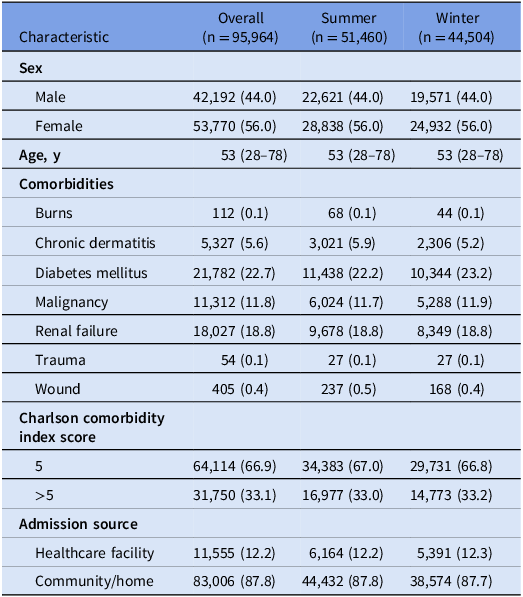
After applying exclusion criteria, 95,964 community-onset clinical cultures from 48,133 unique patients were identified across the 4 participating hospitals (Figure 1). Of these cultures, 51,460 (53.6%) were obtained during summer and 44,504 (46.4%) during winter (Table 1). Female patients accounted for 53,770 cultures (56.0%). The median age was 53 years (IQR, 28–78 yr) in both seasonal groups. The most common comorbidities were diabetes mellitus (n = 21,782; 22.7%), renal failure (n = 18,027; 18.8%), and malignancy (n = 11,312; 11.8%). Admission source was community/home for 83,006 cultures (87.8%) and a healthcare facility for 11,555 (12.2%); admission from a healthcare facility reflected the documented source at the index encounter.
Study population flow diagram, 2012–2016. Flow diagram showing sequential application of study exclusion criteria and identification of community-onset clinical cultures included in the seasonal analysis and cultures yielding at least 1 target organism.

Demographic and clinical characteristics of the analytic cohort overall and by season, 2012–2016

Table 1. Long description
A table comparing demographic and clinical characteristics by season. The table has 12 rows and 5 columns. Column headers are Characteristic, Overall (N = 95,964), Summer (n = 51,460), and Winter (n = 44,504). Row labels include Sex, Age, Comorbidities, and Admission source. Row 1: Sex, Male, 42,192 (44.0), 22,621 (44.0), 19,571 (44.0). Row 2: Sex, Female, 53,770 (56.0), 28,838 (56.0), 24,932 (56.0). Row 3: Age, 53 (28–78), 53 (28–78), 53 (28–78). Row 4: Comorbidities, Burns, 112 (0.1), 68 (0.1), 44 (0.1). Row 5: Comorbidities, Chronic dermatitis, 5,327 (5.6), 3,021 (5.9), 2,306 (5.2). Row 6: Comorbidities, Diabetes mellitus, 21,782 (22.7), 11,438 (22.2), 10,344 (23.2). Row 7: Comorbidities, Malignancy, 11,312 (11.8), 6,024 (11.7), 5,288 (11.9). Row 8: Comorbidities, Renal failure, 18,027 (18.8), 9,678 (18.8), 8,349 (18.8). Row 9: Comorbidities, Trauma, 54 (0.1), 27 (0.1), 27 (0.1). Row 10: Comorbidities, Wound, 405 (0.4), 237 (0.5), 168 (0.4). Row 11: Charlson comorbidity index score, 5, 64,114 (66.9), 34,383 (67.0), 29,731 (66.8). Row 12: Charlson comorbidity index score, >5, 31,750 (33.1), 16,977 (33.0), 14,773 (33.2). Row 13: Admission source, Healthcare facility, 11,555 (12.2), 6,164 (12.2), 5,391 (12.3). Row 14: Admission source, Community/home, 83,006 (87.8), 44,432 (87.8), 38,574 (87.7).
Data are presented as n (%) unless otherwise indicated.
Age is presented as median (interquartile range).
Sex was missing for 2 cultures; admission source was missing for 1,403 cultures; CCI score was missing for 100 cultures.
Bacterial organism distribution
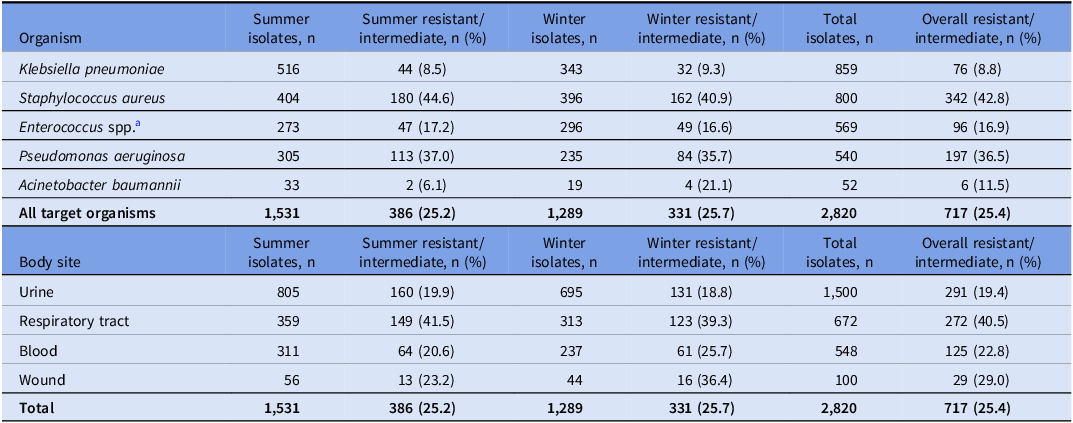
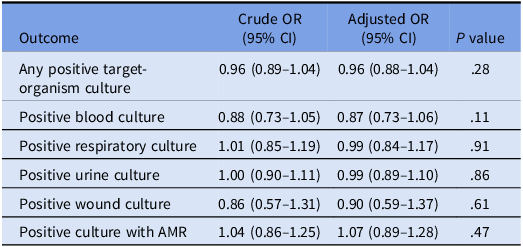
Among the 95,964 community-onset clinical cultures, 2,820 (2.9%) yielded at least 1 of the 6 bacterial organisms of interest (Table 2). K. pneumoniae was the most frequently detected organism (n = 859; 30.5%), followed by S. aureus (n = 800; 28.4%), Enterococcus species (n = 569; 20.2%), P. aeruginosa (n = 540; 19.1%), and A. baumannii (n = 52; 1.8%). Of the 2,820 cultures yielding a study organism, 1,531 (54.3%) were obtained during summer and 1,289 (45.7%) during winter. In unadjusted analyses, summer was associated with increased odds of K. pneumoniae detection (OR, 1.51; 95% CI, 1.31–1.73) and P. aeruginosa detection (OR, 1.30; 95% CI, 1.10–1.54). A. baumannii demonstrated a similar pattern (OR, 1.74; 95% CI, 0.99–3.05), whereas Enterococcus species were not associated with summer detection (OR, 0.92; 95% CI, 0.78–1.09). In the adjusted analysis of any target-organism-positive culture, season was not associated with detection of a study organism (aOR for winter vs summer, 0.96; 95% CI, 0.88–1.04; P = .28) (Table 3).
Distribution and antimicrobial susceptibility of target bacterial organisms and culture body sites, stratified by season, 2012–2016

Table 2. Long description
The table presents data on the distribution and antimicrobial susceptibility of target bacterial organisms and culture body sites, stratified by season from 2012 to 2016. It has 14 rows and 7 columns. The columns are labeled Organism, Summer isolates, n, Summer resistant/intermediate, n (%), Winter isolates, n, Winter resistant/intermediate, n (%), Total isolates, n, and Overall resistant/intermediate, n (%). The rows are labeled with different organisms and body sites. For organisms, the data includes Klebsiella pneumoniae, Staphylococcus aureus, Enterococcus spp., Pseudomonas aeruginosa, Acinetobacter baumannii, and all target organisms. For body sites, the data includes Urine, Respiratory tract, Blood, Wound, and Total. Each row provides the number of isolates and the percentage of resistant or intermediate isolates for summer and winter seasons, along with the total isolates and overall resistant/intermediate isolates.
a Enterococcus spp. includes Enterococcus faecalis and Enterococcus faecium.
Percentages for resistant/intermediate isolates are calculated using the total number of isolates for the corresponding organism or body site within each season as the denominator.
Intermediate susceptibility results were classified as resistant.
Total positive isolates: summer, n = 1,531; winter, n = 1,289; overall, n = 2,820.
Total resistant/intermediate isolates: summer, n = 386 (25.2%); winter, n = 331 (25.7%); overall, n = 717 (25.4%).
Association between season and positive culture outcomes, 2012–2016

Table 3. Long description
A table with six rows and four columns comparing culture outcomes with crude and adjusted odds ratios. The columns are labeled Outcome, Crude OR (95% CI), Adjusted OR (95% CI), and P value. The rows list different culture outcomes: Any positive target-organism culture, Positive blood culture, Positive respiratory culture, Positive urine culture, Positive wound culture, and Positive culture with AMR. Each row provides the crude odds ratio with 95% confidence interval, adjusted odds ratio with 95% confidence interval, and P value for the respective outcome.
OR, odds ratio; CI, confidence interval; AMR, antimicrobial resistance.
Summer was the reference season; ORs therefore represent winter relative to summer.
Adjusted models included age, admission source, chronic dermatitis, diabetes mellitus, and wounds.
Intermediate susceptibility results were classified as resistant.
Specimen source
Among the 2,820 cultures yielding a study organism, 1,500 (53.2%) were urine specimens, 672 (23.8%) were respiratory specimens, 548 (19.4%) were blood specimens, and 100 (3.5%) were wound specimens (Table 2). In adjusted analyses, season was not associated with target-organism detection in blood (aOR, 0.87; 95% CI, 0.73–1.06), respiratory (aOR, 0.99; 95% CI, 0.84–1.17), urine (aOR, 0.99; 95% CI, 0.89–1.10), or wound specimens (aOR, 0.90; 95% CI, 0.59–1.37) (Table 3).
Antimicrobial resistance
Among the 2,820 cultures yielding a study organism, 717 isolates (25.4%) were classified as resistant/intermediate and 2,103 (74.6%) as susceptible under the study definitions. The proportion classified as resistant/intermediate varied by organism, with the highest proportion among S. aureus (342/800; 42.8%), followed by P. aeruginosa (197/540; 36.5%), Enterococcus spp. (96/569; 16.9%), A. baumannii (6/52; 11.5%), and K. pneumoniae (76/859; 8.8%) (Table 2). Among cultures yielding a study organism, 386 of 1,531 summer isolates (25.2%) and 331 of 1,289 winter isolates (25.7%) were classified as resistant/intermediate. Organism-specific resistant/intermediate proportions in summer versus winter were 8.5% versus 9.3% for K. pneumoniae, 44.6% versus 40.9% for S. aureus, 17.2% versus 16.6% for Enterococcus spp., 37.0% versus 35.7% for P. aeruginosa, and 6.1% versus 21.1% for A. baumannii (Table 2). In the adjusted analysis, season was not associated with overall AMR/intermediate susceptibility (aOR, 1.07; 95% CI, 0.89–1.28; P = .47) (Table 3).
Discussion
In this large multicenter study of nearly 96,000 community-onset clinical cultures from 4 hospitals, summer was associated with increased unadjusted detection of several gram-negative organisms, particularly K. pneumoniae and P. aeruginosa, with a similar but statistically uncertain pattern for A. baumannii. In the adjusted analysis of any target-organism-positive culture, however, season was not associated with organism detection. Season was also not associated with target-organism detection by specimen source or with overall antimicrobial resistance/intermediate susceptibility in adjusted analyses. These findings highlight a distinction in interpreting seasonal microbiologic surveillance: seasonal differences observed for individual organisms in unadjusted analyses do not necessarily indicate an overall independent association between season and culture-based organism detection. Since cultures were not restricted to clinically confirmed infections, these findings should be interpreted as patterns of microbiologic detection rather than seasonal incidence of infection.
The observed unadjusted seasonal differences should be considered in the context of prior literature on seasonal variation in bacterial epidemiology and AMR. Previous studies examining environmental temperature or seasonal trends have reported associations between warmer temperatures and resistance among gram-negative organisms,Reference Zeng, Li and Zhao5,Reference Bock, Aguilar-Bultet and Egli6 whereas findings have varied across organisms, patient populations, and healthcare settings.Reference Serletti, Dutcher and Degnan3,Reference Martínez, Rosmalen, Bustillos, Natsch, Mouton and Verbon4 Our findings add to this literature by evaluating both organism detection and antimicrobial resistance across multiple hospitals while accounting for patient and healthcare-related characteristics.
Several mechanisms could contribute to seasonal differences in microbiologic surveillance. Seasonal variation in respiratory viral infections, antimicrobial prescribing, healthcare utilization, and environmental conditions may influence both bacterial epidemiology and the populations represented in clinical cultures.Reference Neumann and Kawaoka2–Reference Bock, Aguilar-Bultet and Egli6 However, we did not directly evaluate these mechanisms or the independent effect of ambient temperature. Therefore, the observed seasonal patterns should not be interpreted as evidence of a direct temperature effect or other specific biological mechanism.
For AMR, the overall proportion of resistant/intermediate isolates was similar between summer and winter (25.2% vs 25.7%), and season was not associated with overall antimicrobial resistance/intermediate susceptibility in the adjusted analysis. Resistance proportions varied substantially across organisms, however, emphasizing the importance of interpreting resistance in relation to specific organism-antibiotic combinations rather than assuming a uniform seasonal pattern. These findings have implications for antimicrobial stewardship and healthcare epidemiology. Seasonal surveillance patterns should be interpreted alongside local organism distribution, patient characteristics, and healthcare-related factors. Routine institutional antibiograms remain important for summarizing local susceptibility patterns and informing empiric antimicrobial decision-making.10
An important strength of this study is the characterization of bacterial epidemiology and AMR during a clearly defined prepandemic period. The observation period provides a baseline preceding substantial changes in healthcare utilization, infection prevention practices, antimicrobial prescribing, and pathogen epidemiology associated with the COVID-19 pandemic beginning in early 2020. Subsequent studies have documented changes in antimicrobial use and resistance during the pandemic, providing a rationale for using prepandemic surveillance data as a baseline for evaluating changes over time.Reference Meschiari, López-Lozano and Medioli11 By examining seasonal patterns across multiple years and hospitals, this study provides a benchmark for comparison with current surveillance. Future longitudinal studies could evaluate whether these seasonal patterns persist in the postpandemic era and whether they differ by organism, specimen source, resistance phenotype, or antimicrobial exposure.
Limitations
This study has several limitations. Individual patients could contribute multiple cultures during the study period. Although bivariable analyses of sample characteristics were performed at the admission level, multivariable analyses were conducted at the culture level without an explicit method to account for correlation among multiple cultures contributed by the same patient. The precision of the reported estimates may therefore be affected by nonindependence of observations. In addition, cultures were analyzed according to microbiologic detection and were not restricted to clinically confirmed infections, and outpatient antimicrobial exposure and healthcare encounters outside the integrated healthcare system were unavailable. These factors may have resulted in outcome misclassification or residual confounding.
Antimicrobial resistance was defined using predefined organism-antibiotic combinations rather than multidrug-resistance criteria. This approach does not characterize resistance across multiple antimicrobial classes or specifically identify current resistance phenotypes such as carbapenem-resistant A. baumannii. Intermediate susceptibility results were classified as resistant, and sensitivity analyses using alternative classifications were not performed. The study also included both pediatric and adult patients; an adult-only sensitivity analysis was not performed. Finally, the study period limits applicability to recent resistance epidemiology. Since the study was conducted within 4 hospitals in a single integrated healthcare system in the northeastern United States, findings may not generalize to healthcare systems with different patient populations, climates, resistance patterns, antimicrobial prescribing practices, or healthcare delivery structures.
Conclusions
Seasonal differences were observed in the unadjusted detection of selected gram-negative organisms, but season was not independently associated with overall target-organism detection or AMR after adjustment. These findings emphasize the importance of interpreting seasonal surveillance within the context of local epidemiology and patient and healthcare-related characteristics. This multisite study offers a well-defined prepandemic benchmark for future studies evaluating how patterns of bacterial detection and antimicrobial resistance evolve over time.
What is already known
-
• AMR surveillance is important for infection prevention, antimicrobial stewardship, and empiric antimicrobial decision-making.
-
• Seasonal variation in bacterial pathogen detection and antimicrobial resistance has been reported, but findings have varied across organisms, settings, and study designs.
-
• The extent to which seasonal differences persist after accounting for patient characteristics and healthcare-related factors remains uncertain.
What this study adds
-
• In a multicenter healthcare system comprising 4 hospitals and 95,964 community-onset clinical cultures, summer was associated with increased unadjusted detection of Klebsiella pneumoniae and Pseudomonas aeruginosa, with a similar but statistically uncertain pattern for Acinetobacter baumannii.
-
• In adjusted analyses, season was not associated with overall target-organism detection or target-organism detection by specimen source.
-
• Overall resistance/intermediate susceptibility was similar between summer and winter, and season was not associated with overall AMR after adjustment.
Acknowledgments
The authors sincerely thank Elaine L. Larson, PhD, RN, FAAN, CIC (Professor Emerita, Columbia University School of Nursing) for her mentorship throughout this project, including guidance in study design, support with data acquisition, and thoughtful scientific advice that contributed to the completion of this work.
Author contributions
CN Skellington contributed to study design, methodology, data analysis, interpretation of findings, drafting of the original manuscript, and critical revision of the manuscript. B Cohen contributed to organizational approvals, data acquisition and curation, study design, methodology, data analysis, and critical revision of the manuscript. All authors approved the final version for submission.
Financial support
None reported.
Competing interests
All authors report no conflicts of interest relevant to this article.
Disclaimer
The views expressed in this article reflect the results of research conducted by the author(s) and do not necessarily reflect the official policy or position of the Defense Health Agency, Department of War, nor the U.S. Government.


 Open access

