Emotional availability (EA) has successfully captured important aspects of parent–child relationships and continues to do so even as children grow older (Biringen & Easterbrooks, Reference Biringen and Easterbrooks2012). EA is a relational construct reflecting the ability of mothers and children to effectively regulate their interactions (Emde, Reference Emde and Taylor1980, Reference Emde2000), taking into account the behavior of both partners (Biringen, Reference Biringen2000). The present research was designed to consider how family psychosocial risk may be associated with EA across age, and consistent with tenets of the developmental psychopathology framework, examined EA in a high-risk population (Cicchetti, Reference Cicchetti1993, Reference Cicchetti, Cicchetti and Cohen2006; Cicchetti & Toth, Reference Cicchetti and Toth2009). EA has been examined in only a few risk populations, including mothers with histories of abuse (Moehler, Biringen, & Poustka, Reference Moehler, Biringen and Poustka2007), low-income samples (Little & Carter, Reference Little and Carter2005; Oyen, Landy, & Hilburn-Cobb, Reference Oyen, Landy and Hilburn-Cobb2000), samples with atypical development (Biringen, Fidler, Barrett, & Kubicek, Reference Biringen, Fidler, Barrett and Kubicek2005; Wiefel et al., Reference Wiefel, Wollenweber, Oepen, Lenz, Lehmkuhl and Biringen2005), and those with young mothers (e.g., Easterbrooks, Chaudhuri, & Gestsdottir, Reference Easterbrooks, Chaudhuri and Gestsdottir2005). Increased levels of EA characterized by higher levels of maternal sensitivity and child involvement, and lower levels of maternal hostility, have been noted to differentiate low versus high-risk samples (Pipp-Siegel, Reference Pipp-Siegel1996). The present study makes a unique contribution by studying EA within the context of a disadvantaged, high-risk community sample where mothers had childhood histories of aggression and/or social withdrawal, and examining mother–child interactions over time (infancy to middle childhood).
There are a multitude of diverse conditions that impact parenting and threaten the development of a healthy, competent child and a positive mother–child relationship. In the face of adverse conditions (e.g., poverty, lack of parental resources, lack of parental warmth, and increased hostility), it is important to consider the processes of socialization and parenting variables (e.g., maladaptive behavioral styles, parenting strategies) that influence whether children will emerge competent and develop healthy relationships. According to Cicchetti and colleagues' developmental psychopathology framework (e.g., Cicchetti, Reference Cicchetti1993, Reference Cicchetti, Cicchetti and Cohen2006; Cicchetti & Toth, Reference Cicchetti and Toth2009), a full understanding of the pathways to adaptive and maladaptive outcomes throughout development is necessary to comprehend the mechanisms behind the appearance and maintenance of disturbed and disordered behavior. To identify such pathways, researchers are encouraged to go beyond the study of indicators of these outcomes and examine the interactive intra- and interindividual processes of deviant behavior. Central to the principles of the developmental psychopathology framework is the need to examine risk and protective factors in light of contextual variables (e.g., the interplay between micro- and macrolevel influences), using multiple levels of analysis in order to better inform prevention and intervention practices for those at highest risk for developing later disorders.
Within disadvantaged communities, risk factors tend to cluster and be sequential over time; low income, low educational achievement and school drop-out, adolescent and single parenthood, substance abuse, low occupational status, poor physical health and nutrition, and so forth, are all elevated risk factors. Thus, children may be at risk over the course of development in these communities. Educational attainment, parental ability to mobilize resources and attend to children's needs, and financial status are known to impact the creation of a stimulating and supportive home environment. Interestingly, parenting is considered one of the most important mediators between financial hardship and child outcome (Caspi & Elder, Reference Caspi, Elder, Hetherington and Lerner1988a, Reference Caspi, Elder, Hinde and Stevenson-Hinde1988b; McLoyd, Reference McLoyd1990, Reference McLoyd1998; Wolkind & Rutter, Reference Wolkind, Rutter, Rutter and Hersov1985). Currently, there is a plethora of research examining the links between parenting and child (mal)adaptive outcomes, implicitly and explicitly supporting the developmental psychopathology framework by highlighting the importance of parenting style and its relation to risk and resilience. For example, studies of low-risk dyads consistently show that healthy child outcomes are associated with positive mother–child relationships (Musick, Stott, Spencer, Goldman, & Cohler, Reference Musick, Stott, Spencer, Goldman, Cohler, Anthony and Cohler1987), and a positive mother–child relationship is a powerful adaptive system in the face of adversity. However, the quality of parent–child relationships in high-risk samples is often poor, placing the child at risk for future problems. Examining EA in high-risk populations provides an important means of understanding specific components of relationship quality that are associated with subsequent outcomes. Positive, stable home environments that are stimulating and communicative and where the parent–child relationship can grow optimally are important. Financial security, parents' level of education, parental warmth, sensitivity, and nonhostility, and levels of parental stress and satisfaction with social and emotional support are also protective factors predicting positive child outcomes (Serbin, Stack, & Schwartzman, Reference Serbin, Stack and Schwartzman2000; Stack, Serbin, Enns, Ruttle, & Barrieau, Reference Stack, Serbin, Enns, Ruttle and Barrieau2010).
As mothers are often the primary caregivers, they play an integral role in the socialization of social and emotional development and in the development of healthy relationships. Research on parenting skills and behaviors support the commonsense notion that negative parenting interactions, such as harsh, authoritarian, and inconsistent parental behaviors, are predictive of negative outcomes for children (Beck, Daley, Hastings, & Stevenson, Reference Beck, Daley, Hastings and Stevenson2004). Conversely, positive parenting behaviors, such as consistency, monitoring, warmth, and authoritative parenting are predictive of more adaptive emotional functioning (Melnick & Hinshaw, Reference Melnick and Hinshaw2000), and may be protective factors in “at-risk” populations.
The Concordia Longitudinal Risk Project (Concordia Project) is an ongoing longitudinal and intergenerational study of children who were identified in elementary school as aggressive, socially withdrawn, both aggressive and socially withdrawn, and those with normative levels of aggression and social withdrawal. These children have been followed over time and into parenthood. Aggression and social withdrawal represent undercontrolled or overcontrolled emotional and behavior responses to social situations, commonly referred to in the child psychopathology literature as externalizing and internalizing problems (Salovey & Sluyter, Reference Salovey and Sluyter1997). Research has reliably demonstrated that early aggression and social withdrawal are linked to a host of negative outcomes (e.g., Rubin, Burgess, & Hastings, Reference Rubin, Burgess and Hastings2002; Stack, Serbin, Schwartzman, & Ledingham, Reference Stack, Serbin, Schwartzman, Ledingham, Peplar, Madsen, Webster and Levene2005), including psychological disorders and physical health problems (e.g., De Genna, Stack, Serbin, Ledingham, & Schwartzman, Reference De Genna, Stack, Serbin, Ledingham and Schwartzman2006; Rubin, Burgess, & Coplan, Reference Rubin, Burgess, Coplan, Smith and Hart2002; Saltaris et al., Reference Saltaris, Serbin, Stack, Karp, Schwartzman and Ledingham2004), and are relatively stable over time (Moskowitz & Schwartzman, Reference Moskowitz and Schwartzman1989).
Intergenerational studies are unique and important because they focus on comparisons between generations at similar points in development, attempting to identify the processes that predict outcomes across generations. Comparatively, although prospective longitudinal research designs allow for the study of developmental periods from childhood to adulthood, intergenerational studies permit the examination across generations. An innovative feature of these intergenerational designs is that they typically allow the researcher to predict behavior across the “parental divide” (that is, the transition to parenthood) and to predict outcomes in the next generation. The role of parenting and socioemotional experiences in the transfer of risk for developmental, health, and in particular for purposes of the present paper, social, emotional, and relationship problems is a central issue (Serbin & Karp, Reference Serbin and Karp2004). Furthermore, parenting difficulties often occur in women and men with childhood histories of aggression and/or social withdrawal, increasing the probability that their offspring will be at-risk for health problems, behavioral/social difficulties, and negative developmental outcomes (e.g., Martin, Stack, Serbin, Ledingham, & Schwartzman, in press; Serbin et al., Reference Serbin, Stack, Schwartzman, Cooperman, Bentley, Saltaris, McMahon and Peters2002). Therefore, the Concordia Project, drawing upon the central tenets of the developmental psychopathology framework (Cicchetti, Reference Cicchetti1993, Reference Cicchetti, Cicchetti and Cohen2006; Cicchetti & Toth, Reference Cicchetti and Toth2009), provides a unique opportunity to study the intergenerational transfer of health and psychosocial risk during childhood.
The measurement of multiple variables and multiple influences is integral to the developmental psychopathology framework, and the importance of the interactions between these influences over time has been underscored (Cicchetti, Reference Cicchetti1993; Cicchetti & Toth, Reference Cicchetti and Toth2009). Consistent with this principle, the present paper examines how histories of risk impact parenting and the quality of the mother–child relationship (EA) from infancy to middle childhood. The general objective was to consider how family psychosocial risk may be associated with EA across age and to examine the continuity of EA over time in two studies of the Concordia Project. Study 1 examined dyads during preschool and middle childhood. Study 2 examined a different sample of dyads, tested intensively at five time points (6, 12, and 18 months, preschool, and school age). Evaluating the continuity of the EA Scales from infancy to middle childhood and determining their predictive relationship to maternal risk status and current levels of maternal support and stress are important steps to better understanding the processes through which risk is transferred via socialization in the home.
Study 1
Study 1 was designed to examine mother–child dyads at two points in time: preschool and middle childhood. We had three objectives to examine:
1. the relation between maternal childhood histories of aggression and social withdrawal and their associations with mother and child EA when the children were at preschool age and again at middle childhood;
2. mothers' current levels of support and stress (parenting stress, social support, quality of the home environment) and their influence on the quality of the mother–child relationship (EA); and
3. prediction from mothers' levels of support and stress at preschool to EA in middle childhood.
Method
Participants
Participants from the present study were part of a subsample of the Concordia Project. Data collection from the Project began in 1976–1978 with a community sample of 4,109 school age children (who participated when they were in Grades 1, 4, or 7) from low-socioeconomic neighborhoods who attended French public school in Montreal, Quebec, Canada. All children were largely from Caucasian, francophone families. Children were screened and 1,774 were selected on dimensions of aggression and social withdrawal using the Peer Evaluation Inventory (PEI; Pekarik, Prinz, Liebert, Weintraub, & Neale, Reference Pekarik, Prinz, Liebert, Weintraub and Neale1976). The PEI contains 34 items loading onto three factors: Aggression (e.g., those who start a fight over nothing), Social Withdrawal (e.g., those who are too shy to make friends easily), and Likeability. Children nominated up to four boys and (separately) four girls who best matched each item on the PEI. Oversampling at the extremes of the sample (i.e., the upper tails of the aggression and withdrawal dimensions) was done deliberately when arriving at the final sample of 1,774, allowing for a range of scores, including children from across the continuum on aggression and withdrawal drawn from the same schools and neighborhoods. This sample of children was subsequently followed in smaller representative subsamples at 3- to 5-year intervals. A more detailed description of the Concordia Project sample can be found in Schwartzman, Ledingham, and Serbin (Reference Schwartzman, Ledingham and Serbin1985), and Serbin et al. (Reference Serbin, Cooperman, Peters, Lehoux, Stack and Schwartzman1998). The Concordia Project provides a unique opportunity to study the intergenerational transfer of health and psychosocial risk during childhood and to determine the processes and protective factors that predict positive outcomes for children within an “at-risk” population. Because the concept of risk is inherently probabilistic, it follows that some individuals from moderate to high-risk backgrounds are likely to develop well, despite their apparently poor prospects in infancy or early childhood. Hence, within a high-risk population, it is expected that there will likely be a range of outcomes, in terms of adaptation and competence across the life span.
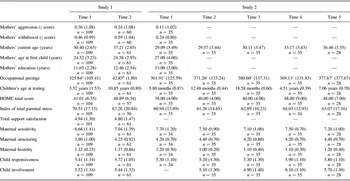
In the present study, a subsample of 109 mothers (who were original female participants; mean age = 30.4 years) took part with their 12- to 72-month-old children at Time 1. Selection was based on the criterion of having a child within this age range at the time the data were collected for this project. Approximately 83% of eligible families chose to participate. At this time point, 48 (44%) of the young children were boys and 61 (56%) were girls. A vast majority of the children were first (44; 40%) or second born (46; 42%), 15 (14%) were third born, and four (4%) were fourth born. In addition, at this time, fathers were present in 84 (77%) of the children's homes. In general, half of the children were functioning within the developmental norms in terms of cognitive ability and language development, and had no observed or reported socioemotional problems. The other half of the children in this sample showed some degree of developmental lag with respect to their cognitive and/or socioemotional functioning. At Time 2, 61 of the original subsample of mothers from Time 1 (mean age = 37.2 years) participated with their now 9- to 13-year-old children. In this sample, 23 (38%) of the children were boys and 38 (62%) were girls. Again, the majority of the children were first (25; 41%) or second born (26; 43%), whereas eight (13%) were third born, and two (3%) were fourth born. Also at this time, fathers were present in 47 (77%) of the children's homes. Consistent with a risk sample, some of the children were doing fine and others were not. In general, children's level of functioning remained similar to that at Time 1. In addition, the children were showing average school performance, however somewhat below that expected based on teacher report. Table 1 provides detailed demographic information, as well as information on the measures used in the present studies.
Means (standard deviations) of maternal childhood histories of aggression and withdrawal, demographic information, current support and stress variables, and EA Scales for Studies 1 and 2

Note: (—) Indicates that reporting data would be repetitive, given the time of measurement (e.g., mother's aggression and withdrawal scores, age at birth of first child, and educational attainment for Times 2–5 in Study 2) or was not measured (e.g., total support satisfaction for Study 2; child involvement, Time 1, Study 2). The occupational prestige rating system changed from Time 1 to Time 2 in Study 1. At Time 1, the household prestige score was used (Nock & Rossi, Reference Nock and Rossi1979); at Time 2, the Standard International Occupational Prestige Scale was used (Treiman, Reference Treiman1977). In Study 2, the household prestige score was used at all time points (Nock & Rossi, Reference Nock and Rossi1979).
aMean occupational prestige ratings correspond to the following occupations: salesperson, filing clerk, cashier, and hairdresser.
bMean occupational prestige ratings correspond to the following occupations: technician, sales worker, and clerical worker.
cMean occupational prestige ratings correspond to the following occupations: clerical worker, nursing aide, and receptionist.
It was important to assess the representativeness of the current sample compared to the participants in the original Concordia Project. The mothers who participated in the present study were compared to a sample of 360 women who were contacted to participate in studies during 1993–1997, as well as a subsample of 373 women (who were part of the original sample of the Concordia Project) and who were also known to be mothers. The women were compared along the dimensions of aggression and social withdrawal, as well as years of education, occupational prestige ratings, and age at birth of first child (if applicable). In terms of risk status, no differences were found along the dimensions of aggression, F (2, 839) = 1.56, p > .10, and social withdrawal, F (2, 839) = 1.43, p > .10, between the three groups. The present sample was, therefore, considered to be representative of the original sample along these dimensions. In addition, no differences arose with respect to mothers' age at first child when comparing the mothers in the current sample to other mothers in the representative sample, F (2, 839) = 0.75, p > .10. However, women who were not mothers completed more years of schooling, F (2, 839) = 24.06, p < .01, and had higher occupational prestige ratings, F (2, 839) = 4.77, p < .01, than women who were mothers. There were no differences in these measures between mothers from the representative sample (n = 373) and mothers from the current sample (n = 109).
To further examine the representativeness of our current sample, we compared the 49 mothers who participated at Time 1 only to the 60 mothers who participated at both Times 1 and 2. The women were compared along the dimensions of aggression and social withdrawal, as well as years of education, occupational prestige ratings, and age at birth of first child. In terms of risk status, no differences were found along the dimensions of aggression, t (107) = 1.55, p > .10, and social withdrawal, t (107) = −1.53, p > .10, between mothers, and therefore considered to be representative along these dimensions. In addition, no differences arose with respect to mothers' age at first child, t (107) = −0.61, p > .10, and occupational prestige, t (101) = −1.63, p > .10, when comparing the mothers who participated at Time 1 only to mothers who participated at both Times 1 and 2. The only difference that appeared was that those who participated at Times 1 and 2 completed more years of schooling than mothers who participated only at Time 1, t (107) = −2.69, p < .01.
Procedure
For each visit, families were visited by two members of the research team (one part-time researcher and one research assistant or graduate student) who were blind to the risk status of the dyad. Mothers were provided with a description of the procedure (based on whether it was Time 1 or Time 2) and read and signed informed consent forms. At Time 1, mothers and their children engaged in a 15-min free-play task with standardized toys in the home environment. Toys were selected in order to be age appropriate for children ages 1 through 6. They included books, puzzles, a doll, building blocks, and a tea set. There were multiple books and puzzles provided, so that younger or older children would have age appropriate choices at their level. At Time 2, mothers and their children, who were then in middle childhood, engaged in a 4-min Jenga task (a game created by Parker Brothers whereby players take turns removing a block from a tower and balancing it on top). All interactions were videotaped (for more detail, refer to Grunzeweig, Stack, Serbin, Ledingham, & Schwartzman, Reference Grunzeweig, Stack, Serbin, Ledingham and Schwartzman2009).
Measures
Demographic Information Questionnaire (DIQ)
Sociodemographic information was collected using the DIQ (e.g., mothers' current age, age of birth of first child, child's age, occupational status, and number of years of education). This measure has proven effective in collecting participant demographics, and has been used in past studies of the Concordia Project (e.g., De Genna et al., Reference De Genna, Stack, Serbin, Ledingham and Schwartzman2006; Serbin et al., Reference Serbin, Cooperman, Peters, Lehoux, Stack and Schwartzman1998).
The Parenting Stress Index (PSI; Abidin, Reference Abidin1990)
The PSI is a 37-item self-report inventory used to identify sources and levels of parenting stress across three main domains (as a parent, in relation to the child, and total life stress). For purposes of the present study, the overall index of total life stress was used. The total life stress subscale includes 12 items assessing the extent that parents find themselves in stressful circumstances that are often beyond their control (e.g., the death of a relative, loss of a job). Validity and reliability of this measure has been found to be satisfactory to excellent (Abidin, Reference Abidin1995).
The Parenting Social Support Index (PSSI; Telleen, Reference Telleen1985)
A modified version of the PSSI, a self-report measure consisting of 22 items assessing seven forms of support that parents could be receiving (e.g., relationship with a confidant, material aid) was used to evaluate the level of parenting social support. Three total scores are then generated (total perceived need for support, total network size, and total support satisfaction). Only total support satisfaction was analyzed. The PSSI has been found to have good reliability and validity (Telleen, Reference Telleen1985).
Home Observation for Measurement of the Environment (HOME; Caldwell & Bradley, Reference Caldwell and Bradley1984)
The HOME Inventory, a standardized observational screening tool used to measure the quality and quantity of stimulation and support available to a child in his or her home environment, was administered at Times 1 and 2 (versions appropriate for age of child). Each version is composed of 45–60 items clustered into six to eight subscales (e.g., parental responsivity, acceptance of child, learning materials). Only the total HOME score (where a higher score equals a more stimulating and supportive home environment) was included. The HOME's psychometric properties are adequate, with ratings of reliability and validity ranging between satisfactory to excellent (Caldwell & Bradley, Reference Caldwell and Bradley1984).
Means and standard deviations for all measures are included in Table 1.
Observational coding
EA Scales
The quality of the mother–child interaction was assessed using the EA Scales (Biringen, Robinson, & Emde, 1988, Reference Biringen, Robinson and Emde1993) during the free-play task at Time 1, and the Jenga task at Time 2. Dyadic interactions were coded for maternal sensitivity, structuring, hostility, and child responsiveness and involvement on 5- to 9-point scales (refer to the introduction to this volume for more detail). Training was conducted via the Biringen tapes. For this paper, although the EA dimension is nonhostility, we inverted the scores and used the name of “hostility,” given our sample. Furthermore, given our sample, the structuring dimension operated as a linear scale from 1 (nonoptimal structuring) to 5 (optimal structuring).
To assess interrater reliability, 30% of the sample at Time 1 and 25% of the sample at Time 2 were randomly selected and double-coded (by trained coders who were blind to the study's hypotheses and mothers' risk status). Intraclass reliability coefficients revealed highly satisfactory levels for all EA Scales (Time 1: r = .82–.99, Time 2: r = .87–.97).
Results
Intercorrelations between EA Scales and predictors were assessed at Times 1 and 2. Given the relatively small sample sizes and the number of analyses that were planned, it was deemed necessary to reduce the number of variables to be included in the study. The analyses involved a minimum of 10 participants per predictor variable that is within the recommended minimum required for a hierarchical regression analysis (Tabachnick & Fidell, Reference Tabachnick and Fidell1996). Previous research has identified a number of contextual variables that are known to affect parenting and child outcomes (Felner et al., Reference Felner, Brand, Dubois, Adan, Mulhall and Evans1995). Within the context of the present study, parental social support, stimulation, and support provided to the child in the home environment by the parents, and parenting stress were considered. Because of significant correlations between these variables at Times 1 and 2, a principal components factor analysis was conducted on the three contextual variables at both time points. At Time 1, one factor was retained that had an eigenvalue of 1.79 and explained 59.62% of the variance. At Time 2, one factor including the same variables was retained that had an eigenvalue of 1.64 and explained 54.78% of the variance. Factor loadings ranged from −0.80 to 0.76 at Time 1 and −0.67 to 0.78 at Time 2. The variables included in these factors represented psychosocial support and stress that mothers and children in the study were currently experiencing when children were preschoolers (Time 1) and again when they were in middle childhood (Time 2); the factors were thus considered indices of current support and stress.
Hierarchical multiple regressions were conducted using SPSS-16. In all regression analyses, maternal education, child gender, and the index of current support and stress were included as control variables. In general, maternal childhood risk status (i.e., maternal childhood histories of aggression or social withdrawal) was entered in Step 1, maternal education at Step 2, and child gender at Step 3; contemporaneous variables were entered in the final steps (e.g., index of current support and stress, EA Scales). Of note, the interaction between maternal childhood histories of aggression and social withdrawal was always entered in the last step, so as not to be redundant with the potential main effects resulting from variables entered in the first step.
Time 1: Maternal childhood histories
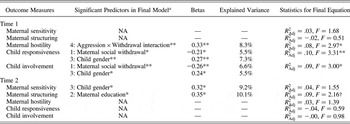
The relations between mothers' childhood histories of aggression and social withdrawal and mother–child EA were examined at Time 1 (see Table 2). The regression examining maternal hostility was significant, where mothers with higher levels of childhood histories of aggression and social withdrawal exhibited hostility when interacting with their children. In addition, it was found that maternal childhood histories of social withdrawal significantly predicted child responsiveness and involvement, suggesting that mothers with higher levels of social withdrawal in childhood were more likely to have children who were less appropriately responsive to their mothers and who involved their mothers less appropriately during the interaction. Furthermore, girls were found to be more appropriately responsive to their mothers and involved their mothers more during the free-play task than boys.
Study 1 summary of results from maternal risk factors regression models predicting Emotional Availability Scales at Time 1 and Time 2
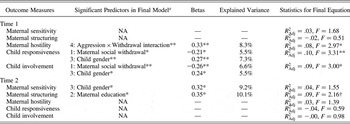
aThe numbers indicate the step at which the predictor was entered.
†p < .10. *p < .05. **p < .01.
Time 1: Index of current support and stress
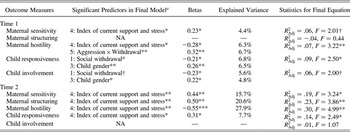
The index of current support and stress variable created by factor analyses was used in the following series of hierarchical regressions. Because predictors were entered in the same sequence as the first set of analyses, only the additional variance explained by the index of current support and stress are presented in this section (see Table 3). Results indicated that mothers with higher levels of sensitivity also had higher levels on the current support and stress index (i.e., more social support for mothers and children, better quality of home environment, and less parental stress). In addition, mothers who displayed more hostility during the free-play task had lower levels on the current support and stress index.
Study 1 summary of results from the index of current support and stress regression models predicting Emotional Availability Scales at Time 1 and Time 2

aThe numbers indicate the step at which the predictor was entered.
†p < .10. *p < .05. **p < .01.
Time 2: Maternal childhood histories
The relations between mothers' childhood histories of aggression and social withdrawal and measures of EA were examined at Time 2 (see Table 2). In the regression examining maternal structuring, maternal education was a significant predictor. Mothers with higher levels of education showed more appropriate structuring with their children during the Jenga task.
Time 2: Index of current support and stress
The effect of current support and stress on mother–child EA above and beyond maternal childhood risk status was examined at Time 2. An index of support and stress was created in the same manner as at Time 1 and predictors were entered in the same sequence (see Table 3). Mothers who displayed more sensitivity toward their children and who used more optimal structuring during the Jenga task also had higher levels on the current support and stress index (i.e., more social support for mothers and children, better quality of home environment, and less parental stress). Moreover, mothers who displayed more hostility had lower levels on the current support and stress index. Finally, children who were more appropriately responsive during the interaction had mothers with higher levels on the current support and stress index.
Time 1: Index of support and stress predicting Time 2 EA
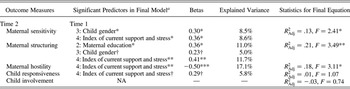
The effects of support and stress at Time 1 on levels of EA at Time 2 were examined and predictors entered in the same sequences as previous analyses (see Table 4). Mothers who displayed more sensitivity and appropriate structuring during the interaction at Time 2 also had higher levels on the current support and stress index (i.e., more social support for mothers and children, better quality of home environment, and less parental stress) at Time 1. Mothers also displayed more sensitivity to girls and structured girls more than boys. Furthermore, maternal education significantly predicted maternal structuring, suggesting that mothers with higher levels of education structured their children more appropriately during the interaction at Time 2. Finally, mothers with lower levels on the current support and stress index at Time 1 displayed more hostility during the Jenga task at Time 2.
Study 1 summary of results from the index of current support and stress at Time 1 regression models predicting Emotional Availability Scales at Time 2

aThe numbers indicate the step at which the predictor was entered.
†p < .10. *p < .05. **p < .01. ***p < .001.
Study 2
Study 2 was designed to examine a different sample of Concordia Project mother–child dyads that were intensively sampled at five time points (6, 12, and 18 months; preschool age; school age). The objectives were to examine (a) age effects in EA over time, (b) whether mother EA predicted child EA, and (c) the contribution maternal childhood risk status added to the prediction. Concurrent parenting stress (PSI) and quality of the home environment (HOME) (with age controlled) and their links to EA were also examined.
Method
Participants
Participants were 35 children and their mothers (mean age = 29.09–36.46 years from Time 1 to Time 5, respectively) from the Concordia Project who participated at five time points: at 6 (Time 1), 12 (Time 2), and 18 (Time 3) months and 4.5 (Time 4), and 6–8 (Time 5) years. In Study 2, 13 (37%) of the children were boys and 22 (63%) were girls. The majority of the children were first (17; 49%) or second born (13; 40%), whereas four (11%) were third born, and one (3%) was fourth born. Also at this time fathers were present in 31 (89%) of the children's homes. Demographic information was consistent across the five time points (see Table 1).
Procedure
Recruitment, participation, and the general procedures were similar to Study 1. At Time 1, infants and mothers participated in a videotaped face to face interaction consisting of three 2-min periods (for more detail, see Moszkowski, Stack, & Chiarella, Reference Moszkowski, Stack and Chiarella2009). The first (greeting period) and third periods (reunion period) consisted of normal (N) periods in which mothers were instructed to interact with their infants as they normally would using facial expressions, voice, and touch. In the second period, mothers' unavailability was achieved through a still-face period (SF; Tronick, Als, Adamson, Wise, & Brazelton, Reference Tronick, Als, Adamson, Wise and Brazelton1978) where mothers were requested to look directly at their infants, but to remain silent with a neutral expression and refrain from touching their infants. At Times 2 to 4, mothers and their children engaged in a 15-min videotaped free-play task as described in Study 1. At Time 5, mothers and their children, who were then in middle childhood, engaged in a 5-min free-play task and toys were three books, two puppets, building blocks, and two puzzles.
Measures
Consistent with Study 1, measures included the DIQ, the PSI, and the HOME and EA Scales (see Table 1 for means and standard deviations). The EA Scales were applied to the first N period preceding the SF, the greeting period. Intraclass reliability coefficients (Shrout & Fleiss, Reference Shrout and Fleiss1979) were conducted from Times 1 to 5, and were above r = .80 on all the mother and infant EA Scales.
Results
Plan of analysis and descriptive statistics
The primary objectives of the present study were to examine age effects in EA over time, to ascertain whether mother EA predicted child EA, and the contribution maternal childhood risk status added to the prediction. Concurrent stress (PSI) and HOME scores (with age controlled) and their links to EA were also examined. The data were analyzed using multilevel modeling in a hierarchical linear modeling (HLM) program (Bryk & Raudenbush, Reference Bryk and Raudenbush1992). Notably, these analyses are especially pertinent in examining growth trajectories in small sample sizes with repeated measures, as estimates can be computed with multiple repeated data points.
For all analyses, data were entered into a two-level model. In each case, mother and child EA (i.e., maternal sensitivity, structuring, hostility, child responsiveness, involvement) was entered separately as the outcome (expressed in the original metric of the scales). Other EA Scales, age, HOME, and PSI scores at each time point were entered at Level 1 (L1). These are considered the within dyad variables, those that were measured repeatedly within a dyad. Age was entered as a centered raw score (expressed in months), and all other variables were standardized for ease of interpretation. There were five points per dyad reflecting the mother–child interactions at each age point (6, 12, and 18 months; preschool; school age) for all but one variable, because child involvement on the EA Scales can only be measured beginning at 12 months, only four data points were available for this variable. The between dyad variables of gender and maternal childhood histories of aggression and social withdrawal were entered at Level 2 (L2); these represent the more stable characteristics of dyads over time. In addition, unconditional models were computed to assess the relative amounts of variance in EA scores between versus within dyads. For the EA Scales of sensitivity, structuring, hostility, responsiveness, and involvement, within-dyad variance was 0.50 (60% total variance), 0.31 (60%), 0.09 (66%), 1.15 (80%), and 1.65 (87%), and between-dyad variance was 0.34 (40%), 0.20 (40%), 0.05 (34%), 0.28 (20%), and 0.24 (13%), respectively.
Associations with age and gender
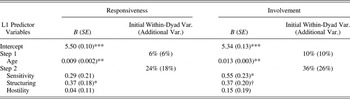
The first set of analyses examined relations between child age and EA Scales, as well as associations with gender. Models predicting mothers' EA Scales revealed that, in all three cases, associations with age were fixed (χ2 < 33, p > .30) and nonsignificant (p > .37). That is, within-dyad variability in maternal sensitivity, structuring, and hostility was unrelated to child age, and the strength of this (nonsignificant) association did not vary between dyads. Conversely, age was significantly positively associated with both child responsiveness and involvement (see Table 5), although the strength of these associations with age did not vary significantly between dyads (χ2 < 32, p > .33).
Study 2 Child EA Scales as a function of age and maternal EA Scales (final models)

Note: Coefficients are based on centered raw scores for age (months) and standardized maternal emotional availability (EA) variables. Outcomes are expressed in raw EA scores. L1, Level 1.
†p < .10. *p < .05. **p < .01. ***p < .001.
When child gender was entered as a standardized predictor of the intercepts and age slopes, there were no effects for maternal sensitivity or hostility. There was a trend for child gender to predict structuring (B = 0.18, SE = 0.10, p < .10; 11% of between-dyad variability explained), with mothers engaging in more appropriately structured interactions with girls (M = 4.36) than with boys (M = 3.98). Child gender was also significantly associated with overall scores for responsiveness (B = 0.30, SE = 0.12, p < .05; 27% of between-dyad variability explained) and involvement (B = 0.52, SE = 0.13, p < .01; 87% of between-dyad variability explained). Girls were more responsive and involved their mothers more appropriately (Ms = 5.71 and 5.75, respectively) than were boys (Ms = 5.08 and 4.74, respectively). Gender did not significantly moderate any of the associations between child age and any of the five EA Scales.
Associations between mother and child EA Scales
The next set of analyses examined within-dyad associations between mother and child EA Scales. Two sets of models were conducted, one for each of the child EA measures (i.e., responsiveness and involvement; see Table 5). As described above, both appropriate responsiveness and involvement increased with age. With age controlled, mothers' EA explained a substantial portion of the within-dyad variability in child EA. Maternal structuring was a significant unique correlate of responsiveness, whereas maternal sensitivity was a significant unique correlate of child involvement. The unique association between structuring and child involvement also approached significance.
Associations between EA Scales, HOME, and PSI
To explore within-dyad variability in EA not explained by chronological age, associations were computed between each of the EA Scales and concurrent HOME and stress scores (child age controlled). That is, whether within-dyad variability was associated with fluctuations in the home environment and family stress was examined (see Table 6). In general, the addition of HOME and stress scores did not reduce the amount of unexplained variability at L1. However, there were a number of significant unique associations. Family stress was negatively related to within-dyad variability in maternal sensitivity and child responsiveness. In turn, HOME scores were positively associated with maternal sensitivity and structuring.
Study 2 EA Scales as a function of age, stress, and HOME (final models)

Note: Coefficients are based on centered raw scores for age (months) and standardized Home Observation for Measurement of the Environment (HOME) and stress scores. Outcomes are expressed in raw emotional availability (EA) scores. L1, Level 1.
*p < .05. **p < .01. ***p < .001.
Associations between EA Scales and maternal childhood histories of aggression and withdrawal
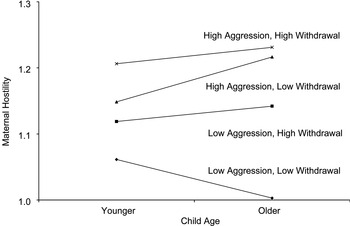
Using a subset of the sample that included mothers from the original Concordia Project, a second set of models was conducted to examine unique and interactive associations between maternal childhood histories of aggression, withdrawal, and EA variables. The analyses revealed a trend for maternal childhood histories of withdrawal to be negatively associated with maternal sensitivity (B = −0.34, SE = 0.17, p < .10). However, this effect no longer approached significance when the interaction between aggression and withdrawal was included in the model. Further, there was a small but significant interaction between aggression and withdrawal that moderated the association between child age and maternal hostility (B = −0.002, SE = 0.001, p < .05). High levels of both maternal childhood aggression and social withdrawal showed consistent and high levels of maternal hostility over age (see Figure 1).
The associations between maternal hostility and maternal histories of aggression and withdrawal for Study 2 across age.

Discussion
The present studies were designed to examine how family psychosocial risk may be associated developmentally with mothers' EA, and consistent with tenets of the developmental psychopathology framework, examined EA in a high-risk population (Cicchetti, Reference Cicchetti1993, Reference Cicchetti, Cicchetti and Cohen2006; Cicchetti & Toth, Reference Cicchetti and Toth2009). Across both studies, maternal childhood risk status predicted negative EA during mother–child interactions. For both Studies 1 and 2, maternal aggression and social withdrawal during childhood predicted higher levels of maternal hostility during interactions with offspring at preschool age. As seen in Study 2, high levels of both aggression and social withdrawal also predicted high levels of maternal hostility over time. These results highlight the importance of the (non)hostility EA Scale. Although the results of Study 2 are limited by the small sample size, findings were consistent across the studies. Furthermore, these findings are consistent with the literature in that maladaptive behaviors and parenting have been demonstrated to be a risk factor for high-risk families and one pathway for the transfer of risk (Serbin & Karp, Reference Serbin and Karp2004; Stack et al., Reference Stack, Serbin, Enns, Ruttle and Barrieau2010). Having a maladaptive behavioral style such as aggression or social withdrawal has been shown to make the transition to parenthood more challenging, manifested in poor parenting skills and strategies and/or negative interactions (e.g., Grunzeweig et al., Reference Grunzeweig, Stack, Serbin, Ledingham and Schwartzman2009; Martin et al., in press; Saltaris et al., Reference Saltaris, Serbin, Stack, Karp, Schwartzman and Ledingham2004; Serbin et al., Reference Serbin, Cooperman, Peters, Lehoux, Stack and Schwartzman1998). For example, parent request strategies and the ways with which oppositional and noncompliant behaviors are handled by parents can reinforce children's defiance and escalate the interactions, while reducing the probability of children's prosocial behaviors (Barkley, Reference Barkley1990; Grunzeweig et al, Reference Grunzeweig, Stack, Serbin, Ledingham and Schwartzman2009; Patterson, Reference Patterson, Reid, Patterson and Snyder2002). Because children are influenced by interactions with their parents over time, maladaptive parenting and interaction patterns are important in both the emergence and maintenance of problem behavior in children (e.g., Calzada, Eyberg, Rich, & Querido, Reference Calzada, Eyberg, Rich and Querido2004).
Histories of both aggression and social withdrawal have consistently been related to the most negative outcomes (Serbin & Karp, Reference Serbin and Karp2004). The associations found in the present study between childhood aggression and social withdrawal and subsequent parenting are also supported by past studies within the Concordia Project: in a different subsample, women with childhood histories of aggression and withdrawal have been shown to demonstrate negative parenting (e.g., failing to provide a stimulating home environment; Saltaris et al., Reference Saltaris, Serbin, Stack, Karp, Schwartzman and Ledingham2004) during interactions with their children (Serbin et al., Reference Serbin, Cooperman, Peters, Lehoux, Stack and Schwartzman1998). These findings are also in line with other studies examining EA in risk populations (Pipp-Siegel, Reference Pipp-Siegel1996; Wiefel et al., Reference Wiefel, Wollenweber, Oepen, Lenz, Lehmkuhl and Biringen2005).
In Study 1, mothers with higher levels of social withdrawal during childhood had children who were less appropriately responsive and involving during interactions at preschool age. Withdrawn women have been shown to have maladaptive interaction patterns (Serbin & Karp, Reference Serbin and Karp2004) and poor social skills (Rubin, Burgess, & Coplan, Reference Rubin, Burgess, Coplan, Smith and Hart2002). Women who were withdrawn during childhood may have removed themselves from social interactions and this would negatively affect the development of their social competence. Upon becoming a parent their maladaptive behavior styles may be modeled to their children and/or manifested in ineffective and poor parenting (Grunzeweig et al., Reference Grunzeweig, Stack, Serbin, Ledingham and Schwartzman2009). Overcontrolling, coercive and power-assertive styles of parenting are known to occur in parents of socially withdrawn children (Rubin, Burgess, & Hastings, Reference Rubin, Burgess and Hastings2002; Rubin, Stewart, & Coplan, Reference Rubin, Stewart, Coplan, Ollendick and Prinz1995).
It is interesting that, at Times 1 and 2 in Study 1, neither maternal sensitivity nor structuring was significant. Furthermore, maternal hostility and child EA (responsiveness and involvement) were not significant at Time 2. It may be that the children were helping to make their mothers look more sensitive, or these high-risk mothers were reaching adequate levels on these EA variables because this is not where the presenting parenting issues were being manifested, at least for videorecorded interactions for brief periods of time. Alternatively, maternal hostility may have overshadowed the potential for sensitivity or structuring to come through because of its negative quality permeating the interaction.
In Study 2, we were in the unique position of being able to examine EA across five time points as the children aged, albeit with a small sample size. Although there were no age effects for mothers' EA, age was positively associated with both child responsiveness and involvement. Moreover, both responsiveness and involvement increased with age; however, with age controlled, mothers' EA explained a substantial portion of the variability in child EA. Higher levels of maternal structuring predicted responsiveness, whereas sensitivity (and structuring) predicted child involvement. Pleasure and eagerness to engage with the parent are the key components reflecting child responsiveness. For child involvement, it is the balance between child's autonomy in play and interest in initiating involvement of the mother in play (Biringen et al., Reference Biringen, Robinson and Emde1993). Therefore, the relations between mother and child EA were in the directions anticipated.
The emergence of a relation between current support and stress and EA found in the present studies is an important consideration. Findings from Study 1 revealed that mothers who were more sensitive had more social support, better quality of the environment, and lower stress. In contrast, mothers who were more hostile had less support, poorer quality of home environment, and higher levels of stress. Furthermore, at middle childhood the findings were even clearer: sensitivity and hostility remained associated with current support and stress, but higher levels of support, better quality of home environment, and less stress were also associated with higher levels of maternal structuring and more child responsiveness during the interaction. Findings from Study 2 were consistent with those from Study 1. By examining EA in these studies, EA is placed in the family and environmental context (i.e., relations between EA and mothers' current support, quality of the home environment, and stress). In keeping with the developmental psychopathology framework, these findings highlight the importance of examining contextual variables. In general, findings appear to suggest that social support, quality of the home environment and levels of parenting stress can be viewed as protective, in that more support and better home environment combined with lower stress predicted better mother–child relationship quality. Thus, although parenting behaviors, by themselves, impact on children's emotional functioning, in combination with other risk factors they appear to have profound ramifications (Serbin et al., Reference Serbin, Stack and Schwartzman2000).
One additional set of results should be considered. Results from Study 1 indicated that girls tended to be more responsive and to involve their mothers more during the interactions. Findings from Study 2 were consistent with those from Study 1; there was a tendency for mothers to be more structured with girls, and girls were more responsive and involved their mothers more than boys. However, gender did not moderate any of the associations between child age and any of the five EA Scales. Moreover, as most of the EA literature to date has not shown gender differences in mean EA scores (e.g., Biringen et al., Reference Biringen, Robinson and Emde1994, Reference Biringen, Emde, Brown, Lowe, Myers and Nelson1999), further research is needed.
Consistent with a developmental psychopathology framework (Cicchetti, Reference Cicchetti1993, Reference Cicchetti, Cicchetti and Cohen2006; Cicchetti & Toth, Reference Cicchetti and Toth2009), a developmental approach was used to understand adaptive or maladaptive behavior, and the contextual factors important to the present studies were drawn out (e.g., maternal childhood histories of risk, stress, support, home environment). The relationship between individual factors or relationship factors, such as maternal childhood histories of aggression and social withdrawal and EA were examined within the context of stress, support, and home environment, but more importantly the quality of the relationship (or EA) was associated with these histories of risk. Aggression and social withdrawal have been demonstrated to be important risk factors linked to a myriad of negative outcomes over the life course (e.g., De Genna et al., Reference De Genna, Stack, Serbin, Ledingham and Schwartzman2006; Grunzeweig et al., Reference Grunzeweig, Stack, Serbin, Ledingham and Schwartzman2009; Martin et al., in press; Saltaris et al., Reference Saltaris, Serbin, Stack, Karp, Schwartzman and Ledingham2004; Serbin et al., Reference Serbin, Cooperman, Peters, Lehoux, Stack and Schwartzman1998, Reference Serbin, Stack and Schwartzman2000, Reference Serbin, Stack, Schwartzman, Cooperman, Bentley, Saltaris, McMahon and Peters2002; Stack et al., Reference Stack, Serbin, Enns, Ruttle and Barrieau2010). Our results provide evidence for how these risk factors impact parenting and the developing mother–child relationship, and suggest that parenting is one mechanism through which transfer of risk occurs, and through which adaptive development is impacted. As part of a developmental psychopathology framework, it is also clear that there may be multiple risks and multiple risk processes acting additively, exponentially or cosynergistically (Cicchetti & Toth, Reference Cicchetti and Toth2009). Although results from the present study do not specifically address the nature of the risk mechanisms, EA was predicted by multiple risk factors, such as histories of aggression and/or social withdrawal, stress, support, and home environment. Evidence for a protective role was found in the fact that more support, better home environment and lower stress were associated with better relationship quality.
Our results contribute to the growing literature on the quality of the parent–child relationship and its associations with child development and growth by examining EA in two different studies across two generations. Within most current developmental theories, parenting is viewed as a major factor in the socialization of interpersonal behavior and as an essential element in the early stimulation of cognitive growth. In the research literature and consistent with the developmental psychopathology framework, mother–child interactions have emerged as potential indices of risk and resilience. This development offers promise for early identification of childhood risk and problematic parenting. Our use of a community sample with high-risk conditions and past histories of risk allowed us to gain a better understanding of how EA is related to risk factors over time and has enlightened us about an important process of development, that of the mother–child relationship. Thus, our findings not only add to the burgeoning literature on EA, but make unique contributions by focusing on a high-risk community sample across time and generations. Emde (Reference Emde2000) emphasized the importance of research on EA in conditions of risk and preventive interventions and the present paper takes us one step forward in this domain. More research on EA with age and risk populations is warranted in order that considerations of EA and quality of the parent–child relationship can be integrated in the design of preventive interventions.
Taken together, our results have implications for a broader understanding of how EA is related to parental history and personal characteristics, as well as ongoing family and environmental context. Early parenting and interactions, family context, and ongoing stress influence, in turn, the quality of the mother–child relationship over time, and contribute to the course of development across early childhood.