INTRODUCTION
The blue spotted stingray, Dasyatis kuhlii (Müller & Henle, 1941) is a coastal batoid found in the waters of the Indo-West Pacific area (Allen, Reference Allen2000) and Indian Ocean until Southern Africa (Compagno et al., Reference Compagno, Ebert and Smale1989). With a maximum wing span of 45 cm (Allen, Reference Allen2000), this species is interesting for display in captivity. Captive breeding of elasmobranchs increased drastically in the last decennia due to increase of large public aquaria, increasing knowledge of water quality maintenance (e.g. Mohan & Aiken, Reference Mohan, Aiken, Smith, Warmolts, Thoney and Hueter2004), nutrition (e.g. Janse et al., Reference Janse, Firchau, Mohan, Smith, Warmolts, Thoney and Hueter2004) and health. Henningsen et al. (Reference Henningsen, Smale, Gordon, Garner, Marin-Osorno, Kinnunen, Smith, Warmolts, Thoney and Hueter2004b) describes successful reproduction of 99 elasmobranchs species in captivity, including 9 species of the genus Dasyatis. Captive breeding of the blue spotted stingray, Dasyatis kuhlii has not been described before. Breeding of elasmobranchs in captivity will help understand overall biological and husbandry knowledge of different species, and will decrease the necessity to get animals from the wild to be able to display elasmobranchs to the public.
Keeping animals in captivity through their life time can provide interesting information about species. The growth of an animal can easily be followed by measuring the body weight and/or size. Growth is directly related to the health status of the animal, the amount of captive stress, and most important the feeding practices. These include the feeding ration, frequency, type of food and vitamin additions. Nutrition practices of captive elasmobranchs vary enormously between different public aquaria (Janse, Reference Janse2003) and species (Janse et al., Reference Janse, Firchau, Mohan, Smith, Warmolts, Thoney and Hueter2004). Mohan et al. (Reference Mohan, Clark, Schmid, Smith, Warmolts, Thoney and Hueter2004) describes both growth and nutrition for common captive sharks. Only one study describes in detail diet and food ration changes of a ray species, the spiny butterfly ray (Gymnura altivela) (Henningsen, Reference Henningsen1996).
The first objective of this paper was to describe the breeding results of this species in captivity and provide information on the reproductive cycle, litter size and age of maturation. The growth characteristic of the young rays and description of the feeding strategy of the rays is the second goal of this study. The husbandry related issues may help to define management for other captive Dasyatis species.
MATERIALS AND METHODS
Animals
Since February 2000, a male and female were kept in the Lagoon display at Burgers' Ocean, Arnhem, The Netherlands. The animals originated from Indonesia. At arrival they had a wing span of 16±1 cm. Based on the estimated relationship between body weight and age of the reared young rays born at Burgers' Ocean (see Results), the age of the rays at arrival was estimated to be 3 to 6 months. An estimated birth date of the female is 1 December 1999 (Tfemale = 0). Body weight (BW) was measured at an accuracy of 2 g and wingspan (WS) at an accuracy of 0.5 cm. The female died on day 1638. Necropsy showed only the left ovary to be active with different sizes of oocytes.
Aquarium
The Lagoon aquarium with a volume of 650,000 l artificial seawater is split in two parts. In one part (13 × 4 m) the rays are kept on a coral sand (ø = 2–6 mm) area surrounded by artificial rocks and artificial corals. This area consists of two horizontal plateaux at different water depths (3.0 and 1.2 m). Three acrylic windows on one long side show the aquarium to the public. Twenty-seven species of teleost fish (with a total number of fish of approximately 250) are in this area of the tank. Filtration of the whole aquarium consists of protein skimmer (70 m3 h−1) injected with ozone (0.03 mg ozone l−1 water), trickling filters (100 m3 h−1), sand filtration (15 m3 h−1) and for two years during this study a Caulerpa rasemosa refugium (10 m2; flow of 0.4 m3 m−2 h−1). Water changes averaged 3% per month. Light above the aquarium consists of a combination of HQI and fluorescent lamps (14L:10D). A dawn and dusk period is created by switching all lights on or off in 5 stages over 1 hour period.
Water temperature at the lagoon tank is kept at 25.0±0.5°C, salinity at 33.0±0.3‰ and pH at 8.0–8.1. Other water quality parameters are: <0.01 mg NH4+–N l−1, <0.01 mg NO2−–N l−1, <35 mg NO3−–N l−1 and <0.8 mg PO43−–P l−1. Water quality of the quarantine system was the same as the lagoon tank concerning temperature, salinity, pH, ammonia and nitrite. Nitrate and phosphate levels were lower at <3.0 mg NO3−–N l−1 and <0.5 mg PO43−–P l−1.
The young were transferred directly after birth to a quarantine tank (120 × 60 × 50 cm), with water from the original Lagoon aquarium. Over a period of one week the water was renewed by water from the quarantine system, to prevent any chemical stress. The quarantine tank is part of a 6000 l system with UV, protein skimmers and trickling tower as filtration. On the bottom of the tank fine coral sand (ø = 2–4 mm) is placed so the animal can bury itself, which happens for more than 90% of the time. When young were around 6 months old they were transferred to a 120 × 120 × 50 cm tank, followed by a 200 × 200 × 70 cm tank at an age of 1 year.
Nutrition
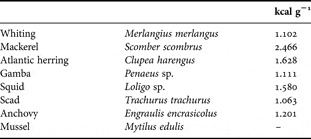
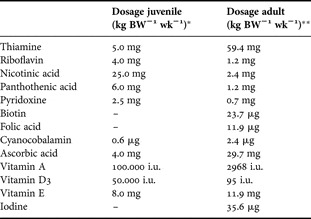
The adult rays were always fed individually from a stick, making it known how much they eat per feeding. When rays became mature they were fed 4 times per week. Every feeding day another type of food was fed consisting of mackerel, anchovy, gamba or whiting (Table 1). Rarely one of the four food types was replaced by squid, scad or herring. The young rays were fed individually from a stick with small pieces of the food types described for the adults with additional mussel (Mytilus edulis) and razor shell (Ensis siliqua). Vitamin addition was done once per week inserted in the food as tablet (Twilmij) to adults or liquid (Eurovet) form to juveniles to the body weight of approximately 500 g (Table 2). About 30% of the time the animal discarded the tablet.
Type of food and energy content (kcal/g) given to captive Dasyatis kuhlii.

Vitamin and mineral addition to the food of captive Dasyatis kuhlii.

*at BW = 0.15 kg, **at BW = 1.05 kg; for the adults in the last six months.
Feeding ration (Table 4) for the adults was calculated over a 6 weeks interval, of which 4 weeks before the measurement of the animals and 2 weeks after.
The wingspan (WS) and body weight (BW) relationship was determined using the allometric equation: BW = a WSb.
Percentage specific growth rate (%SGR) is calculated as the change in body weight (BW) over time (t) as (De Silva & Anderson, Reference De Silva and Anderson1995):

where BWt1 is the initial weight at time t1 or BWt2 is mean weight at time t2.
RESULTS
Breeding results
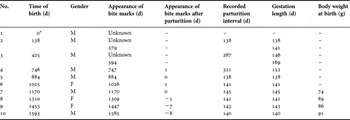
Seven male and three female stingrays have been born (Table 3), of which the first two died within two days after birth. These two animals died with skin haemorrhages possibly caused by aggression of other fish in the Lagoon aquarium. This may have caused death or the animals were too weak after birth. At necropsy, histology showed no abnormalities and bacteriology was negative on both animals. An internal yolk sac of 15 × 10 mm was found in the visceral cavity of the second ray. Histology showed an open vacuole tissue.
Birth data and reproductive cycle of captive Dasyatis kuhlii.

*t = 0 equals 19 January 2003.
The recorded parturition interval is average 177.1 days (±72.5), with a range of 138–321 days (Table 3). The recorded parturition interval for ray numbers 2, 5, 6, 7, 8, 9 and 10 was average 140.9 days (standard deviation of 2.5 days); ray numbers 3 and 4 show a gestation period more than twice as long (287 and 321 respectively).
Until 7 days before birth the neonate is visibly moving within the mother's body. The female sits in the last week regularly on the distal tips of her pectoral fins and the tips of her pelvic fins forming a tunnel. All young were found in the early morning buried under sand.
Mating happened directly after giving birth to the young, since different biting marks were seen on the dorsal surface of the female in the days after parturition (Table 3). The mating has never been seen. The appearance of the bite marks were seen 8 days before to the day after the birth of a young. The comparisons of recorded parturition interval and date of appearance of dermal wounds would suggest two neonates have been missed and eaten by other fish or disappeared in the artificial surrounding, resulting in two new gestation lengths. The range of the gestation length would then be: 138–169 days (Table 3), with an average of 144.9±9.0 days (N = 11).
Nutrition and growth
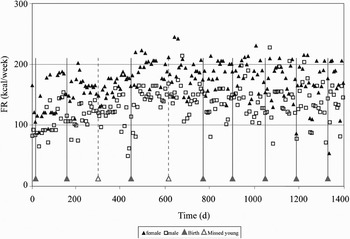
The young started to eat 4 to 11 days after birth, with an average of 7.5±2.5 days (N = 8). The type of food offered varied every day. The type of food eaten for the first time also varied between gamba (N = 2), mussel (N = 1), mackerel (N = 1), scad (N = 2), squid (N = 1) and krill (N = 1). The young are fed 6 times a week. The adults were fed 4 times per week. Figure 1 gives an overview of the change in feeding ration over time, where the moments of birth are described in the figure. No significant correlation could be detected between parturition and food intake.
Changes in feeding ration (FR) over time in captive Dasyatis kuhlii.

Table 4 gives an overview of the feeding ration of the adult female and male. On the day of parturition the female did not eat during 3 cases, 6 times she ate normally or a little less, and one day she was not fed.
Body weight, wingspan and feeding ration of adult captive Dasyatis kuhlii.

*t = 0 equals 19 January 2003.
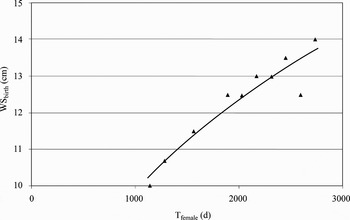
The wingspan at birth (WSbirth) increased with increasing age of the mother animal (Tfemale) (Figure 2) (WS =0.9629*T0.3360; R2 = 0.9113; N = 10). Figures on weight at birth were limited (Table 3).
Relationship between wingspan at birth (WSbirth) and age of the mother (Tfemale).

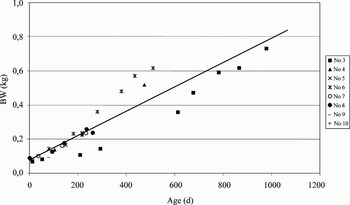
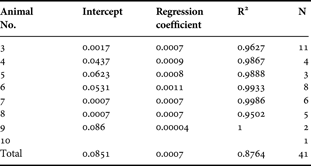
On a regular basis the body weight and wingspan was measured of the animals. Figure 3 gives the relationship between body weight (BW) and age of the captive born animals, with the statistical analysis in Table 5.
Relationship between body weight (BW) and age for captive Dasyatis kuhlii.

Linear regression between body weight and age.
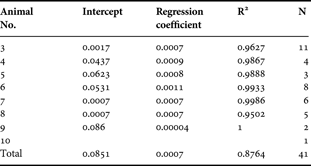
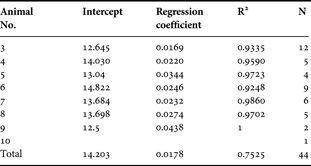
The relationship between wingspan (WS) and age of the captive born animals is given in Figure 4, with the statistical analysis in Table 6.
Relationship between wingspan (WS) and age for captive Dasyatis kuhlii.

Linear regression between wingspan and age.
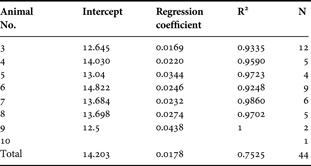
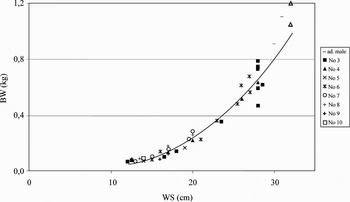
Combining all figures from the two adult and eight young animals a relationship between body weight (BW) and wing span (WS) can be given in Figure 5 and can be expressed as BW = 3.6 × 10⁻⁵* WS2.940 (R2 = 0.9645; N = 45).
Relationship between body weight (BW) and wing span (WS) for captive Dasyatis kuhlii.

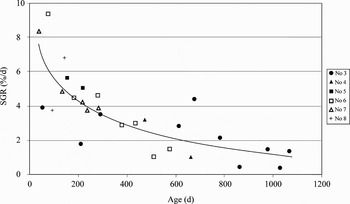
The relationship between the specific growth rate (SGR) and age (t in years) is expressed as SGR = –1.929Ln(t) +14.503 (R2 = 0.6306; N = 30) (Figure 6).
Relationship between specific growth rate (SGR) and age of six captive born Dasyatis kuhlii.

DISCUSSION
The recorded parturition interval ranged between 138 and 321 days. Since mating is directly after parturition this period could give an indication of the gestation time of D. kuhlii. The large variation may be caused by an over-gestation time earlier described as 20% in cownose rays (Rhinoptera bonasus) until 100% for yellow stingrays (Urobatis jamaicensis) (Henningsen et al., Reference Henningsen, Smale, Garner, Kinnunen, Smith, Warmolts, Thoney and Hueter2004a). A smaller variation of the gestation time is described in captive D. americana ranging between 135 and 226 days (Henningsen, Reference Henningsen2000).
The occurrence of dermal wounds in D. sabina is described as a useful non-invasive technique to determine reproductive activity (Kajiura et al., Reference Kajiura, Sebastiana and Tricas2000). Bite markings with D. kuhlii were mostly defined on the dorsal side of the pectoral fins and especially on the caudal ridge or outer tip of the pectoral fin. The same has been observed in Urolophus halleri and U. aurantiacus where the male bit the pectoral fin edges of the female (Nordell, Reference Nordell1994). Combining the recorded parturition interval and date of appearance of dermal wounds will result in a gestation length between 138 and 169 days (Table 3), with an average of 144.9±9.0 days.
Mating occurred in Dasyatis kuhlii directly after parturition, which indicates no breeding season. In a survey on a wild population of D. kuhlii in Tanzania of a total of 117 females caught throughout the year pregnant females were recorded in November (N = 1), December (N = 4), January (N = 2), April (N = 1) and July (N = 1) (Darracott, Reference Darracott1977). This would indicate a breeding season. December and January show the largest number of gravid females which in Tanzania is the turn of monsoon. The constant availability of food and constant abiotic circumstances in the captive environment may result in the lack of a breeding season in captivity. Observations on Dasyatis americana showed mating after parturition in situ (Chapman et al., Reference Chapman, Corcoran, Harvey, Malan and Shivji2003) and ex situ (Henningsen, Reference Henningsen2000). This supports the fact that ex situ observations on the reproductive cycle in D. kuhlii may be copied to the wild. Also the temperate oviparous thorny skate (Amblyraja radiata) has a reproductive cycle that is continuous throughout the year (Sulikowski et al., Reference Sulikowski, Kneebone, Elzey, Jurek, Danley, Hunting Howell and Tsang2005), while other batoids show an annual reproductive cycle Dasyatis pastinaca (Ismen, 2003), Dasyatis sabina (Snelson et al., Reference Snelson, Williams-Hooper and Schmid1988; Tricas et al., Reference Tricas, Maruska and Rasmussen2000), Dasyatis say (Snelson et al., Reference Snelson, Williams-Hooper and Schmid1989) and the eastern shovelnose ray, Aptychotrema rostrata (Kyne & Bennett, Reference Kyne and Bennett2002).
At the age of 4 years, the female gave birth to the first young. With a development period of 146 days, this would suggest the male and female were sexually mature at an age of 3.5 years. This figure can only be used as indication for other D. kuhlii since it is not known if the growth of the animals was the same as in the wild. Also they may have been mature earlier than 3.5 years, but did not result in successful mating or embryo development. Also there may be a difference between sexual maturities of both sexes. This has been described within an in situ population of blue stingray Dasyatis chrysonota chrysonota, where the estimated age at first maturity for males was defined at five years and seven years for females (Cowley, Reference Cowley1997). Also males mature at a smaller size than females for Dasyatis pastinaca (Ismen, 2003).
The minimum disc width of pregnant females in situ was 30 cm (Darracott, Reference Darracott1977).
This study shows a litter size of one for D. kuhlii, with an average gestation time of 145 days; this equals a fecundity of 2.5 young per year per female. The latest measured wing span of the female was 32 cm, while the maximum body width varies between 40 cm (Lieske & Myers, Reference Lieske and Myers1994) and 45 cm (Allen, Reference Allen2000). Since the female can grow bigger the litter size may increase, however it is not expected the number of young will increase drastically since the size of the young still increases with the size of the female. In captive D. americana the litter size ranged from 2–10 and varied directly with maternal size and indirectly with mean size and weight of neonate (Henningsen, Reference Henningsen2000). In the eastern shovelnose ray, Aptychotrema rostrata a positive linear relationship between maternal total length and uterine fecundity is described (Kyne & Bennett, Reference Kyne and Bennett2002). The female in this study showed after death only to have one active ovary. It is unknown if this is normal for this species, or that both ovaries should be active and thus more young could be produced in one litter. Many elasmobranch species have two active ovaries. The development of only one ovary is also described in Carcharhinus brevipinna (Joung et al., Reference Joung, Liao, Liu, Chen and Leu2005) and Carcharhinus dussumieri (Teshima & Mizue, Reference Teshima and Mizue1972). While in Rhinoptera bonasus no uterine or ovary development has been observed in the right reproductive tract and only one young was found in the left tract (Neer & Thompson, Reference Neer and Thompson2005). The above studies did not provide a hypothesis for why only one ovary develops. One hypothesis of this anomaly within D. kuhlii is individual differences within this species, though the study of Neer & Thompson (Reference Neer and Thompson2005) showed 100% occurrence in the population of R. bonasus. So this may also account for D. kuhlii. Another hypothesis is the development of only one reproductive tract will occur in species with only a few young. This way the young can grow larger. Such low birth rate might be considered disadvantageous in terms of maintaining levels of recruitment, though this might be compensated for by the relatively large size at birth, since larger neonates are presumably less likely to be preyed on.
A second goal of this study was to describe the growth of the young and the nutrition of the captive rays.
Growth in elasmobranchs is often characterized by the Von Bertalanffy growth function (VBGF), where the change in weight or length over time is expressed as a function of the asymptotic (maximum) weight or length. The data in this study are mostly concentrating on young animals, which make it impossible to have an asymptotic weight figure. No data are found in literature on the specific growth rate on elasmobranchs. It is added in this study as a descriptive purpose, even though there is a wide variation found in the specific growth rate.
Only one study was found to give the length (L)/weight (W) relationship of in situ D. kuhlii (Darracott, Reference Darracott1977). Of all animals (N = 351) the relationship was expressed as W = –2,73L1,88, for females (N = 117) W = –2,90L2.0 and males (N = 85) W = –2.39L1.65. These figures cannot be compared with the captive population of this study since the length of the animals was used instead of the wing span. Since rays often lose part of the tail it is better to use wing span as size indication. However, from these figures it can be concluded that the animals have an allometric growth and size differences between the male and female. Differences in modal width and weight of the population can be seen between male and female fish, the females being wider and heavier (female mode 35–40 cm, 1.25–1.5 kg; male mode 30–35 cm, 1.0–1.25 kg) (Darracott, Reference Darracott1977). The figures from this study are over too short a period to give conclusive difference between the sexes. The relationship between body weight and wing span is a practical tool when working with captive D. kuhlii. When estimating the width of the animal, an estimation can be made using this graph of the body weight. This can be used to calculate a food ration as a percentage or ratio of the body weight.
The feeding ration of the parents ranged between 10.1 and 11.3% BW week−1. These figures are twice as high, than the 4–6% BW week−1 advised for bottom dwelling rays like Dasyatidae (Janse et al., Reference Janse, Firchau, Mohan, Smith, Warmolts, Thoney and Hueter2004). In captive Dasyatis violacea when consuming squid (Loligo sp.) the feeding ration decreased from 6–7% BW d−1 for juveniles to 1.3% BW d−1 for adults (Mollet et al., Reference Mollet, Ezcurra and O'sullivan2002). When feeding every day this would mean 9.1% BW week−1, which is a little less than was fed to the smaller D. kuhlii in this study.
The feeding ration of spiny butterfly ray (Gymnura altavela) increased from 4.2–8.8 % BW week−1 in their captive life (Henningsen, Reference Henningsen1996). This increase was caused due to acclimation problems in the beginning.
To include the difference of food items offered, feeding ration can better be expressed as a function of the energy content of the food (Janse, Reference Janse2003; Janse et al., Reference Janse, Firchau, Mohan, Smith, Warmolts, Thoney and Hueter2004). The adult D. kuhlii were fed at a range of 131 and 172 kcal kg BW−1 week−1. These figures are much higher than for adult captive Dasyatis violacea that were fed at 9.1% BW week−1 on squid with a wet-mass energy value of 0.800 kcal/g for squid (Loligo opalescens) (Mollet et al., Reference Mollet, Ezcurra and O'sullivan2002). From this it can be calculated that the adults were fed at 73 kcal kg BW−1 week−1. Another study on captive sharks like, Carcharhinus plumbeus (ranging between 32 and 112 kcal kg BW−1 week−1) (Janse, Reference Janse2003) was also lower than the ration for the rays in this study. However, this RAM ventilating shark has a much higher activity and makes comparison difficult with an inactive ray such as D. kuhlii. Figures from other species of bottom dwelling sharks or rays expressed in energy content of the food are not available in literature. It is advised to express feeding ration in future studies both as % BW week−1 and kcal kg BW−1 week−1. Still the feeding strategy as feeding ration and food type used in this study proved to be successful for these animals when looking at the breeding success.
The nutrition of the female adult does not change within the reproductive cycle (Figure 1). Liver reserves are probably stored and metabolized continuously throughout the year. The same has been described in the oviparous thorny skate (Amblyraja radiata), where the hepato-somatic index shows no significant changes in female thorny skates over the reproductive cycle (Sulikowski et al., Reference Sulikowski, Kneebone, Elzey, Jurek, Danley, Hunting Howell and Tsang2005). In contrast Mayer (Reference Mayer1984) mentioned an increase of food intake one month prior to parturition with captive D. americana. This is also described for an oviparous shark, Scyliorhinus canicula, which displayed seasonal variations in liver mass as a result of lipid deposition occurring during different times of the reproductive cycle (Craik, Reference Craik1978), though this species has a seasonal reproductive cycle (Henderson & Casey, Reference Henderson and Casey2001) that may effect the nutrient storage.
Nutrition in the first days of the newly born rays is done via the internal yolk sac and reserves stored in the liver. The internal yolk sac is absorbed yolk material originating from the external yolk sac. This phenomenon has also been described for the small spotted dogfish, Scyliorhinus canicula, an oviparous species (Wrisez et al., Reference Wrisez, Lechenault, Leray, Haye, Mellinger, Walther and Fyhn1993) and the ovoviparous Squalidae, Centrophorus cf. uyato (McLaughlin & Morrissey, Reference McLaughlin and Morrissey2005) and Centrophorus granulosus (Guallart & Vicent, Reference Guallart and Vicent2001). Prior to hatching the yolk transfers from the external yolk sac into the spiral gut, where its digestion starts, and will be ended only one week after birth. Since the gut cannot accommodate all the yolk and the external yolk sac has to be resorbed completely before birth, an internal yolk sac develops, playing the role of a transient storage organ within the abdominal cavity (Wrisez et al., Reference Wrisez, Lechenault, Leray, Haye, Mellinger, Walther and Fyhn1993). All neonates of D. kuhlii had no external yolk sac at birth. To cover the first few days the rays have absorbed the internal yolk material. This explains why the last six young started to eat between the 4th and 11th day of their life on different types of food (Table 4). The first two animals never ate. There seemed to be no preference for the type of food since different types were offered. Young captive D. americana ate shrimp and scallop, though no specific preference was described (Mayer, Reference Mayer1984). In D. pastinica a shift in the diet occurred with increasing body length, from crustaceans to teleosts (Isman, Reference Isman2003). Analysis of stomach content of Dasyatis chrysonota showed a diet shift from primarily a mollusc (Donax sp.) in medium sized animals to a crustacean (Callinassa sp.) at adult size (Ebert & Cowley, Reference Ebert and Cowley2003). The diet of adult D. kuhlii in the wild consists of sand dwelling invertebrates (Lieske & Myers, Reference Lieske and Myers1994), like polychaete worms (Darracott, Reference Darracott1977) and crustaceans (Darracott, Reference Darracott1977; Compagno et al., Reference Compagno, Ebert and Smale1989). Within this study the animals are fed a combination of teleosts (75%) and crustaceans (25%). Even though this diet is not the same as in the wild, the nutritional values are similar and thus can act as a good substitute. However, feeding of captive elasmobranchs is mostly done with pre-frozen food, to eliminate the possibility of parasitic infection and ensure the continuity of food availability. Loss of vitamins and minerals due to food transport, freezing, storage, and preparation make vitamin and mineral supplementation necessary (Janse et al., Reference Janse, Firchau, Mohan, Smith, Warmolts, Thoney and Hueter2004).
ACKNOWLEDGEMENTS
We would very much like to thank all aquarists in Burgers' Ocean for their enthusiastic input in this study. Also we would like to thank Martine Janse-Muller for the interesting discussion we often had on the paper. Finally we would like to thank Dominique Bartelemy (Oceanopolis, Brest) and Dave Gibson (The Deep, Hull) for keeping us updated on the development of the rays they received.