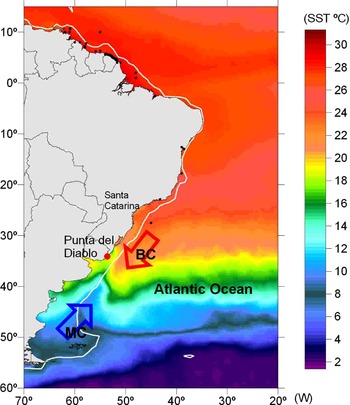
Stellifer rastrifer (Jordan, 1889) has been reported from Colombia to southern Brazil (Santa Catarina; Figure 1) in littoral waters with sand or muddy bottoms (Menezes & Figueiredo, 1980; Froese & Pauly, Reference Froese and Pauly2007). However, the species was relatively commonly recorded in October 2006 and January and May 2007 during a by-catch monitoring programme in the Punta del Diablo (34°04′–33°54′S and 53°32′–53°30′W) shrimp fishery. This fishery operates with small bottom trawl nets in waters shallower than 15 m (Segura, Reference Segura2006). After collection, individuals were fixed in 10% formaldehyde buffered with sodium borate for subsequent preservation in 70% ethyl alcohol. The identity of the species was determined using guides and identification keys available for the regional ichthyofauna (Menni et al., Reference Menni, Ringuelet and Aramburu1984; Menezes & Figueiredo, Reference Menezes and Figueiredo1985).
Distribution of Stellifer rastrifer in the tropical and south-western Atlantic Ocean. Previous (black circles) and new (red circle, Punta del Diablo, Uruguay) records are indicated, superimposed on a mean sea surface temperature map (2006) from Aqua-MODIS satellite data. MC, Malvinas Current; BC, Brazil Current. The arrows depict the direction of each flow. The 1000 m isobath is also shown.

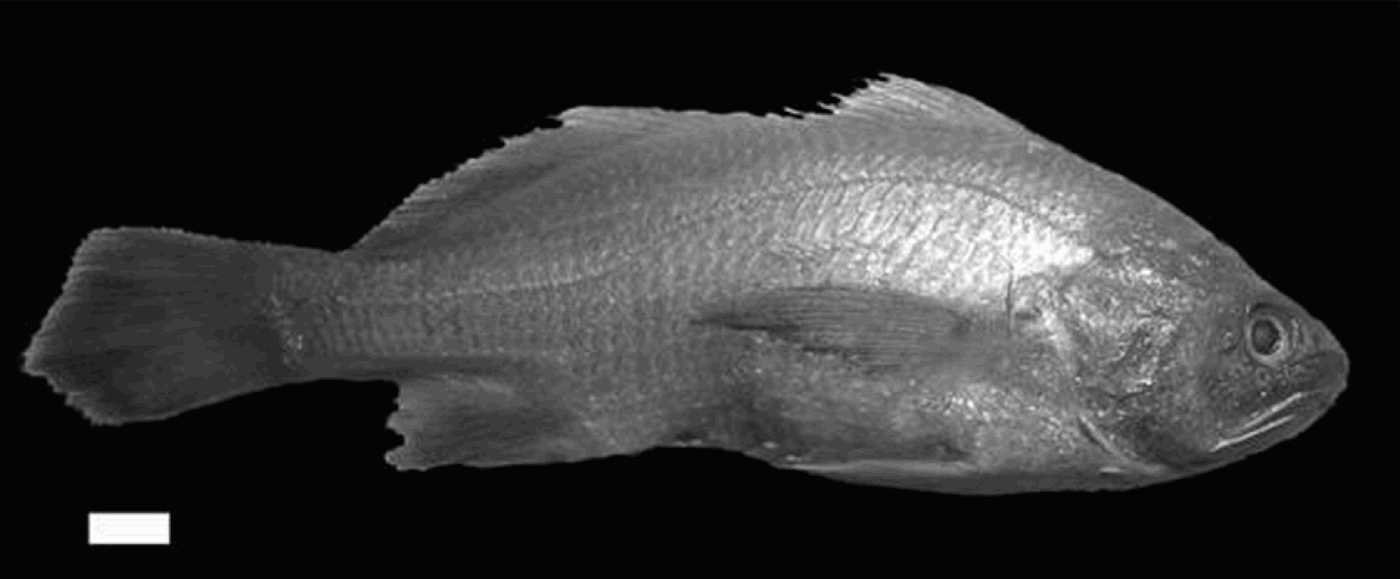
Stellifer rastrifer (Jordan, 1889) caught on the Uruguayan coast. Scale bar: 1 cm.

Some 57 individuals were measured (total length (TL), mm) and weighed to the nearest 0.1 g (WT; g). Sizes ranged from 55 to 176 mm TL with a mode of 80 mm. Wet weights ranged from 1.3 to 66.0 g. Length–weight relation was W = 0.0068*TL3.206 (R2 = 0.97; N = 57). Voucher material is deposited at the ichthyological collections of the Facultad de Ciencias (Collection No. ZVC-P 6983) and the Museo Nacional de Historia Natural y Antropología of Montevideo in Uruguay (Collection No. MNHN-3226) and the Museo de La Plata in Argentina (Collection No. MLP 9738).
Stellifer rastrifer was among the five dominant fish species (Macrodon ancylodon, Paralonchurus brasiliensis, Urophysis brasiliensis and Micropogonias furnieri), in terms of abundance, in the 2006 and 2007 fishing trawls. Although a complete faunal inventory for the area is lacking, we have been monitoring shrimp by-catch since 2005 without observing this species. Further, the Punta del Diablo trawl fishery has been operating regularly for eight years, and yet no local fishermen were able to recognize the species. This suggests that this is the first occurrence of S. rastrifer in the area. Nevertheless, the wide range in the LFD (87.5% of known maximum range in size) and the high abundance probably indicate an established population in the area and not just wandering individuals.
Standardized sea surface temperature anomalies were recorded in the Punta del Diablo area at the time (Reynolds et al., Reference Reynolds, Rayner, Smith, Stokes and Wang2002). A sustained positive (warm) sea surface temperature anomaly was registered in the area during austral spring 2006 and summer and autumn of 2007. This anomaly is possibly related to higher influence of surface water masses advected from the Brazil current (i.e. tropical water and subtropical water), which influences the Uruguayan coast by providing warm oceanic waters. An analogous situation was reported before during ENSO warm episodes (Ortega & Martinez, Reference Ortega and Martínez2007). It is suggested that this tropical species probably arrived in the area following an intrusion of that warmer water.
In a global warming scenario, information on range shifts for marine species is an increasingly required element for management actions, either long-term or short-term, such as reducing emissions of greenhouse gases and appropriate nature reserve design (Botkin et al., Reference Botkin, Saxe, Araújo, Betts, Bradshaw, Cedhagen, Chesson, Dawson, Etterson, Faith, Ferrier, Guisan, Hansen, Hilbert, Loehle, Margules, New, Sobel and Stockwell2007). In this regard, it is significant that S. rastrifer was recorded from a fishing area that includes part of the recently proposed La Coronilla-Cerro Verde Marine Protected Area.
ACKNOWLEDGEMENTS
The authors express their gratitude to Punta del Diablo's fishermen. A.S. is grateful to the Ideawild Biodiversity Conservation Organization (www.ideawild.org) for providing some of the field instruments and to our friends, the Bussys, Alvaro and Mariana for delivery. We thank M. Loureiro for curation of the material deposited in the ichthyological collections of Facultad de Ciencias and A. Milessi for providing Tannat to the first author. Financial support from The Rufford Small Grants for Nature Conservation to A.C. is also acknowledged.