Introduction
On 28 June 2008, in the middle of the monsoon, an Indian Air Force helicopter delivered its cargo—a tranquilized adult male tiger dubbed ST-1 and a party of wildlife experts—into the heart of Sariska Tiger Reserve. Hailed by the chief wildlife warden of Rajasthan as a scientifically planned ‘wild-to-wild relocation’ unlike any before, ST-1's involuntary flight over 200 km north from his established territory in Ranthambore National Park to a ‘key tiger habitat’ compromised by poachers and notoriously devoid of tigers since 2004 was, in fact, well precedented.Footnote 1 In what may have been the world's first attempted reintroduction of the animal, the maharawal (ruling prince) of Dungarpur translocated tigers to his jungles from Gwalior State between 1928 and 1930.Footnote 2 The maharaja (ruling prince) of Gwalior, in turn, had made history when he imported, acclimatized, and released African lions in his territories ten years before.Footnote 3 Their actions largely forgotten today, nineteenth- and early twentieth-century princes regularly trapped and moved tiger, leopard, bear, and wild boar between jungle beats, viewing arenas, private menageries, and zoological gardens. International and domestic pressure to ‘Save the Tiger’, the economics of tourism and ecosystem services, and popular constructions of national pride and natural heritage help to account for the relocation of ST-1 and seven additional tigers to Sariska (as of January 2013), with more introductions planned for the future.Footnote 4 But what led Indian princes to intervene even earlier in the wildlife demographics of their states, and how can their motives and actions inform our understandings of government associations with wildlife and wilderness in South Asia, and the impact of those associations on the animals and habitats concerned?
It is well known that Indian rulers tailored game stocks and hunting grounds to suit their preferences because they were enthusiastic sportsmen and played host to (and hoped to elicit personal and political favours from) visiting British sportsmen.Footnote 5 Yet, there was much more to princely sport than recreation, good hospitality, and diplomatic finesse. Hunting was an essential aspect of rulership that tempered the urbanity of palace-dwelling princes with masculinity-affirming adventures in the wilderness, built martial valour in contests against worthy foes, and fortified royal constitutions with the potent meats and raw powers of the jungle.Footnote 6 The behaviour and attributes of game animals and the qualities of their habitats were central to the cultivation and expression of princely identity and state character. Indeed, the historical persistence and political importance in South Asia of government interests in janglī (wild, uncultivated) animals and places suggests that Indian rulers never conceived of wildlife and wilderness areas as wholly independent of human beings and civil concerns.
British paramountcy severely limited Indian sovereignty in the late nineteenth and early twentieth centuries. Similarly characterized by Ramusack and Copland, the strategically ill-defined paramount power of the colonial government reserved for the British rights including, but not limited to, confirming princely successions, policing disagreements between states, exercising jurisdiction over border-crossing railways, and offering ‘advice’ on administration and internal affairs through resident political agents.Footnote 7 Perhaps the most insidious aspect of paramountcy by the late 1800s was its ability to deceive princes into overestimating their actual position and powers. According to Ernst and Pati, paramountcy included ‘a hegemonic strategy that encouraged Indian rulers to conceive of themselves, against the odds of their actual political impotence, as potent heads of independent states’.Footnote 8 In contrast, Bhagavan, Cannadine, and others insist on the reality of princely sovereignty, both from the princes’ own perspectives and in the eyes of the British.Footnote 9 Even as paramountcy was the rule and princely sovereignty was, in important ways, hollow—the reality of individual rulers being deposed is sufficient proof of this—there remained opportunities for what we might think of as limited sovereignty, or ‘comparative’ power.Footnote 10 Even if princes had to avoid British attention by keeping their exercises small, or, otherwise, had to nod to government for approval, the ruling chiefs of India wielded far more power than their subjects, and they enjoyed even greater sovereignty over their wildlife.
Nevertheless, princely hunting grounds and forest areas were not free from direct imperial interference: the Political Department cited Maharaja Jai Singh of Alwar's draconian controls over villagers living in and near his hunting grounds at Sariska when they removed him from power in 1933, and they similarly considered agrarian unrest directed in part against Maharana Fateh Singh of Mewar's hunting grounds when they deposed him in 1921.Footnote 11 On the whole, however, the British limited their interventions to formal and informal recommendations and advice on wildlife management, good sportsmanship, scientific forestry, and related topics.Footnote 12 Even when they did engage in dramatic interventions, the Political Department made no sustained effort to force princes to change their unique hierarchizations of game, evaluations of wildlife characteristics, or understanding of what features made the landscapes and forests of their states most enviable. Regardless of whether these princely approaches to wildlife and forests were hybrid, exclusively Indian, or based on European and colonial knowledge gained through English educations and cosmopolitan friendships, however, wilderness management was a recognized corollary of independent, legitimate, and comprehensive governance.
The key to understanding Indian princely engagements with state environments, flora, and fauna is in the identity and functions of what I term ‘princely wilderness’, or wilderness as located and conceptualized by the princes. I develop a working definition of princely wilderness by focusing on the efforts of North Indian rulers in the late nineteenth and early twentieth centuries to understand and control the size, composition, and location of wildlife in territories including but not limited to the southern Rajputana states of Mewar (which had many tigers and was rich in other game and tropical dry forest) and Dungarpur (which was comparatively poor in game and forest cover). I conclude that the princes’ refusal to categorize wilderness entirely in opposition to civilization underwrote their staunch belief that government participation in local ecosystems and wildlife demographics was perfectly natural, necessary, and desirable. For wildlife and wilderness the outcomes were decidedly mixed, despite the contemporaneous, gradual shift in the early twentieth century from sport shooting to cameras as the primary (but not exclusive) medium of interaction with increasingly scarce megafauna in the colonies, a trend linked in the Indian context with the publication of F. W. Champion's unprecedented wildlife photography in With a Camera in Tigerland (1927) and The Jungle in Sunlight and Shadow (1933), and Jim Corbett's sympathetic take on the tiger as a ‘large-hearted gentleman’ in Man-Eaters of Kumaon (1944).Footnote 13
It is important to note that I employ wilderness as a convenient but necessarily loose gloss when speaking collectively of a range of Hindi, Persian, and Rajasthani terms used in my sources for jungles, hunting grounds, and other more or less forested areas where game could be found. Wilderness is a loaded word in English, particularly in the wake of William Cronon's critique of the concept in the context of American environmentalism.Footnote 14 I adopt the term deliberately as a contact point with the ongoing investigations of other environmental historians into the cultural and geographical variations in human understandings of nature and culture. I do not, however, wish to invoke the binary divide that Cronon accused modern Americans of. Indian princes in the late colonial period did view wildlife and wilderness as different from human beings and areas of permanent human habitation. But the similarities they saw between themselves and wild animals, and the ways they used forests, gardens, and palace courtyards as interlocking, and even overlapping spaces, indicates a complex, shaded, and layered understanding of human-nature associations, not a simple conceptual binary. The reification ‘of “nature” and “culture” as discrete and incompatible domains’, which constitutes a major intellectual underpinning of the dominant modern concept of wilderness, has become a standard feature of national park management in India today. It has been identified as a major problem in modern conservation efforts in Sariska Tiger Reserve and beyond.Footnote 15 Despite the princes’ more integrated views, their wilderness was far from harmonious, too.
In brief, princely wilderness had flexible boundaries that were contingent on the presence of characteristic flora and fauna; it was intimately connected with good government and princely sovereignty; and, because it was as perilous as it was beneficent, only those who were exceptionally powerful and self-controlled, or half wild themselves, could interact with it fruitfully. Its constituent parts ranged from the deep forest to the garden's edge. It included the common Hindi jangal, which Platts defined as ‘a jungle, wood, forest, thicket; forest land; waste land; land or country overgrown with long grass and weeds; a wild or uninhabited part’. Another haunt of wildlife was jhāṛī, a ‘copse, brake, thicket; wood, forest, [or] jungle’. More open canopies and grassy areas were found in biṛ—according to Macalister, ‘a jungle where there is plenty of grass’, and a wide range of habitats in śikārgāh (shikargah)—back to Platts, a ‘hunting-ground, chase; [or] preserve for game’.Footnote 16
Wildlife and princely wilderness
The Aravalli range of hills defined the landscapes of Mewar and Dungarpur with low, thinly soiled, rocky, scrub-covered peaks. Below the Aravallis, semi-arid plains hosted thorny, tropical dry forest. Both states benefited from sheltered dales where deeper soils had accumulated, rendering these sites capable of supporting cultivation or less prickly dry deciduous forests. Yet, even the best agricultural zones suffered from seasonal shortages of water and a regional scarcity of perennial streams. To meet the needs of human residents and domestic livestock, Mewar and Dungarpur were dotted with man-made lakes, Persian wheels, step-wells, and other infrastructure erected and maintained over the past several hundred years by rulers, powerful merchants, wealthy donors, and commoners alike.Footnote 17 With the availability of water acting as a major limiting factor, southern Rajputana's interlaced habitats also suited the various needs of carnivorous wildlife including tiger, dhole, and leopard; ungulates such as sambar, chital, nilgai, and wild boar; and many other species.
The most fundamental markers of princely wilderness were its animal and vegetable inhabitants. Wherever there were tiger or blackbuck and thūhar (Euphorbia caducifolia) or babūl (Acacia nilotica), there was princely wilderness.Footnote 18 Most wild animals were welcome in the princely wilderness, but not all were accorded the same respect. An official ‘List of Principle Wild Animals Found in the Dungarpur State’ selected 17 species for special mention in 1935: tiger, leopard, caracal, sloth bear, ratel, hyena, dhole, wolf, wild boar, porcupine, pangolin, sambar, chital, nilgai, chousingha, blackbuck, and chinkara. An associated chart giving the ‘Particulars of Rare Animals which are Specially Protected’ declared half of these creatures ‘exclusively preserved’, including highly desirable game species such as the tiger, sloth bear, sambar, chousingha or four-horned antelope, blackbuck, and chital, but also the caracal and the rarely pursued ratel and pangolin. Present in numbers sufficient to merit a notation of ‘common’ were leopard, boar, nilgai, and chinkara, in addition to porcupine, preserved in state shikargahs and forest reserves only.
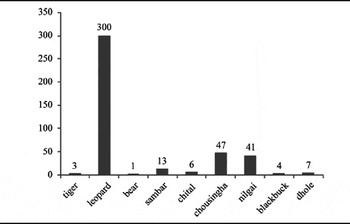
Unlike these animals, the ‘common’ hyena and wolf received no special protections in Dungarpur State. Nevertheless, the reigning prince, Maharawal Lakshman Singh (r. 1918–1989), apparently tolerated these creatures in his princely wilderness, doing nothing to prevent their proliferation, or to encourage their destruction. Even though the wild dog or dhole (Cuon alpinis) was, in contrast, ‘not common’, Lakshman Singh considered it unwelcome and unnecessary, and he offered a reward for its destruction.Footnote 19 His opinion tallied with those expressed by British sportsmen, natural historians, and trained zoologists such as Frank Finn, who expressed ‘no doubt that [wild dogs] are excessively destructive to game . . . cannot even claim utility as scavengers [unlike hyenas] . . . and soon clear game out of a district’.Footnote 20 In his contribution to the Journal of the Bombay Natural History Society in 1893, H. Littlefield spoke of dhole as ‘red demons’ and described them as producing ‘a kind of fiendish hysterical yapping, in a shrill chorus, decidedly uncanny and all-pervading’.Footnote 21 Another article refrained from commenting on the dhole's alleged destructiveness or eerie ferocity, instead submitting that its much-maligned habit of ‘seiz[ing] its prey at the flank, rending the skin and causing the entrails to protrude . . . is the most natural thing to do when seizing a large animal in full flight’.Footnote 22 This is perhaps the kindest thing anyone had to say about the dhole until the 1970s, when the first scientific studies based on extensive field observations were published, countering some of the ‘unfounded myths and negative popular sentiment’ about dholes that earlier natural historians and sportsmen had so often promulgated.Footnote 23
Dungarpur's Bhils, who comprised just under half of the state's population in 1921, reportedly saw wild dogs differently from Lakshman Singh and the British. The same class of colonial authors who encouraged their readers ‘to keep down “red dogs” wherever found’ occasionally reported their impressions of the dissenting opinions of India's ‘wilder tribes’, allegedly expressed by one resident of a jungle-village when he mused, ‘Why should I shoot the wild dog? . . . he is my god: he kills the tigers that take my cows!’Footnote 24 Whether or not Bhils, Gonds, or any other hill communities actually thought or spoke of the dhole as their god, they certainly recognized it as a pack hunter that could and did kill tigers.Footnote 25
British sportsmen and natural historians habitually doubted the credibility of ‘native stories’ that claimed dhole were tiger-killers, but usually conceded that, in principle, a weak or elderly tiger could fall prey to a pack of wild dogs. The stance against dhole in Dungarpur, however, would have resulted whether the maharawal relied on the same information as his Bhil subjects, or instead credited explanations for the dearth of tigers in dhole country that were popular among the British, namely that ‘where a pack has been hunting . . . the game naturally disappears . . . [and] tigers . . . naturally follow the herds’.Footnote 26 It mattered little if dhole were killing Dungarpur's tigers or causing them to abandon the state: either way wild dogs would spoil the maharawal's dreams of reestablishing tigers in his realm. Apparently following logic equivalent to that guiding a trained forester protecting commercially valuable seedlings from rival species, Lakshman Singh believed it was neither unnatural nor undesirable to uproot his animal pests. Although the maharawal was eager to increase his tigers by any means possible, just seven dhole were reported killed in Dungarpur between 1909 and 1928. It is hard to say if this was because they proved too elusive to kill in greater numbers, the Rs 25 bounty on their heads failed to entice the accomplished hunters among the state's populace (many of whom were Bhils), or if the animals simply lived up to their official designation as ‘not common’ (Table 1).Footnote 27
Game shot in Dungarpur State (1909−1929).

Source: Diwan of Dungarpur, to Political Agent, Southern Rajputana States Agency, 15 November 1928, no. 2651, Government of India, Southern Rajputana States Agency, 261-G of 1928, National Archives of India.
By no means recognized as legitimate game species in Dungarpur or any other state, the wholly protected pangolin (Manis crassicaudata) and ratel (Mellivora capensis) and the partially protected porcupine (Hystrix indica) are intriguing entries in these documents. A nocturnal burrowing mammal weighing around 9 kilograms and covered in protective scales, the ‘rare’ pangolin may have rated inclusion as a singular and uncommon curiosity. Indeed, the ‘Particulars of Rare Animals’ chart proclaimed that ‘very little [is] known of the habits of this interesting animal’, suggesting a desire for more information.Footnote 28 Also nocturnal and burrow-dwelling, the same reasoning may have held for the similarly ‘rare’ ratel or honey badger. For the pangolin, protection also may have been in order as the species is hunted for its meat and scales, with reports going back at least to the 1920s that ‘natives believe in the aphrodisiac virtues of the flesh’.Footnote 29 The ratel's meat was not consumed in South Asia, however, nor was the animal targeted for medicinal applications.Footnote 30 The pangolin might have benefited from being a ‘specialist feeder on termites and ants’ and no threat to the maharawal's game, but captive specimens in the nineteenth and early twentieth centuries were offered milk, eggs, and raw meat, suggesting popular misconceptions regarding its diet.Footnote 31 The omnivorous ratel likewise posed no threat to large carnivores and ungulates, but may have needed protection from the maharawal's subjects due to its habit of killing poultry—a crime as likely committed by other small predators—and its alleged propensity towards ‘dig[ging] up dead bodies and devour[ing] them’.Footnote 32
Unlike the pangolin and ratel, the porcupine was ‘common’ in Dungarpur. Unless its protection within reserved forests was an arbitrary result of living in reserved forests, the rationale behind this herbivore's privileged standing remains somewhat obscure. Porcupine and pangolin, and theoretically ratel, could be used by hill communities for food. It is possible that Lakshman Singh protected these species in his preserves not for their perceived value, but in order to encourage Bhil communities living near his shikargahs and reserved forests to rely on settled agriculture rather than forest produce. An understanding of the porcupine as harmless may have influenced the maharawal, too. While porcupine do not interfere with ungulates, the famous sportsman-naturalist Jim Corbett did blame their sharp quills for incapacitating tigers and turning them into man-eaters.Footnote 33 Neither Lakshman Singh nor his staff, however, are likely to have made this connection before Corbett's publications in the 1940s. The caracal's protected status is less mysterious. While caracal would have preyed on the maharawal's smaller ungulates, including blackbuck and chinkara, Indian princes had a long history of trapping wild specimens and training them to serve as hunting cats.Footnote 34
Tigers and people in the forest
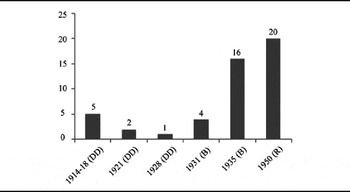
The tiger was the most prized resident of the maharawal's princely wilderness. The tiger population of Dungarpur, however, fluctuated dramatically over the first three decades of the twentieth century (Table 2).
Reported tiger population of Dungarpur State (1914–1950).

Sources: Diwan of Dungarpur, to Political Agent, Southern Rajputana States Agency, 15 November 1928, no. 2651, Government of India, Southern Rajputana States Agency, 261-G of 1928, National Archives of India (DD); G.L. Betham, Mewar Resident and Southern Rajputana States Agent, to Secretary to the Agent to the Governor General, Rajputana, 27 September 1937, no. 3939/148/37, Government of India, Political Department, Political Branch, 27(8)-P of 1939, nos 1–2, National Archives of India (B); Ranjitsinh, Beyond the Tiger, p. 24 (R).
While ‘quite a number’ had been shot by Dungarpur's maharawals in the nineteenth century, only five lived in or frequented the state's forests between 1914 and 1918.Footnote 35 Their numbers fell to two in 1919 and dropped to just one in 1921. According to state records, the species was locally extinct by the mid-1920s.Footnote 36 Determined to repair his broken wilderness, Lakshman Singh, with the assistance of the political agent D. M. Field, managed to obtain four tigers for his jungles from Gwalior State by 1930.Footnote 37
To support these tigers, the maharawal needed a solid prey base. Dungarpur officials estimated in 1928 that the state boasted ungulate populations of over 800 nilgai, 150 four-horned antelope, 200 sambar, 50 chital, and 35 blackbuck.Footnote 38 Assuming all of these animals lived in Dungarpur's 1,977,570 bighās (2,646 km2) of forested area, the ungulate density per 100 km2 was at least 46.7.Footnote 39 Given the unfortunate omission of boar and chinkara from the officials’ data, this number is surely a gross underestimate. According to Karanth et al., a prey density of 6,006 ungulates per 100 km2 can support just over 12 tigers in semi-arid environments.Footnote 40 Clearly Dungarpur's ungulates needed to increase before the maharawal's stock could rise, and this seems to have happened. By 1935 the state's tiger population had increased to 16 without the benefit of further imports.Footnote 41 That year, the state dīwān (hereafter diwan, a chief minister) reported that the animals were ‘doing satisfactorily’, while the chital and blackbuck antelope that the maharawal had also introduced as game and prey were, respectively, ‘rare’ and ‘[doing] well’.Footnote 42 The tigers’ swift multiplication and the evident success with ungulates convinced Lakshman Singh of his project's sound prospects, leaving him confident enough to allow the killing of seven or eight tigers between 1935 and 1937, and a total of 48 by 1950.Footnote 43
According to M. K. Ranjitsinh, the maharawal sanctioned the killing of these 48 tigers because they represented a ‘surplus’ that otherwise would have ‘migrat[ed] to neighbouring areas’. After harvesting his own surpluses, the prince was left with a ‘saturation level’ population of around 20 animals to maintain inside Dungarpur's borders.Footnote 44 Lakshman Singh's vision of tiger conservation was territorially bounded: he showed no interest in exporting tigers to improve princely wilderness in other realms, even though he had benefited from the Maharaja of Gwalior's willingness to do just that. In addition, Lakshman Singh's descendants report his horror upon learning of a tiger's attack on one of his subjects, any recurrence of which he may have hoped to avert by keeping his animals within the bounds of his reserved forests.Footnote 45 In preserving tigers in Dungarpur, the maharawal worked to bolster his own power and his state's reputation, but apparently without exposing his subjects to excessive risk. Tigers were spatially and behaviourally restricted assets of the state, and the maharawal's private property. They lived and died at his pleasure. It is uncertain to what degree, if any, Lakshman Singh was motivated by broader issues of wildlife conservation, much less by any familiarity with the emerging science of ecology. Certainly he thought the dhole could be exterminated in his state without causing any negative repercussions. Perhaps he believed too that no problems would arise for tigers if they lived in Dungarpur and nowhere else.
According to the state diwan, in a letter addressed to the political agent D. M. Field in 1928, the maharawal's ‘ambition’ to have tigers in his forests was no more than that of ‘every keen sportsman’.Footnote 46 Considering that rumours would later circulate accusing Field of poaching the last of Dungarpur's tigers during the maharawal's minority, perhaps the diwan found it politic to gloss over any reason why the prince might want tigers in his state besides the purely personal.Footnote 47 The political importance of presiding over a healthy princely wilderness, however, is hinted at by the fact that Lakshman Singh took action in the very year of his investiture with full ruling powers, just as his father before him had set out to restrict hunting and to pass a Forest Law immediately upon his own investiture in 1909. Combined with the fact that Lakshman Singh actively discouraged even his ‘surplus’ tigers from crossing over into neighbouring states where they might enhance a rival's sovereign status, it is clear that princely wilderness was a political matter and not just a personal or conservationist concern.
Leaving aside the alleged involvement of Field, the maharawal believed a dramatically reduced prey base, occasioned by Dungarpur's jungle- and hill-dwelling Bhil community, had helped to create his state's early twentieth-century dearth of tigers. According to the diwan, ‘[b]efore the great Famine of 1900, tigers were very common in the State’, but during the famine ‘the starving Bhils destroyed every kind of deer’, and ‘when the country became gameless . . . the tiger took to cattle and gradually disappeared’.Footnote 48 Up to 25 per cent of Dungarpur's Bhils and 50 per cent of its cattle died in the famine years of 1899 and 1900.Footnote 49 No estimates are available for the state's losses in wildlife.
According to the diwan, the post-famine recovery of Dungarpur's ungulates began under the tenure of Lakshman Singh's father, Maharawal Bijay Singh, whose 1909 Forest Law ‘put an end to the destruction [by the Bhils] of the almost extinct Sambur, Cheetal and Neelgai’.Footnote 50 The time lag between the culmination of the great famine in 1900 and the onset of recovery in 1909, however, seems dubious, even considering the second round of famine conditions that affected the state between 1901 and 1902. Rather than a natural, ongoing process eventually reinforced through state policies, official interpretations characterized recovery as a political event with its origins wholly in 1909. Not only were natural processes elided in portraying the recovery thus, so too were the respective roles played by the regency council and political agents that governed Dungarpur during the long minorities of Bijay Singh (1898–1909) and, later, Lakshman Singh (1918–1929). Whatever nature did in Dungarpur, we are to understand, it did in response to princely direction, and whatever positive changes accrued in the wilderness were due to princely policies and not to the negative inputs of British officials. The quality of Dungarpur's princely wilderness rested firmly on the maharawals’ shoulders.
Given Bijay Singh's opinion of his state's Bhils, however, the legal protections of 1909 hardly sufficed to protect Dungarpur's ungulates or, by extension, its tigers. In an essay from his school days at Mayo College, Bijay Singh echoed the language and ideology of the British Indian Criminal Tribes Act of 1871 to describe Dungarpur's Bhils as ‘incurably lazy . . . inveterate poachers’ and ‘professional robbers’.Footnote 51 After his investiture, Bijay Singh continued settlement policies spearheaded during his minority by his regency council, at least in part aiming to foster the recovery of deer, antelope, and gazelle by continuing to tempt Bhils out of the hills with low revenue rates designed to turn them into property-owners and farmers.Footnote 52 Ideally, when the next famine came Bhils would turn not to the forest for venison but to their granaries for grain and, perhaps, to the state for famine relief. Twenty years later, when nilgai and chinkara were ‘common’, four-horned antelope and sambar ‘fairly common’, and only chital still ‘rare’, a Dungarpuri Bhil allegedly was ‘no longer a highway man or a Shikari [huntsman], but a peaceful cultivator’.Footnote 53 Yet the Bhils continued to be regarded as the community closest to Dungarpur's forests: they were entrusted with the task of ‘looking after the forests’ in the 1920s and served as Lakshman Singh's preferred beaters in the 1930s.Footnote 54
If Bhils were ‘hunters by nature’, then Rajput princes were instinctive sportsmen.Footnote 55 Just as a tiger could be taken from the forest and tamed to certain degree without fundamentally compromising its innate tigerish nature, certain people could enter the forest and engage in more or less wild activities—such as hunting—without sacrificing their basic humanity. Unlike the ‘unsporting’ Bhils and ‘confirmed’ poachers from other hill communities, an ideal Indian prince subjected his own wildness to a variety of self-imposed constraints, including the rules of etiquette, courtly traditions, zimmedārī (princely duties) towards the populace, and local conceptions of sportsmanship. Princes abided by these civilizing rules at home and in the forest to maintain their reputations as good rulers and to shield their subjects from the raw powers of unrestrained sovereignty.
The major difference between wild animals and Rajput princes was that wild animals required external restraints to attain civility, while good Rajput princes successfully controlled themselves. Indeed, the very best princes were those who required the most self-control on account of having the wildest natures. While every prince risked the loss of self-control when engaged in blood sports in the forest, a sovereign's desire to hunt in the first place testified to his very desirable potency, while his every disciplined success reaffirmed his righteous legitimacy. On the other hand, exposure to blood aroused the killer within the tamest of hand-reared tigers, causing these animals to lose control and forcing their caretakers to permanently confine them or shoot them dead.Footnote 56 It was only with proper control, whether internally or externally imposed, that the wild nature of Rajputs and tigers could be creative, energetic, awe-inspiring, and invigorating forces for the good of the state.
Political ecology of shooting
Because hunting, caging, and otherwise imposing controls on wildlife were basic exercises of princely sovereignty, many Indian princes turned to the field with exceptional enthusiasm. What, then, was the impact of princely sport on wildlife populations? Between 1884 and 1921, Maharana Fateh Singh of Mewar (r. 1884–1921, d. 1930) and his nobles and guests killed at least 82 tiger, 220 leopard, 1,186 wild boar, 65 sambar, 21 chinkara, and 8 chital in Mewar.Footnote 57 The maharana (ruling prince) personally accounted for about 60 per cent of all tiger, 65 per cent of all leopard, and 30 per cent of all boar killed during this period, but for only 14 per cent of sambar and 7 per cent of chinkara and chital combined.Footnote 58 While these numbers reveal much about princely shooting preferences, one of the few facts they can establish regarding the population size of any listed species is its absolute minimum. If 82 tiger and 220 leopard were killed in Mewar between 1884 and 1921, then a minimum of 82 tiger and 220 leopard lived in Mewar between 1884 and 1921. These numbers, however, must be far below reality.
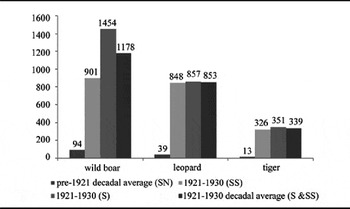
As the maharana shot many more animals towards the end of his life, thereby presumably accounting for a higher percentage of Mewar's actual game population, we may come closer to a baseline using data for the period between 1921 and Fateh Singh's death in 1930. Averaging the somewhat disparate numbers provided by Tanwar in his two published memoirs, the prince killed 339 tiger, 853 leopard, and 1,178 wild boar during the last decade of his life (Table 3).Footnote 59
Big game tallies of Maharana Fateh Singh in Mewar State (pre- and post-1921).

Sources: Śikār kā Nakśā, pp. 21–22 (SN); Tanwar, Saṁsmaraṇ, pp. 81–82 (S), and Tanwar, Śikārī aur Śikār, p. 197 (SS).
If we assume the percentage of kills made by the maharana, his nobles, and guests remained constant from 1884 through to 1930, then the grand totals shot by all parties in the state from 1921 through to 1930 would be 565 tiger, 1,312 leopard, and 3,927 boar. Once again, these numbers can only establish absolute minimum populations.
Supposing Fateh Singh and party killed game steadily rather than in spurts, then at least 57 tiger, 131 leopard, and 393 boar were available to shoot per year between 1921 and 1930.Footnote 60 If these animals all lived in Mewar's 11,883 km2 of forested territory, we arrive at a minimum population density per year of about 0.5 tiger, 1 leopard, and 3.3 boar per 100 km2. If we assume instead that they lived only inside the very best forests, represented by the maharana's 186.5 km2 of shooting reserves, the densities per 100 km2 are over 30 tiger, 70 leopard, and 211 boar.Footnote 61 In comparison, a camera trap study conducted between 1995 and 2003 calculated the population density of tiger per 100 km2 in Rajasthan's ecologically similar Ranthambore National Park at 11.46 animals, while an estimate derived from line transect sampling puts the density of ungulate prey, including wild boar, at 6,006 per 100 km2.Footnote 62 Two other tropical dry forest reserves, Panna and Melghat, could support densities of around 8.3 tigers per 100 km2 under ideal circumstances.Footnote 63 These numbers strongly suggest that Fateh Singh's personal shikargahs did not contain all of his tigers nor the entirety of his princely wilderness.
Individually and collectively, it was the political status and sovereign security of princes that produced the most dramatic and lasting impacts on state forests and wildlife. When Fateh Singh lost his ruling powers in 1921 he turned with a vengeance to one of his few remaining fields of at least partial influence: his hunting grounds. These sites were critical because the British justified Fateh Singh's removal in part on the basis of his alleged mental and physical deterioration, charges he could dispute by demonstrating continued prowess in the field.Footnote 64 Killing large numbers of tiger and wild boar was also a fitting response to the additional charges he faced of flagrant mismanagement (he was accused among other things of being more solicitous of state wildlife than agrarian interests) because his game and hunting grounds had borne the brunt of popular displeasure in the hilly districts around Udaipur. These 1921 attacks on shikargahs, including Nahar Magra, were part of the long-running Bijolia movement, which ‘combined a theoretical discourse of nationalist and partly Gandhian inspiration with denunciation of . . . “feudal” privileges’, and which gained new intensity during the all-India Non-Cooperation movement.Footnote 65
Before being deposed, Fateh Singh had killed an average of just one preferred game animal—a tiger, leopard, or boar—every 25 days. After 1921 he killed an average of two every three days. In other words, his decadal averages jumped an astonishing 26-fold for tiger, 22-fold for leopard, and over 12-fold for boar. This surge occurred precisely at the historical juncture normally celebrated as marking the rise of camera shooting, wildlife conservationism, and the concomitant waning of blood sports in the colonies. Despite the well-known contributions of Champion and Corbett to the dominant discourse on wildlife and sport in British India, at least some princes resisted the move from bullets to film.
Exponential increases in princely shooting tallies from the 1920s were not isolated to Mewar State. Indeed, the interwar years and the Second World War appear to have marked a watershed on the sporting side of wildlife management in India, with the princes of Rajputana killing their highest numbers per decade between the 1920s and the early 1940s. Just three tigers died in Dungarpur State as the result of hunting or poaching between 1909 and 1929.Footnote 66 Between 1929 and 1950, the maharawals and their guests killed enough—on average two or three per year—to artificially hold the population at around 20 individuals.Footnote 67 Naturally, this shift also reflected the increased availability of tigers in Dungarpur from 1928. In Bikaner State, however, there was no shortage of wildfowl in the years leading up to 1920. Still, Maharaja Ganga Singh killed twice as many imperial sand grouse, duck, and demoiselle crane per decade after 1920 as he did before that year: 846 versus 428 imperial sand grouse, 708 versus 433 duck, and 118 versus 49 demoiselle crane. As for tiger, he killed 37 on average per decade before 1920, and an average of 74 after 1920. Perhaps because Ganga Singh valued wild boar and leopard less than wildfowl and tiger, his averages for these animals did not change significantly.Footnote 68
These princes surely knew they were shooting at an increased rate after 1920, but how did they weigh the potential advantages and disadvantages of their actions? Was Fateh Singh, for example, concerned that his enthusiasm might significantly reduce game populations in Mewari territory? Or was he, in fact, seeking that very end? By hunting as many tiger, leopard, and wild boar as he could, Fateh Singh was appealing the judgement against him and, whether intentionally or not, reducing his son and successor's opportunities to exercise sovereignty in this critical field by attempting to retain for himself the reputation of hunter par excellence in the state. Indeed, a seeming desire among Fateh Singh's supporters to short change his successor, even after the maharana's death, is evident in the Śikār kā Nakśā game book, which credited the 36-year-old Bhupal Singh—who had been hunting since a little before his twelfth birthday—with just two boar and a pair of sambar by 1921.Footnote 69 According to the then-unpublished haqīqat bahīda (haqiqat bahida, daily registers of princely activities), however, Bhupal Singh had killed at least eight boar, four leopard, a tiger, and a bear by that date.Footnote 70
Wildlife management and hunting grounds were central to the controversies surrounding Fateh Singh's rulership. Wild boar in particular were a point of conflict between the prince and his agrarian subjects, who suffered significant financial losses when large herds invaded their fields and ate their crops. The maharana's Bhil subjects, too, had cause for complaint: like the state's cultivators, they were liable for begār or corvée labour, a regular ancillary of the prince's massive, organized beats for tiger and other game.Footnote 71 When Mewaris rose in protest against their ruler's unwillingness, among other things, to either keep wild ungulates in check near agricultural fields himself or to allow cultivators to take matters into their own hands, they expressed their grievances by trespassing and killing boar at royal shikargahs, including Nahar Magra. By dramatically increasing the rate at which he hunted and killed boar once he had been deposed, Fateh Singh may have been signalling a new stance on this issue. Ultimately, he hoped his powers would be reinstated if he proved his willingness—and ability—to redress major problems like the proliferation of agricultural pests.Footnote 72 Yet, even as he began killing many more animals than before, his responses to agriculturalists’ petitions and his own petitions to the viceroy insisted that there were actually far fewer wild boar in Mewar in the 1920s than there had been at any time during the nineteenth century, and particularly during the reigns of his predecessors. The prince's message seems to have been that even though there was no legitimate cause for complaint, he would reduce the state's population of wild boar.
If Fateh Singh set out to kill enough big game to prove his worthiness as a prince and protector to his agrarian subjects and to exalt himself as Mewar's pre-eminent hunter, did he also put politics and personal ambition above wildlife conservation? Aside, rather ironically, from wild boar, it is not at all clear if Fateh Singh thought his state's wildlife were dwindling or in need of special protection to maintain their numbers.Footnote 73 If he did not think Mewari wildlife were in crisis, then wildlife conservation was irrelevant to him. What he very much did believe was threatened were his sporting rights and privileges, and the exclusivity and inviolability of his shooting preserves.Footnote 74 Besides this, there was no disputing that his sovereignty was threatened. Although the specific standards varied from state to state, princely wilderness existed to a greater or lesser degree according to the quality and quantity of a prince's wildlife and wilderness areas, which in turn relied on the condition and extent of a prince's sovereignty. If Fateh Singh successfully defended and preserved his personal status and hunting grounds, it did not matter how many animals he killed. Wildlife would regenerate naturally, nurtured by the pristine preserves and largely unworked forests that, in turn, had been maintained by Fateh Singh's conservative policies. In the meantime, liberal killing served his needs, harmed his rivals, and undermined some of the major arguments used to oust him in the first place.
Wildlife was part of the princely wilderness, and thus part of a larger princely ecology that I have defined elsewhere as the ‘web of relationships between politics, society, economy, and environment that princes perceived as existing in their states’.Footnote 75 The animals that Fateh Singh killed helped him to access the raw powers of the forest that would shore up his sovereignty and prove his continuing legitimacy. Destroying jungle tracts, failing to limit his subjects’ use of forests for grazing, timber, and non-timber forest produce collection, or allowing too many trees to be ‘scientifically’ harvested, on the other hand, materially damaged the potential inborn and acquired qualities of Mewari wildlife, thereby hurting the maharana's own character and abilities as a sporting and ruling prince.
So long as Fateh Singh was secure on the gaddī (seat of power), wildlife and princely wilderness seem to have flourished in Mewar. As soon as he was displaced his kills sharply increased, but anecdotal evidence suggests he simultaneously became more reluctant than ever to condone tree-felling. One day (after 1921) the maharana was out hunting west of Udaipur when, ‘there in the midst of the hills he came to a wide open space in which hundreds of jujube trees [Ziziphus zizyphus] had taken root, so that the entire jungle was purely jujubes’, only to find that every last tree had disappeared. The culprit was the new forest officer, Dwarakaprasad, who had harvested the trees to bring in quick profits for Mewar's Forest Department. Fateh Singh, however, saw great loss in Dwarakaprasad's actions. According to Tanwar, the ‘enraged’ prince ‘didn't like the kind of profit that leads to a dearth of food and water for the people’.Footnote 76 The jujube trees existed for the people's benefit. The plants produced abundant edible fruits and helped prevent rainwater loss through evaporation. They sheltered, fed, and retained water for the wildlife that Fateh Singh was pursuing that day, which in turn were essential components of a healthy princely wilderness and a prosperous and well-ruled state.
Because Fateh Singh did not start felling trees after 1921 like he began killing tiger and leopard—and because his most dramatic increase in killing among ungulates targeted just one notoriously prolific prey species—it is possible that his activities did not permanently hinder the ability of Mewar's big cat populations to effect swift recoveries. With their habitats and shared prey base evidently little changed from the decades before 1921, any animals left behind had the resources necessary to survive and, assuming all went well, to successfully breed and repopulate the region.Footnote 77 In the summer of 1931 the Maharawal of Dungarpur saw ten tigers while shooting in Mewar, even though he arrived not long after Fateh Singh's death and just a week after the Maharaja of Jodhpur and his brother had visited the very same spot and shot 15 tigers. When he returned the following year, he saw 20 tigers in the same shikargah.Footnote 78 Similarly, Lakshman Singh's own tigers had increased from four to 16 after just seven years of strict preservation.Footnote 79 Today the pace seems slower in environmentally stressed Sariska, where the seven remaining adult tigers introduced since 2008 only produced their first batch of cubs (courtesy of tigress ST-2) in October 2012, although there has been a recent ‘baby boom’. In July 2014, camera traps caught tigress ST-2 with two new cubs. Two more cubs were photographed by late August, the offspring of ST-10 and her mate ST-4. Tigress ST-9 may be also be pregnant.Footnote 80 The resilience of Mewar's tiger and leopard populations in the 1920s and 1930s was enhanced by far greater connectivity between suitable habitats than exists today in isolated parks like Sariska.Footnote 81
The shock of Fateh Singh's displacement in 1921 was felt far beyond Mewar, echoing throughout the other princely states.Footnote 82 If British officials could set aside the highest-ranking of all Rajput princes, then no Indian ruler was secure.Footnote 83 Yet the early 1920s also held hope for increased power and influence on the all-India stage through the Chamber of Princes, a strictly advisory body presided over by the viceroy. This was particularly true for Ganga Singh of Bikaner, who served as its first chancellor. The connections this maharaja made through the Chamber of Princes enabled his dramatic increase in tiger tallies. Before 1921, Ganga Singh shot tigers in British India, Bundi, Kotah, Datia, and Nepal. Afterwards, he also killed tigers in Gwalior, Bhopal, Danta, Dholpur, Palanpur, Alwar, and from 1937 onwards in Dungarpur and Mewar.Footnote 84 With the exception of Mewar, the princes of each of the latter states were active in the Chamber of Princes in the 1920s and 1930s, providing a venue for the establishment of friendships and alliances, and for the extension and acceptance of shooting invitations.Footnote 85 Ganga Singh's increased tallies, therefore, resulted not so much from a shared sense of princely insecurity occasioned by Fateh Singh's ill-fortune, but rather from the expanded society and potential for power and leadership that the Bikaneri prince enjoyed through the Chamber of Princes.Footnote 86
Moving wildlife and wilderness
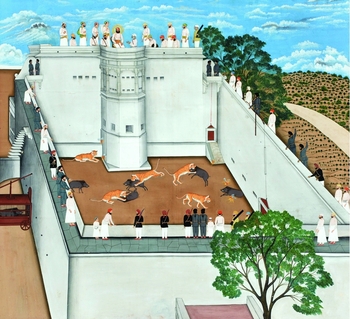
Besides counting, killing, and relocating game, princes commonly shifted individual animals from their home territories to new contexts better suited to princely interests and ideals. Maharana Fateh Singh in particular trapped and moved game to facilitate wild animal fights in his Khas Odi, Nahar Magra, and Chaughan arenas (Figure 1).
Maharana Fateh Singh watching a wild boar fighting a tiger inside Khas Odi, by Shiva Lal, Mewar, circa 1890. Source: © Maharana Mewar Charitable Foundation, Pictorial Archives of the Maharanas of Mewar, Udaipur, 2010.T.0025. (Colour online.)

In order to stage fights on special occasions, such as the visit of a viceroy, commander-in-chief, or high-ranking Indian prince, Fateh Singh needed a reliable method of trapping and the infrastructure necessary to keep dangerous game. The vast majority of animals trapped for the maharana were tiger, leopard, and wild boar. Of the 28 animal fights recorded in the haqiqat bahida registers that Fateh Singh and his guests viewed between 1884 and 1912, just over 46 per cent were between wild boar and tiger, and just under 18 per cent were between wild boar and leopard. Of the remaining fights, 14 per cent pitted a wild boar against a bear, horse, or another boar, 14 per cent were between a leopard and a tiger, bear, or elephant, and just 7 per cent involved no tiger, leopard, or wild boar at all.Footnote 87 The haqiqat bahidas show a total of 15 fights involving tigers, but the Śikār kā Nakśā records only seven of these animals caught between 1884 and 1921. Individual tigers that were used repeatedly were housed between fights in the tiger cages near Victoria Hall in Udaipur's Sajjan Niwas public garden. In 1901, these cages held at least one wild tigress and her three cubs, which were being tamed by Fateh Singh's staff.Footnote 88
Indian kings seem to have kept caged tigers for a very long time, or at the very least had long been advised to do so. The twelfth-century Mānasollāsa of King Someśvara III provided an extensive list of items that kings should keep in their forts, including ‘horses, elephants, weapons . . . ropes, sand, stones, drinks, vehicles, firewood, jaggery, different types of oils, curd, honey, all types of grains, cattle, cowdung, [and] pots’, along with the pertinent ‘lion[s], [and] tigers kept in cages’.Footnote 89 The problem princes faced was how to get these animals in the first place. While placing a baited cage out in the jungle was enough to trap some tigers, the ‘clever ones’ were not so easily caught. To obtain such animals, the maharana's śikārīs (shikaris) relied on the alluring scent of an aromatic herb of the Valerian family, known variously as bālchand, nāgarmothā, and mogtiyā, or Indian spikenard (Nardostachys jatamansi). Sprinkled along a trail leading up to and inside a cage, water boiled with crushed bālchand made tigers and leopards ‘go mad’, allegedly because the scent matched that of a female in heat.Footnote 90 The preparation was so effective that Tanwar wryly cautioned any who used the herb to ‘wash their hands afterwards’.Footnote 91 This trick was known in Jaipur and Gwalior as well.Footnote 92
Different methods were used to catch wild boar. The usual tactic in Mewar was to construct a grain trough in the jungle and to habituate local animals to daily feedings, thereby allowing the site to be used repeatedly for shooting and trapping. Tanwar recommended laying out a trail of maize and hog plum (Spondias s.) syrup to attract boar to newly established sites, where they would find a steady supply of ‘maize, pieces of sāṇṭhā (sugar cane), [and] dried maize and jaggery laḍḍus (sweets)’ in the trough. As a finishing touch, ‘a little opium . . . mixed into the laḍḍus’ ensured success as boar quickly became addicted and would keep coming back for more, particularly if the dosage was steadily increased.Footnote 93
When it came to trapping pig for animal fights or for later release, after the manner of fox hunting, Fateh Singh's shikaris aimed to catch the biggest boar possible. The best way to separate a really big pig out from its peers was to ‘dig a hole one foot deep and one-and-a-half feet wide, place some opium-laced laḍḍus inside, and put a heavy stone on top’.Footnote 94 Small boar would be unable to move the stone but adult males of sufficient size could. All shikaris had to do then was set a trap that would activate the moment the stone was pushed aside. Snares and ropes did not last long against tooth, tusk, or claw, however, and pit traps could injure animals, thereby reducing their value in the arena and field. These methods, too, would have forced shikaris into uncomfortably close contact with their quarry when attempting to collect and move trapped animals. Wooden cages were another option, and one which villagers near Kumbhalgarh used to trap and hold a live leopard in 1921 or 1922. When a state huntsman arrived on the scene, he found the animal ‘had chewed up half the cage with its teeth and was trying to get out’. A few minutes more and it would have escaped.Footnote 95 What Fateh Singh's shikaris needed, then, was a strong, preferably metal, cage, and an effective means of closing it on cue.
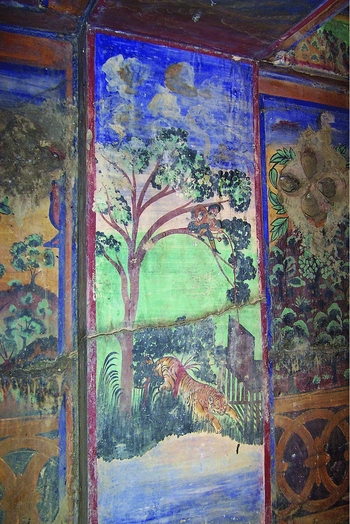
The earliest depiction of such a cage from Fateh Singh's reign may be the circa 1888 image found among the wall paintings inside Nar Odi, a small shooting tower just south of Udaipur (Figure 2).
Wall painting of a Mewar State shikari trapping a tiger, Nar Odi, Udaipur, circa 1888. Source: Photograph by the author.

This scene shows a tiger crouching down in front of a large, rectangular cage with vertical bars, a solid top, and a solid, sliding door at the front, which is held open with a rope by a shikari hiding in a tree. The court artist who painted this scene may have intended the tiger's crouched position to suggest the animal was poised to enter the cage, drawn in by the scent of bālchand or, perhaps, the distress calls of a live animal being used as bait.
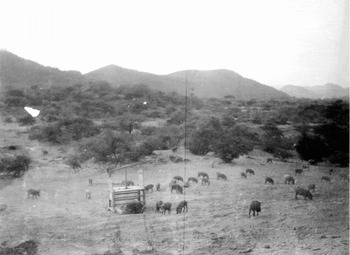
Dating to 1890, the next Mewari cage in the visual record was meant for catching and transporting wild boar (Figure 1). This cage shared several elements with the 1888 one, including vertical bars, a solid top, and a solid, sliding door. Unlike the 1888 model, it was significantly smaller, seems to have been made of metal and wood, and featured horizontally reinforced sides and wheels. Photographs taken near Khas Odi around 1903 show a very similar cage, but sans wheels and with doors on both ends. In one photograph the cage sits in the midst of a small herd of boar with its doors invitingly open (Figure 3).Footnote 96
‘The Wild Pig,’ near Khas Odi, Udaipur, by Gertrude Bell, 1903. Source: © The Gertrude Bell Archive, Newcastle University, RTW, Vol. 2_28.

Fateh Singh's shikaris were probably allowing the animals to familiarize themselves with the cage so they would not hesitate to enter when the device was baited to catch them. Likewise, two undated sequential stereographs show a pair of shikaris with large feed bags standing and sitting on top of the same cage, surrounded by a herd of perhaps 150 animals.Footnote 97 In one frame, a wild boar investigates the interior of the cage while the shikaris huddle on the roof, protecting their extremities and making themselves as unobtrusive as possible. The calmly feeding animals in these images suggest the cage was a familiar sight.
Udaipur's City Palace Museum currently displays a massive double-doored metal cage for catching and holding tiger, and a much smaller single-doored wood and metal cage for catching leopard, or perhaps wild boar. The doors on the tiger cage were operated using a system of pulleys and thin ropes or metal cables that could be wound up (to open the doors) or let out (to close them) using a pair of hand-crank winches. It would have been possible to winch the doors open and, rather than locking the mechanism, rig it to spin freely the moment the cage was disturbed, causing the door to come crashing down.Footnote 98 Judging by its sophistication, this cage probably post-dates the 1888, 1890, and circa 1903 examples. Unlike the earliest tiger cage in evidence, this model could have been left unattended in the forest, rigged to trap the first tiger, leopard, or other animal reckless enough to take the bait. The odds of catching the ‘clever ones’ must have improved when shikaris could leave the scene, taking with them all chance of scaring off their quarry by being seen, scented, or heard too close to the trap. As for the leopard cage, its door was operated by a simple top-mounted lever, similar to the mechanism that apparently operated the 1890 boar cage. Although less sophisticated in design, these cages also may have allowed shikaris to set their trap and leave, resting assured that any game the trap caught would stay caught, and knowing that, upon their return, they could collect their quarry safely.
Lakshman Singh and Fateh Singh were not the only princes to move their tigers and other dangerous game from place to place. Although the Maharaja of Datia had few wild tigers in his state, if any, he kept caged animals. Whenever his tigresses went into heat, he reportedly moved their cages to Datia's border to attract males from tiger-rich Gwalior.Footnote 99 When a forest beat in one ‘small and remote Native State’ in Central India failed to produce any big game when Andrew Fraser, a member of the Indian Civil Service, came visiting late in the nineteenth century, state shikaris caught a leopard overnight and presented the animal to Fraser the next morning ‘in a cage-like trap mounted on wheels’.Footnote 100 And, of course, the Maharaja of Gwalior imported lions from Africa and exported tigers to Dungarpur. The scale of operations in Gwalior State necessitated not only metal cages for moving lions, but a ‘great enclosure . . . [that] consisted of a large area divided internally and surrounded by a stone wall twenty feet high broken by strong gates’.Footnote 101 Small game including guinea fowl, partridge, and quail were also caged, transported, and released on demand by Gwalior State shikaris in the 1920s.Footnote 102
A whole genre of stories, mixing fact and fiction, detail the machinations of Indian princes when it came to moving game. After enjoying two uncommonly good spurts of jungle-fowl shooting in one state, Sir Arthur Cunningham Lothian ‘ascertained that the Ruler had a cage full of jungle-fowl mounted on a Ford car, which he anchored in a recess in the jungle, round the corner from where I was, and from which, every other minute, the driver would release a bird until the cage was empty’.Footnote 103 The Maharaja of Jaipur was notorious for transporting tigers to select jungles where he had prepared the grounds to ensure his guests’ triumphant successes. According to Viceroy Lord Hardinge, during the German crown prince's visit to Jaipur State in 1911, one such ‘tiger travelled in a box in the same train as the Prince . . . and roared so loudly during the night that he seriously disturbed the sleep of the travellers’.Footnote 104 Every trick employed to produce game was matched by another intended to keep animals away. Political agent to Rampur State in the 1930s, Lawrence M. Stubbs ‘sometimes wondered’ when tigers bolted across the line of fire if his host had ordered them driven thus because he thought his guest had already shot his ‘share’.Footnote 105
When captive tigers were deployed in partially staged hunts, additional steps could be taken to help guarantee the desired outcome. Rumours circulated about half-tame, cage-reared, and drugged animals, and Indian princes and state shikaris certainly knew how to administer opiates and had access to a variety of caged animals. When one Indian prince invited him for a tiger shoot, Stubbs asked about the animals on offer. The prince responded ‘I have three kinds . . . There's the grain fed one that comes to the foot of the shooting tower, there's the one you shoot from a motor boat as he sits on the bank of the stream and there's the one you must beat for or look for.’ One tall tale even claimed ‘that one of the tigers shot by the Crown Prince of Prussia during his visit to India had been so heavily drugged that no party of coolies carrying it in could travel for more than five minutes without falling asleep’.Footnote 106
Not every transported animal was meant for a European's gun. Princes did move animals for their own sport, and for that of their nobles and favoured shikaris. Victorious tiger, leopard, and wild boar used in animal fights at Khas Odi in the 1880s and early 1900s were sometimes let loose for hunting in the shikargahs around Udaipur.Footnote 107 Captive pig, hyena, jackal, and fox were also released in the 1940s from Akhet Prakash, just north of Nahar Magra, and pursued on horseback.Footnote 108 At least twice in the 1950s, Maharana Fateh Singh's heir, Bhupal Singh, had captive leopards released on small islands in the Jaisamand and Pichola lakes, where ‘the sport was to see if [the animals] would then hide somewhere, or get away by swimming’.Footnote 109
Nor was every captive tiger destined for the hunt. Lothian once received ‘two almost full-grown tigers on the veranda, which came gamboling up to me like St. Bernard dogs’.Footnote 110 They were gifts from the Maharao Raja of Bundi to the Maharaja of Jaipur. In 1906, the Maharao of Kotah likewise sent a lion cub to Mewar State in the care of a peon and a shikari, whom the maharana rewarded handsomely for their trouble.Footnote 111 Tame animals like these were caught young and hand-raised. When man-eating tigresses were shot in Jaipur, the state shikari Kesri Singh collected any surviving cubs in gunny sacks.Footnote 112 Singh obtained the cubs he named Hero, Happy, and Grumpy in this way, and found them ‘very good pet[s]’ throughout their youth, with Happy in particular bonding with the family dog and enjoying drives around Jaipur in Singh's automobile.Footnote 113 Once these animals matured, their freedoms were curtailed. Generally they were caged and put on public display, and occasionally deployed for a ruler's private entertainments. Singh sold Hero to the Rawal of Nawalgarh and ultimately transferred Happy to the Jaipur zoo.Footnote 114 Grumpy died when she was pitted against her sibling Happy in a fight sponsored by the maharaja for a visitor's entertainment.Footnote 115
If tiger, leopard, and wild boar, not to mention quail, partridge, and jungle fowl, were all fundamental aspects of princely wilderness and could all be moved to suit a prince's preferences, then did princely wilderness itself move with them? Princely wilderness was at its best in a prince's exclusive shooting preserves, where the highest concentrations of game lived and the most impressive trophies were found. Yet, when Fateh Singh moved a wild tiger, leopard, or other animal into one of his arenas—Udaipur's city palace, or the Sajjan Niwas garden zoo—each creature carried its unique contribution to the princely wilderness of the royal shikargah into a new context. While tigers lived in many princely zoos, including those in Udaipur, Bikaner, Jaipur, and Nawalgarh, other species were well represented, too.Footnote 116 Several undated photographs in the Pictorial Archives of the Maharanas of Mewar document a young swamp deer in the city palace compound, and a caged lion. The presence of a zebra in the capital, along with the rare white sambar fawn captured during Bhupal Singh's reign suggest, like the protected pangolin in Dungarpur State, that the exotic and the novel were as desirable as the wild.Footnote 117
The caged tigers in Fateh Singh's Sajjan Niwas garden effectively reminded the public of the potent princely wilderness that they represented and helped to constitute. Tanwar described the interaction of zoo visitors with Udaipur's tigers, writing that ‘observers go near its cage and tease [the tiger] because they know this animal is enclosed and despite the provocation, it will not be able to do anything. When they are teasing it and the animal becomes enraged, roars, and charges at them, it must stop because it crashes into the cage. Nevertheless, the tormenters back away five steps out of fear.’Footnote 118 The power of the caged, city-dwelling tiger was not erased, only contained. Likewise, princes like Fateh Singh suggested that they restrained their own powerful nature, taming themselves for the benefit of their subjects and to meet the routine demands of palace life, urban society, and day-to-day administration under British paramountcy.Footnote 119 But if provoked, princes could intimidate just like the tiger. State subjects who visited royal zoos received visceral reminders of the latent power of dangerous game, princely wilderness, and sovereigns brave enough to keep tigers and stand firm in the forest.
Princes normally kept their live specimens outside or on the edges of their capital cities and palace compounds, but they placed taxidermied creatures next to their gaddīs and in their dining rooms. There were few restrictions on the mobility of a deceased, properly cleaned, and mounted wild animal. One full-body stuffed tiger, taxidermied with a non-threatening expression on its slightly upturned face, sits companionably next to the 10-year-old Maharaj Kumar Gulab Singh of Rewah, two other small boys, and three dogs in a 1913 photograph. At age 15, the same prince was photographed several times on a felt-mounted tiger skin, while two full-body stuffed tigers, seated in alert postures with their mouths open, flanked the stage during his 1936 dassera durbar (formal assembly of princes and nobles for the Dassera festival).Footnote 120 These taxidermied beasts may have produced feelings of awe and admiration reminiscent of the more primal emotions elicited by living specimens. Death, the artistry of taxidermy, and urban contexts diluted its potency, but traces of princely wilderness still clung to these trophies.
Princely wilderness shaded into landscapes adapted to human habitation in fallow and planted fields, urban gardens, parks, and orchards, along jungle roads, and in forest margins and blanks where people and domestic and wild animals searched for forest produce, fodder, and food. Indian princes were deeply invested in wildlife management in thick jungles, hillside thorn forests, and uncultivated or sporadically cultivated zones, and in urban, village, and permanent agricultural settings. Wildlife could and did move between these landscapes on their own, and not just when shikaris transported them in cages. Wild ungulates came out of the jungle to feed in agricultural fields, wild boar visited villages to mate with domestic pig, leopard tore through thatch roofs to kill goats, and tiger walked down country lanes.Footnote 121 Likewise, domestic cattle ranged into the forest.
The mobility of wild as well as domestic animals, and the possibility of discovering domestic mangoes (Magnifera indica) and other familiar plants in the deep forest as well as in the garden, and of finding thorny thūhar and mahua (Madhuca longifolia) trees on the edge of the city and not just in the Aravallis, helps to clarify how princely wilderness overlapped and interacted with civilization. Princely wilderness was not part of a simple binary composed of wilderness and civilization. Rather, princely wilderness achieved higher concentrations in some areas than it did in others. It was present in the royal palace and the public garden, but it peaked most obviously in royal shikargahs and wherever else its primary components congregated. Its contours varied with the movement and proliferation of wildlife (particularly tiger and leopard), the influence of drought and famine, the establishment and desertion of villages, and in response to the legislative decrees of ruling princes and the ongoing struggles between princes, nobles, and subalterns over their individual and collective rights and privileges in the forest and beyond. As such, princely wilderness was neither ahistorical nor unchanging, but historically contingent and deeply responsive to political, social, economic, and environmental changes.
Wilderness and civilization
Numerous scholars have argued that, over the past two millennia or more, Western societies have conceived of wilderness as a natural space, separate from culture, that is either complementary to or in conflict with civilization.Footnote 122 In South Asia, princely wilderness was never entirely distinct from culture, due in large part to the princes’ routine and extraordinary engagements with it. Princely wilderness was so intertwined with courtly culture and civilization in the states that some might baulk at calling it wilderness at all. Yet, in princely India, it was no contradiction in terms for people and wildlife, culture and nature, civilization and wilderness to exist within overlapping categories and to move within overlapping spheres.
Indian elites and subalterns by no means understood princely wilderness to be unnatural, even when it was visibly managed and maintained by princes and their shikaris. Unsettled areas had many possible natural states, each appropriate to reigning conditions in the socio-political, economic, and moral realms of kings and, to a lesser degree, their subjects. In less desirable natural states, extreme scarcity or overabundance, unmitigated danger, and rampant disorder in fields and forests alike signalled the negligence or inadequacy of a less-than-ideal king. In more desirable natural states, princely wilderness was sufficiently tame that powerful individuals could navigate its dangers and collect its fruits for the good of the kingdom at large, which included the forest and its wildlife. An ideal princely wilderness, therefore, bore unambiguous evidence of human visitations and engagements.
Like a state's more settled regions, forests required intensive management to ensure the production and maintenance of the most desirable populations of flora and fauna. Fields needed tilling and cattle grazing, but forests benefited no less from select plantings and infrastructural additions, while wildlife thrived on extra food and water. One of the most common interventions Indian princes made in their forests was to ensure the year-round availability of water. Wherever shikargahs lacked perennial resources, they maintained artificial waterholes. Unless the quarry were bustard or houbara, nearly all wildfowling in Bikaner State took place on the margins of artificial lakes and tanks, such as those at Gajner and Pilap Bund. While most of Dungarpur's jungles had sufficient water, the Forest Department had ‘a number of artificial ponds in dry areas’ in order to ‘prevent animals from leaving their home altogether during Summer and straying out . . . into the adjoining States’.Footnote 123 Despite the proximity of the Pichola lake, Maharana Fateh Singh kept a masonry water trough for his well-fed herds of boar (and the occasional stray bull) near Khas Odi in the early twentieth century.Footnote 124
In addition to grain troughs for feeding wild boar and summer watering facilities for wildlife, royal shikargahs were dotted with shooting boxes, storehouses for ammunition and gunpowder, established campsites, and access roads. Even if a prince failed to visit a particular shikargah for months on end, these elements persisted and would facilitate his eventual return. These buildings and other infrastructure guaranteed an intermittent, if not constant, flow of people into the forest. Shooting towers received regular visits from Shikar or Forest Department employees who cleaned out accumulated dust and debris, checked the locks, and reported any damage.Footnote 125 State shikaris and forest guards also patrolled reserved forests and shikargahs to stop illegal grazing, lopping, and cutting; establish and maintain fire lines; keep tabs on big game; eliminate poaching; and destroy any individual animals that the state had identified as sufficiently dangerous or destructive.
As much as physical infrastructure marked princely wilderness, so too did state laws and jangalāt, or Forest Department policies, shape its connections with local communities. As in British India, the ways in which princely forests were classified and the rules in effect in each changed over time.Footnote 126 Between 1935 and 1940, Dungarpur's Village Forests existed to ‘meet the requirements of the agriculturalists’ for firewood, fodder, timber for plows and other implements, and housing materials.Footnote 127 In these forests, grazing and forest produce collection was regulated by the community rather than the state. Second Class Reserve Forests ‘provid[ed] timber for the needs of the people’, supplementing the Village Forests with larger timbers and serving the firewood, charcoal, and construction needs of Dungarpur's city-dwellers. ‘Scientifically’ managed for state profit, Second Class forest tracts were subject to clear-felling, thinning, mining operations, and the plantation of babūl seedlings and nursery-raised teak (Tectona grandis), Indian rosewood (Dalbergia sissoo), and Indian cedar (Toona ciliata) saplings.Footnote 128 First Class Reserve Forests were closed to the people for the purposes of cutting, although grazing was generally allowed. While these forests included the prince's game reserves and other ‘dense patches of . . . considerable age’, they were not left unworked by the Forest Department.Footnote 129 In First and Second Class forests alike, ‘thinning was carried out by eliminating useless trees. Trees which had suffered from fire, disease or frost were systematically felled. Promising plants were established and climbers and parasites were destroyed.’Footnote 130 In short, ‘every effort was made to encourage and obtain straight shoots’—a prerequisite for the commercial production and harvest of high quality timbers.Footnote 131
Administered separately under the Revenue Department, government efforts to improve Village Forests between 1910 and 1940 focused on the planting of at least 100,000 mango and mahua saplings, the former a domestic variety needing no introduction, and the latter a wild-growing tree highly productive of edible flowers and oil seeds.Footnote 132 Together, some 50,000 of these remained viable in 1944, meaning that just under 623 new trees graced every square kilometre of the state's Village Forests.Footnote 133 These trees would have changed not just the composition of the forests but also, as they matured and bore fruit, the ways in which people, domestic cattle, and wildlife used the forests. If, for example, sweet-smelling and intoxicating mahua flowers littered the ground, they might attract wild boar. If new trees closed the distance between village forests and fields, boar might start raiding crops. With more prey and increased cover, predators that could live in close proximity to human settlements, like leopard, might be drawn to the area. If the prince discouraged or prevented his subjects from killing wild boar or large carnivores, severely afflicted cultivators might take the drastic step of abandoning their village and fields. Deserted sites would cease to concern the Revenue Department and might be taken over by the Forest Department, even becoming subject to reclassification. In the end, such a place would be far more janglī than before. Wilderness itself would have moved in, first with the domestic mango and wild-growing mahua, then with the wild boar, and eventually the leopard and possibly the tiger.
Evidence that some landscapes in Dungarpur may have grown more janglī between 1935 and 1942 is found in forest classification records. Altogether, the maharawal's First Class game reserves grew by 2,100 bighās (2.8 km2), Second Class Forests by 122,000 bighās (163 km2), and Village Forests by 75,000 bighās (100.3 km2).Footnote 134 The growth of the Village Forests suggests the expansion of Forest Department control at the expense of the Revenue Department. In 1940, Village Forests were renamed (Unclassified) Village Forests, and 40,000 bighās (53.5 km2) were newly designated as Protected Village Forests.Footnote 135 The Forest Department brought another 20,000 bighās (26.8 km2) under this heading in 1942. None of these newly declared areas appear to have been classed as any kind of forest prior to these notifications. Had they been declared (Unclassified) Village Forests, relatively little might have changed for any people, cattle, or wildlife that relied on them. As Protected Village Forests, however, they were ‘placed under the supervision of the Forest Department with a view to preventing illicit and unscientific cutting’, resulting in significant new restrictions.Footnote 136 The Forest Department in 1942 also took over the (Unclassified) Village Forests of Pouhari, Jhontri, and Bhinda, without, however, any changes in nomenclature. Finally, they demarcated two new grass reserves, declaring them First Class Forests.
It is perhaps no coincidence that the Forest Department was extending its holdings during the very years when Dungarpur's tigers were breeding successfully enough to produce 48 ‘surplus’ animals.Footnote 137 Indeed, just as the maharawal's shikargahs were included in the state's First Class Reserve Forests, the Forest Department itself housed the prince's śikārkhāna, or hunting department. Preserving the state's wildlife was, however, hardly the only reason for the expansion in Forest Department holdings. The vast bulk of the newly declared forests were Second Class forests, which were not explicitly for shikar (hunting) and were worked for profit by the Forest Department and its contractors.
By the early 1940s, Dungarpur's forests were jointly administered with mining under the Forest and Mines Department. Mines and quarries were either ‘worked departmentally’, licensed, or leased out to local and outside contractors, like the Dungarpur Mining Syndicate, Ltd., and N. Futehally and Co., Bombay, that extracted metals and minerals including asbestos, apatite, agate, bauxite, calcite, copper, dolomite, feldspar, garnet, graphite, iron ore, lime, manganese, marble, quartz, soapstone, and talc.Footnote 138 Judging by the state's revenues, intensive extraction from the forest reserves began in the 1930s and rapidly accelerated through the 1940s. The state levied Rs 2,158 and Rs 2,440 in quarry taxes in 1934 and 1935, and Rs 2,861 in 1939. Mining revenues rose dramatically over the course of the Second World War, with annual returns between Rs 6,616 and Rs 7,883 from 1940 to 1944. If Dungarpur's mining and forestry operations followed trends seen in the Mewas estates, then the pace and scope of extractions would have surged once again when many ‘rulers got alarmed and sold their entire forest[s] to the timber merchants . . . for lump sum payment[s]’ in the late 1940s, with the goal of cashing in their assets and protecting as much wealth as possible prior to their impending losses in property and land revenues with the integration of the states into the newly formed Republic of India.Footnote 139
Recent controversies in the Sariska Tiger Reserve show that mining operations and wildlife often do not coexist with ease in Rajasthan's tropical dry forests.Footnote 140 Likewise, the impacts of widespread forest denotification—undoubtedly alongside the more difficult to quantify trends towards deforestation and degradation—have taken their toll.Footnote 141 In 2011, the Dungarpur District of Rajasthan State contained 294 km2 of reserved, protected, and unclassified forests, including scrub, moderately dense, and open forest areas, while the Udaipur, Rajsamand, Chittorgarh, and Bhilwara Districts had 6,357 km2 under the same headings.Footnote 142 In 1944, the Forest and Revenue departments of Dungarpur State controlled 2,077,176 bighās (2,779 km2) of forest reserves, or nearly nine-and-a-half times more territory than Rajasthan's Forest Department administers today in the Dungarpur District.Footnote 143 Denotification has been far less extensive in the former Mewar State, however, with today's totals just 118 km2 below the estimated holdings of the Forest and Revenue Departments for 1942.Footnote 144
These losses perhaps make it less surprising, then, that the official 2010 tiger status report records no detections and a less than 0.01 per cent probability of any wild tigers living inside or outside protected areas in the former Dungarpur and Mewar states.Footnote 145 Nevertheless, according to Rajasthan's 2010 wildlife census, approximately 200 leopard, 250 bear, 600 chinkara, 65 chital, 185 four-horned antelope, 325 sambar, 1,145 wild boar, and well over 7,000 nilgai could still be found in the combined territories of these two former princely states. These numbers represent about a third of Rajasthan State's remaining population of leopard and bear and nearly 60 per cent of its four-horned antelope. But these areas are deficient in the larger ungulate prey species that tigers have been shown to specialize in, the abundance of which is a ‘critical factor that facilitate[s] sympatry’ among tiger, leopard, and dhole populations.Footnote 146 With around 10 per cent of wild boar, and less than 2 per cent of sambar and chital, these districts stand in marked contrast to the Sariska and Ranthambore tiger reserves, which contain 47 per cent of the state's wild boar, 67 per cent of its sambar, and 84 per cent of its chital.Footnote 147
Conclusion: princely conservationism?
When Maharawal Lakshman Singh of Dungarpur and Maharana Bhupal Singh of Mewar (r. 1930–1955) began inviting mining contractors into state reserves alongside their forest officers in the 1930s and 1940s, did they suspect their profits might come at the expense of wildlife, and thus of princely wilderness? Neither the maharawal nor the maharana ever thought of princely wilderness as something that was entirely or even ideally devoid of people or human enterprise. In Dungarpur, the Forest Department's commercially minded efforts to ‘encourage and obtain straight shoots’ extended into the First Class Reserves, which included the state's prime wildlife habitats. Yet, Lakshman Singh firmly believed in the 1930s that he could simultaneously expand his forests, ‘improve’ their composition with saleable species, work them for profit following scientific principles, and increase his tiger and ungulate populations.Footnote 148 He could not have known the vital importance of biodiversity, a concept first developed by biologists in the 1960s and that only received its current name in 1985.Footnote 149 On the contrary, he almost certainly believed that more intensive state management would result in more trees, more tigers, and more ungulates. In the opinion of the princes, it was the illicit ‘destruction’ of ungulates and the ‘irresponsible’ cutting of trees by hill communities like the Bhils that hurt wildlife and drove local tiger populations to extinction, not the carefully considered practices of a state.Footnote 150
To the extent that Lakshman Singh and Bhupal Singh believed by the late 1940s that their days as sovereign princes were numbered, it made sense to liquidate some portion of their states’ forest and mineral wealth to secure themselves and their descendants against an uncertain future. If they consciously abandoned scientific management for quick, short-term profits, they would have expected wildlife populations to plummet in step with forest reductions. Like Maharana Fateh Singh after 1921, these rulers were experiencing (or beginning to anticipate) the reduction or outright cessation of their sovereign powers, rights, and privileges.Footnote 151 Once they began to accept that their sovereignty was coming to an end—and with it the realities of princely ecology—they had little need and increasingly limited means or authority to maintain large numbers of wildlife. Nevertheless, it appears that some rulers held off until the 1950s or even later, ultimately being spurred into action not by the departure of the British, but in response to continuing post-colonial erosions of their rights and privileges, notably the integration into the provinces of all temporary groupings of princely states in 1956 and the abolishment by constitutional amendment of privy purses, ruling titles, and all remaining special privileges in 1971.Footnote 152
The Mewari huntsman Tanwar complained in 1956 that the new nation and most of its citizens were blind to the economic, social, and political importance of the very wildlife and wilderness areas that he believed former sovereigns had understood so well. He argued that hunting familiarized its practitioners with history, geography, zoology, the languages and dialects of the country, and useful skills like riding and driving. It taught obedience, discipline, courage, agility, and the ability to endure hunger, thirst, exhaustion, and exposure. It fostered acquaintance with holy men, hill communities, and the haunts of robbers alike. Most importantly, it promoted the fundamentals of good citizenship: the spirit of service, the proper exercise of power, and the democratic imperative of treating all as equals. For Tanwar and the princes he worked for, every lesson that could communicate the ideals of good government and a practical knowledge of statesmanship was ‘intimately linked’ with the disciplined pursuit of wildlife in wilderness areas. ‘Hunting,’ he insisted, ‘is not a royal vice of our country. Rather, it is a continuation of India's most ancient traditions. It is the central accomplishment that makes a great man out of an ordinary person.’Footnote 153
Without fostering explicit linkages between governance, wildlife, and forest areas in some new incarnation of princely wilderness, Tanwar believed that the nascent Indian republic risked being as disconnected from its national history as it was from its natural history. Even worse, the nation risked losing important parts of its very nature along with its diminishing forests and dwindling wildlife.Footnote 154 Given the dramatic and well-publicized (if not always successful) government-sponsored interventions in wildlife demographics now ongoing in protected areas like Sariska, it seems that elements within the Republic of India are embracing a modified version of Tanwar's romantic ideas, emphasizing the importance of wildlife and wilderness but, contra Tanwar, omitting hunting as an ideal or even acceptable means of interaction. Without positing any other way of bringing the nation's rulers and citizens into a sustained and intimate relationship with wildlife and wilderness areas—not through cartoon tiger mascots and inspirational slogans, but in ways demonstrably productive in political, social, and economic terms—how will these environments, flora, and fauna figure in everyday concerns?
Yet even the closest connections between people and wildlife in India, as mediated through conceptions of wilderness, have not necessarily produced anything that modern critics would consider desirable environmental outcomes. Lakshman Singh may have increased the tiger population and tree cover in Dungarpur on a temporary basis, but he equally undermined biodiversity by seeking to exterminate the dhole and by following the environmentally problematic precepts of scientific forestry. And, rather than allowing ‘surplus’ tigers to migrate out and potentially expand the species’ range, he hunted and killed them in his state. Fateh Singh may have set out to protect the forests of Mewar against all harm, but he and his nobles slaughtered wildlife by the thousands for personal gain and to score political points, without understanding the shared ecology of these animals and their habitats. There is no clear-cut binary of indigenous harmony and colonial or Western abuse of nature here, despite the princes’ unique conceptions of wilderness. Royal investment was a decidedly mixed blessing for Indian wildlife and wilderness areas.
Because princes strictly limited hunting to themselves and select others, Divyabhanusinh has concluded that ‘whatever their motivations for conservation, their actions resulted in the protection of wild animals and their habitats’.Footnote 155 Rangarajan has countered that princely exclusivity ‘did not mean that theirs was an ethic of nature protection’.Footnote 156 This article has shown that Indian princes protected nature inasmuch as they identified their own interests and powers with its health and integrity. As it became increasingly clear that their powers would lapse with the end of empire, they exploited the natural wealth of their states to ease their transition from revenue-gathering potentates to unemployed ex-princes. Furthermore, princely conservation was not nearly as successful as it could have been. Princes acted on flawed ideas of wildlife ecology and in accordance with unscientific biases for and against certain species. They failed to think of the environment as a whole and instead cared only for local enclaves. Finally, they did far too little to support coexistence between people and wildlife, and in some cases even created the conditions for future conflicts.Footnote 157
It is important, if uncomfortable, to realize that these problematic practices arguably emerged from a deep admiration of select wildlife and identification between their characteristics and those of the Rajput princes. Dhole were hunted down in Dungarpur to make way for desirable ungulates and to eliminate competition with royal tigers. The Maharana of Mewar chose to slaughter noble yet destructive wild boar when he needed to prove his mental and physical fitness against a worthy foe and to refashion his rulership by suppressing an agricultural pest. Although some princes, including the Maharawal of Dungarpur, were beginning to participate in the empire-wide trend towards wildlife conservation that was gaining prominence as the twentieth century progressed, these rulers primarily promoted their own interests and local animals.Footnote 158
Popular as well as scientific understandings of wildlife and ecology have advanced dramatically since the early twentieth century. Inasmuch as princely interventions in wildlife and wilderness were shaped by contemporary popular and scientific understandings—for example, that the extermination of one species would have predictable impacts on other species—it was inevitable that mistakes would be made. Nevertheless, the authoritarian conservancy of princely wilderness failed on at least two counts: the princes were operating in accordance with flawed understandings of wildlife ecology, and their management practices increasingly failed—in an era of expanding cultivation, increasing exploitation of forests, and widespread agitation for democracy—to find workable balances between the demands of their agrarian subjects and the needs of the wildlife that they hoped to promote.Footnote 159 Despite the princes’ high valuation of select game and wildlife habitats, their best legacy has been neither their attitude nor their policies towards animals or wilderness.Footnote 160 Rather, it has been those landscapes they set aside and maintained as game reserves, which today help form the backbone of the Indian network of protected areas and which, unfortunately, continue to present management challenges—including human−animal conflict in Gir, local extinction in Sariska, and the struggle to balance commercial exploitation and environmental protection in Ranthambore—akin to those the princes once faced and even helped create.Footnote 161