Introduction
The political union between Protestant and Catholic Christians has been an important innovation in Germany’s postwar democracy. For the first time, Protestants and Catholics came together in a major political party, the Christian Democratic Union (CDU). The interdenominational merger helped reconcile a long-standing societal division, overcome the political fragmentation of the center and center-right of the Weimar years, and contribute toward the consolidation of Germany’s postwar 2.5-party system. Knowing the political development of the last 70 years, we might be tempted to regard the merger between both denominations as a historical inevitability. Many classic studies have highlighted the normative desire to leave behind prewar conflicts and the path-setting effect of initial restrictions on party competition when explaining the rise of the CDU and low levels of party system fragmentation (e.g., Loewenberg Reference Loewenberg, Dogan and Rose1971: 268–76; Pridham Reference Pridham1977: 21–39; Rogers Reference Rogers1995: ch. 6). Recent work by historians, in contrast, has revealed a high level of uncertainty and contingency that characterized the relationship between Protestants and Catholics in Germany’s early postwar years (e.g., Bösch Reference Bösch2001; Klein Reference Klein2005).
This article focuses on an understudied political party that, at the time, caused significant concerns over a renewed political divide between Catholics and Protestants: Gustav Heinemann’s All-German People’s Party (Gesamtdeutsche Volkspartei, or GVP). Heinemann was a renowned lay leader of the Protestant Church and, after the war, had cofounded the CDU and served as Germany’s first minister of the interior. He formed the GVP after resigning from the cabinet and leaving the CDU in opposition to Konrad Adenauer’s support for Germany’s military participation in a West European defense community.
Recent work has warned against the cognitive bias that emerges from reasoning backward from the safety of knowing an outcome and thus treating past events as having been more predetermined than they were (Capoccia and Ziblatt Reference Capoccia and Ziblatt2010; Møller Reference Møller2017, Reference Møller2021). The GVP’s result of only 1.2 percent in the 1953 election has made it look like an inevitable political failure, reducing it to hardly more than a footnote in the party politics literature (e.g., Von Alemann Reference Von Alemann2010). Footnote 1 However, the GVP illustrates the importance of “reading history forward” when selecting our cases. In the early 1950s, many CDU leaders and political observers feared the disintegration of Catholics and Protestants into opposing political parties. Catholics supported Western rearmament, whereas many Protestants did not. Protestants also resented Catholics for their insistence on separate confessional schools and for their newly achieved political dominance in postwar Germany. Heinemann’s prominence, rootedness in Protestantism, and role as a vocal opponent to rearmament make the GVP’s 1953 result more puzzling than a retrospective perspective would suggest.
If the GVP was associated with important societal and political conflicts, why did it not break through? On the one hand, scholars have explained cases of nonbreakthrough by pointing to unfavorable contextual conditions (e.g., Backes and Mudde Reference Backes and Mudde2000; De Jonge Reference De Jonge2021; O’Malley Reference O’Malley2008). Studies of successful breakthrough, on the other hand, have highlighted the agency of new or previously minor parties in identifying, shaping, and politicizing issues or positions to attract support (e.g., Hobolt and De Vries Reference Hobolt and de Vries2015; Marzouki and McDonnell Reference Marzouki, McDonnell, Marzouki, McDonnell and Roy2016; Riker Reference Riker1986). However, if parties’ strategic choices matter, they should not only matter in cases of success but also in cases of failure. Such negative cases, in which opportunities for breakthrough are favorable but breakthrough is absent, are important for theory building and testing (Mahoney and Goertz Reference Mahoney and Goertz2004). This points toward a gap in the literature on political opportunity structure, which usually assumes but does not demonstrate that actors would capitalize on available opportunities (Meyer and Minkoff Reference Meyer and Minkoff2004: 1463–64).
Heinemann and his allies encountered favorable conditions but made strategic choices about with whom, when, and how to build their party that left the GVP with too narrow an appeal to break through. The conflicts between Catholics and Protestants over rearmament and other issues opened up political space that established parties initially did not address. Yet, Heinemann’s coalition building alienated potential supporters, his hesitancy to form a party allowed established parties to reduce the available space, and a restrictive membership recruitment strategy undermined the party organizationally and financially. All this left the GVP with too small a base for party breakthrough. Neither the 1953 electoral reform in itself nor the Soviet crackdown of the 1953 East German uprising and its alleged impact on discrediting opposition to rearmament explain the GVP’s failure to break through. My analysis relies on archival collections and secondary sources in political science, political history, and church history. I use systematic process tracing, which allows generating internally valid results when the number of competing explanations exceeds the number of cases (Bennett Reference Bennett, Brady and Collier2010: 180–81).
The article makes three contributions. First, it highlights a historically sensitive approach to selecting negative cases. Second, it underlines the importance of relevant negative cases to assess the effect of new or minor parties’ strategic choices on their breakthrough potential. Finally, empirically, it is, to the best of my knowledge, the first study of the GVP in English. I proceed by introducing the case and embedding it within the literature on party breakthrough, whose implications for selecting negative cases I subsequently discuss. This article then evidences that Heinemann’s and the GVP’s choices over coalition building, the timing of party formation, and organization building rather than the contextual opportunities explain the GVP’s failure to break through. The last section discusses my findings’ implications for the literature on new parties, case selection, and party system development and concludes.
The Case of the GVP
Imagine a new democracy. Its first election took place less than a year ago and the resulting coalition government has just a slim majority. The largest party in this coalition is divided along the country’s salient cleavages. It has not been constituted as a national party yet and instead consists of relatively autonomous subnational organizations. Legal constraints on the formation of new parties have just been lifted and, being a federal system, the country’s subnational elections displayed high levels of volatility. In this context, the minister of the interior, himself from the largest governing party and the leading representative of one of the country’s largest cleavage groups, resigns over a dispute on one of the most controversial issues at the time. All else being equal, if this person subsequently decided to form a political party, would we not expect it to have good chances of entering parliament?
This scenario describes well the case of Gustav Heinemann’s GVP. Before 1945, Heinemann had been a leading figure in the Confessing Church, a movement opposing the Protestant churches’ alignment with the Nazi regime. Following Germany’s defeat and partition into occupation zones, he helped form the CDU in North Rhine-Westphalia. While the CDU aspired to integrate Catholic and Protestant Christians, its early years reflected the heightened tensions between both denominations in postwar Germany (Bösch Reference Bösch2001). Heinemann became “the representative of Protestant Christians within the CDU,” having been elected to the Council of the Evangelical Church (Evangelische Kirche in Deutschland, or EKD) in August 1945 and as president of the church’s all-German Synod in 1949 (Klein Reference Klein2005: 190; emphasis added). He became mayor of Essen in 1946 before gaining wider recognition as minister of justice in North Rhine-Westphalia and entering Konrad Adenauer’s first federal cabinet as minister of the interior (ibid.: 188–94).
Denominational conflicts heightened over the prospects of reunifying the predominantly Protestant East German state with the denominationally balanced West German state. The outbreak of the Korean War in mid-1950 intensified discussions over rearming West Germany as part of a Western defense alliance. This would entrench both German states on opposite sides in the Cold War and thus block reunification in the foreseeable future. The implication of rearmament for German reunification made the issue a focal point in the tensions between Protestants and Catholics (Bösch Reference Bösch2001: 119–20; Hehl Reference Hehl1999: 178; Pearson Reference Pearson2010: 272–73).
When learning that Adenauer had stated his willingness to the Western Allies to provide German troops for a West European army, Heinemann declared his resignation during a cabinet meeting on August 31, 1950 (Schwarz Reference Schwarz1995: 547). Heinemann rejected rearmament as a democratically unauthorized act (Adenauer had not consulted the cabinet), a morally wrong decision so soon after World War II, and a threat to peace and national reunification. The latter, in his view, could only be achieved through German neutrality (Klein Reference Klein2005: 196–99; Müller Reference Müller1990: ch. 3). These positions would inspire the GVP’s platform (Müller Reference Müller1990: 258–68).
National Party Breakthrough, Political Opportunities, and Strategic Choices
The background of Heinemann and the GVP seems to suggest promising conditions for national party breakthrough. I define national party breakthrough as the first time a party either gains a seat or achieves a specific vote share (e.g., around 5 percent) in a national election (e.g., Bolleyer Reference Bolleyer2013: 39; Bolleyer and Bytzek Reference Bolleyer and Bytzek2017: 772; Meguid Reference Meguid2008: 4–5). My understanding of national party breakthrough thus does not include gaining legislative or executive representation through mergers with or splits from parties in public office because it is likely to result from very different processes (Bolleyer Reference Bolleyer2013: 26–27).
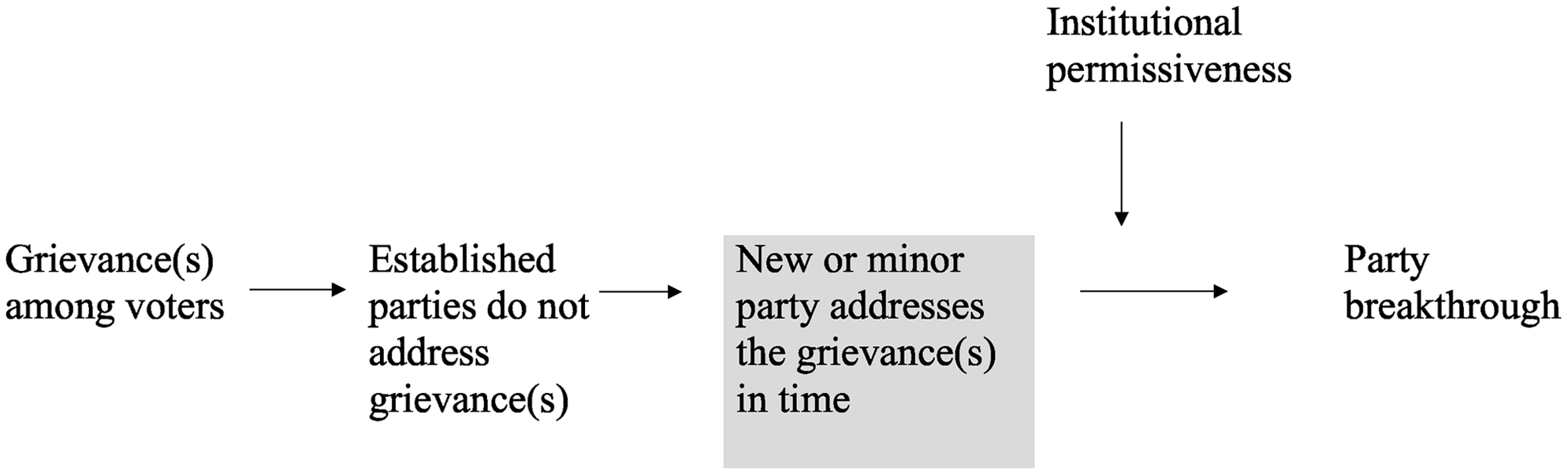
Studies explaining the success of new or previously minor parties have emphasized the interplay between demand-side, institutional, and supply-side factors, often subsumed as political opportunity structure (POS) (e.g., Arzheimer and Carter Reference Arzheimer and Carter2006; Kitschelt Reference Kitschelt1988; Meguid Reference Meguid2008). Demand-side factors have focused on why voters might support new parties. This might be the result of changes in a country’s enfranchised population (Lipset and Rokkan Reference Lipset, Rokkan, Lipset and Rokkan1967), the erosion or lack of traditional party-voter linkages (e.g., Dalton Reference Dalton2006; Sikk Reference Sikk2012), or the rise of new issues (e.g., Ignazi Reference Ignazi1992; Kitschelt Reference Kitschelt1988). On the supply-side, when established parties fail to represent voters on relevant issues, provide distinct policy positions, or incorporate them into a coherent program, new parties can ease such “representational strain” (Rohrschneider Reference Rohrschneider2015: 367; Rohrschneider and Whitefield Reference Rohrschneider and Whitefield2012: ch. 2). Many scholars have seen the breakthrough of new parties as resulting from the failure of parties that have already broken through to address new issues (e.g., Hug Reference Hug2001; Meguid Reference Meguid2008). Established parties might fail to do so, for example, when these issues risk crosscutting or departing from their traditional electoral coalition (Rohrschneider Reference Rohrschneider2015: 358, 367). Addressing an issue also requires acting upon it in public office (ibid.: 368). If established parties do not do this, new or minor parties can break through even while serving well-known ideological questions (Bolleyer Reference Bolleyer2013; Lucardie Reference Lucardie2000; Sikk 2011). The extent to which established parties might get away with “representational strain” without new party breakthrough also depends on the political system’s institutional permissiveness (Rohrschneider and Whitefield Reference Rohrschneider and Whitefield2012: 33). Low hurdles to party registration, a proportional electoral system or a plurality system with geographically concentrated electoral support, a low electoral threshold, second-order elections, and a high level of corporatism have been suggested to help new or minor parties to break through (Arzheimer and Carter Reference Arzheimer and Carter2006; Birnir Reference Birnir2004; Farrer Reference Farrer2015; Golder Reference Golder2003; Kitschelt Reference Kitschelt1988). Party breakthrough becomes more likely as relevant interest groups refuse to endorse established parties (e.g., Warner Reference Warner2000). We would thus expect to see party breakthrough if established parties fail to address important grievances in a political system with a high level of institutional permissiveness.
However, while the POS approach assumes that new/minor parties will use the space available to them (figure 1), these parties’ strategic choices are an independent factor. Parties need to politicize the issue that established parties have not addressed. Many voters who care about this issue might previously not have voted or voted for different parties given the absence of a better choice (Rohrschneider and Whitefield Reference Rohrschneider and Whitefield2012: ch. 5). New or minor parties thus need to build a coalition in terms of the groups coming together in the new party and framing issues in a way that appeals to a sufficiently large number of voters (Hanley et al. Reference Hanley, Szczerbiak, Haughton and Fowler2008; Hobolt and De Vries Reference Hobolt and de Vries2015; Marzouki and McDonnell Reference Marzouki, McDonnell, Marzouki, McDonnell and Roy2016; Przeworski and Sprague Reference Przeworski and Sprague1986; Riker Reference Riker1986; Rovny Reference Rovny2013). Their chances of breakthrough increase if they adopt a position on the issue that differs from those of established parties (Hobolt and De Vries Reference Hobolt and de Vries2015: 1161). Yet, established parties’ responses can importantly reduce new or minor parties’ prospects (Meguid Reference Meguid2008). They can fail to pick up on (changes in) voters’ preferences at t but correct this at t + 1 (Abou-Chadi Reference Abou-Chadi2016; Hug Reference Hug2001). Timing is thus important. While the time established parties require to respond to public opinion can vary for several reasons (e.g., Kitschelt Reference Kitschelt1994), taking ownership of an issue (position) before established parties address it can improve new or minor parties’ electoral prospects (see Stubager Reference Stubager2018 for a critical review). Moreover, while organizational strength has usually been associated with electoral persistence rather than breakthrough (Art Reference Art2011; Bolleyer Reference Bolleyer2013), building an organizational infrastructure is usually important to run a successful campaign (Dinas et al. Reference Dinas, Georgiadou and Konstantinidis2016; Lucardie Reference Lucardie2000). Parties’ organizational strength is not fully explained by their backing in society because parties decide what organizational forms to adopt and how to recruit members (Przeworski and Sprague Reference Przeworski and Sprague1986: 83–84).
Party breakthrough following the POS model.

If seizing political opportunities requires appealing to the available electorate, addressing salient conflict lines before established parties do, and building some organizational infrastructure, why would new or minor parties ever fail to do so? While historical ties to organized special interests constrain parties’ flexibility, this tends to be a problem for established rather than for new or minor parties and to depend on parties’ initial coalition building (ibid.: 115–26). Still, parties might refuse to adopt a platform that risks diluting their ideological identity (Lucardie Reference Lucardie2000; Przeworski and Sprague Reference Przeworski and Sprague1986). Internal conflicts might also prevent parties from seizing opportunities (Hanley et al. Reference Hanley, Szczerbiak, Haughton and Fowler2008; Hobolt and De Vries Reference Hobolt and de Vries2015). Regardless of the reasons, we would expect that if a new or minor party fails to address the available electorate before established parties do, party breakthrough is unlikely.
Selecting Negative Cases
When seeking to explain party breakthrough, studying negative cases (i.e., cases of nonbreakthrough) is important.Footnote 2 They facilitate distinguishing between factors, events, and processes that are merely present and those that are crucial to the outcome (Emigh Reference Emigh1997: 357–58). By providing variation on the outcome variable, negative cases have been essential for the correlational analysis in quantitative studies and for evaluating necessity and sufficiency claims in qualitative studies (Golder Reference Golder2003; Mahoney and Goertz Reference Mahoney and Goertz2004). Even studying a single negative case can thus help develop “the content of theory” (Emigh Reference Emigh1997: 357).
Yet, many attempts at party breakthrough fail without being academically relevant. Most scholars would probably not find it worthwhile to study why the Magdeburg Garden Party (Magdeburger Gartenpartei) did not overcome Germany’s 5 percent threshold in 2017 because the party was only on the ballot for around 3 percent of the electorate. This made breakthrough basically impossible.Footnote 3 Moreover, some parties do not even seek election. The neofascist party The Right (Die Rechte) was criticized for primarily existing not to contest elections but to provide former members of banned neo-Nazi clubs with the legal protection political parties enjoy under German law (Hüllen n.d.). Such cases would not teach us anything about the effects of agentic, structural, and institutional factors, and, if adding up to a large share of negative relative to positive cases, would contribute to underestimating the probability of breakthrough (King and Zeng Reference King and Zeng2001: 146–48; Mahoney and Goertz Reference Mahoney and Goertz2004: 654–56). While there are statistical tools to correct for this problem (King and Zeng Reference King and Zeng2001), the advice commonly goes against simply including all negative cases (Mahoney and Goertz Reference Mahoney and Goertz2004: 656–57).
Choosing cases based on how close they came to achieving breakthrough (i.e., using election results as a proxy for breakthrough potential) entails the risk of selection bias by selecting on the dependent variable and ignoring “relevant” negative cases.Footnote 4 In relevant negative cases, the outcome did not occur but was possible. For example, parties were on the ballot in a sufficient number of districts to have a chance at breakthrough. Moreover, values on at least one independent variable would make us expect to observe the outcome (ibid.: 657–58). For example, we might expect a party to break through because there is an unaddressed grievance and the party has leaders whose name recognition or political expertise makes them credible challengers to established parties (e.g., Hanley et al. Reference Hanley, Szczerbiak, Haughton and Fowler2008). Assuming that parties’ eventual result would capture their breakthrough potential biases case selection in favor of the POS approach because it risks deselecting cases in which parties failed to capitalize on political opportunities (see Mahoney and Goertz Reference Mahoney and Goertz2004: 656, 668).
The GVP is an often-neglected relevant negative case because values on both POS and internal supply-side variables were conducive to party breakthrough. On the POS side, the loss of Germany’s predominantly Protestant eastern territories following World War II and the Adenauer government’s course of Western integration intensified anti-Catholic sentiments and opposition to rearmament among many Protestants. Established parties, for various reasons, initially did not address these grievances. On the GVP’s side, contemporaries agreed that Heinemann’s ecclesiastic and political background put him in a promising position to capitalize on the available space.
The following analysis will assess to what extent changes in the political opportunities or the strategic choices made by Heinemann and his allies explain the GVP’s failure to break through. The POS argument assumes that new or minor parties would use the opportunities available to them. If this argument explained the GVP’s failed breakthrough in 1953, I would expect to observe (changes in) public opinion and established parties’ platform to leave the GVP with no political space to capitalize on and/or the available electorate to be too small to break through given (changes in) the institutional environment (e.g., electoral reform). In contrast, the strategic choice argument would be supported if public opinion and established parties’ platform provided the GVP with a sufficiently large group of voters given the institutional context but the party failed to appeal to this electorate due to its choices over, for example, its political coalitions, the timing of party formation, or organization building.
Identifying whether agency had an effect on party breakthrough when compared to demand-side, external supply-side, and institutional factors requires fine-grained data to reconstruct the timeline of changes in contextual conditions, key events, and actors’ decision making (Bennett Reference Bennett, Brady and Collier2010). I assess public grievances, including the size of opposing groups and the importance voters attributed to relevant issues, by using the few surveys available for the early 1950s. I complement this with archival material and secondary sources on grievances at the mass and elite level. To reconstruct the sequence of events, actors’ decision making, and parties’ platforms, I conducted research in the Archive for Christian Democratic Policy (ACDP), the Foundation Chancellor Adenauer House (StBKAH), and Germany’s Federal Archive (BA). The data includes Heinemann’s and other relevant actors’ notes and correspondence, minutes of party and cabinet meetings, and campaign and press material.Footnote 5 The BA and ACDP also provided online access to additional sources. I also rely on material from the Archive of Social Democracy (AdsD) and smaller church archives that secondary studies have cited and/or paraphrased (e.g., Klein Reference Klein2005; Müller Reference Müller1990). Finally, while the GVP has not attracted much research in comparative politics, I complement the material with studies on political and ecclesiastic history (compare Møller Reference Møller2020).
My analysis proceeds in two steps. First, I will show that Heinemann initially faced favorable conditions for a new party to break through. Second, between his announced resignation in August 1950 and late 1952, Heinemann made choices that left the GVP with too small a potential support base before other parties notably changed their platform. Germany’s 1953 electoral reform and the development of public opinion (e.g., because of the Soviet crackdown of the East German uprising), on their own, do not explain the GVP’s failed breakthrough.
The GVP’s Political Opportunity
Conflicts between Catholics and Protestants after 1945
Building on a long history in German politics, going back to the Reformation, Thirty Years’ War, and Bismarck’s Kulturkampf (Frøland et al. Reference Frøland, Georg Jakobson and Berrefjord Osa2019), conflicts between Catholic and Protestant Christians came again to the forefront by the end of World War II. Prior to 1945, Protestants’ majority position and their alignment with conservative state building elites might explain the initial absence of a notable Protestant party, like the Anti-Revolutionary Party in the Netherlands at that time (Hehl Reference Hehl1999: 172; Lipset and Rokkan Reference Lipset, Rokkan, Lipset and Rokkan1967: 35–38; Pearson Reference Pearson2010: 277–78). The German Conservative Party and subsequently the German National People’s Party mainly represented the Protestant side of the denominational cleavage (Klein Reference Klein2005: 30–35; Mitchell Reference Mitchell2012: 23). The balance between the two denominations, however, changed dramatically in 1945. While Protestants had represented two-thirds of the German population between 1871 and 1945, their share dropped to denominational parity with Germany’s postwar partition and territorial losses (Hehl Reference Hehl1999: 167; Sauer Reference Sauer1999: 1–2).
While the Weimar and war experience as well as the compulsory party licensing imposed by the Allies stimulated interdenominational cooperation (Bösch Reference Bösch2001: 51–53; Mitchell Reference Mitchell2012: 39–53, 86; Pearson Reference Pearson2010: 270; Rogers Reference Rogers1995: 123–25), conflicts between Catholics and Protestants quickly reemerged. The Catholic majority in the new Adenauer government and its policy of Western integration stimulated fears of Catholic domination among many Protestants (Pearson Reference Pearson2010: 271). Historians have summarized these feelings by referring to Martin Niemöller’s interview with the New York Herald Tribune in December 1949 (Bösch Reference Bösch2001: 109; Conway Reference Conway1992: 833; Mitchell Reference Mitchell2012: 187; Sauer Reference Sauer1999: 46–47). The president of the Protestant Church in Hesse and Nassau saw the West German state as having been “conceived in the Vatican and born in Washington.” Its continued existence would entail “the end of European Protestantism” (cited in Sauer Reference Sauer1999: 47). On the ground, clubs and societies split along denominational lines, and letters to Protestant politicians illustrated people’s experiences with denominational conflicts (Bösch Reference Bösch2001: 109–10). Footnote 6
The fear of being marginalized in the new state connected to the opposition of many Protestants to West Germany’s rearmament. While Catholics quickly rallied behind rearming West Germany as part of a European defense alliance, several Protestant state churchesFootnote 7 rejected rearmament for jeopardizing peace and the reunification with the majority Protestant population in Soviet-controlled East Germany (ibid.: 119–20). Survey data from September 1951 indicates that 42 percent of people rejected rearmament before the two German states were reunified, and the “Count me out!” (Ohne mich!) movement against rearmament became one of the first postwar social movements (Görtemaker Reference Görtemaker1999: 189–90; Holl Reference Holl1988: 223–24; Noelle-Neumann and Neumann Reference Noelle-Neumann and Neumann1975: 359).
Arguments about Protestantism’s alleged doctrinal unsuitability for political mobilization are not persuasive. While Martin Luther’s doctrine of keeping matters of faith separate from social and political matters might have contributed toward Protestants’ submission to state authority before 1933, the experience of the Nazi dictatorship and the war had politicized many Protestant leaders and laymen (Pearson Reference Pearson2010: 273–81). This did not result in support for a Protestant party or political agreement per se. Yet, many church elites, most visible in Karl Barth’s progressive-participatory theology, agreed that it was a Christian’s responsibility to participate fully in political life (Klein Reference Klein2005: 386; Müller Reference Müller1990: 47–53; Sauer Reference Sauer1999: 34, 41).
Established Parties’ Initial Struggle to Address Protestants’ Grievances
The CDU aimed to integrate both Catholics and Protestants, but the dominance of Catholics within the party hindered its ability to accommodate Protestant interests. Adenauer’s support for Western rearmament engendered suspicions among many Protestants that he might sacrifice reunification for the sake of consolidating Catholic dominance (Bösch Reference Bösch2001: 118–19; Hehl Reference Hehl1999: 177–78; Mitchell Reference Mitchell2012: 188).
In contrast to the Catholic Church (Warner Reference Warner2000: 198–99), the CDU also lacked the unequivocal support of the Protestant Church. The EKD council was divided into a conservative, Lutheran majority and a vocal and left-leaning reformed minority around Niemöller, organized as the Council of Brethren (Bruderrat) (Sauer Reference Sauer1999: 27–44). Antiparty sentiments had traditionally been widespread within both groups, and several meetings between church, SPD, and CDU representatives failed to generate agreement on whether the church should forge ties with a political party (Klein Reference Klein2005: ch. 12). The EKD refused to favor the CDU in identifying candidates for the 1949 election and did not express an electoral recommendation beyond encouraging Protestants to vote (ibid.: 446–48). Adenauer’s support for rearmament and Heinemann’s resignation intensified the church’s internal divisions, even triggering concerns over a potential split (Hehl Reference Hehl1999: 182; Sauer Reference Sauer1999: 42, 87–88). While CDU support was pronounced among Lutheran elites (Bösch Reference Bösch2001: 36; Sauer Reference Sauer1999: 80–104), opposition to Adenauer’s rearmament course prevailed, especially at the grassroots level. Footnote 8 While the church subsequently adopted a neutral position (Pearson Reference Pearson2010: 287; Sauer Reference Sauer1999: 89), it remained divided on the issue well beyond the 1953 election (Conway Reference Conway1992: 834–35).
After Heinemann’s departure from the cabinet, the CDU’s vote share collapsed in the state elections in many Protestant areas (Hesse: from 31 to 18.8 percent, Württemberg-Baden: 40.9 to 26.3 percent, Bremen: 22 to 9 percent). Footnote 9 While we lack individual-level data, it seems plausible that Protestant voters had distanced themselves from the CDU. “If this development continues,” Paul Sethe analyzed for the Frankfurter Allgemeine Zeitung, “we would revert to the situation as it had existed until 1933: that the convinced Catholics would gather in a specific party” and “that the convinced Protestants could not get themselves to join them” (Sethe 1950). In hindsight, these fears might seem surprising because the CDU ended up absorbing several rivals until the end of the 1950s (Bösch Reference Bösch2001: 174–94; Kreuzer Reference Kreuzer2009: 687–92). In the fall of 1950, however, the CDU had only existed for five years and not even been constituted as a national political party. Footnote 10 The party’s disintegration along denominational lines was a serious possibility for many observers and party elites at that time (Cary Reference Cary1996: 264; Kaiser 1950; Lehr 1950; Sethe 1950).
Disgruntled Protestants within the CDU substantiated the risk of a denominational split. Virtually all CDU Protestants, including prominent figures like Hermann Ehlers, had backed Heinemann as minister of the interior against Adenauer’s initial reluctance (Schwarz Reference Schwarz1995: 444). While Ehlers would become a loyal supporter of Adenauer, his loyalty was not certain in 1950 (Jobke Reference Jobke1974: 63). When Adenauer rejected a Soviet and East German initiative in November 1950 to reunify Germany as a neutral state, Ehlers, Robert Tillmanns (deputy leader of the Berlin CDU), and the exiled Christian Democrats from East GermanyFootnote 11 openly opposed Adenauer at the party council (Volkmann Reference Volkmann and Forschepoth1988: 185–86). When Adenauer rejected an East German initiative to confer over organizing free elections, opposition was so intense at the party council meeting on September 27, 1951 that Friedrich Holzapfel (deputy CDU leader, Protestant) thought it necessary to state that “Dr Adenauer had still the confidence of the CDU” (cited in ibid.: 190; emphasis added). When Stalin ultimately proposed the reunification of a neutral Germany in March 1952, Adenauer’s unwillingness to engage with the proposal again provoked intraparty outcry. Jakob Kaiser, Johann Baptist Gradl, and Ernst LemmerFootnote 12 urged to negotiate with the Soviet Union (ibid.: 191–201). Against Adenauer’s objections, Ehlers even met a delegation from East Germany’s legislature in September 1952 (Koch Reference Koch1972: 347).Footnote 13
Adenauer named the risk of losing the “CDU’s Protestant circles” as his “greatest concern” (größte Sorge) (Buchstab 1986: 87). At a leadership meeting in October 1951, he spoke about the SPD’s attempts to drive a wedge between the CDU’s Protestant and Catholic members, efforts that “thanks to Niemöller and Heinemann” could succeed (ibid.). Recriminations between the two denominations occurred frequently at the national and state level. In addition to disagreements over rearmament, Protestants lamented their minority status in the distribution of posts, whereas Catholics complained about Protestants’ overrepresentation when compared to the CDU’s membership and electorate (ibid.: 51–52, 56, 60, 70, 75, 95, 163, 542–43). Disagreements over education policies came on top of these conflicts (Bösch Reference Bösch2001: 109–33; Cary Reference Cary1996: 254–55).
While the remaining parties tried to benefit from anti-Catholic resentments against the CDU (e.g., Bösch Reference Bösch2001: 121), they were ill-equipped to appeal to dissatisfied Protestants. The Liberals’ (FDP) emphasis on individualism and materialism invited criticism for being the party of “unbelievers” (Klein Reference Klein2005: 310). Moreover, as Adenauer’s coalition partner, the FDP remained largely on Adenauer’s side on rearmament (Jobke Reference Jobke1974: 103; Schwarz Reference Schwarz1995: 551). His other coalition partner, the German Party (DP), stood in the tradition of prewar Protestant Conservatism but emphasized a denominational party brand primarily after the 1953 election. Initially, it feared that denominational campaigns would limit its appeal in South Germany and jeopardize its alliance with the CDU (Klein Reference Klein2005: 294–95; Meyn Reference Meyn1965: 87). In the early 1950s, monarchist, national-conservative, and increasingly right-wing extremist positions characterized the DP, which courted former NS officials to fight off the rising Socialist Reich Party (Klein Reference Klein2005: 292–93; Schmollinger Reference Schmollinger and Stöss1984: 1029–34). The refugee party (BHE) was nondenominational because refugees were denominationally mixed (Vosskamp Reference Vosskamp2007: 34, 168–69). Both the DP and BHE supported rearmament (Jobke Reference Jobke1974: 103; Schoenberg Reference Schoenberg1971: 169–79).
The Social Democrats’ (SPD) position was ambiguous. Although the party attracted a large share of Protestant voters before the war, their support was rooted in a class rather than religious identity. “Religious Socialists” only constituted a tiny minority (Klein Reference Klein2005: 56–58). After 1945, the SPD initially opened up toward the Protestant Church, meeting with Niemöller’s group in July 1947 and October 1950. Yet, a subsequent meeting was cancelled, and the SPD leadership kept henceforth their distance after Niemöller had tried to gain the SPD’s support for opposing rearmament (ibid.: 339–41, 414).Footnote 14 While the SPD had initially opposed rearmament (Drummond Reference Drummond1982: 37–41; Schwarz Reference Schwarz1995: 523), their position changed with the Korean War.Footnote 15 The party’s grassroots continued to condemn rearmament, and, in state elections, the SPD ran slogans such as “Barracks or Hospitals! CDU or SPD!” and “Vote against remilitarization! Vote for peace, social justice, and freedom. Vote Social Democrats!” (Drummond Reference Drummond1982: 58). However, since a press conference in the fall of 1950, seen as authoritative for the SPD’s position (ibid.: 46–47), SPD leader Kurt Schumacher was taking a different position. He demanded a “concentration of military forces on German soil that would make the power and resolution of the Western democracies ‘strikingly visible’” (ibid.: 63). His disagreement with Adenauer was one of sequence rather than principle. While Adenauer saw rearmament, national sovereignty, and security as goals that could only be reached simultaneously, the SPD leader wanted an increase in Germany’s sovereignty and the Allies’ military presence before making any defense contributions (Drummond Reference Drummond1982: 44–47, 52, 64–65; Löwke Reference Löwke1969: 11, 45; Müller Reference Müller1990: 117–18; Schubert Reference Schubert1970: 42–45, 64–70). Given the divisions between the SPD’s leadership and rank-and-file, its position crystalized around calling for new elections to decide the issue of rearmament (Drummond Reference Drummond1982: 58).
Institutional Permissiveness and Electoral Reform
The institutional permissiveness of Germany’s political system does not account for the GVP’s failure to translate the available space into electoral breakthrough. The end of compulsory party licensing in March 1950 significantly facilitated new party emergence.Footnote 16 While the risk of being banned if the Constitutional Court judged a party antidemocratic remained a hurdle to new party entry, this was a concern for the neo-Nazi Socialist Reich Party and the Communist Party (KPD) rather than the GVP (Cary Reference Cary1996: 269; Müller Reference Müller1990: 244–57).
Together with the denominational conflicts described in the preceding section, the widespread opposition to rearmament underlines that there was sufficient potential demand for the GVP to overcome the electoral threshold even after the 1953 electoral reform. Footnote 17 Anticommunism and the fear of a Soviet attack were not enough to discredit the opposition to rearmament (cf. Holl Reference Holl1988: 224–25; Klein Reference Klein2005: 269). The Communists also rejected rearmament, and anticommunism was certainly one of the reasons for a relatively weak Communist Party in West Germany (5.9 percent in 1949). However, opposition to Western rearmament vastly exceeded the Communist vote. By April 1951, six million signatures had been collected against rearmament (Holl Reference Holl1988: 224). Support for German neutrality was widespread, ranging from 30 to more than 50 percent between 1950 and early 1953.Footnote 18 This included 30 percent of people who said in September 1952 that they would want Germany to side neither with the West nor the East even in the case of war (Merritt and Puchala Reference Merritt and James Puchala1968: 221, 224). Opposition to rearmament remained high, scoring between 14 and 30 percent depending on the survey and question, even after the Soviet Union quelled an East German uprising in June 1953 (Noelle-Neumann and Neumann Reference Noelle-Neumann and Neumann1975: 175; Reigrotzki Reference Reigrotzki2015).
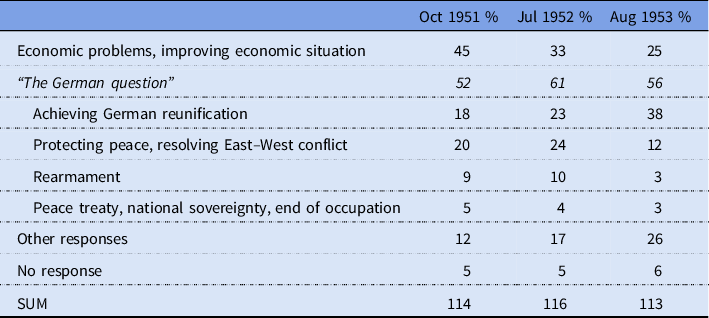
Table 1 shows that rearmament and issues relating to it were also highly salient. While only less or equal to 10 percent of respondents explicitly named rearmament as one of the most important issues, this issue, as outlined above, was inherently linked to the East–West conflict, German reunification, and national sovereignty (Koch Reference Koch1972: 224; Volkmann Reference Volkmann and Forschepoth1988: 194–95). More than half of the respondents regarded issues relating to “the German question” as the most important problems, vastly exceeding the share of respondents concerned about the country’s economic situation.
“What do you think is the most important question that should generally be dealt with in West Germany today?” (open question, multiple answers possible)

Source: Noelle-Neumann and Neumann (Reference Noelle-Neumann and Neumann1975: 392).
Note: Adapted and reprinted with permission.
While the survey data does not allow disaggregating the results to the subnational level, reports on local protests and return rates of signatures against rearmament indicate that opposition was particularly strong in Protestant and denominationally mixed areas. This especially applied to the areas with a reformed Protestant tradition in North Rhine-Westphalia, Hesse, and Baden-Württemberg (Bösch Reference Bösch2001: 120; Dietzfelbinger Reference Dietzfelbinger1984: 97–150; Koch Reference Koch1972: 279–80). It is unclear whether the concentration of support would have been sufficient for a party to secure a district seat. Yet, the importance of the PR component in Germany’s mixed system and the expansion of the 5 percent threshold from the state to the federal territory meant that the geographical concentration of support played a subordinate role for the GVP’s breakthrough potential.Footnote 19
Opposition to rearmament provided a focal point to bring together a broad Protestant coalition. While Protestants had been split into a conservative majority and a liberal and (small) socialist camp before World War II (Klein Reference Klein2005: 21–57), the opposition to rearmament bridged these old divisions. Ranging from nationalists, angry over the loss of the Prussian heartland, to pacifists and the religious minorities in the FDP and SPD, many Protestants rejected Western rearmament for threatening German reunification and peace (Jobke Reference Jobke1974: 116; Klein Reference Klein2005: 342–45; Mitchell Reference Mitchell2012: 101–2; Müller Reference Müller1990: 121; Pearson Reference Pearson2010: 271). The Süddeutsche Zeitung rightly noted in October 1950 that a “politician of passion and temperament” would be able to translate these sentiments into an antirearmament movement that neither the government nor the Western Allies could ignore (cited in Koch Reference Koch1972: 206).
Strategic Choices and the GVP’s Missed Opportunities
Coalition Building
However, while Protestant newspapers and local church groups supported Heinemann by publishing his arguments (ibid.: 207), Heinemann refused to politicize denominational identities. Reflecting the theological discussions among church leaders over whether a party could claim the label “Christian” (Klein Reference Klein2005: ch. 12), Heinemann had reservations over instrumentalizing the Christian faith for political purposes (Klein Reference Klein2005: 203–6, 380–94; Müller Reference Müller1990: 51–52). In his public appearances, he took great care to separate his political remarks from his position in the EKD (Koch Reference Koch1972: 236, 274).
Instead, Heinemann tried to build a broad coalition against rearmament, open to both Protestants and Catholics without being explicitly “Christian.” In late 1950, Heinemann met with former CDU members Ulrich Noack and Günther Gereke to prepare a public declaration against rearmament (ibid.: 236–37). Trying to convince public figures to sign it, he contacted Protestant bishops, the leader of the Catholic Center Party (Helene Wessel), and Protestant elites in the CDU (Hermann Ehlers) and FDP (Edgar Engelhard, Friedrich Middelhauve) (Cary Reference Cary1996: 264; Müller Reference Müller1990: 120–21).
Yet, Heinemann’s choice of partners did not inspire support for his “Call for Peace.” Especially Gereke was a controversial figure. Serving as minister for agriculture in Lower Saxony until mid-1950, the CDU expelled him after meeting with representatives of the East German government (Deutschland-Union-Dienst, 1950; Koch Reference Koch1972: 236–37). As a result, while Wessel and Engelhard supported Heinemann’s initiative, Middelhauve rejected it. Ehlers, despite expressing careful sympathy, wanted to wait and see who else would sign the declaration (Müller Reference Müller1990: 120–21). This first attempt to build a broad antirearmament coalition ended in disaster when Gereke, without Heinemann’s approval, published their declaration before well-known centrists had signed. At that stage, the signatories predominantly came from the far left and right, thus discrediting the declaration and causing Heinemann to withdraw his support (Koch Reference Koch1972: 238–39; Müller Reference Müller1990: 121).
Ehlers’s reluctance to support Heinemann’s initiative, despite their shared background in the Confessional Church and, at least in principle, opposition to rearmament, was also influenced by the coalition building within the CDU. While Heinemann presented his views in front of CDU Protestants, these meetings initially aimed to identify ways to mediate between him and Adenauer (Koch Reference Koch1972: 173–74). In contrast, Adenauer quickly met with leading Protestants in the CDU, like Ehlers, to secure their loyalty in exchange for placing them in influential public and party offices (Klein Reference Klein2005: 200–1; Koch Reference Koch1972: 214; Pearson Reference Pearson2010: 285–86). Footnote 20 Adenauer’s efforts to divide the Protestant opposition within the CDU was probably helped by a letter sent by Niemöller and 38 church veterans accusing the government of conspiring with the Americans against the German people (Pearson Reference Pearson2010: 285). At the CDU’s constituting congress, Protestant delegates presented a declaration against Niemöller’s attacks and in support of Adenauer (Bösch Reference Bösch2001: 124; Klein Reference Klein2005: 200; Müller Reference Müller1990: 117). Heinemann, in turn, withdrew from attending the party congress, criticizing Adenauer for overloading the agenda to render a discussion impossible (Koch Reference Koch1972: 204). Adenauer and his supporters continued their strategy of reaching out to CDU Protestants, while Heinemann, focusing on building an interdenominational movement, convinced only few defectors to join him (Bösch Reference Bösch2001: 126; Koch Reference Koch1972: 321, 346–47, 381).
Moreover, while building a broad support coalition benefits from downplaying issues that could cause frictions (Rovny Reference Rovny2013), Heinemann alienated potential supporters by specifying his left-right position. His roots in the left-leaning minority faction of the Protestant Church distinguished Heinemann from conservative Protestants (Klein Reference Klein2005: 188–89). While Adenauer managed to integrate diverse interests by being vague on divisive issues (Bösch Reference Bösch2001), Heinemann outlined and justified his views (Müller Reference Müller1990). He emphasized the moral basis for his opposition to rearmament, questioning whether Christians should take up arms again so soon after “God’s judgment” had taken them away (cited in Klein Reference Klein2005: 197–98). This helped Adenauer to (unjustifiably) discredit Heinemann as a pacifist, which was at odds with many conservative Protestants’ values (Bösch Reference Bösch2001: 122, 125; Koch Reference Koch1972: 192–200). Moreover, when Heinemann expressed support for a new, non-Catholic party, he specified that this party could bring together Protestants and Socialists (dpa 1950). This resonated with left-leaning Protestants, who would constitute the GVP’s main base (Jobke Reference Jobke1974: 131–35, 142–43; Müller Reference Müller1990: 130–32, 252, 321). However, this group on its own was too small for the GVP to break through, while Heinemann’s left-leaning positioning triggered angry reactions from conservative Protestants (Klein Reference Klein2005: 203). Failing to build a bridge to the EKD’s conservative wing, Heinemann prevented any chance for the GVP to build on the Protestant side what the CDU had built on the Catholic side in terms of a party-church alliance (Koch Reference Koch1972: 296–99, 352–74; Warner Reference Warner2000: ch. 9).
Timing
Heinemann also waited with his political actions until his opponents had closed the previously available space. He allowed Adenauer to wait for six weeks until accepting his resignation. Footnote 21 During this time, Adenauer gathered information on Heinemann’s backing and reached out to CDU Protestants. Footnote 22 Moreover, despite repeated calls by supporters and even the influential weekly magazine Der Spiegel to form a new party (e.g., Koch Reference Koch1972: 268–69, 328–29; Müller Reference Müller1990: 119), Heinemann stayed in the CDU for two more years. Instead, he formed an interest group on November 21, 1951, called the “Emergency Community for the Peace in Europe” (Notgemeinschaft für den Frieden Europas, or NG) (Müller Reference Müller1990: 115–29). Heinemann considered this a more effective strategy to stop rearmament than forming a new party because the ratification of the relevant treaties and legislation was expected to take place before the next federal election (Jobke Reference Jobke1974: 84–86). However, it also meant that other parties rather than the Heinemann movement benefited from the CDU’s collapse in the state elections in many Protestant areas between 1950 and 1952 (Bösch Reference Bösch2001: 96–108). Heinemann even discussed the possibility of receiving a secure place on the CDU list for the 1953 election (Heinemann 1952b; Simpfendörfer 1952a, 1953). Only when Adenauer wanted to postpone this discussion until after the Bundestag had ratified the European Defense Community and thus German rearmament, Heinemann left the CDU and formed the GVP in November 1952 (Adenauer 1952; Heinemann 1952a; Kaiser 1951; Simpfendörfer 1952b). By that time, however, pro-Adenauer CDU Protestants had already organized the Protestant Working Circle (Evangelische Arbeitskreis, or EAK) to mobilize Protestant support (Bach 1951a, 1951b; EAK 1952). During the 1953 campaign, the EAK operated as an “anti-GVP association” (Müller Reference Müller1990: 270), closely monitoring the GVP’s efforts and organizing countercampaigns (Blumenfeld, 1953; EAK 1953).
The GVP only switched to politicizing Protestants’ anti-Catholic resentments after Heinemann and his allies had emphasized for more than a year that they were not a Protestant movement. Initially, they portrayed the NG and GVP as an alternative for Catholics and Protestants who rejected rearmament and were dissatisfied with the existing political parties (Cary Reference Cary1996: 268–70; Heinemann 1953a, 1953b; Klein Reference Klein2005: 266, 275–76; Müller Reference Müller1990: 134–35, 251–52). Only later in 1953, the GVP appealed to anti-Catholic sentiments, as one of its flyers illustrates (“Thus, no Protestant vote for the few and unsympathetic Protestant henchmen of political Catholicism! No Protestant vote for the Catholic CDU!”; cited in Ehlers’s (1953) letter to Heinemann). Starting as an interdenominational organization before embracing denominational politics very likely undermined the GVP’s credibility as the defender of Protestant interests.
Heinemann also only abandoned his reservations against party formation when opposing rearmament was no longer a unique selling point. Already when forming the Emergency Community for the Peace in Europe (NG), Heinemann had waited for a year before suddenly rushing forward (Klein Reference Klein2005: 264–69; Müller Reference Müller1990: 129–30). A similar hesitancy characterized his decision making when forming the GVP, which was further complicated by divisions among the NG leaders (Müller Reference Müller1990: 149–51, 220–35). As a result, the GVP only formed when the SPD’s position on rearmament had changed dramatically. After having publicly condemned one of its MPs for making similar arguments just four months earlier, the SPD started opposing rearmament in February 1952 for the threat it posed to German reunification (Schubert Reference Schubert1970: 72–73). When the GVP formed in November 1952, the SPD had already established itself as the main opposing voice to Adenauer’s rearmament course at a time when political developments drew additional attention to the issue (Cary Reference Cary1996: 268–69; Müller Reference Müller1990: 271).Footnote 23
If the GVP had taken ownership of opposition to rearmament before the SPD did, its electoral prospects would have likely been better. Meguid’s (Reference Meguid2008: 34–35, 58) work suggests that the SPD’s ambiguity on the issue and relatively late shift toward opposing rearmament in combination with the CDU’s consistent and vocal support for rearmamentFootnote 24 would have strengthened the issue’s salience, the GVP’s status as antirearmament party, and consequently the GVP’s electoral support. The GVP was initially well known for a new party. When asked in December 1952, 31 percent of people said that they had heard about the GVP and 13 percent were even able to name its leaders (Noelle-Neumann and Neumann Reference Noelle-Neumann and Neumann1975: 271). Yet, when asked in a later survey which party could prevent Germany from being dragged into another war and achieve German reunification, 24 and 18 percent of respondents, respectively, named the SPD, in contrast to only 2 percent for the GVP (ibid.: 255).
Organization Building
Heinemann and his allies also made choices that undermined the GVP’s prospects organizationally and financially. To be clear, the GVP built an organization that made electoral breakthrough possible. By the time of the 1953 election, it had an organization (Landesverband) in all federal states and a local party group (Kreisverband) in 232 out of 242 constituencies. The GVP ran candidates in 232 of the 242 district races and a list in all federal states (including 211 candidates) (Heimann Reference Heimann and Stöss1984: 1493, 1498). In terms of being available to voters, the GVP thus surpassed the DP, which still entered parliament despite not filing a candidate in 35 districts and withdrawing in an additional 18 districts.Footnote 25 Moreover, the GVP’s leadership could rely on executive and legislative experience. It included a former cabinet minister (Heinemann), party leader (Wessel), party secretary (Wilhelm Hermes), and mayor (Robert Scholl). Wessel and five additional members of the GVP’s leadership board also were or had been members of parliament (Jobke Reference Jobke1974: 121; Müller Reference Müller1990: 246).
The GVP initially encountered decent conditions to recruit a large membership. When the NG formed and started collecting signatures for a petition against rearmament, its early weeks indicated a notable momentum. In the city of Tübingen, for example, around a third of the population signed its petition, and the NG’s headquarters struggled to keep up with the numerous signatures and speaking requests for Heinemann (Koch Reference Koch1972: 279). While the Adenauer government and its supporters tried to sabotage Heinemann’s efforts to collect funds and put pressure on donors and journalists to not support him, several influential regional and national newspapers initially supported Heinemann’s activities (ibid.: 325–26, 380–82).
However, the leadership around Heinemann and Wessel imposed restrictions on who could join their movement, thereby blocking the chance to build a large membership. Aiming to prevent an influx of far-right and far-left forces, the NG’s statute basically constrained membership to its 10 founding members. The NG’s leadership had to unanimously accept any new member and grant written permission to local groups wishing to speak on the organization’s behalf (Jobke Reference Jobke1974: 88–89). Membership recruitment primarily depended on the initiative of local actors (ibid.: 90). With few local activists, the NG only collected around 148,000 signatures for its petition, and when the NG was transformed into the GVP, there was no mass membership to build on (Jobke Reference Jobke1974: 87; Müller Reference Müller1990: 148–49). By June 1953, the GVP’s membership did not exceed 1,500 members, based on the number of subscriptions to its newspaper. It probably did not help that the GVP required prospective members to submit a declaration that they had not been part of any unconstitutional organization after 1949 (a restriction other parties did not impose) (Heimann Reference Heimann and Stöss1984: 1498–99, 1503).
Because its potential donor pool consisted of religious associations and small businesses, the lack of members limited the party’s financial maneuverability (Jobke Reference Jobke1974: 125). The GVP was unable to print its publications at a scale that allowed maintaining ties with a large number of voters. While the GVP had established branches in all states by July 1953, its name recognition had dropped markedly and the number of local party groups did not yet exceed 170 (Heimann Reference Heimann and Stöss1984: 1498; Jobke Reference Jobke1974: 122–23; Koch Reference Koch1972: 380, 407).
Efforts to resolve this weakness by forming electoral alliances with the SPD, DP, and FDP failed (Müller Reference Müller1990: 280–81). The GVP had alienated many conservative Protestants. It had allowed the SPD to occupy the space of an antirearmament party, and the FDP and DP were Adenauer’s coalition partners. They had no incentive to support the GVP. The GVP’s efforts to cooperate with other small parties only increased its internal heterogeneity without adding much to its strength (ibid.: 272–80). The marginal position the GVP leadership had maneuvered the party in ultimately pushed them into the fateful alliance with the League of Germans (Bund der Deutschen, or BdD) (ibid.: 286–95).
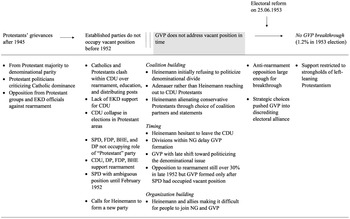
While helping redress the GVP’s organizational weakness, the BdD openly accepted Communists and attracted attention for its “private diplomacy” with the East German government (Cary Reference Cary1996: 270–71; Müller Reference Müller1990: 283–86, 295). Being associated with Communist support, especially so shortly after the uprising of June 1953, further marginalized the GVP. When news broke accusing the BdD of being financed by the East German regime, the party was completely discredited (Müller Reference Müller1990: 297–301, 316–20). Anticommunism mattered at this stage, and the GVP had reached this stage as a result of its leaders’ strategic decisions. While it is hard to say whether the GVP would have entered the Bundestag in September 1953 without this series of political mistakes, it seems fair to conclude that its chances would have been significantly better had they made different choices. Figure 2 summarizes my findings.
The GVP’s failed breakthrough.

Discussion and Conclusion
The failure of the GVP is an important and previously underexplored episode in the development of postwar German politics. Prominent accounts have attributed the swift consolidation of Germany’s 2.5-party system to the Allies’ party licensing, which gave some parties a head start, and the political institutions and alliances these first movers devised (Kreuzer Reference Kreuzer2009; Loewenberg Reference Loewenberg, Dogan and Rose1971; Rogers Reference Rogers1995). This article has added to this scholarship by highlighting the impact minor parties’ decisions had during the tumultuous early 1950s. Gustav Heinemann’s resignation in the fall of 1950 sparked fears among political elites and observers that the CDU’s attempt to integrate both Protestants and Catholics was doomed and the Federal Republic would see a similarly fragmented center and center-right as Weimar. The choices Heinemann and his allies made rather than the development of public opinion, established parties’ platform, and political institutions explain why the GVP failed to break through in 1953.
To what extent can the findings of this study inform research beyond the context of 1950s Germany? We must not stretch the inferential leverage we gain from a single case. Yet, the presented analysis entails insights that have implications for research beyond this article’s specific empirical motivation.
Accounts of party breakthrough gain from appreciating the extent to which new or minor parties forge their own destiny. Considering public grievances, established parties’ positions, and a political system’s institutional permissiveness is important to understand parties’ opportunities for electoral breakthrough. However, political opportunities are only what actors make of them. While political entrepreneurs can improve their electoral prospects (Hobolt and De Vries Reference Hobolt and de Vries2015; Marzouki and McDonnell Reference Marzouki, McDonnell, Marzouki, McDonnell and Roy2016; Riker Reference Riker1986), new or minor parties’ actions can also waste a favorable political opportunity structure. While the GVP had a real chance to break through, Heinemann’s strategic choices over coalition building, the timing of party formation, and organization building maneuvered the GVP into a marginal position. Coalition building, timing, and organization building plausibly influence new parties’ prospects beyond 1950s Germany.
The GVP’s failed breakthrough also teaches us something about party system development. Especially in the first elections after transition, democracies face the challenge of integrating diverse interests within the new political system. Some parties succeed in appealing to a wide range of groups, thus contributing toward comparatively low levels of party system fragmentation, while others do not (e.g., Hanley et al. Reference Hanley, Szczerbiak, Haughton and Fowler2008). When seeking to explain such differences, neglecting the actions by rival parties risks overemphasizing variables like the electoral system. While Germany’s CDU became the seminal example of Kirchheimer’s catchall party, Heinemann’s GVP emerged when the CDU had suffered significant losses in Protestant areas. CDU leaders feared that if Heinemann directly targeted Protestant voters, the CDU’s efforts to accommodate Protestants within the party would take an important, potentially decisive setback. Heinemann’s tactical errors helped Adenauer and the CDU to prevent the resurgence of a fragmented center-right.
The GVP also offers insights into the role of religion during democratic consolidation by reflecting the process through which German Protestantism came to terms with the postwar realities. The GVP’s trajectory from a group that wanted to stay out of party politics toward an uneasy acceptance of parties as the basis of political decision-making and the eventual acceptance of Germany’s postwar party system resembles the church’s own development after 1945 (Klein Reference Klein2005: ch. 11). After the 1953 election, many leading GVP figures, including Heinemann, and numerous Protestant pastors found a new home in the SPD. They contributed to the party’s transformation from a Marxist labor-based party to a moderate center-left and governing party, assuming positions as cabinet ministers and even the Federal Presidency (Klein Reference Klein2005: 345–57; Müller Reference Müller1990: 378–400; Sauer Reference Sauer1999: 45). The GVP’s failure might thus have been a long-term success in integrating Protestants into the new political system.
Methodologically, my findings highlight the importance of a historical approach to case selection. This project did not start by looking at the GVP’s result of 1.2 percent in 1953 and asking why this particular party failed. Instead, Herbert Butterfield (Reference Butterfield1959 [1931]: 16) urged historical scholars, “Real historical understanding is not achieved by the subordination of the past to the present, but rather by our making the past our present and attempting to see life with the eyes of another century than our own.” The more I studied the grievances, institutions, and party platforms in the early 1950s, the more puzzled I was that the GVP did not break through and attracted so little attention in political science. The GVP leadership’s religious and political background and established parties’ difficulties in addressing the salient denominational conflicts made the GVP’s failed breakthrough surprising. A case-selection strategy based on a party’s eventual election result or the snapshot of previous electoral performances would have most likely missed the GVP. My analysis highlights the importance of “reading history forward” when selecting our cases. The emphasis on case selection is an important addition to political science’s “historical turn,” which has mainly focused on periodization, concept formation, and collecting suitable data to test competing explanations (e.g., Capoccia and Ziblatt Reference Capoccia and Ziblatt2010; Kreuzer Reference Kreuzer2009; Møller Reference Møller2017, Reference Møller2021).
A potential but erroneous objection to a historical perspective on case selection might be that it would not matter if we missed cases like the GVP. Negative cases are important for valid inference (e.g., Emigh Reference Emigh1997). The abundance of cases that do not display a particular outcome can be a curse rather than a blessing (Mahoney and Goertz Reference Mahoney and Goertz2004). The size and obscurity of many new or minor parties can significantly complicate collecting data on all relevant variables, thus being a burden on researchers’ time and resources. Moreover, as outlined in the “Selecting Negative Cases” section, some parties might not even primarily exist to compete in elections. Previous scholarship has thus formulated criteria for selecting negative cases, which have focused on the value of potential explanatory variables (ibid.). My article speaks to the case-selection literature by advocating a historical perspective when deciding upon the moment in time for which we collect data on these variables. Tracing public opinion, established parties’ positions, and institutional developments toward election day is better than reasoning backward from parties’ eventual result or looking at snapshots of previous performances.
A second similarly erroneous opposing view might acknowledge that negative cases like the GVP are important but uncovering them would be too resource-intense. While reconstructing public opinion and the development of party platforms for 1950s Germany did require in-depth historical work, data on public opinion, party positions, and institutional variables are usually readily available for contemporary cases. Building on these data sources, we can easily watch out for breaks or major changes in people’s political views or a political system’s institutional permissiveness without a corresponding shift in established parties’ platforms, which would indicate space for party breakthrough.
The risk of missing such an insightful case underlines the importance of “reading history forward” when selecting our cases and to give parties’ strategic choices their due role in accounts of both successful and failed party breakthrough.
Acknowledgments
I thank Giovanni Capoccia, Sukriti Issar, Félix Krawatzek, Ed Turner, and two anonymous reviewers for their generous comments, the International Association for the Study of German Politics (IASGP) for their financial support, and the staff at the Archiv für Christlich-Demokratische Politik, Bundeskanzler Adenauer Haus, the Bundesarchiv, and the Institut für Demoskopie Allensbach for their help while collecting the data.
Supplementary material
To view supplementary material for this article, please visit https://doi.org/10.1017/ssh.2022.1