Introduction
The tobacco aphid, Myzus persicae nicotianae Blackman (Hemiptera: Aphididae), is a serious and cosmopolitan pest of tobacco-growing regions, causing both direct damage by feeding on plant sap and indirect damage by transmitting important plant viruses. The aphid has been reported as a subspecies of M. persicae (Sulzur) and has been adapted to feed on tobacco, Nicotiana tabacum L. (Solanacae) (Blackman & Eastop, Reference Blackman and Eastop2006; van Emden & Harrington, Reference Van Emden and Harrington2007). Myzus persicae nicotianae was first reported on tobacco in the USA in the 1940s (Lykouressis & Mentzos, Reference Lykouressis and Mentzos1995). This subspecies reproduce parthenogenetically throughout the year and do not participate significantly in sexual reproduction (Margaritopoulos et al., Reference Margaritopoulos, Shigehara, Takada and Blackman2007). Vucetic et al. (Reference Vucetic, Petrovic-Obradovic and Stanisavljevic2010) indicated that the tobacco-adapted form of M. persicae clearly differs morphologically from non-tobacco-adapted form and the most important distinctive characteristics are the lengths of the ultimate rostral segment length and processus terminalis, which are longer in tobacco-adapted form. The aphid populations have the greatest effect on the price of harvested tobacco. Control is better when initiated early before aphid populations build up (Reed & Semtner, Reference Reed and Semtner1992).
To control M. persicae nicotianae, farmers use a large amount of chemical insecticides which has resulted in resistance of the aphid to many common chemical insecticides (Field et al., Reference Field, Javed, Stribley and Devonshire1994). Also, the intensive and indiscriminate use of chemical control methods decreases natural enemy populations of tobacco aphid (Katsarou et al., Reference Katsarou, Margaritopoulos, Tsitsipis, Perdikis and Zarpas2005). One of the right ways to reduce the use of chemical insecticides is application of biological control agents, especially parasitoids. Aphidius matricariae (Haliday) (Hymenoptera: Braconidae) is a solitary, koinobiont, polyphagous, and endoparasitoid of more than 40 aphid species. At present, many commercial companies produce A. matricariae with different trade names and spread around the world to use in biocontrol programs (Zamani et al., Reference Zamani, Talebi, Fathipour and Baniameri2006; Tahriri et al., Reference Tahriri, Talebi, Fathipour and Zamani2007; Tazerouni et al., Reference Tazerouni, Talebi, Fathipour and Soufbaf2016a).
A basic understanding of the foraging behavior of parasitoids is the most important factor in selecting natural enemies to application in biocontrol programs. Foraging behavior of parasitoids, including host stage preference, switching, functional response, and mutual interference, are often affected by several factors, for example, host insect species, host plant species, host stage, temperature, and experimental condition (Jervis & Kidd, Reference Jervis and Kidd1996; Fathipour & Maleknia, Reference Fathipour and Maleknia2016). Host stage preference could affect host–parasitoid population dynamics as different host stages influence the life traits of the parasitoid because various host stages may occur in the field (Rakhshani et al., Reference Rakhshani, Talebi, Kavallieratos and Fathipour2004; Stacconi et al., Reference Stacconi, Buffington, Daane, Dalton, Grassi, Kaçar, Miller, Miller, Baser, Ioriatti, Walton, Wiman, Wang and Anfora2015). In parasitoid–host systems, switching plays a crucial role to increase the persistence of parasitoid–host systems in the long term. The switching behavior can be investigated by offering parasitoids mixture of different host species or host stages with constant density of host stages and various relative abundances. Moreover, to design effective strategies for biocontrol programs, switching behavior is necessary (Murdoch, Reference Murdoch1969; Fathipour & Maleknia, Reference Fathipour and Maleknia2016).
Functional response is the number of host successfully parasitized per parasitoid as a function of host density. This behavior describes the way a parasitoid responds to the changing density of its host (De Clercq et al., Reference De Clercq, Mohaghegh and Tirry2000; Pasandideh et al., Reference Pasandideh, Talebi, Hajiqanbar and Tazerouni2015). Three types of functional response were considered by Holling (Reference Holling1959). Two crucial parameters, handling time (the time needed to parasitize the host) and searching efficiency (the rate at which a parasitoid searches for finding its host), are evaluated by functional response models. Parasitoids with higher searching efficiency (a) and lower handling time (T h) are more effective biocontrol agents (Pasandideh et al., Reference Pasandideh, Talebi, Hajiqanbar and Tazerouni2015; Fathipour & Maleknia, Reference Fathipour and Maleknia2016; Tazerouni et al., Reference Tazerouni, Talebi, Fathipour and Soufbaf2016b). Mutual interference is known as an inverse density dependence in searching efficiency. With increasing parasitoid density, parasitoids will waste an increasing proportion of their searching time to encounter other conspecifics. This behavior has often been investigated in the laboratory conditions but it has seldom been reported in the field experiments (Hassell, Reference Hassell1971; Jervis & Kidd, Reference Jervis and Kidd1996). Hassell & Varley (Reference Hassell and Varley1969) who found an inverse relationship between the individual parasitoid searching efficiency and the parasitoid densities initially modeled the phenomenon of mutual interference.
A meticulous understanding of the foraging behavior characteristics of a parasitoid is required to achieve successful mass-rearing and pest control programs. There have been a relatively large number of experimental studies focusing on different aspects of foraging behavior of aphid parasitoids (Perdikis et al., Reference Perdikis, Lykouressis, Garantonakis and Iatrou2004; He et al., Reference He, Wang and Teulon2005; Byeon et al., Reference Byeon, Tuda, Kim and Choi2011), in particular A. matricariae (Hart et al., Reference Hart, De Jonge, Colle, Dicke, van Lenteren and Ramakers1978; Zamani et al., Reference Zamani, Talebi, Fathipour and Baniameri2006; Tahriri et al., Reference Tahriri, Talebi, Fathipour and Zamani2007; Tazerouni et al., Reference Tazerouni, Talebi, Fathipour and Soufbaf2016a). Since the host aphid has a critical effect on the foraging behavior characteristic of parasitoids, the present study is designed to explore the interaction of M. persicae nicotianae and its effective parasitoid, A. matricariae. The aim of the current research was to investigate host stage preference, switching, functional response, and mutual interference of A. matricariae on M. persicae nicotianae reared on tobacco plants.
Materials and methods
Plant and insect rearing protocols
Tobacco plant (N. tabacum), White Burley variety, had been grown in plastic pots (10 cm diameter and 9 cm height) without application of fertilizers or pesticides under glasshouse condition (25 ± 5°C, 65 ± 5% RH, and 16:8 h L:D photoperiod) until the plants reached 5 weeks of age. The 5-week-old tobacco plants were used to rear M. persicae nicotianae in ventilated cages (50 × 50 × 50 cm) in a constant environmental condition (25 ± 1°C, 70 ± 5% RH, and 16:8 h L:D photoperiod). To start both cultures of M. persicae nicotianae and A. matricariae, the primary population of M. persicae nicotianae was collected from tobacco fields of Khomeini Shahr County (32°40′N, 51°33′E, 1591 m) in Isfahan province (central Iran) and A. matricariae mummies were gathered from cucumber greenhouse of Varamin County (35°18N, 51°44′E, 969 m) in Tehran province. Also, the parasitoids were reared on tobacco plants infested with M. persicae nicotianae in ventilated cages (50 × 50 × 50 cm) in the same constant environmental condition. Aqueous honey solution (35%) was provided in each rearing cage as food source for A. matricariae adults feeding and was replaced every 48 h. The aphid and parasitoid were reared on tobacco plants in the growth chamber for four to five generations before they were used in the experiments.
Host stage preference
Host stage preference was evaluated by both the choice and no-choice experiments in a constant environmental condition (25 ± 1°C, 70 ± 5% RH, and 16:8 h L:D photoperiod) with ten replications as follows:
No-choice preference experiment
By the no-choice preference assay, 50 individuals of different life stages (1st, 2nd, 3rd, 4th instar nymphs and new adults) of M. persicae nicotianae were separately exposed to 1-day-old mated female of A. matricariae in the glass Petri dishes (20 × 3 cm) for 12 h. Parasitoids were removed after 12 h of exposure time. Then, the aphids had been reared on the tobacco leaf discs until mummies appeared. In each treatment, the numbers of mummified aphids were recorded.
Choice preference experiment
In this experiment, equal numbers (10 individuals) of each stages (1st, 2nd, 3rd, 4th instar nymphs and new adults) of M. persicae nicotianae were simultaneously exposed to 1-day-old mated female of A. matricariae in the glass Petri dishes (20 × 3 cm) for 12 h. Parasitoids were removed after 12 h and the experiment was continued as described above.
Switching
Above experiments showed that there was no significant difference between parasitization rate of third- and fourth-instar nymphs by A. matricariae in both choice and no-choice stage preference experiments. Therefore, we investigated the host stage switching in A. matricariae provided with third- and fourth-instar nymphs of M. persicae nicotianae. Switching behavior (according to Murdoch method) on variable densities of third- and fourth-instar nymphs was investigated in a constant environmental condition (25 ± 1°C; 70 ± 5% RH; 16:8 h L:D photoperiod). Different density proportions of third- and fourth-instar nymphs, including 10:40, 15:35, 20:30, 25:25, 30:20, 35:15, and 40:10, respectively, were offered to 1-day-old mated female of A. matricariae with eight replications. The parasitoids were removed after 12 h, and the aphid were reared until mummies were appeared. Finally, the numbers of aphid mummies were recorded. The experiment was conducted in translucent plastic containers (11 × 10 × 4 cm), and honey solution (35%) was provided in each container for adult parasitoids feeding.
Functional response
Different densities (2, 4, 8, 16, 32, and 64) of the third-instar nymphs (preferred host stage) of M. persicae nicotianae were separately exposed to 1-day-old mated female of A. matricariae in translucent plastic containers (11 × 10 × 4 cm) for 24 h. After removing the parasitoids, the aphids were reared until mummification. The numbers of healthy and mummified tobacco aphids were separately recorded. The experiment was conducted in a constant environmental condition (25 ± 1°C, 70 ± 5% RH, and 16:8 h L:D photoperiod) with ten replications. Also, the honey solution (35%) was provided in each container for adult parasitoids feeding.
Mutual interference
In this experiment, different parasitoid densities including 1, 2, 3, 4, and 5 of 1-day-old mated female of A. matricariae were separately exposed to 300 third-instar nymphs of M. persicae nicotianae for 24 h. After removing the parasitoids, the tobacco aphids were maintained until mummification. The numbers of mummified aphid were recorded. The experiment was performed in translucent plastic containers (11 × 10 × 4 cm) and in a standard environmental condition (25 ± 1°C, 70 ± 5% RH, and 16:8 h L:D photoperiod) with eight replications per parasitoid density. Also, the honey solution (35%) was placed in each container to feed adult parasitoids.
Statistical analysis
After normalizing using Kolmogorov–Smirnov test, the data obtained from both choice and no-choice stage preference were analyzed using one-way analysis of variance. If there were significant differences among different host stages, comparisons were done using Tukey's honest significance test (HSD).
To analyze the switching experiment, the null or no-switch model (Murdoch et al., Reference Murdoch, Avery and Smyth1975) was used as follows:
 $$P_1\, = \,cF_1\,(1-F_1 + cF_1)$$
where F 1 is the proportion of stage 1 (third-instar nymphs) in the container, P 1 is the proportion of stage 1 among all host parasitized, and c is a parameter described in Equation (2):
 $$N_1/N_2\, = \,c\,(E_1/E_2)$$
where E 1/E 2 is the ratio of two host stages parasitized, N 1/N 2 is the ratio available in the container, and c is a constant. c measures preference and can be defined as the ratio of host stage 1 to host stage 2 (fourth-instar nymph) parasitized when two host stages are equally abundant. When c = 1, there is no preference; c > 1, there is a preference for host stage 1; and c < 1, there is a preference for host stage 2 (Murdoch, Reference Murdoch1969).
In final, to test the hypothesis of switching, we compared the observed ratio with the expected ratio. When switching occurs, the observed ratio E 1/E 2 is higher than expected ratio at high value of N 1/N 2 (Murdoch & Marks, Reference Murdoch and Marks1973).
To statistically analyze the functional response, the logistic regression model was used to determine the type of functional response (Juliano, Reference Juliano, Cheiner and Gurven2001) as follows:
 $$\displaystyle{{N_{\rm a}} \over {N_0}}\, = \,\displaystyle{{{\rm exp}\,(P_0\, + \,P_1N_0\, + \,P_2N_0^2 \, + \,P_3N_0^3}) \over {1\, + \,\exp \,(P_0\, + \,P_1N_0\, + \,P_2N_0^2 \, + \,P_3N_0^3 )}}\; $$
where N a is the number of parasitized aphids, N 0 is the initial host density, N a/N 0 is the proportion of total parasitized aphids and P 0, P 1, P 2, and P 3 are the intercept, linear, quadratic, and cubic parameters, respectively. A significant negative or positive linear coefficient (P 1) of the logistic regression model demonstrates the functional response type II or III, respectively.
After determination of the type of functional response, the handling time (T h) and searching efficiency (a) of type II were calculated using Rogers equation (Rogers, Reference Rogers1972) as follows:
 $$N_{\rm a}\, = \,N_0\,\left[ {1-{\rm exp}\,\left( {-\displaystyle{{aTP_{\rm t}} \over {1 + aT_{\rm h}N_0}}} \right)} \right]$$
where, N a is the number of parasitized aphids, N 0 is the number of offered aphids, T is the total time of the experiment, a the searching efficiency, T h the handling time, and P t the number of parasitoids. The functional response models were estimated in the SAS software (SAS Institute, 2003).
In the mutual interference experiment, the per capita searching efficiency (a) of the parasitoids at various parasitoid densities was estimated according to the following equation (Nicholson, Reference Nicholson1933):
 $$a\, = \,\left( {\displaystyle{1 \over {PT}}} \right){\rm ln}\,\left( {\displaystyle{{N_{\rm t}} \over {N_{\rm t}-N_{\rm a}}}} \right)$$
where, N t is the total number of available hosts (=300), N a is the total number of attacked hosts, P is the number of parasitoids, and T is the duration of experiment (e.g. 24 h).
The interaction between the parasitoid densities and searching efficiency was fitted to a linear regression by the least square method, according to the inductive model of Hassell & Varley (Reference Hassell and Varley1969) as follows:
 $$a\, = \,QP^{-{\rm m}}\quad {\rm or}\quad {\rm log}\,a\, = \,{\rm log}\,Q\,-\,m{\rm log}\,P$$
where, a is the searching efficiency of parasitoid, Q is the quest constant (intercept of the regression line), m is the mutual interference constant (slope of the regression line), and P is the parasitoid density. In current model, m includes only the component of interference due to behavioral interactions between parasitoids (Free et al., Reference Free, Beddington and Lawton1977).
After normalizing the data, all statistical comparisons were completed in SPSS 22 using Tukey's HSD with 95% confidence limit.
Results
Host stage preference
Aphidius matricariae parasitized the different life stages of tobacco aphid, M. persicae nicotianae. The mean number of parasitized hosts of different instar nymphs and new adults parasitized by A. matricariae are shown in fig. 1. There was a significance difference among the number of parasitized hosts on different life stages of M. persicae nicotianae in both choice preference experiment (F = 17.22; d.f. = 4.45; P < 0.05) and no-choice preference experiment (F = 72.38; d.f. = 4.45; P < 0.05). For both choice and no-choice experiments, third- and fourth-instar nymphs were the most preferred according to their higher parasitism rate than other host stages. However, there was no significance difference in number of parasitized aphids between third- and fourth-instar nymphs. Therefore, the third- and fourth-instar nymphs of M. persicae nicotianae were chosen for the subsequent experiments.
Host stage preference of different life stages of Myzus persicae nicotianae parasitized by Aphidius matricariae in both choice (□) and no-choice (■) experiments. Values with different letters are significantly (P < 0.05) different (Tukey), choice test with lower case letters and no-choice test with upper case letters.

Switching
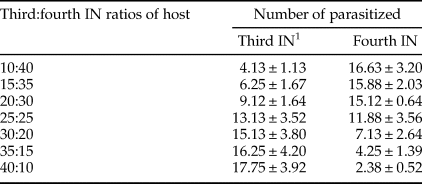
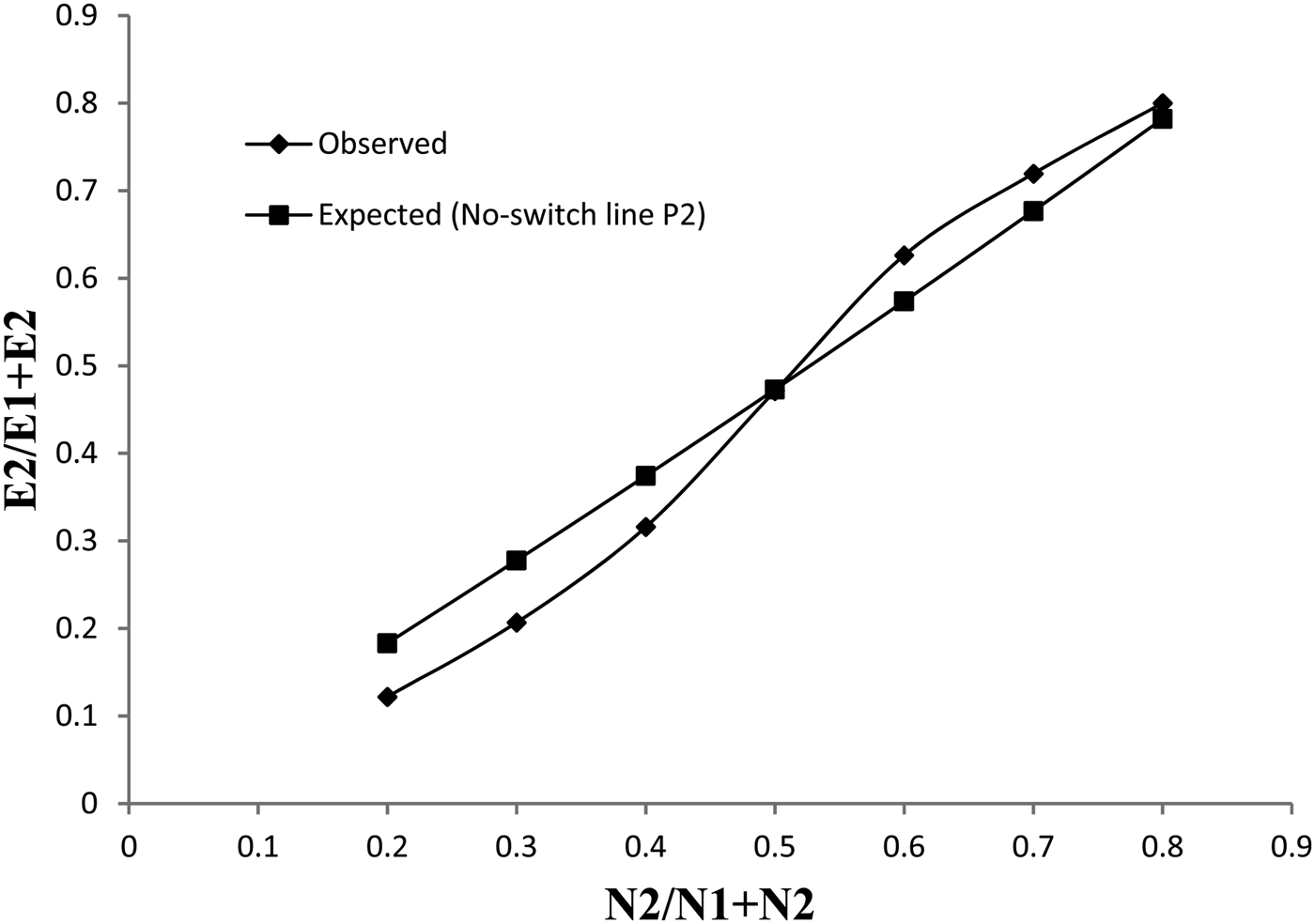
The mean number of M. persicae nicotianae parasitized by A. matricariae at different ratios of third- and fourth-instar nymphs were shown in table 1. When both third- and fourth-instar nymphs were offered in equal numbers, the parasitism rate was higher for third-instar nymphs and preference coefficients (c) for third- and fourth-instar nymphs were calculated as 1.13 ± 0.14 and 0.90 ± 0.12, respectively. These values were used to draw the Murdoch's no-switch line (fig. 2). Preference did not remain constant and it changed directly with increasing host density. For example, at a relative density of third- and fourth-instar nymphs 10:40, respectively, of M. persicae nicotianae, fourth-instar nymphs were significantly preferred compared with third-instar nymphs.
The mean of parasitized Myzus persicae nicotianae by Aphidius matricariae at different ratios of third- and fourth-instar nymphs.

1 IN, instar nymphs.
Switching behavior of Aphidius matricariae to different ratios of third- and fourth-instar nymphs of Myzus persicae nicotianae.

Functional response
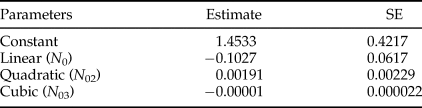
The functional response and parasitism rate curves by A. matricariae on various densities of tobacco aphid are shown in fig. 3. The proportion of aphids parasitized by A. matricariae decreased with increasing host density. Aphidius matricariae showed a type II functional response by logistic regression model at different densities of third-instar nymphs of M. persicae nicotianae (table 2). The estimated values of searching efficiency (a) and handling time (T h) were evaluated as 0.0444 ± 0.00815 h−1 and 0.5068 ± 0.0872 h, respectively. The estimated maximum attack rate (T/T h) was determined to be 47.36 aphids/parasitoid/day.
(a) Type II functional response of Aphidius matricariae and (b) percentage parasitism on different densities of third-instar nymphs of Myzus persicae nicotianae.

Result of logistic regression analysis of the proportion of Myzus persicae nicotianae third-instar nymphs parasitized by Aphidius matricariae to initial host numbers.

Mutual interference
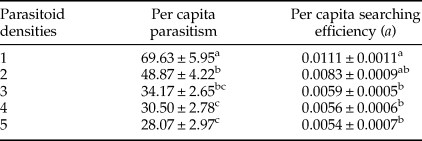
The per capita parasitism rate decreased significantly (F = 20.07; d.f. = 4.39; P < 0.05) from 69.63 to 28.07 with increasing initial parasitoid densities from one to five, respectively. Also, the per capita searching efficiency decreased significantly (F = 9.50; d.f. = 4.39; P < 0.05) from 0.0111 to 0.0054 with increasing parasitoid densities from one to five, respectively. As the parasitoid density increased, per capita searching efficiency decreased. The estimated values of per capita parasitism rate and per capita searching efficiency are shown in table 3. The linear regression between the natural logarithm of per capita searching efficiency and the natural logarithm of parasitoid density has been shown in the follow equation:
 $$\eqalign{& \log \,a\, = -1.957\,-0.477\log \,P \cr & \lpar {R^2 = 0.953} \rpar } $$
Per capita parasitism and per capita searching efficiency (mean ± SE in both) of Aphidius matricariae on Myzus persicae nicotianae.

Values with different letters are significantly (P < 0.05) different (Tukey).
According to the above equation, the interference coefficient (slope of the regression line) was calculated as −0.477. The negative value demonstrates an inverse relationship between parasitoid density and per capita searching efficiency. The regression line of the natural logarithm of different densities of A. matricariae on third-instar nymphs of tobacco aphid and the natural logarithm of per capita searching efficiency is shown in fig. 4.
Regression line in mutual interference of Aphidius matricariae on third-instar nymphs of Myzus persicae nicotianae.

Discussion
Host stage preference
The host stage preference plays a critical role in the biological control programs. Also, in mass rearing of parasitoids, knowing the preferred host stage is important to achieve an optimized production of biocontrol agents (Jervis & Kidd, Reference Jervis and Kidd1996). In this experiment, A. matricariae parasitized all stages of M. persicae nicotianae, which it more preferred third- and fourth-instar nymphs to oviposition. To date, a large number of studies have been conducted on the host stage preference of aphid parasitoids (Rakhshani et al., Reference Rakhshani, Talebi, Kavallieratos and Fathipour2004; Talebi et al., Reference Talebi, Zamani, Fathipour, Baniameri, Kheradmand and Haghani2006; Farhad et al., Reference Farhad, Talebi and Fathipour2011; Stacconi et al., Reference Stacconi, Buffington, Daane, Dalton, Grassi, Kaçar, Miller, Miller, Baser, Ioriatti, Walton, Wiman, Wang and Anfora2015; Yang et al., Reference Yang, Campos-Figueroa, Silva and Henne2015). Our findings are also in agreement with the authors (Rakhshani et al., Reference Rakhshani, Talebi, Kavallieratos and Fathipour2004; Talebi et al., Reference Talebi, Zamani, Fathipour, Baniameri, Kheradmand and Haghani2006; Tazerouni et al., Reference Tazerouni, Talebi and Rakhshani2011) who reported the third- and fourth-instar nymphs of host aphids were the preferred host stages by the aphid parasitoids. By contrast, Praon volucre (Haliday) (Hymenoptera: Braconidae), Aphidius colemani Viereck (Hymenoptera: Braconidae), and Diaeretiella rapae (McIntosh) (Hymenoptera: Braconidae) preferred second-instar nymphs of Sitobion avenae (Fabricius) (Hemiptera: Aphididae), first-instar nymphs of M. persicae, and second-instar nymphs of Schizaphis graminum (Rondani) (Hemiptera: Aphididae), respectively (Perdikis et al., Reference Perdikis, Lykouressis, Garantonakis and Iatrou2004; Farhad et al., Reference Farhad, Talebi and Fathipour2011; Jokar et al., Reference Jokar, Zarabi, Shahrokhi and Rezapanah2012). Tazerouni et al. (Reference Tazerouni, Talebi, Fathipour and Soufbaf2016a, Reference Tazerouni, Talebi, Fathipour and Soufbafb) demonstrated that A. matricariae chose the third-instar nymphs of M. persicae (green peach aphid) as a preferred host stage, but our results showed that not only third-instar nymphs but also fourth-instar nymphs of M. persicae nicotianae were preferred by A. matricariae. One possible explanation for this difference in findings may be that these two forms of M. persicae have different physiological mechanisms to respond the parasitoid (Field et al., Reference Field, Javed, Stribley and Devonshire1994). The previous studies revealed that the first-instar nymph of aphids is not an appropriate host stage for parasitization because the high mortality of the parasitoid has occurred in the first-instar nymphs of aphids considering inadequate food for the successful development of parasitoid offspring. On the other hand, there is the risk of mortality in parasitization of the late host stages regarding the encapsulation of parasitoid progeny (Jervis & Kidd, Reference Jervis and Kidd1996; Tahriri et al., Reference Tahriri, Talebi, Fathipour and Zamani2007). The host stage preference is not rigid and it is affected by various factors such as experimental conditions (exposure time, host densities, etc.), host behavior, and availability of each instar nymph in the field condition (Pasandideh et al., Reference Pasandideh, Talebi, Hajiqanbar and Tazerouni2015; Tazerouni et al., Reference Tazerouni, Talebi, Fathipour and Soufbaf2016b). It is demonstrated that host stage selection can influence considerably the population dynamics of both host and parasitoid. Consequently, the phenomenon can have a drastic effect on the success of biocontrol programs by parasitoids (Stary, Reference Stary1988; Lin & Ives, Reference Lin and Ives2003).
Switching
According to the results, switching behavior was observed in A. matricariae on two stages (third- and fourth-instar nymphs) of M. persicae nicotianae. The preference of the parasitoid in different ratios of host stages was variable and the numbers of parasitized hosts were raised by increasing the proportion of a given host stage density. In other words, A. matricariae switched to abundant host stage (fig. 2). This behavior has been determined in other biological control agents such as Nasonia vitripennis (Walker) (Hymenoptera: Pteromalidae) (Cornell & Pimentel, Reference Cornell and Pimentel1978), Scolothrips longicornis Priesner (Thysanoptera: Thripidae) (Heidarian et al., Reference Heidarian, Fathipour and Kamali2012) and Phytoseius plumifer (Canestrini & Fanzago) (Acari: Phytoseiidae) (Khodayari et al., Reference Khodayari, Fathipour and Sedaratian2016). By contrast, Takalloozadeh et al. (Reference Takalloozadeh, Kamali, Talebi and Fathipour2005) did not find the switching behavior in Lysiphlebus fabarum (Marshall) (Hymenoptera: Aphidiidae), at all different ratios of third- and fourth-instar nymphs of Aphis craccivora Koch (Hemiptera: Aphididae). The switching behavior has often been investigated under laboratory conditions. Murdoch (Reference Murdoch1969) described that the switching behavior occurred when the parasitoid has a weak preference for one of two host species or stages, it has a chance to switch on more abundant species or stages. In switching condition, the relationship between the numbers of parasitized hosts vs. the numbers given will be sigmoid (Murdoch, Reference Murdoch1969; Heidarian et al., Reference Heidarian, Fathipour and Kamali2012; Khodayari et al., Reference Khodayari, Fathipour and Sedaratian2016). In general, the parasitoids do not sustain host populations applying this mechanism.
Functional response
Functional response of A. matricariae on M. persicae nicotianae has not been investigated previously. Aphidius matricariae showed type II functional response on M. persicae nicotianae. According to type II functional response, the rate of parasitization decreases with an increase in host density so that the linear term should be negative (Rogers, Reference Rogers1972; Brown & Rothery, Reference Brown and Rothery1993). Type II functional response is more frequent in different parasitoids (Fathipour et al., Reference Fathipour, Hosseini, Talebi and Moharramipour2006; Poncio et al., Reference Poncio, Montoya, Cancino and Nava2016) and has also been reported for A. matricariae on different host aphid species such as Aphis fabae Scopoli (Hemiptera: Aphididae) (Tahriri et al., Reference Tahriri, Talebi, Fathipour and Zamani2007) and Aphis gossypii Glover (Hemiptera: Aphididae) (Zamani et al., Reference Zamani, Talebi, Fathipour and Baniameri2006). Also, type II functional response has been often determined in other aphid parasitoids such as P. volucre on S. avenae (Farhad et al., Reference Farhad, Talebi and Fathipour2011), D. rapae on Diuraphis noxia (Mordvilko) (Hemiptera: Aphididae) (Tazerouni et al., Reference Tazerouni, Talebi and Rakhshani2011), A. colemani on A. gossypii (Zamani et al., Reference Zamani, Talebi, Fathipour and Baniameri2006), P. volucre on M. persicae (Tazerouni et al., Reference Tazerouni, Talebi, Fathipour and Soufbaf2016b), and L. fabarum on A. craccivora (Takalloozadeh et al., Reference Takalloozadeh, Kamali, Talebi and Fathipour2005). By contrast, type III functional response which is density-dependent was reported for A. matricariae on M. persicae (Hart et al., Reference Hart, De Jonge, Colle, Dicke, van Lenteren and Ramakers1978; Tazerouni et al., Reference Tazerouni, Talebi, Fathipour and Soufbaf2016a, Reference Tazerouni, Talebi, Fathipour and Soufbafb). In addition, it was demonstrated in other parasitoids such as Trioxys pallidus (Haliday) (Hymenoptera: Braconidae), Chromaphis juglandicola (Kaltenbach) (Hemiptera: Aphididae) (Rakhshani et al., Reference Rakhshani, Talebi, Kavallieratos and Fathipour2004), and Diachasmimorpha longicaudata (Ashmead) (Hymenoptera: Braconidae) (Montoya et al., Reference Montoya, Liedo, Benrey, Barrera, Cancino and Aluja2000). Various factors can affect the type of functional response, including different host ages (Pasandideh et al., Reference Pasandideh, Talebi, Hajiqanbar and Tazerouni2015; Tazerouni et al., Reference Tazerouni, Talebi, Fathipour and Soufbaf2016b), temperature (Zamani et al., Reference Zamani, Talebi, Fathipour and Baniameri2006; Farhad et al., Reference Farhad, Talebi and Fathipour2011), host species, host densities, host plant cultivar, exposure time of parasitoid, experimental conditions, size of experiment containers (Jervis & Kidd, Reference Jervis and Kidd1996), and in particular learning (Yazdani & Keller, Reference Yazdani and Keller2016). Moreover, it is possible that the type of functional response can be affected by different geographical race of the parasitoid species (Van Den Bosch et al., Reference Van Den Bosch, Hom, Matteson, Frazer, Messenger and Davis1979).
Two important parameters, the searching efficiency and handling time, were obtained by functional response model. Handling time is the time spent handling the host, parasitizing the host, and also the time spent cleaning and resting. These parameters may vary in different conditions (Van Lenteren & Bakker, Reference Van Lenteren and Bakker1977; Fathipour & Maleknia, Reference Fathipour and Maleknia2016). A shorter handling time and higher searching efficiency in parasitoids mean that higher numbers of hosts can be parasitized in a given time interval (Jervis & Kidd, Reference Jervis and Kidd1996). According to the results, the searching efficiency, handling time, and estimated maximum attack rate of host parasitized by A. matricariae were evaluated as 0.0444 h−1, 0.5068 h, and 47.36 hosts/parasitoid/day, respectively. In contrast to other finding, Tahriri et al. (Reference Tahriri, Talebi, Fathipour and Zamani2007) reported greater handling time of A. matricariae on A. fabae than we estimated. Nevertheless, the parameter was estimated as 0.042 and 0.46 h on A. gossypii and M. persicae by Zamani et al. (Reference Zamani, Talebi, Fathipour and Baniameri2006) and Tazerouni et al. (Reference Tazerouni, Talebi, Fathipour and Soufbaf2016a, Reference Tazerouni, Talebi, Fathipour and Soufbafb), respectively. This discrepancy could be attributed to different host species (especially subspecies), various geographical population of parasitoid, or dissimilar experimental conditions. So, it is clearly showed that A. matricariae is a more effective parasitoid to control M. persicae nicotianae in comparison with A. fabae.
Mutual interference
A strong relationship between parasitoid densities and per capita searching efficiency has been reported in the literature (Fathipour et al., Reference Fathipour, Hosseini, Talebi and Moharramipour2006; Nachman & Skovga, Reference Nachman and Skovga2015; Yang et al., Reference Yang, Campos-Figueroa, Silva and Henne2015; Poncio et al., Reference Poncio, Montoya, Cancino and Nava2016). In the current study, there were inverse relationships between parasitoid density and per capita searching efficiency. In other words, the number of parasitized hosts per parasitoid decreased with an increase in the number of female parasitoids. Contrary to expectations, a multiply in the number of parasitoids to attack host did not result in a multiply in the number of parasitized hosts, leading to mutual interference; indeed, intraspecific competition between the female parasitoids results in more time being spent for host finding (Jervis & Kidd, Reference Jervis and Kidd1996; Fathipour et al., Reference Fathipour, Hosseini, Talebi and Moharramipour2006). Our findings seem to be consistent with data obtained in other parasitoids such as D. rapae on Brevicoryne brassicae (L.) (Hemiptera: Aphididae) (Fathipour et al., Reference Fathipour, Hosseini, Talebi and Moharramipour2006), Tamarixia trozae (Burks) (Hymenoptrea: Eulophidae) on the potato psyllid, Bactericera cockerelli (sule) (Hemiptera: Psyllidae) (Yang et al., Reference Yang, Campos-Figueroa, Silva and Henne2015), and P. volucre on S. avenae (Farhad et al., Reference Farhad, Talebi and Fathipour2011). Tahriri et al. (Reference Tahriri, Talebi, Fathipour and Zamani2007) reported that when 30 third-instar nymphs of A. fabae were exposed to 1, 2, 3, 4, and 5 densities of A. matricariae per capita parasitism, per capita searching efficiency significantly decreased from 7.1 to 2.88 and 0.272 to 0.139, respectively. In our experiment, these values were different than in the mentioned study. An explanation for this might be that there was difference in aphid species and showed that A. matricariae has various degrees of mutual interference behavior on different host aphids. In mass-rearing programs, optimized density of parasitoid is essential to produce high-quality insects with acceptable sex ratio because quality control parameters of parasitoid affect by mutual interference (Hassell, Reference Hassell1971; Rezaei et al., Reference Rezaei, Karimzadeh and Shakarami2014, Reference Rezaei, Karimzadeh and Shakarami2018; Fathipour & Maleknia, Reference Fathipour and Maleknia2016). Therefore, the mutual interference plays an important role in mass propagation and release projects of parasitoids.
Conclusion
Aphidius matricariae has a vast host range (more than 40 aphid species) (Talebi et al., Reference Talebi, Rakhshani, Fathipour, Starý, Tomanović and Rajabi-Mazhar2009). Tobacco aphid, M. persicae nicotianae, is one of the most important hosts for A. matricariae. In particular, the aphid can be effective in mass-rearing procedure of A. matricariae as a host aphid. The results of this research extend our knowledge of one of the most important parasitoid of aphids and reveal a better understanding of the host–parasitoid interactions. Also, the results can be used in mass-rearing and mass release programs of A. matricariae. The parasitoid showed a high potential to control the population of tobacco aphid. Moreover, further field or semi-field experiments are necessary for the management of M. persicae nicotianae.
Acknowledgement
We are grateful to the Department of Entomology, Tarbiat Modares University and Iran National Science Foundation (INSF) for financial support of this study. This experiment was conducted as a part of PhD thesis of the first author (Mehran Rezaei). We cordially thank two anonymous reviewers and the subject editor, Dr Mayam Yazdani (The University of Adelaide) for their critical review and constructive comments, which significantly helped in the improvement of the manuscript.