Introduction
Metazoan reef-builders began to occur in the late Proterozoic (Grotzinger et al., Reference Grotzinger, Watters and Knoll2000) and flourished throughout the Phanerozoic (James and Wood, Reference James and Wood2010). The Cambrian–Ordovician was a transitionary period in terms of reef evolution between the Proterozoic and Phanerozoic, containing various metazoan-microbial reefs that fluctuated throughout the period. Archaeocyaths, now considered as a separate class under phylum Porifera (Rowland, Reference Rowland2001; Debrenne et al., Reference Debrenne, Zhuravlev and Kruse2012), mainly constructed reefs during the early Cambrian (Terreneuvian and Series 2). They required the assistance of microbes to construct reef (Rowland and Shapiro, Reference Rowland and Shapiro2002), although some archaeocyaths could form reef frameworks by themselves (Riding and Zhuravlev, Reference Riding and Zhuravlev1995). After the major decline of archaeocyaths at the end of Cambrian Series 2, it has been generally suggested that microbialites thrived and formed reefs during the Cambrian Series 3–Furongian. This period was considered to be the longest Phanerozoic metazoan “reef gap” (Rowland and Shapiro, Reference Rowland and Shapiro2002; Kiessling, Reference Kiessling2009).
Reef-building metazoans (mainly anthaspidellid sponges with some Calathium, corals, stromatoporoids, bryozoans, and pelmatozoans) generally resurged during the Early Ordovician (Cañas and Carrera, Reference Cañas and Carrera1993; Rowland and Shapiro, Reference Rowland and Shapiro2002; Webby, Reference Webby2002; Kwon et al., Reference Kwon, Lee, Choi and Chough2003; Adachi et al., Reference Adachi, Ezaki, Liu and Cao2009, Reference Adachi, Ezaki and Liu2011; Choh et al., Reference Choh, Hong, Sun, Kwon, Park, Woo, Kwon, Lee and Lee2013; Hong et al., Reference Hong, Choh and Lee2014; Li et al., Reference Li, Li and Kiessling2014). Similar to the archaeocyath-microbial reefs of the early Cambrian, the Early Ordovician reef-building metazoans also required microbes for reef building (Adachi et al., Reference Adachi, Ezaki and Liu2011), although recent studies suggest that some anthaspidellid sponges, Calathium, bryozoans, and pelmatozoans could have formed frameworks by themselves (Adachi et al., Reference Adachi, Ezaki and Liu2011; Li et al., Reference Li, Li and Kiessling2014). The metazoan-microbial reefs were eventually replaced by metazoan-dominated reefs during the Middle–Late Ordovician (Webby, Reference Webby2002).
Recent discoveries of reef-building metazoans shed light on the Cambrian Series 3–Furongian “metazoan reef gap” (Fig. 1) (Hamdi et al., Reference Hamdi, Rozanov and Zhuravlev1995; Mrozek et al., Reference Mrozek, Dattilo, Hicks and Miller2003; Dattilo et al., Reference Dattilo, Hlohowskyj, Ripperdan, Miller and Shapiro2004; Shapiro and Rigby, Reference Shapiro and Rigby2004; Johns et al., Reference Johns, Dattilo and Spincer2007; Kruse and Zhuravlev, Reference Kruse and Zhuravlev2008; Hong et al., Reference Hong, Cho, Choh, Woo and Lee2012; Kruse and Reitner, Reference Kruse and Reitner2014; Lee et al., Reference Lee, Chen, Choh, Lee, Han and Chough2014a). Among them, anthaspidellid sponges, which appeared in the late Cambrian Series 2 (Kruse, Reference Kruse1983, Reference Kruse1996) and diversified greatly during the Early Ordovician (Carrera and Rigby, Reference Carrera and Rigby2004), occupied a major portion among the Cambrian Series 3–Furongian metazoan reef-builders (Fig. 1). In this study, we present a new reef-building anthaspidellid sponge Rankenella zhangxianensis n. sp. from the middle Cambrian Series 3 (late Stage 5–early Guzhangian) deposits of the eastern North China Platform, which is the oldest example of a reef-building anthaspidellid sponge. The material was discovered by Woo (Reference Woo2009), but no detailed paleontological or sedimentological study has been performed yet. This study contributes to an understanding of the recovery of reef-building metazoans after the end-Cambrian Series 2 extinction and diversification of early anthaspidellid sponges within reefs.
Occurrence of reef-building sponges and non-reef-building anthaspidellid sponges during the Cambrian Series 3–Furongian. Light gray lines: non-reef-building anthaspidellid sponges; dark gray lines: metazoan-microbial reefs not constructed by anthaspidellid sponges; black lines: reefs constructed by anthaspidellid sponges. (1) Rankenella mors, Tindall Limestone (Daly Basin) and Thorntonia Limestone (southern Georgina Basin), and Angulocellularia-Taninia-R. mors reef, Ranken Limestone (Undilla Sub-Basin, Georgina Basin), Australia (Kruse, Reference Kruse1983, Reference Kruse1996; Kruse and Reitner, Reference Kruse and Reitner2014). (2) Unidentified anthaspidellid sponge, La Laza Formation (San Juan), Argentina (Beresi and Rigby, Reference Beresi and Rigby1994). (3) Kordephyton-Jawnya gurumal-Wagima galbanyin reef, Tindall Limestone, Daly Basin, Australia (Kruse, Reference Kruse1996; Kruse and Reitner, Reference Kruse and Reitner2014). (4) Orlinocyathus-Epiphyton reef, Dedebulak Formation, Kyrgyzstan (Vologdin, Reference Vologdin1962). (5) Fieldospongia, Burgess Shale Formation, British Columbia, Canada (Rigby, Reference Rigby1986). (6) Capsospongia, Burgess Shale Formation, British Columbia, Canada (Rigby, Reference Rigby1986). (7) Epiphyton-Rankenella zhangxianensis-Cambroctoconus orientalis reef, Zhangxia Formation, Shandong Province, China (Woo, Reference Woo2009; Park et al., Reference Park, Woo, Lee, Lee, Lee, Han, Chough and Choi2011; this study). (8) Siliceous sponge-Epiphyton reef, Daegi Formation, Taebaeksan Basin, Korea (Hong et al., Reference Hong, Cho, Choh, Woo and Lee2012). (9) Rankenella hamdii and R. hamdii-Girvanella reef, Mila Formation, Iran (Hamdi et al., Reference Hamdi, Rozanov and Zhuravlev1995; Kruse and Zhuravlev, Reference Kruse and Zhuravlev2008). (10) Gallatinospongia conica-dendrolite reef, Bonanza King Formation, Nevada and California, USA (Shapiro and Rigby, Reference Shapiro and Rigby2004). (11) Gallatinospongia conica, Gallatin Formation, Wyoming, USA (Okulitch and Bell, Reference Okulitch and Bell1955). (12) Siliceous sponge-microbial reef, Chaomidian Formation, Shandong Province, China (Lee et al., Reference Lee, Chen, Choh, Lee, Han and Chough2014a). (13) Wilbernicyathus donegani-Girvanella-Tarthinia reef, Wilberns Formation, Texas, USA (Johns et al., Reference Johns, Dattilo and Spincer2007). (14) Wilbernicyathus donegani-Girvanella-Tarthinia reef, Dotsero Formation, Colorado, USA (Johns et al., Reference Johns, Dattilo and Spincer2007). (15) Anthaspidellid sponge-microbial reef, Desert Valley Formation, Nevada, USA (Mrozek et al., Reference Mrozek, Dattilo, Hicks and Miller2003; Dattilo et al., Reference Dattilo, Hlohowskyj, Ripperdan, Miller and Shapiro2004).

Geological setting
The North China Platform, an extensive epeiric platform, formed on a stable craton of Sino-Korean Block (Meng et al., Reference Meng, Ge and Tucker1997). The block was located near or at the margin of Gondwana during the early Paleozoic (McKenzie et al., Reference Mckenzie, Hughes, Myrow, Choi and Park2011). Deposition on the North China Platform initiated during the Cambrian Series 2 and lasted until the Middle Ordovician (Meng et al., Reference Meng, Ge and Tucker1997; Kwon et al., Reference Kwon, Chough, Choi and Lee2006). Shandong Province, China, was located in the central part of the platform (Fig. 2). Six lithologic units were identified from the Cambrian succession of Shandong Province: Liguan, Zhushadong, Mantou, Zhangxia, Gushan, and Chaomidian formations in ascending order (Chough et al., Reference Chough, Lee, Woo, Chen, Choi, Lee, Kang, Park and Han2010). The siliciclastic-dominant Liguan Formation (37 m thick) was deposited in the eastern part of Shandong Province, unconformably overlying the Precambrian basement of granitic gneiss and sedimentary rocks. The Liguan Formation laterally and vertically changes into the carbonate-dominant Zhushadong Formation (up to 50 m thick), representing peritidal environments (Lee and Chough, Reference Lee and Chough2011) with a few small microbial reefs containing various calcified microbes (Lee et al., Reference Lee, Lee, Chen, Woo and Chough2014b). Overlying the Zhushadong Formation, the siliciclastic-dominant Mantou Formation (ca. 200 m thick) was deposited in supratidal to subtidal environments dominated by tidal processes (Lee and Chough, Reference Lee and Chough2011).
Geological setting and stratigraphy. (1) Location map of the outcrops. BQZ: Beiquanzi section (36°28'47"N, 116°55'28"E), JLS: Jiulongshan section (36°04'48"N, 117°44'51"E). (2) Detailed sedimentological log of the Zhangxia Formation in Beiquanzi (BQZ) and Jiulongshan (JLS) sections. Samples in this study are from the shaded interval in the basal part of BQZ section. S=Shale, M=Lime mudstone, W=Wackestone, P=Packstone, G=Grainstone, C=Conglomerate, T=Thrombolite, D=Dendrolite, E=Epiphyton framestone.
The Zhangxia Formation is a carbonate-dominated succession (~180 m thick) that formed on top of the Mantou Formation. The formation consists of various carbonate facies including limestone-shale alternation, bioturbated lime mudstone, wackestone, packstone, oolitic/oncolitic/skeletal grainstone, and various microbial reefs including Epiphyton framestone, thrombolites, dendrolites, and stromatolites, deposited on a stable carbonate platform (Woo et al., Reference Woo, Chough and Han2008; Woo, Reference Woo2009; Woo and Chough, Reference Woo and Chough2010; Howell et al., Reference Howell, Woo and Chough2011). It was formed during the Changhian Stage, including trilobite biozones of Lioparia, Crepicephalina, Amphoton-Taizuia, and Damesella-Yabeia, which corresponds to the late Stage 5 to the early Guzhangian of the Cambrian Series 3 (Geyer and Shergold, Reference Geyer and Shergold2000; Chough et al., Reference Chough, Lee, Woo, Chen, Choi, Lee, Kang, Park and Han2010; Peng et al., Reference Peng, Babcock and Cooper2012). The reef-building sponges are generally found within the thrombolites throughout the Zhangxia Formation, but mainly in the basal part (Woo, Reference Woo2009) (Fig. 2.2). Some sponges also occur in dendrolites (Fig. 2.2).
The study materials were collected from the basal part of the Zhangxia Formation (Lioparia Zone), indicating the late Cambrian Stage 5 (Geyer and Shergold, Reference Geyer and Shergold2000; Chough et al., Reference Chough, Lee, Woo, Chen, Choi, Lee, Kang, Park and Han2010) (Fig. 2B). In the Beiquanzi section, where samples were collected, sponges sporadically occur within thrombolites of more than 7 m in height and 30 m in width. Several buildups are stacked vertically and laterally, causing difficulty in differentiating their outlines. The buildups are surrounded by skeletal and oolitic packstone to grainstone with a relatively sharp boundary. Within the buildups, Rankenella zhangxianensis n. sp. was found together with the calcified microbe (cyanobacteria) Epiphyton Bornemann, Reference Bornemann1886 and a stem-group cnidarian Cambroctoconus orientalis Park et al., Reference Park, Woo, Lee, Lee, Lee, Han, Chough and Choi2011 (Fig. 3.1). Rankenella zhangxianensis also occasionally occurs within the inter-reef packstone to grainstone (Fig. 3.2).
Outcrop photographs of Rankenella zhangxianensis in Zhangxia Formation, Beiquanzi section. For location, see Figure 2. (1) Bedding-plane view of Epiphyton-R. zhangxianensis-Cambroctoconus orientalis reef. Coin for scale is 20 mm in diameter. (2) Bedding-parallel view of R. zhangxianensis within the inter-reef grainstone.
Systematic paleontology
Class Demospongia Sollas, Reference Sollas1885
Order Orchocladina Rauff, Reference Rauff1895
Family Anthaspidellidae Miller, Reference Miller1889
Genus Rankenella Kruse, Reference Kruse1983
Type species
Rankenella mors Gatehouse, Reference Gatehouse1968. Late Cambrian Stage 4–early Guzhangian, Ranken Limestone, Tindall Limestone, and Thorntonia Limestone, Australia (cf. Kruse and Reitner, Reference Kruse and Reitner2014).
Other species
Rankenella hamdii Kruse and Zhuravlev, Reference Kruse and Zhuravlev2008. Late Cambrian Series 3 (Guzhangian)–early Furongian (Paibian), Mila Formation, northern Iran.
Diagnosis
“Smooth-walled conicocylindrical, digitate or explanate sponges with deep, cylindrical spongocoels in the former. Skeletal spicule net of regular anthaspidellid type, trabs parallel to gastral surface, and diverging upward toward dermal surface. Differentiated canal systems absent. Some spicular modification in dermal layer” (Kruse, Reference Kruse1983, p. 51; Reference Kruse1996, p. 164).
Remarks
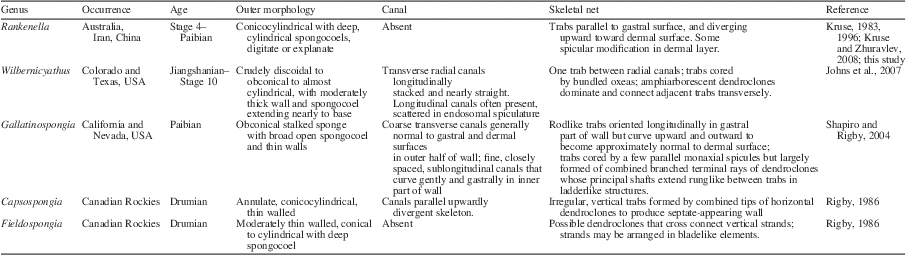
Rankenella represents one of the oldest sponges of the family Anthaspidellidae, which occurs from the late Cambrian Series 2 to the early Furongian. There are two other anthaspidellid genera reported from Cambrian reefs, Wilbernicyathus Wilson, Reference Wilson1950, and Gallatinospongia Okulitch and Bell, Reference Okulitch and Bell1955 (Table 1). Both Wilbernicyathus and Gallatinospongia have canal system, and can be easily differentiated from Rankenella. Two other non-reefal anthaspidellid sponges, Capsospongia Rigby, Reference Rigby1986, and Fieldospongia Rigby, Reference Rigby1986, both from the early–middle Cambrian Series 3 Burgess Shale, are also different from Rankenella (Table 1). Capsospongia, a thin-walled, obconical sponge with vertical trabs, has major canals parallel to the trabs. Fieldospongia lacks an organized canal system, but it has vertically arranged trabs.
Summary of reported Cambrian anthaspidellid sponges
Rankenella zhangxianensis new species
Photomicrographs of Rankenella zhangxianensis in Zhangxia Formation, Beiquanzi section. All photomicrographs are taken from bedding-parallel thin sections. For location, see Figure 2. (1) Holotype NIGPAS159373. Longitudinal section. (2) NIGPAS519388. Two individuals in longitudinal section and five individuals in transverse section. Two Cambroctoconus orientalis (longitudinal and transverse sections; white arrows), characterized by octagonal conical shape, occur with R. zhangxianensis. (3) NIGPAS519385. Oblique section of the largest identified individual. (4) NIGPAS519382. Transverse section of four individuals. (5) NIGPAS519389. Longitudinal section of the wall. (6) NIGPAS519390. Oblique and transverse sections. (7) NIGPAS519391. Transverse section. Note occurrence of microstromatolite within the spongocoel. Scale bars: (1, 3, 4: 10 mm; 2, 5–7: 5 mm).
Photomicrographs of Rankenella zhangxianensis in Zhangxia Formation, Beiquanzi section. All photomicrographs are taken from bedding-parallel thin sections except for (7) and (10). For location, see Figure 2. (1) NIGPAS519384. Transverse and longitudinal sections. Note that one individual is attached to the other. (2) NIGPAS519390. R. zhangxianensis encrusting on Cambroctoconus orientalis (arrow). (3) Holotype NIGPAS159373. Transverse section of the holdfast. For location, see Figure 4.1. (4) Holotype NIGPAS159373. Transverse section. Trabs subparallel to gastral surface (lower left), diverge outward and almost perpendicularly meet dermal surface (upper right). For location, see Figure 4.1. (5) NIGPAS159392. Trabs parallel to gastral surface (upper left) and subvertically meet dermal surface (lower right). (6–8) Tangential views showing longitudinal trabs and dendroclones, forming ladderlike spicule networks. (6) NIGPAS159384. Note occurrence of canal-like structures. For location, see Figure 5.1. (7) NIGPAS159387. (8) NIGPAS159384. For location, see Figure 5.1. (9, 10) Transverse sections showing dendroclones between trabs with some Y-shaped dendroclones. (9) NIGPAS159382. For location, see Figure 4.4. (10) NIGPAS159387. Scale bars: (1) 5 mm, (2) 3 mm, (3–10) 1 mm.
Diagnosis
Trabs parallel/subparallel to gastral surface, diverging outward and almost perpendicularly meet dermal surface. Approximately 7–12 trabs occur between dermal and gastral surfaces. Between trabs, 3–7 ladderlike series of dendroclones occur. Spicular modification in dermal layer absent.
Description
Mostly obconical in shape with deep cylindrical spongocoels (Fig. 4.1, 4.2). Digitate or planar forms absent. Length ranges up to 610 mm (Fig. 4.1). Transverse sections of obconical structure have diameter 3–21 mm, with spongocoels 1–14 mm in diameter, although most are 5–10 mm total diameter and 3–6 mm spongocoel diameter (Figs. 4.1–4.7, 5.1, 5.2, 6). Ratio of spongocoel diameter/total diameter is 17%–69%, and many are 39%–58% (Fig. 6). Wall generally thicker in larger specimens, with higher ratio of spongocoel diameter/total diameter. Several specimens have holdfasts, which have similar spicule arrangements as other parts of body (Figs. 4.2, 5.1–5.3).
Box plots of measured values of some studied specimens (n=53). For raw data, see Supplementary Table 1.
Dermal and gastral surfaces generally smooth. Secondary thickening of skeletal net is absent, except for boundary between holdfast and attached substrate (Fig. 5.3). In longitudinal sections, trabs parallel/subparallel to gastral surface, diverging outward and meet dermal surface perpendicularly or subangularly (Fig. 5.4, 5.5). Thicknesses of trabs ~0.1 mm (Fig. 5.6–5.8). Individual spicules not identified within trab. Trabs linked by 3–7 dendroclones, forming ladderlike series. Dendroclones measured from center of a trab to other center of a trab are ~0.02 mm wide and 0.3–0.35 mm long. A few Y-shaped dendroclones identified (Fig. 5.9, 5.10). Approximately 7–12 trabs occur between dermal and gastral surfaces (14–24 mm thick) (Figs. 4.1, 4.2, 5.4). Differentiated canal systems generally absent, although two specimens contain well-differentiated canals (Fig. 5.6).
Etymology
From Zhangxia Formation, referring to the occurrence of the species.
Type material and repository
All figured specimens are deposited in Nanjing Institute of Geology and Palaeontology (NIGPAS159373–159392). Holotype: NIGPAS159373, Paratypes: NIGPAS159374–159392. All samples are thin sections perpendicular to the bedding except for NIGPAS159387, which is a thin section parallel to the bedding. Late Cambrian Stage 5–early Guzhangian, Zhangxia Formation, Shandong Province, China.
Occurrence
Two outcrops (Beiquanzi and Jiulongshan sections) of the Zhangxia Formation in Shandong Province, China (Fig. 2). Most specimens occur within bioherms, some within surrounding packstone to grainstone.
Remarks
Rankenella zhangxianensis shows structures generally similar to the other two species of Rankenella: the type species, R. mors found in wackestone (late Cambrian Stage 4–early Cambrian Stage 5) and an Angulocellularia-Taninia-Rankenella reef (late Drumian) of Australia (Kruse, Reference Kruse1983, Reference Kruse1996; Kruse and Reitner, Reference Kruse and Reitner2014), and R. hamdii reported from wackestone (late Cambrian Series 3) and a Rankenella-Girvanella reef (early Furongian) of Iran (Hamdi et al., Reference Hamdi, Rozanov and Zhuravlev1995; Kruse and Zhuravlev, Reference Kruse and Zhuravlev2008). Rankenella mors is characterized by diverse shapes including conicocylindrical, digitate or explanate structures, and a relatively thin wall (3 to 5 trabs between dermal and gastral surfaces). On the other hand, R. hamdii has a thicker wall (4 to 10 trabs between dermal and gastral surfaces) and similar overall morphology with that of R. mors, plus notable occurrence of bowl shape. The number of dendroclones that connect two nearby trabs are 3–4 in R. mors and 3–10 in R. hamdii.
Compared to these two other species, R. zhangxianensis is characterized by less diverse shape (mostly obconical/cylindrical) and a thicker wall (7–12 trabs between dermal and gastral surfaces). Spongocoel diameter of R. zhangxianensis generally overlaps with that of R. mors (~13 mm) and R. hamdii (~11 mm in digitate shape; ~31 mm in bowl shape), although some specimens exceed these range (~21 mm in obconical shape). The number of dendroclones connecting each trab of R. zhangxianensis overlaps with the other species (3–7), although the number is generally larger than in R. mors and smaller than in R. hamdii. Secondary thickening of the spicule net adjacent to the dermal surface, which notably occurs in the other two species, is generally absent in R. zhangxianensis. On the other hand, angles between dermal surfaces and trabs intersecting the surfaces are also different; the angles are up to 90° in R. zhangxianensis (Fig. 5.4, 5.5), which is notably larger than ~60° in the other species. All these features collectively indicate that R. zhangxianensis is a new species that can be separated from R. mors and R. hamdii.
Minor occurrence of canals within R. zhangxianensis is noteworthy, because both Australian and Iranian species lack differentiated canals. The occurrence of canals within R. zhangxianensis suggests that the species may not belong to Rankenella because the genus has been characterized by absence of differentiated canal systems (Kruse, Reference Kruse1983, Reference Kruse1996). Rankenella zhangxianensis may be similar to young individuals of Gallatinospongia, which only develop distinct canals during the final stage of growth (R.S. Shapiro, personal communication, 2014). However, the absence of canals in the largest specimen of R. zhangxianensis (Fig. 4.3) and rare occurrence of canals within the species indicate that differentiated canal systems are most likely features that seldom developed in the species. Therefore, R. zhangxianensis is closer to Rankenella than to other genera, although the species may represent a transitional form between Rankenella and other Furongian genera with canals (Gallatinospongia and Wilbernicyathus). It is necessary to have more examples of Cambrian anthaspidellids in order to determine their evolutionary history.
Rankenella zhangxianensis and its implication to other early Paleozoic sponge-microbial reefs
Preliminary sedimentological results suggest that Rankenella zhangxianensis is the oldest known anthaspidellid sponge that constructed reefs. Although many specimens only show a transverse section, some specimens with a longitudinal section suggest that R. zhangxianensis encrusted on microbialite, Cambroctoconus orientalis, or other individuals of R. zhangxianensis (Figs. 4.1, 4.2, 5.1, 5.2). Both R. zhangxianensis and C. orientalis are commonly covered by microstromatolites, and interstitial spaces between these organisms are occupied by micrite (Figs. 4.2, 5.1). Epiphyton comprises a significant volume of the reef, mainly growing upward. These data collectively suggest that Epiphyton, R. zhangxianensis, and C. orientalis were framework builders, in which R. zhangxianensis and C. orientalis were encrusted and stabilized by microstromatolites. The Epiphyton-Rankenella-Cambroctoconus reefs most likely grew within a shallow subtidal environment, where ooid shoals formed (Woo, Reference Woo2009). Some reef-building organisms would have been reworked and deposited within reef-flank sediments (Fig. 3.2).
The other examples of Cambrian reef-building anthaspidellid sponges include R. mors (late Drumian, Australia) (Kruse and Reitner, Reference Kruse and Reitner2014), R. hamdii (early Paibian, Iran) (Hamdi et al., Reference Hamdi, Rozanov and Zhuravlev1995; Kruse and Zhuravlev, Reference Kruse and Zhuravlev2008), Gallatinospongia conica Okulitch and Bell, Reference Okulitch and Bell1955 (early Paibian, Nevada and California, USA) (Shapiro and Rigby, Reference Shapiro and Rigby2004), Wilbernicyathus donegani Wilson, Reference Wilson1950 (Jiangshanian–Stage 10, Texas and Colorado, USA) (Johns et al., Reference Johns, Dattilo and Spincer2007), and an unidentified anthaspidellid sponge (Jiangshanian–Stage 10, Nevada, USA) (Mrozek et al., Reference Mrozek, Dattilo, Hicks and Miller2003; Dattilo et al., Reference Dattilo, Hlohowskyj, Ripperdan, Miller and Shapiro2004) (Fig. 1). Among these examples, reefs containing R. mors may be comparable to those of this study in terms of their age. Although the age of the Australian reef is only poorly constrained (late Drumian; Kruse and Reitner, Reference Kruse and Reitner2014), the relatively large difference in time suggests that R. zhangxianensis (late Stage 5–early Guzhangian) is the oldest reef-building anthaspidellid sponge ever reported.
There are also some reports of reef-building non-anthaspidellid sponges during the Cambrian Series 3–Furongian. The heteractinide sponge Jawonya gurumal Kruse, Reference Kruse1987, and Wagima galbanyin Kruse, Reference Kruse1987 (late Cambrian Stage 4–early Cambrian Stage 5) occur within Kordephyton-dominant reefs as dwellers (Kruse, Reference Kruse1996; Kruse and Reitner, Reference Kruse and Reitner2014). Orlinocyathus Krasnopeeva in Vologdin, Reference Vologdin1962, which is classified in family Streptosolenidae (Finks et al., Reference Finks, Read and Rigby2004) and thought to be a junior synonym of Gallatinospongia (Finks et al., Reference Finks, Read and Rigby2004) or Rankenella (Kruse and Zhuravlev, Reference Kruse and Zhuravlev2008), formed reefs with Epiphyton in the early middle Cambrian succession of Kyrgyzstan, but it has not been studied in detail (cf. Teslenko et al., 1983). Two other reefs consisting of siliceous sponges of unknown affinity and microbes have been reported, from the Cambrian Series 3 (Drumian) of the Daegi Formation, Taebaeksan Basin, Korea (Hong et al., Reference Hong, Cho, Choh, Woo and Lee2012), and the Furongian (Jiangshanian) of the Chaomidian Formation, Shandong Province, China (Lee et al., Reference Lee, Chen, Choh, Lee, Han and Chough2014a). Both siliceous sponges are unidentifiable from outcrops and only identifiable under the microscope, causing problems for identification. The characteristics of spicules and spicule networks of these sponges, however, suggest that both examples most likely belong to class Demospongia (Rigby, Reference Rigby1983; Hooper and Van Soest, Reference Hooper and Van Soest2002; Pisera, Reference Pisera2002). On the other hand, some of the sponges in the Daegi Formation (an eastward extension of the Zhangxia Formation) showing rectangular pattern spicules (Hong et al., Reference Hong, Cho, Choh, Woo and Lee2012) may belong to the family Anthaspidellidae.
The occurrence of metazoan-microbial reefs in the Cambrian Series 3 together with other occurrences in the Furongian indicates that the metazoan reef gap after the decline of archaeocyaths could have been shorter than previously suggested (e.g., Hong et al., Reference Hong, Cho, Choh, Woo and Lee2012; Kruse and Reitner, Reference Kruse and Reitner2014; Lee et al., Reference Lee, Chen, Choh, Lee, Han and Chough2014a). Further studies on the Cambrian Series 3–Furongian reefs may improve our understanding of the geological events during these periods.
Acknowledgments
Comments by P.D. Kruse and R.S. Shapiro greatly improved the quality of the present paper. We thank R.J. Elias for carefully correcting the English, M. Carrera and A. Pisera for proofreading the earlier version of the manuscript, and H.-J. Park for preparing thin sections. This study was supported by the KOPRI fund (PM15030 funded by the MOF, Korea) to J.W. and by the Korea Research Foundation grants funded by the Korean Government (MOEHRD) (KRF-NRF-2013R1A2A2A01067612) to D.-J.L.
Accessibility of supplemental data
Supplemental data deposited in Dryad data package: http://dx.doi.org/10.5061/dryad.f4168