The point of departure for this study is the recent work of Burden (Reference Burden2008) on the “gender gap” in partisanship in the United States.Footnote 1 He shows that the preponderance of Democratic identification among women is partly a function of the measurement of party identification. When respondents were asked “Do you feel that you are” rather than, more traditionally, “Do you think of yourself as” a Democrat or Republican, the sex gap narrowed to statistical nonsignificance. Burden's explanation for this result lies in the psychology of partisanship. The traditional “think of yourself as” (or cognitive) question primes women to consider their partisanship as a social identity, which in turn activates the stereotypical association between women and the Democratic Party. The “feel that you are” (or affective) question encourages a deeper, more personalized response, rendering social identity less relevant and thereby nullifying the effect of that stereotype.
A principal purpose of this article is to assess whether there is a parallel wording interaction effect by sex on partisanship in Britain, and specifically on partisanship measured in the new, less directive style (Sanders, Burton, and Kneeshaw Reference Sanders, Burton and Kneeshaw2002). More broadly, we test Burden's assumptions about the psychology underlying that measurement effect, and examine whether the observed effect of question wording can be explained by sex differences in the affective and cognitive bases of partisanship.
We open with a brief review of the psychology of party identification, making specific reference to potential sex differences. The focus then sharpens on Burden's (Reference Burden2008) findings, assessing his own and alternative interpretations of those results, and outlining the methodological requirements of a study that can test these rival theories. Next, we consider the relevance of these discussions in the British context, both in terms of sex and party politics and in terms of the revised measure of partisanship used increasingly in British surveys. The empirical work is divided into two sections: First, we report on a replication of Burden's survey experiment with British voters; second, we estimate sex differences in the affective and cognitive dimensions of partisanship. Our results point to Norris's (Reference Norris, Denver, Norris, Broughton and Rallings1993; Reference Norris, Evans and Norris1999) “gender-generation gap,” with the effect of question wording differing according to the age as well as the sex of the voters. Yet we find no evidence that these effects are due to differences by age or sex in the internal psychology of partisan attachments. In the concluding section, we explore some alternative explanations.
SEX AND THE PSYCHOLOGY OF PARTY IDENTIFICATION
Considering its centrality in our understanding of electoral democracy, partisanship is a drastically undertheorized concept, and only recently has it come under serious scrutiny as a psychological phenomenon (see Greene Reference Greene2002 and Weisberg and Greene Reference Weisberg, Greene, Mackuen and Rabinowitz2003 for reviews). There are currently two main strands of research in the political psychology of partisanship, conceptualizing it as an attitude and as an identity, respectively. Both imply potential sex differences.
As Burden says: “Like all attitudes, party identification is a combination of affect and cognition” (Reference Burden2008, 60; see also Burden and Klofstad Reference Burden and Klofstad2005; Greene Reference Greene2002). Early accounts, set out most famously in The American Voter, emphasized the emotional dimension: party identification was defined as “the individual's affective orientation to an important group-object in his environment” (Campbell et al. Reference Campbell and Converse1960, 121). In reaction, more cognitively focused accounts of partisanship have been proffered by, among others, Key (Reference Key1966), Fiorina (Reference Fiorina1977), and Lodge and Hamill (Reference Lodge and Hamill1986). More recent syntheses have acknowledged two points: First, party identification can have both affective and cognitive elements; second, the relative weight or importance of those elements can vary across individuals and across contexts (Burden and Klofstad Reference Burden and Klofstad2005 and Green, Palmquist, and Schickler Reference Green, Palmquist and Schickler2002; see also Chaiken, Pomerantz, and Giner-Sorolla Reference Chaiken, Pomerantz, Giner-Sorolla, Krosnick and Petty1995).
One potential source of such variation is an individual's sex. Social psychologists have found that women are, in general, more likely than men to have emotion-laden attitudes, to be conscious of this affective content, and to be able to distinguish it from cognitive content (Grossman and Wood Reference Grossman and Wood1993; Robinson and Clore Reference Robinson and Clore2002).Footnote 2 The consensus is that these differences inhere in gendered socialization patterns (Brody Reference Brody and Fischer2000), which, Sapiro (Reference Sapiro1983) suggests, also lead men to prioritize rationality and objectivity. Burden summarizes that “the degree to which an attitude is affective or cognitive often depends on the sex of the person holding the attitude” (Reference Burden2005, 6). At the same time, men tend to be more interested in, attentive to, and knowledgeable about politics (Bennett and Bennett Reference Bennett and Bennett1989; Burns, Schlozman, and Verba, Reference Burns, Schlozman and Verba2001; Conway, Steuernagel, and Ahern Reference Conway, Steuernagel and Ahern1997; Delli Carpini and Keeter Reference Delli Carpini, Keeter, Tolleson-Rinehart and Josephson2000; Frazer and MacDonald Reference Frazer and MacDonald2003), which leads Greene and Elder to suggest that their political attitudes are more likely to be cognitively driven (2001, 71; see also Edwards Reference Edwards1990), a suggestion for which they find some (but statistically insignificant) support.Footnote 3
These potential sex differences could be important, since affective and cognitive identifications are liable to vary in numerous significant respects (see Millar and Tesser Reference Millar and Tesser1986). In the political realm, Abelson and his colleagues (Reference Abelson, Kinder, Peters and Fiske1982), Marcus (Reference Marcus1988), and Kinder (Reference Kinder, Shank and Langer1994) have all shown that affect and cognition vary in their impact on candidate evaluation. Studies of affective and cognitive partisanship have been rarer, but it seems clear that affective partisanship is more stable (Greene Reference Greene1999), not surprisingly given that more dynamic understandings of partisanship hinge on cognitive processing (Erikson, MacKuen, and Stimson Reference Erikson, MacKuen and Stimson2002; Fiorina Reference Fiorina1977; Franklin and Jackson Reference Franklin and Jackson1983; Popkin Reference Popkin1991).
Although Campbell and his colleagues (1960) use the term “affective,” arguably the key to their understanding of partisanship lies in the ensuing words: “orientation to an important group-object.” They thus expressed—and, according to Greene (Reference Greene2002, 174), measured—the idea in the terminology of reference-group theory, the central assumption of which is that “individual perceptions, evaluations, and behavior are determined in large part by the standard and values of the groups with which the person identifies” (Belknap and Campbell Reference Belknap and Campbell1952, 601). A broadened and updated version of reference-group theory, social identity theory (see Brewer Reference Brewer2001; Tajfel Reference Tajfel1981), carries the same basic implications for partisanship, namely, that it is about perceiving a given party as “your own,” that is, as a group to which you belong.Footnote 4 This version of partisanship has been explored most thoroughly by Greene (Reference Greene1999; Reference Greene2004) and Green, Palmquist, and Schickler (Reference Green, Palmquist and Schickler2002) in the United States, and by Kelly (Reference Kelly1988; Reference Kelly1989) and Abrams (Reference Abrams1994) in the British context. As Weisberg and Greene (Reference Weisberg, Greene, Mackuen and Rabinowitz2003, 93) note, however, there has as yet been very little empirical investigation of either the antecedents or consequences of partisan social identification.
Again, one such plausible antecedent of partisan social identification is gendered socialization and gendered norms. At a basic level of sense of self, women have been argued to be more other-regarding than men (Belenky et al. Reference Belenky, Clinchy, Goldberger and Tarule1986; Chodorow Reference Chodorow1978; Gilligan Reference Gilligan1982; Winters and Campbell Reference Winters and Campbell2007). Women are more open to social influence (Eagly Reference Eagly1983), a tendency that extends to politics, according to Atkeson and Rapoport, who attribute it to “a culture that sees politics as a man's world and keeps women's political self-esteem low” (Reference Atkeson and Rapoport2003, 500). Turning to specifically political behavior, there is some evidence that American women weigh sociotropic judgment more heavily in voting decisions than do men (Chaney, Alvarez, and Nagler Reference Chaney, Alvarez and Nagler1998 and Welch and Hibbing Reference Welch and Hibbing1992, although, for more recent evidence to the contrary, see Kam Reference Kam2009). And, in the United States at least (but not in the United Kingdom—as you will see in Table 2), women are more likely to report a partisan identification (Burden and Greene Reference Burden and Greene2000; Norrander Reference Norrander1997). All these arguments provide indirect support for the notion that a social identity account of partisanship is likely to be more accurate for women. Greene and Elder (Reference Greene and Elder2001) provide some direct support: Having measured respondents' social identifications with their preferred party, they found that these identifications were strong and significant predictors of overall partisan evaluations for women, but not for men.
MEN, WOMEN, PSYCHOLOGY, AND THE MEASUREMENT OF IDENTIFICATION
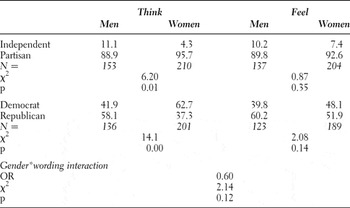
We now turn to whether the potential sex differences identified previously are realized in practice. An obvious starting point is the startling sex/wording interaction effect observed by Burden (Reference Burden2008), and repeated here in Table 1.
Sex, question wording, and party identification in Burden's experiment

Source: Burden, Reference Burden2008, Table 2.
At the outset, we noted the key finding: A clear and significant partisan gap between men and women observed with the conventional cognitive question closes to nonsignificance when respondents are asked a question prompting affect. Some further points are worth making here. First, as the results in the upper panel show, that finding holds also for the proportion of independents: Women were significantly less likely to be independent on the cognitive question, but not on the affective version. Second, question wording exerts a significant influence only over female respondents: Whether considering the proportion of independents versus partisans or the proportion of Democrats versus Republicans, the results for men are roughly the same across the two conditions. Third, the question wording effect among women is startlingly large, not because such wording effects are unusual in survey research (see Schuman and Presser Reference Schuman and Presser1981) but because partisanship, given its supposed centrality to voters' political outlook and its accessibility as an attitude (Bassili Reference Bassili1995; Rahn Reference Rahn1993), might be thought to be particularly robust against such effects. This third point, therefore, reinforces the arguments made by Zaller (Reference Zaller1992), Tourangeau, Rips, and Rasinski (Reference Tourangeau, Rips and Rasinski2000, chaps. 6–7) and Schwarz and Böhner (Reference Schwarz, Böhner, Tesser and Schwarz2002); even the most accessible, salient, and crystallized attitudes are subject to wording effects where the altered wording primes different considerations about, or a different aspect of, the attitude in question. The final point is methodological, and is important to note for the purposes of comparison with our own analyses later in this article. Even though the sex/wording interaction is very clear in terms of the percentage tables, and yields an odds ratio that is some distance from 1, it is not statistically significant.Footnote 5 Clearly, a substantial sample is required if interactions, even those of considerable magnitude and substantive importance, are to pass significance tests. (A power analysis revealed that Burden's sample of partisans would have needed to be around 50% larger, at N = 983, rather than N = 649, in order for the interaction term to be significant at the P < 0.05 level.)
Burden applies those arguments about priming in attitude measurement in three stages. He first asserts that the conventional “think of yourself” question primes social stereotypes, encouraging respondents to “think about what their identifications ‘ought’ to be” (Reference Burden2005, 12), rather than to draw on deeply rooted personal feelings about the parties (see also Burden and Klofstad Reference Burden and Klofstad2005, 873–74).Footnote 6 Second, the media have familiarized voters with the notion that there is a gender gap in U.S. politics, with women (now) clearly more Democratic than men (for a variety of hypothesized reasons—value differences, more left-wing attitudes, different socioeconomic locations, and so on—see Mueller Reference Mueller1988 and Chaney, Alvarez, and Nagler Reference Chaney, Alvarez and Nagler1998 for summaries). Third, despite the fact that the gap is owed principally to a move by men away from the Democrats (Kauffmann and Petrocik Reference Kaufmann and Petrocik1999), it is almost invariably presented as women who are more Democratic (Burden Reference Burden2008, 58–60). This reflects a common media tendency to present women as a homogenous and deviant group, whose behavior is in need of special explanation (Miller, Taylor, and Buck Reference Miller, Taylor and Buck1991).Footnote 7 In other words, the stereotypes generated by coverage of the gap are strongly asymmetric. This can explain why the question wording had little effect on male respondents; there is no clear social stereotyping of them as either Republicans or Democrats.
This chain of argument is notable not only because it provides a compelling explanation for Burden's empirical findings but also because that explanation does not, in itself, presuppose any sex differences in the nature of party identification. Women and men react differently to the “think” question, not necessarily because they differ in the relative weight of cognition in their partisanship, or in the degree to which they seek identification with social groups like parties, or in the propensity to interpret that question in terms of social identity. The gap exists because gendered politics are presented to voters in a way that associates women with the Democrats without providing a similarly clear and accessible partisan stereotype about men. The switch to an affective measure influences only women's responses, not necessarily because they react differently to affective measures but because it deactivates a stereotype that was influencing only women. In other words, the explanation for Burden's results lies not in the internal psychology of partisanship but in the external context.Footnote 8
Our point is not that there are or are not such sex or gender differences in the internal psychology of partisanship, but simply that the case is not proven by Burden's results. Moreover, setting aside sex and gender for a moment, we lack direct validating evidence even that the feel and think questions elicited reports of a psychologically different kind of partisanship. In sum, the simple cross-tabulation in Table 1 shows a clear interaction effect of sex and wording on reported party identification, but constitutes only circumstantial evidence about the psychological processes that generate this effect—as Burden himself readily acknowledges (2008, 70).
These discussions carry two important implications for future research. First, we need to heed the context in which sexed and gendered partisan stereotypes are formed, and in which partisanship is measured. Second, the survey experiment reported by Burden needs to be replicated and accompanied by more direct measurements of the psychological basis of partisanship.
SEX AND PARTISANSHIP IN BRITAIN
The first question to address is whether sex and partisanship are costereotyped in the same (and asymmetric) way in Britain. There are reasons to suppose so. Historically (since records began in 1945), women voters have traditionally favored the Conservative Party with a sex gapFootnote 9 ranging from as large as 17 percentage points (in 1951 and 1955) to as small as 1% (1987 and 2001), finally reversing with more women than men voting for Labour in 2005. Since the 1997 election, in which women were directly targeted by the Labour Party, British media have employed the term “Worcester woman” to represent “a traditional female Tory voter from so-called middle England, who was won over by Tony Blair's New Labour in the 90s”Footnote 10 Her male counterpart, the suburban Middle England swing voter dubbed “Mondeo man,” receives far less attention.Footnote 11 Yet while less explicitly targeted in advance, the affluent working-class “Essex man” was also highlighted as a key factor in the Conservatives' election success in 1992 (Heath, Jowell, and Curtice Reference Heath, Jowell and Curtice2001, 128–32). These archetypes may have helped to forge a stereotypical association between the parties. Notably, though, they have emerged only in the past 20 years or so, by which time the partisan gender gap was an established phenomenon in U.S. politics and academic studies.
Meanwhile, the proportion of female parliamentarians is markedly higher for Labour than for the Conservatives, not least because the former party has shown greater (and well-publicized) willingness to use positive discrimination to that end (Campbell and Lovenduski Reference Campbell, Lovenduski, Norris and Wlezien2005). Moreover, parts of Labour's campaigning are more openly directed at women, and academic analysis of the 2005 manifestos confirms that the party pledged more for women (Childs Reference Childs, Geddes and Tonge2005). British Election Studies (BES) respondents in 2001 and 2005 were asked how well the two major parties looked after the interests of women, and in both years the Labour Party was viewed more positively in that respect, though not by a huge amount (and the gap was narrower among female respondents, who perhaps, not surprisingly, also tended to rate each party lower).Footnote 12 Last but most importantly, the U.S. and British contexts share in common the asymmetry in the treatment of an individual's biological sex and politics. Parties are assessed in terms of what they will do for, how they are regarded by, and how they should appeal to women (whereas no mention is made of the attitudes or behavior of male voters) (Campbell and Lovenduski Reference Campbell, Lovenduski, Norris and Wlezien2005, 191–92). This increases the likelihood that female voters as a group take on stereotypical, gendered associations, in this case presumably with Labour. All in all, there is reason at least to consider the possibility that a parallel sexed and/or gendered partisan stereotyping effect—and, in turn, sex/wording interaction effect—operates in Britain.
On the other hand, compared with the United States, the notion of a gender gap is much less prominent in media treatment of UK politics. There are three key reasons for this. The first is simply the lower salience of a voter's sex in British (party) politics. Campbell (Reference Campbell2006) offers a number of potential explanations, including the traditional dominance of the class cleavage in Britain, the lower salience of key gendered issues—especially those, like abortion, entangled with religion—and the role of the welfare state in at least improving women's relative socioeconomic position.
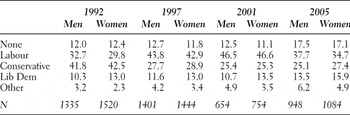
The second reason, following directly from these arguments, is that the gender gap in voting is much narrower (Campbell Reference Campbell2006, chap. 5). The same can be said of partisanship judging by Table 2, which reports responses by gender to the “traditional” party identification question (set out in full in the Appendix) from the past four British Election Studies. Insofar as there is a sex gap in partisanship, it is in the opposite direction from that implied by the earlier costereotyping arguments: Men are slightly more likely to identify with Labour and women slightly more Conservative.Footnote 13 Yet the two-party difference is significant (at the p < 0.05 level) only in 1992 and 2005.Footnote 14 And the differences are much smaller than in the United States.
Sex and party identification in Britain, 1992–2005

Sources: British Election Studies 1992–2005.
The third reason is that the direction of the sex gap has been inconsistent over time. Evidence suggests that British women voters have shifted from being disproportionately Conservative to being disproportionately Labour (Campbell Reference Campbell2004; Norris Reference Norris, Evans and Norris1999). This is due largely to generational replacement, with the shift to Labour confined to those born after 1945. In other words, the narrow (and often nonsignificant) overall gap in partisanship may conceal two opposing sex gaps that cancel each other. This “gender-generation” thesis raises the possibility that the impact of question wording also differs according to age. Younger voters, socialized politically at a time when Labour was becoming established as the party for women, are more likely to think of themselves as Labour, while not necessarily feeling as such. Among those from older generations, less inclined to associate party with sex (or even to consider politics within a gendered framework), that effect seems unlikely, and if anything the reverse may be true, with older women more likely to think of themselves as Conservative. These are somewhat speculative arguments, but again, there is at least reason to check whether age moderates any relationship between an individual's sex and the effect of question wording. In summary, any stereotypical association between women and the more progressive party is certainly a newer phenomenon in Britain than in the United States, and seems likely also to be a less pronounced effect.
Finally, we should note a different reason, unconnected to sex or gender, to expect a smaller wording effect in Britain. Burden and Klofstad (Reference Burden and Klofstad2005, 874) suggest that those most affected by the difference between “think” and “feel” will be those with ambiguous attitudes with respect to the parties. The fact that so few respondents in the Unites States—8% in Burden's think condition, similar to the proportions recorded in recent National Election Studies—are designated as pure independents tends to suggest that many of those classified as “leaners” will be reporting just the type of weaker partisan attitudes that are susceptible to wording effects. Meanwhile, in the UK, even with just the same “traditional” Michigan question structure, the number of nonpartisans is markedly higher, between 15% and 20% in recent surveys (Clarke et al. Reference Clarke, Sanders, Stewart and Whiteley2004, chap. 6). In any case, surveys of electoral behavior in Britain increasingly employ an alternative question—also known as the “party supporter” question—which inquires whether, rather than presuming that, respondents identify with a party, and which, unsurprisingly, elicits much higher levels of nonidentification (Bartle Reference Bartle2001; Blais et al. Reference Blais, Gidengil, Nadeau and Nevitte2001; Sanders, Burton, and Kneeshaw Reference Sanders, Burton and Kneeshaw2002). Such a question, by permitting those unsure of their partisan leanings to deny any such attitude, might be thought to constrain the potential for a wording effect on partisanship.
It also renders the study a cleaner measure of the nature of partisanship, because all respondents will have actively pronounced themselves party identifiers. This contrasts with, for example, the study of men and women and the psychology of party identification reported by Greene and Elder (Reference Greene and Elder2001). Their findings were based on a measure of partisanship inferred from rating scales, rather than asked directly of respondents, and therefore tell us more about the nature of evaluations of parties than the nature of partisanship.
QUESTIONS AND DATA
To give structure to the results sections, we find that it is worthwhile to set out specific research questions that the data analyses are designed to address. Since, apart from the replication of Burden's experiment, this study is somewhat exploratory in nature, we specify open-ended questions rather than precise hypotheses for testing. The five empirical questions are as follows:
Q1. Does affective question wording moderate the relationship between men and women and the proportion of identifiers?
Q2. Does affective question wording moderate the relationship between men and women and the partisan distribution of identifiers?
Q3. Is there evidence that these wording effects differ by age?
Q4. Does question wording influence the nature of partisanship reported?
Q5. Are there sex differences in the nature of partisanship?
The data used to address these questions come from an Internet survey conducted by YouGov from May 29 to June 2, 2008.Footnote 15 YouGov has an impressive track record of sampling and weighting to achieve representative samples of the British electorate—as measured by their accuracy in predicting election results. Moreover, in a mode experiment fielded as part of the 2005 BES, Sanders and his colleagues (2007) showed that the covariance structures—and hence the conclusions about party choice and turnout – generated from a YouGov internet sample were not significantly different from those generated from a traditional face-to-face sample. In total, 2,461 respondents completed the questionnaire, for a response rate of 64% (the denominator here being the number of panel members asked to take part in this particular survey). The results presented here are based on data weighted to make the sample representative of the British adult population.Footnote 16 So, like Burden's (Reference Burden2008) study, this experiment moves beyond the student samples to which such research is often confined.
Party choice is not the only dimension of political representativeness, however, and there is consistent evidence that self-selecting approaches like the YouGov panel generate samples unduly high on political interest (e.g., Malhotra and Krosnick Reference Malhotra and Krosnick2007; Sanders et al. Reference Sanders, Clarke, Stewart, and Whiteley2007). Although we do not have a direct measure of interest in this study, we can reasonably assume that the same is true of our sample. The consequences are unclear. It has generally been supposed that question wording will have more impact on those with less accessible and less crystallized attitudes (Krosnick and Schuman Reference Krosnick and Schuman1988; Zaller Reference Zaller1992); that is, on the less politically aware, a group that is probably underrepresented in a self-selected YouGov sample. On the other hand, in Burden's own experiment (Reference Burden2005, 23–25), question wording wielded the strongest influence over those scoring higher on political awareness, measured by education, newspaper readership, and interest in politics. This supports his argument that the wording effect is driven by social stereotypes, of which the politically sophisticated are more likely to be aware. In the light of these conflicting expectations (see Herrmann, Tetlock, and Visser Reference Herrmann, Tetlock and Visser1999, 556), we can only note both the likelihood that the sample is unusually politically aware and the ambiguities this implies.
The cornerstone of the study is the same survey experiment as reported by Burden (Reference Burden2008): The party identification question was varied such that a random half of the sample was asked a “feel” version (the affective condition) while the other half was asked the more customary “think” version (the cognitive condition).Footnote 17 As noted earlier, since it is important for present purposes to ensure that what is measured is genuine partisanship—as opposed simply to support for a party—we use the alternative rather than the traditional BES formulation. The question wordings are in the Appendix. Most of the (relatively few) other measures are taken verbatim from recent BES questionnaires. This study does, however, include some new measures—of the affective and cognitive dimensions of partisanship—that warrant further discussion.
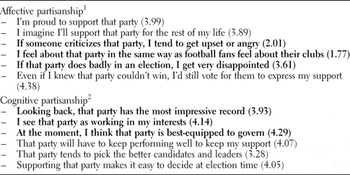
Partisanship has been not only undertheorized but also undermeasured. As Greene (Reference Greene2002, 171–72) notes, the Michigan branching measure has been virtually ubiquitous for a long time. Few studies have included multiple-item measures of party identification, and still fewer have used these to delineate the affective and cognitive dimensions of partisanship. The most notable exception so far is Greene's own (1999, 2002) work, in which he used the semantic differentials designed by Crites, Fabrigar, and Petty (Reference Crites, Fabrigar and Petty1994) in order to gauge affective and cognitive reactions to any given attitude object. For this study, we piloted some alternative—and more party-specific—measures. These were Likert-style items, to be given only to respondents who had already reported a partisan attachment, and designed to tap a range of both cognitive and affective aspects of that loyalty.Footnote 18 The items tested are listed in Table 3. The table also includes the mean score on each item, on a scale from 0 (“very untrue”) to 6 (“very true”). And the items in bold type are those that formed internally consistent and valid three-item scales, basic details of which are reported at the bottom of each pool of items.
Items comprising the measures of affective and cognitive partisanship

Notes: 13-item scale: mean = 2.46; mean interitem correlation = 0.50; alpha = 0.75; 23-item scale: mean = 4.12; mean interitem correlation = 0.59; alpha = 0.81.
Both of the three-item scales perform well in terms of internal consistency, with healthy mean interitem correlations. The reason why we selected just three from each pool of six items is that, given the focus of this study, it was essential to delineate the cognitive and affective dimensions. Factor analysis, although it revealed a fairly clear affective-cognitive split, also showed a number of items—for example, “proud to support”—that loaded on both dimensions. Hence, we omitted such items from the shorter measures. As reported in the following, that still leaves a healthy correlation between the two dimensions, not surprisingly given that affective loyalties also translate into beliefs about the party's record and competence. Nonetheless, these multiple-item measures of distinct psychological dimensions can provide a more precise test of gender differences in the nature of partisanship.
RESULTS
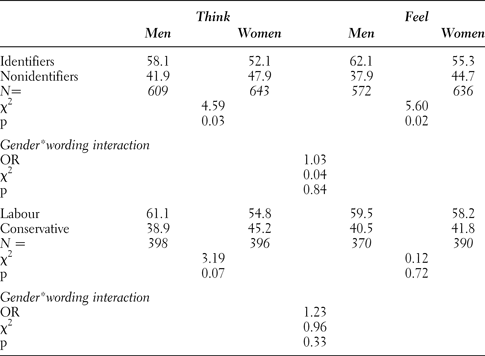
We begin with the results of the question-wording experiment. Table 4 mirrors Table 1, reporting first the proportions of partisans and nonpartisans (and accompanying significance tests), and then comparing Labour versus Conservative partisans. The upper panel of the table addresses Q1, about the effect of question wording on the relationship between men and women and the proportion of identifiers. The comparison of these results with those obtained by Burden is complicated by the huge disparity in the general willingness to report nonidentification. Nonetheless, some important differences can be noted. First, at odds not only with Burden's results but also those in Table 2, women were noticeably (and significantly, as indicated by the χ2 tests) less likely than men to identify with parties. Second, while Burden found women less likely to report identification on the feel question, we find the opposite. Indeed, both men and women were more likely to feel than to think of themselves as party identifiers. (This difference for men is perhaps surprising given the gendered arguments put forward earlier; men, having been socialized to prioritize objectivity, are reluctant to report emotional attachments.) Expressing these arguments in statistical terms, there are main effects of sex and wording. But there is no evidence of an interaction between those two (as indicated by an odds ratio barely different from 1). The tendency for men to identify more with parties held regardless of wording, and the tendency for more people to feel identifications held for both sexes. So, although there are some interesting findings here, the answer to Q1 is “no.”
Sex, question wording, and party identification in this experiment
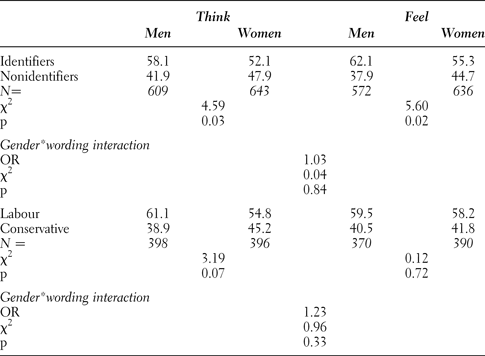
Turning now to the lower panel of the table, we can address Q2, concerning the effect of wording on the sex–party relationship in identification. Here, there is a different pattern of results and at least some sign of a sex/wording interaction. In the think condition, there is an appreciable difference between men and women (which is significant at the 0.1 level), but that gap closes almost entirely in the feel condition. This matches the findings in Burden (Reference Burden2008), as does the fact that women's responses do more to drive the wording effect. (Men split roughly 60:40 in Labour's favor, regardless of wording.) Yet there are two vital differences between Burden's results and those in Table 4. First, the wording effects are considerably weaker and the odds ratio for the interaction does not even border on statistical significance. Given that our sample was considerably larger than Burden's, this cannot be attributed to a lack of statistical power; the relationship, itself, is much weaker. Second, the direction of the sex gap in the think condition is “wrong”: Women are less likely to report Labour identification. Thus, insofar as the observed sex gap in partisanship is conditional on the measurement of party identification, we cannot readily attribute this to the stereotyping by sex and party.
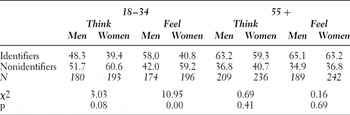
One possible explanation for these null findings—or, at best, the much smaller wording effects—is the generational difference discussed earlier. If only younger generations have been socialized into associating women with the Labour party, then assessments involving the whole sample will miss that effect. Breaking down the results by age, as required for Q3, might also provide some insight into why the overall effect is in the opposite direction to that identified by Burden (Reference Burden2008). We reran the analyses from Table 4, by three age groups: 18 to 34, 35 to 54, and 55 and over.Footnote 19Table 5 presents the results addressing Q1 (about the proportion of respondents reporting identification under the different wordings).Footnote 20
Sex, question wording, and the extent of identification by age

Looking first at those ages 55 or over, there is little to report. Regardless of question wording, women are slightly but not significantly less likely to report an identification. Among the younger respondents, however, the sex gap is much wider. In other words, the large generational decline in partisan identification seems to have taken place especially among women.Footnote 21 The tendency for more young men than young women to report partisanship was marked—a difference of 17 percentage points—when the prompt is “feel” rather than “think,” Here, the wording effect is driven by male responses: Younger men were particularly inclined to report feeling a partisan attachment, while only around 40% of women reported identification in either condition. Given that previous research has focused on women's rather than men's partisanship, the existing literature provides no ready explanation for this result.
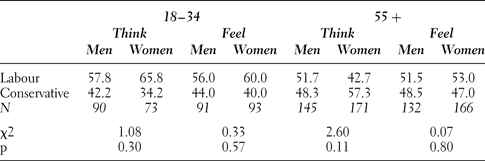
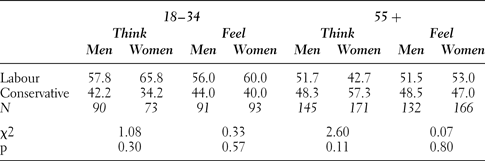
Turning to the Q2 analysis, about which party identification, Table 6 reports the results for the two age groups. Question wording seems to have no effect on the partisan balance of men's identifications. Younger men are somewhat more inclined than older men both to think and to feel themselves to be Labour. The wording change does, however, affect women's responses, and in opposite directions for the different age groups. This interaction among sex, wording, and age in predicting partisanship is significant at the p < 0.1 level. Younger women were more likely to think of themselves as Labour (66% compared to 60% in the feel condition). By contrast, older women were more likely to feel Labour (53% compared to just 43% with the think prompt). In other words, it is only among younger respondents that the wording effect parallels that reported by Burden (Reference Burden2008). The traditional tendency for women to vote disproportionately for the Conservatives may, therefore, be a manifestation of a broader, gendered party association that still influences the thinking (but not the feeling) of older women, even if for younger voters the association has reversed.
Sex, question wording, and party identification by age
Thus far, the evidence does not suggest the existence of fixed and uniform sex differences between men and women. In fact, intrasex differences, namely, that the wording effect ran in opposite directions for young and old women, suggests that partisanship has little to do with enduring psychological differences between the sexes that might be expected to apply consistently to men and women across all age groups. External factors—the changing relationships between the parties and British men and women, for instance—appear likelier sources of change. That said, it is worth testing for sex differences in the nature of partisanship.
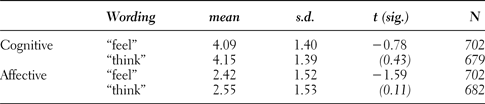
The first step is to address Q4. After all, the results so far can only be brought to bear on an individual's sex and the nature of partisanship if the different wordings do indeed tap different types of partisanship. A simple check is to compare those reporting a think with those reporting a feel identification in terms of mean scores on the measures of affective and cognitive partisanship. Table 7 reports the relevant mean comparisons, along with t-tests for significance, for the three-item Likert scales. There is little evidence that changing the wording of the single-item measure affects the nature of partisanship measured. The measures of cognitive partisanship are more or less the same, regardless of whether respondents answered the cognitive or affective version of the original identification question. And the affective scale scores are actually slightly higher among those who received the think prompt. What seems most plausible—and in line with psychometric orthodoxy—is that a single-item measure, even worded specifically for the purpose, is insufficient to measure a particular dimension of partisanship.
Mean scores on affective and cognitive partisanship (Likert scales) by question wording
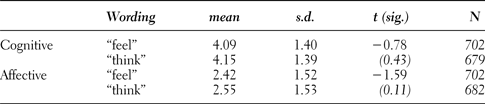
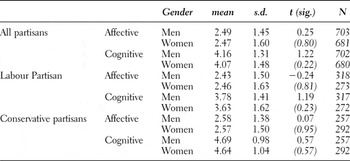
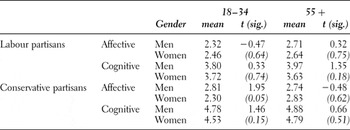
The wording manipulation does not generate significant differences in the relative weight of affect and cognition in the partisanship reported. This does not, however, rule out the possibility that that relative weight varies by sex. It does, though, leave us in need of an alternative explanation of the sex/wording interaction. The next task, then, addressing Q5, is to look for sex differences in the nature of partisanship, and to assess whether they can better explain the question-wording effects in Tables 4 and 6. We begin by repeating the analyses from Table 7, but this time comparing means across the sexes rather than experimental condition. In the lower rows of Table 8, we break down the results by respondent's chosen party identification.
Mean scores on affective and cognitive partisanship (Likert scales) by sex and party

As in Table 7, the pattern here is of mean differences that are nonsignificant and usually very narrow. Looking first at results for all partisans, we find no support for the presumption that women's partisanship will be more affectively driven, and only a hint that men's attachments are more cognitive.Footnote 22 Moreover, this pattern does not differ much by party. In particular, there is no explanation for the question-wording effect in the lower panel of Table 4, namely, the tendency for a female pro-Conservative sex gap to open up in the think condition. While Conservative identifiers were disproportionately cognitive in their partisan attachments, there is no indication that this was particularly true among women. Indeed, based simply on Table 8, there is no cause to expect any interaction between the sex of an individual and the affective–cognitive wording manipulation on which this article is based. And the answer to Q5 is a resounding “no.”
Our earlier results suggest that these null findings may be concealing differences across age groups. So, we reran the analyses by party from Table 8, this time splitting the sample into the three age categories. The results are presented in Table 9. As before, to simplify presentation and to illustrate the key contrasts, we present only the results for the “outer” age categories.
Mean scores on affective and cognitive partisanship by sex, party, and age group

Put simply, breaking the analysis down by age does not open up a series of sex gaps that were hidden in Table 8. There are, however, some differences that emerge, most notably with younger Conservatives, among whom the men scored markedly higher on affective partisanship (though also somewhat higher on cognitive partisanship). Relating this result back to Table 6, we might then have expected the “feel” prompt to elicit disproportionately Conservative partisanship among men. In fact, that difference is negligible; it was younger women who were especially drawn to the Conservatives in the affective condition. Yet, as we see here, younger Conservative women are the group least affectively tied to their parties.
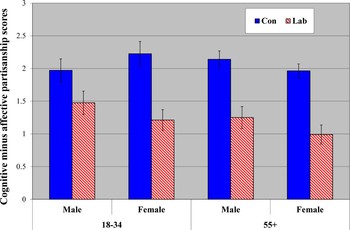
To facilitate comparison between the experimental results and these data on the internal psychology of partisanship, we use a variable measuring the relative weight of cognition and affect in each respondent's partisan attachment. This was calculated by subtracting affective partisanship from cognitive partisanship scale scores. In Figure 1, we show mean scores on this variable by sex, age, and party, along with error bars reflecting the standard errors of these means.
Mean scores on cognitive-minus-affective partisanship by sex, party, and age group.

The Conservative bars are invariably higher, reflecting the fact that that party attracts cognitive identification disproportionately.Footnote 23 Our main focus, however, is on other differences in order to address Q5. In Table 6, the two most noticeable wording effects were both among female respondents: Among younger women, the cognitive prompt elicited Labour partisanship disproportionately; among older women, it generated more Conservative partisanship. We might, therefore, expect particularly high bars (reflecting especially cognitive partisanship) for Labour among younger women and for the Conservatives among older women. But neither prediction is borne out. Among respondents ages 18–34, the converse result emerges: It is female Conservatives whose partisanship is disproportionately cognitive, and men who are more likely to be cognitively attached to Labour (although the overlapping error bars mean that, again, the differences are not quite statistically significant). Among the older age group, women are less cognitively attached to both parties—and so both bars are lower—but there is no sign of the particular cognitive attachment to the Conservatives that Table 6 might imply. This conforms to the pattern that has recurred throughout: Little or nothing in our evidence on the internal psychology of partisanship can account for the observed experimental effects of question wording.
SUMMARY AND IMPLICATIONS
We sought to investigate whether the sex/wording effect observed by Burden (Reference Burden2008) operates on partisanship in the UK and to explore the psychological processes underlying that effect. In the survey experiment, we found that switching from the usual cognitive to an affective prompt tended to increase slightly the proportion of identifiers (among both males and females), and also served to close a sex gap that in the cognitive condition saw women disproportionately identify with the Conservatives. This result ran opposite to that reported by Burden, in which a cognitive question seemed to prompt female respondents to adopt the stereotypical identification with the more pro-women Democratic Party. Given that the differences were not statistically significant, the contrast should not be overplayed. More telling—and at least of borderline significance—younger respondents did conform to that Burden pattern; it was the older respondents who drove the overall wording effect in the opposite direction. Within each age group, the question-wording effects were sizable: not as spectacular as those from the United States, but still quite large given the subtlety of the wording change in this experiment (see Burden and Klofstad Reference Burden and Klofstad2005, 873).
In the absence of detailed measures of the internal psychology of partisanship, Burden was obliged to leave certain questions open: “The gender gap might or might not be due to sex differences in the use of affect and cognition, but it does seem to be related to the ways in which the mass media treat sex differences in partisanship” (Reference Burden2008, 70). We directly addressed the first point and found very little evidence of sex differences in the psychological structure of partisan attachments. There is certainly no evidence at all to support any simple “women with their hearts; men with their minds” reading of partisan attitudes. The occasional gaps observed were very narrow and, in any case, not in line with the results from the wording experiment.
Since internal psychology seems unable to explain the experimental effects, we endorse Burden's suggestion of an external cause, namely, the way that parties and gendered representations of men and women are costereotyped in political discourse. That can account for the narrower wording differences in this study—the sex gap in partisanship (and voting) is neither so pronounced nor so often pronounced upon as in the United States. It may also be able to account for the observed generational differences, given that the discursive association between women and the Labour Party is a more recent phenomenon than the parallel costereotyping between women and the Democratic Party. Finally, the fact that Neely (Reference Neely2007) could replicate Burden and Klofstad's experiment, but not their results in a survey a few years later, tends to support the conclusion that these experimental effects are driven by the external context rather than being inherent in the responses of either men or women.
The finding that women are not more affectively driven than men in their political preferences contributes to a growing body of literature that challenges traditional stereotypes of how British men and women approach politics. A similar challenge is posed by the finding that younger Conservative men scored markedly higher on affective partisanship. We lack alternative theoretical frameworks to draw upon in order to account for these results that confound predictions of gendered behavior. Further investigation is required in order to produce new theories on gender, generational differences, and men's and women's use of affect and cognition. In particular, we need to problematize men's political preferences outside of stereotypical gendered roles. Winters and Campbell (Reference Winters and Campbell2007) used focus groups to analyze men and women's leadership evaluations and found that men and women use similar criteria for judging the two main party leaders. Their work on political interest (Campbell and Winters Reference Campbell and Winters2008) indicates that women are not less interested in politics, as has often been written, but are simply interested in different issues. Nonetheless, there have been real differences in men and women's partisanship, and the experimental effects reported here suggest that such differences have left their mark. Specifically, voters may retain long-term identification with,and emotional attachment to, their original partisan orientation.
Whatever the cause of these experimental effects, they leave researchers with a quandary, namely, that conclusions about party identification—and in particular about any sex-driven gaps in partisanship—are dependent on the wording chosen. An understandable reaction is to ask: Which is the right (or at least the better) wording? But this is misguided. The differences between the two conditions are not measurement error but, rather, the product of respondents reacting in meaningful ways to the different prompts (Alvarez and Brehm Reference Alvarez and Brehm2002; Zaller Reference Zaller1992). Hence, the right wording will depend on the way that researchers want respondents to react. If the aim is to measure more personal affective commitments to a party, then “feel” is the better option. If the target is people's cognitive evaluations of their partisan identities, then the “think of yourself” version is preferable. If the aim is to predict voting behavior, then the appropriate wording hinges on whether affective or cognitive partisanship is the stronger influence on party choice (see Burden Reference Burden2008, 71).
It is surprising that after more than half a century of partisanship research, we are unsure on that last point. The reason is that partisanship has not been adequately measured. This study is one among many that demonstrates that the Michigan-style question alone is inadequate for measuring a concept as complex and as important as party identification. As Table 7 shows, simply using “think” or “feel” is not sufficient to ensure that a measure taps predominantly cognitive or affective attachments. Instead, the field needs multiple-item measures of those dimensions of partisanship, solidly grounded in the theory of party identification and thoroughly tested for reliability and validity.Footnote 24 The Likert-style batteries piloted here are a short step along that methodological path.
APPENDIX: WORDINGS OF PARTY IDENTIFICATION QUESTIONS
Traditional Michigan question
“Generally speaking, do you usually think of yourself as a Republican, a Democrat, an Independent, or what?”
[If Republican/Democrat] “Would you call yourself a strong Democrat/Republican or a not very strong Democrat/Republican?”
[If Independent] “Do you think of yourself as closer to the Republican or Democratic party?”
Affective version of traditional Michigan question [Burden 2008]
“Generally speaking, do you usually feel that you are a Republican, a Democrat, an Independent, or what?”
[If Republican/Democrat] “Do you feel that you are a strong Democrat/Republican or a not very strong Democrat/Republican?”
[If Independent] “Do you feel that you are closer to the Republican or Democratic party?”
Traditional BES question
“Generally speaking, do you think of yourself as Labour, Conservative, Liberal Democrat, or what?”
[If party named] “Would you call yourself very strong [party named], fairly strong, or not very strong?”
[If no party named] “Do you generally think of yourself as a little closer to one of the parties than the others?”
Alternative BES question [cognitive condition in this study]
“Some people think of themselves as being a supporter of one political party rather than another. Do you usually think of yourself as being a supporter of one particular party or not?”
[If yes] “Which party is that?”
Affective version of alternative BES version [affective condition in this study]
“Some people feel themselves to be a supporter of one political party rather than another. Do you usually feel yourself to be a supporter of one particular party or not?”
[If yes] “Which party is that?”