Introduction
Half of all lifetime case-level mental disorders have their first onset by age 14 and three-quarters by age 24 (Kessler et al. Reference Kessler, Berglund, Demler, Jin, Merikangas and Walters2005). Moreover, mental disorders have been found to be the largest contributors to disability in young people (Mathews et al. Reference Mathews, Hall, Vos, Patton and Degenhardt2011). In particular, the long-term sequelae of mental disorders are often exacerbated by delayed help seeking or the lack thereof (Harris et al. Reference Harris, Henry, Harrigan, Purcell, Schwartz, Farrelly, Prosser, Jackson and Mcgorry2005; de Girolamo et al. Reference De Girolamo, Dagani, Purcell, Cocchi and Mcgorry2012; Thornicroft, Reference Thornicroft2012). Strategies to promote appropriate and earlier help seeking by young people are clearly and urgently needed.
The ability to label or identify a mental disorder accurately is one factor that has been found to influence help seeking by young people. Indeed, labelling a mental disorder as it emerges is believed to be an important part of the process of help seeking (Vogel et al. Reference Vogel, Wester, Larson and Wade2006; Biddle et al. Reference Biddle, Donovan, Sharp and Gunnell2007). Labelling is defined here as ‘the lay use of unprompted terms or descriptors to characterize the symptoms of a mental disorder being experienced by a hypothetical or actual person’ (Wright et al. Reference Wright, Jorm and Mackinnon2012, p. 917). The use of psychiatric terms by the public to label mental disorders has been the subject of continuing debate (Read et al. Reference Read, Haslam, Sayce and Davies2006, Reference Read, Haslam and Davies2009; Jorm & Griffiths, Reference Jorm and Griffiths2008), mainly due to concerns that labelling may fuel stigma (Scheff, Reference Scheff1966; Gove, Reference Gove1975; Link et al. Reference Link, Cullen, Struening, Shrout and Dohrenwend1989; Jorm & Griffiths, Reference Jorm and Griffiths2008). For instance, evidence indicates that the use of psychiatric labels by the public (Penn & Nowlin-Drummond, Reference Penn and Nowlin-Drummond2001; Angermeyer & Matschinger, Reference Angermeyer and Matschinger2005; Rose & Thornicroft, Reference Rose and Thornicroft2010), including young people (Rose et al. Reference Rose, Thornicroft, Pinfold and Kassam2007), can have a stigmatizing impact.
Nonetheless, the importance of labelling has been highlighted in an emerging body of evidence. For instance, a study of an Australian clinical sample revealed that the time taken to recognize the problem as being related to anxiety or depression accounted for the majority of the total delay in seeking treatment (Thompson et al. Reference Thompson, Issakidis and Hunt2008). In addition, findings from a study of young people presenting to general practitioners (GPs) revealed that young people's ability to accurately identify their problems as a mental health problem of some kind was associated with their GP's accurate identification of their problem (Haller et al. Reference Haller, Sanci, Sawyer and Patton2009). While preliminary, these findings suggest the promise of improving accurate psychiatric labelling to decrease the delay in treatment seeking by young people, and increase the chances of accurate diagnosis and appropriate treatment when young people do present to health services.
Relatedly, two vignette-based studies of young people have directly examined the association between labelling and help-seeking preferences. The first study found that accurate labelling of depression and psychosis predicted the choice of various forms of appropriate help or treatment for the person described in a vignette (Wright et al. Reference Wright, Jorm, Harris and Mcgorry2007). Building on these findings, the second study (Wright et al. Reference Wright, Jorm and Mackinnon2012) examined the association between labelling and unprompted help-seeking preferences for oneself, as opposed to a fictional character in a vignette. It also examined whether the accurate label is more effective in facilitating help seeking than other more common lay terms; e.g. ‘depression’ v. ‘stress’. Examining these associations in three vignettes: depression, psychosis and social phobia; this study found that the use of the accurate label predicted a preference for recommended sources of help more consistently than other common lay terms. These findings are largely consistent with those of studies with adults (Angermeyer et al. Reference Angermeyer, Holzinger and Matschinger2009; Rüsch et al. Reference Rüsch, Evans-Lacko and Thornicroft2012).
The current study sought to replicate and extend the recent study by Wright et al. (Reference Wright, Jorm and Mackinnon2012), using data from a 2011 national survey of Australian young people aged 15–25 years. In particular, it included five different vignettes, namely depression, depression with suicidal thoughts, psychosis, social phobia and post-traumatic stress disorder (PTSD). This is the first study of its kind to examine these associations for depression with suicidal thoughts and PTSD in young people. Including the former is of particular interest given its crisis nature and the urgency of appropriate treatment, especially because suicide is such a major public health concern in young people (Hawton et al. Reference Hawton, Saunders and O'connor2012; Varnik, Reference Varnik2012). Including the latter builds the scarce literature on the community's knowledge and actions with regard to anxiety disorders in general and to PTSD specifically, given that it has the highest prevalence among the anxiety disorders across all age groups in Australia (Slade et al. Reference Slade, Johnston, Oakley Browne, Andrews and Whiteford2009).
Hence, the aim of this study was to examine whether accurate psychiatric labelling of disorders in the five abovementioned vignettes is associated with intentions or preferences to seek help from various sources, after controlling for socio-demographic variables known to be associated with help seeking in young people, including age (Rickwood et al. Reference Rickwood, Deane, Wilson and Ciarrochi2005; Jorm et al. Reference Jorm, Wright and Morgan2007), sex (Rickwood et al. Reference Rickwood, Deane, Wilson and Ciarrochi2005) and ethnicity (Zwaanswijk et al. Reference Zwaanswijk, Verhaak, Bensing, Van Der Ende and Verhulst2003; Hsu & Alden, Reference Hsu and Alden2008). In particular, in order to capture a more realistic snapshot of young people's real-life experience, we focused on the sources of help most commonly and spontaneously nominated by young people, as opposed to expert-recommended forms of treatment or prompted beliefs about treatment. In addition, like Wright et al. (Reference Wright, Jorm and Mackinnon2012), we focused on young people's unprompted labels of the vignettes described, but given that their study found accurate labels to be the most consistent predictors of help-seeking, we examined only accurate labels in this study.
Methods
Participants
The survey involved computer-assisted telephone interviews with 3021 young people aged 15–25 years. The survey was carried out by the survey company Social Research Centre using random-digit dialling of both landlines and mobile phones covering the whole of Australia from January to May 2011. Up to six calls were made to establish contact. The response rate was 47.9%, defined as completed interviews (3021) out of sample members who could be contacted and were confirmed as in scope (6306). Interviewers ascertained whether there were residents in the household within the age range and, if there were multiple, selected one for interview using the nearest-birthday method.
Survey questions
The interview was based on a case vignette of a young person (John or Jenny) with a mental disorder. On a random basis, respondents were read one of six vignettes – depression, depression with suicidal thoughts, depression with alcohol abuse, social phobia, PTSD or psychosis (early schizophrenia) – portraying a person aged 15 years (for participants aged 15–17 years) or 21 years (for participants aged 18–25 years) of the same sex as the respondent (Reavley & Jorm, Reference Reavley and Jorm2011).
All respondents were then asked a series of questions that assessed socio-demographic characteristics, mental health literacy, stigma, exposure to mental disorders, beliefs about interventions and prevention for the mental disorder in the vignette, psychological distress (using the K6 screening scale; Kessler et al. Reference Kessler, Andrews, Colpe, Hiripi, Mroczek, Normand, Walters and Zaslavsky2002) and exposure to mental health organizations and media campaigns.
The present paper focuses on labelling of the disorder in the vignette and help-seeking preferences if the respondent had a similar problem to the vignette character, so these are described in detail here. The depression with alcohol abuse vignette was not included in this paper because it comprises two comorbid disorders, whereas each of the other five vignettes of interest in this paper represents a single diagnostic group.
Recognition of the disorder portrayed in the vignette
Young people were asked: ‘What, if anything, do you think is wrong with John/Jenny?’ Interviewers recorded verbatim responses according to pre-coded response categories (depression, schizophrenia, psychosis, mental illness, stress, nervous breakdown, psychological/mental/emotional problem, has a problem, cancer, nothing, don't know) derived from a content analysis of responses to the same questions in earlier surveys (Jorm et al. Reference Jorm, Korten, Jacomb, Christensen, Rodgers and Pollitt1997; Wright et al. Reference Wright, Harris, Wiggers, Jorm, Cotton, Harrigan, Hurworth and Mcgorry2005). A content analysis of responses that did not fit these pre-coded categories led to post-coding of 53 other categories, which have been detailed elsewhere (Reavley & Jorm, Reference Reavley and Jorm2011; Yap et al. Reference Yap, Reavley and Jorm2012). The content analysis involved a systematic analysis of the content of the responses to determine the respondents' intended meaning with regards to the type of problem identified. For example, a response such as ‘anxiety disorder, self esteem problem’ would have been coded ‘1’ for the two categories ‘anxiety disorder’ and ‘self-esteem’. Of interest for this paper, the post-coded categories included the most accurate responses for the anxiety disorder vignettes: anxiety/anxious, social anxiety/social phobia/anxiety disorder, post-traumatic stress/stress disorder/syndrome and trauma/traumatized/adverse life event. Accurate labelling was defined as those labels that approximated the DSM-IV diagnostic label (American Psychiatric Association, 1994) upon which the vignettes were based and validated (Jorm et al. Reference Jorm, Korten, Jacomb, Christensen, Rodgers and Pollitt1997; Wright et al. Reference Wright, Harris, Wiggers, Jorm, Cotton, Harrigan, Hurworth and Mcgorry2005). However, given the low rates of using the exact DSM-IV labels ‘social phobia’ and ‘post-traumatic stress disorder’, we expanded our definition of ‘accurate’ label for social phobia to include any mention of anxiety, anxious, social anxiety/phobia and anxiety disorder; and for PTSD, any mention of post-traumatic stress/stress disorder/syndrome, trauma, traumatized and adverse life event. ‘Depression’ or ‘depressed’ were the only accurate labels accepted for both depression vignettes. Mentions of psychosis/psychotic, schizophrenia/schizophrenic were accepted as accurate labels for the psychosis vignette.
Help-seeking preferences
Young people were asked: ‘If you had a problem right now like (John/Jenny), where would you go?’. Verbatim-recorded responses were coded based on categories identified from the 2006 survey (Jorm et al. Reference Jorm, Wright and Morgan2007), with additional categories formed that were relevant to the different mental disorders studied. Responses were coded with a ‘yes’ or ‘no’ in each category, so that multiple categories were possible. Categories included family, such as parents, spouse or relative, general practitioner (GP)/doctor, mental health specialist/service (including psychologist, psychiatrist, other mental health professionals and local mental health service), counsellor, helpline, teacher/lecturer and friend.
Statistical analysis
The data were first analysed using per cent frequencies and 95% confidence intervals (CI). We then conducted binary logistic regressions to explore whether accurate psychiatric labelling of the disorder predicted preferences to seek help from various sources, separately for each vignette. All regressions controlled for age in years, sex and language spoken at home. In each regression, the source of help was the dichotomous dependent variable, and all predictor variables (the three covariates and the accurate label) were entered simultaneously. Age in years was a continuous variable; whereas sex (reference: males), language spoken at home (reference: speaks a language other than English) and use of the accurate psychiatric label (reference: did not use accurate label) were dichotomous.
All analyses used sample weights that took account of number of in-scope persons in the household, phone type, age group, sex and geographic location, and were conducted using Intercooled Stata 12 (StataCorp, 2011). The p < 0.05 significance level was used.
Ethics
Oral consent was obtained from all respondents before commencing the interview. Respondents aged below 18 could only commence their interviews after their parents provided oral consent. This study was approved by the University of Melbourne Human Research Ethics Committee.
Results
The 3021 respondents were randomly assigned to one of six vignettes as follows: 506 to depression, 502 to depression with suicidal thoughts, 499 to depression with alcohol abuse, 507 to social phobia, 506 to PTSD and 501 to psychosis.
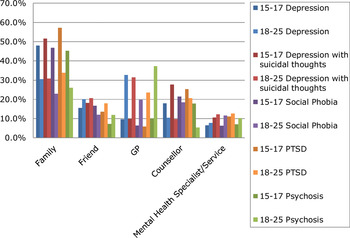
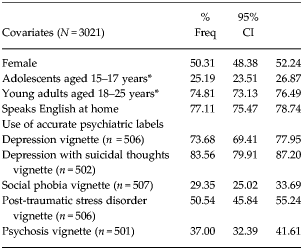
Figure 1 shows the per cent frequencies and standard errors of young people who reported that they would seek help from the five most frequently mentioned sources: GP, counsellor, mental health specialist/service, family and friend, separately for each vignette and divided by age group (15–17 v. 18–25 years). Family was the most commonly mentioned source of help especially for younger respondents. GP was the most frequently mentioned source of professional help especially by older respondents. Differences between age groups were largest for the preference to seek from family (more younger respondents) and GPs (more older respondents). Table 1 shows the descriptive statistics for all covariates and predictor variables. Accurate labelling of depression had the highest rates, especially when suicidal thoughts were present, followed by PTSD, psychosis and social phobia.
Per cent frequencies of young people who reported the intention to seek help from various sources for each vignette and age group (15–17 v. 18–25 years). GP = general practitioner or local doctor; PTSD = post-traumatic stress disorder. (A colour version of this figure is available online at http://journals.cambridge.org/eps)

Descriptive statistics for all covariates and predictor variables
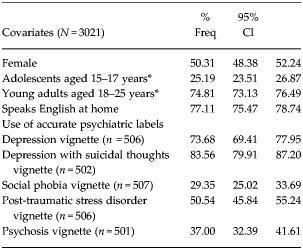
*In regression analyses, age in years is used as a continuous variable; but for simplicity age is presented here as two groups. % Freq = per cent frequency; CI = confidence interval.
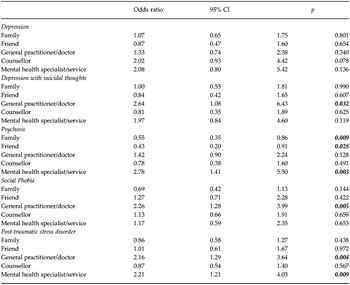
To limit the number of logistic regressions conducted, help-seeking preferences were examined only for the five most commonly mentioned sources. This resulted in a total of 25 regressions (five vignettes by five sources). Table 2 summarizes findings from these regressions, adjusted for age in years, sex and language spoken at home. The use of the accurate psychiatric label for depression with suicidal thoughts, social phobia and PTSD predicted a preference to seek help from a GP. Accurate psychiatric labelling of psychosis and PTSD predicted a preference to seek help from a mental health specialist, while for psychosis it also predicted a preference for not seeking help from family or friends.
Summary of logistic regressions predicting intentions to seek help from various sources with the use of accurate psychiatric labels, separately for each vignette

Note. All regression models were adjusted for age in years, sex and language spoken at home. Findings significant at the p<0.05 level are shown in bold and italics.
CI = confidence interval.
Discussion
This study contributes to the emerging evidence base that accurate psychiatric labelling of mental disorders may facilitate professional help seeking in young people. Findings largely replicate those reported by Wright et al. (Reference Wright, Jorm and Mackinnon2012), but provide an important extension by examining two new vignettes, PTSD and depression with suicidal thoughts.
Accuracy of labelling
The accuracy of labelling by young people in the current study varied greatly between disorders. In particular, when suicidality was evident, most young people were able to accurately label the problem described in the vignette as depression. Even when suicidality is not mentioned, almost three in four young people could accurately identify the problem as depression. In contrast, the accuracy of labelling social phobia was much lower, despite it being one of the most common disorders in this age group (Australian Bureau of Statistics, 2007), and the broadening of the definition of an accurate label for this disorder to include any mention of ‘anxiety’ or ‘anxious’. Likewise, despite it being the most common anxiety disorder (Slade et al. Reference Slade, Johnston, Oakley Browne, Andrews and Whiteford2009) and its broadened definition to include any mention of trauma or adverse life event, only half of the sample could identify PTSD, The accuracy of labelling psychosis was also low, comparable with an earlier survey of Australian youth (Wright & Jorm, Reference Wright and Jorm2009). It is noteworthy that beyondblue: Australia's national depression initiative, which was established in 2000 to address issues associated with depression, anxiety and related disorders across Australia (Beyondblue), had initially focused on promoting awareness and an effective response to depression in the community. It was only in more recent years that it has increased its efforts targeting anxiety disorders. Given evidence to-date suggesting that beyondblue may have promising effects on improving the mental health literacy of young people (Wright & Jorm, Reference Wright and Jorm2009; Yap et al. Reference Yap, Reavley and Jorm2012; Yap et al. in press), it is possible that there may be some improvement in the recognition of anxiety disorders in the near future.
Labelling and help seeking for depression
In contrast to Wright et al.'s (2012) finding that accurate labelling of depression predicted a preference to seek help from a counsellor, the current study found that accurate labelling was not associated with the intentions of young people to seek help from any of the five most common sources. Nonetheless, the association between accurate labelling and preference to seek help from a counsellor approached significance. The proportion of respondents who accurately labelled depression in the current study was larger compared with that in Wright et al.'s (2012) study (74 v. 69%). This may be because the current study did not include younger respondents aged 12–14 years, who tend to have lower rates of accurate labelling of mental disorders (Wright & Jorm, Reference Wright and Jorm2009). Hence the higher recognition rate in the current study may have reduced power to detect significant associations.
Labelling and help seeking for depression with suicidal thoughts
Respondents who accurately labelled the problem described in the depression with suicidal thoughts vignette as ‘depression’ were more likely to report a preference for seeking help from a GP if they had a similar problem. Given its crisis nature, it is promising to note that improving young people's ability to correctly identify the problem may facilitate appropriate help seeking, especially since Australia's system of primary care for mental disorders is based around GPs as the first point of contact, with referrals to mental health specialists as required. For the same reason, it is crucial that GPs are provided with adequate training and support to identify such problems in their patients so as to facilitate prompt and appropriate treatment. For example, the action of assessing for suicide risk has been endorsed as helpful by professionals (Jorm et al. Reference Jorm, Morgan and Wright2008) and recommended in existing training programs like Mental Health First Aid (Kitchener & Jorm, Reference Kitchener and Jorm2006) and Applied Suicide Intervention Skills Training (ASIST; Ramsay et al. Reference Ramsay, Tanney, Tierney and Lang1999).
Labelling and help seeking for psychosis
Our findings involving the psychosis vignette concurred with those of Wright et al. (Reference Wright, Jorm and Mackinnon2012). Respondents who used the labels ‘psychosis’, ‘psychotic’, ‘schizophrenia’ or ‘schizophrenic’ were more likely to report an intention to seek help from a mental health specialist. This is again promising given the severity of this disorder and the devastating consequences of a longer duration of untreated psychosis (Marshall et al. Reference Marshall, Lewis, Lockwood, Drake, Jones and Croudace2005; Perkins et al. Reference Perkins, Gu, Boteva and Lieberman2005), suggesting that improving young people's ability to correctly identify early psychosis may facilitate earlier professional help seeking. Conversely, respondents who used the accurate label for this vignette were less likely to report the intention to seek help from their family or friends. This may reflect young people's recognition of the severity of the illness and hence their perception that family and friends might be unable to help or might react negatively to their symptoms (Jorm et al. Reference Jorm, Wright and Morgan2007; Yap et al., in press).
Labelling and help seeking for social phobia
Respondents who correctly identified the vignette character as having some form of anxiety problems were more likely to report an intention to seek help from a GP if they had a similar problem, consistent with earlier findings (Wright et al. Reference Wright, Jorm and Mackinnon2012). However, unlike the earlier study, we did not find an association between accurate labelling and preference to seek help from a mental health specialist. The finding that accurate labelling may facilitate professional help-seeking is important given that social phobia has one of the lowest rates of professional help-seeking intentions in young people compared to other disorders (Jorm et al. Reference Jorm, Wright and Morgan2007), despite its high prevalence (Slade et al. Reference Slade, Johnston, Oakley Browne, Andrews and Whiteford2009).
Labelling and help seeking for PTSD
Accurate labelling of PTSD was associated with a preference to seek help from GPs as well as mental health specialists. This is the first study to examine this association in PTSD, and suggests that accurate identification of this disorder may indeed facilitate professional help seeking by young people. Given the high prevalence of PTSD (Slade et al. Reference Slade, Johnston, Oakley Browne, Andrews and Whiteford2009) and high rates of exposure to potentially traumatic events in young people (Mills et al. Reference Mills, Mcfarlane, Slade, Creamer, Silove, Teesson and Bryant2010), the current findings underscore the importance and potential of improving young people's ability to accurately identify PTSD as a mental disorder.
Strengths and limitations
This national survey is the first of its kind to examine the mental health literacy of young people with regard to depression with suicidal thoughts and PTSD. Findings contribute to our limited knowledge about the associations between young people's ability to accurately label mental disorders and their help-seeking preferences.
Nonetheless, its findings should be interpreted in light of the study limitations. Firstly, we only assessed help-seeking intentions with reference to a vignette character; hence, it is unclear how closely these reflect actual experience or behaviours. Relatedly, it was not possible to assess whether the self-reported intentions accurately reflect the respondents' actual behaviours if they do develop mental health problems. Nonetheless, a recent report found that young people's help-seeking intentions did prospectively predict some of their actual help-seeking behaviours two years later (Reavley et al. Reference Reavley, Yap, Wright and Jorm2011). In particular, the intention to seek help from a GP prospectively predicted such help-seeking behaviours in the subsequent two years for mental health problems. These findings are consistent with the theory of planned behaviour (Ajzen, Reference Ajzen1991) which has garnered much supporting evidence indicating that changing behavioural intentions has the potential to engender behavioural change (Armitage & Conner, Reference Armitage and Conner2001; Webb & Sheeran, Reference Webb and Sheeran2006).
Implications and conclusions
Findings from this study add to emerging evidence that the use of accurate psychiatric labels to describe mental disorders is associated with young people's professional help-seeking preferences. This body of evidence provides support for the potential of community awareness campaigns, designed to improve young people's ability to accurately label mental disorders, to enhance professional help seeking for such problems. In particular, this evidence is complemented by related evidence to-date indicating the promising effects of community awareness campaigns such as those conducted by beyondblue to improve the community's general literacy about mental health, including the ability to accurately label mental disorders (Wright & Jorm, Reference Wright and Jorm2009; Yap et al. Reference Yap, Reavley and Jorm2012). Such campaigns have involved multiple channels, including promotional efforts through schools, the Internet, television advertisements and billboards (Beyondblue: The National Depression Initiative). Nonetheless, such community education efforts need to take into consideration findings of associations between accurate labelling and some stigmatizing attitudes (e.g. psychosis and beliefs about dangerousness or unpredictability; Wright et al. Reference Wright, Jorm and Mackinnon2011), and address them accordingly.
Financial Support
This research received no specific grant from any funding agency, commercial or not-for-profit sectors.
Conflict of Interest
Funding for this study was provided by the Department of Health and Ageing and the National Health and Medical Research Council. The authors declare no conflict of interests related to the present paper.
Ethical Standard
The authors assert that all procedures contributing to this work comply with the ethical standards of the relevant national and institutional committees on human experimentation and with the Helsinki Declaration of 1975, as revised in 2008.