Implications
The effects of different dietary tannins on ruminant productivity and product quality were seldom compared. We administered three different commercial extracts to lambs to compare the effects of condensed tannins (from mimosa) and hydrolysable tannins (from chestnut and tara) on growth performances and meat quality. Only the chestnut extract reduced feed intake and growth. The tara extract increased vitamin E (γ-tocopherol) in muscle, whereas none of the extracts affected meat fatty acids (FA) and oxidative stability. These results confirm that each source of tannins exerts specific effects and that further research is still necessary to standardize their applicability as feed supplements.
Introduction
Tannins are phenolic compounds naturally occurring in several plants. Although their chemical characteristics are very heterogeneous, tannins are broadly classified into main groups, such as hydrolysable and condensed tannins (Makkar, Reference Makkar2003). Research on tannins in ruminant feeding has a long history and early studies have almost exclusively looked at these compounds as anti-nutritional or even toxic molecules (Reed, Reference Reed1995). Subsequently, positive effects were attributed to dietary tannins, especially condensed tannins, among which: more efficient protein utilization along the gastrointestinal tract, improved growth performances or antiparasitic and antimicrobial effects (Mueller-Harvey, Reference Mueller-Harvey2006). Nevertheless, for several fundamental aspects, the information provided on the effects of tannins on animal metabolism is contradictory, and it is still not possible to extrapolate general conclusions that would be necessary to exploit their potential benefits, or to prevent their negative effects, with a satisfactory level of confidence. For instance, early studies conducted with tannin-rich forages have led to broad generalizations for the level at which tannins in the diet can improve the target parameters without exerting negative effects (Min et al., Reference Min, Barry, Attwood and McNabb2003). However, it is difficult to extrapolate general conclusions from experiments in which animals were fed with specific plants because a number of botanical and environmental factors affect the content and chemical composition of tannins in plants. Also, differences in analytical methods may impair the comparability between studies in which tannin-rich plant materials were fed to animals (Silanikove et al., Reference Silanikove, Landau, Or, Kababya, Bruckental and Nitsan2006; Gravador et al., Reference Gravador, Luciano, Jongberg, Bognanno, Scerra, Andersen, Lund and Priolo2015). Furthermore, when it comes to the effects of these plant metabolites on the quality traits of food products (meat and milk), the knowledge is even more contradictory. For example, the potential of dietary tannins to improve meat oxidative stability is a controversial topic, because the antioxidant effectiveness of dietary phenolic compounds in vivo is still not clear (Halliwell et al., Reference Halliwell, Rafter and Jenner2005; Vasta and Luciano, Reference Vasta and Luciano2011). For ruminants, literature has provided extensive information on the antioxidant effects of several feedstuffs naturally rich in phenolic compounds, including widespread and local forages, fruits and agro-industrial by-products. However, tannins occur in plants together with a blend of other antioxidants, which makes impossible to isolate the specific contribution of each compound to the overall antioxidant capacity of the plant.
In this context, using tannins as purified as possible may certainly contribute to clarifying the effects of tannins, and plant extracts could represent a practical way to selectively include tannins in diets for livestock (Mueller-Harvey, Reference Mueller-Harvey2006). Indeed, several tannin extracts are nowadays commercially available, and some are officially approved as feed supplements. Experiments conducted to assess the effects of dietary tannin-rich extracts on meat quality generally tested one specific tannin extract. In particular, quebracho (Schinopsis lorentzii) and grape seed extracts were almost exclusively used as sources of condensed tannins, whereas chestnut extract represented the main source of hydrolysable tannins (Vasta and Luciano, Reference Vasta and Luciano2011). Conversely, the comparison between the effects of different tannin-rich extracts on meat quality is almost missing. However, a wide selection of commercial extracts would be available to compare the effects of tannins from different botanical origin and belonging to different chemical classes. In a preceding experiment, we observed that the inclusion of 10.4% quebracho (S. lorentzii) extract into a concentrate-based diet for lambs modified the intramuscular FA composition and improved the oxidative stability of meat, but caused a dramatic reduction of animal growth performances (Luciano et al., Reference Luciano, Monahan, Vasta, Biondi, Lanza and Priolo2009; Vasta et al., Reference Vasta, Mele, Serra, Scerra, Luciano, Lanza and Priolo2009).
In the light of the above, the aim of this study was to compare the effects of the dietary administration of three different commercial tannin-rich extracts, at a 4% level of inclusion into a concentrate-based diet, on lamb growth performances and meat oxidative stability. The extracts were: mimosa (Acacia mearnsii, De Wild; condensed tannins), tara (Cesalpinia spinosa, (Molina) Kuntze; hydrolysable gallotannins) and chestnut (Castanea sativa, Mill; hydrolysable ellagitannins). We hypothesized: (i) that a 4% level of inclusion may represent a practical dose under farm conditions to avoid severe detrimental effects on animal growth performances (Min et al., Reference Min, Barry, Attwood and McNabb2003) and (ii) that comparing three tannin extracts added to the same basal diet could highlight if tannins of different botanical origin and chemical nature may exert different effects. Also, among the three commercial extracts tested, no information is available on the effects of feeding mimosa and tara extracts on meat quality.
Material and methods
Experimental feeding and samplings
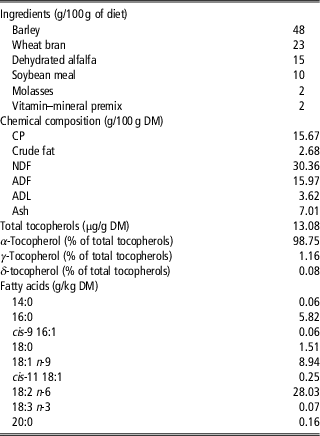
This experiment was carried out in the experimental facilities of the University of Catania from October 2015 to January 2016. Animals were handled in accordance with the European Union Directive No.63/2010 (EC, 2010). In all, 36 2-month-old male Sarda×Comisana lambs (initial weight 20.0 kg±SD 1.87 kg) were sourced from a commercial farm and randomly selected from a flock of 130 animals available, all born within 3 weeks. Lambs were randomly assigned to four groups (n=9) and housed in individual pens (1.5×1.8 m), separated with metallic grid and bedded with wheat straw. Each pen was equipped with a feeder and a drinking trough. After an adaptation period of 7 days in which the pre-experimental concentrate diet was gradually replaced with the experimental diets, each group of lambs was fed with the respective experimental diet for 75 days. The control group (CON) received a pelleted standard concentrate-based diet (ingredients and chemical composition in Table 1). The other three groups were fed the same diet as the CON group in which 4% (as fed) of one of the following tannin extracts were included among the ingredients: mimosa (A. mearnsii; MI), chestnut (C. sativa; CH) or tara (C. spinosa; TA). The diets were offered each morning at 0900 h, being available ad libitum (10% minimum feed residual allowed). The commercial extracts (Mimosa OP®=mimosa; Nutri-P®=chestnut; Tannino T80®=tara) were obtained from Silvateam (San Michele Mondovì, Cuneo, Italy). The tannin extracts were added to the ingredients before pelleting at the temperature of 40°C. According the method of Makkar et al. (Reference Makkar, Blümmel, Borowy and Becker1993) the concentration of total phenolic compounds in the diets was: 4.7 (CON), 25.3 (MI), 24.9 (CH) and 29.1 (TA) g/kg DM (tannic acid equivalents). The proportion of tannins over the total phenols was: 32.1% (CON), 88.1% (MI), 84.2% (CH), 86.9% (TA).
Composition of the basal diet (CON) fed to the lambs

ADL=acid detergent lignin.
Individual feed intakes were measured daily, whereas BW was measured weekly. At the end of the experimental feeding period, the lambs were slaughtered at a commercial abattoir. After 24 h of storage at 4°C, the carcasses were weighed, halved and the entire longissimus thoracis and lumborum muscles (LTL) from the right half-carcass was packed under vacuum and stored at −80°C for analyses of intramuscular FA and tocopherols. The LTL from the left half was vacuum-packaged and aged at +4°C for 3 days, pending oxidative stability measurements.
Analysis of fatty acids and vitamin E in muscle
The analysis of FA in the total intramuscular lipids was performed as described by Luciano et al. (Reference Luciano, Pauselli, Servili, Mourvaki, Serra, Monahan, Lanza, Priolo, Zinnai and Mele2013). In brief, intramuscular fat (IMF) was extracted with chloroform/methanol, and FA methyl esters (FAME) were produced by base-catalyzed transesterification. Gas chromatographic analysis was carried out with a Trace Thermo Finningam GC equipped with a flame ionization detector (FID; ThermoQuest, Milan, Italy) and 100-m high polar fused silica capillary column (0.25 mm i.d., 0.25 μm, film thickness; SP-2560; Supelco, Bellefonte, PA, USA). Helium was the carrier gas at a constant flow of 1 ml/min and samples were injected at 1:80 split ratio. The GC conditions were: 40°C oven temperature held for 4 min, then increased to 120°C at 10°C/min and held for 1 min, then increased up to 180°C at 5°C/min and held for 18 min, then increased up to 200°C at 2°C/min and held for 15 min, and then increased up to 230°C at 2°C/min and held for 19 min. The injector and detector temperatures were 270°C and 300°C, respectively. A standard mixture of 52 Component FAME Mix (Nu-Chek Prep Inc., Elysian, MN, USA) and individual FAME standards (Larodan Fine Chemicals, Malmo, Sweden) were used for identification. Quantification was achieved using nonadecanoic acid as internal standard and FA were expressed as mg/g of muscle. A total of 54 individual FA were quantified and were used for computation of the main classes: saturated, monounsaturated and polyunsaturated FA (SFA, MUFA and PUFA, respectively), as well as the highly peroxidizable (HP) PUFA with unsaturation degree>2. Finally, according to Luciano et al. (Reference Luciano, Pauselli, Servili, Mourvaki, Serra, Monahan, Lanza, Priolo, Zinnai and Mele2013), the peroxidability index (PI) was calculated as:
 $$\eqalign{{\rm PI \,{\equals}}\,&\left( {\mathop{\sum}{{\rm dienoic{\times}1}} } \right){\rm {\plus}}\left( {\mathop{\sum}{{\rm trienoic{\times}2}} } \right)\cr&{\rm {\plus}}\left( {\mathop{\sum}{{\rm tetraenoic{\times}3}} } \right){\rm {\plus}}\left( {\mathop{\sum}{{\rm pentaenoic{\times}4}} } \right)\cr&{\rm {\plus}}\left( {\mathop{\sum}{{\rm hexaenoic{\times}5}} } \right)$$
Vitamin E (α-, γ- and δ-tocopherols) was extracted from muscle and analysed as described by Luciano et al. (Reference Luciano, Roscini, Mattioli, Ruggeri, Gravador, Natalello, Lanza, De Angelis and Priolo2017). In brief, vitamin E was analysed using a Perkin Elmer series 200 HPLC, equipped with a Synergy Hydro-RP column (4 μm, 4.6×100 mm; Phenomenex, Bologna, Italy). Samples dissolved in acetonitrile were eluted at a flow rate of 2 ml/min, and tocopherols were identified using an FD detector (model Jasco, FP-1525; Jasco Corporation, Cremella, Italy) set at excitation and emission wavelengths of 295 nm and 328 nm, respectively. External calibration curves of standard compounds (Sigma-Aldrich, Milan, Italy) were used for identification and quantification.
Meat oxidative stability measurements
Oxidative stability in raw and cooked meat over aerobic refrigerated storage was measured as described by Cherif et al. (Reference Cherif, Valenti, Abidi, Luciano, Mattioli, Pauselli, Bouzarraa, Priolo and Ben Salem2018). In brief, three slices (2 cm thickness) from the left LTL were placed in polystyrene trays, covered with PVC film and stored at +4°C and each slice was used for measuring lipid oxidation and colour stability at days: 0 (after 2 h of blooming), 4 and 7. Other three slices were packed under vacuum and cooked for 30 min at 70°C in a water bath. One slice was used immediately for measurement of lipid oxidation (day 0), whereas the other two slices were stored at +4°C as for the raw meat samples, and lipid oxidation was measured after 2 and 4 days. For both row and cooked meat, lipid oxidation was measured as thiobarbituric acid and reactive substances (TBARS) values according to the procedure of Luciano et al. (Reference Luciano, Roscini, Mattioli, Ruggeri, Gravador, Natalello, Lanza, De Angelis and Priolo2017). Colour was measured in raw meat using a Minolta CM-2022 spectrophotometer (d/8° geometry; Minolta Co., Ltd, Osaka, Japan) set in the specular components excluded mode, illuminant A and 10° standard observer. The descriptors lightness (L*), redness (a*), yellowness (b*), Chroma (C*) and Hue angle (H*) were recorded, as well as the reflectance (R) spectra from 400 to 700 nm. According to Luciano et al. (Reference Luciano, Vasta, Monahan, López-Andrés, Biondi, Lanza and Priolo2011), the ratio (K/S)572÷(K/S)525 was calculated to monitor the accumulation of metmyoglobin (MetMb) on the meat surface over time of storage. This ratio decreases with increasing proportion of MetMb. The ratio (K/S) between the absorption (K) and the scattering (S) coefficients at the selected wavelengths was calculated as:
 $$\left( {K{\rm /}S} \right)_{{\rm \lambda }} \,{\rm {\equals}}\,\left( {{\rm 1 - }R_{{\rm \lambda }} } \right)^{{\rm 2}} {\rm / 2}R_{{\rm \lambda }} $$
The resistance of LTL to lipid and Mb oxidation was also assessed by incubating meat homogenates with ferric chloride/sodium ascorbate (Fe/Asc) as a catalyst of oxidative reactions, according to Luciano et al. (Reference Luciano, Roscini, Mattioli, Ruggeri, Gravador, Natalello, Lanza, De Angelis and Priolo2017). In brief, meat homogenates were prepared in MES buffer (pH 5.6) and incubated at 37°C under continuous shaking. Two aliquots were collected immediately (0 min), then ferric chloride hexahydrate and L-sodium ascorbate were added (45 μM final concentration), and other two aliquots were collected after 30 and 60 min of incubation. One aliquot was used for TBARS analysis (Luciano et al., Reference Luciano, Roscini, Mattioli, Ruggeri, Gravador, Natalello, Lanza, De Angelis and Priolo2017), whereas the other was centrifuged at 6800×g at 4°C, filtered through Whatman 541 paper and directly scanned in a UV/VIS spectrophotometer (UV-1601; Shimadzu Co., Milan, Italy) to calculate the concentration of Mb and the percentage of MetMb (Tang et al., Reference Tang, Faustman and Hoagland2004).
Statistical analyses
The effect of the dietary treatment (Diet; D) on growth performances, feed intake, intramuscular FA and tocopherols was analysed by means of one-way analysis of variance, according to the following model:
 $$y_{{ij}} \,{\rm {\equals}}\,\mu {\rm {\plus}}D_{{\rm i}} {\rm {\plus} }e_{{ij}} $$
where y ij is the observation; μ is the overall mean; D i the diet (i=CON, MI, CH, TA) and e ij the residual error.
Oxidative stability parameters were analysed with a mixed model to test the effect of the Diet (D), of the time of storage/incubation (Time; T) and of the Time×Diet interaction (D×T) as fixed factors. The individual lamb was included as a random effect. The following model was adopted:
 $$Y_{{ijkl}} \,{\rm {\equals} }\,\mu {\rm {\plus}}D_{{\rm i}} {\rm {\plus} }T_{j} {\rm {\plus} }I_{k} \left( D \right){\rm {\plus}}\left( {D{\rm {\times}}T} \right)_{{ij}} {\rm {\plus} }e_{{ijkl}} $$
where y ijkl is the observation; μ is the overall mean; D i the fixed effect of diet (i=CON, MI, CH, TA); T j the fixed effect of time (j=0, 4, 7 days for raw meat; 0, 2, 4 days for cooked meat; 0, 30, 60 min for meat homogenates); I k (D) is the random effect of the individual lamb nested within the diet; (D×T) ij the interaction between diet and time and; e ijkl the residual error.
Differences between means were assessed using the Tukey’s adjustment for multiple comparisons. Significance was declared when P⩽0.05, whereas effects and differences were considered in tendency when 0.05<P⩽0.1. Statistical analyses were performed with the statistical software Minitab, version 16 (Minitab Inc., State College, PA, USA).
Results
Growth performances and feed intake
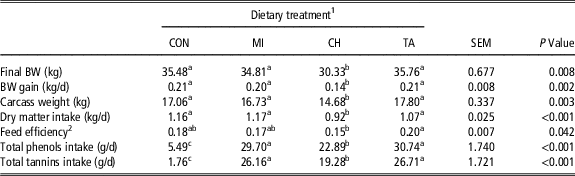
The results on the growth performance parameters and the voluntary feed intake are reported in Table 2. Only the inclusion of the chestnut extract (CH) into the diet reduced the daily feed intake, growth rate and carcass weight compared with the other treatments (P<0.05), whereas the MI and TA treatments did not differ from the CON group for any of the measured parameters. Nevertheless, the concurrent reduction of both the daily weight gain and the feed intake brought the CH-fed lambs to have a lower feed efficiency compared with only the TA group, but not different from the CON and MI groups. The daily intake of total phenolic compounds and tannins was obviously much greater for the animals fed the diets supplemented with the tannin-rich extracts (MI, CH and TA) compared with the CON diet (P<0.001). However, the above differences found in the voluntary daily feed intake led to a lower intake of total phenols and tannins for lambs in the CH treatment compared with both MI and TA groups (on average: −24.3% and −27.1% for total phenols and total tannins, respectively; P<0.001), whereas the latter treatments resulted in very similar intakes of total phenols and, especially, of total tannins.
Effect of the dietary treatment on lamb growth performances and feed intake

CON=concentrate-based diet; MI=mimosa; CH=chestnut; TA=tara.
a,b,cWithin a row, different superscript letters indicate differences (P⩽0.05) between treatments tested using the Tukey’s adjustment for multiple comparisons.
1 Treatments were: CON; CON diet + 4% tannin extract from either MI, CH, TA.
2 Calculated as: BW gain/dry matter intake.
Muscle fatty acids, vitamin E and oxidative stability
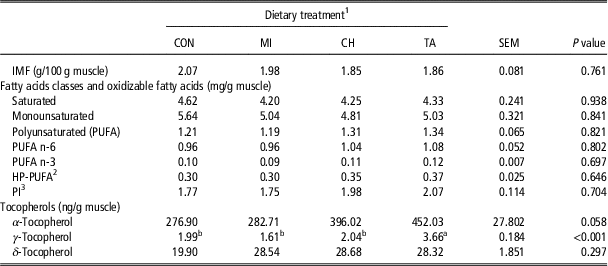
Table 3 reports the effect of the dietary treatment on the concentration of the main classes of FA and vitamin E in muscle. First, the IMF was not statistically affected by the dietary treatment (P>0.05). No effect of the dietary treatment was found on the main groups of FA: SFA, MUFA and PUFA. Also, the dietary treatment had no effect on the concentration of the n-6 and n-3 PUFA, on the HP PUFA and the PI.
Effect of the dietary treatment on the fatty acid classes, oxidizable fatty acids and tocopherols in lamb muscle

CON=concentrate-based diet; MI=mimosa; CH=chestnut; TA=tara; IMF=Intramuscular fat; HP=highly peroxidizable; PI=peroxidability index.
a,bWithin a row, different superscript letters indicate differences (P⩽0.05) between treatments tested using the Tukey’s adjustment for multiple comparisons.
1 Treatments were: CON; CON diet+4% tannin extract from either MI, CH, TA.
2 HP PUFA: calculated as the sum of PUFA with three or more unsaturated bonds.
3 PI, calculated as:
 $${\rm PI\,{\equals}}\,\left( {\mathop{\sum}{{\rm dienoic}{\times}{\rm 1}} } \right){\rm {\plus}}\left( {\mathop{\sum}{{\rm trienoic}{\times}{\rm 2}} } \right){\rm {\plus}}\left( {\mathop{\sum}{{\rm tetraenoic}{\times}{\rm 3}} } \right){\rm {\plus}}\left( {\mathop{\sum}{{\rm pentaenoic}{\times}{\rm 4}} } \right){\rm {\plus}}\left( {\mathop{\sum}{{\rm hexaenoic}{\times}{\rm 5}} } \right).$$
The concentration of α-tocopherol in muscle tended to be greater in muscle from lambs fed the TA diet compared with the MI and CON treatments (P=0.1), whereas muscle from CH-fed lambs contained an intermediate concentration. The concentration of γ-tocopherol was greater in muscle from the TA-fed lambs compared with the CON, CH and MI treatments (P<0.001). Lastly, the dietary treatment did not affect the concentration of δ-tocopherol.
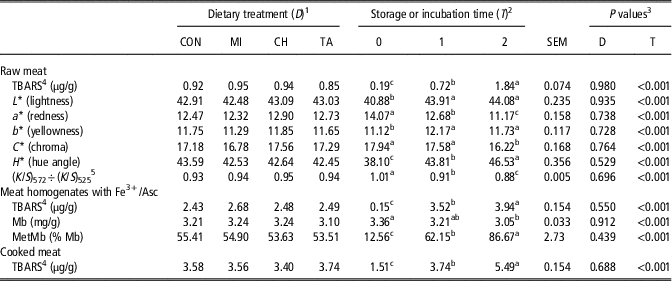
For the oxidative stability parameters of meat the Time×Diet interaction was not significant and therefore removed from the model. The main effects of the Diet and of the storage/incubation Time are presented in Table 4. Overall, all the oxidative stability parameters were affected by the storage/incubation time (P<0.001). The TBARS values increased in raw meat slices over 7 days of refrigerated aerobic storage. The incubation of the homogenates with Fe/Asc catalyst produced a marked increase of lipid oxidation, with much higher TBARS values after 30 and 60 min of incubation than those measured in raw meat slices after 4 and 7 days. Similarly, in cooked meat slices, lipid oxidation markedly increased across the 4 days of refrigerated aerobic storage, with the initial extent (1.51 μg/g at day 0) being already higher (P<0.001) than that measured at the beginning of storage/incubation in both raw meat slices (0.19 μg/g at day 0) and in meat homogenates (0.15 μg/g at 0 min). Nevertheless, the dietary treatment did not affect lipid oxidation in raw and cooked meat, as well as in meat homogenates. Similarly, the colour stability parameters in raw meat were not affected by the dietary treatment, but were all affected by the time of storage, with L*, b* and H* values increasing over time, whereas a*, C* and (K/S)572÷(K/S)525 values decreased (P<0.001). The proportion of MetMb % markedly increased, whereas the concentration of Mb decreased in muscle homogenates across the 60 min of incubation (P<0.001). Again, the dietary treatment did not affect the oxidation of myoglobin, nor the concentration of the pigment over incubation of the homogenates.
Effect of the dietary treatment and time of storage or incubation on the oxidative stability parameters of lamb meat

CON=concentrate-based diet; MI=mimosa; CH=chestnut; TA=tara; Mb=myoglobin; MetMb=metmyoglobin.
a,b,cWithin a row, different superscript letters indicate differences (P⩽0.05) between times of storage or incubation tested using the Tukey’s adjustment for multiple comparisons.
1 Treatments were: CON; CON diet + 4% tannin extract from either MI, CH, TA.
2 Times 0, 1, 2=days 0, 4, 7 (raw meat slices); minutes 0, 30, 60 (meat homogenates with Fe3+/ascorbate); days 0, 2, 4 (cooked meat slices).
3 P values for the effects of the dietary treatment (D) and of the time of storage or incubation (T). The D×T interaction was not significant for any of the parameters and was, therefore, removed from the model
4 Lipid oxidation, measured as TBARS values.
5 The (K/S)572÷(K/S)525 ratio expresses metmyoglobin accumulation. Values of the ratio decrease with increasing proportion of metmyoglobin.
Discussion
Growth performances and feed intake
The results found here for the feed intake and growth performances challenge some of the generalizations made in the past years on the effects of dietary tannins in ruminant nutrition. In particular, it has been suggested that high levels of tannins in the diets (>5%) may exert detrimental effects, whereas low-moderate levels (2% to 4%) could result in neutral or even positive effects (Min et al., Reference Min, Barry, Attwood and McNabb2003). Also, different effects were often attributed to condensed tannins compared with hydrolysable tannins (Makkar, Reference Makkar2003; Mueller-Harvey, Reference Mueller-Harvey2006). In our study, adding 4% of the three tannin extracts enriched the diets with an average 2.3±0.2% concentration of tannins, which falls within the putative ‘safe’ range. Also, the three extracts used here are characterized by the predominance of different chemical classes of tannins. Indeed, mimosa extract is a source of condensed tannins (mainly prorobinetinidins), the chestnut extract is mainly composed by hydrolysable ellagitannins, whereas tara tannins are mainly hydrolysable gallotannins (Pash et al., Reference Pash, Pizzi and Rode2001; Pellikaan et al., Reference Pellikaan, Stringano, Leenars, Bongers, van Laar-van Schuppen, Plant and Mueller-Hervay2011; Kardel et al., Reference Kardel, Taube, Schulz, Schütze and Gierus2013). We found that, at the same level of inclusion in the same basal diet, tara and mimosa did not affect animal feed intake and growth while only chestnut impaired these parameters. This result suggests that each source of tannins may produce specific effects and agrees with the current opinions that: (i) the dose-dependent effects of tannins may strictly depend on the specific type of tannins and (ii) generalizations on possible different effects between broad groups of tannins (e.g. hydrolysable v. condensed tannins) should be carefully considered (Mueller-Harvey, Reference Mueller-Harvey2006).
Several mechanisms have been proposed to explain why dietary tannins impair ruminant performances (Makkar Reference Makkar2003; Mueller-Harvey, Reference Mueller-Harvey2006). These mechanisms were linked to the reduction of the voluntary feed intake often observed when animals are given diets containing high doses of tannins. In a previous experiment, we also observed that lambs experienced a reduction of the dry matter intake and growth performances when 10.4% quebracho (S. lorentzii) extract was included into a concentrate-based diet (Vasta et al., Reference Vasta, Mele, Serra, Scerra, Luciano, Lanza and Priolo2009). The astringent taste of tannins has been proposed as one of the factors responsible for the reduction of the feed intake (Mueller-Harvey et al., Reference Mueller-Harvey2006). Long exposure to dietary tannins can induce adaptation mechanisms in the animals, such as modifications of salivary proline-rich proteins (Jerónimo et al., Reference Jerónimo, Pinheiro, Lamy, Dentinho, Sales-Baptista, Lopes and Capela e Silva2016). In relation to this, it should be stressed that the lambs used in our experiments were young (2 months old) and were fed tannins for 75 days only. Some authors suggested that reducing the intake of tannin-rich feeds is a defence mechanism for the animal, particularly against the hydrolysable tannins (Jerónimo et al., Reference Jerónimo, Pinheiro, Lamy, Dentinho, Sales-Baptista, Lopes and Capela e Silva2016). Indeed, unlike condensed tannins, the hydrolysable tannins may be degraded in the rumen, and the released monomers could exert toxic systemic effects (Makkar, Reference Makkar2003). This could explain the depressive effect of chestnut extracts (hydrolysable tannins) found in our study on the feed intake, although it is noteworthy that the other source of hydrolysable tannins used (tara extract) did not affect this parameter. Lastly, tannins were also proposed to impair growth performances due to a reduced digestibility of the diet, with major effects on the protein availability (Jerónimo et al., Reference Jerónimo, Pinheiro, Lamy, Dentinho, Sales-Baptista, Lopes and Capela e Silva2016). Although we did not study the diet digestibility, we observed that the feed efficiency was not different between the CH, MI and CON groups. This may suggest that lambs fed the chestnut extract did not experience a serious reduction of the diet digestibility but, rather, reduced the feed intake with a consequent proportional reduction of the growth rate.
Intramuscular fatty acids and vitamin E
As described above, we found that the inclusion of the tannin-rich extracts into the diet had no effect on any of the main groups of FA and the PI. On the one hand, it should be noticed that most of the studies on the effect of dietary tannins on meat FA composition express the FA as the proportion of each compound relative to the total FA (% of total FA). This expression might be useful to highlight the preferential deposition of the individual FA in the IMF in response to the specific diet. However, for meat oxidative stability, the actual concentration of the readily oxidizable FA per unit of muscle (e.g. mg of FA/g of meat) gives more relevant information (Luciano et al., Reference Luciano, Pauselli, Servili, Mourvaki, Serra, Monahan, Lanza, Priolo, Zinnai and Mele2013). Nevertheless, this latter expression is more affected by the inter-animal and inter-treatment variability in the IMF content than the proportional expression. When we expressed the FA classes with the proportional expression (data not shown), we did not find any effect of the dietary treatment. This further demonstrates that the dietary administration of the three tannin extracts did not cause changes in the intramuscular FA composition. Literature reports controversial information on the ability of dietary tannins to modify FA in meat. Authors suggested that the effect of tannins may depend on factors inherent to the basal diet, such as the forage:concentrate ratio and the level and composition of fat in the diet (Jerónimo et al., Reference Jerónimo, Pinheiro, Lamy, Dentinho, Sales-Baptista, Lopes and Capela e Silva2016). For instance, adding oils to concentrate-based diets can amplify the effect of dietary tannins on the ruminal biohydrogenation of dietary unsaturated FA, because of the greater amount of substrates provided (linoleic and/or α-linolenic acids; Jerónimo et al., Reference Jerónimo, Pinheiro, Lamy, Dentinho, Sales-Baptista, Lopes and Capela e Silva2016). The fact that, in the present study, diets were not supplemented with oils may contribute to explaining the lack of effects of tannins on intramuscular FA groups. Therefore, our results overall show that, in these experimental conditions, the three tannin extracts did not affect the susceptibility of IMF to oxidation.
As commented above, the potential of tannins to act as dietary antioxidants is still controversial (Vasta and Luciano, Reference Vasta and Luciano2011). Phenolic compounds, or their metabolites, should be absorbed along the gastrointestinal tract to act as direct antioxidants in the animal tissues. Phenolic compounds were detected in the tissues of ruminants fed with selected compounds or with sources of low-molecular-weight polyphenols (Gladine et al., Reference Gladine, Rock, Morand, Bauchart and Durand2007; Moñino et al., Reference Moñino, Martínez, Sotomayor, Lafuente and Jordán2008; Bodas et al., Reference Bodas, Prieto, Jordán, López-Campos, Giráldez, Morán and Andrés2012). However, literature generally reported the absence of phenolic compounds in the tissues of animals fed with sources of condensed tannins and the almost null degradation in the rumen and intestinal absorption of these compounds (Makkar, Reference Makkar2003; López-Andrés et al., Reference López-Andrés, Luciano, Vasta, Gibson, Biondi, Priolo and Mueller-Harvey2013). Other authors suggest that, if polyphenols are absorbed (as it may be possible for monomers released from hydrolysable tannins), most would be excreted or converted into metabolites with much lower antioxidant capacity (Khan et al., Reference Khan, Huma and Dangles2014). Therefore, indirect antioxidant effects of dietary polyphenols were suggested, among which a sparing effect of polyphenols on other antioxidants, such as tocopherols and ascorbic acid (Halliwell et al., Reference Halliwell, Rafter and Jenner2005; Iglesias et al., Reference Iglesias, Pazos, Torres and Medina2012). Recently, it has been found that the dietary administration of quebracho (S. lorentzii) condensed tannins to sheep, increased the concentration of vitamin E in milk and, consequently, in the meat from suckling lambs (Lobón et al., Reference Lobón, Sanz, Blanco, Ripoll and Joy2017). An increase in vitamin E was also observed in meat from lambs fed with red wine polyphenols (Ortuño et al., Reference Ortuño, Serrano and Bañón2015). Nevertheless, most of the studies assessing the antioxidant effects of dietary tannin-rich extracts did not report the concentration of tocopherols in animal tissues. In the present study, we found that the TA diet increased the concentration of γ-tocopherol in muscle and tended to increase the concentration of α-tocopherol compared with the CON and MI diets. Expressing the vitamin E concentration relative to the IMF confirmed these results and brought the trend observed for α-tocopherol to the statistical significance (14.33 and 15.32<25.48 μg/g of fat for CON, MI and TA, respectively; P < 0.01; data not shown). The tannin extracts used here were produced by maceration in water under varying temperature and pressure conditions, so that they did not contain tocopherols and other fat-soluble compounds. Therefore, although the mechanisms cannot be explained, our results suggest the ability of tannins from tara to positively interact with vitamin E in muscle. This effect might be due to the fact that tara extract contains hydrolysable tannins which, unlike condensed tannins, may be degraded and absorbed (Makkar, Reference Makkar2003; Mueller-Harvey, Reference Mueller-Harvey2006) and could, therefore, exert a protective effect on vitamin E both in the gastrointestinal tract and in the animal tissues. Overall, while these results can suggest interesting speculations, it should be observed that the concentration of vitamin E found in muscle was rather low compared with meat from animals fed diets rich in vitamin E (e.g. pasture or supplemented concentrates; Bekhit et al., Reference Bekhit, Hopkins, Fahri and Ponnampalam2013). This may depend on the fact that our basal diet was not supplemented with vitamin E.
Meat oxidative stability
As extensively reviewed, meat oxidative stability is affected by the complex balance between muscle oxidizable substrates (e.g. PUFA) and antioxidants, among which exogenous compounds such as vitamin E (Bekhit et al., Reference Bekhit, Hopkins, Fahri and Ponnampalam2013). The lack of effects found here on intramuscular FA, together with the generally low concentration of vitamin E in muscle, may explain why the three tannin extracts did not affect meat oxidative stability measured under three different and increasing oxidative challenges (raw and cooked meat aerobically stored, or incubation with Fe/Asc). However, other possible factors deserve consideration. First, the ability of dietary tannins to affect meat oxidative stability is contradictory, with some studies demonstrating antioxidant effectiveness, whereas others reported no effects (Vasta and Luciano, Reference Vasta and Luciano2011). As commented above, characteristics inherent to the basal diet may strongly influence the effectiveness of tannins (Makkar, Reference Makkar2003; Jerónimo et al., Reference Jerónimo, Pinheiro, Lamy, Dentinho, Sales-Baptista, Lopes and Capela e Silva2016). For example, it cannot be excluded that the use of a basal diet supplemented with oils and/or with vitamin E, in the present study, could have better allowed the tannins to act on the balance between muscle pro-oxidants and antioxidants.
Furthermore, research has rather recently demonstrated that the antioxidant effects of dietary tannins could be better highlighted under conditions that challenge the animal antioxidant defences already in vivo. For example, Frankic and Salobir (Reference Frankic and Salobir2011) reported antioxidant effects of dietary chestnut extract in pigs under PUFA-induced oxidative challenge. Liu et al. (Reference Liu, Zhou and Li2013) found an antioxidant effect of chestnut extract when fed to cows during the oxidative stress of the transition period. Conversely, Buccioni et al. (Reference Buccioni, Pauselli, Minieri, Roscini, Mannelli, Rapaccini, Lupi, Conte, Serra, Cappucci, Brufani, Ciucci and Mele2017) did not observe antioxidant effects of dietary quebracho or chestnut extracts in sheep during the late lactation stage, when animals recovered from the oxidative stress of the early lactation period. In an interesting study, Liu et al. (Reference Liu, Li, Mingbin, Zhao and Xiong2016) observed that chestnut extract improved meat oxidative stability only when lambs were subjected to heat stress. In our experiment, we did not challenge lambs with oxidative stressors in vivo, which may further explain the lack of appreciable antioxidant effects of the tannin extracts tested.
Lastly, the variable amount and purity of tannins in the different commercial extracts available may strongly impair the comparability between studies. For example, we found that including 10.4% quebracho (S. lorentzii) extract into a concentrate-based diet for lambs improved the antioxidant status of muscle and the colour stability of meat (Luciano et al., Reference Luciano, Monahan, Vasta, Biondi, Lanza and Priolo2009 and Reference Luciano, Vasta, Monahan, López-Andrés, Biondi, Lanza and Priolo2011). However, in those experiment, tannins represented only 68.2% of the total phenols present in the extract. Therefore, a remarkable amount of non-tannin phenolics, more bioavailable, may have exerted antioxidant effects. Conversely, all the tannin extracts used in the present study had a much greater proportion of tannins (on average: 86.5% of the total phenols), which certainly reduced interferences from small non-tannin phenolics. Unfortunately, there is great variability in the data available on the tannin content of the extracts used in literature. This partially depends on differences in the analytical techniques adopted, but also on the fact that authors often did not measure the quantity of phenols and tannins in the extracts, but reported only information provided by the companies where the extracts were sourced.
Conclusions
The results of this study highlight that it is not easy to propose general threshold levels above which dietary tannins may exert negative effects. Also, it is not straightforward to generalize on the effects of broad groups of tannins (condensed v. hydrolysable). This was clearly demonstrated by the fact that, at the same concentration and in the same basal diet, condensed tannins from mimosa and hydrolysable tannins from tara did not affect lamb performances, whereas only chestnut hydrolysable tannins had a negative impact. From a meat quality perspective, the content of tocopherols in muscle was overall low. However, tara extract proved to positively interact with vitamin E in muscle, confirming recent findings on the possible synergic role between dietary tannins and other antioxidant components in muscle. None of the extracts tested affected the content of the main FA classes in muscle. Consequent to the minimal impact on the balance between pro-oxidants and antioxidants, tannins did not affect the oxidative stability parameters of meat. Finally, the comparison of our results with the literature available supports the opinion that the effects of tannins on animal metabolism and product quality may also depend on characteristics of the basal diet and the metabolic status of the animals.
Acknowledgements
The authors gratefully acknowledge Silvateam (San Michele Mondovì, Cuneo, Italy) and, particularly, dr. Nicola Panciroli for the precious assistance in the choice of the commercial tannin extracts used in this experiment. The authors acknowledge funding from the University of Catania (Italy), under the Research Project ‘FIR/2014’ (Principal Investigator, Prof. L. Biondi).
Declaration of interest
The authors declare no conflict of interest.
Ethics statement
Animals were handled in accordance with the European Union Directive No.63/2010 (EC, 2010) and the experimental protocol was approved by the experimental and ethic committee of the University of Catania
Software and data repository resources
The authors declare that data or models are not deposited in an official repository.