Late in November 1860, a new “wonder” shuffled onto the stage of Barnum's Museum in New York: Dora Dawron, a “half man and half woman with a deep and powerful tenor and a sweet and delicate soprano voice.”Footnote 1 Although Dawron was certainly not the first woman to impersonate a man on stage, she was, as far as we know, the first to impersonate both a male and a female at the same time. In so doing, Dawron originated a type of performance that survived, in various forms, into the 1920s. Historians who have described Dawron's unusual performance characterize her as a hermaphrodite or sexual curiosity, but this is untrue. Dawron was not a sexual curiosity; she was a vocal “freak”Footnote 2 whose physical imposture was the signifier rather than the source of her attraction. Her stage routine was only one example in a vast corpus of unusual and deceitful performances that operated on the fringe of freakery, acts that were popular because they confused the senses and appealed to the spectators' interest in the unusual. The changes that affected double-voiced performance between 1860 and 1920 offer insights into sight and sound, convention and transgression, imposture and truth in Gilded Age and Progressive Era entertainment. Because the era's audiences applauded double-voiced performers when they prodded, rather than broke the laws of nature, the successes and failures of double-voiced acts reveal what is otherwise hard to see: the shifting border between reality and illusion, the innate and the cultivated, the conventional and the abnormal. Double-voiced singing originated as a variety of freak entertainment. Showmen marketed freaks as different in essential ways from their audience, as performers who embodied the “permanent, qualitative difference between deviance and normality.” But as historian Richard Bogdan explains, freakery was primarily a performance practice and, as such, it was more fluid than descriptors such as “normal” and “unnatural” tend to imply.Footnote 3 In fact, double-voiced singers challenge the conventional wisdom that freak performers should be interpreted as both objects of a marginalizing, alienating gaze and as transgressive performers who made a living contesting the normal. Double-voiced singers used some of the conventions of freak performance in order to visually codify and enhance abilities that they wanted to present as spectacular rather than transgressive.
Historians of nineteenth-century entertainment have distinguished freak performers who marketed unusual physical characteristics, such as midgets, racial curiosities, and those affected by diseases like hypertrichosis, from adepts in artifice: those who challenged audiences to question whether what they did or how they looked was “real” or innate.Footnote 4 However, the distinction is an imperfect one, because most freak entertainers, including double-voiced singers, contortionists, mentalists, and ventriloquists, could present their physical oddities as manufactured (through training) rather than intrinsic. For reasons discussed below, in the Gilded Age, most of these performers wanted their abilities to be seen as “inborn” rather than “trained,” but the demarcation line between nature and nurture was permeable and it moved dramatically in the early twentieth century. The permeability and transience of concepts such as normal and freak in turn-of-the-century America means that “abnormality” was not a stable property, or even one that was clearly defined in performance. Some manifestations of physical oddity might be less “transgressive” than others because individual performers could choose to emphasize their “skill” or their “nature,” depending on the effect they were trying to achieve and the receptiveness of audiences to their pitch.
Dora Dawron, the originator of double-voiced singing, appeared in two weekday matinees, at 11 a.m. and 3 p.m., during two extended runs at Barnum's Museum, the first in 1860–61 and the second in 1864–65. She was not the only auditory curiosity featured at the Museum, as its managers were interested in all types of unusual acts, freaks, and wonders. At various times they placed ventriloquists, talking heads without bodies, and automatons that sang or spoke on the Museum stage.Footnote 5 Dora Dawron, who possessed two voices, was included in the category of auricular marvels. She was, however, also something more. When Dawron first stepped awkwardly onto the stage of Barnum's Museum, she was wearing a costume that was half male and half female. A spectator recalled her in this way: “she used to walk on sideways, like a soldier-crab, and sing in a gruff voice ‘Take Now This Ring,’ and then she'd swing around and take it in a high squeaky voice. On one leg she had a pantaloon and on the other a little one-legged flaunced petticoat. One half was man's coat and t'other low-necked waist with short sleeves. One side of her head was braided and sweet-smiling cheek, and the other was shingled and decorated with a section of mustache and fierce side-whiskers. She kept twisting and alternately singing base and treble until you got sick, and when she fronted you, you were insensible.”Footnote 6
We know relatively little about Dawron. Her name was Emma Dickinson, and she had been born in England sometime around 1830. She was the wife of the English actor, George K. Dickinson, and she migrated with him to America in 1859 with their ten-year old daughter. Her husband worked for a time with Laura Keene's Company in New York and Emma found what singing work she could around the city. Although she may not have had much vocal training, she performed as a contralto in oratorios and in musical revues at Keene's Theatre. The particular timbre of her voice, its depth, and her ability to imitate a male must have come to the attention of someone at Barnum's American Museum, though who came up with the costume is unclear. Before working at the Museum, she seems never to have worn the freakish outfit. Over a couple of years, Dawron remained a regular at Barnum's in New York. In the fall of 1862, she went to Boston with the Museum show, singing in her bizarre get-up at the Aquarial Gardens, which Barnum operated during the 1862–63 season. In September 1862, she moved with her husband to Jamaica where he performed until his sudden death in June 1863. A subscription raised money to send Emma and her two children back to America, and she was singing as Dora Dawron again at the American Museum in November 1863. She left the Museum early in 1864 and worked for three months at the Canterbury concert saloon in Washington before touring West. Between these gigs she must have had trouble supporting her family, as a benefit was held for her in Buffalo in December 1863 and another in April 1864 in New Orleans. In the fall of 1864, she secured a full season of employment with George Lea's combination troupe. Within a year, however, she stopped her double-voiced act, though she resurfaced off and on as a contralto, singing as Mrs. George or Emma Dickinson, through the late 1860s. In 1872 she once more donned her “double face” and revived her career as Dora Dawron. She kept at it for the next three years, finally mothballing the act around the same time that she married the comedian John Fisher. In the late 1870s, she sang in musical comedies, though not in double-voiced costume, under the name of Dawron. Fisher died of pneumonia while on tour in Colorado in 1883 and Emma followed him two years later, dying of unknown cause, unnoticed by the press.Footnote 7
Despite her on-again off-again relationship with the double-voiced Dawron, Dickinson created what became a popular theatrical genre. Between 1860 and 1920, at least sixty double-voiced singers achieved careers prominent enough to have been advertised or reviewed in one of the country's leading theatrical papers.Footnote 8 Countless others undoubtedly appeared in smaller dime museums and tent shows across the United States. Vaudeville audiences especially liked double-voice singers, and the Dramatic Mirror observed as late as 1915 that “we don't know anything surer of applause in the two-a-day than a double voice—unless it's an Irish ballad.”Footnote 9 Dawron's double-voiced successors followed her lead in performing a wide musical repertoire from “coon songs” and sentimental favorites to “The Jewel Song” from Faust and Ethelbert Nevin's classical-crossover hit, “Rosary.” Like her, they were known as performers of serious and sentimental ballads and, because they were double voiced, they specialized in singing romantic or operatic duets by themselves. All those identified as active before 1900, also appeared in two-sided costumes modeled on Dickinson's.
According to Morris Werner's 1926 biography of Barnum, Dawron was a visual freak: a hermaphrodite. He was wrong. While it is true that she wore an outlandish rig, Dawron was a vocal rather than a visual freak.Footnote 10 How she sounded was at the time considered more significant than how she looked. In advertisements, Dawron was declared “by musical critics the most EXTRAORDINARY MUSICAL PHENOMENON ever known”; she was promoted by the Museum as “the Greatest Phenomenon of the World” who sings “her most favorite Duetts [sic] in the remarkable manner of two distinct voices, Tenor and Soprano, with Costumes appropriate, as Male and Female.” The Canterbury saloon advertised her “as one of the most wonderful double-voiced vocalists in the country,” while the bill for Wild's Opera House in Little Rock explained that “she changes her voice from a deep baritone to a high tenor with the greatest of ease. She appears on stage in a novel dress, half masculine and half female.” In short, the advertising all prioritized Dawron's vocal, not corporeal, oddity. Moreover, no one was encouraged to doubt that she was a woman. Dawron was variously known as the “famous lady tenor,” “Barnum's double-voiced lady,” and “the female double-voiced vocalist.” Mid-nineteenth-century audiences expected to see a woman who sang like a man, which suggests that they were able to separate a male voice from a male identity. There was no reason why Dawron couldn't sound like a man while still being biologically a woman.Footnote 11
Given that audiences anticipated seeing a woman, what was the meaning of Dawron's freakish disguise? Double-voiced performers were singers with a reasonably wide vocal range; most claimed theirs to be two and one-half to four octaves (a normal human voice spans about two octaves; well-trained singers today will have a vocal range of about three octaves). More importantly, they were able, through intonation and tone, to make their falsetto, or head voice, sound tangibly different in quality or timbre from their lower register. The reviews and the advertisements all agreed on this point: performers such as Dawron had two separate and distinct “voices”: one soprano and one baritone (or rather less often, tenor). As Claire Rochester, a double-voiced singer of the early twentieth century made clear, the act was more than just a matter of a woman singing low notes or a man singing high ones; it was all about “singing like a man” or woman. Journalists judged double-voiced singers in terms of their ability to sound like two different people, and they were invariably critical of those who “merely displayed a good falsetto.”Footnote 12
Whoever came up with the idea of dressing Dickinson in man/woman gear apparently did not feel that her vocal ability was sufficient to distinguish her singing from that of a normal contralto or a baritone. Dawron, after all, used the same vocal equipment when she sang in oratorios as she did when she wore her freak outfit. She adopted the costume in order to signify when she was singing as a male and when she was acting as a female. Hence, Dawron was described as “singing with equal cue and effect a loud and manly, tenor and a delicate, feminine soprano, and being dressed one half as a man, the other half as a lady, and changing to the audience simultaneously with the change of voice, the effect [of which] is both novel and amusing.”Footnote 13 In other words, the costume was there not to make Dawron into a hermaphrodite, but to enhance the effect of her two voices by adding visual cues.
Dawron's biological imposture was clearly more apparent than real. She never disguised her identity as a woman or suggested that she was a sexual oddity. Her costume drew attention to a natural and organic physical ability and enhanced an image rather than generating a falsehood. This was the essence of the popular art of deception: she wore a disguise that her audiences knew was false in order to help them better appreciate something bizarre or otherwise inexplicable: in this case, her vocal abnormality. Dawron's double-voiced successors in the 1880s and 1890s continued to use visual freakery in the same way. They did not employ their disguise to problematize their own sexual identity even though they sometimes appeared in freak shows. They always treated their imposture as a costume that drew attention to their ability to sing with both their own voice and that of the opposite sex.
Interestingly, Dawron's immediate successors were all males, and many of them seemed to have chosen double-voice singing as an alternative to female impersonation. Only one woman, Helene Mora, kept the tradition of “the female baritone” alive on the first-class stage. Mora immigrated to the United States from England in 1888, appearing first at Koster & Bial's music hall in New York, and quickly ascending to the most prestigious two-a-day vaudeville theaters. Her tone was judged of such “great depth and sonorousness” as to justify seeing her as having a male voice that was “strictly speaking a physiological impossibility.” Unlike Dawron and her male double-voiced contemporaries, Mora performed as a cross dresser rather than a freak. When singing, Mora preferred “ballads of the pathetic order” and, unlike Dawron and the freak performers who succeeded her, she used her voice to mesh a sentimental sensibility increasingly unfashionable in male performance with masculine vocalization. Although she did not live to see it (she died of cancer in 1903), her approach to double-voiced performance soon became the dominant one.Footnote 14
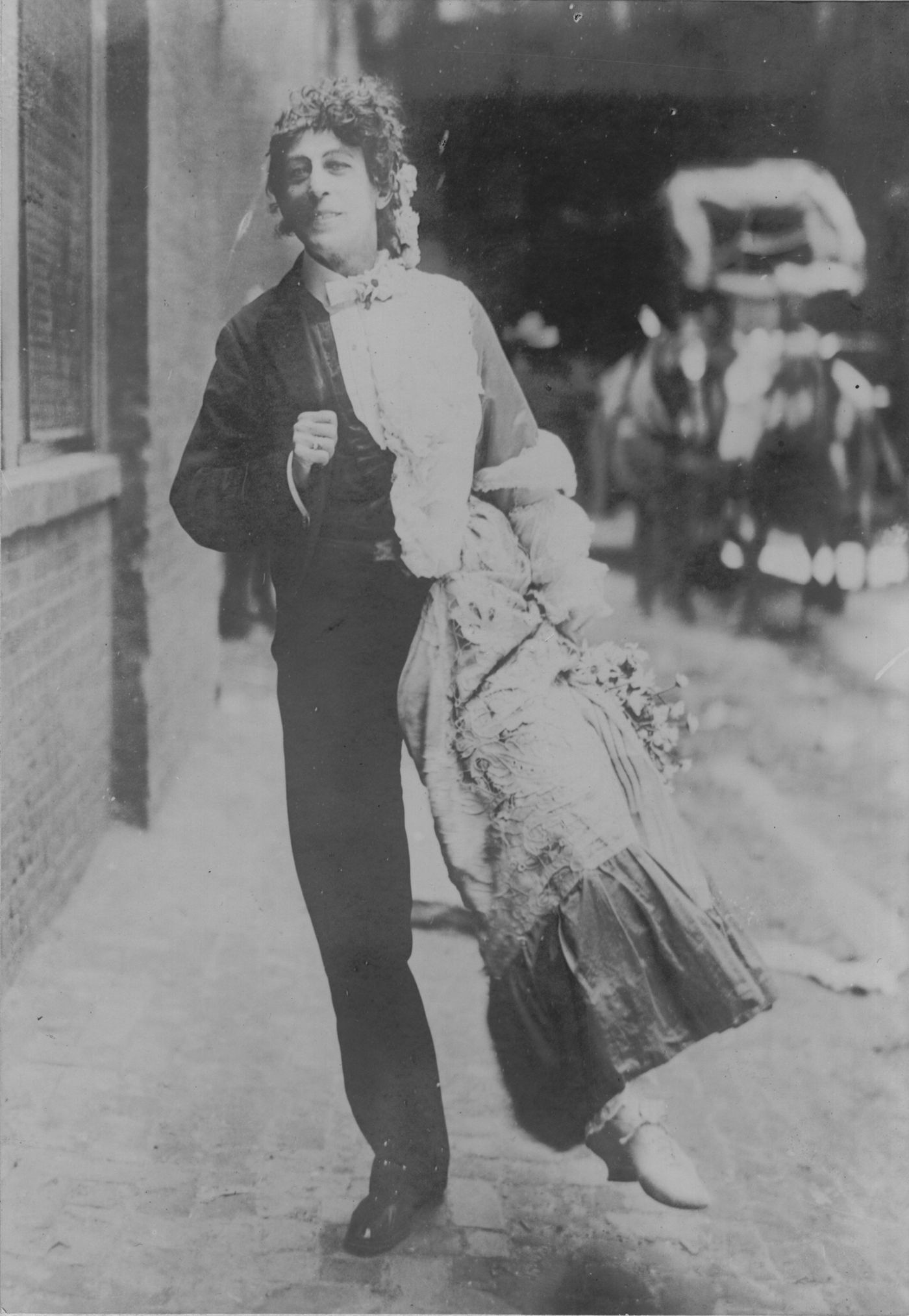
A rare photograph of a nineteenth-century double-voiced singer in costume. The minstrel-show performer, Charles Heywood. Source: Harry Ransom Library, Minstrel Show Collection, Box 33.14.

Cross dressers such as Mora were relatively common in the nineteenth century, but the majority of them were comics who wore women's dresses or male tights as a gag or tease. The fun in the act came from the way they made their audiences aware of their imposture. Female impersonators lifted their dresses to show their boots, offered wisecracks about the tightness of corsets, or threw knowing looks to the audience when they received sexual or romantic suggestions. Sometimes, as in the case of the 1869 Elise Holt's vehicle, Lucretia Borgia, men were cast as women so that they could play against women who performed male roles in tights. Cross-dressing males also performed roles deemed inappropriate for an actual woman, such as those that were bawdy or suggested adultery, spousal abuse, or alcoholism. In contrast, cross-dressing females were generally good-looking young performers who dressed as males to show off their figures. Commenting on Elise Holt's performance in Lucretia, for example, a reporter for the Clipper said that if she “were to lose her lace collar during the performance she would have nothing left to cover her but her boots.”Footnote 15
One of the attractions of double-voiced singing, especially to male performers with soprano registers or good falsettos or to contraltos such as Mora, was that it enabled them to sing sentimental ballads. An uncomfortable feature of cross-dressing for many vocalists was that by singing serious songs they had do what the comics avoided: perform in serious, convincing and appealing ways as a person of the opposite sex.Footnote 16 Because the effectiveness of a ballad lay in the performer's ability to make the audience feel sadness or affection, the rendering of a serious song required the cross-dressing singer to temporarily eliminate his or her actual sexual identity and become a member of the opposite sex. Singing in a double-gender outfit possibly became popular with performers who, because of their vocal range, might have been classed as cross-dressers. because it allowed them to sing love songs when dressed as a woman without resorting to comedy or risking being seen as a biological freak. Both Louis St. Clair and Gus Richards took up double-voiced performance after starting out as cross dressers. Ironically, by becoming outlandish travesties—a man and a woman at the same time—they were able to perform sentimental songs by adopting a female persona without erasing their male identities. As Alexander Tacianu, who claimed to be “triple voiced,” rather indignantly informed the press, he was “never billed as a female impersonator and uses feminine apparel simply in order to have everything in his specialty in harmony.” Other double-voiced performers in the 1880s and 1890s also used their costume as a way of countering any impression of physical or sexual abnormality. The African American double-voiced singer, James Hollis, who performed with the Georgia Minstrels in the late 1890s, for example, used his “sweet falsetto voice” to sing such tender ballads as “Angels are Watching Sweet Baby Sleep,” while demanding classification as a “male soprano.” Similarly, William Everett, who did his act in the conventional side-split costume, billed himself as a “double-voiced tenor-basso monologist and singer,” which left no room for the female part of his act.Footnote 17 By sporting the outfit of twin-bodied freaks, performers such as Tacianu, Hollis, and St. Clair managed, as peculiar as it might sound, to engage in sympathetic female imposture without risk of audiences seeing them as women or freaks.
This suggests an approach to gender quite different from the one that would become normative in the twentieth century. Mid-nineteenth-century Americans did see men and women as different, and they did assign them distinct roles in society: men ran governments and businesses, fought in wars, and were considered more passionate and aggressive; women raised children, looked after the household, and were believed to be more delicate and refined in their feelings. The fundamental understanding of male and female difference was, however, complicated. Some emotions were less intensely felt by women (such as rage or courage) than men; and women were often seen as tougher and less prone to melancholy. At the same time, men sustained loving and tender relations with each other, gossiped energetically, enjoyed sentimental fiction, and were expected to emote (sometimes passionately) in public.Footnote 18 In effect, although accepted gender norms assigned men and women different tasks and placed different expectations upon them, in the mid-nineteenth century, masculinity and femininity included emotions and attitudes that later generations would consider unnatural. Arguably, right up to the turn of the century, double-voiced impersonators were evidencing the persistence of these earlier understandings of gender. The side-split costume made it permissible for men to express emotions that were increasingly seen as feminine and women to reveal a masculine side apparently at odds with society's construction of their gender. In applauding double-voiced singers, audiences implicitly accepted the idea that a man or woman could have both a female and a male voice, and the capacity to express (without burlesque) female and male emotions in song.
In recent years, historians have moved impostures such as Dawron's, Mora's, and St. Clair's to the center of nineteenth-century American culture. As they point out, the most popular forms of entertainment—minstrel shows that presented white men painted black, museums that displayed stuffed mermaids, melodramas that offered a spectacular form of verisimilitude, and a literature preoccupied with false appearances and dark secrets—all explored the idea that appearances could not be trusted.Footnote 19 Double-voiced singers operated within the conventions of this type of art. The ostensible physical abnormality, or freakery, was a deception, a disguise created in order to signify the phenomenon of one person having two voices. The costume, which was patently false, did, however, raise questions about whether the auditors' ears could be trusted. The spectators' eyes took in a performer in a nonsensical disguise, but their ears registered a performer who seemed to have the voices of two different people.
The interplay of fiction and reality upon which the double-voiced act rested was typical of a great deal of nineteenth-century art. Americans seemed to especially enjoy the challenge of distinguishing the true from the make believe. Nineteenth-century entertainment, as cultural historian Benjamin Reiss explains, aimed to produce “a feeling of pleasurable disorientation, a sense of inrushing and vertiginous possibility.” This preference was a product of living in a fluid society where mobility, opportunity, and territorial expansion subverted the order normally provided by hierarchy. The “cultural work” of the country's art was to raise the question of identity and then resolve it in some satisfying way. “It is extraordinary,” a correspondent in the Brooklyn Eagle mused in 1850, “to what an extent humbug has become incorporated with the social system. In fact, it would appear that men have become so habituated to conceal their true motives from each other, that it would be difficult for them to distinguish what they really are, like the skeptic who, from doubting every thing, began at last, to entertain misgivings of his own personal identity.” As historian Louis Warren suggests, this antebellum preoccupation with deception carried over into the late nineteenth century, making American identity itself into something of an imposture, a veil of charades, braggadocio, tall tales, and double meanings. The very name, “Gilded Age,” Peter Argersinger points out, seems “redolent of fraud and artifice.”Footnote 20
The formless appearance of the country's urbanizing, expanding, democratizing, and turbulent society—no matter how central to the American experience—was worrying to those whose status and success depended on the answer to a recurring question: whom can you trust? In a nation of hustlers, Herman Melville joked, “to do is to act; so all doers are actors.”Footnote 21 Art manifested the concerns of ordinary people, as performances called into question the accuracy of the audience's perceptions. Beneath the reality of the face-to-face society of the nineteenth century, where so many people created new personae, ambivalence existed over the morality of “artful deception.” From Davy Crockett to Will Rogers, hucksters and spinners of yarns retained a definite folksy appeal, but what they symbolized was also worrying. As a result, in art, as in life, the public most enjoyed those deceptions that it felt were anchored in something they trusted or knew was right and ethical. The people who wore masks needed a certain gravitas to make them acceptable as cultural icons, whether it came in the form of Buffalo Bill's chivalry or Mark Twain's humanity. Even Melville's anonymous swindler in The Confidence-Man is a congenital and amiable optimist who has the good sense and human decency to abhor scoundrels worse than himself. Americans found it hard to forgive the imposter whose deceptions seemed immoral, which was surely one of the more important lessons learned from the Beecher-Tilton scandal or the spectacular flight of Louis Menage.
In this sense, the question that cultural critic Elizabeth Wilson asks is essential: are deceits that appear to transgress moral codes and cultural expectations actually transgressive, since their “transgression depends on, and may even reinforce, conventional understandings of what it is that is to be transgressed”?Footnote 22 Late nineteenth- and early twentieth-century Americans expected to confront hucksters, and they were attracted to art that manifested their anxieties about truth and appearances. They most approved, however, of the deceptions that they considered harmless or that enhanced expectations about the person, values, or thing perceived. Artful deception was not imagined, generally, as a way of masking the truth so much as telling it better. Exaggeration, or “the lie that tells a truth,” enhanced and made more accessible the talent, heroism, faith, or affection of the deceiver.
Nineteenth-century Americans enjoyed a tall tale, reveled in gossip, and accepted an amiable trick because they were convinced that truth and falsehood could still be judged according to a higher standard. It was possible, they believed, to separate genial exaggeration and profitable imposture from true deceit. They remained confident that deeper truths were more important than the surface fakeries. This is why Ralph Waldo Emerson, who had complete certainty in the existence and perceptibility of higher reality, could genially advise his readers that “we live amid surfaces and the true art of life is to skate well upon them.”Footnote 23 The popularity of deception and imposture hinged on the belief in absolute principles of right and wrong or true and false.
In the late nineteenth century, double-voiced singing rested on confidence in biological sex and then told a visual lie in order to express a truth. When a man sang a sentimental song to himself, flipping back and forth between male and female sides, he was not questioning the fact of gender difference. The boundaries of masculine and feminine which double-voiced singers expressed might have been increasingly archaic ones by the late nineteenth century, but in joining physical and vocal representation, they reinforced the fact of sexual difference. The deception of the freak costume therefore served to communicate the essential truth that men and women were separate and distinct even if one person could contain both voices and express gender-bending emotions.
The bizarre costume worn by double-voiced artists served another function, and that was to represent the vocal miracle of two voices in physical and natural ways. Medical opinion held that vocal range was determined by the glottis (the space between the vocal chords) and later by larynx length, both of which (they insisted) could only be marginally extended through practice. “The ordinary limits of the voice comprehend about two octaves of the musical scale,” physicians maintained, and it was the same for a man or a woman. Those few who “reach the exceptional range of three, and three and a half,” a correspondent in the Saturday Evening Post noted in 1877, had a “natural gift [which] is manifested without culture.” Training, it was believed, provided “suppleness and intensity” but could not to alter the singer's actual range. The possession of a voice that extended much of the way from 80 Hz to 1100 Hz (E2 to C6) was a wonder, but it was unconnected to the sex of the vocalist and was innate rather than learned.Footnote 24
If deceits like the man/woman costume, which enhanced audience perception of the ability and “natural” physiology of the performer, remained a prominent feature of nineteenth-century cultural expression, how did the perception of double voicedness change when confidence in the fixity of natural order diminished? Gilded Age audiences understood double-voiced performers to be freaks to the extent that they naturally possessed two distinct voices. They also saw them as performers who used a costume to enhance appreciation of their vocal abnormality. This view rested on lingering confidence that God determined the boundary separating the sexes, that wondrous and singular exceptions to nature were miracles or horrors, and that everything in life had a purpose and communicated a moral message. Increasingly, however, science, philosophy, and biblical criticism raised questions about the unchangeable perfection of “nature.” These questions provoked a cultural revolution. As historians have shown, in the last decade of the nineteenth century, racial segregation, nativism, imperialism, and the destruction of Indian cultures were all conceived as “modern” measures justified by science and, in particular, by pseudo-Darwinian notions of social evolution. Underlying these movements was a sense that the superiority of white Christians, God's chosen people and the standard against which others could be measured, was no longer assured and had to be engineered.Footnote 25 Cultural and sexual miscegenation, for example, moved from being an unfortunate though personal failing (a surrender to passion) best kept quiet, to a racial threat that had to be stamped out by force of law. The erosion of confidence in the certainties of physical existence and their gradual replacement by a sliding scale derived from legal, scientific, material, and personal assessments of truth, virtue, and value created a paradox. People became less receptive to challenges to core values than before. As faith in the fact that everything served a divine purpose gave way to the conviction that American society would fail if it did not establish its own rules and solve its own problems, tolerance narrowed for those who profited from lies, abused public trust, or threatened what was now seen as a man-made racial and sexual order.
These attitudinal changes were not just evident in politics, the academy, or elite culture. What the history of double-voiced performance suggests is that as the basis of core values shifted and as tolerance for what lay outside social and scientific normality diminished; even popular entertainers stopped wanting to present themselves as being deceitful or freakish. From Dawron's first stage turn in 1860 to Gus Richards's premiere in 1900, the bizarre costume of the double-voiced singer served as a signifier of unconventional vocal ability rather than sexual abnormality. In the 1880s and 1890s it may even have been used as a way of re-gendering female impersonators who wanted to continue singing romantic ballads as male. The meaning of the costume changed, however, as Progressive Era audiences became less tolerant of acts that implied biological deviance. With confidence in the fact that history and nature moved according to a celestial plan eroding in the 1890s, and with growing “scientific” evidence showing that sexual identity was inherited, Americans began to believe in the existence of a third sex that was neither male nor female, one that arose out of social practice but that gained physiology permanence through heredity.Footnote 26
As historians of fin-de-siècle sexuality make clear, in the decades around 1900 there was an increasingly public discussion of “sex inversion.” In 1892, the “lust murder” of Frida Ward by Alice Mitchell put lesbianism in the headlines. In 1907, Indiana became the first jurisdiction to legalize the sterilization of homosexuals and other “sexual perverts,” and by World War I, fifteen other states had followed suit. The 1912 vice trials in Portland, Oregon, made front-page news when local police charged dozens of men as “perverts.” These events helped to shape the perception of homosexuality as a dangerous subculture. In his 1915 edition of Sexual Inversion, Havelock Ellis insisted that in American cities, 99% of normal men had been “accosted on the streets by inverts … it is a community distinctly organized.” Homosexuality came to be seen as a dangerous congenital disease, a form of physiological degeneration: a freakery. Under the influence of pseudo-Darwinian notions that biology adapted to behavior, medical experts called for therapeutic and punitive measures to prevent practices (such as onanism or effeminacy) that could be passed from generation to generation. These experts traced a direct connection between a social practice and a physical inheritance. Sodomy, for example, warped sexual identity, and the character mutation could be passed down to the sodomite's children.Footnote 27
The growing association of homosexuality with biological abnormality produced by “immoral” or “unnatural” behavior made both playing the visual freak and sounding like an invert rather less appealing. Consequently, in the first decade of the twentieth century, double-voiced singers abandoned their conventional freak costume even though they continued to sing in voices that seemed by turns male and female. Breaking so radically away from the traditions of the museum stage may have eliminated the perception that they were unnatural, but it created a new set of problems for double-voiced performers. If the sex of the singer's two voices was no longer going to be defined visually, how could it be coded in ways that audiences would find comprehensible and appealing?
Early in 1910, a small, dapper young man from California, Luciano Lucca, made his first appearance at the Majestic Theatre, a Chicago vaudeville house. He crossed the stage in male evening attire, looking “a little funny” under the spotlight, and then began to sing in a high soprano voice. The audience did not like what it heard and “murmurs of derision” arose, for, despite the impressive “trills, runs, cadenzas and all sorts of twists” Lucca provided in his opening song, “he displayed only his soprano tones.” For his second contribution, the singer switched to baritone but the atmosphere in the theater remained hostile. The audience only warmed to Lucca after his final selection, a duet in which he sang both baritone and soprano parts. At the close, he received “enough applause to cover for three bows.”Footnote 28
Lucca's voice carried him across a visual divide, and he needed to affirm his connection to the double-voiced tradition—by singing a duet—to restore himself to his audience's horizon of expectations. Appearing as a man in evening dress and singing as a woman now aroused too many negative connotations. In subsequent performances, Lucca tried various ways of sexually coding his voice without un-gendering himself. He experimented with offering his first “soprano” song offstage, “causing the audience to guess whether it is a man or a woman” who was singing. He also adopted the practice of entering and exiting between numbers with some costume adjustment (he does not seem to have ever worn a dress), apparently in an effort to convince the audience that he was two people. His agent, in the meantime, released a fabricated story about him being an opera star from La Scala in Milan who one day “unconsciously” began singing along with a “famous” soprano while rehearsing Lucia di Lammermoor. “His clear soprano,” apparently “astounded” everyone, not least the singer himself, “who had never sung anything but baritone.” This launched his career as “a dual vocal wonder.” The critics, unfortunately, remained unconvinced by these efforts to legitimize the sexual transgression that Lucca's vocal promiscuity implied. They repeatedly commented on his small stature, and the reporter for Variety even declared that to make it big he “should be given … some kind of a costume—then Luciano wouldn't look so funny in the spotlight.” Footnote 29
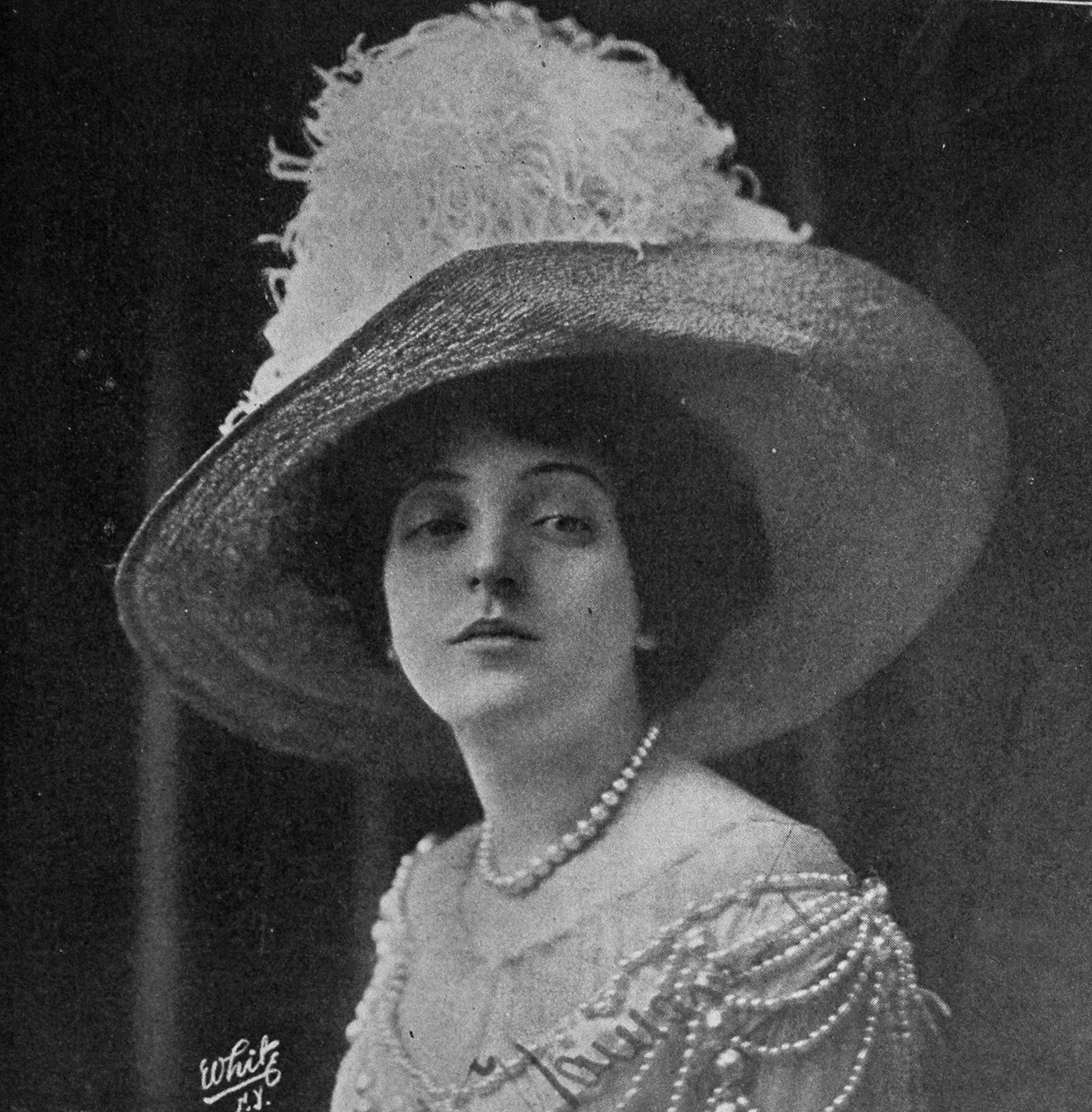
Luciano Lucca disturbed critics when he used his “soprano voice” because he seemed to them insufficiently “manly.” Source: “The Love I Give to You,” Grinnell Bros. Music: Detroit. New York Public Library, Music Division.
Lucca was not the only artist in the prewar decade to probe and then retreat from the sexual boundaries that had hitherto normalized conventional double voicedness. Bob Albright, “The Man Melba,” proved even more disconcerting to critics in 1910 because, unlike Lucca, he was a “manly and very good looking fellow.” Albright came on stage singing “coon songs” in a rich baritone. Only after establishing his male persona did he astound his audience when, for his final two selections, he “utilized his soprano” voice in what one reviewer described as an unexpected “freak attack.” Doubting that a person so conventionally manly could sing with a woman's voice while dressed as a man, another critic insisted that it was some kind of ventriloquist act. The puritanical reporter for Variety, who was extremely uncomfortable with the separation of sound and image, considered it a “surprise that Albright sings soprano at all, with his appearance.” Like Lucca, he did not do so for long. Recasting himself in late 1911 as Oklahoma Bob, he relaunched his career as a singing cowboy, and in this guise he employed his soprano tones in the more manly art of yodeling.Footnote 30
Both Lucca and Albright hoped to turn their vocal ranges into money and celebrity, and apparently neither wanted to cast themselves as stage freaks. The irony is that by forgoing the costume that coded their vocal abnormality, their voices threatened to turn them into real-life “inverts.” The different conventions of the theater and the museum partly intruded here. Vaudeville occasionally featured “natural” curiosities—such as sports heroes and animal performers—but it was a theater where culture, not nature, was on display. The vaudeville context shaped expectations for critics, entertainers, and members of the audience. Vaudeville spectators assumed that performers were sharing the fruits of their training and talent, not their physiology. In fact, in order to prove that she was not a freak, one double-voiced singer in 1909 told the press that a physician even inserted a mirror into her throat while she sang and concluded that there was nothing abnormal about “the play of her muscles” (how she managed to sing in this state is a bit puzzling).Footnote 31 But if vaudeville eliminated the freak element in double-voiced singing, how could this performance be explained? If a man in a vaudeville house chose to sing like a woman, then it suggested that there was something wrong with him; by refusing to place themselves visually or sonically in the freak tradition, Lucca and Albright put their own sexual orientation on show.
These concerns had a predictable result: they quickly drove men out of double-voiced performance. Males dominated the art from the 1870s through to 1900, but by World War I, all of the notable double-voiced singers were women. This suggests the greater openness of Progressive Era audiences to the façade of a manly woman than a feminized man. Like Lucca and Albright, female double-voiced singers after 1900 eschewed the traditional duple costume, which meant they still had to explain their ability to impersonate a man. Moreover, they had to do so in terms of their talent while affirming that they had not chosen to become vocal freaks. Many of them approached the problem in the same way as Luciano Lucca, by claiming to be trained opera singers who only “discovered” their double voice by accident. Once they “discovered” their natural ability, they put it through rigorous vocal training to make it effective. Emma Carus maintained that her mother, an opera singer, taught her to sing in a baritone and that her agent had suggested she emulate Helene Mora and use her “secret” opera voice. Claire Rochester's press releases reported that she attended the Boston Conservatory where she refined the voice she had “discovered” in a Catholic boarding school.Footnote 32 But Dorothy Toye offered the most intricate story of all.
Double-voiced singers of the early twentieth century rejected the “vocal freak” billing. Madame Dorothy Namara-Toyé, the former Dollie Toye, insisted that her unusual vocal skills were refined through studies in Paris with the great Jean de Reszke. Source: New York Public Library, Billy Rose Theatre Collection, Robinson Locke Collection, envelope 2376.
Toye was born Marguerite Banks in Cleveland in 1888. Her father, William A. Banks, was a fruit wholesaler and for a time the family lived in Portage la Prairie, Manitoba, before settling in Los Angeles in 1894. Her mother taught her to sing and she took lessons at St. Vincent's Academy for Girls. In 1907, she went to Milan for further studies, accompanied by her mother, Margaret McNamara Banks. There she studied to become a dramatic soprano, and she claimed to have debuted in Genoa singing Marguerite in Gounod's Faust in 1908. If she did make it to a European opera stage, which is doubtful, she found little success there. In the summer of 1908, she was back in Los Angeles with her mother. Two years later, under the name Dollie Toye, she walked onto the stage of a vaudeville theater in Chicago performing as “the girl with the Jekyll and Hyde voice.” Toye claimed at various times to have been born in Canada, California, and Minnesota; to have “discovered” her male voice in a boarding school in Michigan or Canada; and to have studied at Vassar, the Conservatoire de Paris, and as a private student with the renowned tenor Jean de Reszke. She left America as Dollie Toye, a double-voiced vaudevillian at the end of 1909 and returned as Madame Namara-Toyé, a dramatic soprano from Paris with unexplained Japanese roots, in February 1912. After a short-lived career as a classical musician (she sang with the Philharmonic Orchestra and at Carnegie Hall and went on tour as a soloist with a Russian American orchestra) using her new name, she resumed her vaudeville stage career in 1913 as a double-voiced singer.Footnote 33
All of these performers maintained that they only turned to vaudeville when they discovered their second singing voice. Toye, however, insisted that hers was not her “natural” voice, despite her “freak” billing. Like Carus and Rochester, she maintained that her male voice, as she put it in a 1913 interview, “is a real voice, though quite distinct and apart from my own.” Like Rochester, who said she resented being classified as a “Jekyll and Hyde freak,” Toye said her voice was not a “trick” or a “deception,” but something “cultivated.” Nature provided only the raw vocal materials. Her ability, Toye explained, “[was] not a natural gift, but a mastery of vocal technique.” The fact that so many double-voiced artists in the early twentieth century presented their voices as trained (a fabrication in many cases) was important as it suggested to audiences that the singers had not grown up as biological freaks and that they were artists instead of curiosities. In this way, vocal training took the place of the implausible split costume, becoming a way to expose the artifice involved in the act.Footnote 34
Some double-voiced musicians in the early twentieth century found additional ways of filling the gap that their performance choices opened between nature and nurture, sound and sight. Audiences and critics expected double-voiced singers to have two voices that suggested two people. In order to maintain that impression, Lucca sang as a soprano offstage; and the African American contralto, Flora Batson, adopted the trick of looking around in surprise when she first sang as a baritone. Toye copied the mannerisms and phrasing of the tenor Enrico Caruso and introduced her male voice by singing one of the arias most associated with him (La donna è mobile from Rigoletto or Vesti la giubba from Pagliacci), thereby suggesting she was an impersonator. Claire Rochester's gimmick was to begin her act in a completely darkened theater, singing a ballad in a “man's voice” and continuing in the dark for several minutes before “a spotlight would switch on to reveal her femininity.” According to one critic who sat peering into the darkness: “the effect is very realistic and one would imagine that a man were [sic] singing.”Footnote 35
Toye associated her double voice with well-to-do culture by performing popular operatic numbers and claiming a connection with recognizable institutions and people (Vassar, the Conservatoire, La Scala, and Caruso). By directing their ears to grand opera, Toye sought to add cultural credibility to her act. “The girl with such a remarkable range as to be termed double voiced is not a freak singer,” an interviewer explained, “her tenor is trained as well as her soprano … Miss Toye's voice is simply a wonder or marvel, but withal a natural one, finely and exquisitely trained.” It did not hurt her image management that Toye, with her youth and mass of red hair, was considered very pretty. In fact, her delicate and “bewitching” appearance in all likelihood made her “baritone voice” sound all the more shocking and wonderful.Footnote 36
Claire Rochester employed similar tricks. She was just twenty in 1912, when she broke into big-time vaudeville, and she transfixed reviewers with her “stunning appearance.” One reviewer called her a “beautiful woman with a phenomenal voice,” while another described her as “an attractive girl with a big beautiful voice. Another critic observed that Rochester was “a dainty little creature, graced with beauty and a voice.” Her attractiveness coded her in a particular way, and it encouraged critics and publicity agents to disassociate her baritone from a masculine identity. According to the press, her voice was “charming,” it had a “limpid sweetness” being “sweet toned” with her low notes being especially “beautiful”; her baritone voice had “depth and soul”; she was possessed of a “beautiful contralto” and a “big beautiful voice.” In what can be read as a further attempt to shift attention away from the gendered binary, Rochester started to insist in 1913 that she actually had four voices, which she demonstrated by closing her act with the quartet from Rigoletto “as it was originally written.”Footnote 37
Rochester did not allow conventional notions of femininity to constrain her voice. Instead, she explored the transgressive possibilities of having a man's voice by acting like a “tomboy.” Lucca never found a way to answer questions about his sexuality, and his career was short lived. Rochester, however, successfully filled the gap between her sex and her “cultivated” male voice that the denial of visual freakery created. She turned her “natural” manliness into playful energy. She was featured in the press racing cars, riding horses, cheering on the Boston Braves, urging men to enlist during the World War I, and exuding a sense of fun that “flashes from her like electric sparks.”Footnote 38
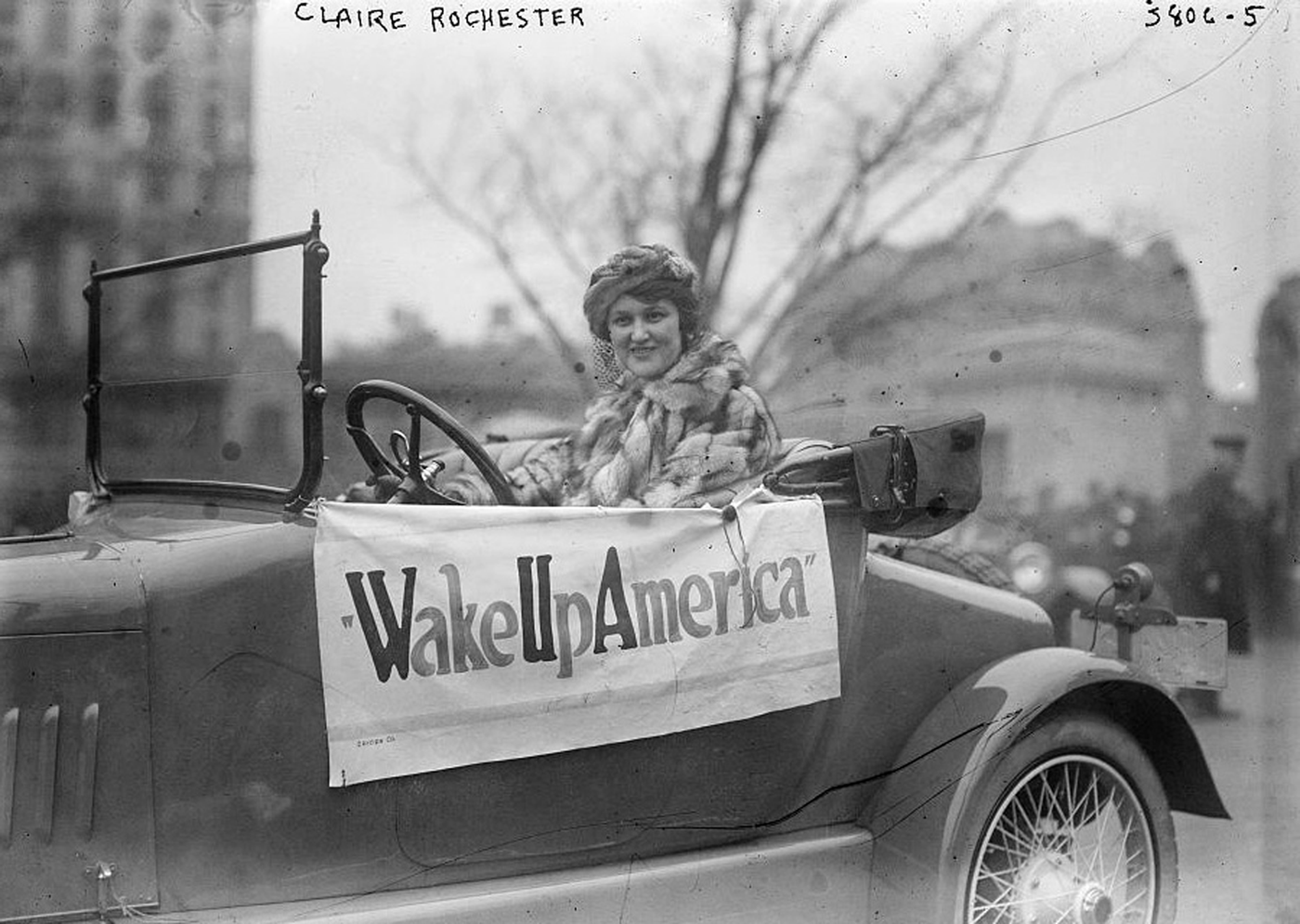
Claire Rochester in her Golden Flyer, campaigning for the “Wake up America” Liberty War Bond drive of April 1916. Source: Library of Congress, Prints & Photographs, LC-B2-3806-5.
Similarly innovative as a convention breaker was the double-voiced vaudevillian, Emma Carus. Carus was a German-born singer who migrated to the United States when she was a teenager. She made her debut in regional variety in 1894, and a year or two later her agent suggested that she make something more of her loud contralto by billing herself as a “female baritone.” Her main rival in that line was Mora, but, where Mora sang in male attire, Carus chose to continue showing off her long flaxen hair and well-turned legs “beautifully fitted in pink tights.” Like Lucca, she manipulated the sexual imposture of double voicedness by singing as a man while dressed as a soubrette. The original freak outfit was transformed here into visual/vocal incongruity, but Carus gained acceptance in her performance where Lucca did not.Footnote 39
Like Rochester, Carus presented a funny, outgoing, and sexy stage persona. She projected an interest in pursuits conventionally coded as masculine even though, unlike Rochester, she was a Giants fan. She specialized in “coon songs,” which she delivered in the expected “stage Negro” dialect but with a German accent. She claimed to have learned African American speech “from a Kentucky colored man known only to posterity as Frog Eyes. This dusky person also taught me to do the toodolo dancing step and the cakewalk.” This was a shocking thing to say, not just because white women were not supposed to learn how to talk and move from a black man, but also because the toodolo was considered a risqué dance. According to a critic who saw her at the Cherry Blossom Grove in 1901, the songs she sang were “very bad [read: indelicate] coon song with even worse movements.” Another critic remembered how in one number she stripped off her costume to reveal “the thinnest of bathing suits in full view of the audience” and how the males in “the gallery rose as one man and demanded for her a niche in the temple of dramatic triumph.” One of Carus's biggest successes came when she premiered Irving Berlin's “Alexander's Ragtime Band,” and one can imagine how she carried that song with swinging hips and booming baritone voice. “Her powerful voice was wont to shake the dust off the rafters, and that pleased the youngsters who sit in the lofts ... they are of the opinion that if any of those opera house vocalists ever heard Emma singing ‘I Just Can't Help Lovin’ Dat Man' they would quit cold.”Footnote 40
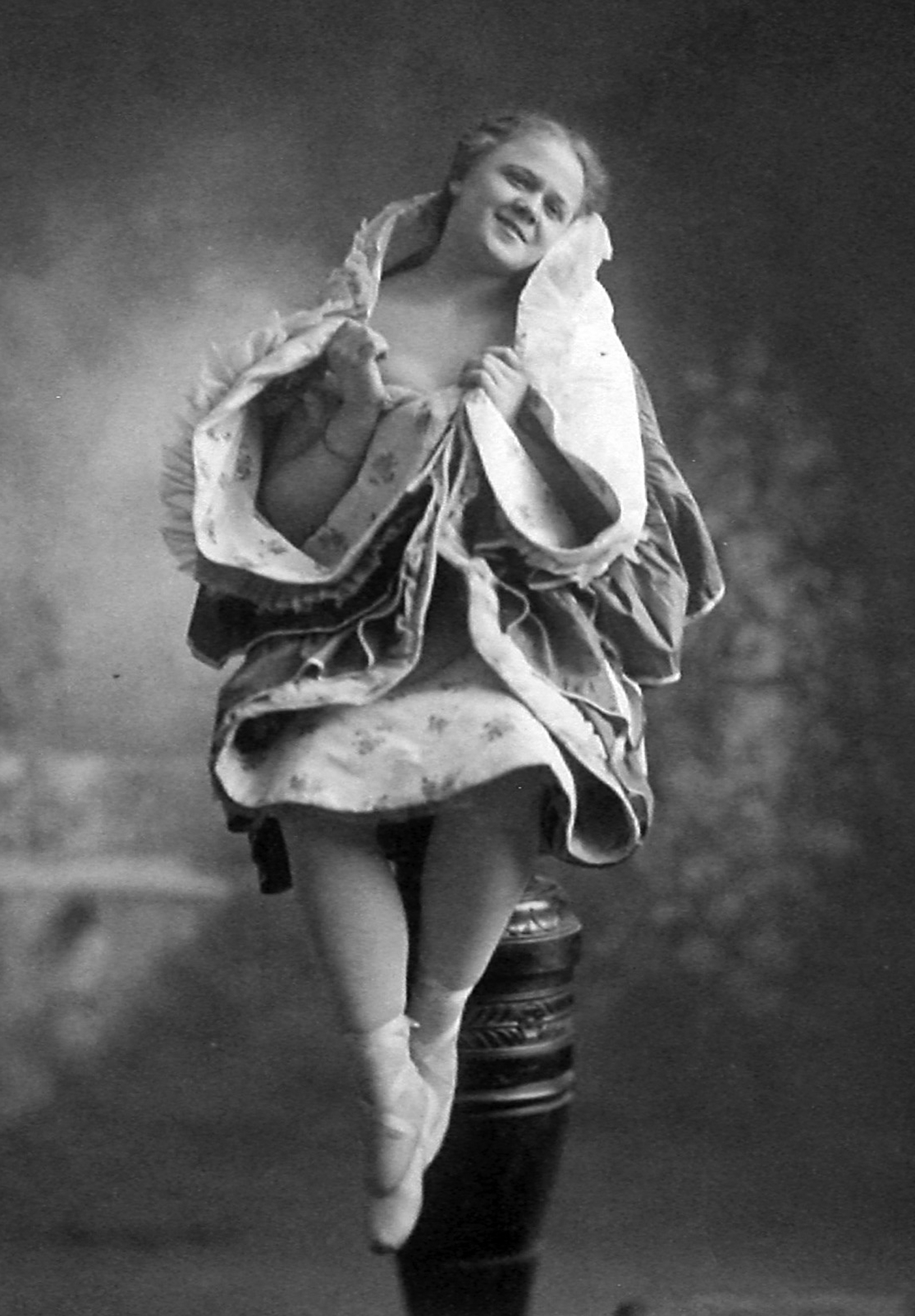
Emma Carus flirts with us from atop her pedestal c. 1900. Source: Photographer: Arthur Gilnes, David S. Shields Collection.
As with Rochester, reviewers feminized Carus's powerful voice in order to realign the vocal and visual codes and eliminate the possibility of seeing her as a “pervert.” “Strictly classified,” explained a western New York columnist, “she is a baritone of the purest quality,” but “her voice has a wonder of pathetic sweetness in it. The depth is remarkable but in no way is the charm of femininity lost.” Carus reinforced this view by embracing the freedom her manly voice allowed her. She projected an image of vigorous heterosexuality and was somewhat notorious for the number of men she had romanced, engaged, married, and divorced. Newspapers in 1902 reported one woman attacking her with a horsewhip for seducing her brother. A stage routine at the Palace in Chicago with the comic Larry Comer played off her reputation for promiscuity. “How many times have you been married?,” Comer wondered. “Fifty-five [times], not counting my last husband,” Carus replied. “What is your idea in marrying so many times?,” inquired Comer. “Some time,” she retorted, “I may get a good one.”Footnote 41
Where Lucca seemed small and effeminate, and so offended audiences when he sang like a woman, Carus was sexy in conventionally female ways and she appears to have titillated audiences when she sang like a man. It was not, therefore, the imposture that raised eyebrows, it was the connection of the imposture to the perception of the performers' actual sexual identity that troubled audiences. Carus might be seen as sexually provocative and Rochester as a tomboy, but they were classifiable and acceptable female types. As had always been the case, acceptable truth legitimized artful deception. Expressing that truth was harder once double-voiced singers gave up their freak billing, but it remained no less crucial.
Part of the reason why Toye, Carus, and Rochester were able to navigate the treacherous waters of identity was that they were major vaudeville stars who benefited from a good deal of media coverage. They were interviewed in the newspapers, had agents controlling their press releases, and found ways to manage their image, thereby influencing their audiences' perceptions. They worked with the reviewers to create personae for themselves that made their double-voiced performances acceptable to a society concerned with sexual deviance. By managing their images, they were able to successfully manipulate female gender conventions while staying clear of the ultimate stigma of homosexuality. They did so by placing their voice in the context of the new woman, a potent symbol in the early twentieth century, which allowed them to associate their manly side with energy, dynamism, physical activity, and sexual freedom. The control these vaudeville artists exercised over the way they were seen was a big change from the days when double-voiced singers were museum curiosities.
Image management was important because these vaudeville artists negotiated the separation of sound from sight that the renunciation of visual freakery imposed. In becoming conventional, at least in terms of dress, the double-voiced performer had to explain how he or she sang like someone of the opposite sex without the deceptive aid of a costume. The dissonance of codes did create transgressive possibilities, which these artists had to manage or exploit. Actors, agents, managers, and reviewers worked in the successful cases as a community to establish a public stage onto which the unconventional artist could safely appear. Although none of these vaudeville artists wanted to cross the ultimate boundary between normative sexual identities, several of them used their voices to expand the gender horizon on which they were seen.
The history of double-voiced performance illustrates the changes affecting both freak performance and the culture of imposture. It reveals the constant element that grounded artful deception in the Gilded Age and Progressive Era: it was a lie that had to enhance appreciation of a greater moral or artistic truth. This was not just the case with double-voiced artistry, as many of the characteristic cultural phenomena of the period involved an intermingling of fact and fiction. Real people played themselves on stage, escape artists were thrown shackled from bridges, and Buffalo Bill transformed an imagined West from myth into popular reality.Footnote 42 It was an age when art was expected to reveal truth, even if it used fabrication to do so. This remained the prevailing ethos of entertainment through the early nineteenth century, even in so dissonant and anarchistic a theater as vaudeville.Footnote 43 But the erosion of confidence in inherent moral truths changed the way in which artists told their stories and revealed their talents.
When Dora Dawron first stepped, crab-like, onto the stage of Barnum's American Museum in the fall of 1860, she had not intended anyone to see her as a sexual freak. Quite the contrary, she wanted them to hear her as a vocal wonder, and she used physical imposture simply to heighten the impact of her two voices. Her successors wanted to project the same image and, although they adopted her peculiar split-sex costume, they never suggested that they were abnormal in any respect other than their voices. Maintaining this pretense, so important to the impression that they hoped to make, became harder after 1900. New scientific approaches to what made people male or female filled gender-manipulating freak acts with a sexual implication. Now artists had to define their voices as trained, rather than “natural.” Simultaneously, the artful disguise became less artful as the audience began to doubt its own ability to see through the mask or to separate the surface from the essence. This was the deeper current produced by the emerging science of sexual identity and by the crisis of belief.
The pleasure of imposture in the nineteenth century and its widespread acceptance rested on the conviction that people could look through the ostensible and perceive an inner truth. When that truth was benign and enhanced by imposture, they enjoyed the pretense as an instructive or playful deceit. When science, technology, and high criticism troubled the stability of the true, however, the pleasure derived from layering falsehood upon truth became less automatic. A few deceptions—cosmetics, for example, which were reimagined as enhancing rather than masking natural beauty—continued to fit the older model, but many of the new arts of disguise now required policing to ensure their morality. In the early twentieth century, imposture lost some of its charm as the state, the knowledge factory, and science replaced eternal and perceptible truths as the arbiters of the ethical lie.