

1. Introduction
On 21 September 2007 the Panel issued its final report in Turkey – Measures Affecting the Importation of Rice.Footnote 1 The action, brought by the United States, with Argentina, Australia, China, Egypt, the EU, Korea, Pakistan, and Thailand as Third Parties, challenged various aspects of Turkey's import restrictions on rice. Turkey is a producer and net importer of rice. Since 2004 Turkey has officially structured its import regime of rice in the following manner: (a) for some periods between 2004 and 2006, Turkey had in place predetermined tariff-rate quotas (TRQ) with those ‘in-quota’ imports being offered at preferential tariff rates; (b) for free-trade-agreement partners EC and Macedonia, a minor fixed zero-tariff TRQ was in place; and (c) ‘over-quota’ imports were being submitted to MFN tariff rates of 34, 36, and 45% ad valorem (depending on the type of rice).Footnote 2 (Turkey's WTO bound rate for rice is 45% ad valorem.)
Three circumstances of Turkey's import regime are of significance for this dispute: First, all rice imports required an approved Certificate of Control (‘Certificate’) from Turkey's Ministry of Agriculture and Rural Affairs (MARA). Second, Turkey seems to have adopted a policy of denying Certificates of Control to over-quota rice imports at MFN rates (at least to those originating in the United States). This policy resulted in the practice of effectively channeling all rice imports through in-quota TRQ imports. Third, the TRQ exhibited the unique feature of a domestic purchase requirement: importers could import foreign rice only if they also bought a significant share of domestic rice, either directly from Turkish producers or from the Turkish Rice Board (TMO), a governmental intervention agency.
From a domestic political point of view, Turkey's import policy for rice made absolute sense. Given the twin goals of achieving the complete absorption of domestic rice production and of maintaining high producer prices, the choice of channeling imports through the TRQ was an effective policy, especially for a developing country that lacks sufficient funds for creative subsidization policies. Turkey needs between 250,000 and 300,000 tons of rice imports each year to satisfy domestic demand. TRQs, provided with a domestic purchasing condition, were a good mechanism to flexibly regulate importation while keeping up domestic demand (and therefore prices). This measure seems superior to using a tether between bound and applied rates, costly production subsidies, or charging an intervention agency to tamper with domestic prices by means of building up and liquidating stocks.
However, from an international legal standpoint, Turkey's red-tape measure was contentious. The United States challenged Turkey's denial, or failure to grant, out-of-quota import licenses, as well as the domestic purchase requirement for in-quota imports of rice, as inconsistent with Articles III:4 and XI:1 of GATT 1994; Article 4.2 of the Agreement on Agriculture (AoA); Article 2.1 and paragraph 1(a) of the TRIMs Agreement; and Articles 3.5(e) and 3.5(f) of the Import Licensing Agreement.Footnote 3
The Panel concluded that Turkey's practice of denying approval of Certificates for various periods of time for importation of rice outside of the tariff quota amounts constituted a quantitative import restriction and a practice of discretionary import licensing, neither of which are permitted under the Agreement on Agriculture (AoA), Article 4.2 and footnote 1.Footnote 4 With respect to the in-quota TRQ regime, the Panel found inconsistency with GATT Article III:4: ‘[T]hrough the requirement that importers must purchase domestic rice in order to be allowed to import rice at reduced-tariff levels under the tariff quotas, Turkey accorded less favourable treatment to imported rice than that accorded to like domestic rice.’Footnote 5 The Panel addressed only the GATT Article III:4 and AoA Article 4.2 challenges; it declined to consider the rest on grounds of judicial economy.
If Turkey–Rice has any lasting significance, it is likely in the lesson it offers for responding Members that refuse to cooperate with the Panel: failure to respond to a Panel's request for information may greatly reduce the burden on the complaining Member to demonstrate a prima facie case before the burden of proof shifts to the responding Member, because the Panel may be prepared to assume or infer certain key facts rather than requiring the Complainant to prove them.Footnote 6
The actual drawing of such inferences, as distinct from the threat, has been relatively rare in Panel and Appellate Body proceedings, but in this case the Turkish recalcitrance to answer the Panel's repeated requests for information was particularly blatant. Once the United States had established its prima facie case and the burden had shifted to Turkey, Turkey was placed in an impossible situation: it could either refuse to provide the incriminating data and allow the inferences to be drawn (as it did), or produce the documents that likely would have established the veracity of the allegations by the United States.
In Section 2 we discuss the facts and the contentions of the key parties, the United States and Turkey. Section 3 addresses the rationale and conclusions of the Panel. Section 4 analyzes the legal and economic significance of the report. Section 5 briefly summarizes our main findings and their likely impact for future WTO litigation.
2. Summary of facts and contentions of the parties
The Turkish rice market is complex, as the Panel's characterization of the facts of the case show. At various times, the United States, Egypt, the EC (Italy and Bulgaria in particular), China, Australia, Ukraine, Viet Nam, and Thailand exported rice to Turkey. Distance is a factor in rice shipments. Because of the longer shipping distance, US exporters tend to make fewer shipments of larger allotments, typically between 10,000 and 20,000 metric tons each. What likely concerned the United States most was that, for a 20-month period in 2004 and 2005, no over-quota shipments of US rice to Turkey had occurred.Footnote 7
2.1 The facts
The essential facts are confusing and incomplete. What follows is an attempt to summarize the main facts and events.
2.1.1 Overview
Turkey is a producer and net importer of rice.Footnote 8 Its annual consumption varies between 540,000 and 570,000 tons. Rice comes in three aggregation forms: ‘paddy’ and ‘brown’ rice are preliminary stages; both can be converted into (and are consumed as) ‘milled white rice’. Three import regimes existed at the time of the complaint. There is a small fixed zero-rate quota for preferential trade agreement partners,Footnote 9 a second category of TRQ-cum-domestic purchase requirements,Footnote 10 and a third category of over-quota imports subject to Turkey's MFN duties at a bound rate of 45%. Under Turkish law and administrative practice, an approved Certificate of Control is a necessary but not a sufficient condition for importation of rice. Certificates are issued by the Ministry of Agricultural and Rural Affairs (MARA). The Certificate is submitted to Turkish customs authorities at the port of entry. Officially, Certificates may be refused for a variety of reasons, primarily related to noncompliance of imports with the specifications in the Certificate or inconsistency with SPS requirements.Footnote 11
2.1.2 Over-quota import regime
Evidence presented by the United States indicated that Certificates for over-quota imports had been denied during certain periods after September 2003 and that the time periods for accepting Certificates had also been restricted from time to time.Footnote 12 Importers of US rice had their Certificate applications denied repeatedly, ostensibly on grounds of spelling errors and other formal bagatelles. The Panel concluded that MARA's General Directorate of Protection and Control had ‘repeatedly and periodically’ issued recommendations to the Minister of Agriculture to temporarily suspend Certificates for importation of rice outside of the tariff quota limits (so-called ‘letters of acceptance’).Footnote 13 At one point the Ministry of State of Turkey advised the US Trade Representative that he would see to it that Certificates for imports from the United States would be issued again in April 2006, suggesting that prior to the issuance of that letter such Certificates were being denied for domestic political reasons.
In some instances, importers of US rice appealed the rejections of their Certificate applications before Turkey's administrative court. The administrative court rejected the importers' appeals, inter alia, by giving effect to the ‘letters of acceptance’ by MARA's General Directorate of Protection and Control, in which the General Director advises/recommends to the Minister of Agriculture that he temporarily suspend the granting of over-quota Certificates (claiming that supply is secured with domestic and in-quota rice imports).
Among the administrative court's reasons for restrictions on imports were the protection of domestic rice producersFootnote 14 and Turkish government agency determinations that existing rice stocks in Turkey were adequate for the nation's needs. All challenges by importers contesting MARA's denial of Certificates in Turkish courts were resolved in favor of MARA. One administrative court dismissed a challenge to a Certificate rejection on the ground that it was legal for MARA to reject applications based on adequate supply, and to continue refusal to approve certificates until domestic consumption volumes and trade policies were reviewed.Footnote 15
The (undisputed) evidence at hand supporting the US contentions is: (a) a handful of rejection letters (whether as evidence of a deliberate government practice or simply of isolated events); (b) letters of acceptance, providing evidence of recommendations to the Turkish Minister of Agriculture by a high MARA official to temporarily suspend the granting of over-quota Certificates as a matter of general policy at various times; and (c) a continuing stream of rice imports into Turkey – whether through in-quota or over-quota imports is unclear. This evidence raises the question whether the rejection letters submitted by the United States are evidence of a systematic trade restriction, at least of US imports (as claimed by the United States), or simply isolated instances of Certificate denial based on formal shortcomings in the Certificate application process, as claimed by Turkey.
Turkey alleged that some 2,242 Certificates had been authorized by MARA between 2003 and November 2006, claiming that 95% of total Certificate applications were officially approved between 2003 and November 2006,Footnote 16 and that 59.5% of the Certificates were allotted to over-quota imports (i.e., MFN or FTA trade). Turkey also stated that ‘letters of acceptance’ had no legal bearing on decisions concerning granting of Certificates, and that the Minister of Agriculture had no legal authority to restrict rice imports. Moreover, according to the Turkish defense, the administrative court wrongly gave legal effect to the letters of acceptance addressed to the Minister of Agriculture.
The crux of the matter, however, is that Turkey, despite repeated requests by the Panel, did not provide crucial exonerative information. Turkey based its refusal to provide information on an obscure domestic criminal law relating to disclosure of ‘confidential’ information. Despite multiple requests by the Panel, Turkey refused to provide to the Panel blacked-out copies of the 2,242 granted Certificates, or the 56 blacked-out copies of denied and resubmitted Certificate applications, identified by the United States as being the most crucial evidence.Footnote 17 Turkey also refused to provide information on those instances where letters of acceptance, i.e. recommendations by MARA's Director General, were not implemented or were explicitly rejected by Turkish import authorities.Footnote 18 Turkey did submit summaries of the Certificates and a list of the rejected applications, along with reasons for denial.Footnote 19
Turkey offered to submit the 56 rejected, resubmitted, and eventually approved Certificate applications on the condition that they would be made available only to the Panel and to the Secretariat, but not to the United States or the Third Parties. The Panel rejected this offer because of the prohibition in DSU Article 18.1 barring ex parte communications between the Parties and the Panel, noting that Turkey had not made any request for special treatment of confidential information in the course of the Panel proceedings.Footnote 20
Thus, the Panel was ultimately forced to base its decision on the scant evidence laid out by the United States, namely a limited number of letters of refusal, letters of acceptance, the defense by MARA's attorney, and the rulings of the domestic administrative court.
2.1.3 In-quota tariff regime
The United States also alleged that importers of rice under Turkey's below-MFN-tariff TRQ were required to purchase specified quantities of locally grown rice from the Turkish Grain Board (TMO), Turkish producers, or producer associations. Turkey confirmed the existence of a domestic purchase requirement for importations.Footnote 21 The Turkish policy mandated that rice importers purchase up to four-fifths of the imported amount from local sources, with the conditions for sourcing from TMO being most favorable. Where the litigating parties disagree is the effect for importers of this tying of import rights to domestic rice purchases. Turkey emphasizes the advantages provided by the lower-than-MFN import tariffs, while the United States sees the local content obligation as discrimination in favor of domestic like products and against imports.
2.2 Principal contentions of the parties
The United States challenged Turkey's denial of or failure to grant licences to import rice at or below the bound rate of duty; the requirement that importers must purchase specified quantities of domestic rice in order to be allowed to import specified quantities of rice at reduced tariff levels; Turkey's administration of tariff-rate quotas for reduced-tariff duty imports of rice; and administration of its import regime for rice more generally. The United States also characterized Turkey's actions as a ‘blanket prohibition on the issuance of Control Certificates’.Footnote 22
Turkey contended that, throughout the period, over-quota imports had been permitted and Certificates issued, and that in any event Certificates were not the equivalent of import licenses. Without admitting any violation of WTO Agreements, Turkey asserted that, since reduced-tariff duty imports of rice were no longer permitted, the Panel should refrain from ruling on their legality.Footnote 23 Turkey also alleged that the reduced-tariff duty imports were administered through ‘automatic import licensing procedures’ in a nondiscriminatory, predictable, and transparent manner. Consequently, it denied that any of its measures were inconsistent with provisions of the WTO Agreements as contended by the United States.Footnote 24
The United States asserted that the requirement that importers of rice must also purchase specified quantities of domestic rice was inconsistent with GATT Article III:4:
Turkey's imposition of a domestic purchase requirement under the TRQ regime on potential importers of rice into Turkey is inconsistent with Article III:4 of the GATT 1994, because the measure treats imported rice less favorably than domestic rice and adversely affects the conditions of competition for imported rice in the Turkish market.Footnote 25
Turkey did not deny the existence of this requirement, but asserted that it was actually a measure that benefited imported products by making it cheaper to purchase imported rather than domestic rice, and one that did not affect conditions of competition between imported and domestic rice. Therefore, there was no violation of GATT Article III:4.Footnote 26
3. Rationale and conclusions of the Panel
The Panel characterized the ‘measure’ before it as ‘Turkey's alleged denial, or failure to grant, from September 2003 and for periods of time, licences to import rice outside of the tariff rate quota’.Footnote 27 Because a series of substantive GATT and covered agreement violations were raised by the United States, the Panel, once it had disposed of the procedural issues (including burden of proof and inferences from Turkey's failure to comply with the Panel's requests for information), was required to determine the proper order of analysis of the substantive claims. It chose to begin with the Agreement on Agriculture Article 4.2 and GATT Article XI:1, reasoning that if a violation of either by Turkey were found, ‘the question of how the measure had been administered by Turkey becomes irrelevant’. The Panel would then avoid having to address either the Import Licensing Agreement or GATT Article X issues.Footnote 28 The Article III:4 question, relating to the requirement that importers must also purchase locally grown rice, was addressed separately.
The Panel decided that it would examine the AoA before considering GATT Article XI:1. The AoA ‘may be considered more specific to the border measures imposed on agricultural products’ even though the two provisions both apply to border measures.Footnote 29
3.1 Burden of proof
Turkey's failure to provide information requested by the Panel is intertwined in the Panel's view with issues relating to the burden of proof in proceedings before WTO Panels and its duties more generally under the DSU:
Under Article 11 of the DSU, Panels have the duty to ‘make an objective assessment of the matter before [them], including an objective assessment of the facts of the case’. In order to exercise such duty, Panels have been granted the authority ‘to seek information and technical advice from any individual or body which [they deem] appropriate’ by Article 13.1 of the DSU. Pursuant to Article 13.1 of the DSU, Members have committed to collaborate with Panels in the exercise of their duties: ‘[a] Member should respond promptly and fully to any request by a Panel for such information as the Panel considers necessary and appropriate’.Footnote 30
The Panel noted that the initial burden of proof rested on the United States as a Complainant, who asserts the affirmative elements of a particular claim, to make a prima facie case. If the United States established such a case, the burden would shift to Turkey. However, this duty on the part of the Complainant is affected by the willingness of Turkey to comply with requests for information. Where there is no such cooperation, and the Panel remains seized with a duty to make an objective assessment of the facts under DSU Article 11, ‘a Panel is entitled to draw appropriate inferences’. As the Appellate Body stated in United States–Wheat Gluten, ‘Where a party refuses to provide information requested by a Panel under Article 13.1 of the DSU, that refusal will be one of the relevant facts of record, and indeed an important fact, to be taken into account in determining the appropriate inference to be drawn.’Footnote 31
Such inferences are not conclusive. Rather, ‘they have to be considered by the Panel, with all other available evidence on the record, to determine whether the Complainant has succeeded in meeting its burden to make its prima facie case and whether the Respondent has successfully rebutted such a case’.Footnote 32
The United States encouraged the Panel to change its final report to clarify that the burden of proof in making a prima facie case rests solely on the Complainant, not partially on the Respondent; the Panel could properly consider only the evidence submitted by the United States. The United States explained that the proposed language would:
[A]void any possible misinterpretation of the current text as partially relieving the Complainant of its burden of making out a prima facie case by placing some of that burden on the respondent. The burden of making out a prima facie case by making argumentation and providing evidence on the record lies solely with the complaining party – in this case, the United States. Once the complainant has made out a prima facie case, a burden which the United States has met, it falls to the responding party to rebut that prima facie case with evidence and arguments of its own.Footnote 33
The Panel was not fully persuaded. It concluded that the requirement that a Panel make an ‘objective assessment’ under DSU Article 11 requires it to consider all evidence on the record, whether submitted by the parties or obtained under its broad information-seeking authority. This approach, the Panel reasoned, ‘would not relieve the complaining party of its burden to make a prima facie case …’.Footnote 34
3.2 Factual analysis
The Panel decided to proceed strictly sequentially on facts and legal analysis as well. It first engaged in a factual analysis aimed at determining whether Turkey's conduct really constituted the denial, or failure to grant, licenses to import outside the tariff quota,Footnote 35 perhaps driven in part by the need to define the ‘measure at issue’. Only afterwards did the Panel engage in a legal analysis, examining whether the measure proven to have occurred can be considered to be a border measure ‘of the kind which have been required to be converted into ordinary customs duties’.
The Panel reviewed evidence indicating that MARA had deliberately suspended issuance of Certificates for importation of rice above the tariff quota limits for various periods from September 2003 to April 2006. It rejected assertions by Turkey that the actions of MARA were ultra vires, choosing to assume that the actions of a WTO Member were consistent with its own legislation. The Panel also considered that the correspondence between the Turkish Foreign Secretary and the US Trade Representative, in which Turkey promised to grant Certificates to import rice as of 1 April 2006, was evidence that such Certificates were not being granted prior to that date. On the basis of this factual evidence, the Panel concluded that the United States had established a prima facie case on the part of the United States, shifting the burden to Turkey to rebut the presumption that Turkey had denied or failed to grant certificates for rice imports outside of the tariff rate quota.Footnote 36
It was here that Turkey's refusal to provide full information on the Certificates became a major factor. Turkey had asserted that the Certificates were ‘systematically and regularly’ approved, but showed no willingness to back up the assertion with corroborating evidence.Footnote 37 In particular, Turkey refused to provide copies of the applications considered most relevant by the United States, as noted above. The Panel seems to have been annoyed that the evidence requested by the Panel regarding the Certificates of Control was clearly in Turkey's sole possession, and that concerns regarding risks of ‘information leaks’ and criminal prosecutions of responsible Turkish authorities should the documents be provided to the Panel were not entirely credible.Footnote 38
Ultimately, the Panel decided that ‘in the absence of any rebutting evidence provided by Turkey, it is appropriate for this Panel to draw the appropriate inferences, as the United States has suggested on several occasions during this dispute’.Footnote 39 Interestingly, the Panel used the term ‘adverse inferences’ in its interim report but was persuaded by the United States to substitute ‘appropriate inferences’. The United States' reasoning for demanding such a change is not persuasive; the United States simply notes that ‘adverse inferences’ appears only in Annex V, paragraphs 7–8 of the SCM Agreement, and suggests that an ‘appropriate’ inference should be drawn from Turkey's failure to provide evidence supporting its arguments.Footnote 40 The United States should rather have alleged to standing WTO jurisprudence in US–Wheat Gluten,Footnote 41 in which the Appellate Body rejected the Complainant's arguments suggesting that the Panel erred in not drawing ‘adverse’ inferences simply from the Respondent's refusal to provide certain information requested from it by the Panel. The Panel gives no further insight into motivation to initially use the term ‘adverse’ inferences; here, in contrast to its resistance to other suggested US changes in the interim report, the Panel simply acquiesces in the use of the softer ‘appropriate’ inferences terminology.Footnote 42
US concerns with Panel overreaching also relate to the parties' alleged ‘duty to collaborate’ with the Panel in its exercise of authority to seek information under DSU Article 13.1. The United States suggested that references in the interim report to a ‘rule of collaboration’ by the disputing parties be deleted, asserting that the DSU does not provide for such a rule. The Panel disagreed, arguing that the language in Article 13.1 stating that ‘a Member should respond promptly and fully to any request by a Panel for such information as the Panel considers necessary and appropriate’ is a sufficient basis for its rule of collaboration.Footnote 43 However, the Panel modified the language in the final report, stating that Members have ‘committed to collaborate’Footnote 44 as quoted above.
3.3 Legal analysis: interpreting Agreement on Agriculture, Article 4.2 and Note 1
An interesting aspect of the Panel's analysis is that the entire burden-of-proof discussion takes place within the factual analysis, while the legal analysis is completely removed from the factual examination. This approach results in a complete parallelism and sequencing of factual and legal analyses. True, the Panel first had to define what the measure at issue was and whether it actually existed – i.e., whether Turkey was systematically denying licenses – before it could consider whether doing so was inconsistent.Footnote 45
However, what the Panel then does in its legal interpretation could be perceived as partially undermining its previous meticulous factual examination: First, in its legal analysis, the Panel examines the intent and purpose of Turkey's measure.Footnote 46 One wonders whether this is advisable or necessary. If Panels engage in intent-driven analyses or even start questioning parties' good-faith behavior, this may do the dispute settlement system a great disservice. Second, in the course of its legal analysis the Panel states: ‘even if a number of Certificates had been approved, that would not nullify the fact that a decision was adopted to suspend at times the concession of Certificates to import rice outside the TRQ’.Footnote 47 Given that, in order to prove the existence of the measure at issue, the lynchpin of the United States' offense was to prove that there was a consistent and methodical rejection policy in place, this strikes us as a counter-intuitive statement. Third, the Panel states that ‘the challenged measure does not affect the level of duties, but rather the quantities of product [sic] that can enter the Turkish market … Even without any systematic intention to restrict the importation of rice … the lack of transparency and of predictability of Turkey's issuance of Certificates to import rice is similarly liable to restrict the volume of imports.’Footnote 48
There is an apparent circularity in the Panel's logic here: The first sentence starts out by asserting that the challenged measure affects the quantities of products entering the Turkish market; the last sentence closes the logical chain by stating that the lack of transparency and predictability is liable to restrict the volume of imports. The Panel effectively asserts that regardless of the purpose of the Certificates, they are liable to restrict trade.Footnote 49 Basically, the Panel finds that the mere decision to suspend at times some Certificates is likely to affect quantities through the lack of transparency and predictability that results. However, the rationale for this conclusion is sufficiently incomplete as to call into question the Panel's previous analysis. Was it the mere decision to restrict the issuance of Certificates (i.e., the ‘letters of acceptance’) that established an illegality, or was it the actual conduct by Turkey?
The essence of the United States' argument was that Turkey's Certificates were effectively being used as a discretionary import licensing system in violation of the AoA and GATT Article XI:1. Turkey countered that the Certificates were simply administrative forms used for customs purposes and that they had been ‘systematically and regularly approved on a non-discriminatory basis’.Footnote 50
Article 4.2 of the Agreement on Agriculture states that:
Members shall not maintain, resort to, or revert to any measures of the kind which have been required to be converted into ordinary customs duties,Footnote 1 except as otherwise provided for in Article 5 and Annex 5.
The documentation the United States had provided included rejected Certificate applications; motions and other documents related to procedures before Turkish courts; various documents related to reasons advanced by Turkey for the rejections; documents in which the government recommended temporary suspensions of granting of Certificates; and the earlier-mentioned letter to the USTR advising that Certificates would be issued as of 1 April 2006. The United States asserted that such evidence demonstrated that Turkey had maintained a legal prohibition and restriction on rice imports based on a discretionary process of approving Certificates.Footnote 51 According to the Panel, Turkey did not dispute the ‘veracity’ of the documents, but characterized the rejections as individual rather than systematic, pointing out that the overwhelming majority of Certificates were approved straightaway, and most resubmitted ones after revision.Footnote 52
The Panel was not convinced by Turkey's affirmations. It pointed to evidence that MARA's general directorate had ‘repeatedly and periodically’ issued recommendations to MARA to temporarily suspend the granting of Certificates for rice importation over various periods.Footnote 53 Was this a ‘measure’ that was required under the AoA to be converted to ordinary customs duties? Yes, it was. In addition to the facts developed earlier, the Panel noted that one of the justifications given by Turkish authorities for the suspension of approval of Certificates was ‘as an instrument to assure the absorption of local rice production’.Footnote 54 As the Panel concluded:
[W]e consider that there is sufficient evidence regarding the manner in which, from September 2003 and for different periods of time, Turkey has denied or failed to grant Certificates of Control to import rice outside of the tariff rate quota, to characterize this measure as a quantitative import restriction. Through this practice, the Turkish authorities have restricted the importation of rice for periods of time. This conduct can, therefore, be considered as a measure of the kind which have been required to be converted into ordinary customs duties under Article 4.2 of the Agreement on Agriculture.Footnote 55
The Panel then discussed the issue of whether the Turkish measure was a ‘discretionary import licensing’ scheme. The Panel agreed with the United States, based on the same facts, that the measure was a ‘practice of “discretionary import licensing” that was required to be converted into ordinary customs duties under Article 4.2 of the Agreement on Agriculture’.Footnote 56 On grounds of judicial economy, the Panel declined to render an additional finding on GATT Article XI:1.
3.4 Legal analysis: the Domestic Purchase Requirement for ‘in-quota’ imports and GATT Article III:4
There was no disagreement between the Parties as to the existence of a law or regulation that importers purchase domestic rice as a condition of enjoying favorable customs duties on rice imported under the tariff-rate quotas, or that imported and domestic rice were ‘like products’. The Panel therefore concluded that the measure was ‘a requirement affecting the internal sale, offering for sale, purchase and use of imported rice, within the meaning of Article III:4 of the GATT 1994’.Footnote 57 The issue for the Panel was thus whether the requirement resulted in less favorable treatment of imported rice. The disputing parties held contrasting views on the economic attractiveness for operators in Turkey to import rice under the TRQ. While Turkey stipulated an advantage to importers (and indirectly to exporting countries) due to lower-than-MFN tariffs for imported rice, the United States contended that ‘the large cost associated with domestic purchase more than offsets any alleged cost saving resulting from the preferential rates of duty realized by importers under the TQR’.Footnote 58
The Panel found it irrelevant whether or not importers of rice ultimately benefit from the TQR. Instead, it looked for guidance at the jurisprudence in Korea–Beef, in which the Appellate Body directed that the assessment of less favorable treatment should focus on determining ‘whether a measure modifies the conditions of competition in the relevant market to the detriment of imported products’.Footnote 59 According to the Panel:
compliance with the domestic purchase requirement was a necessary condition to benefit from access to the TRQ. Purchase of like imported rice did not grant the same benefit … [T]he domestic purchase requirement modified the conditions of competition in the Turkish market to the detriment of imported rice. The purchase of domestic rice accorded an advantage that the purchase of the like imported product did not, i.e., the option to buy imported rice at reduced tariff rates.Footnote 60
In other words, the Panel found that purchase of domestic rice accorded an advantage to operators vis-à-vis that of imported rice solely through the option of being able to import rice at reduced tariff rates. Because this unequal treatment resulted in less favorable treatment of imported rice, the Panel established the presence of a violation of Article III:4.
We acknowledge that we are somewhat skeptical about the Panel's way of constructing discrimination between the imported and domestic like product. If Turkey, for whatever reasons, were to enact a TRQ that had a domestic purchase requirement component, yet would indubitably benefit both domestic producers and exporting countries, it would still be illegal according to the Panel's interpretation. Suppose the following design of an out-of-quota regime
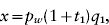
where p w is the world price for rice, t 1 is the MFN import tariff for rice, q 1 the import quantity, and x the value of rice imports. Now suppose that Turkey came up with a TRQ at reduced tariffs (t 1/2), which satisfied the following criteria:

With p Dq D as the local purchase requirement, this TRQ system would have a solution for every p w and at least some import quantities q 1. Hence, for the same value, Turkey would import no less under the new TRQ and at the same time the importer would satisfy some local purchase of rice, without harming local consumers. What constitutes tariff revenues to the government under the current import regime would just be reallocated between importers, exporters, and consumers under the alternative scenario.
We fail to see any discrimination in this arrangement, yet under the Turkey–Rice jurisprudence, such a TQR regime would be deemed illegal, because domestic rice would still be granted the option to import at reduced tariffs.
3.5 Legal analysis: the domestic purchase requirement in conjunction with the denial to grant licenses
In addition to its separate claims against the domestic purchase requirement for in-quota imports and the denial to grant licenses to import over-quota rice, the United States in its request for the establishment of a Panel, also raised claims against both measures conjointly, claiming that these measures working in combination are inconsistent with Arts. X.1 of the GATT, 4.2 of the AoA, and 1.6 of the Import Licensing Agreement (ILA).Footnote 61 For reasons of judicial economy, the Panel refrained from an analysis of this point, contending that each of the two measures individually has been found illegal, and that two wrongs acting in concert cannot be expected to be consistent with Turkey's obligations under the covered Agreements.Footnote 62
4. Legal and economic aspects of the report
Leaving aside Turkey's rather dismal and desolate defense, the Turkey–Rice case offers some interesting legal and economic aspects of a more general nature.
4.1 Burden of proof, evidence, collaboration, inference, and sequence of events
As stated above,Footnote 63 the United States reacted to the Panel's interim report by requesting a significant change in the burden-of-proof language of the original report text. The interim report had stated that evidence provided by both litigating parties should be considered when deciding whether the United States as Complainant sufficiently raised its preliminary presumption that Turkey had engaged in the measures at issue, and that a failure by Turkey to rebut the existence of a measure at issue would be followed by a legal examination whether the facts so demonstrated could be qualified as a WTO-inconsistent measure.Footnote 64 The United States opined that the burden of bringing legal and factual prima facie evidence should reside exclusively with the complaining party, and hence demanded a drastic change in the language for purposes of the final report.Footnote 65 As a reason for its request, the United States claimed that it wanted to avoid possible misinterpretations of the rules on burden of proof: The sole responsibility to successfully construct a prima facie case should always reside with the complaining party.Footnote 66
To our mind, this somewhat altruistic argumentation is a thinly veiled fig leaf for the United States' principal objective behind its proposed change of wording. It seems much more likely that the United States wanted to promote and establish its concept of how the litigation process before the Panel was to be conducted. Figure 1A illustrates what we believe to be the United States' preferred litigation process.
The litigation process according to the United States

The United States proposes a very clear linearity in its concept of the litigation process, where the Complainant's burden of proof (BoP) consists in establishing a prima facie case. Notice that legal and factual input stems solely from the complaining party (C). In case this exercise is successfully completed (it must be if refutation by the Respondent is impossible), the burden of proof shifts to the responding party (‘R’ in Figure 1A), who submits legal and factual evidence in its rebuttal submission. After this, the Panel in its objective assessment bestowed by it under DSU 11 must decide whether the facts as demonstrated by the Complainant can be qualified as constituting an illegal measure. After weighing and balancing the evidence at hand, the Panel reaches its finding.
Given that Turkey effectively stonewalled the process by completely failing to deliver any relevant facts in its defense, the United States' perception of the litigation process seemed straightforward – from the perspective of the United States. As Figure 1B shows, according to the United States' linear concept of the litigation process, an ineffective rebuttal by the Respondent basically ends the process prematurely. The Panel draws ‘appropriate’ inferences and the case is closed in favor of the complaining party.
Ineffective rebuttal in the United States' version of a litigation process

The US view of the litigation process likely reflects the legal culture of the common-law system (with the availability of discovery) as adapted to a Panel process that is basically a civil-law system without much discovery but with some history of a more activist judiciary, and with the added complexity of the need to seek relevant factual information from a possibly noncooperative sovereign government. Yet, the Panel accepted neither the United States' requests for changes in the language of the report, nor the linearity and unidimensionality of the United States' preferred litigation. Instead, the Panelists brought forth their own concept of the litigation process. Citing the Panel's duty under Art. 11 of the DSU to ‘make an objective assessment of the matter before it, including an objective assessment of the facts of the case’, the Panel opined that it had the obligation to consider for the prima facie examination all the facts of the case (as submitted by both parties and those procured by the Panel itself under its broad authority of Art. 13 DSU). In a nutshell, the Panel's version of the litigation process is that illustrated in Figure 2.Footnote 67
The litigation process according to the Panel in Turkey–Rice

As noted above, the Panel in Turkey–Rice essentially partitioned the litigation process into two constituent parts: a factual analysis and a legal assessment.Footnote 68 The Panel made clear that for the Complainant to satisfy its prima facie case of inconsistency of a measure with a provision of the WTO covered agreements, it is not solely responsible for the production of all facts raised in relation to the issue at hand. Rather, it is appropriate for the Panel to draw on factual evidence laid out by both litigating parties, Complainant and Respondent alike. Once a Panel is satisfied that the measure at issue has actually occurred, the burden of proof shifts to the responding party.
According to the Panel, if the Respondent is unable or unwilling to produce satisfactory rebuttal evidence, the litigation process is not over by default – in contrast to the United States' version of litigation process (Figures 1A and 1B, above). Rather, the Panel has the obligation, or at least the discretion, under DSU Articles 11 and 13.1, to launch a parallel process in which it seeks additional information and technical advice from any individual or body within the two litigating countries.Footnote 69 Although both litigating parties are under a duty and obligation to respond promptly and fully to requests for information made by Panels at that point in the litigation process,Footnote 70 refusal to cooperate by any party will only be ‘one of the relevant facts of record, and indeed an important fact, to be taken into account in determining the appropriate inference to be drawn’.Footnote 71 The Panel will draw ‘appropriate inferences’ not solely in light of the refusal to cooperate, but in light of and in connection with all other available evidence on the record.Footnote 72
Once the Panel – after its objective assessment of the facts – is of the opinion that the Complainant was successful in raising its preliminary presumption and the responding party failed to rebut it, the Panel moves on to conduct its legal analysis. It assesses whether the facts so demonstrated can be qualified as constituting a violation of WTO law.Footnote 73 The outflow of this weighing and balancing mechanism is the Panel's findings in form of rulings and recommendations. Once again, we see in the Panel's approach (and perhaps in DSU Articles 11 and 13.1 as well) the influence of a civil-law litigation system in which the judges have considerably more flexibility to seek out factual information on their own, without relying more or less exclusively on the ‘adversarial’ approach used in the common-law system to develop the facts.
Next to the litigation scenario brought forth by the United States, and that applied by the Panel in Turkey–Rice, we can see a third variant of how the DSB litigation process can be interpreted. We are here motivated by the Rice Panel's own words:
In our view, the duty that a Panel has, under Article 11 of the DSU, to ‘make an objective assessment of the matter before it, including an objective assessment of the facts of the case’, implies that the Panel is bound to consider all the evidence on record, which includes the evidence submitted by the parties and that procured by the Panel itself under its broad authority ‘to seek information and technical advice from any individual or body which it deems appropriate’ in the terms of Article 13.1 of the DSU. As noted by the Appellate Body in US–Wheat Gluten, ‘under Article 11 of the DSU, a Panel must draw inferences on the basis of all of the facts of record relevant to the particular determination to be made’ [footnote omitted]. A Panel's duty to consider all available evidence on record does not relieve the complaining party of its burden to make a prima facie case that a challenged measure is inconsistent with the WTO agreements by putting forward adequate legal arguments and evidence. Indeed, in the lack of adequate legal arguments and evidence to sustain its claim, the Panel would have to conclude that the complaining party has failed to make a prima facie case.Footnote 74
Figure 3 illustrates how we understand the operation of this third variant of the litigation process, and how it differs from the previous two alternatives.
A third alternative of interpreting the litigation process

In contrast to the Panel's actual conduct in Turkey–Rice (Figure 2), the litigation process in this scenario is no longer divided into a sequence of factual and legal components. The Complainant brings a case in which it specifies the measures at issue and the legal basis for its allegations, adduces factual evidence, and brings forth a coherent legal argumentation. However, in contrast to the previous two scenarios, the Panel here draws on evidence from both litigating parties to assess the strength of the Complainant's prima facie case. Giving effect to the quotation above, the Panel can already make an objective assessment of the facts at hand. Using its discretion to request additional information from the parties at any point in time during the litigation process (vested to the Panel by DSU Article 13.1), and mindful of its right to seek outside information and opinion (DSU Article 13.2), the Panel will be able to make autonomous inferences as to whether the Complainant has satisfied its prima facie case.Footnote 75
In the event the Panel – in light of the facts at hand – is satisfied by the Complainant's submission of evidence and legal reasoning, the burden of proof will shift to the responding party. The Respondent is charged with the production and submission of exonerative factual evidence and adequate legal reasoning. The Panel can make use of its discretion again to request further clarifying information and necessary evidence from both litigants. Should it deem it pertinent, the Panel may seek outside advice by experts, international organizations, or Member governments under its right bestowed by Art. 13.2 DSU. The Panel's findings generated in the entire process will then flow into its rulings and recommendations.
It could be argued that the burden of proof should be discarded altogether in this scenario of a trade dispute, since an active Panel does not need this procedural straw man to do its job. The litigation process then would just be a bifurcated procedure where parties make their submissions (oral, written, answers to Panel) and the Panel conducts its independent deliberations. Figure 4 illustrates this approach.
Figure 4.

However, we strongly disagree with the contention that burden of proof is a futile concept in the Panel process. To our mind, the Panel's role is not in the first instance to find the truth, but to assess which party's contentions are correct (or more reasonable). The burden of proof is thereby an immensely important tool; it directs the Panel's attention to certain issues, and limits the complaining party in making frivolous, unfounded, or excessive allegations. Requiring that the party which makes a positive allegation to provide proof of such accusation, and asking the responding party to rebut it is an efficient and commonly accepted element of litigation. It is also essential in a system in which the Panel cannot compel the cooperation of the respondent in providing relevant information that is often totally within the respondent's knowledge and control, as is well-illustrated in the instant proceeding.
This third scenario of litigation breaks open the linearity of the previous two alternatives. All through the litigation, the Panel's weighing and balancing is an integral part, but not the final step in the process. Objective panel assessment runs in perfect parallel to the parties' submissions and testimonials. The dispute Panel is certainly more proactive and arguably more interventionist or intrusive than in the other two scenarios. We will call the US interpretation of the litigation process the ‘low-involvement’ scenario (‘Scenario 1’), the Panel's interpretation the ‘medium-involvement’ alternative (‘Scenario 2’), and our own interpretation the ‘high-involvement’ or ‘activist’ scenario (‘Scenario 3’).
4.1.1 An assessment of the scenarios of the litigation process
It seems rather obvious that the three scenarios of the litigation process differ strikingly both in practice and in outcome. Without claiming to be comprehensive, we compare the three scenarios on the basis of a few criteria.
First, from the point of view of strategic gamesmanship, the three described scenarios provide the disputing parties with different strategic incentives of whether and when to disclose and submit relevant information to the Panel. Under the low-involvement Scenario 1 (Figures 1A and 1B), the litigation process is not only linear, but also organized in a fashion that game theorists would call a ‘sequential game’. In order to raise the preliminary presumption of a WTO violation, the Complainant supplies evidence to the Panel. Thereafter, it falls upon the Respondent to supply information.Footnote 76 This nonsimultaneous setup of the litigation game gives the Respondent a substantial strategic edge over the complaining party. Knowing the basis for the other party's actions, the former can optimally shape its argumentation according to the latter's allegation and evidence, and submit eclectic facts tailored to the previous prima facie material.Footnote 77
In a medium-involvement Scenario 2 world (Figure 2), the sequential nature of Scenario 1 is partially alleviated: The Panel will adduce evidence submitted by the Respondent in its evaluation of the prima facie case. Hence, the Respondent has a vital interest in providing information aimed at invalidating the Complainant's factual evidence that the measure at issue has actually been implemented by the Respondent. However, given that the Respondent is under no obligation to collaborate from the beginning of the proceedings,Footnote 78 it again has a strong strategic incentive to hold back important private information until such information either becomes pertinent or is requested by the Panel after the Respondent has submitted its rebuttal.
Under an activist Panel (Scenario 3; Figure 3), in substantial contrast, the litigating parties face not only a more active panel process but also the strategic setup that more resembles a ‘simultaneous game’. Parties will likely find it more useful to submit evidence early on in the process, since the Panel reserves its right in any event to question them at any time of the process, but also since the Panel may also rely upon outside expertise to get a more comprehensive idea of the facts of the case.
Second, the Scenarios differ in the way they deal with ‘stonewalling’: A refusal to supply the Panel with private information is never a good idea, as Turkey–Rice clearly has demonstrated. Since it is impossible not to communicate, snubbing the Panel in the way Turkey did will never be seen favorably under any of the above scenarios. The Panelists will be indignant and draw their inferences accordingly.
But what if the Respondent really cannot adduce the evidence requested?Footnote 79 Under Scenario 1, such a case is lost for the Respondent. In contrast, under Scenario 2 the Panel will take this circumstance into consideration as one salient factor among others to consider. In a Scenario-3 world, the Panel will actively address the information glitch and seek outside advice and input. Armed with more informational ammunition than under Scenario 2, the Panel – arguably – will be able to make more balanced decisions under Scenario 3, assuming, of course, that the relevant information exists and can be acquired by the Panel.
This brings us to the next point: factfinding and autonomous inference. Under Scenario 1 (and probably Scenario 2 as well), Panels are quite reluctant to venture out on factfinding missions. Independent factfinding is a factor missed in Turkey–Rice, given that this fact-heavy case had considerable room for independent Panel inference. Even after reading the Turkey–Rice report several times, the authors were still very unclear regarding key factual issues, their salience for the case at hand, and the way they interact. For example, who was responsible for the massive price hikes in the Turkish rice market – speculators, importers, or the TMO?Footnote 80 What is the interrelationship of the various Turkish agencies TMO, FTU, and MARA? Did Turkey discriminate only against US rice, or was there a blanket prohibition vis-à-vis other countries as well? A more active Panel under Scenario 3 could have dug into the issue and possibly answered some of these and other salient questions.
Fourth, an important aspect in which Scenarios 1–3 differ is that of ‘correlation vs. causality’. Given the scant factual situation under which the Panel was operating, the United States constructed its prima facie case around rather sketchy evidence: It alleged a causal link between the Turkish Minister of Agriculture's receipt of a recommendation to suspend temporarily the granting of Certificates of Control and the rejection of Certificates for a handful of US imports. The Panel correctly stated that ‘merely because two facts coincide in time, it does not automatically lead to the conclusion’ that a prohibition of US imports is proven.Footnote 81 However, the Panel did not test for causality and instead moved to assess further circumstantial evidence.Footnote 82 A more active Scenario-3 Panel might have attempted to examine more closely the possible causality between ‘letters of acceptance’ and rejections of Certificates for over-quota imports. Doing so, however, is only possible if the Panel takes it upon itself to look for additional evidence and factual inter-linkages.
The choice among Scenarios 1, 2, and 3 is very clearly a tradeoff between expanded Panel involvement in the factfinding process (some may call it intrusiveness or hyperactivity) and traditional arbitrating. We see considerable advantages for Scenario 3 if accuracy and completeness are among the highest priorities for the system, although we fully recognize that some Members are likely to oppose it as interventionist Panel behavior, overreaching, judicial insolence, or a practice that makes the Panel process more time-consuming, more expensive, and less predictable for the Complainant. Common-law Members, whose lawyers are trained to believe that the judge in most litigated disputes should rely solely or almost exclusively on the submissions of the parties and possibly upon amicus curiae briefs, are probably less likely to favor Scenario 3 than those Members with a civil-law tradition. There, the activism of the judges in adducing evidence is more generally accepted, and in some ‘code’ jurisdictions, including the European Court of Justice, advocates generally exercise broad functions,Footnote 83 so that the parties are not expected to have a monopoly on the facts and legal theories placed before the court.
From a process point of view, a more activist Panel system would incur higher costs, both in terms of the time required to complete reports and financial expense for both the WTO and for the disputing Parties if outside experts are retained to supply the Panel with information not made available by the disputing Parties. Among some WTO Members, there is a general lack of confidence in the competence and independence of Panelists, a concern that would likely discourage modifying the panel process to grant the Panelists greater powers and discretion.Footnote 84 These factors may encourage many civil-law Members to side with their common-law colleagues against more active Panel factfinding. In other words, we recognize that there may be less than a groundswell of support for the change we are proposing!
In our view, the most significant additional advantage of Scenario 3 is that it makes strategic withholding of information less desirable for litigating parties. Scenario 3 is the most inclusive of the three alternatives. The Panel effectively has discretion for a more reticent approach and does not necessarily have to go on factfinding missions, particularly where all parties cooperate in providing necessary factual information promptly. However, in a world where Scenario 3 is a recognized option for the Panel, subject to its discretion, disputing Parties will not know ex ante which ‘type’ of Panel approach they will face. This makes strategic retention of information relatively less attractive ex ante. Hence, litigants can be expected to be more forthcoming with information right from the get-go of the litigation, even if they realize that most Panels will not resort to Scenario 3 unless the Respondent is stonewalling or presents an incomplete factual record. Whether this tips the balance for most Members as a dispute settlement policy matter is something we cannot determine.
4.1.2 Support for Scenario 3 from the L&E literature on ‘Judicial Activism’
In addition to the above points, we find strong support for Panel involvement along the lines of Scenario 3 from the literature on ‘judicial activism’: this relatively novel strand of law-and-economics (L&E) research examines the interplay between the design of contracts and the nature and degree of court involvement.Footnote 85
The literature on ‘judicial activism’ in trade-dispute resolution is based on two fundamental premises:
• First, trade agreements, such as the WTO, are inherently incomplete contracts in the sense that they do not specify with certainty all states of nature (future conditions, or contingencies).Footnote 86 In other words, a defining feature of incomplete contracts is that they contain gaps: Compared to the contracting ideal of the complete contingent contract (CCC),Footnote 87 important contingencies are not exhaustively and unambiguously specified ex ante, i.e. at the time of the conclusion of the contract. The presence of contractual gaps give rise to one (or indeed a combination) of three contractual shortcomings:
(i) Vagueness: Contractual gaps can play out in the form of vague language, i.e. ambiguous and ambivalent contract language, resulting from poorly described contingencies and their outcomes;Footnote 88
(ii) Discretion: By this we mean insufficient language that gives contracting parties too much discretion or maneuvering space. Gaps of this kind are ‘Type-I errors’ or ‘false positives’. Type-I errors result from the inclusion of excusable contingencies into the contract, whereby ex post nonperformance does not actually lead to a mutual welfare increase, but instead opens the floodgates to opportunistic abuse by the enacting party;
(iii) Rigidity: Rigidity is the opposite of discretion. Here, the language of the contract is overtly strict, or rigid. It wrongly prohibits nonperformance in situations where a complete contingent contract would mandate welfare-enhancing ex post adjustment (gaps of this sort are ‘Type-II errors’ or ‘false negatives’).
• The second premise on which L&E approaches to judicial activism are founded is that dispute settlement is more than simply punishment.Footnote 89 Whereas traditional formal economic analysis of trade agreements tends to focus on the self-enforcement capability of contracting parties,Footnote 90 various L&E contributions have advocated a more nuanced stance: Keck and Schropp (Reference Keck and Schropp2008), for example, contend that enforcement really is a function of two variables: enforcement capacity and enforceability, whereby enforcement capacity is the ability to reciprocate credibly against a violation of the terms of the contract.Footnote 91Enforceability of a contract is another vital determinant of enforcement. Typically, issues of observability, verifiability, and quantifiability feature prominently when it comes to enforceability.Footnote 92, Footnote 93
If one accepts the two axioms of contractual incompleteness and the importance of enforceability, disputes are to be reckoned with, and thus a clear role for an independent trade court, or dispute settlement body, emerges: Anticipating that trade disputes will occur, contracting parties to any trade agreement can be assumed to charge trade courts or dispute panels with completing the various dimensions of the incomplete contract. The unachievable CCC, which maximizes the joint welfare ex ante the occurrence of future contingencies, thereby remains the normative benchmark.Footnote 94 Hence, dispute Panels see it as their duty to fill (ex post) the contractual gap in a way the Pareto-efficient CCC would have prescribed it (ex ante). This in turn implies that Panels strive for replicating the outcome of the CCC by looking for those solutions that maximize the joint welfare of all parties.Footnote 95
The literature on optimal court behavior now finds that activist courts that adjudicate with high accuracy, or quality, can achieve the best results ex post compared to the benchmark of the complete contingent contract: Activist courts are thereby courts that diminish obligations when the contract language is too rigid, add obligations (fill gaps) when the contract lacks appropriate language, and interpret or clarify passages or terms where the original contract was vague or ambiguous. Dispute Panels can be said to be of high accuracy, or quality, when they are engaged in active information-gathering so as to reduce the probability of issuing wrong rulings.
Since it would go beyond the scope of this paper to review comprehensively the approaches and results of all contributions dealing with judicial activism, we focus here on the presentation of a new and indeed fascinating contribution by Maggi and Staiger (Reference Maggi and Staiger2008). Their working paper is a prime example of formal economic analysis of dispute Panels in trade agreements. The novel feature of their piece is that it highlights the interaction and mutual dependency of contractual design (how many resources can contracting parties be assumed to spend on writing an ever-complete contract, and how should they phrase contractual rights and obligations?) on the one hand, and the design of the DSB mandate on the other. In fact, the formal model developed in the Maggi and Staiger paper views these as two components of a single overarching institutional-design problem that the framers of a trade agreement face at the time of the conclusion of their contract.
Based on the work of Battigalli and Maggi (Reference Battigalli and Maggi2002), and Horn et al. (Reference Horn, Maggi and Staiger2005, Reference Hartley2006), Maggi and Staiger evaluate the possible mandate of the WTO DSB and its role in helping parties to complete the incomplete trade contract. The paper starts from the premise that contracting is a costly exercise and that the conclusion of a CCC is not an option; incompleteness of the trade deal is an inevitable consequence. This gives rise to three types of contractual gaps: rigidity (too few environmental contingencies are considered), discretion (too few rules constrain the behavior of the parties), and vagueness (contingencies are only partially defined, giving rise to ambiguity, ambivalence, opposite interpretation, and misunderstandings). The framers of the trade agreement, by deciding on the language of the contract, to some extent can control which of the three gaps they deem the smallest evil.
Maggi and Staiger (Reference Maggi and Staiger2008) then pair three possible roles of the WRO DSB with the three forms of contract incompleteness: The DSB can interpret aspects of the contract that are left vague; the DSB can fill gaps where the contract is silent and therefore leaves governments with discretion; and the DSB can grant exceptions and thereby modify aspects of the contract that are too rigid. Or the DSB can be excluded from fulfilling any of these functions and simply enforce contractual obligations that are unambiguous.Footnote 96
In order to characterize the contracting parties' deliberate choice of contractual incompleteness and the DSB design at the time of the conclusion of the agreement, the paper constructs a static partial-equilibrium game with one industry and two countries, each of which has one strategic choice: The importer can select a trade policy of ‘protectionism’ or ‘free trade’, and the exporter can either file a complaint at the DSB or refrain from doing so. Importantly, using the DSB is costly for both parties. This game setup gives rise to a nontrivial strategic interaction in which different institutional arrangements affect the equilibrium occurrence of disputes.
Without going into the details of the model, we summarize the most important findings for our purposes. First, the most efficient results (as compared to the unachievable benchmark of the CCC) are attained if the DSB rulings are of a high quality, the contracting parties opt for an activist DSB, and the contract is designed such that it gives ex post discretion to contracting parties as well as a mandate of gap-filling to the DSB. Second, if contracting parties must assume that DSB rulings will be of intermediate quality, they are likely to opt for vagueness as a contractual design tool to deal with the contractual incompleteness. The DSB consequently is charged with interpreting this ambiguous language. However, this contractual design produces less efficient outcomes than the first design option. Third, if the accuracy of DSB rulings is anticipated to be of low quality (the probability that the DSB will rule in error is high), contracting parties will prescribe the DSB with a ‘hands-off’ policy, i.e. they will stipulate a nonactivist role for the trade court. Dispute Panels will simply execute unambiguous contract language and leave contractual incompleteness unbridged. This results in less efficient outcomes as compared to the CCC. Fourth, diminishing obligations by modifying rigid contract language is not an optimal institutional design, contrary to the suggestion of some legal scholars (ibid.: 21).
Maggi and Staiger's model suggests that the optimal combination of contract design and DSB mandate is a function of the degree of accuracy of DSB rulings: ‘Notably, if DSB rulings are sufficiently accurate and the DSB is given an activist role, we show that the first-best outcome can be achieved even though the contract is highly incomplete, the use of the DSB is costly and the DSB rulings are imperfect. The reason is that the threat of invoking the DSB and the expectation of a sufficiently precise ruling is sufficient to induce governments to act efficiently’ (ibid.: 4). This implies that if the quality of the DSB rulings is reasonably good, fewer disputes can be expected to occur in the first place.Footnote 97
To conclude, the new working paper by Maggi and Staiger (Reference Maggi and Staiger2008) suggests that deliberately concluding an incomplete contract does not necessarily imply efficiency losses ex post. Leaving gaps can be optimal, but only when the DSB is given an activist mandate and if the accuracy of DSB rulings is considerably high (ibid.: 21). A necessary precondition for high accuracy of the DSB rulings is a sound information basis for the dispute Panels that allows them to achieve a certain threshold level of accuracy of their ruling.Footnote 98 If the quality of rulings is inadequate or random, rational contracting parties can be expected to deny dispute Panels any role in completing the contract, and instead mandate them to simply enforce the letter of the law. This outcome is accompanied by significant efficiency losses and more bad-faith (or opportunistic) disputes.Footnote 99
4.1.3 How to operationalize Scenario 3?
For the above reasons, the authors of this paper feel compelled to advocate in favor of a Scenario-3 reform of the DSB Panel process, at least as an option for Panels in appropriate circumstances. An important question to consider is what, exactly, would have to change in the language of the DSU or in the Panel practice to make Scenario 3 a choice available for Panels. We believe that nothing in the wording of the DSU would have to be altered to make way for Scenario 3, given the broad language of DSU 11 and 13. However, assertions like the Appellate Body's in EC–Hormones would have to be reconsidered.Footnote 100 There, the AB stated that a prima facie case is ‘one which, in the absence of effective refutation by the responding party, requires a Panel, as a matter of law, to rule in favour of the complaining party’.Footnote 101 Under Scenario 3, it could be the Panel's own autonomous inference, instead of the Respondent's, that provides for a successful rebuttal and completes the defense.
One custom that dispute PanelsFootnote 102 most certainly would have to review and reconsider is the timing and number of hearings during a DSB proceeding. Under current procedures, the first Panel hearing after the deposit of the first written submission by parties is largely ineffective – the Panel hasn't yet read the submissions and therefore has little to ask. Ideally, Panels should be able to direct questions and requests at parties throughout the Panel process, so as to satisfy their information needs. This, however, would require the implementation of a procedure that does not significantly increase the time required for Panel reports to be issued.
4.2 Myopia of judicial economy?
At various points during the Turkey–Rice Report, the Panel has exercised judicial economy. Although cognizant of the fact that judicial economy is an important concept in the WTO (not least given the tight deadlines under which Panels and the AB are operating), we have some concerns about the practice from both a law-and-economics perspective and a systemic perspective.
Here, we note the Panel's decision to exercise judicial economy and not to examine the claim that Turkey's domestic purchase requirement for in-quota imports in conjunction with its denial to grant out-of-quota licenses to importers of rice violates WTO law and nullifies and impairs US benefits. Where a dispute escalates and reaches a DSU Article 22.6 arbitration, as seems to be the developing situation in Turkey–Rice,Footnote 103 the way in which two WTO violations act in concert may very well matter. The level of trade damages (or ‘nullification and impairment’) suffered by the United States due to a series of illegal measures working in combination could well be higher than trade damages resulting from each illegal measure individually. Yet, in order for the United States to pursue its case that it suffered nullification and impairment through the interaction of these violating measures at a level higher than the mere sum of effects, the Arbitrator would probably demand proof in form of a relevant Panel or AB judgment.
Still, Panels have been very recalcitrant to act as stirrup-holder for later WTO arbitrations.Footnote 104 This creates nontrivial problems for Art. 22.6 arbitrations, the final and, indeed, salient chapter of DSB litigation. It would therefore be advantageous if Panels and the AB were more mindful of later steps of the litigation process, even though Article 22.6 arbitrations are not a common occurrence.
Perhaps a more serious problem is the one faced by the AB when it wishes to decide the case on a different legal basis from that chosen by the Panel. Suppose, for example, we enter the appeal phase in Rice and the AB preferred to focus on GATT Article XI? An incomplete factual and legal record would have precluded such an approach. It is not surprising that in one recent AB report, Brazil–Tyres,Footnote 105 the Appellate Body chided the Panel, emphasizing that a ‘[P]anel's discretion to decline to rule on different claims of inconsistency … is limited by its duty to make findings that will allow the DSB to make sufficiently precise recommendations and rulings “in order to ensure effective resolution of disputes to the benefit of all Members”’.Footnote 106 The prospect of a Scenario 3 approach by the Panel could very well result in a Panel report with the stronger factual (as well as legal) analysis that would facilitate broader AB consideration of the issues and fewer cases that are undecided because the AB cannot complete the analysis.
Although not couched in judicial-economy language, the Panel also declined to make a recommendation in response to the United States’ request that it determine that Turkey's domestic purchase requirement was inconsistent with Article 2.1 and paragraph 1(a) of the Annex to the TRIMs Agreement.Footnote 107 The Panel decided that, because the measure no longer existed at the time of the Panel report and Turkey had declared it did not intend to reintroduce the questioned measure, ‘we do not believe that there is any need for the Panel to recommend to the DSB that it make any request to Turkey in this regard’.Footnote 108 Given the Panel's evident frustration with Turkey's stonewalling on providing essential evidence, it is somewhat surprising that the Panel was willing to leave the United States in the position of having to bring a new DSB action should Turkey in fact introduce a similar measure in the future, and to deprive other members of the benefits of its analysis. For the reasons discussed above in addressing judicial economy, we believe the Panel should have issued a ruling on this issue as well.
5. Summary and conclusions
Turkey–Rice will not go down in history as the most intriguing and challenging WTO case ever litigated. The overwhelming evidence leaves hardly any doubt about Turkey's illegal red-tape measures. The steadfast refusal of Turkey's defense to provide exonerating evidence and the Panel's drawing of appropriate inference were probably the most remarkable issues of the case.
Yet, we believe that the case raised at least three pertinent legal and economic questions: (i) was the Panel's discrimination test of Art. III:4 GATT wisely chosen?; (ii) was the Panel's exercise of judicial economy myopic?; and (iii) what concept of a Panel process is currently preeminent in the DSB, and with what consequences for Panels' inferences and parties' strategic incentives to provide information?
As indicated in note 103, the compliance proceedings under DSU Article 21.5 in Rice are underway. We are looking forward with curiosity and anticipation to what the sequel of the Rice Age-saga will have in stock for the ALI Reporters in the future ….



