


INTRODUCTION
Ebru, a university student studying management, was the first of her family to go to college at the age of 17. Soon after, she also became the first to join the guerillas. Ahmet, from a peasant family displaced by political violence, worked as a cook in an upscale restaurant in Istanbul. Five years later, his family received the news that Ahmet died on a guerilla mission on the Iranian side of the border. Altan, an illiterate young woman, lived with her parents taking care of her younger siblings in a Kurdish city. Her family expected her to get married soon, but she left for the mountains to fight. Abüzer, a teenager with primary school education, lived in a remote rural area in eastern Turkey. One day, he and his soccer friends joined the guerillas encamped nearby.
These individuals with different life opportunities and diverse backgrounds joined the Kurdish insurgency, one of the longest lasting ethnic conflicts in the world, and eventually died at a very young age. Why did these ordinary people take extraordinary risks and join an armed rebellion? The persistence of civil war in contemporary times makes the question of what motivates individuals to put their lives on the line directly relevant to global peace and security. Some scholars argue that individuals belonging to ethnic groups repressed by the state develop grievances, fear the extinction of their identity, and become rebellious (Horowitz Reference Horowitz2000, 175–9; Wimmer Reference Wimmer2013, 4, 13–6). Other scholars suggest that while grievances are ubiquitous, rebellions are rare and occur only under propitious structural conditions (Collier, Hoeffler, and Rohner Reference Collier, Hoeffler and Rohner2008; Tilly Reference Tilly, Badgley and Wilson1974, 302). “[T]he average level of grievance in a group may not matter that much. What matters is that whether active rebels can hide from government forces and whether economic opportunities are so poor that the life of a rebel is attractive to 500 or 2,000 young men” (Fearon and Laitin Reference Fearon and Laitin2003, 88). Such an emphasis on structural factors to explain the occurrence of rebellions make these macro level perspectives “microrealization robust,” as long as changes in individual level motivations to fight do not make rebellions less likely to occur (List and Spiekermann Reference List and Spiekermann2013). Yet, these perspectives have a fundamental shortcoming when it comes to explaining the duration and intensity, rather than the onset of rebellions (Bueno de Mesquita Reference Bueno de Mesquita2010). Many insurgencies would not be durable and would not pose a serious threat to the incumbent states without the participation of ordinary people who risk their own well-being, such as Ebru, Ahmet, Altan, and Abüzer.
This article studies the motivations of individuals who join an existing armed rebellion. The scholarship exploring individual motivations of participation in an armed rebellion offers two competing perspectives. According to economic perspectives, the decision to rebel ultimately reflects individual-level cost-benefit calculations. Individuals who seek security and who find material incentives offered by insurgent organizations attractive are more likely to rebel. Sociological perspectives, on the other hand, suggest that collective concerns directly affect the decision to rebel. Individuals embedded in social networks cultivating norms of solidarity and reciprocity are more likely to fight on behalf of their collective identity. I develop three hypotheses, derived from the economic perspective, that concern material benefits, security, and social sanctions. The three other hypotheses, derived from the sociological perspective, concern distinctive cultural identities, war-radicalized identities, and dense social networks. I then develop an additional hypothesis based on prospect theory (Tversky and Kahneman Reference Kahneman and Tversky1979) and argue that as politically efficacious individuals develop a perception of collective identity threat through political activism, they are likely to rebel.
I test these hypotheses utilizing a unique multimethod research strategy. Focusing on the Kurdish insurgency (the PKK, Partiya Karkerên Kurdistan) in Turkey, I combine an original dataset containing demographic information about 8,266 militants with extensive fieldwork including 68 in-depth interviews primarily with militants’ families. The large-N analysis allows for more generalizable inferences (i.e., enhancing external validity), and provides a more comprehensive picture of recruitment. In turn, ethnographic research involving fine-grained data clarifies the causal mechanisms and alleviates ecological inference problems. Overall, I conduct four distinct analyses by combining these data sources: (1) comparing differences in recruitment across subnational units (i.e., districts), (2) studying temporal patterns of recruits over time, (3) comparing different types of recruits, and (4) comparing recruits with nonrecruits with similar characteristics.
Some of the findings support existing theories of recruitment. As suggested by opportunity cost arguments, many villagers joined the insurgency to achieve social mobility and with the expectation of future benefits. Consistent with theories of control, recruitment was higher among villagers who happen to live in areas with strong insurgent presence especially in the initial periods of the conflict. State repression contributed to insurgent recruitment through three distinct mechanisms. Individuals sought security during violent counterinsurgency operations, developed radicalized identities in the face of human rights violations conducted by state forces, and followed the path of family members and friends who had already joined the insurgency. At the same time, these patterns do not explain the recruitment of educated individuals with good life prospects and no immediate experience of political violence. Many educated and politically efficacious individuals engaged in political activism developed existential threat perceptions through this activism, and perceived nonviolent struggle as being an ineffective political strategy before joining the insurgency. This finding is particularly pertinent for insurgencies across the world with a sizeable number of educated fighters. Finally, preexisting ethnic cleavages do not explain recruitment patterns that primarily reflect the dynamic nature of violent conflict and ethnic mobilization. Social networks of trust and reciprocity conducive to contentious collective action are not exogenous to rebellion, but emerge because of framing and mobilization efforts of political organizations. These findings suggest the importance of agency, normative motivations, and ideological framing in rebellion.
THEORIES OF PARTICIPATION IN AN ARMED REBELLION
Scholars theorize how different motivations simultaneously affect participation in an armed rebellion (Gates Reference Gates2002; Humphreys & Weinstein Reference Humphreys and Weinstein2008; Mason Reference Mason2004). Elster's distinction (1985) between selfish and nonselfish motivations characterizing cooperative behavior, which is similar to Weinstein's distinction (2007) between economic and social endowments, provides a useful way to distinguish between two general types of motivations. According to the theories that highlight the tension between individual and group interests (Olson Reference Olson1965; Tullock Reference Tullock1971), grievances are not sufficient to induce participation in a rebellion unless individuals obtain benefits exclusive to their participation. First, individuals may join insurgencies because they receive material incentives (Lichbach Reference Lichbach1994) and want to achieve upward social mobility (Fearon and Laitin Reference Fearon and Laitin2003, 88; Lee Reference Lee2011; Race Reference Race1972, 170–4). Weinstein (Reference Weinstein2007; 106, 120–1; see also Hirshleifer Reference Hirshleifer, Hartley and Sandler1995) identifies a negative relationship between an individual's educational attainment and the attractiveness of material benefits and social status offered by an insurgency.
Hypothesis 1: Individuals with low educational levels and socioeconomic status are likely to join an insurgency that can offer them immediate or future rewards.
A second set of benefits concerns security in the face of state violence (Goodwin Reference Goodwin2001; Humphreys and Weinstein Reference Humphreys and Weinstein2008; Kalyvas and Kocher Reference Kalyvas and Kocher2007; Kilcullen Reference Kilcullen2009; Mason and Krane Reference Mason and Krane1989; Stoll Reference Stoll1993). When state repression targets individuals who are not active participants in an insurgency, many individuals fearing that their lives are in danger may join the insurgents. Similarly, individuals may join insurgents if they happen to live in areas with rebel control (Kalyvas Reference Kalyvas2006).
Hypothesis 2: Individuals who live in areas experiencing heavy clashes and insurgent presence are likely to join an insurgency.
A third set of selfish benefits concern individuals who live in societies characterized by robust monitoring and enforcement mechanisms. When these communities harbor grievances against the central government and become supportive of an armed opposition group, their members may join the rebellion to avoid harsh communal sanctions (Hechter Reference Hechter1987; Humphreys and Weinstein Reference Humphreys and Weinstein2008).
Hypothesis 3: Individuals who are members of strong and tight-knit communities are likely to join an insurgency claiming to represent communal grievances.
Other scholars suggest that nonselfish motivations such as altruistic and moralistic concerns also lead to rebellious behavior (Elster Reference Elster1985, 151; Reference Elster1998). A set of arguments about such motivations focus on social identity and norms (Cederman, Wimmer, and Min Reference Cederman, Wimmer and Min2010; Fanon Reference Fanon2004; Gates Reference Gates2002; Sunstein Reference Sunstein1996, 909, 935; Varshney Reference Varshney2003; Viterna Reference Viterna2013; Wucherpfenning et al. Reference Wucherpfenning, Metternich, Cederman and Gleditsch2012). A central insight of identity economics is that individuals can behave in ways that appear detrimental to their self-interest in order to “bolster a sense of self or to salve a diminished self-image” (Akerlof and Kranton Reference Akerlof and Kranton2000, 717; Reference Akerlof and Kranton2005, 13–4; Shayo Reference Shayo2009). Sambanis and Shayo's (Reference Sambanis and Shayo2013, 300–3) model of conflict and social identity suggests that the perceived similarity between an individual and the members of her group and the status of her group relative to other groups affects her decision to join a rebellion. In particular, linguistic, religious, and racial differences and historical memories of victimhood increase the relative salience of ethnic versus common national attributes. These factors can also make ethnicity “functionally continuous with kinship” (Horowitz Reference Horowitz2000, 78), generate reciprocal help and mutual obligations among ethnic group members, and contribute to their rebellious collective action.
Hypothesis 4: Individuals who maintain their cultural distinctiveness vis-à-vis the national identity are likely to join an insurgency claiming to represent their cultural group.
However, groups with distinctive cultural identities are not immune to internal divisions undermining the basis of cooperation. Tribal, sectarian, and linguistic divisions within an ethnic group may be more salient than interethnic divisions. Another component of Sambanis and Shayo's model suggests that if the intensity of conflict leads to an increase in the relative salience of ethnic attributes, it both increases an individuals’ distance from the nation and decreases national status. As conflict escalates, state forces are likely to engage in widespread human rights violations that would generate moral outrage among ethnic group members inducing their participation in a rebellion (Gurr Reference Gurr1970, 159–60; White Reference White1989; Wood Reference Wood2003).
Hypothesis 5: Individuals exposed to negative impacts of state violence are likely to develop exclusive and salient group identities and join an insurgency.
Individuals may participate in an insurgency due to familial emotional and moral commitments regardless of the costs and expected outcomes (Aspinal Reference Aspinal2009, 91; Parkinson Reference Parkinson2013). Moreover, tight-knit religious or patriotic groups characterized by high levels of repeated interactions, interpersonal trust, and patterns of reciprocal obligations may also lead to high-risk contentious behavior even in the absence of enforcement mechanisms (Gould Reference Gould1991; McAdam Reference McAdam1986; Petersen Reference Petersen. Roger2001; Viterna Reference Viterna2013). They transform fear into anger and desire for revenge in the face of state repression (Kalyvas Reference Kalyvas2006, 154; Lerner and Keltner Reference Lerner and Keltner2001; Petersen Reference Petersen. Roger2002, 19; Wood Reference Wood2003, 233–4), generate norms that counter legal rules and self-interest, and motivate individuals to undertake high-risk action (Elster Reference Elster1990, 864; Petersen Reference Petersen. Roger2001, 22).
Hypothesis 6: Individuals embedded in dense social networks with linkages to an insurgency are likely to join that insurgency.
PARTICIPATION IN A HIGH-RISK REBELLION AND PROSPECT THEORY
These perspectives about the role of nonselfish motivations are valuable but do not adequately deal with a fundamental challenge. Individuals typically do not face a binary choice of participation or nonparticipation in an armed rebellion (Blattman and Miguel Reference Blattman and Miguel2010, 15). Following Petersen (Reference Petersen. Roger2001, 9), the constituency of an insurgency can be conceived of as in four concentric groups. Both Petersen (Reference Petersen. Roger2001) and Wood (Reference Wood2003) focus on individuals who help the insurgents without being fully committed fighters. An individual may help the insurgency in various capacities due to her social network and identity, but why does an individual become a full-time fighter when less risky options to express social solidarity are available?
Prospect theory (Kahneman and Tversky Reference Kahneman and Tversky1979), one of the core elements of behavioral economics, offers a compelling model to make sense of why a specific group of individuals (i.e., educated) would prefer armed struggle to more limited but less risky forms of political participation. One of the central expectations of prospect theory is that individuals facing very bad options, who are well below their reference points, are likely to “take desperate gambles, accepting a high probability of making things worse in exchange for a small hope of avoiding a large loss” (Kahneman Reference Kahneman2011, 318–9). This expectation regarding risk-seeking behavior is particularly consistent in “the arena of life and death decisions” (McDermott, Fowler, and Smirnov Reference McDermott, James and Smirnov2008, 347). If individuals perceive themselves operating in the domain of losses, they develop loss aversion, that is “losses (outcomes below the reference state) loom larger than corresponding gains (outcomes above the reference state)” (Tversky and Kahneman Reference Tversky and Kahneman1991, 1047) and become more risk seeking.
Political entrepreneurs and organizations, which play central roles in contentious action (McCarthy and Zald Reference McCarthy and Zald1977) often exaggerate threats to collective identity and portray themselves as the only defenders of the group (Hale Reference Hale2008, 38–9; McAdam, Tarrow, and Tilly Reference McAdam, Tarrow and Tilly2001, 95; Saideman et al. Reference Saideman, Lanoue, Campenni and Stanton2002). They frame the status quo as the domain of losses (i.e., ethnic subordination) and generate a new reference point among their constituencies (i.e., ethnic self-determination). In this framing, “not to revolt entails continued losses from the status quo, and to revolt entails an expected value of increased loss attendant to participation but also some smaller prospect for improvement” (Berekijian Reference Berekejian1992, 653; also see McDermott Reference McDermott2004, 291; Mercer Reference Mercer2005; Snow et al. Reference Snow, Rochford, Worden and Benford1986,). In particular, ethnic political leaders identify the nation-state dominated by other ethnicities as presenting an existential threat to their group. As this perception becomes widespread among group members, it is likely to lead to higher levels of collective action among group members (Ellemers, Spears, and Doosje Reference Ellemers, Spears and Doosje2002, 177).
At the same time, an individual who develops this perception but does not believe that her efforts would affect the probability of political success is unlikely to participate in a collective struggle.Footnote 1 An existential threat perception generated by political mobilization leads to risky political action only among individuals with a sense of efficacy, the belief in one's capacity to exercise influence over events affecting her life (Bandura Reference Bandura and Ramachaudran1994). Experimental research suggests that self-efficacious individuals are more likely to take risks as they downplay the probability of failure (Haerem et al. Reference Haerem, Kuvaas, Bakken and Karlsen2011; Krueger and Dickinson Reference Krueger and Dickson1994). A direct implication is that individuals with greater internal political efficacy, having the perception that they can affect the political process through their actions, would be more willing to participate in risky collective endeavors especially when they perceive nonviolent struggle as being ineffective. While internal political efficacy may have various sources including the very act of participation itself,Footnote 2 many studies consistently show that education leads to higher levels of political efficacy (e.g., Niemi, Craig, and Mattei Reference Niemi, Craig and Mattei1991; Norris Reference Norris2002).
Hypothesis 7: Political mobilization cultivating an existential threat perception leads to higher rates of participation in an insurgency among individuals with high levels of political efficacy.
DATA SOURCES
The Kurds constitute a large ethnic group mainly inhabiting the borders areas of Turkey, Iran, Iraq, and Syria. The peace treaties in the wake of the World War I resulted in the formation of nation-states with no substantial Kurdish political representation (Romano Reference Romano2006). The PKK has fought against the Turkish state since 1984 and has powerful branches in Iran, Iraq, and Syria. It has remained feasible as it operates in mountainous terrain with access to cross-border camps and to funding from a large Kurdish Diaspora in Europe. A crucial factor for the durability of the PKK has been its ability to motivate individuals to risk their lives and fight on behalf of their ethnic group. The PKK involves several tens of thousands of militants with diverse characteristics. Hence, it presents an ideal case to test the hypotheses stated above using two original data sources.Footnote 3
THE KURDISH INSURGENTS DATASET
The Kurdish Insurgency Militants (KIM) is one of the most comprehensive datasets on insurgent recruitment. The PKK publishes short obituaries to honor its fallen fighters in its publications (Serxwebûn, a monthly magazine published since January 1982, special martyrs albums, and Berxwedan, a magazine published throughout the 1980s and early 1990s) and on its websites (www.hpg-sehit.com and www.sehid.net). I have systematically coded all these obituaries providing demographic information about the militants including their names, genders, and birth, recruitment, and death years and places. They often include additional information about the militant's family socioeconomic status, education level, occupation, and the location of recruitment (see Table A.1 in the Online Appendix). This dataset contains information about 8,266 militants representing between 37 and 41 percent of the total PKK fatalities.Footnote 4
Several types of PKK militants are not included in the KIM dataset: (a) currently active militants, (b) defected or captured militants, and (c) deceased militants whose information remains unavailable or unpublished. These omissions may result in four biases that may threaten the validity of the inferences. The first source of potential bias concerns deceased militants without obituaries. The militants executed by the PKK (the execution bias) and militants from areas with weak PKK networks and support (the mobilization bias) are less likely to have their obituaries published.Footnote 5 The execution bias may result in the underrepresentation of educated individuals, who are more likely to be critical of the top-down structure of the PKK and executed for disobedience (Yılmaz Reference Yılmaz2014). The fact that the PKK actually makes a concerted attempt to portray itself as an organization with widespread support from all Kurdish regions including the areas with low PKK support is likely to mitigate the mobilization bias.
The second source of potential bias concerns differences between the killed and the surviving militants (the survival bias). The former may be the most dedicated or dispensable. The PKK has a very centralized structure. Its leader, Abdullah Öcalan, created a cult of personality, tolerated no dissent, and sent his commanders to dangerous missions. While some areas are more dangerous for the militants, the PKK regularly circulates its militants across regions. Many militants end up serving in areas other than their home districts/provinces. Furthermore, militants with mixed backgrounds (e.g., college graduates and illiterates, doctors and shepherds, etc.) are usually teamed up with each other to develop a stronger sense of national unity. Nonetheless, it is likely that the killed militants are “lower quality” (i.e., lacking skills or commitment) than the surviving ones. Overall, the execution and survival biases are likely to result in the underrepresentation of educated and committed militants in the KIM. These biases favor Hypothesis 1 about material benefits but disfavor Hypotheses 6 and 7 about networks and mobilization.
Finally, the recording bias concerns the PKK's recording capacity that was overwhelmed during the 1990s when the conflict was most intense. This bias disfavors Hypothesis 2 about security, as militants killed in the 1990s, when the state violence was most intense, are underrepresented in the sample. To address this issue, I run separate models focusing on recruitment in the post-1999 period and compare the results to the earlier periods for robustness purposes. I also analyze the recruitment over five periods characterized by distinct historical developments rather than focus on year-to-year variation.
These biases notwithstanding, the KIM database reveals that the life of a typical PKK member is often harsh and short (for demographics, see Figure A.1. in the Online Appendix). The PKK cultivates a culture of martyrdom and militant funerals are highly politicized events attracting large crowds since the early 1990s. In this political environment, potential recruits do not have any illusions about the challenges and dangers of a militant's life that offers few comforts. As one of my interviewees put it, “they [the militants] carry their shrouds with them” (Interview LXV). A typical militant in the KIM dataset joins the insurgency as a teenager and dies before the age of 24, a finding consistent with the observation about youth and risk-taking behavior (Gardner and Steinberg Reference Gardner and Steinberg2005). Both the average recruitment age and death age increased significantly (ρ < 0.001) in the post-1999 period, reflecting the decreasing intensity of clashes and greater professionalization of the insurgency. Similar to the leftist insurgencies in Central America in the 1980s, the PKK has a significant number of women fighters (14 percent of the entire sample, and 16 percent of the post-1999 sample), as it deliberately challenges the patriarchal social hierarchies and transforms gender relations (Viterna Reference Viterna2013; Wood Reference Wood2008). Female fighters join at an earlier age than males (p < 0.001) and die younger (p < 0.001).
ETHNOGRAPHIC RESEARCH
I conducted 68 in-depth interviews, primarily with individuals whose close family members joined the insurgency and lost their lives, to shed further light on the decision to participate. Most of these interviews took place in Turkey between September 2012 and January 2013 as the clashes continued to claim lives. I chose to interview families of the deceased militants for several reasons. First, it was dangerous and unrealistic to conduct interviews with the militants themselves as violence in 2012 reached the highest levels since 1999. Second, I reasoned that families of the active militants would be more reluctant to provide information during a period when thousands of Kurds faced terrorism charges (Fujii Reference Fujii2010). Unsurprisingly, many of my interviewees were hesitant to talk about their relatives who were active militants. Next, interviewing family members rather than militants themselves reduces the risk of ex post justifications and the probability of present political affiliations coloring memories of the past (Wood Reference Wood and Schatz2009, 125). Finally, interviewing several members of the same family allowed me to crosscheck information.
I principally followed two strategies in selecting interviewees. First, I contacted the solidarity associations representing people whose family members were either deceased militants or civilians killed by the state (YAKAY-DER in Istanbul and MEYA-DER in Kurdish cities). The leaders of these associations introduced me to my interviewees (Cohen and Arieli Reference Cohen and Arieli2011). My repeated interactions with members of these associations over an extended period helped me build rapport and facilitated my ability to conduct interviews in a conflict environment. Next, I have relied on personal contacts in the Kurdish regions I cultivated over the years to reach out to other militant families. This second strategy enabled me to reach politically less mobilized families who may have different narratives than the families who are members of solidarity associations. I was able to collect precise information about 74 militants and identify the main factors that led them to join the PKK (see Table A.2 in the Online Appendix).
In addition to interviews with families of the deceased militants, I interviewed individuals with similar life stories to the militants, but who did not become militants, as the failure to ignore them is likely to bias the findings (Geddes Reference Geddes1990). These individuals were either politically active Kurds or relatives of recruits who considered joining the insurgents but eventually did not join. Finally, I was a participant observer in funerals, commemorations, and events organized by the Kurdish nationalists (e.g., events in solidarity with Kurdish prisoners who organized a hunger strike between September and November 2012). I have identified the norms and perceptions cultivated by the Kurdish nationalist movement by participating in these events.
STATISTICAL ANALYSIS
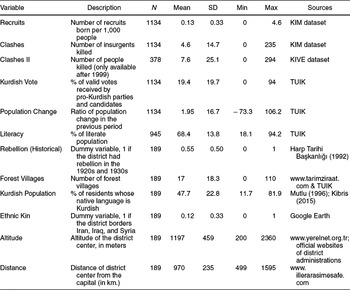
This section tests the hypotheses by analyzing spatial and temporal variation characterizing recruitment in the KIM dataset at an aggregate level. The unit of analysis is the Kurdish populated districts of Turkey (n = 189) observed at five different periods: (1) 1984–1989, the emergence of the insurgency; (2) 1990–1994, the peak years of the insurgency; (3) 1995–1999, the decline of the insurgency resulting in the capture of its leader; (4) 2000–2004, the ceasefire period with occasional clashes; (5) 2005–2012, the rekindling of the armed conflict before the ceasefire of 2013.Footnote 6 Table 1 provides summary statistics. The dependent variable, Recruits, is the number of recruits born in a district per 1,000 inhabitants in a period.
Summary Statistics

Notes: All variables are measured at district level. Rebellion, Forest Villages, Kurdish Population, Ethnic Kin, Altitude, and Distance are time invariant. KIM: Kurdish Insurgency Militants; KIVE: Kurdish Insurgency Violent Events (see footnote 10); TUIK: Turkish Statistical Institute (www.tuik.gov.tr).
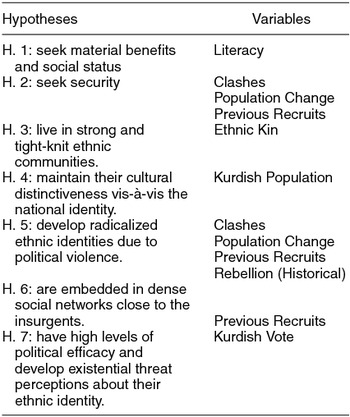
Table 2 lists hypotheses and variables that test them. Literacy, measuring the level of development in a district in a given period, tests Hypothesis 1 suggesting that individuals with high opportunity costs are unlikely to fight.Footnote 7 Districts with low levels of Literacy would have higher Recruits; increases in Literacy in a district over time would reduce Recruits. Both Hypotheses 2 and 5 focus on the effects of armed conflict on the decision to fight. Individuals may join the insurgency as they fear for their security or develop radicalized ethnic identities in the face of both widespread state violence and insurgent activity.Footnote 8 I use three variables to test Hypothesis 2 and four variables to test Hypothesis 5. Clashes,Footnote 9 the number of killed insurgents, would result in higher Recruits.Footnote 10 Population Change is a proxy for rural demographic change, as the state forces evacuated villages as a counterinsurgency strategy. I expect this lagged variable to be negatively correlated with Recruits. Individuals whose family members join the insurgency are likely to be victimized by the state, become targets of recruitment efforts by the insurgents, and develop more radicalized ethnic identities. Previous Recruits, the lagged dependent variable, test these expectations. Finally, I use Rebellion (historical) as a fourth variable to test Hypothesis 5. This dummy variable indicates whether the district had a repressed rebellion in the 1920s and 1930s. Memories of past state violence orally transmitted across generations may contribute to contemporary violent mobilization (Pecency and Stanley Reference Pecency and Stanley2010, 69; Smith Reference Smith2013).
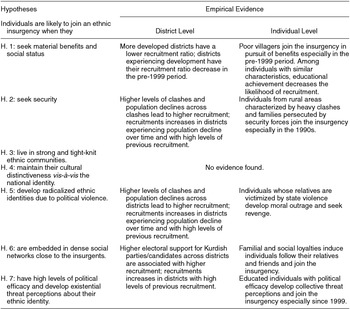
Hypotheses and Variables Individuals are likely to join an ethnic insurgency when they

While Hypotheses 3 and 4 identify distinct causal mechanisms, they both suggest that individuals who live in tight-knit and homogenous ethnic communities that maintain their distinct cultural identity vis-à-vis the national identity are more likely to rebel. For this reason, I measure them with the same two variables. Kurdish Population, a time invariant variable, measures the ratio of Kurdish-speaking population to the general population in a district. Assimilation policies pursued by the Turkish state have been less successful in districts with a concentration of ethnic Kurds. A third variable is Ethnic Kin, receiving the value of 1 if a district borders Iran, Iraq, or Syria and 0 otherwise. I expect Kurdish identity to be higher in districts bordering Kurdish areas in neighboring states where the persistence of cross-border relations may increase the risk of ethnic violence (Gurses Reference Gurses2015; Salehyan Reference Salehyan2007).
Finally, I use two identical variables to measure both Hypothesis 6 about social networks and Hypothesis 7 about threat perceptions. Districts with high ratios of Previous Recruits and electoral support for Kurdish nationalists, measured by Kurdish Vote, the percentage of votes received by the Kurdish nationalists in the parliamentary elections in a district in a period, are expected to have both denser pro-insurgency social networks and ethnic mobilization generating collective threat perceptions.Footnote 11 The distinction between Kurdish Population and Kurdish Vote builds on the distinction between ethnic structure and practice (Chandra and Wilkinson Reference Chandra and Wilkinson2008). I expect recruitment to be higher in districts with higher levels of Kurdish Vote and to increase as Kurdish Vote increases in a district.
Following Bell and Jones (Reference Bell and Jones2015), I estimate a Random Coefficient Model (RCM) for three principal reasons. First, unlike random effects (RE) models, RCMs do not suffer from heterogeneity bias, a form of endogenity that violates the RE assumption that residuals are independent of the covariates. RCMs explicitly model the source of heterogeneity bias by distinguishing between two types of time-varying effects: the “within effects” (the effect of an independent variable on the dependent variable over occasions in a given district) and the “between effects” (the effect of an independent variable on the dependent variable across districts). Next, fixed effects models may have an omitted variable bias, as they cannot measure the effects of theoretically relevant time-invariant variables, unlike RCMs. I use are two time-invariant variables Kurdish Population and Ethnic Kin to test Hypotheses 3 and 4. Finally, RCMs can be extended to test theoretically important cross-level interactions between the within and between effects. For instance, the effect of Literacy on Recruits may be different in districts with high Clashes than low Clashes.
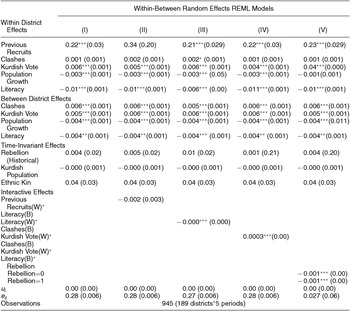
Table 3 presents the results of five RCMs.Footnote 12 Model I shows that districts with higher levels of literacy rate tend to have fewer recruits supporting Hypothesis 1. Similarly, districts experiencing Literacy increases tend to have fewer recruits over time. While districts with high levels of armed conflict tend to have higher levels of recruits than low conflict districts, a district experiencing increases in clashes over time does not have its recruitment rate go up. At the same time, population growth in the previous period is negatively associated with recruitment in a given district and districts losing population on the average tend to have higher recruits than districts experiencing population growth. Previous Recruits has also a significant and positive coefficient. However, the models show no support for Hypotheses 3 and 4. The coefficients of Kurdish Population and Ethnic Kin are insignificant. The analysis will benefit from more fine-grained variables such as the density of tribal networks with historically hostile relations with the Turkish state at the district level. Nonetheless, the results show that cultural differences do not necessarily generate rebellion, a finding consistent with previous scholarship (Posner Reference Posner2005). Finally, the results suggest that ethnic mobilization as measured by Kurdish Vote induces recruitment even when controlling for Kurdish Population.Footnote 13 Kurdish Vote has a positive and statistically significant both within and between effects. While persistent ethnic cleavages do not necessarily translate into rebellion, the effects of violent conflict and ethnic mobilization strongly contribute to insurgent recruitment. The impact of ethnic identity on the decision to rebel has an endogenous character (Arjona and Kalyvas Reference Arjona, Kalyvas, Guichaoua and York:2011).
The Insurgent Recruitment 1984–2012

Notes: Source: KIM Dataset. REML: Restricted Maximum Likelihood. W: within effects; B: between effects. Significance level (Two-tailed): *ρ < 0.05, ** ρ < 0.01, *** ρ < 0.001. Standard errors are shown in parentheses.
The relationship between Clashes and Kurdish Vote, on the one hand, and Recruits, on the other, may be spurious. Districts that historically support Kurdish nationalism would produce both higher vote for Kurdish parties and number of recruits that would in turn invite state repression resulting in intense violence. To account for this source of endogeneity, I estimate a structural equation model with the onset of Clashes, Recruits, and Kurdish Vote as the dependent variables (see Table A.4 in the Online Appendix). The results show that pre-1984 PKK Recruitment does not predict the onset of Clashes (1984–9) undermining the argument that preexisting historical Kurdish sentiments are responsible for both recruitment and fighting. Rather, structural factors that facilitate guerilla warfare such as the ratio of forest villages and remoteness from the capital make armed conflict more likely in a district (consistent with Fearon and Laitin Reference Fearon and Laitin2003). Furthermore, neither these factors nor previous Clashes explain the emergence of electoral mobilization. Districts with high levels of Previous Recruits have higher levels of initial electoral mobilization that in turn contributes to greater recruitment in subsequent periods.
I also calculate the marginal effects of both between and within variables to assess their relative magnitudes. I compare the 10th, 50th, and 90th percentiles of each of these variables while holding other variables at their means (see Table A.3 and Figure A.4 in the Online Appendix). Here I focus on Literacy and Kurdish Vote as both these variables have practical implications and the highest magnitude effects. A district experiencing an average decline of 11 percent (the 10th percentile) in Literacy has 2.6 recruits per 10,000 people; a district experiencing an average increase of 13 percent (the 90th percentile) has just 0.1 recruits, a difference of 26 times. Similarly, a district with an average Literacy level of 54 percent (the 10th percentile) has 2.1 recruits per 10,000 people, but a district with 81 percent (the 90th percentile) has only 0.9 recruits, a difference of around two-thirds. These numbers suggest that government development programs would decrease recruitment in poor and underdeveloped districts. When I estimate Model I only using observations from the post-1999 period, however, Literacy has significant but positive within and no longer significant between effects. As I discuss later, this finding is consistent with the individual-level analysis showing a notable increase in the ratio of educated recruits in the post-1999 period. Conversely, while a district experiencing an average decline of 16 percent in Kurdish Vote (the 10th percentile) has 0.6 recruits per 10,000 people in a district, a district experiencing an increase of 28 percent in Kurdish Vote (the 90th percentile) has 2.5 recruits, a difference of more than four times. Furthermore, a district with an average Kurdish Vote of 8 percent has 0.6 recruits per 10,000 people; a district with 43 percent has 2.6 recruits. These numbers highlight the strong effect of mobilization on recruitment.
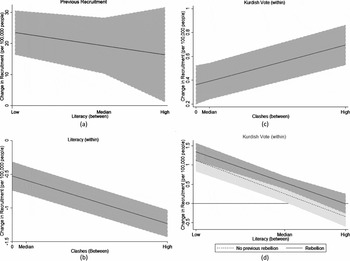
Finally, Models II–V introduce cross-level interactions between variables of theoretical interest. Model II (Figure 1(a)) shows that Literacy does not condition the effects of previous recruitment. An increase of 100 recruits per 100,000 people in the previous period leads to an increase of 23 recruits per 100,000 people in the current period in an underdeveloped (low Literacy) district. While the same increase in the previous period leads to an increase of only 18 recruits in a developed district, the difference is not significant with 0.05 significance level. Model III (Figure 1(b)) show that the negative impact of literacy increases on recruitment is stronger in districts characterized by very intense clashes. While a ten percent increase in literacy is associated with 1.3 fewer recruits per 100,000 people in high clash districts, it leads to 0.6 fewer recruits per 100,000 people in districts with no clashes.
Marginal Effects for Participation in the Kurdish Insurgency

Model IV (Figure 1(c)) and Model V (Figure 1(d)) explore the marginal effects of ethnic electoral mobilization. Figure 1(c) shows that Kurdish Vote has a higher positive impact on recruitment in high clash districts (10 percent increase in Kurdish Vote associated with 0.7 more recruits per 100,000 people) than in districts with no clashes (10 percent increase associated with 0.3 more recruits per 100,000 people). Figure 1(d) shows that the positive effects of Kurdish electoral mobilization on recruitment disappear in developed (high Literacy) districts. Increasing economic opportunities partially offset the effects of political mobilization and lower participation in the rebellion. Figure 1(d) also shows that that the impact of political mobilization (Kurdish Vote) on recruitment is stronger in districts with a rebellious history.
AN IN-DEPTH LOOK AT RECRUITMENT
The above analysis does not make it possible to distinguish among distinct causal mechanisms. For instance, it remains unclear how exactly state repression is associated with recruitment. Additionally, the analysis does not provide a direct test of Hypothesis 7, as it is not clear if Kurdish vote stands for political mobilization generating threat perceptions and leading to recruitment among politically efficacious individuals. Furthermore, it may have internal validity problems, as district-level correlations may be different from individual-level correlations. Some individuals locate to other places for many reasons before joining the PKK. For them, birth districts may not be a good proxy of life experiences that shape the decision to join. Finally, unobserved factors such as the number and location of villages with paramilitary forces, military outposts, and militant camps affecting the dynamics of war and recruitment, and local political allegiances affecting Kurdish electoral support generate additional concerns with endogeneity.
I now utilize more fine-grained data from the KIM dataset and in-depth interviews to gain leverage over these issues, flesh out causal mechanisms underlying the impact of state repression on the decision to rebel, explain temporal variation in recruitment, and compare different types of recruits with each other to offer direct tests of competing hypotheses.
STATE REPRESSION
According to in-depth interviews (see Figure A.2 in the Online Appendix), a majority of recruits who joined since the early 1990s personally experienced state violence or witnessed victimization of family members who were not involved in the insurgency. “Both of my husband's brothers departed after his arrest” (Interview IX). “He joined after the arrest of his brother” (Interview XI). Consistent with Hypothesis 2, some of these recruits joined the insurgents to avoid physical harm at the hands of the security forces. “My son left because of threats. . . . By that time, they already killed my nephew in front of his house” (Interview LV).
At the same time, a militant does not typically have a higher chance of survival than a sympathizer. Fleeing to large cities was also a feasible option. “We did not want to join the village guards. . . . This is the reason they [the security forces] went after us. . . . The guerillas were visiting the village. She [my sister who had no schooling] said, ‘I can no longer endure this oppression.’ She joined the guerillas. . . . Others including me moved to Istanbul” (Interview XLVII). Many individuals joined because they developed radicalized moral outrage (Hypothesis 5). “My son went two years ago after finishing high school. He witnessed our ordeals. They detained me and raided my house many times” (Interview XXXVI). In this regard, a common thread in the interviews is disfigurement of the body of a loved one and the inability to perform a proper burial (Feldman Reference Feldman1998). Consistent with Hypothesis 5, this experience generates a desire for revenge, as people derive satisfaction from punishing violators of social norms even at some personal cost (de Quervain et al. Reference de Quervain, Fischbacher, Treyer, Schelhammer, Schnyder, Buck and Fehr2004; Ostrom Reference Ostrom, Ostrom and Walker2003). One of the interviewees mentioned how the security forces displayed the maimed corpses of a group of militants in a schoolyard in a small town to intimidate the children (Interview I). According to a mother, the decision of her younger son to join was primarily a reaction to the treatment of his elder guerilla brother whose body remained in open field for 21 days, as soldiers did not allow its burial. Her younger son joined the insurgents six years after his elder brother's death to seek revenge (Interview LX). Finally, many individuals who joined since 1990 already had family members who had previously joined. Consistent with Hypothesis 6, the victimization of entire families by the security forces and family obligations led to multiple recruits from many families, a process similar to the Lebanese (Parkinson Reference Parkinson2013) and Colombian civil wars (Arjona and Kalyvas Reference Arjona, Kalyvas, Guichaoua and York:2011).
TEMPORAL VARIATION IN RECRUITMENT
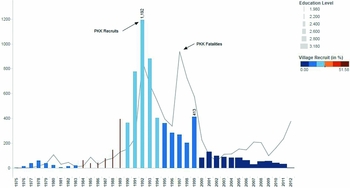
As shown in Figure 2, recruitment peaked in the early 1990s when the insurgency was at the height of its military power, a pattern consistent with perspectives that associate the belief in eventual success with participation in contentious action (Coleman Reference Coleman1990, 480–1; Finkel, Muller, and Opp Reference Finkel, Muller and Opp1989). While being a PKK fighter remained very dangerous regardless of the number of participants, the PKK's promise of greater future benefits attracted a large number of individuals to the insurgency as suggested by the threshold model of participation (Granovetter Reference Granovetter1978).
Temporal Variation in Insurgent Recruitment and Deaths

When the security forces captured Öcalan in February of 1999 and brought the PKK to the brink of dissolution, recruitment was already in a downward trend. Yet, an unusually large number of educated individuals joined the PKK in that year and since then. As articulated in Hypothesis 7, Prospect theory's notion of loss aversion offers a powerful explanation of this counterintuitive pattern. Many Kurds perceived Öcalan's capture as a huge loss and took arms to revitalize the struggle. “My brother left in 1999 shortly after the capture of Öcalan. Many people were in an emotional shock and were anxious to join the fight” (Interview LXII). “She almost had a heart attack when she heard his capture. She decided to join the guerillas immediately after” (Interview LXIII).Footnote 14 The period between 2000 and 2005 was the years of the EU-led political liberalization in Turkey. During the same period, the intensity of fighting declined and nonviolent avenues of Kurdish political activism proliferated. Recruitment continued at a lower but steady rate (Tezcür Reference Tezcür2010). In summary, the expectations of tangible benefits (as suggested by Hypothesis 1) and threat perceptions (as suggested by Hypothesis 7) are central to these fluctuations in recruitment over time.Footnote 15
RECRUITMENT LOCATION AND EDUCATIONAL ATTAINMENT
As mentioned earlier, the statistical analysis shows that the negative effect of Literacy on recruitment weakens in the post-1999 period. Similarly, Figure 2 shows temporal shifts in the average education of the recruits (bars shown in different sizes) as well as the location of recruitment (bars shown in different colors). The ratio of rural recruits experienced a steady decline over time; the ratio of educated recruits increased after 1999. Similarly, according to information obtained from in-depth interviews, out of eight recruits with university education, six of them joined the ranks in the post-1999 period. This dual pattern, increasing number of urbanized and educated recruits in the recent years, is partially a result of the unusually rapid urbanization due to political violence and increases in national educational rate. While university education remained a privilege accessible to few, the ratio of Turkish citizens with university education increased from 3.8 in 1990 to 7.6 percent in 2010 (from 2.2 to 4 percent in Kurdish provinces during the same period). The decision to fight is likely to have different causal dynamics based on the location of residence and educational attainments.
Village Recruits
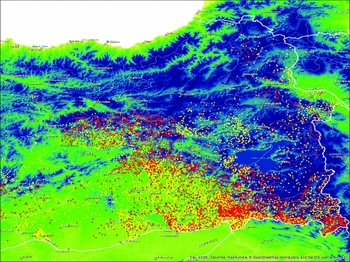
Figure 3 shows the geographical distribution of recruits’ birth (yellow dots) and death places (red dots). Direct exposure to the militants was often the primary factor in joining the rebellion in rural areas. “Before the start of the war, the guerillas used to visit the village so we knew them. One day, the guerilla came to our village and my brother [a primary school graduate] left with them” (Interview XXXVIIII). “Our village is in the plains but close to the mountains. The guerilla came to the village for the first time in late 1991. . . . My brother was the first one to join from the village” (Interview XVIII). This considerable overlap between insurgent activity as measured by militant deaths and recruitment is consistent with Hypothesis 1 about economic endowments and Hypothesis 2 about local balance of power (Arjona and Kalyvas Reference Arjona, Kalyvas, Guichaoua and York:2011). Similar to the Vietcong (Race Reference Race1972, 39–40) and the Shining Path (Degregori Reference Degregori and Stern1998), the PKK offered a previously unavailable channel of social upward mobility in areas characterized by deep inequalities (Marcus Reference Marcus2007). In fact, many poor and uneducated peasants rose in the ranks to be influential and powerful PKK commanders. A multivariate statistical analysis suggests that the lack of education does not reduce the likelihood of being a PKK commander (Table A.5 in the Online Appendix). Next, village recruits tend to come from remote areas with weak state control and heavy insurgent presence. While the PKK's employment of coerced recruitment was limited except for the late 1980s—in contrast to cases like Sierra Leone and Uganda (Beber and Blattman Reference Beber and Blattman2013; Cohen Reference Cohen2013; Humphreys and Weinstein Reference Humphreys and Weinstein2008)—it engaged in coerced recruitment primarily in such areas.Footnote 16
Geographical Variation in Insurgent Recruitment and Deaths in Turkey (1984–2012)

At the same time, rural recruitment is also consistent with hypotheses highlighting the role of nonselfish motivations. Individuals in the conflict zones are more likely to harbor strong grievances, develop radicalized identities, and have moral outrage due to violent counterinsurgent practices (Wood Reference Wood2003, 237–8). Many peasants joined the insurgents in reaction to counterinsurgent practices involving extrajudicial executions, village evacuations, home raids, and harassment of family members (as suggested by Hypotheses 5 and 6). “Men in civilian clothes took my son away from our house and shot him. At that time, nobody from our family went to the mountains. My daughter joined the insurgents after two months” (Interview V). “They beat their father in the eyes of his children. My daughter, who was just a middle school student, reacted against such practices and joined the guerillas” (Interview LXVI).
Educated Urban Recruits
Figure 3 also shows that recruitment is more spread out than clashes, which take place in the mountainous regions with a concentration just north of the Iraqi border. Large numbers of insurgents born (yellow dots) in flat areas with urban centers and weak insurgency activity hint that political mobilization is central to recruitment in these areas. While education is associated with lower recruitment at the district level, recruits became more urbanized and educated over time, as shown in Figure 2. Particularly interesting is the case of university-educated recruits. Hypotheses 1, 2, and 3 are not helpful in explaining their motivations. Unlike villagers in conflict zones, these individuals neither experienced clashes in their daily lives nor lived in insulated and tight-knit communities. In fact, more educated-recruits, who typically came from well-off families, tended to be born in provinces with low levels of clashes and electoral support for Kurdish nationalists (see Table A.5 and Figure A.5 in the Online Appendix). Hypothesis 4 about ethnic distinctiveness is not helpful either, as these individuals could be integrated into the broader Turkish society through their educational achievements and professional skills.
In some cases, Hypothesis 5 about identity radicalization due to violence and Hypothesis 6 about social networks offer compelling explanations of the recruitment of these individuals. “Ersan was 11 years old when police raided his house and detained his father and uncle. His uncle is still in prison. . .He was deeply influenced by these events. . . . He was studying physics at the college and was very active among the students. He left for the mountains in 2004” (Interview LVIII). Previous exposure to state violence was a major cause of radicalization, a pattern hinted at by Figure 1(c). “We moved to Istanbul after they [soldiers] burned down our house. . . . My son became involved with the party. . . . He was one of the leaders of the human shields movement. . . . He joined the ranks in 2005” (Interview XXXII).
At the same time, Hypotheses 5 and 6 do not satisfactorily address the question of why educated individuals joined the PKK when they could take leadership positions in proliferating Kurdish parties and associations. Interestingly, most educated recruits were involved in various forms of nonviolent political activism (e.g., participating in demonstrations, organizing events, etc.) before joining the armed struggle. According to the KIM Dataset, at least 60 percent of university recruits had a history of political activism compared to 50 percent of high school recruits, 41 percent of middle school recruits, 35 percent of primary school recruits, and 25 percent of recruits with no education. In the sample based on interviews, almost all urban recruits who joined after 1999 (23 out 25) had a history of prior political activism.
Hypothesis 7 helps to make sense of the motivations of educated urban recruits. Kurdish nationalist organizations cultivate a new reference point, the Kurdish self-determination. The status of the Kurds remains well below this point. The Kurdish nationalists suggest that the most effective manner to redress this situation is to engage in armed struggle. An oft-repeated expression by Kurdish politicians and activists is, “Kurds are subject to political, cultural, and social genocide.” As one of my interviewees, a university student, put it, “Kurdistan is a country under occupation” (Interview LXII). The fear of the extinction of the Kurdish language persists despite recent reforms partially liberalizing Kurdish publications, broadcasting, and education (Interview LVX). In the words of a recent university graduate, “[a]mong the Kurds who are aware of their national identity, there is a widespread perception that the system aims to destroy our nation” (Interview III) (also see Çelebi et al. Reference Çelebi, Verkuyten, Köse and Maliepaard2014). As this perception persists, nonviolent activism loses its appeal, and armed struggle appears as the only method to defend the collective existence of the Kurdish people. “[T]he Kurdish youth don't care about their economic well-being. They are concerned that their identity is under threat. They say, ‘The real struggle only takes place in the mountains. Our place is within the armed struggle’” (Interview VII).
In this political context, many educated Kurdish activists perceive that they would play a more effective role in the collective struggle as armed militants. Hüseyin was a student of law at a prestigious university at the time of his recruitment (Interview LII). Özgür was on track to gain his college degree in electrical engineering when he joined the PKK (Interview LVI). Ebru was a student of management in a provincial university when she became a militant (Interview L). They all had good life prospects and had the option of successfully assimilating into the Turkish society. They all grew up in cities and had no direct experience of state violence. Hüseyin and Ebru had no previous recruits from their families. Özgür had a cousin who joined the ranks and lost his life, but his father was not a PKK supporter. In summary, tangible benefits (Hypothesis 1), security concerns (Hypothesis 2), ethnic homogeneity (Hypotheses 3 and 4), exposure to political violence (Hypothesis 5), and social networks (Hypothesis 6) do not adequately explain their recruitment. Instead, their political activism made them deeply concerned with the threats facing Kurdish people during their college years. Hüseyin, a leader among Kurdish students, became a well-known PKK commander at the time of his death. Özgür was one of the leaders of the PKK's youth movement in the city before joining the armed struggle. Ebru developed interest in the Kurdish question at the university and became a student leader. The life stories of these three educated, resourceful, and politically efficacious recruits suggest that their political activism resulted in the formation of a new subjective reference point, ethnic self-determination, and a perception that only armed struggle could this achieve this goal. As suggested by Hypothesis 7 and Prospect theory's notion of loss aversion, these individuals were willing to risk their lives to redress this situation even at great personal cost.
COMPARING RECRUITS WITH NONRECRUITS WITH SIMILAR CHARACTERISTICS
Finally, I compare recruits with nonrecruits with similar characteristics to further flesh out the mechanisms leading to the decision to rebel. Using data from in-depth interviews, I identify 14 individuals who share at least two characteristics with the recruits but who did not join the insurgency (see Table A.6 in the Online Appendix). This sample is obviously not an ideal control group as it is impossible to identify all confounding factors. I build this comparison on a most similar systems design and use it to identify the factors that distinguish between recruits and nonrecruited individuals with similar life experiences. In this way, this comparison also offers a more direct test of Hypothesis 7. Twelve of 14 nonrecruits directly experienced state repression as they involuntarily left their villages, had their close family members arrested, tortured, or executed, or had their homes repeatedly raided by security forces. As we have seen earlier, these characteristics increase the likelihood of joining the insurgency. Then why did they not join?
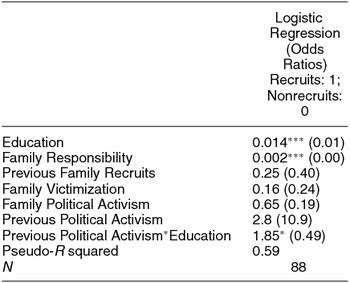
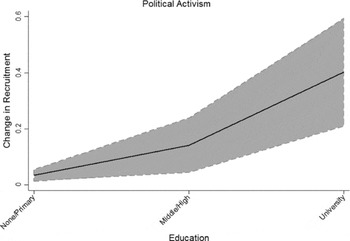
Table 4 presents the results from a logistical regression model comparing these individuals with the 74 recruits identified in the in-depth interviews. Young individuals with family responsibilities (i.e., married with children and taking care of siblings) are less likely to rebel as these responsibilities limit their demographic availability for the insurgency (Viterna Reference Viterna2013). Furthermore, and in line with Hypothesis 1, education increases the opportunity cost of rebellion. One level increase in education (e.g., from middle/high school to university) decreases the odds of participation by 85 percent. The interaction variable between activism and education measures the impact of political mobilization on recruitment among three different education groups. As visualized in Figure 4, political activists with university education are significantly more likely to join the insurgency than activists who are less educated, a finding providing additional empirical support to Hypothesis 7.
Recruits Compared to Nonrecruits with Similar Characteristics

Notes: Source: In-depth interviews. Robust standard errors clustered at periods in parentheses. *ρ < 0.05, ** ρ < 0.01, *** ρ < 0.001.
The Effect of Political Activism on Insurgent Recruitment by Education

CONCLUSION
Benedict Anderson defines nation as a “fraternity that makes it possible, over the past two centuries, for so many millions of people, not so much to kill, as willingly to die for such limited imaginings” (1991, 7). This study identifies dynamics central to this sacrificial behavior, and focuses on the microdynamics of rebellions that are caused by political exclusion of ethnic groups (Cederman, Wimmer, and Min Reference Cederman, Wimmer and Min2010; Wimmer Reference Wimmer2013) and on these groups’ collective struggles for greater power (Tilly Reference Tilly2003, 238). The decision to join the Kurdish insurgency in Turkey was the interplay of several dynamics whose relative effects vary among individuals with different characteristics and across periods. Table 5 summarizes the findings. The argument about security is most helpful in explaining the decision to rebel among villagers who live in conflict zones or activists who are victims of state violence. This pattern was most visible during the 1990s when clashes were most intense and counterinsurgency policies had little regard for human rights. Meanwhile, as the PKK gained in power and effectively challenged the authority of the state, it attracted poor peasants with dim life prospects seeking rewards and status. As economic conditions improved over time, however, this pattern of rural recruitment became less significant.
Participation in the Kurdish Insurgency: A Summary of the Findings

As the Kurdish insurgency had more urbanized and educated recruits in the post-1999 period, arguments about security and opportunity costs become less helpful. Individuals whose relatives had previously joined the insurgency and families and friends exposed to state violence continued to join the insurgency in the absence of tangible benefits or direct personal threats during these years. The armed conflict generated lasting legacies, as radicalized identities conducive to militant action persisted even if the actual levels of violence declined. In this regard, for many recruits, the decision to join the insurgents was not a simple cost-benefit calculation, but involved moral considerations and familial and social loyalties. At the same time, many educated and activist young Kurds with political efficacy perceived the armed struggle as the most effective method to reach their reference point, the Kurdish self-determination. The durability of the Kurdish insurgency after its military defeats and the capture of its leader was a function of its ability to attract these higher quality recruits. This finding building on prospect theory's notion of loss aversion underlies the role played by political entrepreneurs organizing rebellion who reinforce group boundaries, cultivate collective threat perceptions, and call for arms to combat these threats (Lyall, Blair, and Imai Reference Lyall, Blair and Imai2013; Sambanis, Schulhofer-Wohl, and Shayo Reference Sambanis, Schulhofer-Wohl and Shayo2012).
These findings directly inform studies of recruitment in civil wars in other parts of the world. In a seminal study, Weinstein (Reference Weinstein2007, 10–11) argues that, while rebels with access to natural resources or external patronage tend to attract recruits primarily motivated by opportunistic concerns, rebels operating in resource-poor environments tend to attract highly committed recruits with low future discount rates and motivated by norms and ideals. The latter attract fighters by capitalizing on social endowments, “shared beliefs, expectations and norms” of “ethnic, religious, cultural, or ideological groups,” (7) which facilitates cooperation through norms of reciprocity and trust, feelings of solidarity and moral commitments, and credible sanctions (49, 101). The PKK primarily fits the pattern of a social endowment insurgency and attracts large number of committed and educated recruits despite the enormous risks and limited gains over many years. Thus, the causal dynamics identified in this study are particularly relevant to other insurgencies relying on social endowments. However, social endowments that cultivate trust and reciprocity and facilitate collective action are not exogenous to rebellion. They are endogenous to the dynamics of political violence and the framing and mobilization efforts and ideological discourses of rebellious organizations (Gutiérrez Sanín and Wood Reference Gutiérrez Sanín and Wood2014). Insurgents in settings as diverse as Indonesia (Aspinal Reference Aspinal2009: 209), Nepal (Eck Reference Eck, Lawoti and Pahari2010), and Niger (Deycard Reference Deycard and Guichaoua2011) deliberately pursue similar strategies to cultivate threat perceptions and construct identities to mobilize fighters. While governmental developments programs may reduce insurgent recruitment in rural and impoverished areas, they will be less effective in ending rebellions that develop significant social endowment through political mobilization. Power sharing or autonomy agreements that mitigate collective anxieties and undermine the basis of insurgent threat frames would be more effective in ending rebellions mobilizing educated and efficacious people. The decision to rebel is as much political as economic and sociological.
SUPPLEMENTARY MATERIAL
To view supplementary material for this article, please visit http://dx.doi.org/10.1017/S0003055416000150.




Comments
No Comments have been published for this article.