Healthcare-associated infections (HAIs), particularly those due to multidrug-resistant organisms, cause significant morbidity and mortality in acute care settings.Reference Cosgrove1–Reference Roberts, Hota and Ahmad3 Antimicrobial stewardship programs (ASPs) are one practice used to limit resistance and are especially crucial given the lack of new antimicrobials in development.Reference Spellberg, Blaser and Guidos4, Reference Lautenbach and Perencevich5 In 2007, the Infectious Disease Society of America (IDSA) and the Society for Healthcare Epidemiology of America (SHEA) published a guidelineReference Dellit, Owens and McGowan6 for developing ASPs with the goal of improving patient outcomes while minimizing the unintended consequences of antimicrobial use. These programs have been shown to improve outcomes and reduce costs.Reference Dellit, Owens and McGowan6
Recognizing the importance of ASP, in a recent policy statement jointly published by IDSA, SHEA, and the Pediatric Infectious Disease Society, the authors recommended that ASPs be required through regulatory mechanisms, similar to Center for Medicare and Medicaid Services requirements, wherein all participating institutions would develop an ASP.7 Currently, California is the only state to mandate that all general acute-care hospitals develop a process for evaluating the judicious use of antimicrobials, although this mandate does not require a formal ASP (Senate Bill 739, Health and Safety Code §§1288.5–1288.9, 2006).
Given the growing evidence on the effectiveness of ASPs and increased interest in regulating implementation, the objective of this study was to describe the use of antimicrobial stewardship policies in a sample of National Healthcare Safety Network (NHSN) hospitals and to investigate factors associated with implementation.
METHODS
We conducted a national survey of infection control directors in acute care hospitals in the Fall of 2011.Reference Stone, Pogorzelska-Maziarz and Herzig8 A subset of hospitals also provided access to their 2011 NHSN annual survey data. The survey process and data sources are described in detail elsewhere.Reference Stone, Pogorzelska-Maziarz and Herzig8
Respondents were asked whether their hospital had a policy regarding antimicrobial stewardship and, if yes, to indicate the specific policies in place. The specific answer choices were as follows: antibiotic formulary restriction for selected agents, need for infectious disease (ID) or microbiology consult prior to prescribing antibiotics (ie, preauthorization), requiring an indication for antibiotics prescribed, use of automatic stop orders, providing clinicians with hospital or unit-based antibiograms, and prescriber audit and feedback. Additionally, the respondents were given the option to write in a response if it was not provided as one of the answer choices. Respondents were instructed to endorse all the policies that applied to their hospital. We specifically did not limit this question to asking only about policies included in a formal ASP because we were interested in capturing all stewardship activities in responding hospitals.
Data on infection control department staffing (ie, the presence of MD Hospital Epidemiologist (HE) and/or Infection Preventionist (IP) certification) and hospital characteristics (ie, location, bed size, setting, involvement in HAI initiatives) were also collected through the survey. Data on medical school affiliation, hospital type, and ownership status were available from the NHSN annual survey.
Descriptive statistics were calculated to describe the presence and types of policies. The χ2 and Fisher’s exact tests were used to examine predictors of having a policy. Given the California mandate, presence of a policy and use of specific policies in California versus other states were compared using χ2 tests. Additionally, the analysis examining predictors of having a policy was repeated excluding California hospitals. Analyses were conducted in Stata, Version 11 (College Station, Texas). The study was approved by the Columbia University Medical Center’s and RAND Corporation’s Institutional Review Boards.
RESULTS
Responses were received from 1,015 hospitals (ie, a response rate of 30%). Additionally, NHSN annual survey data were available for 725 hospitals. The majority of respondents reported that their hospital had a policy regarding antimicrobial stewardship (N=652, 64%). In these hospitals, the most frequently reported activities included providing clinicians with hospital- or unit-based antibiograms (83%), antimicrobial restriction for select agents (65%), and automatic stop orders (51%). One-third of respondents reported policies requiring an ID or microbiology consult prior to prescribing antimicrobials (35%) and prescriber audit and feedback (34%). Fewer hospitals had a policy requiring that prescribers specify an indication for antimicrobial orders (23%). Other types of policies reported (11%) included pharmacy review and education.
The sample included 75 hospitals located in California, which were more likely to have a policy in place than hospitals located in other states (77% vs 63%, P=.014). California hospitals reporting a policy were more likely to require specified indication for the antimicrobials prescribed (36% vs 21%, P=.009) and to have a policy for automatic stop orders (62% vs 50%) than non-California hospitals; however, the latter did not reach statistical significance (P=.075).
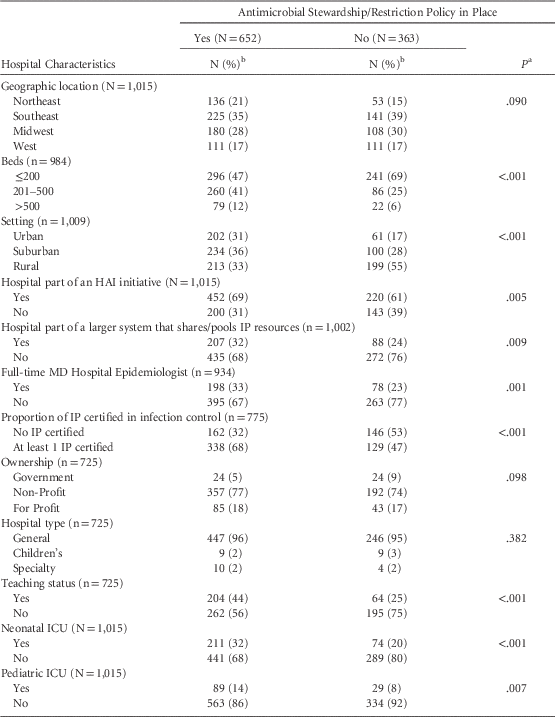
Characteristics of hospitals with and without a policy are presented in Table 1. Respondents from larger, urban, or teaching hospitals, or those taking part in an HAI initiative or that are part of a larger system that shares/pools IP resources were more likely to have a policy in place (P<.01). In addition, respondents from hospitals with a full-time MD HE or with at least one IP certified in infection control were more likely to report a policy, as well as those with a neonatal or pediatric ICU (P<.01). Hospital type, ownership, and geographic location were not statistically significant predictors of having a policy. Restricting the analysis to non-California hospitals did not change the results (data not shown).
Comparison of Hospitals With and Without Antimicrobial Stewardship/Restriction Policies in Place

NOTE. IP, infection preventionist; HAI, healthcare-associated infection; ICU, intensive care unit.
a P-values provided for χ2 or Fisher’s exact test as appropriate.
b % may not add up to 100% due to rounding.
DISCUSSION
These results come from the largest and most comprehensive survey of infection control departments in the United States and provide a snapshot of the antimicrobial stewardship policies currently utilized. We found that 66% of hospitals had a policy for antimicrobial stewardship; however, specific policy components differed among hospitals. A 2008 survey of SHEA members, 1 year after the publication of the guideline,Reference Dellit, Owens and McGowan6 found that 74% of hospitals had or were developing an ASP program, although only 48% reported that an ASP was currently in place.Reference Pope, Dellit and Owens9 In addition, hospitals reported the implementation of antimicrobial stewardship policies even in the absence of a formal ASP.Reference Pope, Dellit and Owens9 Similarly, in a 2009 survey of ID physicians participating in the IDSA Emerging Infections Network, 73% of respondents indicated that their hospital had or was planning an ASP.
Only one-third of hospitals reported that prescriber audit and feedback was instituted in their hospital even though this is one of the two core strategies recommended by the IDSA/SHEA guidelineReference Dellit, Owens and McGowan6 and is an A-I level recommendation (evidence from ≥1 properly randomized clinical trial and good evidence to support recommendation for use). Another core strategy recommended by the guideline is the use of preauthorization, which can lead to immediate and significant reduction in antimicrobial use (A-II level recommendation); however, preauthorization was reported by only one-third of hospitals. Both policies may be more difficult for hospitals to implement because they are resource-intensive and require dedicated staffing,Reference Johannsson, Beekmann and Srinivasan10 which may be the reason for the infrequent implementation of these policies in some hospitals.
In our survey, hospitals located in California were more likely to report the presence of a policy than hospitals in other states (77% vs 63%). A high prevalence of ASPs in California was reported by Trivedi & Rosenberg, with 50% of California hospitals reporting a current ASP, and 30% reporting a planned ASP.Reference Trivedi and Rosenberg11 Moreover, 22% reported that the California mandate influenced initiation of their ASP.Reference Trivedi and Rosenberg11 Given the higher prevalence of antimicrobial stewardship policies in our California sample than in the rest of the country, it seems that the statutory requirement played a role in the initiation of antimicrobial stewardship policies. These results also confirm the finding that many California hospitals were able to meet the statutory requirements with the institution of policies and perhaps without specifically instituting a formal ASP.7
Several predictors of an antimicrobial stewardship policy were identified, including greater bed size, participation in HAI initiatives, and pooling of IP resources. These factors may relate to resources available for infection prevention and the hospital’s focus on HAI prevention. In a study of the prevalence of ASPs at children’s hospitals, Newland et alReference Newland, Gerber and Weissman12 identified solid organ transplantation, greater bed size, and patient days as being associated with having a program. In the survey of California hospitals, those without an ASP were more likely to be smaller and located in a rural setting.Reference Trivedi and Rosenberg11 Additional research is needed on ways to implement ASP in hospitals with limited resources and outreach and education efforts may need to focus on these settings.
The results of this study are limited due to its cross-sectional nature. Given the low response rate, there is potential for limited generalizability and nonresponse bias. When compared to survey respondents, non-respondents tended to be from smaller facilities with fewer patient days; however, there were no differences in terms of medical school affiliation, ownership, and central-line-associated bloodstream infection rates.Reference Stone, Pogorzelska-Maziarz and Herzig8 Because respondents may be among the more committed hospitals, it may be possible that ASPs are less common among non-respondents. Another limitation is that survey respondents were directors of infection control departments. Clinicians involved in ASPs are predominantly physicians and pharmacists and less frequently IPs;Reference Pope, Dellit and Owens9 however, infection control directors should be aware of different ASP policies in place at their hospitals. Our survey was not specifically designed to measure other aspects of stewardship policies, such as the department in which the program was housed, dedicated resources, or specific end points monitored, nor did we collect detailed information on the specific components of policies under study. These data would provide a detailed picture of the intensity of ASP activities and should be the focus of future research. While many hospitals indicated they had a restriction policy in place, we have no data on the agents restricted and whether the policy is related to quality improvement or cost-containment. Additionally, we did not ask whether the antimicrobial stewardship policies were part of a formal ASP. Our aim was to capture all stewardship efforts and not only those that were part of a structured program. This makes it challenging to compare our data to those from studies examining aspects of formal ASPs.
This study provides a snapshot of the implementation of antimicrobial stewardship policies in place in U.S. hospitals and shows that variation exists in the types of policies in place. Statewide efforts in California seem to be having their intended effect of increasing the implementation of policies. Further research is needed to strengthen the evidence base on the effectiveness of these policies and to identify factors that foster their adoption.
Acknowledgments
We thank all of the National Healthcare Safety Network hospitals for their participation and support.
Financial support: This work was supported by the National Institute of Nursing Research (R01NR010107). The content is solely the responsibility of the authors and does not necessarily represent the official views of the National Institute of Nursing Research.
Potential conflicts of interest: MPM has served as a consultant for Becton, Dickinson, and Company. All other authors report no potential conflict of interest.