




No CrossRef data available.
12. CONTENT-BASED INSTRUCTION: PERSPECTIVES ON CURRICULUM PLANNING
Published online by Cambridge University Press: 15 June 2004
Abstract
Content-based instruction (CBI), distinguished by its dual commitment to languageand content-learning objectives, has been translated into practice in diverse ways to meet the needs of second and foreign language student populations. This article explores the general characteristics of and challenges associated with content-based curricula by reviewing (1) case studies that document outcomes of CBI programs at elementary, secondary, and higher education levels and (2) curricular models that have been implemented in first and second language contexts. Included in this review of curricular models, because of its implications for second and foreign language contexts, is a brief explanation of Concept-Oriented Reading Instruction (CORI), an approach to content learning and reading development that has been used and extensively researched in first language settings. Empirical studies focusing on CORI, immersion models, and other CBI-related issues (including teacher–student interactions; teachers' oral discourse; and teachers' attention to language, content, and task) are summarized to illustrate the complexities of content-based curricula. The article concludes with a call for further research that can inform the practices of teachers, curriculum and course designers, materials developers, and individuals involved with assessment in content-based settings.
Information
- Type
- CURRICULUM, PEDAGOGY, AND TEACHER PREPARATION
- Information
- Copyright
- © 2004 Cambridge University Press
Content-based instruction (CBI), distinguished by its dual commitment to language- and content-learning objectives, is not a new topic of exploration in the Annual Review of Applied Linguistics (ARAL). In the 10th volume of ARAL, Spanos (1990) identified the 1980s as a decade in which applied linguists exhibited substantial interest in “integrated instruction,” with five promising book-length publications on instructional approaches that combined language- and contentlearning objectives (Brinton, Snow, & Wesche, 1989; Cantoni-Harvey, 1987; Crandall, 1987; Enright & McCloskey, 1988; Mohan, 1986). Despite the interest that was generated by these publications and others in incorporating nonlanguage subject matter into second and foreign language courses, the widespread adoption of contentbased instruction, at that time, was met by many challenges, including coordination between language and content instructors, administrative support, materials development, and program evaluation.
In the 13th issue of ARAL, Crandall (1993) provided a historical overview of CBI in the United States. As part of her overview, she reported data on the changing demographics of second language (L2) student populations—in K–12, adult, and higher-education settings—that led to an increased concern for students' language and content learning needs. To meet those needs, Crandall summarized sound instructional strategies that fit easily into content-based paradigms, including cooperative learning, task-based and experiential learning, whole language strategies, and the use of graphic organizers. (See Schleppegrell & Achugar, 2003; Short, 1999; Smallwood & McCargo, 1999; and Snow, 2001, for more recent discussions of instructional strategies that promote language and content learning.) Added to the challenges introduced by Spanos (1990) earlier was Crandall's call for case studies that explored the difficulties experienced by L2 learners in their content classes and the effectiveness of integrated instruction. The paucity of research in these areas made it difficult for practitioners to identify optimal conditions for integrated instruction, including its timing, the relative effectiveness of different program models, and particularly useful instructional strategies, texts, and assessment measures.
In the 18th issue of ARAL, Snow (1998) examined the impact of contentbased instruction on (1) instructional practices, (2) assessment, and (3) teacher training, with additional commentary on language and content teachers' efforts at collaboration. Unlike the previous ARAL articles, Snow summarized classroombased research, extending beyond program outcomes, including studies that focused on the characteristics of disciplinary language (Short, 1994, 1997), changes in the pedagogical orientation of content-area university faculty after training seminars (Snow, 1997), and the impact of CBI on English as a second language (ESL) students' academic progress (Kasper, 1997).
Although the focus of these three ARAL articles on content-based instruction shifted between 1990 and 1998, what remained constant throughout these explorations of CBI was the rationale for instructional approaches that integrate content- and language-learning objectives. All three authors emphasized that CBI, in its various guises (Snow, 1998), provides a means for students to continue their academic development while also improving their language proficiency. Wesche and Skehan (2002) have supported this claim:
In successful CBI, learners master both language and content through a reciprocal process as they understand and convey varied concepts through their second language … CBI may be seen as particularly relevant to learners who are preparing for full-time study through their second (or weaker) language, at any level of education. (p. 220–221)
This present ARAL article, an extension of earlier discussions, explores content-based instruction, with an emphasis on the following: recent indications of a global interest in CBI; support for CBI and the common curriculum-level challenges that emerge from course outcomes; curricular models, originating from first and second language contexts; and empirical studies with implications for the development of content-based curricula. The article concludes with a call for further research, with the hopes that future ARAL articles on CBI will be able to report on larger numbers of empirical studies that can inform the practices of teachers, curriculum and course designers, materials developers, and individuals involved with assessment in the context of content-based classrooms.
Global Interest in Content-Based Instruction
The notion of integrating content- and language-learning objectives has stimulated interest globally among language professionals and some content specialists. Since Snow's ARAL article, numerous book-length publications have appeared with a focus on some aspect of language and content integration (e.g., Crandall & Kaufman, 2002; de Courcy, 2002; Echevarria & Graves, 2003; Echevarria, Vogt, & Short, 2000; Johns, 1997; Johnson & Swain, 1997; Kasper, 2000; Mohan, Leung, & Davison, 2001; Pally, 2000). An entire issue of The Canadian Modern Language Review/La Revue Canadienne des Langues Vivantes (Wesche, 2001) was devoted to immersion and content-based language teaching in Canada (see also Wesche, 2000). Similarly, the Summer/Autumn 2001 TESOL Journal (Murphy & Stoller, 2001b) explored sustained content language teaching and the ways in which the concept is being translated into practice in various instructional settings. During the same time frame, numerous countries in the European Community formalized Content and Language Integrated Learning (CLIL) and engaged in innovative initiatives integrating language and content as part of its “Plurilingual Education” agenda (Marsh, n.d.; Marsh & Langé, 1999; see also Pufahl, Rhodes, & Christian, 2000).
Other indications of a global interest in integrating content and language teaching include a fall 2003 international conference with the theme of “Integrating content and language: Meeting the challenge of a multilingual higher education,” hosted by the University of Maastricht, The Netherlands (see http://www.unimaas.nl/icl/index.htm). European initiatives involving the integration of content and language learning objectives are complemented by interests in other parts of the world where increasing numbers of educational institutions are using a foreign language (often English) as a medium of instruction for lectures, primary and supplementary readings, and class discussions (Crandall & Kaufman, 2002). The University of Maastricht conference followed an earlier one that focused on “Integrating content and language: Providing access to knowledge through language,” hosted by Peninsula Technikon, South Africa, in March 2001. Many of the papers presented at the conference in South Africa reveal the challenges faced by university lecturers, including many in South Africa, in the wake of increasingly wide access to universities and technical colleges for previously marginalized student populations whose first language is not the language of instruction (see http://www.pentech.ac.za/pil88/ for specifics about conference papers). In another African setting, 50 educators from more than 11 countries in sub-Saharan Africa enrolled in an online course entitled “Africa online: English language teaching using web resources to develop content-based materials for the classroom” (Opp-Beckman, 2002). Two goals of the online course were to familiarize participants with three content areas (i.e., entrepreneurship, civic education, HIV-AIDS education) and to guide participants in incorporating these content areas into their English language teaching. In the United States, the Content-Based Language Teaching through Technology (CoBaLTT) initiative, launched in 1999 by the Center for Advanced Research on Language Acquisition (CARLA) at the University of Minnesota, was designed to assist K–16 foreign language teachers in creating content-based curricula and utilizing technology to support content-based language instruction (see http://carla.acad.umn.edu/COBALTT.html). The American Council on Immersion Education (ACIE), by means of its newsletter The Bridge: From Research to Practice (see http://carla.acad.umn.edu/acie-bridges.html), regularly highlights issues related to content-based instruction for the immersion context.
Support from CBI Course Outcomes
Over the years, much support for CBI has followed from the outcomes of actual CBI courses (and programs) that have documented successes with combined language and content instruction. Although there have been few controlled empirical studies to support the claims made by individuals associated with those courses, the fact that students are reported to exit the courses with improved language abilities and content-area knowledge attests, at one level, to the perceived successes of CBI. It is through case-studies that we gain a sense of the characteristics of and challenges associated with content-based curricula.
At the elementary school level, there are numerous examples of successful FLES (foreign language in the elementary school) programs. Gilzow and Branaman (2000) showcase seven early-start, long-sequence foreign language programs, identified by two projects funded by the U.S. Department of Education (i.e., the National K–12 Foreign Language Survey Project and the Improving Foreign Language Education in Schools Project). The goal of the two projects was to identify model foreign language programs that would provide interested educators with insights into establishing, implementing, and maintaining similar programs. Among the seven model programs are five content-enriched programs in which concepts from regular school subject matter (e.g., math, science, geography) are taught (and reinforced) in English lessons. The two other model programs—one a partial immersion program and the other a middle-school immersion continuation program—teach school subject matter in the foreign language. Although many factors have contributed to the successes of these model curricula, four factors are identified by Gilzow and Branaman as worthy of special attention. One key to their success is flexibility, demonstrated in the ability of the seven model programs to respond to unanticipated events. Another key to success depends upon teamwork among foreign language teachers, regular classroom teachers, administrators, parents, and community members. In some cases, teamwork with nearby universities added to the success of the programs, “with benefits ranging from professional development opportunities and shared technical expertise to long-range articulation plans and teacher recruitment possibilities” (p. 5). The third key to success is linked to leadership, in the form of one or two individuals with a vision of foreign language teaching who can inspire and organize people and resources to build their programs. The fourth key to success is tied to a shared commitment, among program staff, to the program and the goal of providing foreign language education to young learners. This commitment has been translated into a range of activities including ongoing program building, grant proposals, fund raising, advocacy events, and systematic efforts to motivate students.
At the middle-school level, Bunch, Abram, Lotan, and Valdés (2001) report on a project in which two social studies and two language arts teachers, with the cooperation of university faculty and graduate assistants, are reforming social studies classes to combine an explicit focus on academic language development with Complex Instruction, an approach that emphasizes higher-order thinking, small-group interaction, and writing. One goal of Complex Instruction is to engage students in multiple-ability activities designed to promote more equal participation among English language learners and mainstream students who find themselves in the same classroom. As might be expected, the effort to integrate a specific focus on academic language in the context of a mainstream social studies class has been accompanied by challenges, including social studies and language arts teachers' diverse reactions to interdisciplinary responsibilities and even larger issues like standardized testing. Although data on the impact of this curricular innovation on students' growth in academic language and content mastery are not yet available, the project suggests interesting approaches for meeting the language and content learning needs of a heterogeneous student population.
Langman (2003) reports on a different middle-school mainstreaming effort, set into place after all teachers in the school received ESL training. In a yearlong case study of one seventh-grade science classroom with an ESL-trained science teacher, Langman found that the ESL strategies used by the teacher (e.g., using visuals, writing objectives on the board), although somewhat effective in conveying content, were less than effective in developing students' academic English. Because students received no explicit language instruction, Langman concluded that students were reduced to “incidental language learning opportunities” (p. 14), resulting in little English improvement in one school year. The documented failure of the school's policy, largely motivated by a principal's interest in better test scores, provides “evidence in support of focused language instruction as a necessary part of the curriculum for middle-school second language learners, together with content-based instruction” (p. 24).
At the tertiary level, numerous case studies have reported efforts to integrate content and language learning. Early on, Krueger and Ryan (1993) and Stryker and Leaver (1997) compiled case studies of content-based instruction in postsecondary foreign language classes. More recently, Bueno (2002; see also Dupuy, 2000, and Hoecherl-Alden, 2000) documented efforts to convert a third-year composition and conversation foreign language course into a content-based course. Bueno's experience highlights some of the challenges that teachers face when switching from a skills-based to a content-based curricular orientation including (1) the determination of course content in response to diverse student interests, (2) the selection of content resources and the designation of targeted grammar points for students with varied proficiency levels, and (3) the sequencing of structured input and output activities. In response to the challenges associated with determining content around which a foreign language course is developed, Bragger and Rice (1999) have proposed a developmental model for “content-oriented instruction” that moves students from familiar to less familiar academic and cultural content in a foreign language curriculum. A carefully orchestrated transition from familiar to unfamiliar content has been billed as one way to minimize “the ‘sudden jumps’ in difficulty” (p. 373) that typically frustrate foreign language students and faculty in curricula defined by language and literature classes.
In a South African higher-education setting, Parkinson (2000) has advocated a theme-based approach as the organizing principle for an English for Specific Purposes course. Parkinson involves students in learning science content to assist them in acquiring the range of literacies associated with science learning. The course uses themes (e.g., wastewater treatment, ozone) in slightly different ways, the differences seen in “the extent to which students are exposed to real data (measurements) and whether they collect the data themselves or not” (p. 376).
Added to this set of case studies are efforts to integrate language and content learning in tertiary-level ESL classes. Pally (2000) and Murphy and Byrd (2001), for example, compiled case studies showcasing efforts to integrate one subject area into language classes for an extended period of time (up to a full semester), thus the designations “sustained content-based instruction” (Pally, 2000) and “sustainedcontent language teaching” (Murphy & Stoller, 2001a). What distinguishes these case studies from others is their commitment to an exploration of one content area, or carrier topic, that simulates the demands of mainstream university-level courses, with the addition of explicit instruction in language and academic skills. Examples of sustained-content language teaching, like those mentioned below, illustrate its versatility (in terms of content selection, source of content, skills foci, syllabus design, and task orientation), usefulness for integrating language- and contentlearning objectives, and ability to provide students with opportunities for deep engagement with content. Brinton (2001), as an example, uses sustained content (centered on the city of Los Angeles) while structuring her class around a genrebased syllabus; Carson (2000) uses sustained content (focusing on psychology) to complement an integrated-skills task-based English for Academic Purposes (EAP) curriculum; Janzen (2001) combines sustained content (on special effects in movies) with a discrete-skill focus, emphasizing reading skill and strategy development; and Weissberg and Lipoufski (2002) exploit local issues (in the community, county, and state) to restructure a reading and vocabulary course. Mendelsohn (2001) combines sustained content (on Canadian language and culture) with a strategy-based approach, exposing students to content and language learning strategies that will assist them in handling EAP tasks. The content in Mendelsohn's course, like many of the other examples, “is not only treated as a vehicle for language learning but is given major prominence” (p. 309). Despite the growing interest in a sustainedcontent orientation, and the many ways in which the concept has been translated into practice in second and foreign language curricula, as illustrated by these examples, some in the field see limitations in crafting a curriculum around a single content area. Davison and Williams (2001), for instance, have noted that restricting a curriculum to a single subject area limits language coverage, thereby disadvantaging the very students meant to be served by such curricula.
Crandall and Kaufman (2002) compiled a more eclectic set of case studies on CBI in second and foreign language higher-education settings. The case studies in their edited volume showcase the “commonality of purpose” (p. 1) among distinct approaches to integrating content and language objectives; these studies bring attention to approaches to CBI that go well beyond the models popularized by Brinton, Snow, and Wesche (1989) and those referred to by Crandall (1993), Snow (1998), and Spanos (1990) (e.g., adjunct, integrated, language sensitive, sheltered, theme based). For example, Stewart, Sagliano, and Sagliano (2002) demonstrate the evolution of a modified adjunct course to a collaborative interdisciplinary teamteaching approach in an EFL setting. Brinton and Jensen (2002) describe a simulated adjunct ESL course in which authentic content and tasks are imported from a subject-area course into a language course. Iancu (2002) describes a bridge program that links a general education course with four language-skill courses. Snow and Kamhi-Stein (2002) describe a modified adjunct model characterized by the pairing of a general education class with study group sections that are team taught by an ESL instructor and peer study group leader. (See also Ronesi, 2001, for a description of a university CBI program with adjunct study sessions supported by undergraduate students trained to assist ESL classmates.)
While illustrating diverse ways of combining content- and language-learning objectives and encouraging collaboration between language and content faculty, this representative set of case studies highlights a common set of challenges faced by teachers and program administrators. With implications for curriculum development efforts in other settings, these challenges include the following:
- The identification and development of appropriate content
- The selection and sequencing of language items dictated by content sources rather than a predetermined language syllabus
- The alignment of content with structures and functions that emerge from the subject matter (Short, 1999)
- The choice of appropriate materials and the decision to use (or not to use) textbooks
- Faculty development that assists language instructors in handling unfamiliar subject matter and content-area instructors in handling language issues
- Language- and content-faculty collaboration
- The institutionalization of CBI in light of available resources and the needs of faculty and students
- Systematic assessment to demonstrate (1) students' language and content learning and (2) program effectiveness
Curricular Models
The case studies just mentioned reveal many of the ways in which contentbased instruction can be structured to meet the needs of diverse student populations. In reviewing curricular approaches to content-based instruction, Met (1998; see also Snow, 2001) demonstrates how different models of content-based instruction constitute a continuum, showcasing the shifting emphasis on content and language, most often a response to the exigencies of the instructional settings in which they are implemented. At one end of the continuum are “content-driven” approaches with strong commitments to content-learning objectives (immersion, partial immersion, sheltered subject-area courses); at the other end of the continuum are “languagedriven” approaches with strong commitments to language learning objectives, using content mainly as a springboard for language practice. Language courses built around themes, for example, vary in their commitment to content-learning objectives, depending on the weighting of different curricular elements (Davison & Williams, 2001).
Wesche and Skehan (2002) visualize a continuum with different end points. They have depicted content-based instruction, and its many variations, on a continuum with “strong” forms of CBI at one end of the continuum and “weak” forms of CBI at the other end. The so-called strong forms place the greatest emphasis on the mastery of nonlinguistic subject matter (parallel to Met's contentdriven approaches) and the weak forms of CBI focus on language learning (parallel to Met's language-driven approaches).
On either continuum, there are approaches to content-based instruction that fall somewhere between the end points, demonstrating more balanced commitments to the language and content learning needs of target student populations. Subjectarea courses, paired with language support courses, the latter often labeled adjunct or linked courses (see Johns, 1997), fall somewhere in the middle of the continuum. Stoller (2002) has proposed ways in which to modify theme-based courses (often placed at the language or weak end of the continuum) so that students are better prepared for the demands of future subject-area courses where they will be expected to develop some degree of content-area expertise and to display their grasp of knowledge on formal assessment measures. Although some CBI models, like Stoller's modified theme-based model, aim at addressing students' language and content learning needs (thus falling toward the middle of the continuum), Davison and Williams (2001) have claimed that few, if any, comprehensive models or teaching materials are appropriately placed at the center of the language and content continuum.
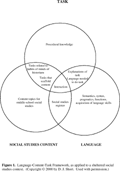
Besides the CBI models that are traditionally placed on these content-tolanguage emphasis continua, there are other curricular models to consider. One commonly referred to curricular model, the Cognitive Academic Language Learning Approach, or CALLA, was developed by Chamot and O'Malley (1987, 1994). CALLA is noted for its three-way commitment to content, language, and strategy training. More recently, Short (2002) introduced the Language-Content-Task (LCT) framework (see Figure 1), which is structured around three components associated with academic literacy: knowledge of the target language (L), knowledge of the content area (C), and knowledge of how tasks (T) are to be completed to succeed in academic settings. These three components, and their interactions, represent the core of the LCT curricular framework, applied by Short to sheltered social studies classes at the middle-school level, but widely applicable to other disciplines. Although sheltered instruction has been implemented in a variety of ways (e.g., Echevarria & Graves, 2003; Short, 1999), in this framework, teachers are encouraged to structure their lessons so that language, content, and tasks are dealt with individually and in interaction with one another. The language domain helps students master semantic, syntactic, and pragmatic aspects of the language, in addition to the traditional four skills (reading, writing, speaking, and listening). The content domain focuses on school curriculum objectives and the content introduced in the textbook and other instructional materials. This domain emphasizes the importance of addressing the learning strategies that students need to access, process, and remember content. The third domain consists of common academic tasks (and training in accomplishing the tasks) that engage students in the use of strategies to improve their academic performance and the application of content knowledge, thereby allowing teachers to evaluate students' understanding and recall of information. The intersection of the three domains of the LCT framework provides “the glue for students to pull together their knowledge of language, content, and task so that they can participate actively in the academic classroom” (Short, 2002, p. 20).

Language-Content-Task Framework, as applied to a sheltered social studies context. (Copyright © 2000 by D. J. Short. Used with permission.)
One curricular framework rarely referred to in second and foreign language discussions of content-based instruction is Concept-Oriented Reading Instruction (CORI), an approach to content learning and reading development used (and extensively researched) in first language settings (e.g., Guthrie et al., 1998; Guthrie, Schafer, Von Secker, & Alban, 2000; Guthrie & Ozgungor, 2002; Guthrie, Wigfield, & Von Seker, 2000). CORI, which has major implications for second and foreign language content-based curricula, began with instructional principles for stimulating interest and motivation to read. It has evolved into a more elaborate, yet flexible approach organized around four stages: (1) immersion into a main theme through students' personal engagement with the topic, (2) wide reading and information gathering on the theme across multiple information sources, (3) reading strategy instruction to assist with comprehension, and (4) project work leading to a product that demonstrates what students have learned. A significant component of CORI is strategies instruction to support the extensive and varied input from text material required for thematic instruction; yet it also incorporates comprehension instruction activities that go beyond strategy training (e.g., vocabulary development, fluency practice, extensive reading). In the development of the four stages of CORI, students engage in content discussions and activities that require the purposeful use of multiple strategies such as forming questions, noting text structure and text characteristics, activating background knowledge, answering questions, taking notes, determining main ideas, synthesizing information, paraphrasing, summarizing, monitoring and repairing comprehension, integrating information through graphic organizers, and carrying out a range of project tasks. These strategies are developed as part of explicit instruction while students are reading interesting texts to find information related to their projects; they are accompanied by consistent teacher modeling, teacher scaffolding, and extensive practice.
A number of larger goals are associated with CORI. With an emphasis on student motivation to read and to learn, the approach involves discussions that center around content, reading goals, strategies, and learning while students are engaged with multiple informational texts. As Guthrie and Ozgungor (2002) note, “CORI begins with knowledge goals and situates the critically important reading comprehension strategies within a rich subject-matter domain” (p. 281).
Another important aspect of CORI is its commitment to curricular coherence (Guthrie, Cox, et al., 2000), often lacking in many content-based approaches (Stoller & Grabe, 1997; see also Davison & Williams, 2001). In CORI, coherence is operationalized by nurturing sustained student engagement with content material, by assisting students with making connections across texts and across subject areas, by helping students see the transferability of the strategies that they are mastering, and by guiding students in building upon prior knowledge and interests. (See Swan, 2003, for more detailed discussions of the differences between coherent and fragmented curricula in the context of CORI.)
Collaborative Strategic Reading (CSR), designed for English language learners, is an instructional framework that is rarely mentioned in discussions of CBI even though it combines cooperative learning principles and reading comprehension strategy instruction to promote content learning, language mastery, and reading comprehension (Klingner & Vaughn, 2000). During CSR, students work collaboratively to comprehend content-area texts, the belief being that cognitive development is stimulated by social interaction (the result of cooperative learning activities). While working in groups, students apply four strategies to their content reading: They preview (i.e., predict what the passage might be about), “click and clunk” (i.e., identify difficult words and concepts and use fix-up strategies to make sense of difficult texts), get the gist (i.e., restate the most important ideas in portions of the text), and wrap up (i.e., summarize what has been learned). CSR teachers, like CORI teachers, introduce the four strategies (and the approach) through modeling, role playing, thinking aloud, and discussing why, when, and how to use the strategies.
Quite different from the curricular orientations just described is Foreign Languages Across the Curriculum (FLAC), sometimes referred to as Languages Across the Curriculum (LAC), which broadens the scope of CBI curricular models by giving students the opportunity to build upon, and thereby supplement, formal language education through the use of foreign languages in courses outside of foreign language and literature departments (Klee, 2000; see also Krueger & Ryan, 1993; Straight, 1994; Stryker & Leaver, 1997). In FLAC programs, foreign languages are used for instructional purposes (i.e., in lecturing, in recitation sections, and/or for reading of authentic materials) in courses that focus on subject matter such as history, social sciences, and business. FLAC programs are often adopted as part of an institutional effort to internationalize the curriculum.
Empirical Studies
Although much of the professional literature advocating content-based approaches relies on nonempirical support, numerous empirical studies have implications for CBI curriculum development. CORI, mentioned earlier, is an example of a first language approach to language (mainly reading) and content learning that has been the subject of extensive research. Results from CORI studies have shown that students at multiple grade levels outperform control groups in text comprehension, uses of strategies for learning, and motivation for learning (e.g., Guthrie & Ozgungor, 2002; Guthrie, Wigfield, & Von Seker, 2000; Guthrie et al., 1998). The main elements of CORI—including extended reading on and sustained engagement with a theme; strategy training and the purposeful use of strategies; classroom discussions of content, strategies, and learning; information gathering; project work; and student motivation—could easily be adapted to, and investigated in, second and foreign language settings.
Collaborative Strategic Reading (CSR), introduced in the previous section, has also been the subject of empirical research. Klingner and Vaughn (2000) investigated the frequency and means by which 37 bilingual and limited English proficient students in a fifth-grade elementary school classroom helped each other while implementing CSR with science textbook reading. Results revealed that students spent about half of their time identifying and clarifying “clunks” (i.e., difficult words and concepts), with the remainder of their time divided among the other three strategies. Students took the responsibility for learning content, and helping others to do the same seriously. Results of pre- and post-English vocabulary measures indicated gains in vocabulary learning as well.
Continuing a long-standing tradition, numerous Canadian studies focus on immersion-program curricula. Turnbull, Lapkin, and Hart (2001) and Bournot-Trites and Reeder (2001), for example, explore the effects of different immersion models, the proportion of instructional time in English, and the language of testing. Turnbull, Lapkin, and Hart compared French immersion and nonimmersion students' performances on tests of English reading and writing and mathematics. The researchers concluded that immersion does not have a negative impact on students' literacy and mathematical skills in English even though their results, confirming earlier studies, demonstrated a lag in early total immersion students' literacy skills at grade 3. Yet, immersion students who were exposed to some instruction in English language arts (even if only in grade 3) performed as well as nonimmersion students. At grade 6, immersion students' literacy scores were better than their peers' in English-only programs. At both grades 3 and 6, immersion students' math scores were almost identical to nonimmersion peers. (See Thomas & Collier, 2002, for a study of the effectiveness of U.S.-based bilingual, immersion, and mainstream programs for long-term academic achievement.)
Other indications of the strong research tradition in Canada are seen in the work of Burger and Chrétien (2001), who studied the oral language development of students enrolled in a university psychology course and adjunct language course. Results revealed that students can make measurable gains in oral language skills, in terms of both fluency and accuracy, as a result of the paired classes. Their results build upon earlier studies that show the effectiveness of linking a content course and a language support course. Duff (2001a) conducted an ethnographic study of a secondary social studies class and determined that students not only needed to be able to succeed in a variety of speaking, reading, and writing tasks, but they also “needed a current knowledge of popular North American culture, mass media, and newsworthy events; an ability to express a range of critical perspectives on social issues and to enter quick-paced interactions, and a great deal of confidence” (p. 103).
Other studies with implications for content-based curricula have examined the role of discourse—including teachers' oral discourse and teacher–student interactions—in content-based settings. For example, Short (2002) conducted a study to examine teachers' oral discourse to determine whether and how teachers (two certified social studies instructors and two trained ESL teachers) addressed language, content, and task learning (the three major components of the LCT framework mentioned earlier) in U.S. middle-school sheltered social studies classrooms. Data culled from audiotaped classroom observations and a review of lesson plans and classroom practices revealed that teachers placed more emphasis on content and tasks than on language. Only 20 percent of teachers' utterances focused on language development; 95 percent of those language-related utterances was devoted to issues related to pronunciation and vocabulary comprehension. In contrast, 35 percent of oral interactions addressed content, and 44 percent addressed tasks. The lack of attention to language was also evident in the review of lesson plans and instructional practices. Short points out that efforts to address content and tasks are not uncommon in sheltered curricula because of external pressures to cover the standard curriculum and prepare students for state and local testing. Contributing to the lack of attention to language is the fact that, on the one hand, ESL teachers in such settings are struggling with content for which they have not been trained, and the social studies teachers, on the other hand, do not believe that teaching language should be part of their responsibilities. Because of the teachers' uneven attention to language, content, and tasks, neither the lessons of teachers with social studies training nor those with ESL training complement the LCT model proposed by Short (2002). To remedy this problem and move teachers toward addressing students' multifaceted needs, as characterized by the LCT model, Echevarria, Vogt, and Short (2000; see also Short & Echevarria, 1999) have generated guidelines for training and supervising teachers so that they can improve their sheltered content teaching.
Gibbons (2003) investigated how teacher–student interactions in an Australian content-based science classroom (focusing on magnetism) contribute to 9- and 10-year-old ESL students' language development. Drawing on constructs from systemic functional linguistics and sociocultural theory (see also Huang & Morgan, 2003; Mohan & Beckett, 2001), Gibbons examined how teachers mediate between students' current language abilities and understanding of science, on the one hand, and the educational discourse and specialist understanding of science, on the other. Gibbons' data, drawn from 14 hours of classroom discourse, revealed that teachers mediate language and learning by recasting, signaling for reformulations, and modeling alternative ways of reconstructing knowledge for the benefit of others. The interaction between these forms of teacher mediation and ESL students' active participation in the discourse of the classroom resulted in the gradual transformation of student language so that it more closely approximated the specialist discourse of the school curriculum, that is, the targeted academic register.
Creese (2002) examined the discursive practices of 14 content and 12 language specialists working in partnerships in three mainstream classroom settings in London, England, to understand “the ways these teachers' discourses underpin and are unpinned by different sets of knowledge hierarchies within the classroom” (p. 598). Data drawn from a one-year ethnography revealed that language teachers' knowledge and skills are perceived to have lower status than the subject area teachers.' In these settings, pedagogical approaches perceived as highly effective in many ESL/EFL settings (e.g., scaffolding, making form-function links, noticing gaps in input, providing opportunities for negotiation) were perceived as less important than the content teachers' pedagogical practices. The undermining of the language teachers' contributions to the partnership marginalizes not only the teacher but also the students who are supposed to benefit from the language teachers' presence. (See Leung, 2001, and Leung & Franson, 2001a and 2001b, for other discussions of mainstreaming in England.)
Pica (2002) explored the extent to which learners and teachers modify their interactions, during classroom discussions, about subject-matter content through negotiation of meaning, form-focused intervention, and form-focused instruction. She wanted to determine the extent to which modified interactions, if they occurred, led to input, feedback, and production of modified output that could draw students' attention to form and meaning relationships. Pica conducted her research in a university-based English language institute with two content-based classes. Findings revealed that classroom discussions, the most frequently employed interactional activity in these classrooms, included little negotiation of meaning and negligible amounts of form-focused intervention or instruction, resulting in a “paucity of the kinds of interaction considered helpful to learners' input, feedback and production needs” (p. 10). To better meet students' language-learning needs, Pica has recommended that content-based teachers modify their responses to students' contributions to classroom discussions in ways that would generate more input, feedback, and modified student output. Pica's recommendations reinforce similar suggestions made by Doughty and Varela (1998), whose research indicates ways in which teachers recast students' responses to further students' development of verb form and meaning in content-based science and math classes for ESL students. Pica has also suggested that teachers follow up classroom discussions with interactive, form-focusing tasks to draw students' attention to developmentally difficult formmeaning relationships. (See also Swain, 1998, 2001, for results of studies on the role of output in prompting metalinguistic reflection and the role of collaborative tasks, focusing on content, in drawing learners' attention to language.)
A Call for Further Research
Additional empirical research on content-based instruction is needed. In the Winter 2001 TESOL Quarterly, 10 specialists in the field were asked to identify research priorities for the near future. Three of the specialists identified research areas that are directly pertinent to content-based instruction. Christian (2001), for example, identified the need to understand (1) the relationship between school-based language instruction and students' needs to master content through L2 literacy, (2) the acquisition of literacy competence and subject-matter learning as critical factors in academic success, and (3) the processes involved in, and interactions among, acquiring literacy competence, subject matter learning, and L2 learning. Duff (2001b) pinpointed the need to understand the impact of participation in language programs on students' L2 abilities, content knowledge, and career outcomes as particularly relevant. Freeman (2001) called for a better understanding of the role of teachers' subject matter knowledge on classroom instruction. The focus of Freeman's suggested research agenda is linked most strongly to teachers' knowledge of applied linguistics subject matter and the English language, but such research could easily be extended to other subject-matter knowledge.
Elsewhere, Short (1999) and Gottlieb (1999) have pointed out the need for systematic research on assessment in the context of content-based instruction. Because it is difficult to separate language learning issues from content learning issues in the assessment process, we need to find a way to determine if students are unable to demonstrate knowledge because of a language barrier or because of a lack of understanding of content material. Short (1999) has called for “a new paradigm for assessment” (p. 131), one that moves beyond standardized tests and toward assessment that monitors students' academic progress, language learning, and content learning. Leung (2001) has called for an assessment of educational and public policy and its influence on the content and language learning of L2 students who are placed into mainstream curricula.
The challenges intimated by the case studies reviewed here suggest the need for research in additional areas related to content-based curricula. Wesche and Skehan (2002) have identified the interface of language and content as “the most important pedagogical issue for CBI at all program levels” (p. 225), making it worthy of investigation. Fruitful areas of investigation include the selection, sequencing, and balance of content and language; the relationships among input, output, and feedback; student engagement with the information gathering, processing, and reporting process; strategy training; the contextualization of grammar instruction; the relationship between tasks and texts; and the development of curricular coherence, to name just a few areas that would benefit from further exploration. Studies such as those suggested here are needed to inform the practices of teachers, curriculum and course designers, materials developers, and those involved with assessment. The result could be more effective approaches to content-based instruction which would benefit students who desire stronger content- and language-learning abilities.
ANNOTATED BIBLIOGRAPHY
Crandall, J. A., & Kaufman, D. (Eds.). (2002). Content-based instruction in higher education settings. Alexandria, VA: TESOL.
This volume represents the most recent compendium of case studies showcasing the different ways in which content-based instruction has been adapted in ESL and EFL settings.
Echevarria, J., Vogt, M. E., & Short, D. J. (2000). Making content comprehensible for English language learners: The SIOP model. Needham Heights, MA: Allyn & Bacon.
This volume presents a field-tested model of sheltered instruction that specifies features of effective sheltered lessons. The volume provides guidance for teacher supervisors who are in the position to observe and quantify sheltered teaching.
Guthrie, J. T., & Ozgungor, S. (2002). Instructional contexts for reading engagement. In C. Collins Block & M. Pressley (Eds.), Comprehension instruction: Research-based best practices (pp. 275–288). New York: Guilford Press.
This chapter provides a thorough description of Concept-Oriented Reading Instruction (CORI) as applied in different grades and different schools. The chapter provides an example of an eight-week CORI unit, which is followed by a discussion of the principles that account for the effectiveness of CORI. Evidence from longitundinal and cross-sectional studies of CORI are presented to illustrate the benefits of CORI for reading comprehension, reading motivation, and knowledge acquisition. Although the authors do not address the use of CORI in L2 contexts, the chapter offers many insights that are pertinent to discussions of content-based instruction in L2 contexts.
Short, D. J. (2002). Language learning in sheltered social studies classes. TESOL Journal, 11(1), 18–24.
This article introduces a content-based curricular framework—the Language-Content-Task (LCT) framework—that is structured around three components associated with academic literacy: knowledge of the target language (L), knowledge of the content area (C), and knowledge of how tasks (T) are to be completed to succeed in academic settings. The article showcases how the framework can be used in a sheltered social studies curriculum and how it was applied to classroom-based research.
Swan, E. A. (2003). Concept-oriented reading instruction: Engaging classrooms, lifelong learners. New York: Guilford Press.
This book explores Concept-Oriented Reading Instruction (CORI) in very practical terms. The book is replete with concrete examples showcasing the CORI framework in actual use. Like the Guthrie & Ozgungor (2002) chapter cited earlier, this volume is not directed at L2 teachers. Yet the potential for adapting CORI for content-based classrooms in L2 settings makes this a worthwhile volume for practitioners (including those interested in curriculum and course design, and materials development).
Wesche, M. B. (Ed.). (2001). French immersion and content-based language teaching in Canada/Immersion et apprentissage axe sur le contenu au Canada [Special issue]. The Canadian Modern Language Review/La Revue canadienne des langues vivantes, 58(1).
The entire volume is dedicated to an exploration of French immersion and content-based instruction in Canada. The eight studies reported address the conditions and processes underlying successful language and content teaching and learning.
References
American Council on Immersion Education (ACIE).
The bridge: From research to practice
[Newsletter]. Retrieved September, 2003, from http://carla.acad.umn.edu/acie-bridges.html.
Bournot-Trites M., &
Reeder K.
2001.
Interdependence revisited: Mathematics achievement in an intensified French immersion program.
The Canadian Modern Language Review/La Revue canadienne des langues vivantes,
58
(1),
27–
43.Google Scholar
Bragger J. D., &
Rice D. B.
1999.
The message is in medium: A new paradigm for content-oriented instruction.
Foreign Language Annals,
32
(3),
373–
391.Google Scholar
Brinton D. M.
2001.
A theme-based literature course: Focus on the City of Angels.
In J. Murphy &
P. Byrd (Eds.),
Understanding the courses we teach: Local perspectives on English language teaching
(pp. 281–
308).
Ann Arbor:
University of Michigan Press.
Brinton D. M., &
Jensen L.
2002.
Appropriating the adjunct model: English for academic purposes at the university level.
In J. A. Crandall &
D. Kaufman (Eds.),
Content-based instruction in higher education settings
(pp. 125–
137).
Alexandria, VA:
TESOL.
Brinton D.,
Snow M. A., &
Wesche M.
1989.
Content-based second language instruction.
New York:
Newbury House.
Bueno K. A.
2002.
Creating community and making connections in the third-year Spanish course: A content-based approach.
Foreign Language Annals,
35
(3),
333–
341.Google Scholar
Bunch G. C.,
Abram P. L.,
Lotan R. A., &
Valdés G.
2001.
Beyond sheltered instruction: Rethinking conditions for academic language development.
TESOL Journal,
10
(2/3),
28–
33.Google Scholar
Burger S., &
Chrétien M.
2001.
The development of oral production in contentbased second language courses at the University of Ottawa.
The Canadian Modern Language Review/La Revue canadienne des langues vivantes,
58
(1),
84–
102.Google Scholar
Cantoni-Harvey G.
1987.
Content-area language instruction: Approaches and strategies.
Reading, MA:
Addison-Wesley.
Center for Advanced Research on Language Acquisition (CARLA), University of Minnesota.
Content-based language teaching through technology.
Retrieved October, 2003, from http://carla.acad.umn.edu/COBALTT.html.
Carson J. G.
2000.
Reading and writing for academic purposes.
In M. Pally (Ed.),
Sustained content teaching in academic ESL/EFL: A practical approach
(pp. 19–
34).
Boston:
Houghton Mifflin.
Chamot A. U., &
O'Malley J. M.
1987.
The Cognitive Academic Language Learning Approach: A Bridge to the Mainstream.
TESOL Quarterly,
21
(2),
227–
249.Google Scholar
Chamot A. U., &
O'Malley J. M.
1994.
The CALLA handbook: Implementing the Cognitive Academic Language Learning Approach.
Reading, MA:
Addison- Wesley.
Christian D.
2001.
Dual-language education for English language learners.
TESOL Quarterly,
35
(4),
601–
602.Google Scholar
Crandall J. A. (Ed)
1987.
ESL through content-area instruction; Mathematics, science, and social studies.
Englewood Cliffs, NJ:
Prentice Hall.
Crandall J. A.
1993.
Content-centered learning in the United States..
Annual Review of Applied Linguistics,
13,
111–
126.Google Scholar
Creese A.
2002.
The discursive construction of power in teacher partnerships: Language and subject specialists in mainstream schools.
TESOL Quarterly,
36
(4),
597–
616.Google Scholar
Davison C., &
Williams A.
2001.
Integrating language and content: Unresolved issues.
In B. Mohan,
C. Leung, &
C. Davison (Eds.),
English as a second language in the mainstream: Teaching learning and identity
(pp. 51–
70).
New York:
Longman.
de Courcy M.
2002.
Learners' experiences of immersion education: Case studies of French and Chinese.
Clevedon, UK:
Multilingual Matters.
Doughty C., &
Varela E.
1998.
Communicative focus on form.
In C. Doughty &
J. Williams (Eds.),
Focus on form in second language classrooms
(pp. 114–
138).
New York:
Cambridge University Press.
Duff P. A.
2001a.
Language literacy, content, and (pop) culture: Challenges for ESL students in mainstream courses.
The Canadian Modern Language Review/La Revue canadienne des langues vivantes,
58
(1),
103–
132.Google Scholar
Duff P. A.
2001b.
Learning English for academic and occupational purposes.
TESOL Quarterly,
35
(4),
606–
607.Google Scholar
Dupuy B. C.
2000.
Content-based instruction: Can it help ease the transition from beginning to advanced foreign language classes?
Foreign Language Annals,
33,
205–
223.Google Scholar
Echevarria J., &
Graves A.
2003.
Sheltered content instruction: Teaching Englishlanguage learners with diverse abilities
(2nd ed.)
Boston:
Allyn & Bacon.
Enright D. S., &
McCloskey M.
1988.
Integrating English.
Reading, MA:
Addison-Wesley.
Freeman D.
2001.
Teacher learning and student learning in TESOL.
TESOL Quarterly,
35
(4),
608–
609.Google Scholar
Gibbons P.
2003.
Mediating language learning: Teacher interactions with ESL students in a content-based classroom.
TESOL Quarterly,
37
(2),
247–
273.Google Scholar
Gilzow D., &
Branaman L. E.
2000.
Lessons learned: Model early foreign language programs.
Washington, DC:
Center for Applied Linguistics and McHenry, IL: Delta Systems.
Gottlieb M.
1999.
Assessing ESOL adolescents: Balancing accessibility to learn with accountability for learning.
In C. J. Faltis &
P. Wolfe (Eds.),
So much to say: Adolescents, bilingualism, & ESL in the secondary school
(pp. 176–
201).
New York:
Teachers College Press.
Guthrie J. T.,
Van Meter P.,
Hancock G. R.,
McCann A.,
Anderson E., &
Alao S.
1998.
Does Concept-Oriented Reading Instruction increase strategy use and conceptual learning from text?
Journal of Educational Psychology,
90
(2),
261–
278.Google Scholar
Guthrie J. T.,
Cox K. E.,
Knowles K. T.,
Buehl M.,
Mazzoni S., &
Fasculo L.
2000.
Building toward coherent instruction.
In L. Baker,
M. J. Dreher, &
J.T. Guthrie (Eds.),
Engaging young readers: Promoting achievement and motivation
(pp. 209–
237).
New York:
Guilford Press.
Guthrie J. T.,
Schafer W. D.,
Von Secker C., &
Alban T.
2000.
Contributions of integrated reading instruction and text resources to achievement and engagement in a statewide school improvement program.Journal of Educational Research,
93,
211–
226.Google Scholar
Guthrie J. T.,
Wigfield A., &
Von Seker C.
2000.
Effects of integrated instruction on motivation and strategy use in reading.
Journal of Educational Psychology,
92
(2),
331–
341.Google Scholar
Hoecherl-Alden G.
2000.
Turning professional: Content-based communication and the evolution of a cross-cultural language curriculum.
Foreign Language Annals,
33,
614–
621.Google Scholar
Huang J., &
Morgan G.
2003.
A functional approach to evaluating content knowledge and language development in ESL students' science classification texts.
International Journal of Applied Linguistics,
13
(2),
234–
262.Google Scholar
Iancu M. A.
2002.
To motivate and educate, collaborate and integrate: The adjunct model in a bridge program.
In J. A. Crandall &
D. Kaufman (Eds.),
Contentbased instruction in higher education settings
(pp. 139–
153).
Alexandria, VA:
TESOL.
Janzen J.
2001.
Strategic readings on a sustained content theme.
In J. Murphy &
P. Byrd (Eds.),
Understanding the courses we teach: Local perspectives on English language teaching
(pp. 369–
389).
Ann Arbor:
University of Michigan Press.
Johns A. M.
1997.
Text, role, and context: Developing academic literacies.
New York:
Cambridge University Press.
Johnson R. K., &
Swain M. (Eds)
1997.
Immersion education: International perspectives.
New York:
Cambridge University Press.
Kasper L. F.
1997.
The impact of content-based instructional programs on the academic progress of ESL students.
English for Specific Purposes,
16
(4),
309–
320.Google Scholar
Kasper L. F. (Ed)
2000.
Content-based college ESL instruction.
Mahwah, NJ:
Erlbaum.
Klee C. A.
2000.
Foreign language instruction.
In J. W. Rosenthal (Ed.),
Handbook of undergraduate second language education
(pp. 49–
72).
Mahwah, NJ:
Erlbaum.
Klingner J. K., &
Vaughn S.
2000.
The helping behaviors of fifth graders while using collaborative strategic reading during ESL content classes.
TESOL Quarterly,
34
(1),
69–
98.Google Scholar
Krueger M., &
Ryan F. (Eds)
1993.
Language and content: Discipline- and content-based approach to language study.
Lexington, MA:
Heath.
Langman J.
2003.
The effects of ESL-trained content-area teachers: Reducing middle-school students to incidental language learners.
Prospect,
18
(1),
14–
26.Google Scholar
Leung C.
2001.
Evaluation of content-language learning in the mainstream classroom.
In B. Mohan,
C. Leung, &
C. Davison (Eds.),
English as a second language in the mainstream: Teaching learning and identity
(pp. 177–
198).
New York:
Longman.
Leung C., &
Franson C.
2001a.
Curriculum identity and professional development: System-wide questions.
In B. Mohan,
C. Leung, &
C. Davison (Eds.),
English as a second language in the mainstream: Teaching learning and identity
(pp. 199–
214).
New York:
Longman.
Leung C., &
Franson C.
2001b.
Mainstreaming: ESL as a diffused curriculum concern.
In B. Mohan,
C. Leung, &
C. Davison (Eds.),
English as a second language in the mainstream: Teaching learning and identity
(pp. 165–
176).
New York:
Longman.
Marsh D. (n.d.).
Using languages to learn and learning to use languages.
Retrieved April 23, 2003, from TIE-CLIL Web site: http://www.tieclil.org/html/products.
Marsh D., &
Langé G. (Eds)
1999.
Implementing content and language integrated learning: A research driver TIE-CLIL foundation course reader.
Jyväskylä, Finland:
Continuing Education Centre, University of Jyväskylä.
Mendelsohn D. J.
2001.
Canadian language and culture: A course for nine academic credits.
In J. Murphy &
P. Byrd (Eds.),
Understanding the courses we teach: Local perspectives on English language teaching
(pp. 309–
326).
Ann Arbor:
University of Michigan Press.
Met M.
1998.
Curriculum decision-making in content-based language teaching.
In J. Cenoz &
F. Genesee (Eds.),
Beyond bilingualism: Multilingualism and multilingual education
(pp. 35–
63).
Philadelphia, PA:
Multilingual Matters.
Mohan B.
1986.
Language and content.
Reading, MA:
Addison-Wesley.
Mohan B., &
Beckett G. H.
2001.
A functional approach to research on contentbased language learning: Recasts in causal explanations.
The Canadian Modern Language Review/La Revue canadienne des langues vivantes,
58
(1),
133–
155.Google Scholar
Mohan B.,
Leung C., &
Davison C. (Eds)
2001.
English as a second language in the mainstream: Teaching learning and identity.
New York:
Longman.
Murphy J., &
Byrd P. (Eds)
2001.
Understanding the courses we teach: Local perspectives on English language teaching.
Ann Arbor:
University of Michigan Press.
Murphy J., &
Stoller F. L.
2001a.
Sustained-content language teaching: An emerging definition.
TESOL Journal,
10
(2/3),
3–
5.Google Scholar
Murphy J., &
Stoller F. L. (Eds)
2001b.
TESOL Journal,
10
(2/3)
[Special topics issue on sustained content for language teaching].
Opp-Beckman L.
2002.
Africa online: A Web- and content-based English language teaching course.
TESOL Journal,
11
(3),
4–
8.Google Scholar
Pally M. (Ed)
2000.
Sustained content teaching in academic ESL/EFL: A practical approach.
Boston:
Houghton Mifflin.
Parkinson J.
2000.
Acquiring scientific literacy through content and genre: A theme-based language course for science students.
English for Specific Purposes,
19,
369–
387.Google Scholar
Peninsula Technikon.
2001, March).
Integrating content and language: Providing access to knowledge through language.
Conference proceedings. Retrieved September, 2003, from http://www.pentach.ac.za/pil88/.
Pica T.
2002.
Subject-matter content: How does it assist the interactional and linguistic needs of classroom language learners?
The Modern Language Journal,
81,
1–
19.Google Scholar
Pufahl I.,
Rhodes N. C., &
Christian D.
2000.
Foreign language teaching: What the United States can learn from other countries.
Washington, DC:
Center for Applied Linguistics.
Ronesi L.
2001.
Training undergraduates to support ESL classmates: The English Language Fellows Program.
TESOL Journal,
10
(2/3),
23–
27.Google Scholar
Schleppegrell M., &
Achugar M.
2003.
Learning language and learning history: A functional linguistics approach.
TESOL Journal,
12
(2),
21–
27.Google Scholar
Short D. J.
1994.
Expanding middle school horizons: Integrating language, culture, and social studies.
TESOL Quarterly,
28,
581–
608.Google Scholar
Short D. J.
1997.
Reading and 'riting and … social studies: Research on integrated language and content in second classrooms.
In M. A. Snow &
D. M. Brinton (Eds.),
The content-based classroom: Perspectives on integrating language and content
(pp. 213–
232).
New York:
Longman.
Short D. J.
1999.
Integrating language and content for effective sheltered instruction programs.
In C. J. Faltis &
P. Wolfe (Eds.),
So much to say: Adolescents, bilingualism, & ESL in the secondary school
(pp. 105–
137).
New York:
Teachers College Press.
Short D. J., &
Echevarria J.
1999.
The sheltered instruction observation protocol: A tool for teacher-research collaboration and professional development.
Santa Cruz:
Center for Research on Education, Diversity & Excellence, University of California, Santa Cruz.
Smallwood B. A., &
McCargo C. (Eds)
1999.
Integrating language and content in secondary school: Instructional strategies and thematic units for English, mathematics, science, and social studies.
Washington, DC:
Center for Applied Linguistics.
Snow M. A.
1997.
Teaching academic literacy skills: Discipline faculty take responsibility.
In M. A. Snow &
D. M. Brinton (Eds.),
The content-based classroom: Perspectives on integrating language and content
(pp. 290–
304).
New York:
Longman.
Snow M. A.
1998.
Trends and issues in content-based instruction..
Annual Review of Applied Linguistics,
18,
243–
267.Google Scholar
Snow M. A.
2001.
Content-based and immersion models for second and foreign language teaching.
In M. Celce-Murcia (Ed.),
Teaching English as a second or foreign language
(3rd ed., pp. 303–
318).
Boston:
Heinle & Heinle.
Snow M. A., &
Kamhi-Stein L. D.
2002.
Teaching and learning academic literacy through Project LEAP.
In J. A. Crandall &
D. Kaufman (Eds.),
Contentbased instruction in higher education settings
(pp. 169–
181).
Alexandria, VA:
TESOL.
Spanos G.
1990.
On the integration of language and content instruction..
Annual Review of Applied Linguistics,
10,
227–
240.Google Scholar
Stewart T.,
Sagliano M., &
Sagliano J.
2002.
Merging expertise: Developing partnerships between language and content specialists.
In J. A. Crandall &
D. Kaufman (Eds.),
Content-based instruction in higher education settings
(pp. 29–
44).
Alexandria, VA:
TESOL.
Stoller F. L.
2002.
Promoting the acquisition of knowledge in a content-based course.
In J. A. Crandall &
D. Kaufman (Eds.),
Content-based instruction in higher education settings
(pp. 109–
123).
Alexandria, VA:
TESOL.
Stoller F. L., &
Grabe W.
1997.
A six-Ts approach to content-based instruction.
In M. A. Snow &
D. M. Brinton (Eds.),
The content-based classroom: Perspectives on integrating language and content
(pp. 78–
103).
New York:
Longman.
Straight H. S. (Ed)
1994.
Languages across the Curriculum: Translation perspectives VII.
Binghamton, NY:
Center for Research in Translation, SUNY at Binghamton.
Stryker S. B., &
Leaver B. L. (Eds)
1997.
Content-based instruction in foreign language education: Models and methods.
Washington, DC:
Georgetown University Press.
Swain M.
1998.
Focus on form through conscious reflection.
In C. Doughty &
J. Williams (Eds.),
Focus on form in second language classrooms
(pp. 64–
81).
New York:
Cambridge University Press.
Swain M.
2001.
Integrating language and content teaching through collaborative tasks.
The Canadian Modern Language Review/La Revue canadienne des langues vivantes,
58
(1),
44–
63.Google Scholar
Thomas W. P., &
Collier V. P.
2002.
A national study of school effectiveness for language minority students' long-term academic achievement.
Santa Cruz, CA:
Center for Research on Education, Diversity & Excellence, University of California.
Turnbull M.,
Lapkin M., &
Hart D.
2001.
Grade 3 immersion students' performances in literacy and mathematics: Province-wide results from Ontario (1998–99).
The Canadian Modern Language Review/La Revue canadienne des langues vivantes,
58
(1),
9–
26.Google Scholar
University of Maastricht, Netherlands.
2003 fall).
Integrating content and language: Meeting the challenge of a multilingual higher education.
Conference program. Retrieved October, 2003, from http://www.unimaas.nl/icl/index.htm.
Weissberg R., &
Lipoufski M.
2002.
Borders and barriers: A model for a localissues ESL course.
TESOL Journal,
11
(2),
12–
18.Google Scholar
Wesche M. B.
2000.
A Canadian perspective: Second language teaching and learning in the university.
In J. W. Rosenthal (Ed.),
Handbook of undergraduate second language education
(pp. 187–
208).
Mahwah, NJ:
Erlbaum.
Wesche M. B., &
Skehan P.
2002.
Communicative, task-based, and content-based language instruction.
In R. B. Kaplan (Ed.),
The Oxford handbook of applied linguistics
(pp. 207–
228).
New York:
Oxford University Press.
Language-Content-Task Framework, as applied to a sheltered social studies context. (Copyright © 2000 by D. J. Short. Used with permission.)
 You have
Access
- 83
- Cited by