Introduction
Ageing always takes place within a changing context, which provides opportunities and constraints for individual development (Baltes, Cornelius and Nesselroade 1978). Many of these changes occur at the macro level and are driven by globalisation, economic modernisation and technological advancement; individualisation and pluralisation of the lifecourse; shifts towards liberal and self-expressive values; moves from autocratic to democratic rules; as well as demographic changes characterised by increasing longevity and declining fertility (see Tomasik and Silbereisen Reference Tomasik and Silbereisen2009; Welzel, Inglehart and Klingemann Reference Welzel, Inglehart and Klingemann2001). Some of them bring about benefits for older people, foster self-determination or help to create age-friendly environments. Others, however, result in constraints for successful ageing, increase uncertainty or pose a risk of further marginalisation of older people.
The focus of the present paper are the implications of demographic change which, in combination with economic pressures due to globalisation, have been challenging the welfare systems of many European states (Esping-Andersen Reference Esping-Andersen and Esping-Andersen1996; Mishra Reference Mishra1999). Population ageing alone would require a fundamental reorganisation of the present welfare systems (see Razin, Sadka and Swagel Reference Razin, Sadka and Swagel2002). In addition to it, however, we are observing at the same time a rising speed of innovation, accelerated social and economic change, the rise of unpredictable market developments, greater flexibility in work processes and locations, precarious work contracts, and increasingly unpredictable work careers, to name a few phenomena which all reflect higher competition in the markets (e.g. Alasuutari Reference Alasuutari2000; Held et al. Reference Held, McGrew, Goldblatt, Perraton, Held and McGrew2000; Hofäcker, Buchholz and Blossfeld Reference Hofäcker, Buchholz, Blossfeld, Blossfeld, Buchholz and Hofäcker2006; Robertson Reference Robertson, Haferkamp and Smelser1992; Sutcliffe and Glyn Reference Sutcliffe and Glyn1999).
The amalgam of population ageing and globalisation is particularly challenging for welfare states. As a first response to these challenges, many countries have implemented early retirement policies in order to provide employers with greater flexibility to organise labour (e.g. Guillemard Reference Guillemard1985; Loretto, Duncan and White Reference Loretto, Duncan and White2000; Tikkanen, Valkeavaara and Lunde Reference Tikkanen, Valkeavaara and Lunde1996). As these policies turned out too cost-intensive and were not sustainable vis-à-vis predictable labour and skills shortages due to demographic change, calls became loud for policies aimed at capitalising on the productive capacities of older citizens by promoting active ageing (Phillipson Reference Phillipson and Evandrou1997; Walker Reference Walker1996).
The European Commission (2002: 6) defines active ageing as ‘a coherent strategy to make ageing well possible in ageing societies’ and specifically mentions ‘life long learning, working together, retiring later and more gradually, being active after retirement and engaging in capacity enhancing and health sustaining activities’. The Organisation for Economic Co-operation and Development (1998: 84) uses a broader definition, which, however, again emphasises productivity when stating that active ageing relates to ‘the capacity of people, as they grow older, to lead productive lives in society and the economy. This means that they can make flexible choices on the way they spend time over life – in learning, in work, in leisure and in care-giving’. The World Health Organization (2002: 12), in turn, puts an emphasis on the quality of life by stating that ‘active ageing is the process of optimising opportunities for health, participation and security in order to enhance the quality of life as people age’.
Across countries, active ageing policies look very different and they have been implemented to a different degree and by different stakeholders (e.g. Ney Reference Ney2005; Perek-Białas, Ruzik and Vidovićová Reference Perek-Białas, Ruzik and Vidovićová2008). They may comprise, for instance, activating labour market policies aiming at raising the statutory retirement age and fostering labour market participation of older workers by reduced lay-off protection or by incentives given to employers; actions and campaigns aimed at raising the awareness for the needs of older people, campaigns promoting civic engagement, self-employment and second careers; age-neutral personnel policy approaches; instalment of ‘senior citizen bureaux’ which serve the placement of older people who wish to do voluntary work; funding of internet cafés dedicated for older people; and many more (e.g. Phillipson Reference Phillipson and Evandrou1997; Walker Reference Walker1996). Large differences exist between the different welfare regimes, the various non-governmental organisations and regional governments as to which of these measures are favoured and promoted (see Ney Reference Ney2005). In the Nordic countries, for instance, programmes have been set up that aimed at retaining older workers, adapting workplaces, and encouraging on-the-job training and life-long learning. By contrast, British policies are trying to remove barriers to labour market participation by defining legitimate entitlements for older people, changing tax regimes, and setting up building and environmental regulations aimed at empowering people with disabilities. Top-down and bottom-up measures are often combined which makes the landscape of European active ageing polices highly fragmented. All these policies, however, are often accompanied and supplemented by a reduction of age discrimination and a gradual yet constant shift of cultural stereotypes concerning age and ageing towards more activity which can be observed, for instance, in public media and advertising (e.g. Kessler, Rakoczy and Staudinger Reference Kessler, Rakoczy and Staudinger2004; Kessler, Schwender and Bowen Reference Kessler, Schwender and Bowen2010; Moody Reference Moody1995; van Dyk and Lessenich Reference van Dyk, Lessenich, van Dyk and Lessenich2009). In the long run, it is expected that not only will society profit from the activation of older people but also that older people will profit from activation in terms of better health and subjective wellbeing (e.g. Wahrendorf and Siegrist Reference Wahrendorf, Siegrist, Erlinghagen and Hank2008).
The question now is how all these policies and changed beliefs on ageing affect individual development and whether or not individuals play an active role in responding to them. In order to answer these questions, we introduce a model that describes how challenges at the macro level translate or cascade down to the individual level and how individuals deal with these challenges.
A model linking macro and micro
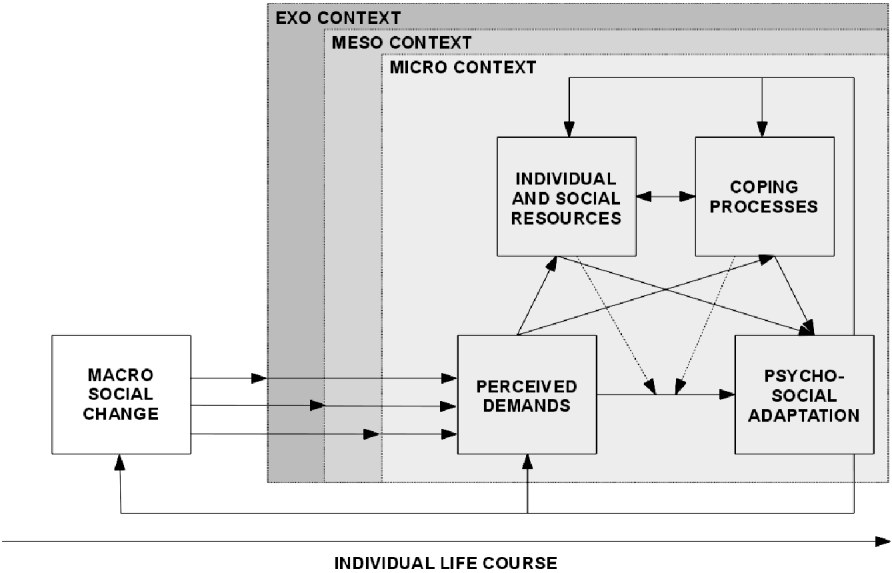
Although neither social change in general nor in the specific context of active ageing has been a main concern of psychological research, a number of psychological studies have recently addressed the question of how macro changes link with individual development (e.g. Schoon and Silbereisen Reference Schoon and Silbereisen2009; Silbereisen and Chen Reference Silbereisen and Chen2010). This research is driven by the Jena Model of Social Change and Human Development (Pinquart and Silbereisen Reference Pinquart and Silbereisen2004) that is depicted in Figure 1 and that combines three theoretical approaches. The first one concerns the notion of interlaced contexts of human development (Bronfenbrenner Reference Bronfenbrenner1986), the second lifecourse sociological theories about structurally bounded agency (Shanahan and Hood Reference Shanahan, Hood, Crockett and Silbereisen2000), and the third models of individual control processes that conceptualise individuals’ efforts to negotiate opportunities and constraints in a changing social ecology (Elder Reference Elder1985; Heckhausen, Wrosch and Schulz Reference Heckhausen, Wrosch and Schulz2010). The Jena Model suggests that structural changes at the societal level (such as changes in the terms of trade due to globalisation or newly implemented active ageing policies) cascade down through the various levels of contexts, which may or may not include the individual, and only become psychologically effective if they are perceived by individuals as ecological constraints or individual demands.
The Jena Model of Social Change and Human Development.

Ecological constraints due to social change
Structural changes at the macro level can manifest themselves and be perceived by individuals as changed ecological constraints. Individuals may perceive that the surroundings of their everyday life are deteriorating by observing, for instance, vacant shop buildings, shutdown businesses, shattered families or undue expectations on the local labour market. As these constraints are situated on the exo level (see Bronfenbrenner Reference Bronfenbrenner1986), individuals per definition are not personally affected by them in a direct way. However, these constraints may affect the resources people have available for mastering everyday tasks or spill-over to individual micro-contexts of development such as the family or the workplace where they become effective. For instance, a neighbourhood characterised by an uncertain economic situation where shops are vacant and businesses shut down will make it difficult for older people to perform their activities of daily living and presumably increase the uncertainty perceived concerning one's own workplace. An increasing number of studies suggest that the neighbourhood context can have (causal) effects on mental health (e.g. Leventhal and Brooks-Gunn Reference Leventhal and Brooks-Gunn2003; Yue et al. Reference Yue, Leventhal, Brooks-Gunn and Earls2005), although few studies have investigated the role of ecological constraints that arise from changes at the macro level (see Lewis and Araya Reference Lewis, Araya, Sartorius, Gaebel, Lopez-Ibor and Maj2002). In the Jena Model, ecological constraints influence which demands individuals perceive in their micro contexts of development and how they deal with these demands.
Individual demands of active ageing
Within micro contexts such as the workplace or family life, macro-level changes manifest themselves and are perceived as individual demands representing a mismatch between what the individual expects and is prepared for, on the one hand, and the new requirements of the changed context, on the other. Conceptually, the cause of the demands lies in the external changes outside the person and not changes due to individual ageing processes. A case in point is the need to learn the internet in order to perform activities of daily living such as ordering groceries, registering to vote, or to communicate with one's children and grand-children who live far away because such activities cannot or only with difficulties be performed without the internet today. Generally speaking, this mismatch disturbs habits, interrupts routines, makes previously learned behaviours obsolete and requires new forms of adaptation (Tomasik and Silbereisen Reference Tomasik and Silbereisen2009). Depending on what the individual does in order to resolve this mismatch, demands can influence individual adaptation and development at different levels of functioning in terms of stress reactions and cardiovascular health (biological level; e.g. Huneault, Mathieu and Tremblay Reference Huneault, Mathieu and Tremblay2011), subjective wellbeing and helplessness (psychological level; e.g. Tomasik and Silbereisen Reference Tomasik and Silbereisen2012), or social participation and civic engagement (social level; Silbereisen, Tomasik and Grümer Reference Silbereisen, Tomasik, Grümer, Silbereisen and Pinquart2008), to name a few examples.
What are the specific individual demands that stem from the various active ageing policies aiming to foster the social participation of older people and their contribution to the public good? Pavlova and Silbereisen (Reference Pavlova and Silbereisen2012) present a set of such demands, which also are at the core of the present study. The demands were formulated against a careful investigation of present policies of active ageing and societal trends for which empirical evidence was available. They comprise the call for greater involvement of older people and the need for lifelong learning (social participation), expectation that older people should invest in maintaining physical and mental health (functioning), and the need to deal with financial insecurity due to reduced welfare spending of the state and the need to take care of one's rights due to more complex legal matters (individual responsibility). The topics chosen do not only reflect the actual policies that are implemented by the different stakeholders but also, and even more importantly, how older people perceive demands of active ageing themselves (see Bowling Reference Bowling2008). Hence, ‘keeping up with the world’ (Stenner, McFarquhar and Bowling Reference Stenner, McFarquhar and Bowling2010: 473), i.e. getting along in an ever-changing and technologically mediated world as well as maintaining one's level of functioning despite the gradual obsolescence of one's previously useful knowledge, are demands older people mention spontaneously when asked about what active ageing means to them.
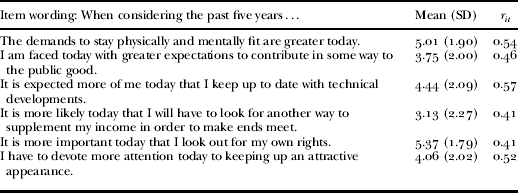
The exact wording of the items is presented in Table 1. Pavlova and Silbereisen (Reference Pavlova and Silbereisen2012) reported a moderately high endorsement of these demands in a sample of German young old between 55 and 75 years of age. Furthermore, they show that East Germans as compared to West Germans, those with better subjective health and those who are unemployed reported a higher level of demands of active ageing, whereas retired and widowed individuals reported a lower level. Finally, older people seem to consider demands of active ageing as a challenge rather than as a threat, particularly if they have a higher educational attainment and better subjective health. These results are encouraging as they suggest that older people do not feel overburdened by the level of demands but, on the contrary, have a quite positive appraisal of demands of active ageing unless they are confronted with unemployment and limited physical functioning in older age. What the results do not tell us yet, however, is how individuals deal with these demands. Are they approached actively or rather avoided? Do people, for instance, invest time and effort into mastering demands of active ageing or do they rather apply self-protective attributions that help them to disengage from these demands without losing face?
Individual demands
Notes: Baseline assessment N = 1,506. SD: standard deviation.
Negotiating demands of active ageing
Individuals are neither passive recipients nor victims of demands of active ageing but they negotiate their own development by setting up and pursuing goals and by adjusting them to social opportunities and constraints. From this point of view, a high load of demands of active ageing can be regarded as the beginning of a longer process of adaptation in which different aspects of individual and collective agency are relevant. Individuals can deal with demands of active ageing in various ways, depending on, for instance, their endowment with relevant resources or the appraisal of these demands and of the individual's means to overcome them (for details, see Pinquart and Silbereisen Reference Pinquart and Silbereisen2004; Tomasik, Silbereisen and Pinquart Reference Tomasik, Silbereisen and Pinquart2010). Such factors will influence whether an individual will approach the demands to overcome them or rather avoid them, whether an individual will seek help and support or not, or whether an individual will seek reasons inside or outside his or her person to explain own success and failure in this adaptive process.
We used the m otivational theory of life-span development (Heckhausen, Wrosch and Schulz Reference Heckhausen, Wrosch and Schulz2010) as a framework to classify and evaluate how individuals deal with demands of active ageing. The authors distinguish between control strategies that are targeted at changing the external world and those that are directed towards the self. Reverting to a terminology originally proposed by Rothbaum, Weisz and Snyder (Reference Rothbaum, Weisz and Snyder1982), the distinction between primary and secondary control is made. The life-span theory of control thus shares a central feature of other two-process approaches to adaptive behaviour (e.g. Folkman et al. Reference Folkman, Lazarus, Dunkel-Schetter, DeLongis and Gruen1986). However, primary and secondary control may have either a selective or a compensatory functionality, which results in four basic modes of adaptive behaviour.
Selective primary control addresses the investment of personal resources such as ability, time and effort in order to master a demand or to fight difficulties on the way to its mastery. Take as an example the demand to use the internet in order to communicate with one's children or grandchildren who live far away. A selective primary control strategy to deal with this demand would be to buy a computer and to visit an internet training course offered for senior citizens by the local community college. Selective secondary control serves the motivational commitment through enhancement of the perceived positive consequences after mastery of the demands and through enhanced appraisal of one's own capacity for control. This strategy inhibits premature disengagement when difficulties arise. In our example, if a particular training course turns out to be too demanding, an individual could keep up commitment by imagining over and over again how happy he or she would be to see the grandchildren in a video chat. If personal resources do not suffice for mastering the respective demands, compensatory primary control can be activated. This control strategy comprises seeking social support, breaking new ground, and looking for detours and alternative solutions. In our example this could be asking one's children to set up and configure the new computer so that it is ready to use.
Whereas the latter three modes of control represent goal engagement in terms of behaviours and cognitions directed towards changing the stressors (i.e. ‘changing the world’), the function of compensatory secondary control is to protect the individual from the negative effects of failure through distancing oneself from stressors by adjusting goals and aspirations (i.e. ‘changing the self’). We distinguished two different aspects of compensatory secondary control (for details, see Tomasik, Silbereisen and Pinquart Reference Tomasik, Silbereisen and Pinquart2010). Some strategies target the protection of the motivational potential and emotional wellbeing of the individual by finding self-protective attributions for not being able to master the demand. In our example, after having had trouble to connect to the internet, an individual could start looking for pieces of information allegedly confirming that the internet is an impersonal or even sometimes a dangerous place anyway and that it is better to visit one's grandchildren once in a while even if this is more expensive and more strenuous. Other strategies help to ease the final distancing from goal engagement when, for instance, the mastery of certain demands is no longer feasible. In our example, individuals could try to devalue the personal significance of multimedia contact with one's children and grandchildren by saying to themselves that using a regular phone does the same job without bringing the hassle of having to learn the unduly complicated technology of the internet.
Determinants of engagement and disengagement
To our knowledge, there are virtually no studies investigating how individuals deal with demands of active ageing and what predicts engagement with or disengagement from these demands. On a more general level, however, we know that demands central to an individual's self-concept are dealt with in an engagement mode rather than by disengagement (e.g. Heckhausen, Wrosch and Fleeson Reference Heckhausen, Wrosch and Fleeson2001). Furthermore, higher levels of stress are generally associated with more coping efforts (e.g. Lazarus and Folkman Reference Lazarus and Folkman1984) although the appraisal of the stressor (i.e. primary appraisal) and the appraisal of one's own resources (i.e. secondary appraisal) determine which mode of coping is preferred. Literature on stress and coping shows that the primary appraisal of a stressor as a challenge is associated with more engagement and less unproductive ways of coping (e.g. McCrea Reference McCrae1984). Similar results can be found with regard to the appraisal of change as associated with gains as opposed to losses (e.g. Wurm, Tomasik and Tesch-Römer Reference Wurm, Tomasik and Tesch-Römer2010). Concerning secondary appraisal, there is substantial evidence that individuals who feel in control are more likely to engage with stressors, at least if the situation is actually controllable (e.g. Folkman et al. Reference Folkman, Lazarus, Dunkel-Schetter, DeLongis and Gruen1986; Forsythe and Compas 1987; Scheier, Weintraub and Carver Reference Scheier, Weintraub and Carver1986). Gender effects are sometimes reported, but their size is rather modest (e.g. Feldman, Fisher and Ransom Reference Feldman, Fisher and Ransom1995).
The context in which demands are negotiated, in contrast, seems to play a prominent role because it offers social opportunities and constraints for engagement. Examples for relevant contexts are the workplace that offers few or many opportunities for advanced training and the local labour market that offers few or many constraints for older workers. These contexts are constantly changing and when contextual constraints for primary control arise, people might first increase their engagement in order to overcome them (e.g. Heckhausen and Tomasik Reference Heckhausen and Tomasik2002). At some point in time, however, constraints might become overburdening so that more engagement becomes ineffective. Many individuals then revert to disengagement in order to save their personal resources and to protect themselves from the repeated experiences of failure (Tomasik, Silbereisen and Heckhausen Reference Tomasik, Silbereisen and Heckhausen2010; Tomasik and Silbereisen Reference Tomasik and Silbereisen2012).
Based on these considerations about the role of personal and contextual predictors of control strategies, Tomasik, Silbereisen and Pinquart (Reference Tomasik, Silbereisen and Pinquart2010) analysed in a cross-sectional study how young adults (aged 16–42 years) dealt with demands of social change related to uncertainty in the domains of work and family life. This study, which is relevant here because it conceptually builds on the Jena Model, too, could confirm for demands of social change what is known from literature on stress and coping. Specifically, demographic variables were only loosely related to engagement and disengagement whereas primary and secondary appraisal played a prominent role. Individuals who considered demands of social change as a challenge (as opposed to threat), as associated with gains (as opposed to losses), and those who felt that they were well prepared reported more engagement and less disengagement. Furthermore, a higher load of demands of social change was associated with more engagement and disengagement. All these findings, however, may not necessarily generalise to demands of active ageing and/or to an older population which is, at least on average, confronted with more developmental losses as opposed to the sample of young adults studied by Tomasik and colleagues. Moreover, these findings have not yet been confirmed longitudinally, which makes their interpretation at least ambiguous.
Hypotheses
The purpose of this paper is to provide empirical evidence for how older people (aged 55–75) negotiate demands of active ageing. The negotiation of demands was conceptualised in terms of primary and secondary control strategies according to the motivational theory of life-span development. The actual outcome variable was the respective control strategy measured at follow-up that was statistically controlled by the respective control strategy measured at baseline. In other words, we predicted residual change in the control strategies over the course of one year. This time lag was a pragmatic compromise between a too short time lag (say, one month) in which there is presumably high stability in the control strategies, and a too long time lag (say, five years) in which the original demands might lose their salience or be superimposed by others.
The longitudinal approach was chosen to overcome the limitations of cross-sectional research, such as the unclear direction of effects, and to account for the fact that being confronted with a certain load of demands is not a singular, non-recurring circumstance but rather represents a condition which may be of some duration and which tends to aggravate when not resolved accordingly. Take, for instance, the need to learn new technologies. This demand does (usually) not come or go overnight but rather tends to build up gradually and to become more difficult to negotiate when avoided for a longer period. This fact increases the urgency to negotiate the demands of active ageing and we expected that the increasing urgency would in turn also be reflected in increases or decreases of the control strategies.
Based on the literature discussed, we have set up several hypotheses concerning possible predictors of the control strategies. First, we hypothesised that a higher load of individual demands of active ageing at baseline is associated with a residual increase in engagement strategies, namely selective primary, selective secondary and compensatory primary control. This hypothesis is based on the presumption that active ageing is an important aspect of adult development thus calling for some adaptive response; and on the findings that individuals increase effort and commitment when confronted with demands that are central to their self-concept and thus threaten the maintenance of primary control capacities (e.g. Heckhausen, Wrosch and Schulz Reference Heckhausen, Wrosch and Schulz2010).
Our second hypothesis referred to individuals’ perception of constraints in their everyday lives that were reflecting social change at the exo level, such as closed shops in rural areas due to urbanisation and demographic change. Against the backdrop of environmental gerontological concepts and studies that have clearly demonstrated the influence of neighbourhood characteristics on the activity levels of older people (e.g. Cunningham and Michael Reference Cunningham and Michael2004; Wahl and Weissman 2003; Humpel, Owen and Leslie Reference Humpel, Owen and Leslie2002), we hypothesised that a higher confrontation with ecological constraints is associated with a residual increase of disengagement from demands of active ageing, namely compensatory secondary control. Our assumption was that if individuals perceive many constraints in their context, they also expect a higher likelihood of difficulties in dealing with demands of active ageing. Consequently, they should respond with an increase in disengagement in order to prevent their motivational and emotional resources being wasted (Tomasik and Silbereisen Reference Tomasik and Silbereisen2012; Tomasik, Silbereisen and Heckhausen Reference Tomasik, Silbereisen and Heckhausen2010).
Third, we hypothesised that appraising demands of active ageing more as a challenge and less as a threat is associated with an increase in engagement and a decrease in disengagement from these demands. This hypothesis is based on literature on coping in general (e.g. McCrea 1984; Wurm, Tomasik and Tesch-Römer Reference Wurm, Tomasik and Tesch-Römer2010) and on literature specific to dealing with demands of social change (e.g. Tomasik, Silbereisen and Pinquart Reference Tomasik, Silbereisen and Pinquart2010). What was found for younger people and for demands related to uncertainty in work and family life we expect to find for older people with regard to demands of active ageing.
Fourth, research has demonstrated that individuals who feel in control are more likely to engage with stressors and less likely to disengage from them (e.g. Folkman et al. Reference Folkman, Lazarus, Dunkel-Schetter, DeLongis and Gruen1986; Forsythe and Compas Reference Forsythe and Compas1987; Tomasik, Silbereisen and Pinquart Reference Tomasik, Silbereisen and Pinquart2010). We hypothesized the same association for higher internal control beliefs and lower external control beliefs with regard to dealing with demands of active ageing.
Finally, we were interested in the interaction effects between individual demands and ecological constraints thus combining Hypotheses 1 and 2. We hypothesised that individuals will increase their engagement when being confronted with many demands of active ageing, especially if they perceive few ecological constraints to tackle with. Considered from another perspective, if ecological constraints are high, engaging with demands of active ageing will not pay off and thus will probably be reduced. Similarly, we hypothesised that perceiving many ecological constraints is associated with an increase in disengagement only if the individual load of demands of active ageing is high. Put another way, even under the worst ecological conditions, individuals usually do not need to disengage from demands if they are confronted only with few of them (see also Sameroff 2000).
In our statistical models, we control for basic demographic variables including age, gender, occupational and marital status, and region. Although findings on associations between demography and ways of coping are mixed, we include these predictors anyway in order to control for possible spurious associations, as it is plausible to assume that some of these variables might be related to primary and secondary control. Married participants, for instance, might have more social support available which makes it easier for them to increase compensatory primary control. We do not have explicit hypotheses concerning the demographic predictors.
Method
Participants and procedure
The sample analysed was part of the Jena Study on Social Change and Human Development, which was approved by the German National Science Foundation (DFG) concerning ethical standards. Respondents were drawn from two West German (Schleswig-Holstein and Baden-Wurttemberg) and two East German federal states (Mecklenburg-Western Pomerania and Thuringia). For sampling the participants, each state was split further into smaller regional units (administrative districts), and within each district sampling points were randomly selected and potential participants contacted based on a random route procedure (see Hoffmeyer-Zlotnik Reference Hoffmeyer-Zlotnik, Gabler and Hoffmeyer-Zlotnik1997). The target population were men and women aged between 55 and 75 years who lived in private households. A professional survey institute conducted computer assisted face-to-face interviews (CAPI) based on a standardised interview manual. A similar number of participants were interviewed in each federal state regardless of the actual population.
Between July and August 2009, 1,508 interviews lasting approximately 60–90 minutes were conducted. At the baseline interview, the mean age of the participants was 65.71 years (standard deviation (SD) = 5.88) and 52.4 per cent were women. The majority of the participants were married (58.7%), widowed (17.9%) or divorced (14.9%). Two-thirds of the sample were already retired (66.3%), one-quarter were still employed (24.0%) and a minority were unemployed (4.9%).
At the end of the baseline interview, participants were asked whether they agreed to be interviewed again one year later and 1,144 participants (75.9% of the baseline sample) did so. One year later, between July and September 2010, we were able to complete follow-up interviews with 602 participants (or 39.9% of the baseline sample) which does, however, not reflect a high self-selective attrition rate but rather was intended by design as we had funds available for conducting only 600 interviews. Those who participated in the follow-up did not significantly differ from those who did not in terms of age (p = 0.25), gender (p = 0.18) or employment status (p = 0.10). However, follow-up participants were more likely to be divorced as compared to those who dropped out (p < 0.05). This meant that there were 107 divorced participants as compared to the 90 that one would have expected from the marginal distribution in the baseline sample.
Measures
For testing the hypotheses, the independent variables of the study (individual demands, ecological constraints, appraisals, control beliefs and demographics) were all measured at baseline whereas control strategies were measured at baseline and at follow-up. Whenever means and other statistics of the independent variables are reported, we refer to the entire baseline sample. There were no significant differences between dropouts and follow-up participants in the means (smallest p = 0.40) and variances (second smallest p=0.15) of the independent variables with the only exception that the variance of internal locus of control was higher for those who participated in the follow-up as compared to those who did not (p < 0.05).
Individual demands
Six items were used to assess individual demands related to activation in terms of social involvement, health and fitness, and individual responsibility (see Table 1). It is important to emphasise once again that our demands of active ageing did not comprise age normative demands due to physical or cognitive changes in later life (which is supported by the finding that the load of demands of active ageing is not correlated with age; see Pavlova and Silbereisen Reference Pavlova and Silbereisen2012). Rather, our demands comprise only those that resulted from changes at the societal macro level related to the specific amalgamation of demographic change and globalisation that challenges the welfare state and is perceived by older people as the need of ‘keeping up with the world’ (Stenner, McFarquhar and Bowling Reference Stenner, McFarquhar and Bowling2010: 473).
Participants were prompted to ‘consider the past five years’ and then asked to endorse each perceived demand on a scale ranging from 1 (does not apply at all) to 7 (fully applies). As evident from Table 1, mean endorsement of the items was quite high, which indicates a high relevance of the topics chosen for the participants. Based on the six items, we computed a composite index by counting all demands that were highly endorsed, as indicated by a scale value of 6 or 7. The formation of such an index was made against the backdrop of earlier research that proved the cumulation of stressors as the actual risk factor for psychosocial development (e.g. Sameroff Reference Sameroff2000). The cumulative index has been used at various instances (e.g. Tomasik and Silbereisen Reference Tomasik and Silbereisen2012; Tomasik, Silbereisen and Heckhausen Reference Tomasik, Silbereisen and Heckhausen2010; Tomasik, Silbereisen and Pinquart Reference Tomasik, Silbereisen and Pinquart2010) for its conceptual advantage over a simple sum scale, although the present results hardly changed when we conducted the analyses using a traditional sum scale.
Ecological constraints due to social change
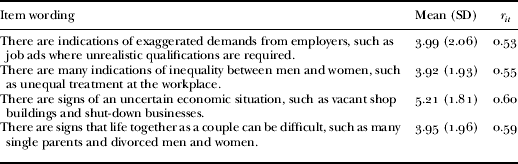
Four items were used to assess perceived ecological constraints that reflect growing uncertainty in the proximal ecology of the individual (see Table 2). These items were developed to capture the subjective perception of visible indications of exaggerated expectations from employers, indications of economic downturn, indications of gender inequality and indications of family break-up. The former two aspects are related to the work domain, whereas the latter two address partnership and family life. We have chosen these two domains because they are central to individual development both subjectively and objectively so that there is good reason to assume that ecological constraints in these domains of life will not be simply ignored by the individuals. Four statements were presented to the participants. Participants were addressed to think about the ‘impressions you have of the places and people you encounter in everyday life … where you live, work, do your shopping, or spend your free time’ and then asked to endorse each statement on a scale ranging from 1 (does not apply at all) to 7 (fully applies). The internal consistency of α = 0.64 is still satisfactory given the fact that heterogeneous aspects of the social ecology were addressed. The stability of this measure over a period of one year as another indicator of the measure's reliability was r it = 0.54 and thus satisfactory.
Perceived ecological constraints
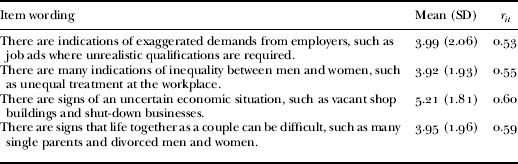
Notes. Baseline assessment N = 1,506. SD: standard deviation.
Appraisals of demands of active ageing
Referring to Lazarus and Folkman's (Reference Lazarus and Folkman1984) concept of primary appraisal, we used two single items to assess whether the six demands of active ageing as a set were considered (a) a challenge and (b) a threat. Participants were asked to endorse the two items on a scale ranging from 1 (does not apply at all) to 7 (fully applies). Whereas the endorsement of the challenge appraisal was rather high (mean = 4.38; SD = 1.77), the endorsement of the threat appraisal was low (mean = 2.86; SD = 1.81). Both appraisals were only loosely correlated with each other (r = − 0.10). The stabilities of these measures over a period of one year were r tt = 0.39 (challenge), r tt = 0.43 (threat), and thus only moderate which can be either seen as an indication for the malleability of the appraisals or a rather low reliability of the single-item indicators.
Control beliefs concerning demands of active ageing
Participants were asked for ‘the reason for how well you deal with the changed expectations’ referring to the six demands of active ageing as a set. Then they could indicate on a scale ranging from 1 (not at all) to 7 (totally, squarely) whether the reason was ‘myself’ or ‘outside influences’. Note that we did not ask about the internal/external attribution of the demands of active ageing themselves but about control beliefs concerning the way these demands are negotiated. Participants on average endorsed the internal item (mean = 4.80; SD = 1.61) and the external item (mean = 4.33; SD = 1.53) to a similar degree but with a slight preference for an internal attribution. Internal and external control beliefs were almost uncorrelated (r = − 0.06), thus indicating two independent dimensions. The stabilities of these measures over a period of one year were r tt = 0.38 (challenge), r tt = 0.30 (threat), and thus even lower than for the appraisals. Again, this can either be attributed to the malleability of the control belief or the rather low reliability of the single-item indicators.
Primary and secondary control
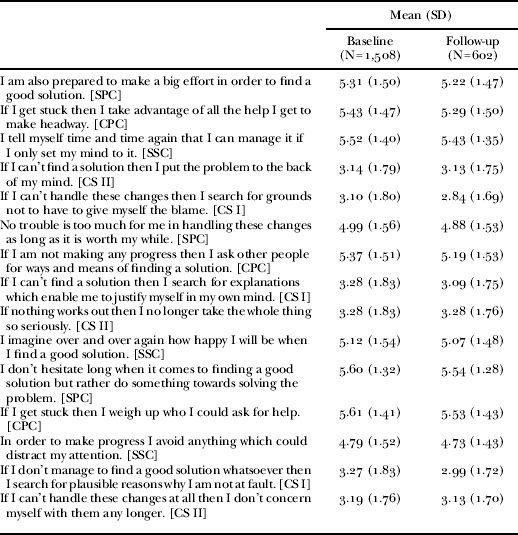
A scale developed by Tomasik, Silbereisen and Pinquart (Reference Tomasik, Silbereisen and Pinquart2010) and based on the framework of the motivational theory of life-span development was used to assess primary and secondary control strategies with regard to demands of active ageing. Participants were asked to rate their endorsement to 15 control strategy items immediately after having rated their endorsement to the six demands of active ageing. The items as ordered in the questionnaire are presented in Table 3 together with the items’ means and standard deviations. Participants were asked to rate their endorsement for each item on a scale ranging from 1 (does not apply at all) to 7 (fully applies).
Item wordings for the assessment of control strategies in the order of the questionnaire
Notes. SPC: selective primary control. SSC: selective secondary control. CPC: compensatory primary control. CS I: compensatory secondary control I (self-protection). CS II: compensatory secondary control II (distancing). SD: standard deviation.
Five scales representing selective primary control, selective secondary control, compensatory primary control, compensatory secondary control (self-protection) and compensatory secondary control (distancing) were computed by averaging the respective three items. Tomasik, Silbereisen and Pinquart (Reference Tomasik, Silbereisen and Pinquart2010) reported the scales’ excellent psychometric quality in a sample of younger adults. In the present sample of older adults, internal consistencies ranged from 0.68 < α <0.87 at baseline and from 0.72 < α <0.90 at follow-up.
Demographic variables
Participants’ age and gender were assessed by self-report in the interview. The information about where the interview took place (West versus East Germany) was provided by the survey institute. Participants also reported their current employment status by indicating whether they were employed, unemployed, incapable of working, retired, homemakers or something else. We computed a contrast variable that differentiated between the retired and all other status groups because we assumed retirement to be the most relevant cleavage in this sample. As two-thirds of the sample were retired we did not further differentiate the non-retired group.
Similarly, participants also reported their marital status and we computed a contrast variable differentiating between all those who were married and those who were not. The latter category primarily comprised widowed and divorced individuals as well as a few singles and cohabiting individuals.
Results
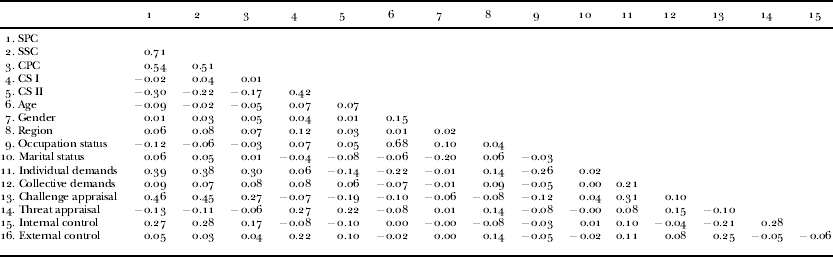
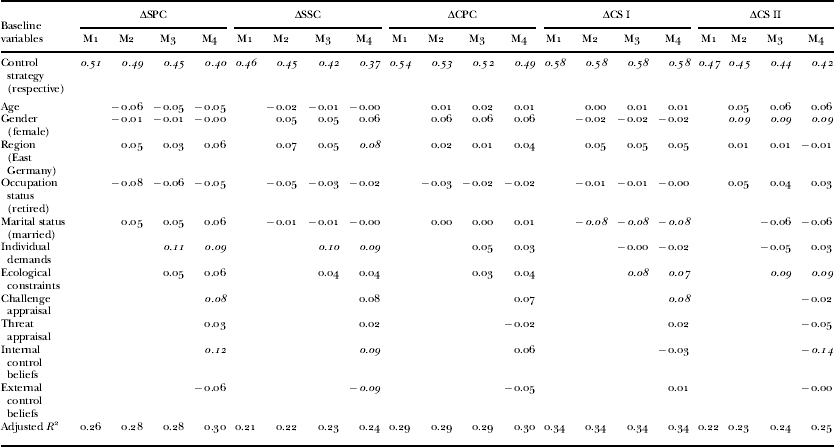
In order to test our hypotheses, a set of linear regression models with four sequential steps of analysis were computed. As dependent variables, the five control strategy scales administered at the follow-up were used. In Model 1, we entered the respective control strategy administered at the baseline in order to control for the stability of the measure. In Model 2, we entered all demographic variables simultaneously in order to control for spurious effects related to age, gender, region and occupational as well as marital status. In Model 3, we entered individual demands and ecological constraints in order to test our central hypotheses that individual demands are associated with an increase in engagement and ecological constraints predict an increase in disengagement. Finally, in Model 4, we entered the appraisals concerning demands of active ageing. The highest absolute correlation between the predictors was r = 0.68 (higher age with being retired), the second highest r = 0.28 (between challenge and internal control) and all other correlations were r < 0.25 (see Table 4).
Correlation between baseline variables
Notes: SPC: selective primary control. SSC: selective secondary control. CPC: compensatory primary control. CS I: compensatory secondary control (self-protection). CS II: compensatory secondary control (distancing). Gender: female (as compared to male). Region: East Germany (as compared to West Germany). Occupation status: retired (as compared to employed, unemployed and others). Marital status: married (as compared to all other status groups). N = 602.
Table 5 shows the results of the analyses. Results for Model 1 reveal a substantial stability of all five control strategies with about one-quarter to one-third of the variance at follow-up being determined by the baseline measurement. However, most of the variance is due to situation-specific factors if one considers that measurement error was removed from the measures used. Thus, there is enough variance left for prediction by our hypothesised variables. Model 2 results reveal that the demographic control variables play a negligible role in predicting the residual change of control strategies across one year. The only two exceptions were that married couples seemed to report a decrease of self-protective strategies (CS I) over time whereas women tended to increase distancing (CS II) more from demands of active ageing as compared to men.
Standardised regression coefficients for the prediction of primary and secondary control strategies
Notes: Predictors printed in italics are p < 0.05 significant; standard errors (SE) = 0.04 for all variables except for age where SE = 0.05. SPC: selective primary control. SSC: selective secondary control. CPC: compensatory primary control. CS I: compensatory secondary control (self-protection). CS II: compensatory secondary control (distancing). M: Model. N = 602.
In Model 3 our central hypotheses were confirmed for four of the five scales considered. More individual demands of active ageing were associated with an increase in selective primary control (SPC; β = 0.11) and selective secondary control (SSC; β = 0.10). Against our expectation, there was no significant association between individual demands and change in compensatory primary control (CPC). More ecological constraints, as expected, were associated with increasing self-protection (CS I; β = 0.08) and distancing (CS II; β = 0.09).
In Model 4 we added the two measures of appraisals and the two measures of control beliefs, which hardly changed the associations obtained in the previous steps. Challenge appraisals were, as hypothesised, positively associated with residual change of selective primary control. However, we did not find the expected associations with selective secondary and compensatory primary control at the p < 0.05 level of significance. Against our expectations, higher challenge appraisals were associated with an increase of self-protection.
Contrary to our expectations, we did not find any significant associations between threat appraisal and residual change in compensatory secondary control, which does not support our hypothesis that feeling threatened by demands of active ageing leads to increased withdrawal.
Concerning the internal locus of control, the analysis confirmed our hypotheses and it seems that internal locus of control is one of the most important variables that predicts residual changes in engagement with and disengagement from demands of active ageing. Internal control beliefs were associated with an increase of selective primary and selective secondary control and a decrease of distancing.
External control beliefs, finally, were associated only with less selective secondary control over time but not with the other control strategies. Older people, hence, do not do more or less when they believe that other forces are responsible for the way they deal with demands of active ageing, but they reduce their commitment to solving the demands. This finding, together with the non-existent associations between threat appraisals and all control strategies, suggests that the ‘negative’ appraisals of demands of active ageing (threat, external control) are less relevant than the ‘positive’ ones (challenge, internal control) when predicting the way individuals deal with the demands.
In a final step (not displayed in Table 5), we entered the interaction term between the individual load of demands of active ageing and ecological constraints. For selective primary, selective secondary, compensatory primary and compensatory secondary control (self-protection), the interaction terms were not significant (0.25 < p <0.75). For compensatory secondary control (distancing), however, the interaction was significant (β = 0.08; p < 0.05). A graphical inspection of the interaction revealed that the positive association between ecological constraints and disengagement was only present when the individual demand load was high. This means that people increased their disengagement when confronted with many ecological constraints only if their individual demand load was high. However, if their individual demand load was low, ecological constraints were not associated with disengagement. This finding confirmed our interaction hypothesis at least for one out of four control strategies.
Discussion
In this paper we investigated how individuals dealt with demands of active ageing that result from changed social policies and cultural stereotypes fostering a higher responsibility of older people for their lives and their participation for the public good. Our first finding was that older people endorsed strategies of engagement with demands of active ageing higher than strategies of disengagement from them. Against the backdrop of earlier findings presented by Pavlova and Silbereisen (Reference Pavlova and Silbereisen2012), we can thus conclude that demands of active ageing are on average considered as manageable challenges that are actively approached by most of the young old (aged 55–75 years). As we did not find a systematic pattern of associations with demographic variables, we are tempted to conclude that the way older people negotiate the demands of active ageing is only marginally associated with their social standing in terms of age, gender, occupational and marital status, and the region where they live. This is not to say that these demands are negotiated stereotypically as there is variance in the control scales. Rather, factors other than the mere social niche are more relevant for predicting whether people engage or disengage with demands of active ageing. The only exception worth noting here is women's tendency to disengage more from demands of active ageing. This might reflect a strategy of selective optimisation, as women tend to engage more in care-giving (Wood Reference Wood1994), which could limit their resources for engagement with demands of active ageing.
Our regression analyses demonstrated a relatively high stability of control strategies (0.46<β < 0.58 in Model 1) which, however, was substantially reduced by including the psychological predictors, namely individual demands and ecological constraints, appraisals and control beliefs (in the subsequent Models 3 and 4) presumably because of concurrent correlations between the psychological predictors and control strategies at baseline.
The positive associations between individual demands and positive residual change in strategies of engagement with these demands suggest that these demands indeed activate older individuals to deal with them in an active way. This might have to do with the fact that these demands are on average considered a challenge by most older individuals and the load of these demands does not overburden them (see Pavlova and Silbereisen Reference Pavlova and Silbereisen2012). Put another way, older people today, at least those who were healthy enough to participate in the interview lasting 60–90 minutes, in general seem to have enough reserve capacities and resources available to face demands of active ageing by investing more time and effort and by staying motivationally committed. This is an encouraging finding that qualifies critical voices who consider active ageing as a concept that might overburden older people and particularly those who are marginalised already (e.g. Ranzijn 2010; van Dyk and Lessenich Reference van Dyk, Lessenich, van Dyk and Lessenich2009). How important a critical debate on the concept of active ageing might be, and how important it is to identify groups of older people who cannot meet the expectations society puts on them, we should take cognisance of the fact that most of the young old (aged 55–75 years) in Germany respond to higher demands of active ageing by engagement and not by disengagement. Various studies show that this engagement is likely to promote health and subjective wellbeing in old age (e.g. Bath and Deeg Reference Bath and Deeg2005).
However, our findings also show that one has to consider the wider context in which individuals live and work in order to understand how they negotiate demands of active ageing. Our findings showed that individuals who reported higher ecological constraints (not related to active ageing but to the spheres of work and family life) tended to increasingly disengage from individual demands of active ageing. As demonstrated by our interaction analyses, this was especially true when people were confronted with a high load of individual demands. In other words, if in the everyday ecology of older people there were signs of negative impact of social change for the economy and for families, individuals reacted with increasing disengagement from demands of active ageing when confronted with many of them. This strategy might be considered a particular way to optimise their resources selectively and to invest them into more urgent demands that result from the ecological constraints such as those associated with their own health or the education of their grandchildren. Communities that decline economically and socially also offer few opportunities for active ageing such as opportunities for participation, age-friendly environments or ways to improve one's financial standing by pursuing a second career so that engagement with demands of active ageing would waste resources and confront individuals with repeated experiences of failure (see Tomasik, Silbereisen and Heckhausen Reference Tomasik, Silbereisen and Heckhausen2010; Tomasik and Silbereisen Reference Tomasik and Silbereisen2012).
Among the other psychological predictors of control strategies, internal control beliefs stood out in terms of significance and effect size. Our findings showed that those who considered how they dealt with the demands of active ageing as determined by themselves were investing more time and effort in negotiating the demands (selective primary control), increased their motivational commitment to do so (selective secondary control), and decreased the strategies related to distancing from these demands (compensatory secondary control). If we consider internal control beliefs as an indicator of sufficient tangible, psychological and social resources individuals dispose of to deal with demands of active ageing in an engaged way, this finding is not surprising. As already evident from our items used to assess demands of active ageing (e.g. ‘It is more important today that I look out for my own rights’), one central issue of activation is personal responsibility and self-determination, which always requires sufficient resources to strive.
External control beliefs as opposed to internal ones, however, had only a small effect on the way individuals dealt with demands of active ageing. If anything at all, they were disadvantageous for the individuals’ motivation and commitment but did not predict changes in disengagement at all. Similarly, threat appraisals were virtually irrelevant. Both findings might either be suggestive of the normative power that active ageing has gained; or self-regulatory skills older people have which allow them to ‘ignore’ their external control beliefs and the threat they impose on them and engage or disengage with demands of active ageing regardless of their negative evaluation of the situation.
Limitations and research directions
Despite various strengths of the study, including its sampling technique and longitudinal design, the study also has some limitations. The first certainly is that the participants were the only source of information, which, however, could not be avoided at least for the independent variables, as we were specifically interested in the participants’ subjective perceptions of demands of active ageing. The second is that due to the limited time of a multi-theme interview, we could only use single items to assess appraisals and control beliefs. This probably resulted in fewer reliable measures than one would have wished. On the one hand, this limitation is not as serious as it conservatively worked against our hypotheses. The fact that we have found significant associations between these predictors and change in control strategies suggests that we would find even stronger associations with more reliable measures. On the other hand, however, non-significant findings are ambiguous to interpret because these may be either due to the fact that the associations do not exist in the population or due to the fact that the measures were not very reliable. We cannot decide which one of the interpretations holds.
Another limitation of our study is its reference to a conservative welfare regime which is just one of many possibilities for distributing responsibility between individuals, families, employers and the state (see Esping-Andersen Reference Esping-Andersen and Esping-Andersen1996). Policies of active ageing dramatically differ even between the different welfare regimes and the limited scope of this paper did not allow us to discuss policies and demands resulting from them in other countries (for an overview, see World Health Organization 2002). We thus can hardly generalise our findings to other countries. Further comparative research is needed that evaluates the different systems not only from an economic point of view, but also in terms of their psychological impact for and psychological responses of older people. This would render possible the identification of those welfare regimes which encourage and do not discourage older people from engaging with demands of active ageing.
Further research is also needed to identify groups of older people who cannot engage with demands of active ageing due to limited health, limited cognitive and other psychological resources, social marginalisation or limited financial assets. Although we have seen a strong preference for engagement in many older people in our sample, some may be overburdened by demands of active ageing, especially if these come in combination with other demands of social change such as increased uncertainty of losing a job, uncertainty in career planning, higher geographical mobility of children and grandchildren, higher risk of separation or divorce in late life, and many more (see Tomasik and Silbereisen Reference Tomasik and Silbereisen2009). For this subgroup of older people at the limits of their reserve capacities, special policies are necessary that take into account their specific situation. Furthermore, it might be more adaptive for some of those people to disengage from rather than to engage with demands of active ageing in order to optimise selectively and to protect their motivational and emotional resources (see Tomasik, Silbereisen and Heckhausen Reference Tomasik, Silbereisen and Heckhausen2010; Tomasik and Silbereisen Reference Tomasik and Silbereisen2012).
Conclusions
The strength of the present study is its longitudinal design which offered support for our hypotheses that demands of active ageing are negotiated in terms of increasing engagement when older individuals were confronted with more of these demands, with increasing disengagement if they were confronted with many ecological constraints due to social change, and with increasing engagement and decreasing disengagement when they appraised these demands more positively. It has to be emphasised that although a high load of demands of active ageing has the potential to overburden the individual reserve capacities in some cases, the demands of active ageing are considered a challenge by most older people and are met with effort and commitment, especially if the context provides sufficient opportunities to do so and individuals see themselves as being in control. Both aspects have been identified as highly relevant in other gerontological contexts too (e.g. Bosma Reference Bosma, Siegrist and Marmot2006; Walker Reference Walker2002).
Our findings have two important implications for the further development of social policies targeted at the activation of older people. First, social policies should focus on individuals-in-context rather than isolated individuals. Specifically, our data suggest that providing incentives for economic activity and at the same time protecting both employees and the unemployed from disproportionate work demands, fostering gender equality and supporting families might also encourage older people to contribute to society or at least not to withdraw their productive capacity. Both the younger and the older generation could profit from such measures that will presumably strengthen the opportunities for engagement with demands of active ageing. Interestingly, the measures suggested have already been implemented quite successfully in at least two Nordic countries, which could offer role models for possible policies in other parts of Europe (see Christensen and Ervik Reference Christensen and Ervik2003; Piekkola Reference Piekkola2003). Second, policies of active ageing have to provide leeway for individual initiative and empower older individuals to determine by themselves how they want to contribute to the public good (see Lemon, Bengtson and Peterson Reference Lemon, Bengtson and Peterson1972). Our findings suggest that only policies that put people in control of their lives can be effective, whereas coercive measures that deprive the individual from the freedom to choose will probably have the opposite effect. This suggestion is supported by research showing that social productivity in old age is only associated with higher subjective wellbeing when the level of autonomy of these activities is high (Wahrendorf and Siegrist 2008). An example for a possible policy could be the deregulation of statutory retirement age by taking into account individual career decisions and providing opportunities for learning and advanced training, for voluntary work that is considered for pension claims, and for second and third careers (see Davey Reference Davey2002; Walker Reference Walker2002). Some of the measures suggested are already reality in some European countries and evaluation of their effectiveness is awaited (see Ney Reference Ney2005; Piekkola Reference Piekkola2004). We are convinced that the possible costs of such policies may be compensated by positive effects of active ageing in terms of presumed increased productivity, better quality of life and better health of older people.