Diaphragm dysfunction following surgery for congenital heart disease is a known complication leading to delays in recoveryReference Talwar, Agarwala, Mittal, Choudhary and Airan1 as well as increased post-operative morbidity and mortality.Reference El Tantawy, Imam, Shawky and Salah2 The reported incidence of diaphragm dysfunction following congenital heart surgery is 0.28–5.6%. Procedures associated with the highest incidence of paresis dysfunction are the bidirectional Glenn procedure, Fontan completion, systemic to pulmonary artery shunts, Tetralogy of Fallot repair, and ventricular septal defect repair.Reference Talwar, Agarwala, Mittal, Choudhary and Airan1 Consequences of diaphragm dysfunction are particularly severe in newborns and young infants due to the fact that the diaphragm provides close to 75% of the work breathing, compared to older children who are more able to compensate for the loss of diaphragmatic function.Reference Joho-Arreola, Bauersfeld, Stauffer, Baenziger and Bernet3
Management strategies for diaphragm dysfunction following cardiac surgery consist of prolonged mechanical ventilation or diaphragm plication. A conservative approach includes respiratory support until recovery of diaphragm function, which occurs at variable times.Reference Talwar, Agarwala, Mittal, Choudhary and Airan1 A mean time of 40.8 days to extubation has been described by Simansky et al.Reference Simansky, Paley, Refaely and Yellin4 Diaphragm plication is a definitive repair of diaphragm dysfunction, although the optimal timing of this procedure remains unknown.Reference Talwar, Agarwala, Mittal, Choudhary and Airan1 Tonz et al showed that plication of the diaphragm resulted in earlier extubation and did not interfere with return of normal function.Reference Tonz, von Segesser, Mihaljevic, Arbenz, Stauffer and Turina5 Akay et al found that delayed plication beyond 10 days from cardiac repair is associated with increased incidence of pneumonia and increased mortality.Reference Akay, Ozkan and Gultekin6
Materials and methods
A retrospective review of the Pediatric Health Information System database was conducted from 2004 to 2014. Pediatric Health Information System database is an administrative database with data from 43 not-for-profit tertiary pediatric hospitals in United States of America. Children’s Hospital Association and the participating hospitals ensure data quality and reliability. De-identified data are submitted by the hospitals and after a thorough reliability and validity check included into the database.Reference Akhavan, Merguerian, Larison, Goldin and Shnorhavorian7,Reference Bagdure, Custer and Rao8 Patients less than 18 years of age who underwent cardiac surgery were included. Risk Adjustment for Congenital Heart Surgery was utilized to determine procedure complexity. ICD-9 codes used to identify diaphragm paralysis were 519.4 (diaphragmatic paralysis) and 998.2 (diaphragmatic paralysis due to accidental section of phrenic nerve during procedure). Other factors evaluated included baseline demographic characteristics, time to plication, length of stay, and medical costs. Institutional review board approval was waived for this investigation.
Results
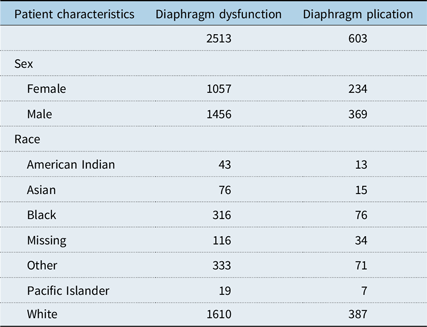
A total of 112,110 patients less than 18 years underwent cardiac surgery from January 2004 to December 2014. The overall incidence of diaphragm dysfunction was 2.2% (n = 2513). Of those patients, 603 received diaphragm plication. There were 1057 females included in the study and 1456 males. In total, 234 (22.1%) of 1057 females and 369 males (25.3%) of 1456 males underwent diaphragm plication. Table 1 shows the demographic data for the cohort. The majority of patients evaluated had a Risk Adjustment for Congenital Heart Surgery score of 3 (n = 1065) and 69.5% of patients had a Risk Adjustment for Congenital Heart Surgery score of 3 or greater. Only eight patients had a Risk Adjustment for Congenital Heart Surgery category of 5.
Demographic data for children with diaphragm paresis dysfunction post-cardiac surgery

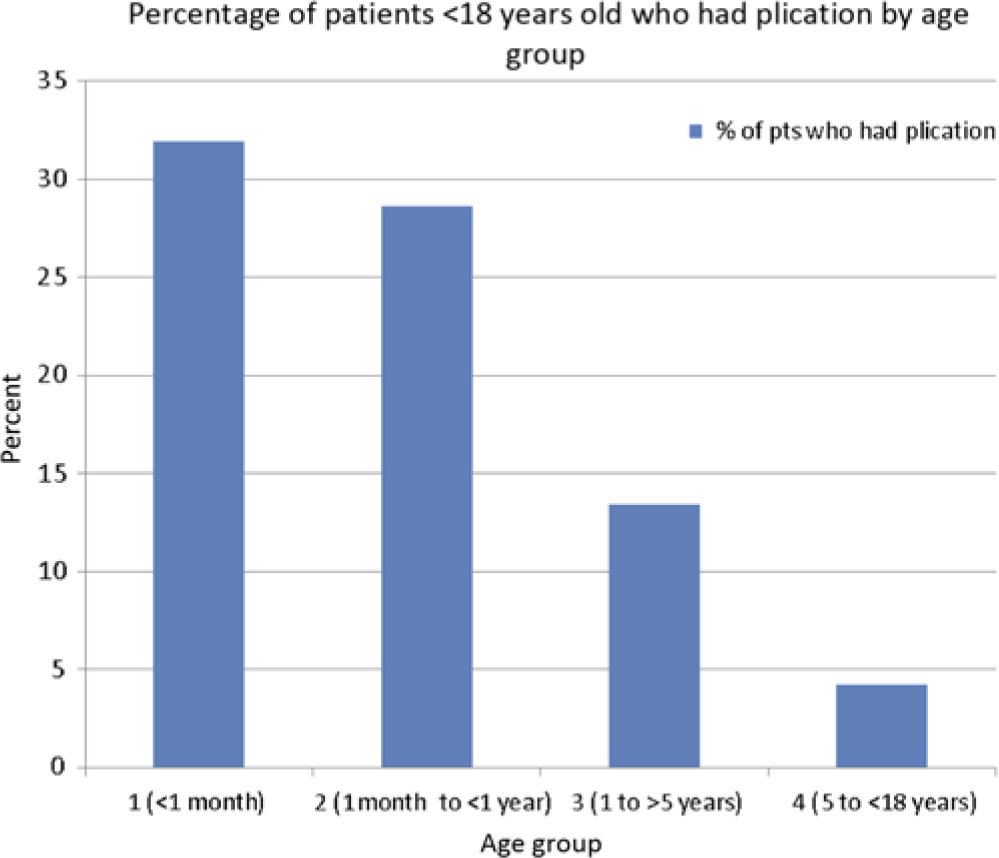
To assess the effects of age on outcomes, patients were divided into four age groups: less than 1 month of age (group one), 1–12 months of age (group two), 1–5 years of age (group three), and 5–18 years of age (group four). In group one, 305 of 956 patients (31.9%) received diaphragm plication. There were 787 patients in group two, of which 225 (28.6%) were plicated. In group three, 59 of 440 patients (13.4%) were plicated. Of the 330 patients in group four, 14 (4.2%) received plication.
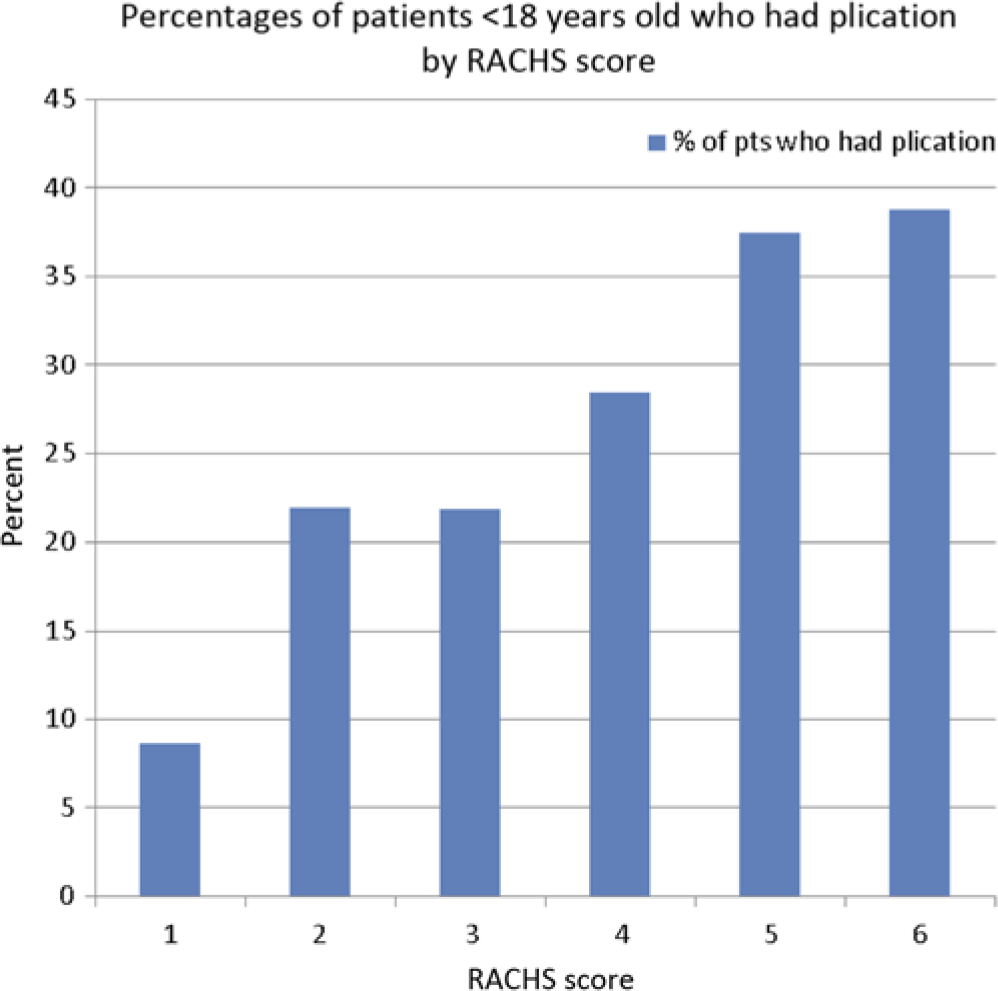
Of the 2513 patients with diaphragm dysfunction, 92 had cardiac operations in Risk Adjustment for Congenital Heart Surgery Category 1. Of these, eight (8.7%) received plication. In Risk Adjustment for Congenital Heart Surgery Category 2, 148 of 675 (21.9%) were plicated. Incidence of plication was 233 of 1065 (21.9%) for Risk Adjustment for Congenital Heart Surgery category 3, 137 of 482 (28.4%) for Category 4, 3 of 8 (37.5%) for Category 5, and 74 of 191 (38.7%) for Category 6. There was a strong trend for higher incidence of plication with decreasing age (p-value < 0.0001) Fig 1) and with increasing Risk Adjustment for Congenital Heart Surgery score (p-value < 0.0001) (Fig 2).
Percentages of patients who had diaphragm plication by age group.

Percentages of patients who had plication by RACHS-I.

The median length of stay in patients without diaphragm plication was 18 days (interquartile range from 8 to 41 days), and in patients with plication it was 46 days (interquartile range from 27 to 82 days). Younger age and higher Risk Adjustment for Congenital Heart Surgery category were also associated with increased length of stay. The median length of stay for patients in age groups 1, 2, 3, and 4 were 41, 23, 12, and 7 days, respectively. Patients in Risk Adjustment for Congenital Heart Surgery Category 1 had a median length of stay of 12.5 days, followed by 16, 20, 33, 36.5, and 54 days in Risk Adjustment for Congenital Heart Surgery I 2, 3, 4, 5, and 6, respectively.
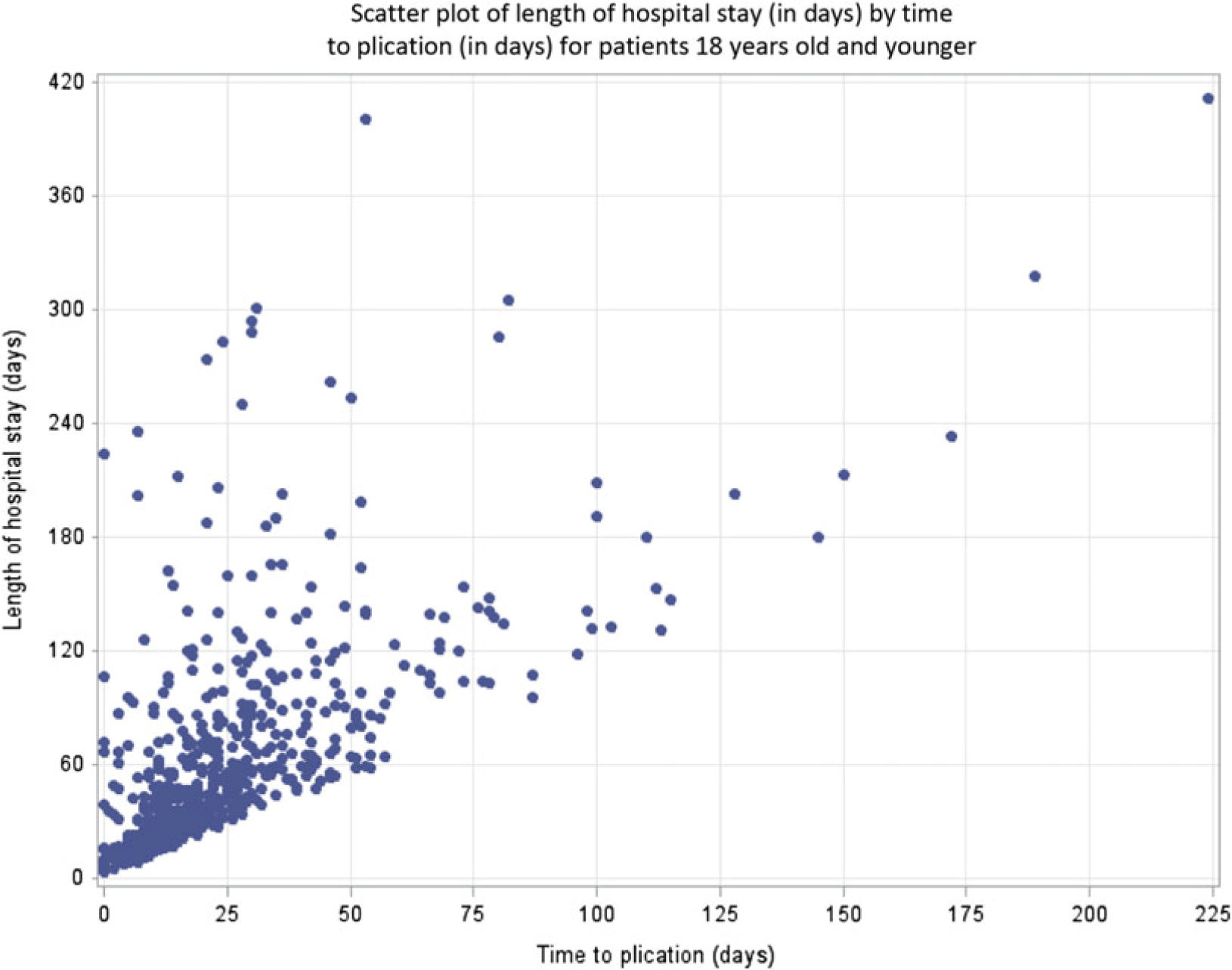
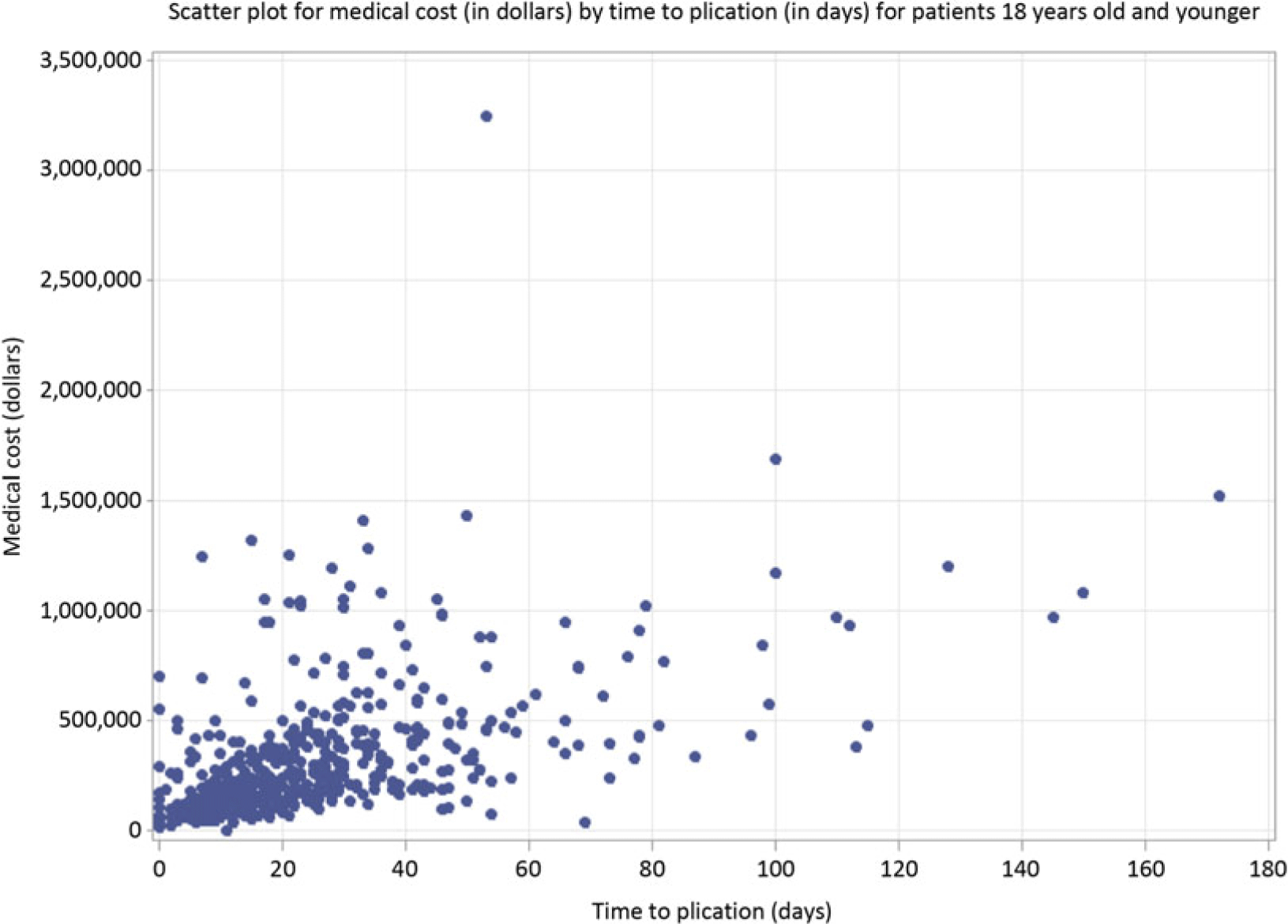
Medical costs were increased in those plicated compared to those who did not undergo plication ($224, $834, and $103,001, respectively). In addition, younger age group, higher Risk Adjustment for Congenital Heart Surgery score, and longer hospitalization were associated with increased medical costs. There is a strong positive correlation (R = 0.815, p < 0.0001) between length of stay (in days) and medical costs, and this correlation persists regardless of plication status. In addition, there is also a strong positive correlation (R value 0.729, p < 0.0001) between increased time to plication and increased length of stay (Fig 3), as well between increased time to plication and increased medical cost (R value 0.626, p < 0.0001) (Fig 4).
Scatter plot of time to plication by length of stay.

Scatter plot of medical cost by time to plication.

Discussion
In this multicenter review of the risk factors for and consequences of diaphragm plication is a unique addition to existing literature given our large sample size as well as our evaluation of the effects of plication on hospital cost and length of stay. We found an overall incidence of diaphragm dysfunction of 2.2%. This incidence is within the reported range of 0.3–12.8% found in other studies.Reference Joho-Arreola, Bauersfeld, Stauffer, Baenziger and Bernet3,Reference Floh, Zafurallah, MacDonald, Honjo, Fan and Laussen9,Reference Georgiev, Konstantinov, Latcheva, Mitev, Mitev and Lazarov10 The innervation to the diaphragm is particularly vulnerable to cardiac surgery due to extensive resection in the area of the phrenic nerve as well as cooling protocols required for surgery. Both adults and children are at risk for phrenic nerve injury post-cardiac surgery,Reference Simansky, Paley, Refaely and Yellin4 although the effects on children are much more significant due to the impact of the diaphragm on respiratory function.
We found that younger age and increased surgical complexity were associated with increased incidence of plication and that the need for plication was associated with increased length of stay and medical costs. Infants less than 1 month of age had the highest incidence of diaphragm plication, but the incidence of plication declined with increasing age. This finding is similar to the results of Floh et al in a retrospective analysis of 6448 children who underwent cardiac surgery. They found that the two greatest predictors of requiring diaphragm plication were younger age and undergoing deep hypothermic circulatory arrest.Reference Floh, Zafurallah, MacDonald, Honjo, Fan and Laussen9
The incidence of diaphragm plication in our population also increased with increasing surgical complexity as defined by Risk Adjustment for Congenital Heart Surgery score. Patients with a Risk Adjustment for Congenital Heart Surgery score of 5 or 6 were much more likely to undergo plication than those with a Risk Adjustment for Congenital Heart Surgery score of 1. The association of increased surgical complexity and necessity of diaphragm plication has been described in the literature. Floh et al found that the highest incidence of diaphragm plication occurred in patients undergoing arch repair, ventricular septal defect/arch repair, or coarctation repair followed by tetralogy of fallot/right ventricular outflow tract obstruction repair and arterial switch operation.Reference Floh, Zafurallah, MacDonald, Honjo, Fan and Laussen9 Other studies have found that the incidence of dysfunction requiring plication was higher following the Blalock–Taussig shunt, tetralogy of fallot repair, and the arterial switch operation.Reference Joho-Arreola, Bauersfeld, Stauffer, Baenziger and Bernet3,Reference Akay, Ozkan and Gultekin6
The definitive procedure for diaphragm dysfunction is plication of the diaphragm. Although the optimal timing of this procedure is unknown, we have found that increased time to plication is associated with increased length of stay and increased medical cost. The median length of stay in patients without diaphragm plication was 18 days, and the median length of stay in those undergoing plication was 46 days. Increased lengths of stay for patients undergoing diaphragm plication have been reported by other studies. Johnson et al found that the diaphragmatic paralysis requiring plication was an independent predictor of a fourfold increase in hospital length of stay.Reference Johnson, Zubair and Armsby11 Earlier time to plication has been suggested as a means to ameliorate some of the length of stay associated with the need for plication. Floh et al found that performing plication within 7 days of diagnosis can bring intensive care unit and hospital length of stay closer to those of patients who did not undergo plication. Recovery of the diaphragm without surgical intervention is variable and may occur between 5 and 51 days but has been reported to take as long as 6–12 months.Reference Talwar, Agarwala, Mittal, Choudhary and Airan1
Our study had several limitations. The retrospective nature of this study limits our ability to determine the clinical decision making behind the indications for and the timing to diaphragm plication. In addition, it is unable to take into consideration the diagnostic methods used for diagnosis of diaphragm dysfunction or length of mechanical ventilation. Other potential contributors to increased length of stay, including residual lesions, organ dysfunction, and other comorbid conditions, are also not accounted for in this study. A prospective study would be helpful to evaluate the decisions surrounding diagnosis and management of diaphragm dysfunction, as well as comorbid conditions. Furthermore, there are limitations in a search involving ICD-9 codes for diaphragm paralysis. It is difficult to distinguish partial versus complete paralysis of the diaphragm with the ICD-9 codes used in the query. An additional limitation is the inherent bias that comes from querying a large database. We are unable to determine errors in documentation, coding, and classification in such a query.
In conclusion, diaphragm plication after surgery for congenital heart disease is associated with younger age and increased procedure complexity, as well as a longer hospital length of stay and increased medical cost. Methods to improve early recognition and treatment of diaphragm dysfunction should be developed to improve patient care, reduce duration of hospitalization, and decrease medical costs.
Acknowledgements
None.
Financial Support
This research received no specific grant from any funding agency, commercial, or not-for-profit sectors.
Conflicts of Interest
None.
Ethical Standards
Met.