Introduction
QoL is a concept that comprises objective and subjective indicators (Keating and Gaudet, Reference Keating and Gaudet2012). The objective indicators include standard of living, levels of chronic illness, interpersonal relationships, and community resources. Subjective indicators are based on personal evaluations of life satisfaction, happiness, adequacy of food, financial resources, housing, family relationships, and feeling valued or fully human (Keating and Gaudet, Reference Keating and Gaudet2012).
There is a substantive literature reporting the factors related to caregivers’ QoL; however, little attention has been given to the impact of disease exclusively on spouse-caregivers’ QoL. After the onset of dementia, the PWD and the spouse-caregiver are affected by changes in their lives caused by the progression of the disease.
The couple may adjust to a committed-dependent relationship with the disease (Wright, Reference Wright1991). Therefore, with the caregiving routine, the role of caregiver can transform the marital relationship into a parental relationship (Nogueira et al., Reference Nogueira, Brasil, Sousa, Santos and Dourado2013). Thus, the quality of intimacy in AD couples may decline with increased difficulty of communication and decreased pleasure in the company of each other (Vugt et al. Reference Vugt2003). Declines in intimacy and less emotional closeness result in a more negative perception of the quality of their marital relationship for spouse-caregivers, most likely resulting in higher levels of burden and lower quality of the provided care (Svetlik et al., Reference Svetlik, Dooley, Weiner, Williamson and Walters2005).
Dementia affects companionship and the total quality of the marital relationship, as well as the couple's sexual intimacy (Dourado et al., Reference Dourado, Finamore, Barroso, Santos and Laks2010; Nogueira et al., Reference Nogueira, Brasil, Sousa, Santos and Dourado2013). However, because of the difference in how the disease is perceived by each member of the couple, they would experience different extents of decline in the relationship (Wright, Reference Wright1991; Vugt et al., Reference Vugt2003; Clare et al., Reference Clare2012). Additionally, there are gender-related differences in attitudes towards intimacy (Nogueira et al., Reference Nogueira, Brasil, Sousa, Santos and Dourado2013). Female spouse-caregivers report difficulty in having sexual desire when combining the role of spouse and caregiver, because wives generally take all of the responsibilities related to caretaking. On the other hand, male spouse-caregivers possibly preserve the role of husband, as they often receive help with the care (e.g. from another family member, friend or professional caregiver) (Nogueira et al., Reference Nogueira, Brasil, Sousa, Santos and Dourado2013). Many spouse-caregivers tend to believe that they would retain some feelings of the marital relationship and closeness to the PWD until the end, even if their relationship continued to be disturbed by the progression of the disease (Boylsten and Hayes, Reference Boylsten and Hayes2012).
The impact of dementia on sexuality and intimacy in spousal relationships has been investigated by a number of authors (Wright, Reference Wright1991; Simonelli et al., Reference Simonelli2008; Dourado et al., Reference Dourado, Finamore, Barroso, Santos and Laks2010). The onset of dementia has an impact on sexual activity because the PWD may exhibit inappropriate sexual behavior, or they may not able to remember what to do during sexual intercourse, which can cause spouse-caregivers to have feelings of rejection (Nogueira et al., Reference Nogueira, Brasil, Sousa, Santos and Dourado2013). Davies et al. (Reference Davies2010) found that changes in sexual functioning can affect QoL, but the relationship between sexuality and QoL of spouse-caregivers remains unclear. Thus, it is necessary to consider spouse-caregivers’ QoL by gender, highlighting the main demands, and characteristics of each group in order to develop adequate interventions. The factors related to PWD and their spouse-caregivers’ QoL lead to some key questions: (1) is there a relation between spouse-caregivers’ and PWD QoL? (2) is sexual satisfaction related to spouse-caregivers’ QoL? (3) how does gender influence the way QoL is perceived?
In this context, this study aims (1) to evaluate the relationship between sexual satisfaction and spouse-caregivers’ QoL and (2) to determine the influence of the clinical characteristics of the PWD on spouse-caregivers’ self-reported QoL. We hypothesized that there are significant differences between spouse-caregivers’ QoL by gender.
Methods
Participants
The sample consisted of couples (N = 54; 36 males) whose spouses were diagnosed with probable Alzheimer's disease (AD) according to the Diagnostic and Statistical Manual of Mental Disorders, Fourth Edition (DSM-IV-TR; American Psychiatric Association, 2000). Participants attended the outpatient clinic for routine follow-up appointments, and they were consecutively selected according to the psychiatrist, from January 2012 to January 2013. In order to ensure the findings were applicable to AD rather than other clinical problems, PWD with head trauma, aphasia, history of alcoholism, psychotic symptoms, epilepsy and uncontrolled medical problems such as hypertension, depression, and diabetes were excluded from the study. The clinical diagnosis of AD was made by a psychiatrist based on a clinical interview with the PWD and spouse-caregivers, cognitive screening tests, laboratory tests, and imaging studies.
All spouse-caregivers had been previously informed of the diagnosis by the psychiatrist. We interviewed all spouse-caregivers in order to exclude those who reported a history of psychiatric or cognitive disorders to ensure that the findings are not biased on caregivers’ clinical problems.
Each PWD and spouse-caregiver pair was separately interviewed. The PWD completed assessments about QoL, cognition, sexual satisfaction, and their awareness of disease. The spouse-caregivers provided information about the PWD (including demographics, the ability to perform activities of daily living (ADLs), depressive symptoms, and dementia severity) and their QoL, sexual satisfaction, and burden of care were assessed.
This study was approved by the Ethics Committee of the Institute of Psychiatry of the Federal University of Rio de Janeiro, and all of the PWD and spouse-caregivers received a full description of the study and signed informed consent forms prior to the first interview.
Measures
We used the Brazilian adaptation of all instruments.
Spouse-caregivers’ measurements
Quality of life
The primary outcome was QoL measured by the quality of life in QoL-AD. The 13 domains (physical health, energy, mood, living situation, memory, family, marriage, friends, chores, fun, money, self, and life as whole) are rated as (1) poor, (2) fair, (3) good, (4) or excellent, and the total score ranges from 13 to 52 (Novelli et al. Reference Novelli, Nitrini and Caramelli2010).
Sexual satisfaction
Spouses-caregivers independently answered the QSES which examines changes in sexual satisfaction in couples by determining the presence of sexual dysfunction. There are 14 direct and closed questions, with a score ranging from 14 to 84. Sexual behavior and satisfaction are considered normal when the score is below 35. Scores between 36 and 58 denote mild to moderate dysfunction; scores greater than 59 denote moderate to severe dysfunction (Abdo and Oliveira, Reference Abdo and Oliveira2004).
Burden
The 22 direct and closed questions of the ZBI were used to measure spouse-caregiver burden. The caregiver assesses the impact of the illness on the caregiver's life by indicating how often the caregiver experiences a particular feeling: never (0), rarely (1), sometimes (2), quite frequently (3), or nearly always (4). The score ranges from 0 (no burden) to 88 (high burden) (Scazufca, Reference Scazufca2002).
PWD measurements
Quality of life
This questionnaire was developed specifically for the assessment of QoL in dementia. This is the same scale used to assess the spouse-caregivers’ QoL, but we used the self-report of the PWD (Novelli et al. Reference Novelli, Nitrini and Caramelli2010).
Sexual satisfaction
PWD independently completed the same scale about their sexual satisfaction (Abdo and Oliveira, Reference Abdo and Oliveira2004).
Cognition
Cognitive function and orientation, registration, language use, short-term memory, and basic motor skills were measured with MMSE with a score ranging from 0 to 30. Lower scores indicate impaired cognition (Bertolucci et al., Reference Bertolucci, Brucki, Campacci and Juliano1994). Only individuals with MMSE scores of 13–26 were included in the study.
Dementia severity
The severity of AD was measured with the CDR, with stages ranging from 0 (no dementia) to 3 (severe dementia) according to cognitive, behavioral and ADL impairment. Only PWD classified as CDR1 or CDR2, according to the summed score, were included. We used the full protocol (Maia et al., Reference Maia2006).
Awareness of disease
The ASPIDD is a 30-question scale scored based on the discrepancies between the PWD and the caregiver reports about awareness of cognitive deficits, social relationships, family relationships, instrumental, and basic ADL. The ratings range from preserved (0–4), mildly impaired (5–11), moderately impaired (12–17) to absent (over 18) awareness of disease (Dourado et al., Reference Dourado2014).
Activities of daily living (adl)
ADL were measured with the FAQ, a caregiver-reported inventory with a score ranging from 0 (normal) to 3 (dependent), with a total of 30 points. Higher scores indicate worse functional status (Nitrini et al., Reference Nitrini, Caramelli, Bottino, Damasceno, Brucki and Anghinah2005).
Depressive symptoms
PWD circadian functions, physical, mood, and behavioral symptoms were measured with the CSDD. Scores greater than seven indicate the presence of mild, moderate or severe depression (Carthery-Goulart et al., Reference Carthery-Goulart2007).
Statistical methods
All data and statistical analyses were performed with SPSS software for Windows release 17.0. To verify whether scores were normally distributed, the Kolmogorov–Smirnov test was used. The parametric variables were described by their mean and standard deviations (SD), and the non-parametric variables were described by their median and interquartile ranges. The sociodemographic and clinical characteristics of the spouse-caregivers and PWD were analyzed with descriptive statistics.
The paired Student's T test was used to assess the differences between the PWD and the spouse-caregivers’ QoL ratings. The Wilcoxon signed rank test was used to assess the differences between PWD and spouse-caregivers’ ratings of sexual satisfaction. Matrices of correlations (Pearson's and Spearman's correlations) were created to investigate the correlations between the PWD self-reported and spouse-caregivers’ QoL and age, gender, educational level, duration of the disease, awareness of disease, cognitive function, functional activities, presence of depressive symptoms, and burden.
The χ2 test was used to assess the differences between male and female PWD awareness of disease and the clinical stage of dementia. The Student's T test and the Mann–Whitney test were used to compare the differences between PWD and spouse-caregivers’ sociodemographic and clinical characteristics by gender. Spearman's and Pearson's correlation was used to investigate, detailed by gender, sociodemographic, and clinical characteristics of the PWD and the spouse-caregivers.
Two multivariate linear regression analyses were completed to identify the factors that influenced the spouse-caregivers’ QoL ratings. The linear regression was conducted only with the variables that were significantly correlated (awareness of disease and PWD QoL).
All correlations were performed at a two-tailed α level of 0.05. For linear regression, only variables with p ≤ 0.001 were included.
Results
Description of the sample
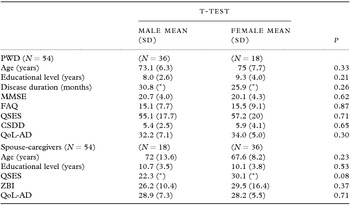
The PWD mean age was 73.1 years (SD = 6.3) for males and 75 years (SD = 7.7) for females. The mean age of spouse-caregivers was 72.0 (SD = 13.6) for males and 67.6 (SD = 8.2) for females. The sociodemographic data of PWD and spouse-caregivers are provided in Table 1.
Sociodemographic and clinical characteristics of PWD and spouse-caregivers

PWD = people with dementia; SD = standard deviation; MMSE = Mini-Mental State Examination; FAQ = pfeffer functional activities questionnaire; QSES = questionnaire on sexual experience and satisfaction; CSDD = Cornell scale for depression in dementia; QoL-AD = quality of life in Alzheimer's disease; ZBI = Zarit burden interview.
(*)Mann–whitney test.
Clinical data
Pwd
The PWD showed mild disease severity stage (N = 34; 22 male) to moderate disease severity stage (N = 20; 14 male). A higher level of sexual satisfaction was found in 20.4% (13% (N = 7) of males and 7.4% (N = 4) of females), whereas 37% showed mild to moderate sexual dissatisfaction (24% (N = 13) of males and 13% (N = 7) of females), and 42.6% (29.6% of male (N = 16) and 13% (N = 7) of females) showed moderate to severe dissatisfaction. There was no significant difference between sexual satisfaction and gender of PWD (p = 0.71).
The awareness of disease of PWD was preserved in 38.9% (27.8% (N = 15) of males and 11.1% (N = 6) of females); 44.4% (25.9% (N = 14) of males and 18.5% (N = 10) of females) showed impaired awareness of disease; and 16.7% (13% (N = 7) of males and 3.7% (N = 2) of females) were unaware of their disease. There was no significant difference between male and female PWD awareness of disease (p = 0.48).
Spouse-caregivers
We did not find a significant difference in QoL between male and female spouse-caregivers (p = 0.71). Higher levels of sexual satisfaction were found in 13% of spouse-caregivers (5.6% (N = 3) of males and 7.4% (N = 4) of females), 26% (14.8% (N = 8) of males and 11.1% (N = 6) of females) showed mild to moderate sexual dissatisfaction and 61% (13% (N = 7) of males and 48.1% (N = 26) of females) showed a moderate to severe sexual dissatisfaction. There was a trend between male and female spouse-caregivers’ sexual satisfaction (p = 0.08). The PWD and spouse-caregivers’ clinical information is depicted in Table 1.
Univariate analysis
Qol
We found a correlation between PWD and spouse-caregivers’ QoL (ρ = 0.55, p = 0.000). The lower the PWD QoL results in lower spouse-caregivers’ QoL.
The spouse-caregivers’ QoL was negatively correlated with burden (ρ = −0.37, p = 0.006). Spouse-caregivers with a higher level of burden reported lower QoL. No correlation was observed between spouse-caregivers’ QoL ratings and their sociodemographic characteristics or sexual satisfaction.
The spouse-caregivers’ QoL was negatively correlated with PWD functional status (ρ = −0.27, p = 0.04). Lower spouse-caregivers’ QoL was related to higher levels of functional dependence in PWD. Additionally, spouse-caregivers’ QoL was negatively correlated with PWD awareness of disease (ρ = −0.40, p = 0.003). Spouse-caregivers presented lower QoL when PWD had impaired awareness of disease.
QoL and sexual satisfaction
When analyzing the relationship between QoL and sexual satisfaction, we did not find a significant correlation between PWD QoL and spouse-caregivers’ sexual satisfaction (ρ = 0.01, p = 0.91).
Additionally, we did not find a significant correlation between spouse-caregivers’ QoL and PWD self-reported sexual satisfaction (ρ = −0.03, p = 0.80) or between spouse-caregivers’ sexual satisfaction and QoL (ρ = 0.11, p = 0.41).
Univariate analyses by genders
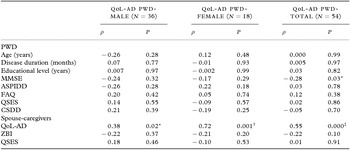
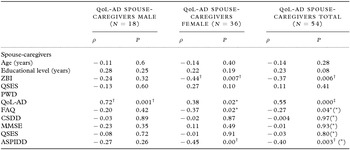
There was a significant correlation between QoL of PWD and male spouse-caregivers (ρ = 0.72, p = 0.001) and female spouse-caregivers’ QoL (ρ = 0.38, p = 0.02). Lower QoL in PWD results in lower QoL for both genders of spouse-caregivers.
We found that female spouse-caregivers’ QoL had a significant correlation with PWD impaired awareness of disease (ρ = −0.45, p = 0.00) and functionality (ρ = −0.37, p = 0.02). There was no correlation between the male and female spouse-caregivers’ QoL ratings and their sexual satisfaction or sociodemographic characteristics. The correlations by gender are depicted in Tables 2 and 3.
Spearman's correlations between PWD QoL and study variables by gender

QoL-AD = quality of life in Alzheimer's disease; PWD = people with dementia; MMSE = Mini-Mental State Examination; ASPIDD = assessment scale of psychosocial impact of the diagnosis of dementia; FAQ = pfeffer functional activities questionnaire; QSES = questionnaire on sexual experience and satisfaction; CSDD = Cornell scale for depression in dementia; ZBI = Zarit burden interview.
*p < 0.05; † p < 0.01; ‡ p < 0.001.
Correlations between spouse-caregivers’ QoL and study variables by gender

QoL-AD = quality of life in Alzheimer's disease; PWD = people with dementia; MMSE = Mini-Mental State Examination; ASPIDD = assessment scale of psychosocial impact of the diagnosis of dementia; FAQ = pfeffer functional activities questionnaire; QSES = questionnaire on sexual experience and satisfaction; CSDD = Cornell scale for depression in dementia; ZBI = Zarit burden interview.
*p < 0.05; † p < 0.01; ‡ p < 0.001.
(*)Pearson correlation.
Multivariate analysis
We investigated the factors related to spouse-caregivers’ QoL with linear regression analysis. Due to the sample size, only variables with p ≤ 0.001 were included. The linear regression indicated that lower levels of awareness of disease and QoL for PWD were significantly related to spouse-caregivers’ QoL ratings (p = 0.000). The final model of the factors related to the spouse-caregivers’ QoL explained 53% of the observed variance (p = 0.000). The adjusted R 2 and standardized regression weights are shown in Table 4.
Regression model of factors predicting total spouse-caregivers’ QoL

ASPIDD = assessment scale of psychosocial impact of the diagnosis of dementia; PWD QoL = people with dementia quality of life.
*p > 0.001.
Multivariate analysis by gender
Only female spouse-caregivers had sufficient variables that were correlated to perform a multivariate analysis. For linear regression by gender, only variables with p ≤ 0.001 were included. The linear regression demonstrated that lower QoL for PWD (p = 0.000) and higher impairment on awareness (p = 0.000) were significantly related to female spouse-caregivers’ QoL. The final model of the factors related to the spouse-caregivers’ QoL explained 58% of the observed variance (p = 0.000). The adjusted R 2 and standardized regression weights are shown in Table 5.
Regression model of factors predicting female spouse-caregivers’ QoL

ASPIDD = assessment scale of psychosocial impact of the diagnosis of dementia; PWD QoL = people with dementia quality of life.
*p < 0.001.
Discussion
QoL is a multidimensional construct, and includes many factors that depend on the group being evaluated and the purpose of the evaluation (Logsdon et al., Reference Logsdon, Gibbons, McCurry and Teri2002; Novelli et al. Reference Novelli, Nitrini and Caramelli2010). Alongside this, dementia, different from other disabling illnesses, is a clinical condition characterized by cognitive and functional decline leading to significant impairment in the PWD's life, and it interferes significantly with PWD and caregivers’ QoL (Novelli et al. Reference Novelli, Nitrini and Caramelli2010).
Several studies related QoL between PWD and their caregiver, including spouse, adult children, and other relatives as caregivers (Logsdon et al., Reference Logsdon, Gibbons, McCurry and Teri2002; Conde-Sala et al., Reference Conde-Sala, Garre-Olmo, Turró-Garriga, López-Pousa and Vilalta-Franch2009). The aim of this study was to evaluate the relationship between sexual satisfaction and spouse-caregivers’ QoL and to investigate the influence of PWD clinical characteristics on spouse-caregivers’ QoL, as relatively little effort has been devoted to studying the QoL of this specific population.
In our study, we assessed both PWD self-reported and spouse-caregivers’ QoL ratings. We found that spouse-caregivers’ QoL was strongly related to the QoL of PWD, as other studies in the field (Logsdon et al., Reference Logsdon, Gibbons, McCurry and Teri2002; Conde-Sala et al., Reference Conde-Sala, Garre-Olmo, Turró-Garriga, López-Pousa and Vilalta-Franch2009). Caregivers may have been influenced by the perceptions of the PWD. This fact highlights the importance of self-reported assessments of QoL and well-being. Conde-Sala et al., (2013) demonstrated that, generally, PWD own ratings remained stable over time, whereas caregiver ratings showed a decline. In addition, many studies demonstrate that QoL will vary for PWD and their spouse-caregivers according to the existing context in each stage of the disease (Logsdon et al., Reference Logsdon, Gibbons, McCurry and Teri1999; Vogel et al., Reference Vogel, Mortensen, Hasselbalch, Andersen and Waldemar2006; Karttunen et al., Reference Karttunen2011). However, we can assume that PWD and spouse-caregivers provide valid, although differing, perspectives of QoL (Schiffczyk et al., Reference Schiffczyk, Romero, Jonas, Lahmeyer, Müller and Riepe2010).
Moreover, when spouse-caregivers formulate their QoL ratings, they take into account many factors, such as impaired awareness and PWD QoL (Sousa et al., Reference Sousa2013). Compared to other kinships, spouse-caregivers tend to be closer to PWD because of the different position in the relationship. It seems likely that when the spouse-caregivers have higher QoL, the relationship is less distressful, resulting in higher quality of provided care and consequently, better QoL of both the PWD and their spouse-caregivers (Svetlik et al., Reference Svetlik, Dooley, Weiner, Williamson and Walters2005; Sousa et al., Reference Sousa2013).
We decided to analyze by gender because of the difference in the involvement in care between male and female spouse-caregivers. The basis of differences in care work is due to gender roles, that is, a gender-based set of skills, resources, and expectations (Hong et al., Reference Hong and Coogle2014). However, the results of the present study did not lead us to accept our hypothesis about the differences between spouse-caregivers’ QoL by gender, because only female spouse-caregivers had sufficient variables that were correlated to perform a multivariate analysis. However, we found that the female spouse-caregivers’ QoL was significantly related to QoL of PWD. Lower PWD QoL results in lower female spouse-caregivers’ QoL. Overall, female spouse-caregivers spend more time on the care of a spouse and may be more emotionally affected than male spouse-caregivers by loss of reciprocity throughout the disease progression. The development of adequate interventions for both genders of spouse-caregivers, as redefining the role as a helper, obtaining the support of others, and maintaining social ties, can help reconstruct feelings of marital closeness and avoid the more negative stressors of long-term caregiving (Boylsten and Hayes, Reference Boylsten and Hayes2012).
We observed that spouse-caregivers’ ratings of QoL are related to PWD awareness of disease. Several studies demonstrated that impaired awareness of disease affects PWD safety with risky behaviors and the maintenance of decision capacities, which increases caregiver burden (Conde-sala et al., Reference Conde-sala2013; Dourado et al., Reference Dourado2014). Therefore, decreased awareness of disease influences spouse-caregivers’ QoL, possibly because PWD do not recognize the deficits or may deny the impairment, requiring more assistance from the spouse-caregiver with ADLs (Logsdon et al., Reference Logsdon, Gibbons, McCurry and Teri2002; Conde-sala et al., Reference Conde-sala2013). Impaired awareness may influence the decrease in sexual satisfaction between the couple, as spouse-caregivers attempt to balance between the sexual needs of both PWD safety and ethical concerns. Further research would be required to confirm these hypotheses, because we cannot dismiss the possibility of reverse causality (e.g. PWD may be more sexually satisfied with a lower awareness of disease, because the sexual activity from the past is perceived as present (Nogueira et al., Reference Nogueira, Brasil, Sousa, Santos and Dourado2013) or spouse-caregivers increase their affection and try to be closer to the PWD to enjoy the time they still have together (Vugt et al., Reference Vugt2003)).
Contrary to previous studies, we did not find a significant relation between sexual satisfaction and PWD or spouse-caregivers’ QoL. Psychological and physiological changes in PWD contribute to alterations in the intimacy of couples (Nogueira et al., Reference Nogueira, Brasil, Sousa, Santos and Dourado2013). It is an area influenced by the attitudes and beliefs of the spouse-caregivers. For them, cultural values and personal beliefs might provide obstacles to addressing their sexual needs (Simonelli et al., Reference Simonelli2008), resulting in a perception of sexual activity as a low priority (Nogueira et al., Reference Nogueira, Brasil, Sousa, Santos and Dourado2013). The non-significant result may be because spouse-caregivers are more focused on how to manage PWD functionality and awareness of disease than on sexual activity. Several studies demonstrated that the onset of dementia causes a decline in sexual satisfaction as intimacy played a key role in determining happiness in the marital relationship (Simonelli et al., Reference Simonelli2008; Dourado et al., Reference Dourado, Finamore, Barroso, Santos and Laks2010). It would also be interesting to investigate, in future research, the suspected discrepancy between sexual satisfaction and the severity of dementia by gender as female spouse-caregivers may lose interest in sex sooner than male spouse-caregivers, believing that sexual need is somehow inappropriate and wrong (Simonelli et al., Reference Simonelli2008).
Some limitations of this study must be acknowledged. First, the non-random selection and cross-sectional design are limitations that should be addressed in further research. In future studies, paired data are necessary. Second, the small sample size is another identifiable concern and, unfortunately, because of this, we were not able to investigate QoL and severity of dementia separately by gender. Third, we did not include a control group in the study. The presence of a control group may allow to better understanding of the differences between our findings and sexual satisfaction and QoL in a healthy population. Additionally, we did not assess PWD neuropsychiatric symptoms. Further studies should investigate the relationship between spouse-caregivers’ QoL, sexual satisfaction, and PWD behavioral changes. Furthermore, previous studies related that sexual activity is replaced by other types of intimacy, but the scale used to investigate sexual satisfaction is restricted and does not consider those qualitative aspects.
Moreover, social support and material conditions, personal value systems, and coping styles play a role in evaluating personal objective measures (including memory and functional abilities) (Sousa et al., Reference Sousa2013). Therefore, further studies should also address the assessment of personality traits and coping ability, because coping strategies are employed to overcome, tolerate or reduce the impact of stressful events and may have an influence on strategies in the care of those with dementia (Cooper et al., Reference Cooper, Katona, Orrell and Livingston2008).
Despite these limitations, we found that the QoL of PWD and impaired awareness of disease are factors strongly related to spouse-caregivers’ QoL. The impairment of the PWD awareness caused by the disease had an influence on the relationship of the couple. The spouses, mostly female, assumed a caregiver role and this may contribute to an increased loss of companionship and lower QoL. Moreover, our study would be helpful for improving the studies about this specific population in order to develop adequate psycho-educational approaches to increase PWD and their spouse-caregivers’ QoL, considering the main specificities of the couples’ relationship.
Conflict of interest
None.
Description of authors’ roles
M. M. L. Nogueira was involved in designing the study, collecting the data, and writing the paper. M. F. B. Sousa and R. L. Santos collected the data and assisted with the writing. P. Simões performed the statistical analyses. R. D. L. Rosa, T. Belfort, B. Torres collected the data. M. C. N. Dourado designed the study, supervised the data collection, and approved the final paper.
Contributions
We’re indebted to João Carlos da G. D. Costa for helping in the statistical analysis.
Acknowledgments
This study was supported by the Foundation for Research from the Government of the State of Rio de Janeiro (Fundação de Apoio a Pesquisa do Estado do Rio de Janeiro – FAPERJ), grant E-26/102.256/2010.